
France Gasoline Direct Injection Market Size & Forecast:
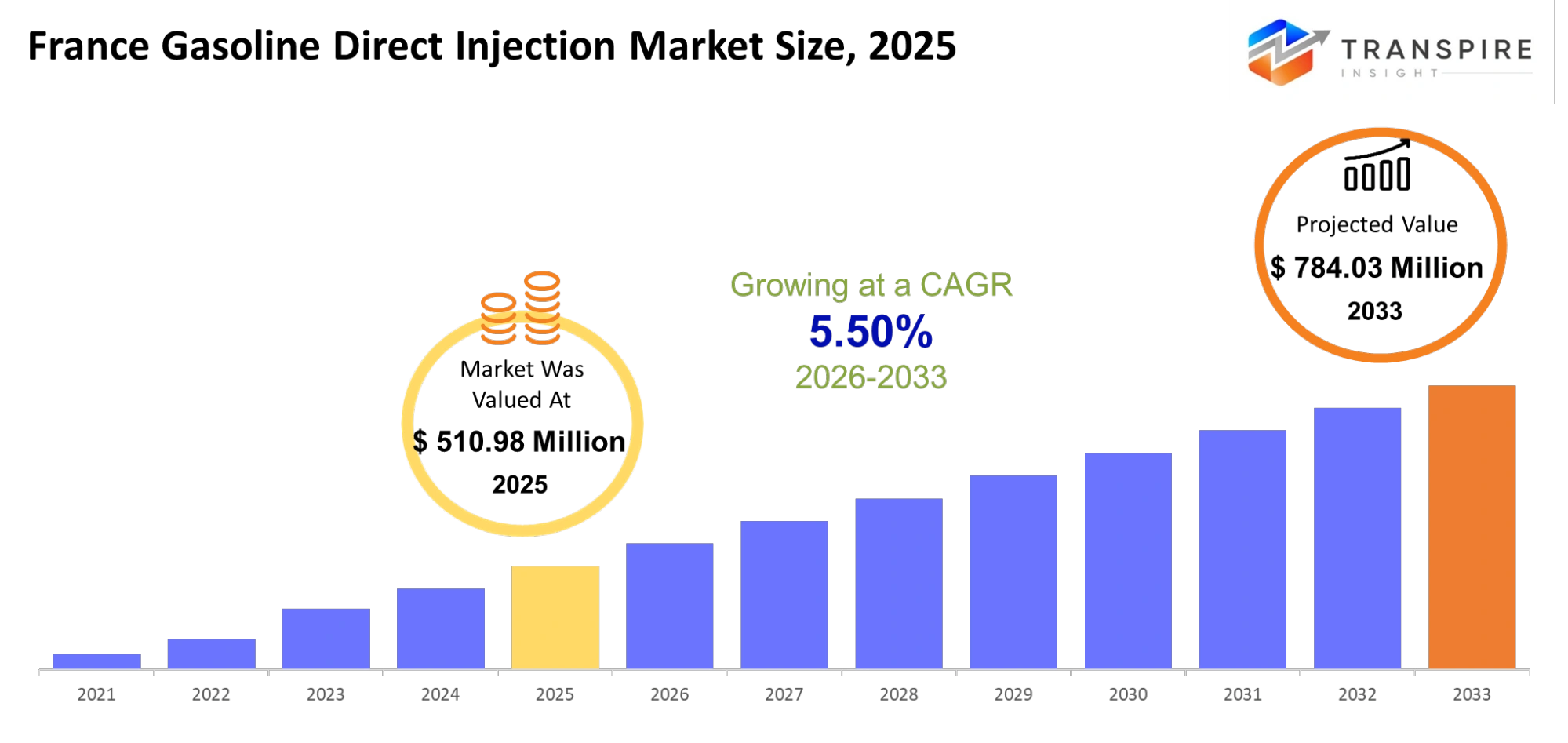
- France Gasoline Direct Injection Market Size 2025: USD 510.98 Million
- France Gasoline Direct Injection Market Size 2033: USD 784.03 Million
- France Gasoline Direct Injection Market CAGR: 5.50%
- France Gasoline Direct Injection Market Segments: By Type (Wall-guided GDI, Spray-guided GDI, Air-guided GDI, Others); By Application (Passenger Vehicles, Commercial Vehicles, Hybrid Vehicles, Performance Cars, Others); By End-User (Automotive OEMs, Component Suppliers, Aftermarket, Fleet Operators, Others); By Component (Fuel Injectors, ECU, Sensors, Pumps, Others)
To learn more about this report,  Download Free Sample Report
France Gasoline Direct Injection Market Summary
The France Gasoline Direct Injection Market was valued at USD 510.98 Million in 2025. It is forecast to reach USD 784.03 Million by 2033. That is a CAGR of 5.50% over the period.
The French gasoline direct injection market focuses on developing fuel delivery systems which enable vehicles and light industrial machines to achieve higher power outputs while satisfying stricter emission regulations. The GDI systems permit automakers to achieve performance targets while meeting regulatory standards through compact and mid-sized passenger vehicle design which enables fuel efficiency improvements to impact fleetwide CO₂ emissions targets.
The market has undergone complete structural changes throughout the last three years because automakers now develop powertrains that use hybrid-compatible GDI systems instead of creating entirely new combustion engine systems. European emission standards have become stricter which forced manufacturers to enhance their systems for fuel delivery and combustion process management. The vehicle system now includes advanced injectors and electronic control units which raise system worth for each vehicle. The market growth shows two factors which include increased unit sales and the shift toward advanced GDI technologies that generate higher profit margins.
Key Market Insights
- The Northern and Île-de-France regions control 40% of the France Gasoline Direct Injection Market through their strong automotive production facilities which will remain active until 2025.
- The southern part of France will experience its highest growth rate until 2033 because of developing component supply chains and establishing production facilities in the area.
- Automakers choose electronic gasoline direct injection systems as their main technology which provides 55% market share because it allows them to achieve accurate fuel management and decrease harmful emissions.
- Vehicle manufacturers utilize mechanical GDI systems as their second most popular option because these systems provide cost savings for basic vehicle models.
- The hybrid-compatible GDI systems represent the fastest-growing segment between 2025 and 2033 because OEMs implement electrification plans.
- The France Gasoline Direct Injection Market finds its main market section through passenger vehicles which hold almost 70% market share because regulations demand higher fuel efficiency.
- The fastest-growing application market for hybrid passenger vehicles demonstrates the transition towards environmentally friendly transportation methods which produce fewer emissions.
- Automotive OEMs maintain their market leadership position because they control more than 65% market share through their vehicle production process.
- The aftermarket sector experiences strong growth because customers need high-pressure injectors to be replaced and they require system enhancements.
- OEM collaborations provide the platform for manufacturers to introduce their advanced GDI systems into new hybrid vehicle systems from their earliest development stages.
- Companies develop production facilities in new areas to achieve two goals: they want to decrease supply chain risks while they work to decrease operational costs.
- AI-based engine control together with precision fuel mapping technology create competitive advantages which lead to increased market share for businesses.
What are the Key Drivers, Restraints, and Opportunities in the France Gasoline Direct Injection Market?
The European emission regulations which restrict vehicle emissions through Euro 6 and upcoming Euro 7 frameworks serve as the main force which drives the growth of the France Gasoline Direct Injection Market. Automakers need to implement exact fuel delivery systems because the standards require them to decrease particulate emissions while enhancing combustion efficiency. Gasoline direct injection technology allows higher compression ratios together with improved fuel atomization which results in better fuel efficiency and reduced CO₂ emissions. OEMs now utilize advanced GDI systems in their mid-range vehicles which they position between their regular models and their high-end models. The company achieved revenue growth through two factors which included increased system value per vehicle and enhanced components which comprised high-pressure injectors and electronic control units.
The development of complete electrification systems creates a primary structural barrier because European governments provide financial support for this shift together with their bans on internal combustion engine vehicle sales. GDI systems will experience market decline because this transition will create market reductions which continue until 2030. GDI suppliers face difficulties with their operations because this transition requires both public policies and substantial financial resources which create challenges to maintain their business operations while internal combustion engine demand decreases. GDI platform development has been delayed because automakers use cautious purchasing methods which results in lost potential revenue growth.
The main opportunity exists through GDI system implementation in hybrid powertrain systems. The manufacturers of hybrid vehicles continue to depend on combustion engines which generate efficient power. The manufacturers of hybrid vehicles are developing advanced GDI technologies which enhance engine performance during start-stop operations. The combination of advanced multi-hole injectors and AI-driven engine control systems results in improved fuel efficiency.
What Has the Impact of Artificial Intelligence Been on the France Gasoline Direct Injection Market?
The automotive industry in France is undergoing a transformation because of artificial intelligence which impacts the creation, adjustment, and upkeep of gasoline direct injection systems. The present engine control units of manufacturers now incorporate AI-based control systems which enable automatic modification of fuel injection timing and pressure based on actual driving conditions. The system enables automatic operation which enhances combustion accuracy and decreases the time needed for manual calibration during the manufacturing process. The AI-driven system of connected vehicle platforms enables remote performance assessment while optimizing fuel consumption and emissions compliance tracking for fleet management.
Machine learning models enable predictive maintenance through the examination of injector wear patterns and pressure changes and combustion irregularities. The systems forecast when components will fail which results in decreased unexpected downtimes and extended injector operational durations. Automakers achieve measurable benefits through their implementation of early fault detection because it results in better fuel efficiency and decreased maintenance expenses. AI-driven simulation tools enable better injector design development which results in shorter product development processes and consistent performance results.
The practical aspect of adoption faces a major obstacle. The high costs associated with system integration together with the requirement for extensive and reliable data sets create barriers to implementation which particularly affect smaller suppliers. The unpredictable nature of actual driving conditions creates problems for model accuracy which delays the complete implementation process across all types of vehicles.
Key Market Trends
- Automakers switched from traditional fuel injection systems to high-pressure GDI systems which operate above 350 bar starting from 2021 because they needed to comply with new particle emission regulations.
- GDI systems became more common in hybrid vehicle platforms between 2020 and 2024 because manufacturers chose to use them instead of replacing their existing internal combustion engine systems.
- European emission regulations required OEMs to create new combustion system designs after 2022 while they needed to use multi-hole injectors which provided better fuel atomization and cleaner combustion results.
- Robert Bosch GmbH and Continental AG expanded their research and development budget after 2021 to create engine control units which use artificial intelligence for injection optimization during engine operation.
- French manufacturers began localizing their supply chains after 2023 because they needed to reduce their dependency on Asian components during semiconductor and logistics interruptions.
- The market demand after 2020 focused on compact turbocharged engines which used GDI systems to achieve higher power output while meeting fuel efficiency regulations.
- From 2022 onwards, the demand for injector replacement and system diagnostics tools increased because vehicles with GDI systems reached their post-warranty period.
- Vehicle manufacturers started using predictive maintenance systems in their vehicles after 2021, which used sensor data to track injector performance and decrease unplanned performance drops.
- The global competition between Denso Corporation and Magneti Marelli became more intense after 2023 because both companies established new partnerships with European OEMs to obtain long-term supply agreements.
France Gasoline Direct Injection Market Segmentation
By Type
- The France Gasoline Direct Injection Market operates with dependence on spray-guided GDI systems because these systems provide accurate fuel distribution for combustion near the spark plug which leads to better combustion performance and reduced emissions. This type maintains strong adoption across modern engine platforms due to compatibility with stricter European emission standards. Automakers prefer this configuration because it enables engines to operate at greater compression ratios while achieving improved fuel atomization in all engine types including conventional and hybrid systems.
- The segment keeps growing because manufacturers now develop advanced injectors together with electronic control systems to fulfill new regulatory requirements. Wall-guided systems are gradually declining because they operate with decreased efficiency while air-guided systems exist for use in specific markets only. The increasing emphasis on hybrid powertrains establishes greater importance for spray-guided systems which receive backing from advancements in high-pressure injection systems and real-time engine calibration technology.
By Application
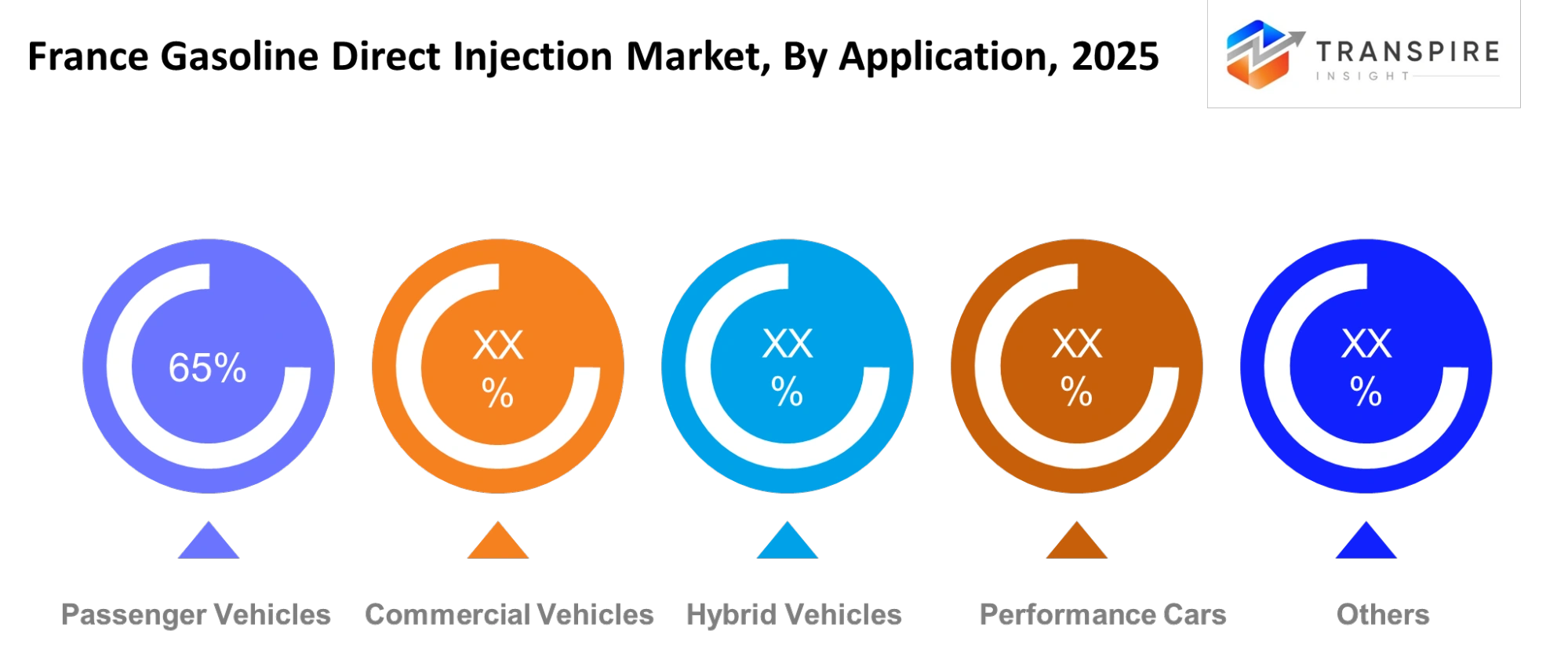
- The France Gasoline Direct Injection Market depends on passenger vehicles because manufacturers must develop fuel injection systems that meet both production needs and emissions control requirements. The high demand for compact and mid-sized vehicles leads to the complete adoption of GDI systems across all vehicle types. Manufacturers choose hybrid vehicles for urban mobility because they seek to achieve a balance between electric power and combustion efficiency. The segment develops further through performance car adoption of advanced GDI systems which deliver better power and fuel efficiency. Light commercial fleets are starting to transition to gasoline solutions although commercial vehicles take more time to adopt because they still depend on diesel engines. The hybrid vehicle market will determine growth because stricter emission regulations will require advanced fuel delivery systems.
To learn more about this report, Download Free Sample Report
By End-User
- Automotive OEMs dominate the France Gasoline Direct Injection Market because system integration occurs during vehicle manufacturing and design stages. Strong collaboration between OEMs and component suppliers ensures early adoption of advanced injection technologies. The segment achieves its dominant market position because it directly affects engine design and meets regulatory compliance demands.
- The aftermarket segment is expanding steadily as vehicles equipped with GDI systems age and require maintenance or replacement components. The component suppliers deliver injectors, sensors and control units to OEMs through their long-term contract relationships. The segment will expand because of the combination of high-precision component innovations and rising demand for system upgrades and diagnostics solutions.
By Component
- Fuel injectors serve as the main component of the France Gasoline Direct Injection Market because they establish both fuel distribution and engine combustion performance. High-pressure injectors dominate the market because they fulfill demanding emission requirements while enhancing engine efficiency. Electronic control units maintain a strong market position through their capabilities to control injection timing and manage system operations. The segment is advancing through integration of sensors and smart control technologies which improve performance monitoring capabilities. Pumps together with their companion components provide both stable fuel pressure and dependable system functionality. The industry will grow through upcoming research efforts which will develop advanced injector technologies together with AI-powered electronic control units and enhanced system lifespan. The research will create new business opportunities for suppliers who focus on precise engineering and digital system development.
What are the Key Use Cases Driving the France Gasoline Direct Injection Market?
Passenger vehicles represent the primary application of gasoline direct injection systems which provide accurate fuel delivery for European emission standards while sustaining performance capabilities. Automakers use this technology to meet their CO₂ emission requirements through compact and mid-sized vehicles which achieve better fuel efficiency without reducing engine power.
The use of light commercial vehicles and hybrid passenger vehicles has expanded since then. French cities have implemented low-emission zones which urban delivery fleets now satisfy through their adoption of gasoline-powered vehicles equipped with direct injection systems. Hybrid vehicles use these systems to achieve fuel efficiency during engine start-stop periods which occur commonly in stop-and-go traffic.
Hybrid vehicles which focus on performance and advanced plug-in hybrid systems represent new use cases for development. The applications need high-pressure injectors which can function successfully during different load situations so next-generation injection systems will emerge in high-end vehicles that utilize advanced technologies.
|
Report Metrics |
Details |
|
Market size value in 2025 |
USD 510.98 Million |
|
Market size value in 2026 |
USD 539.09 Million |
|
Revenue forecast in 2033 |
USD 784.03 Million |
|
Growth rate |
CAGR of 5.50% from 2026 to 2033 |
|
Base year |
2025 |
|
Historical data |
2021 - 2024 |
|
Forecast period |
2026 - 2033 |
|
Report coverage |
Revenue forecast, competitive landscape, growth factors, and trends |
|
Regional scope |
France |
|
Key company profiled |
Bosch, Continental, Denso, Delphi, Magneti Marelli, Hitachi Automotive, Valeo, STMicroelectronics, NXP, Renesas, Infineon, ZF Friedrichshafen, Hyundai Mobis, Aptiv, TI |
|
Customization scope |
Free report customization (country, regional & segment scope). Avail customized purchase options to meet your exact research needs. |
|
Report Segmentation |
By Type (Wall-guided GDI, Spray-guided GDI, Air-guided GDI, Others); By Application (Passenger Vehicles, Commercial Vehicles, Hybrid Vehicles, Performance Cars, Others); By End-User (Automotive OEMs, Component Suppliers, Aftermarket, Fleet Operators, Others); By Component (Fuel Injectors, ECU, Sensors, Pumps, Others) |
Which Regions are Driving the France Gasoline Direct Injection Market Growth?
The market is dominated by Île-de-France because it contains the main automotive headquarters and engineering facilities and governmental agencies which determine national emission regulations. European emission standards require strict compliance which has compelled regional automakers to implement advanced gasoline direct injection technology ahead of schedule. Major research centers and testing facilities enable ongoing product development and testing procedures. The combination of extensive supplier networks and nearby decision-making bodies enables companies to maintain market leadership while rapidly implementing new technologies.
The automotive supply base of Auvergne-Rhône-Alpes delivers stable economic support because of its industrial diversity and steady financial backing from automotive suppliers. This region differs from Île-de-France because it prioritizes manufacturing efficiency and component production instead of establishing regulatory frameworks. Established supplier ecosystems ensure steady demand for injection systems across multiple vehicle categories. The combination of economic stability and active partnerships between OEMs and tier-one suppliers results in consistent revenue generation which remains stable throughout business cycles.
The fastest expansion in Occitanie occurs because the region established multiple automotive innovation centers and increased its funding for clean mobility initiatives after 2022. The regional government provides incentives which motivate startups and mid-sized suppliers to create next-generation fuel systems and hybrid-compatible technologies. The combination of infrastructure advancements and research collaborations has shortened the time needed for prototype creation and product market entry. The growth of these supply chains from 2026 to 2033 creates profitable investment opportunities for both investors and companies who want to enter new markets.
Who are the Key Players in the France Gasoline Direct Injection Market and How Do They Compete?
The France gasoline direct injection market shows moderate market consolidation because a few Tier 1 suppliers control most OEM relationships while small companies focus on developing electronics and control systems. The current market leaders maintain their positions through long-term supply contracts with automakers which prevent new companies from entering the market until they establish operational reliability and production capacity. The development of technology has become the key element that determines competition between companies which develop high-pressure injection systems and intelligent engine control units. OEMs still consider cost as an important factor but they now prefer products which offer precise performance and long-lasting durability and meet new emission control requirements.
Bosch presents its competition through complete software and hardware integration which delivers injectors together with AI-powered control units that enhance real-time combustion optimization. Continental AG creates its market distinction through fuel management systems which operate based on sensors to enhance injector performance during changing load situations and the company maintains its market position through its extensive manufacturing network across Europe. Denso Corporation develops ultra-high-pressure injectors which operate beyond 350 bar to create hybrid systems that depend on accurate measurements of which elements directly affect operational performance.
Magneti Marelli establishes its competitive edge by creating adaptable systems which meet European OEM standards while moving forward with its business partnerships in hybrid vehicle development. Infineon Technologies improves its market position through power semiconductor products which enhance injector control and energy efficiency while meeting the growing market needs for electronically controlled injection systems.
Company List
- Bosch
- Continental
- Denso
- Delphi
- Magneti Marelli
- Hitachi Automotive
- Valeo
- STMicroelectronics
- NXP
- Renesas
- Infineon
- ZF Friedrichshafen
- Hyundai Mobis
- Aptiv
- TI
Recent Development News
In April 2026, Valeo announced acquisition. Valeo acquired a minority stake in a European fuel injection technology startup to strengthen its gasoline direct injection systems portfolio and accelerate low-emission engine innovation. https://www.valeo.com
In Marcj 2026, BorgWarner announced acquisition. BorgWarner completed the acquisition of a French precision injector components manufacturer to expand its gasoline direct injection capabilities and European production footprint. https://www.borgwarner.com
What Strategic Insights Define the Future of the France Gasoline Direct Injection Market?
The gasoline direct injection market of France is developing into a hybrid-focused model which uses internal combustion engines as components of electric powertrain systems instead of treating them as independent power sources. The current market direction exists because regulations create restrictions on complete combustion systems but still permit hybrid systems to achieve emission limits at lower expenses compared to complete electric systems. The primary revenue sources will shift from increasing production capacity to developing cutting-edge injectors and software-based control technologies.
A less visible risk lies in overdependence on hybrid pathways. Automakers will accelerate their shift towards electric vehicles when battery prices drop more rapidly than expected while charging networks develop at a fast pace which will decrease the need for injection systems before the anticipated period.
The development of ultra-precise injection systems for plug-in hybrid platforms which function in urban areas with strict emission regulations presents a business opportunity. Companies that invest early in adaptive, software-integrated injection technologies should secure long-term contracts. The company needs to direct its research and development activities towards hybrid engine improvement instead of traditional combustion system development..
France Gasoline Direct Injection Market Report Segmentation
By Type
- Wall-guided GDI
- Spray-guided GDI
- Air-guided GDI
- Others
By Application
- Passenger Vehicles
- Commercial Vehicles
- Hybrid Vehicles
- Performance Cars
- Others
By End-User
- Automotive OEMs
- Component Suppliers
- Aftermarket
- Fleet Operators
- Others
By Component
- Fuel Injectors
- ECU
- Sensors
- Pumps
- Others
Frequently Asked Questions
Find quick answers to common questions.
The confirmed 2033 market size figure is USD 784.03 Million
Key segments for the France Gasoline Direct Injection Market are By Type (Wall-guided GDI, Spray-guided GDI, Air-guided GDI, Others); By Application (Passenger Vehicles, Commercial Vehicles, Hybrid Vehicles, Performance Cars, Others); By End-User (Automotive OEMs, Component Suppliers, Aftermarket, Fleet Operators, Others); By Component (Fuel Injectors, ECU, Sensors, Pumps, Others).
Major France Gasoline Direct Injection Market players are Bosch, Continental, Denso, Delphi, Magneti Marelli, Hitachi Automotive, Valeo, STMicroelectronics, NXP, Renesas, Infineon, ZF Friedrichshafen, Hyundai Mobis, Aptiv, TI.
The France Gasoline Direct Injection Market size is USD USD 510.98 Million in 2025.
The France Gasoline Direct Injection Market CAGR is 5.50% from 2026 to 2033.
- Bosch
- Continental
- Denso
- Delphi
- Magneti Marelli
- Hitachi Automotive
- Valeo
- STMicroelectronics
- NXP
- Renesas
- Infineon
- ZF Friedrichshafen
- Hyundai Mobis
- Aptiv
- TI
Recently Published Reports
-
Apr 2026
ATV & UTV Market
ATV & UTV Market Size, Share & Analysis Report By Type (ATV, and UTV), By Variants (Less Than 400 CC, 400 CC To 800 CC, and More Than 800 CC), and Geography (North America, Europe, Asia-Pacific, Middle East and Africa, South and Central America), 2021 - 2031
-
Apr 2026
Automotive Central Gateway Module Market
Automotive Central Gateway Module Market Size, Share & Analysis Report By Type (Ethernet Central Gateway Module, CAN Central Gateway Module, LIN Central Gateway Module, and FlexRay), By Application (Powertrain Control, Body Control, Infotainment System, Advanced Driver Assistance Systems (ADAS), and Others), By End User (Passenger Vehicles, and Commercial Vehicles), and Geography (North America, Europe, Asia-Pacific, Middle East and Africa, South and Central America), 2021 - 2031
-
Apr 2026
Automotive Engine Oil Filter Market
Automotive Engine Oil Filter Market Size, Share & Analysis Report By Filter Type (Fuel Filter, Engine Oil Filter, Hydraulic Oil Filter, and Others), By Filter Media (Cellulose, Synthetic, and Micro), By Sales Channel (OEMs, and Aftermarket), By Vehicle Type (Passenger Cars, Light Commercial Vehicles, Heavy Duty Trucks, Buses and Coaches, and Off-road Vehicles), and Geography (North America, Europe, Asia-Pacific, Middle East and Africa, South and Central America), 2021 - 2031
-
Apr 2026
Automotive Parts Aluminium Die Casting Market
Automotive Parts Aluminium Die Casting Market Size, Share & Analysis Report By Production Process (Pressure Die Casting, Vacuum Die Casting, Squeeze Die Casting, Gravity Die Casting), By Application (Body Parts, Engine Parts, Transmission Parts, Battery And Related Components, Other Application Types), and Geography (North America, Europe, Asia-Pacific, Middle East and Africa, South and Central America), 2021 - 2031
Our Clients