

Europe E-Fuel Market Size & Forecast:
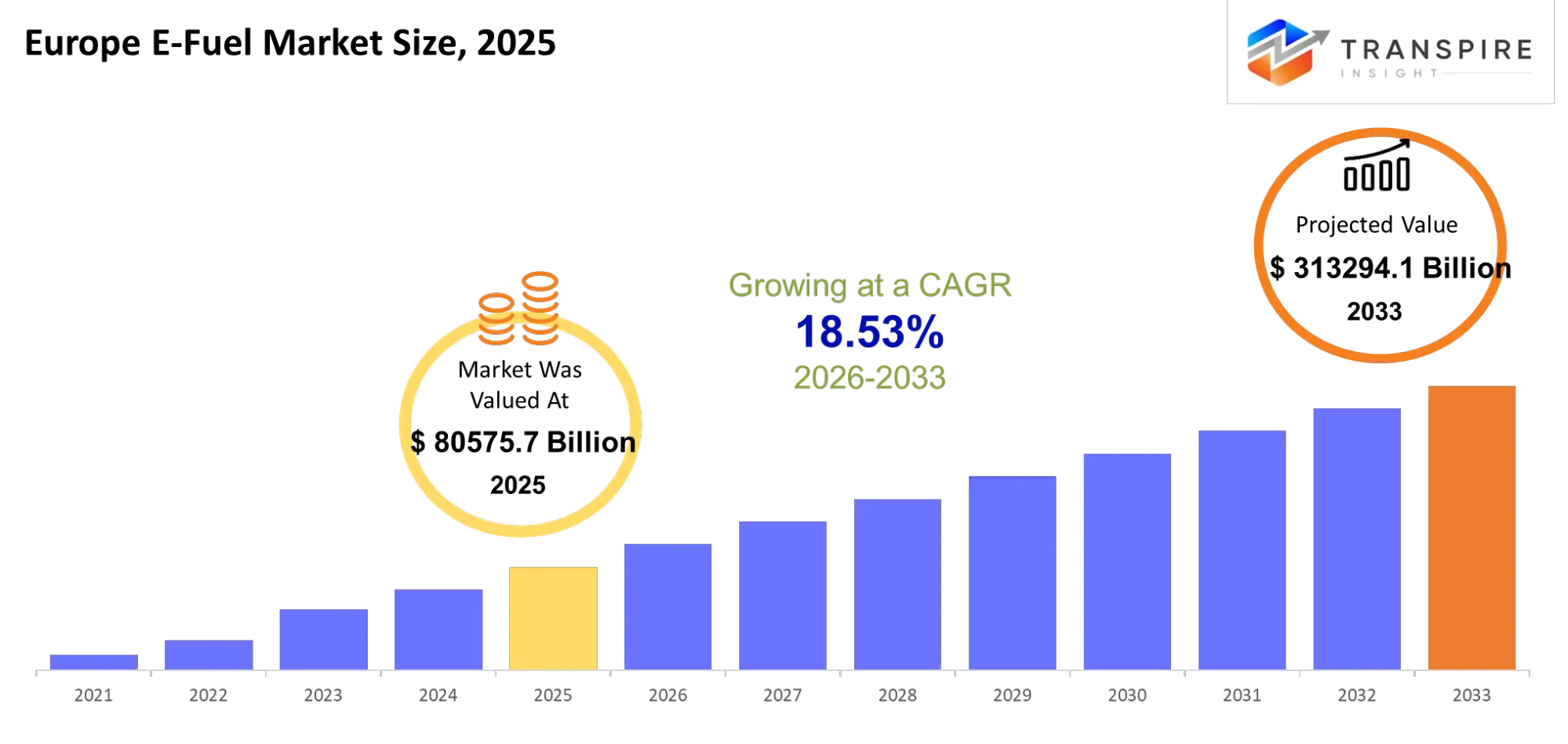
- Europe E-Fuel Market Size 2025: USD 80575.7 Million
- Europe E-Fuel Market Size 2033: USD 313294.1 Million
- Europe E-Fuel Market CAGR: 18.53%
- Europe E-Fuel Market Segments: By Type (E-Diesel, E-Gasoline, E-Kerosene, E-Methanol, Others); By Application (Automotive, Aviation, Marine, Industrial, Power Generation, Others); By End-User (Automotive Companies, Airlines, Energy Companies, Shipping Companies, Governments, Others); By Production (Electrolysis, Fischer-Tropsch, Carbon Capture, Renewable Hydrogen, Others)
To learn more about this report,  Download Free Sample Report
Europe E-Fuel Market Summary:
The Europe E-Fuel Market size is estimated at USD 80575.7 Million in 2025 and is anticipated to reach USD 313294.1 Million by 2033, growing at a CAGR of 18.53% from 2026 to 2033.
Europe e-fuel market in the energy and alternative fuels industry is shaping a new path for low-emission transportation and industrial energy use. the need for cleaner transportation solutions will drive people to explore synthetic fuels which are made through renewable electricity and carbon capture technology. European countries are changing their regulations to support carbon-neutral fuel development which will affect how energy companies and transportation systems develop their operational plans. fuel production will become more efficient and stable through the development of new electrolysis technologies and carbon capture systems. fuel selection now responds to consumer demand for environmental sustainability while companies will follow more rigorous emission standards and climate change targets in their operational activities.
What Has the Impact of Artificial Intelligence Been on the Europe E-Fuel Market?
The Europe E-Fuel Market undergoes rapid transformation through artificial intelligence which enables businesses to make better decisions while their entire operational process experiences faster development. The Europe E-Fuel Market uses AI-powered market research tools to analyze large datasets which help users discover hidden market trends and obtain useful market information. Businesses use advanced machine learning systems to study customer preferences and changes in regulations and shifts in energy consumption patterns thus enabling European e-fuel market participants to identify new market developments.
Prediction models which use AI technology enable Europe E-Fuel Market businesses to forecast future market trends by analyzing fuel demand patterns with enhanced accuracy. Companies use predictive analytics to assess fuel requirements by studying primary economic drivers together with climate change policies and transportation patterns which helps them plan their operations with greater accuracy. The implementation of smart automation technologies enables organizations to achieve better production efficiency while decreasing their active working hours. The European e-fuel market companies can achieve environmentally friendly production growth through these abilities while they keep their expenses under control.
Artificial intelligence strengthens supply chain resilience in the Europe E-Fuel Market through its capacity to monitor operations in real-time while managing logistics through automated systems which also help businesses save costs. The AI-driven system handles inventory optimization through route efficiency enhancements while it protects businesses from supply chain interruptions through its risk management system. AI enables businesses to achieve a competitive edge through its ability to drive innovation and personalization and its power to create data-based operational methods which enable the Europe E-Fuel Market to grow sustainably in the digital age of environmentally sustainable energy solutions.
Key Market Trends & Insights:
- Germany holds more than 35% of the e-fuel market in Europe during 2024 because of its government backing and industrial funding.
- The Scandinavian region represents the most rapid growth area which will experience more than 32% compound annual growth rate until 2030 because of its adoption of renewable energy and green hydrogen.
- The European e-fuel market recognizes E-diesel as its leading product because it holds almost 40% market share in 2024 through its ability to operate with current diesel engines and their associated infrastructure.
- E-kerosene holds the second-largest share due to increasing aviation sector demand and decarbonization mandates across Europe.
- E-methanol represents the most rapidly expanding market segment which will achieve more than 35% compound annual growth rate from 2024 to 2030 because of maritime fuel transition initiatives.
- The European e-fuel market shows more than 45% market share for automotive applications because legacy vehicle fleets start to adopt e-fuels.
- The aviation sector will experience the highest growth rate because sustainable aviation fuel mandates drive development which will produce a 34% compound annual growth rate until 2030.
- The transportation sector dominates the European e-fuel market with more than 50% market share because regulations require reductions in carbon emissions.
- The industrial sector experiences fast development because companies start using e-fuels to produce heat and store energy.
- Companies establish competitive advantages and sustainable business practices through their development of new technologies together with carbon capture system integration.
Europe E-Fuel Market Segmentation
By Type:
The market will demand E-diesel because it works with current engine systems and existing distribution networks. E-kerosene will experience growth according to the aviation industry's decarbonization goals. The use of E-methanol in marine applications will increase because it produces fewer emissions during combustion. E-gasoline will power passenger vehicles whereas other fuels will meet specific needs of industrial and energy operations.
By Application:
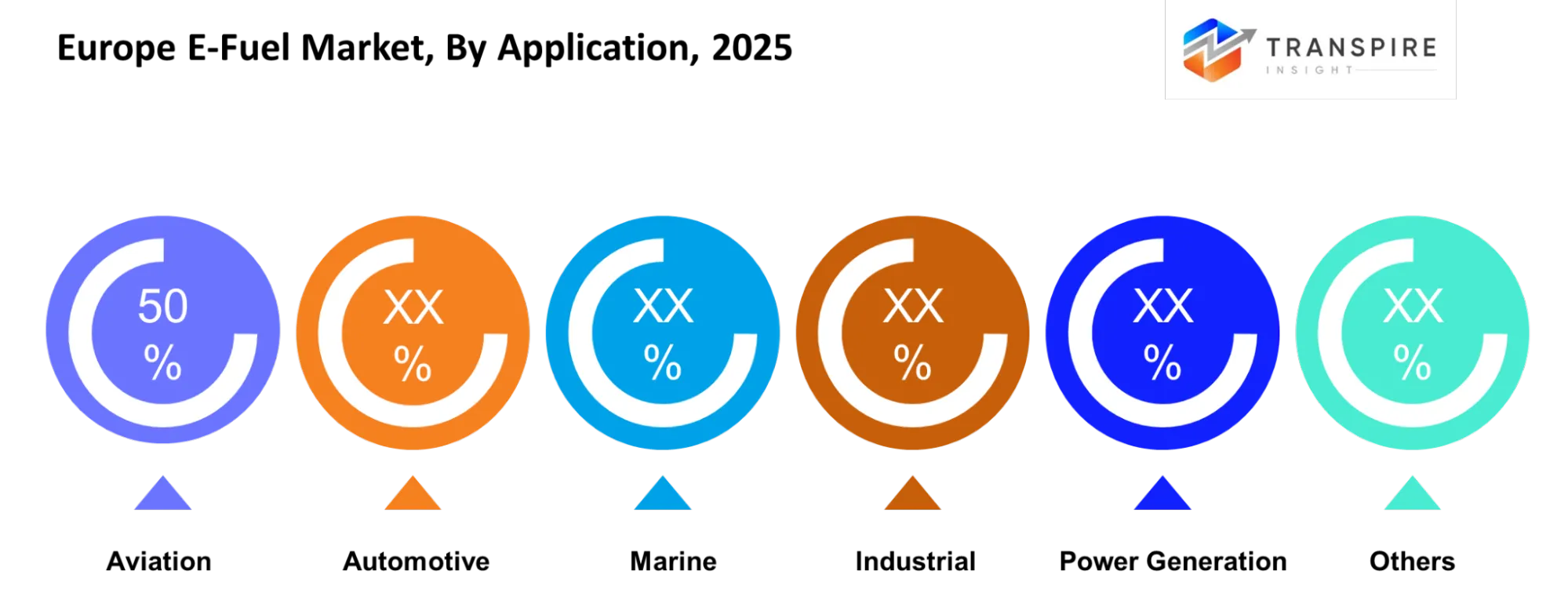
The automotive industry will maintain its high demand because of its extensive vehicle inventory and need to change to new technologies. The aviation sector will experience rapid expansion because of upcoming sustainable fuel requirements. The marine industry will begin using environmentally friendly fuels to decrease their emissions. The industrial sector together with power generation facilities will utilize synthetic fuels because they provide dependable energy sources that produce less carbon dioxide emissions.
To learn more about this report, Download Free Sample Report
By End-User:
Automotive companies will dedicate their resources toward developing fuel options that work with their current vehicle fleets. Airlines will adopt synthetic fuels to meet emission targets. Energy companies will expand their capacity to create and deliver energy products. Shipping companies will transition to more environmentally friendly fuels while governments will enhance adoption through monetary support and legislative measures and infrastructure construction.
By Production:
Electrolysis serves as a basic process that creates hydrogen through the use of renewable energy sources. Fischer-Tropsch synthesis will convert hydrogen and carbon into liquid fuels. Carbon capture technology will enable environmentally friendly manufacturing processes to operate sustainably. Renewable hydrogen will function as the primary source of clean fuel production while other techniques will enhance production efficiency and decrease operational expenditures as time progresses.
What are the Main Challenges for the Europe E-Fuel Market Growth?
The technical and operational problems in the European e-fuel market make it impossible to implement large-scale operations. The production of electrolysis and synthetic fuel conversion pathways demands enormous energy resources from dependable renewable energy systems. Performance capabilities of the system depend on feedstock availability together with the efficiency drops that happen during the conversion process which makes scalability into a major challenge. The current operational problems in the European e-fuel market system prevent regular production and efficiency improvements from reaching their full potential.
The European e-fuel market encounters obstacles from both manufacturing and commercialization restrictions. Production facilities demand significant capital investment, while compliance with strict environmental and safety regulations increases operational costs. The elevated manufacturing costs associated with production create pricing challenges that restrict market competitiveness with conventional fuels. The market experience project approval delays which also extend infrastructure development times, thus hindering progress toward commercializing complete pilot projects.
The Europe e-fuel market faces main adoption challenges because of its insufficient refueling stations together with its weak distribution systems. The end-user base has low product understanding while the advanced fuel technologies field lacks skilled workers which creates a growth barrier. The growth of businesses faces challenges because of funding gaps which especially affect early-stage projects that need approval for general use across different fields.
The European e-fuel market faces additional threats from competing solutions that include electric mobility and hydrogen-based systems. The fast development of these technologies together with changing regulatory rules will result in investment shifts, which will create lasting market development uncertainty.
Regional Insights
The European E-Fuel Market will experience continuous growth because governments create favorable regulations and the need for environmentally friendly fuels increases but market progress will depend on businesses reaching their financial targets and complete infrastructure systems becoming operational.
Germany will emerge as the top nation because its industrial power together with government funding and initial investments in synthetic fuel research will drive continuous production capacity growth. Scandinavia will grow rapidly because it possesses abundant renewable energy resources and emphasizes green hydrogen production. Southern Europe will expand gradually with better infrastructure development while Eastern Europe will experience lower progress because of funding difficulties and technological limitations.
Recent Development News
In April 2026, Siemens has established a partnership with Vulcan Energy to support renewable energy-based lithium production through the provision of automation and digitalization technologies which will enhance operational efficiency and environmental sustainability of energy-related industrial operations.https://www.electrive.com
|
Report Metrics |
Details |
|
Market size value in 2025 |
USD 80575.7 Million |
|
Market size value in 2026 |
USD 95321.3 Million |
|
Revenue forecast in 2033 |
USD 313294.1 Million |
|
Growth rate |
CAGR of 18.53% from 2026 to 2033 |
|
Base year |
2025 |
|
Historical data |
2021 - 2024 |
|
Forecast period |
2026 - 2033 |
|
Report coverage |
Revenue forecast, competitive landscape, growth factors, and trends |
|
Regional scope |
Europe (Germany, United Kingdom, France, Italy, Spain, Rest of Europe) |
|
Key company profiled |
Siemens Energy, Porsche, Audi, Shell, TotalEnergies, ExxonMobil, Sunfire, Climeworks, Neste, HIF Global, Repsol, BP, Linde, Air Liquide, Mitsubishi Heavy Industries |
|
Customization scope |
Free report customization (country, regional & segment scope). Avail customized purchase options to meet your exact research needs. |
|
Report Segmentation |
By Type (E-Diesel, E-Gasoline, E-Kerosene, E-Methanol, Others); By Application (Automotive, Aviation, Marine, Industrial, Power Generation, Others); By End-User (Automotive Companies, Airlines, Energy Companies, Shipping Companies, Governments, Others); By Production (Electrolysis, Fischer-Tropsch, Carbon Capture, Renewable Hydrogen, Others) |
How Can New Companies Establish a Strong Foothold in the Europe E-Fuel Market?
New entrants aiming to succeed in the europe e-fuel market must begin with focused niche targeting and clear value differentiation. Companies should adopt a targeted approach to sustainable aviation fuel and marine decarbonization and industrial heat applications instead of pursuing general market competition. Through market alignment with present growth sectors and regulatory system needs emerging businesses can create products which meet market demand usage requirements which will boost their initial market success and steady revenue growth.
The European e-fuel market will use innovation as its primary market entry method through development of new production methods and operational efficiency enhancements. The company Synhelion demonstrates how solar technology enables its fuel production system to cut both energy requirements and greenhouse gas emissions. The company Infinium produces modular e-fuel production systems which allow businesses to establish production capabilities and bring their products to market more rapidly. These innovation strategies help solve industry challenges related to high production costs and limited scalability.
Market access and credibility will depend on strategic partnerships which will become essential for the company. The new companies will establish supply agreements through partnerships with energy companies and airlines and industrial manufacturers which will enable them to expand their operations. The use of predictive analytics combined with smart automation digital tools will enhance operational efficiency while decreasing operational expenditures.
European e-fuel market entry requires companies to execute their business operations through both innovative solutions and their practical application. The company will achieve competitive advantage through infrastructure development and regulatory compliance and supply chain resilience development which will enable sustainable growth in a competitive business environment.
Key Europe E-Fuel Market Company Insights
The Europe E-Fuel Market requires businesses to demonstrate cost-effective operations which enable them to produce goods at scale while their products comply with all applicable industry regulations. The organization achieves its competitive advantage through specific applications which utilize its advanced technological capabilities and its ability to obtain sustainable energy resources for essential business operations.
The leading companies will establish their market presence through partnerships and will make large investments in advanced fuel technologies. New companies will establish market presence through product development and their ability to operate multiple production methods while serving specific market segments. The organization will enhance its infrastructure access through energy partnerships and its industrial partnerships while technology enhancements will help decrease expenses and boost productivity.
Company List
- Siemens Energy
- Porsche
- Audi
- Shell
- TotalEnergies
- ExxonMobil
- Sunfire
- Climeworks
- Neste
- HIF Global
- Repsol
- BP
- Linde
- Air Liquide
- Mitsubishi Heavy Industries
What are the Key Use-Cases Driving the Growth of the Europe E-Fuel Market?
The europe e-fuel market develops through actual applications which demonstrate its value to industries that need low-carbon fuel solutions which do not require substantial changes to their existing systems. E-fuels enable the automotive industry to achieve emissions reduction through their application in current internal combustion engine vehicles which enables fleet operators to decrease their environmental impact without needing to switch to electric vehicles. The use-case experiences ongoing growth because it helps organizations which lack sufficient electric vehicle charging networks.
Aviation serves as a primary force behind the growth of the europe e-fuel market because airlines start using synthetic fuels to accomplish their demanding emission reduction goals. E-kerosene operates as a complete replacement for standard jet fuel which enables it to function as a scalable option for use during extended international flights. The application drives market expansion because of the mandatory regulations and the growing financial support for sustainable aviation fuel production facilities throughout Europe.
The european e-fuel market experiences significant growth because of the contributions made by the marine and industrial sectors. E-shipping companies are using e-methanol and similar fuels to lower carbon output while maintaining operational efficiency. E-fuels serve industrial facilities as dependable power sources which supply energy to high-temperature applications and enable cleaner production methods while meeting environmental regulations.
The europe e-fuel market benefits from new applications which develop within the power generation and energy storage industries. E-fuels provide the capacity to store energy for extended periods while supporting grid operations that require balance through their connection with renewable energy systems. The scalable solutions demonstrate multiple areas for innovation which will drive market expansion through various industrial sectors.
Europe E-Fuel Market Report Segmentation
By Type
- E-Diesel
- E-Gasoline
- E-Kerosene
- E-Methanol
- Others
By Application
- Automotive
- Aviation
- Marine
- Industrial
- Power Generation
- Others
By End-User
- Automotive Companies
- Airlines
- Energy Companies
- Shipping Companies
- Governments
- Others
By Production
- Electrolysis
- Fischer-Tropsch
- Carbon Capture
- Renewable Hydrogen
- Others
Frequently Asked Questions
Find quick answers to common questions.
The approximate Europe E-Fuel Market size for the market will be USD 313294.1 Million in 2033.
Key segments for the Europe E-Fuel Market are By Type (E-Diesel, E-Gasoline, E-Kerosene, E-Methanol, Others); By Application (Automotive, Aviation, Marine, Industrial, Power Generation, Others); By End-User (Automotive Companies, Airlines, Energy Companies, Shipping Companies, Governments, Others); By Production (Electrolysis, Fischer-Tropsch, Carbon Capture, Renewable Hydrogen, Others).
Major Europe E-Fuel Market players are Siemens Energy, Porsche, Audi, Shell, TotalEnergies, ExxonMobil, Sunfire, Climeworks, Neste, HIF Global, Repsol, BP, Linde, Air Liquide, Mitsubishi Heavy Industries.
The Europe E-Fuel Market size is USD 80575.7 Million in 2025.
The Europe E-Fuel Market CAGR is 18.53%.
- Siemens Energy
- Porsche
- Audi
- Shell
- TotalEnergies
- ExxonMobil
- Sunfire
- Climeworks
- Neste
- HIF Global
- Repsol
- BP
- Linde
- Air Liquide
- Mitsubishi Heavy Industries
Recently Published Reports
-
Apr 2026
Active Power Filter Market
Active Power Filter Market Size, Share & Analysis Report By Type (Shunt Active Power Filters, Series Active Power Filter, Hybrid Active Power Filter), By Application (Harmonics Mitigation, Reactive Power Compensation, Voltage Regulation, Power Factor Correction), By Phase (Single Phase, Three Phase), By End-User Industry (Manufacturing, Healthcare, Commercial, Automotive, Oil and Gas, Others), and Geography (North America, Europe, Asia-Pacific, Middle East and Africa, South and Central America), 2021 - 2031
-
Apr 2026
Electrical Transformer Market
Electrical Transformer Market Size, Share & Analysis Report By Core (Closed, Shell, and Berry), By Insulation (Gas, Oil, Solid, Air, and Other), By Phase (Single, and Three), By Rating (100 MVA to 500 MVA, 501 MVA to 800 MVA, and 801 MVA to 1200 MVA), and Geography (North America, Europe, Asia-Pacific, Middle East and Africa, South and Central America), 2021 – 2031
-
Apr 2026
Hydraulic Piston Pumps Market
Hydraulic Piston Pumps Market Size, Share & Analysis Report By Type (Axial Piston Pumps, Radial Piston Pumps), By Operating Pressure (Low Pressure, Medium Pressure, High Pressure), By Application (Construction, Mining, Agriculture, Automotive, Oil & Gas, Industrial Machinery, Others), By End-User (OEMs, Aftermarket), and Geography (North America, Europe, Asia-Pacific, Middle East and Africa, South and Central America), 2021 – 2031
-
Apr 2026
Laboratory Gas Generators Market
Laboratory Gas Generators Market Size, Share & Analysis Report By Product (Nitrogen Gas Generator, Hydrogen Gas Generator, Zero Air Gas Generator, Purge Gas Generator, TOC Gas Generators, Others), By Application (Gas Chromatography, Liquid Chromatography-mass Spectrometry (LC-MS), Gas Analyzers, Others), By End-user (Life Science, Chemical & Petrochemical, Food & Beverage, Others), and Geography (North America, Europe, Asia-Pacific, Middle East and Africa, South and Central America), 2021 – 2031