
Global Automotive Communication Technology Market Size & Forecast:
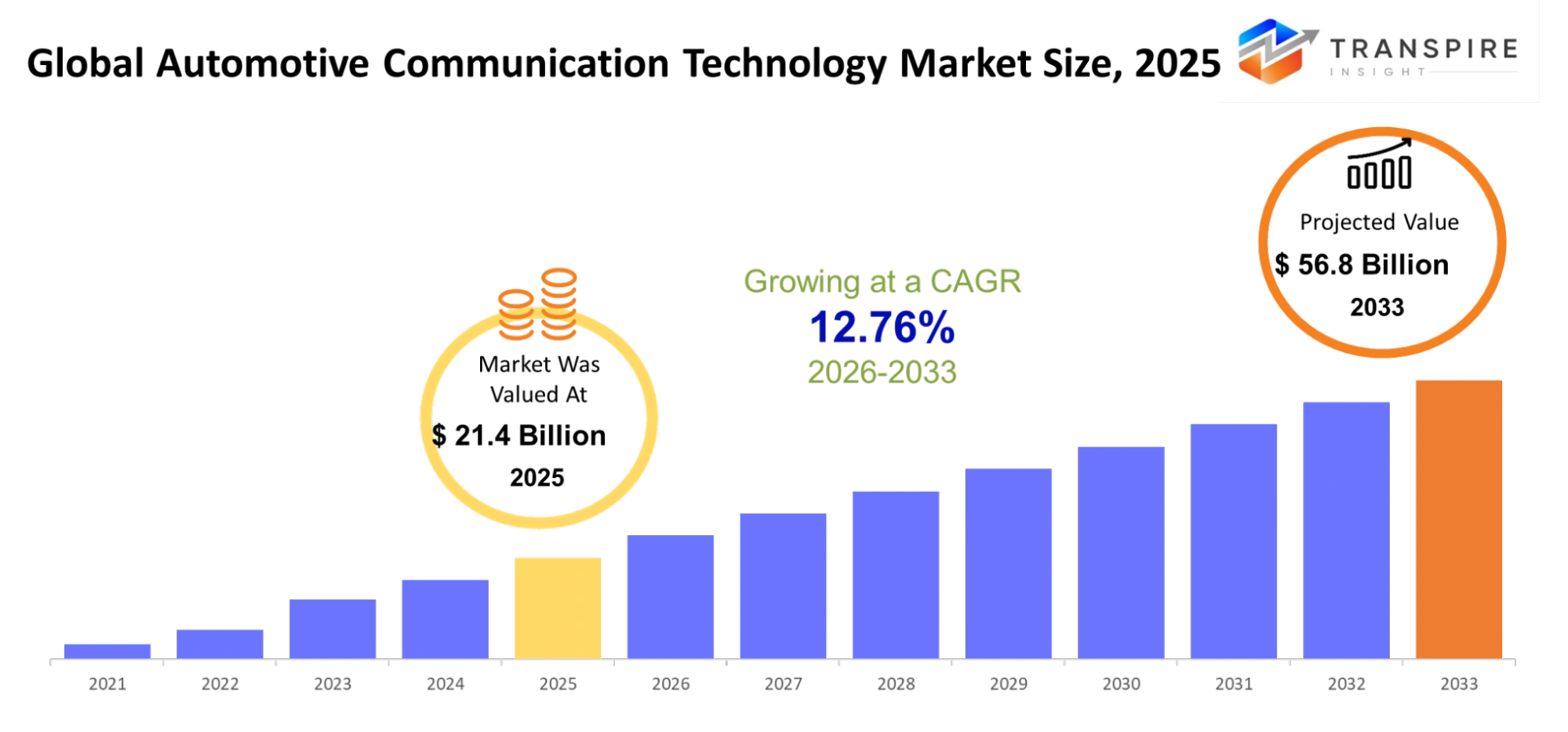
Global Automotive Communication Technology Market Size 2025: USD 21.4 Billion
Global Automotive Communication Technology Market Size 2033: USD 56.8 Billion
Global Automotive Communication Technology Market CAGR: 12.76%
Global Automotive Communication Technology Market Segments: By Technology (CAN, LIN, FlexRay, Ethernet), By Vehicle Type (Passenger Cars, Commercial Vehicles), By Application (Powertrain, Body Control & Comfort, Infotainment & Communication, Safety Systems).
To learn more about this report,  Download Free Sample Report
Global Automotive Communication Technology Market Summary:
The Global Automotive Communication Technology Market was valued at USD 21.4 billion in 2025. It is forecast to reach USD 56.8 billion by 2033. The CAGR over this period is 12.76%.
Cars hold numerous electronic control units - dozens of them in fact. These ECUs continually exchange data. They use vehicle networks for doing this. CAN, LIN, FlexRay, and Ethernet represent the primary bus technologies. Each manages a unique combination of speed, price, and amount of information.
CAN retains the market lead. It has actually been the standard ECU bus since the 1980s. It is reliable, well-known, and rather inexpensive to set up. Most body and engine networks still operate with CAN. The installed base is enormous and really hard to modify.
Ethernet is the rapidly growing competitor. ADAS, cameras, and over-the-air upgrades require high-bandwidth links. CAN simply can't provide it. Automotive Ethernet at 100 Mbps and 1 Gbps covers that gap. Automakers are installing Ethernet backbone structures on new platforms. This is essentially the key factor driving the market's 12.76% CAGR.
LIN handles slower-moving tasks. Seating adjustments, rearview mirror control, and door modules run on LIN. It is rather cheap and quite straightforward. FlexRay handles data that requires extremely precise timing. It is used in brake-by-wire and active suspension systems. Both continue to be relevant in their respective applications.
Key Market Trends & Insights:
- Software-defined vehicles require far more bandwidth per electronic control unit (ECU). Legacy CAN buses are reaching their limits very quickly indeed. Automakers are rethinking their network architectures almost from scratch.
- Zonal vehicle architectures group multiple ECUs into a few much more powerful nodes. This really cuts the weight of the wiring harness. It also demands a lot faster backbone networks - such as Ethernet itself.
- Over-the-air software updates demand a reliable, high-speed connection. Ethernet makes OTA quite feasible on a large scale. CAN alone really can't cope with the necessary throughput.
- ADAS camera and radar data is both huge and extremely time-sensitive. Only Ethernet can handle this at the required speed. Each new ADAS-equipped model includes a lot more Ethernet content all the time.
- Cybersecurity standards for automotive networks are rising fast. Standards like ISO/SAE 21434 now actually mandate highly secure communication protocols. This adds a whole lot more complexity to each and every bus technology in the entire stack.
Global Automotive Communication Technology Market Segmentation
By Technology
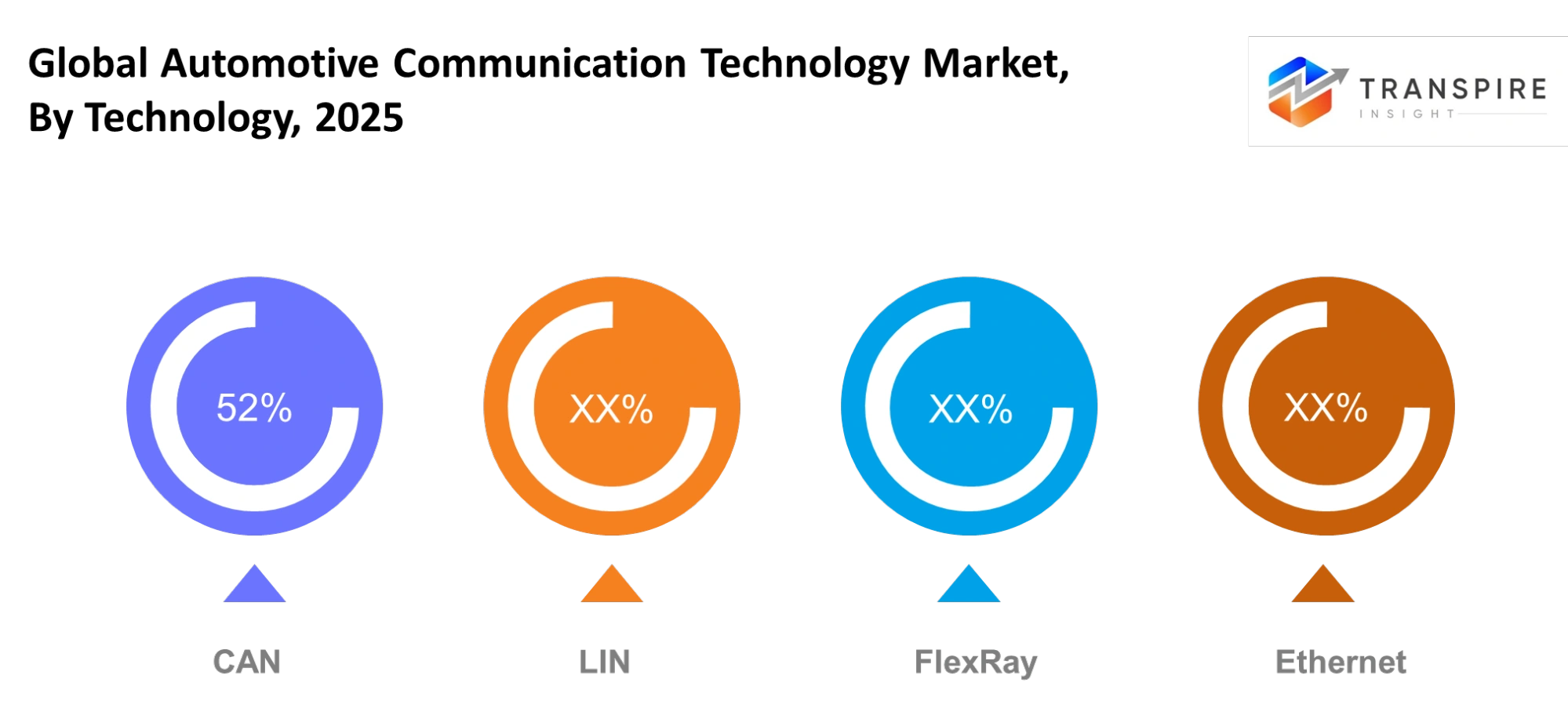
- CAN (Controller Area Network): CAN is the biggest technology segment at 52 percent of market revenue itself. It was actually developed by Bosch back in the 1980s. Virtually every production vehicle today holds at least one CAN bus. The protocol runs at speeds of up to 1 Mbps. CAN FD - a newer variant - hits 8 Mbps. This extension keeps CAN very relevant indeed as ECU counts continue to rise. Body control, engine management, and transmission networks often run on CAN or CAN FD itself. The switching cost of replacing CAN is extremely high, though.
- LIN (Local Interconnect Network): LIN is a very low-cost single-wire bus for slow, less critical tasks all around. It runs at speeds of up to 20 Kbps itself. LIN handles seat motors, window switches, door handles, and climate control actuators very well. LIN is relatively inexpensive to set up. It really doesn't need a transceiver on every node. These characteristics really keep it the preferred choice for peripheral functions all the time.
- FlexRay: FlexRay offers a highly deterministic, very fault-tolerant communication system at speeds of up to 10 Mbps itself. Deterministic basically means the bus delivers data at a guaranteed time - every single cycle. This really matters for brake-by-wire, steer-by-wire, and active chassis systems all around. These functions simply cannot tolerate variable latency itself. FlexRay was actually developed specifically for X-by-wire applications all along. It is more expensive to implement than CAN, unfortunately. Its adoption has been limited mainly to German premium OEMs and safety-critical chassis systems.
- Automotive Ethernet is the fastest-growing technology in the Global Automotive Communication Technology Market. The 100BASE-T1 standard runs at speeds of 100 Mbps over a single twisted pair. The 1000BASE-T1 standard hits speeds of 1 Gbps itself. These speeds really support camera streams, radar data, LiDAR feeds, and large software packages all the time. Ethernet is becoming the main backbone network in new vehicle architectures itself. Domain controllers and zonal computers communicate with each other over Ethernet very well. Slower CAN and LIN sub-networks attach to them as leaf networks indeed.
To learn more about this report, Download Free Sample Report
By Vehicle Type
- Passenger Cars: Passenger cars are really the bigger vehicle type segment. They typically have even more ECUs per vehicle than commercial vehicles. ADAS features, infotainment systems, and comfort electronics are often quite densely packed in passenger cars. Premium and mid-range passenger cars were actually the first to start adopting Ethernet backbone networks. They drive the technology upgrade cycle forward. Passenger car production volumes are also really larger all over the world than commercial vehicles. This makes them the main revenue source in the Global Automotive Communication Technology Market.
- Commercial Vehicles: Commercial vehicles comprise of trucks, buses, and vans. They have rather different network requirements compared to passenger cars. Telematics, fleet management, and powertrain monitoring are the key priority systems. CAN is quite deeply embedded in commercial vehicle platforms. Replacement cycles are indeed longer than those of passenger cars. Ethernet adoption is really starting to grow in new truck platforms for camera monitoring systems and digital mirrors. Regulatory requirements for advanced safety systems in commercial vehicles are indeed pushing communication technology investment in this very segment.
By Application
- Powertrain: Powertrain networks link together the engine control unit, transmission controller, and battery management system. These systems exchange lots of data very frequently indeed. Timing is really quite critical. CAN and CAN FD handle most powertrain communication nowadays. Electric vehicle battery management systems add completely new communication needs. The BMS watches hundreds of cell voltages and temperatures in real-time all the time. This data volume is actually pushing some EV platforms towards even faster bus options for battery network communication.
- Body Control & Comfort: Body control networks manage lighting, climate, seat position, mirrors, and door functions. LIN handles most actuator-level communication right here. CAN connects the body control module to the main vehicle network. This application area actually has the highest number of nodes in a vehicle. It is also the most budget-sensitive indeed. LIN and CAN remain the dominant technologies for body control. Ethernet just doesn't compete in this application because of the cost and the relatively low bandwidth requirements of the functions involved.
- Infotainment & Communication: Infotainment and connectivity systems demand the highest bandwidth requirements of any in-vehicle application ever. Screen mirroring, navigation maps, streaming audio, and over-the-air update packages are all very large data transfers indeed. Ethernet is actually the standard for infotainment system backbones. Most modern head units connect to the vehicle network via Ethernet. Connectivity modules for 5G, Wi-Fi, and Bluetooth add even more processing requirements to this domain. This application drives a significant amount of Ethernet chip and module content per vehicle all the time.
- Safety Systems: Safety system networks carry data from radar, camera, LiDAR, and ultrasonic sensors. They feed ADAS processing units that run collision avoidance, lane keeping, and adaptive cruise control. Latency can't really vary at all. Data has to arrive on time, every single time. Ethernet with TSN extensions actually addresses this need for higher-level ADAS fusion. FlexRay handles the most time-critical actuation paths in current platforms right now. ISO 26262 functional safety requirements dictate exactly how safety networks are designed and validated indeed. This adds certification costs to any new bus technology entering this application area.
To learn more about this report, Download Free Sample Report
Regional Insights
Germany really leads in developing automotive communication technology. Bosch, Continental, and Infineon are all located here. German automobile manufacturers - including BMW, Mercedes, and Volkswagen - were among the first to start using FlexRay and CAN FD. They're also quite early adopters of Ethernet-backbone architectures. German tier-one suppliers essentially set the technical direction for much of the global automotive market.
The United States is one of the biggest markets for semiconductors used in automotive networking. Texas Instruments, Microchip, and Qualcomm all provide a lot of automotive network chip volume. US automakers are investing in brand-new electrical architectures. GM and Ford have both announced plans for centralized computing platforms. These require some new network designs and therefore create a fresh need for Ethernet hardware.
China is growing very rapidly as a regional market. Domestic electric vehicle brands are designing new platforms almost from the ground up. They don't have the constraints of legacy CAN architectures. Quite a few Chinese manufacturers have bypassed CAN altogether and gone with Ethernet-centric designs instead. This really speeds up Ethernet adoption faster in China than in Europe or North America. Chinese semiconductor suppliers are also making a move into the automotive network chip market.
Japan hosts Toyota, Honda, Denso, and Renesas. Japanese manufacturers have generally been rather conservative in adopting new network technologies. CAN and LIN remain quite deeply embedded in their current platforms. However, the push toward electrification is actually encouraging even Japan's most conservative manufacturers to reassess their network architectures. Renesas is a major global supplier of automotive network microcontrollers.
South Korea, thanks to Hyundai and Kia, has been a relatively aggressive adopter of new vehicle electronics. These brands have quite actively integrated ADAS systems. This has really added Ethernet content to their platforms before some of their competitors.
Recent Development News
In 2025, Several Tier 1 suppliers have released new automotive Ethernet switch chips in the past two years. These chips route data between domains in zonal vehicle architectures. NXP, Marvell, and Broadcom are all active in this segment.
In 2022, ISO/SAE 21434 came into full effect. It requires automakers to manage cybersecurity across the full vehicle network lifecycle. This has created demand for secure in-vehicle communication stacks and hardware security modules on network nodes. Suppliers that offer integrated security alongside bus technology have a selling advantage in current platform bids.
Report Metrics
|
Report Metrics |
Details |
|
Market size value in 2025 |
USD 21.4 Billion |
|
Market size value in 2026 |
USD 24.5 Billion |
|
Revenue forecast in 2033 |
USD 56.8 Billion |
|
Growth rate |
CAGR of 12.76% from 2026 to 2033 |
|
Base year |
2025 |
|
Historical data |
2021 - 2024 |
|
Forecast period |
2026 - 2033 |
|
Report coverage |
Revenue forecast, competitive landscape, growth factors, and trends |
|
Regional scope |
United States; Canada; Mexico; United Kingdom; Germany; France; Italy; Spain; Denmark; Sweden; Norway; China; Japan; India; Australia; South Korea; Thailand; Brazil; Argentina; South Africa; Saudi Arabia; United Arab Emirates |
|
Key company profiled |
Robert Bosch GmbH, Continental AG, NXP Semiconductors N.V., Infineon Technologies AG, Texas Instruments Incorporated, STMicroelectronics N.V., Denso Corporation, Vector Informatik GmbH, Microchip Technology Inc., Renesas Electronics Corporation, Qualcomm Incorporated, ON Semiconductor Corporation, Harman International Industries Inc., Aptiv PLC, Panasonic Corporation. |
|
Customization scope |
Free report customization (country, regional & segment scope). Avail customized purchase options to meet your exact research needs. |
|
Report Segmentation |
By Technology (CAN, LIN, FlexRay, Ethernet), By Vehicle Type (Passenger Cars, Commercial Vehicles), By Application (Powertrain, Body Control & Comfort, Infotainment & Communication, Safety Systems). |
Key Global Automotive Communication Technology Company Insights
The market splits into two groups. One group makes the chips that run the networks. The other makes the tools and software that configure them. Both are necessary. Neither works without the other.
NXP, Infineon, Renesas, and Texas Instruments are the dominant chip suppliers. They make the transceivers, microcontrollers, and Ethernet switch chips that go on every ECU. Their product roadmaps set the pace for the market. When NXP releases a new Ethernet switch, OEMs begin designing it into the next platform.
Bosch and Continental sit at the Tier 1 level. They integrate these chips into ECUs and complete domain or zonal controllers. They have deep relationships with every major OEM. Their influence over network architecture decisions is significant. A platform decision made at Bosch or Continental affects millions of vehicles.
Vector Informatik occupies a specific but important position. It does not make hardware. It makes the software tools used to design, simulate, and test automotive networks. CANalyzer and CANoe are the industry-standard tools for network development. Almost every OEM and Tier 1 engineering team uses Vector tools. This gives Vector a durable position that is not easily displaced.
Aptiv has built a strong position in the high-voltage and vehicle architecture space. Its signal and power distribution systems directly affect how network topologies are physically implemented in a vehicle. Harman, now owned by Samsung, focuses on the infotainment domain where Ethernet content is densest.
Company List
- Robert Bosch GmbH
- Continental AG
- NXP Semiconductors N.V.
- Infineon Technologies AG
- Texas Instruments Incorporated
- STMicroelectronics N.V.
- Denso Corporation
- Vector Informatik GmbH
- Microchip Technology Inc.
- Renesas Electronics Corporation
- Qualcomm Incorporated
- ON Semiconductor Corporation
- Harman International Industries Inc.
- Aptiv PLC
- Panasonic Corporation
Global Automotive Communication Technology Market Report Segmentation
By Technology
- CAN (Controller Area Network)
- LIN (Local Interconnect Network)
- FlexRay
- Automotive Ethernet
By Vehicle Type
- Passenger Cars
- Commercial Vehicles
By Application
- Powertrain
- Body Control & Comfort
- Infotainment & Communication
- Safety Systems
By Regional Outlook
- North America
- U.S.
- Canada
- Mexico
- Europe
- UK
- Germany
- France
- Italy
- Spain
- Denmark
- Sweden
- Norway
- Asia Pacific
- Japan
- China
- India
- Australia
- South Korea
- Thailand
- Latin America
- Brazil
- Argentina
- Middle East & Africa
- South Africa
- Saudi Arabia
- UAE
- Kuwait
Frequently Asked Questions
Find quick answers to common questions.
The Global Automotive Communication Technology Market is expected to reach approximately USD 56.8 billion by 2033.
Key segments include Technology (CAN, LIN, FlexRay, Ethernet), Vehicle Type (Passenger Cars, Commercial Vehicles), and Application (Powertrain, Body Control & Comfort, Infotainment & Communication, Safety Systems).
Major players include Robert Bosch GmbH, Continental AG, NXP Semiconductors N.V., Infineon Technologies AG, Texas Instruments Incorporated, STMicroelectronics N.V., Denso Corporation, Vector Informatik GmbH, Microchip Technology Inc., Renesas Electronics Corporation, Qualcomm Incorporated, ON Semiconductor Corporation, Harman International Industries Inc., Aptiv PLC, and Panasonic Corporation.
The Global Automotive Communication Technology Market size is approximately USD 21.4 billion in 2025.
The Global Automotive Communication Technology Market is expected to grow at a CAGR of 12.76% from 2026 to 2033.
- Robert Bosch GmbH
- Continental AG
- NXP Semiconductors N.V.
- Infineon Technologies AG
- Texas Instruments Incorporated
- STMicroelectronics N.V.
- Denso Corporation
- Vector Informatik GmbH
- Microchip Technology Inc.
- Renesas Electronics Corporation
- Qualcomm Incorporated
- ON Semiconductor Corporation
- Harman International Industries Inc.
- Aptiv PLC
- Panasonic Corporation
Recently Published Reports
-
Apr 2026
ATV & UTV Market
ATV & UTV Market Size, Share & Analysis Report By Type (ATV, and UTV), By Variants (Less Than 400 CC, 400 CC To 800 CC, and More Than 800 CC), and Geography (North America, Europe, Asia-Pacific, Middle East and Africa, South and Central America), 2021 - 2031
-
Apr 2026
Automotive Central Gateway Module Market
Automotive Central Gateway Module Market Size, Share & Analysis Report By Type (Ethernet Central Gateway Module, CAN Central Gateway Module, LIN Central Gateway Module, and FlexRay), By Application (Powertrain Control, Body Control, Infotainment System, Advanced Driver Assistance Systems (ADAS), and Others), By End User (Passenger Vehicles, and Commercial Vehicles), and Geography (North America, Europe, Asia-Pacific, Middle East and Africa, South and Central America), 2021 - 2031
-
Apr 2026
Automotive Engine Oil Filter Market
Automotive Engine Oil Filter Market Size, Share & Analysis Report By Filter Type (Fuel Filter, Engine Oil Filter, Hydraulic Oil Filter, and Others), By Filter Media (Cellulose, Synthetic, and Micro), By Sales Channel (OEMs, and Aftermarket), By Vehicle Type (Passenger Cars, Light Commercial Vehicles, Heavy Duty Trucks, Buses and Coaches, and Off-road Vehicles), and Geography (North America, Europe, Asia-Pacific, Middle East and Africa, South and Central America), 2021 - 2031
-
Apr 2026
Automotive Parts Aluminium Die Casting Market
Automotive Parts Aluminium Die Casting Market Size, Share & Analysis Report By Production Process (Pressure Die Casting, Vacuum Die Casting, Squeeze Die Casting, Gravity Die Casting), By Application (Body Parts, Engine Parts, Transmission Parts, Battery And Related Components, Other Application Types), and Geography (North America, Europe, Asia-Pacific, Middle East and Africa, South and Central America), 2021 - 2031
Our Clients