
United States Advanced Driver-Assistance Systems (ADAS) Market Size & Forecast:
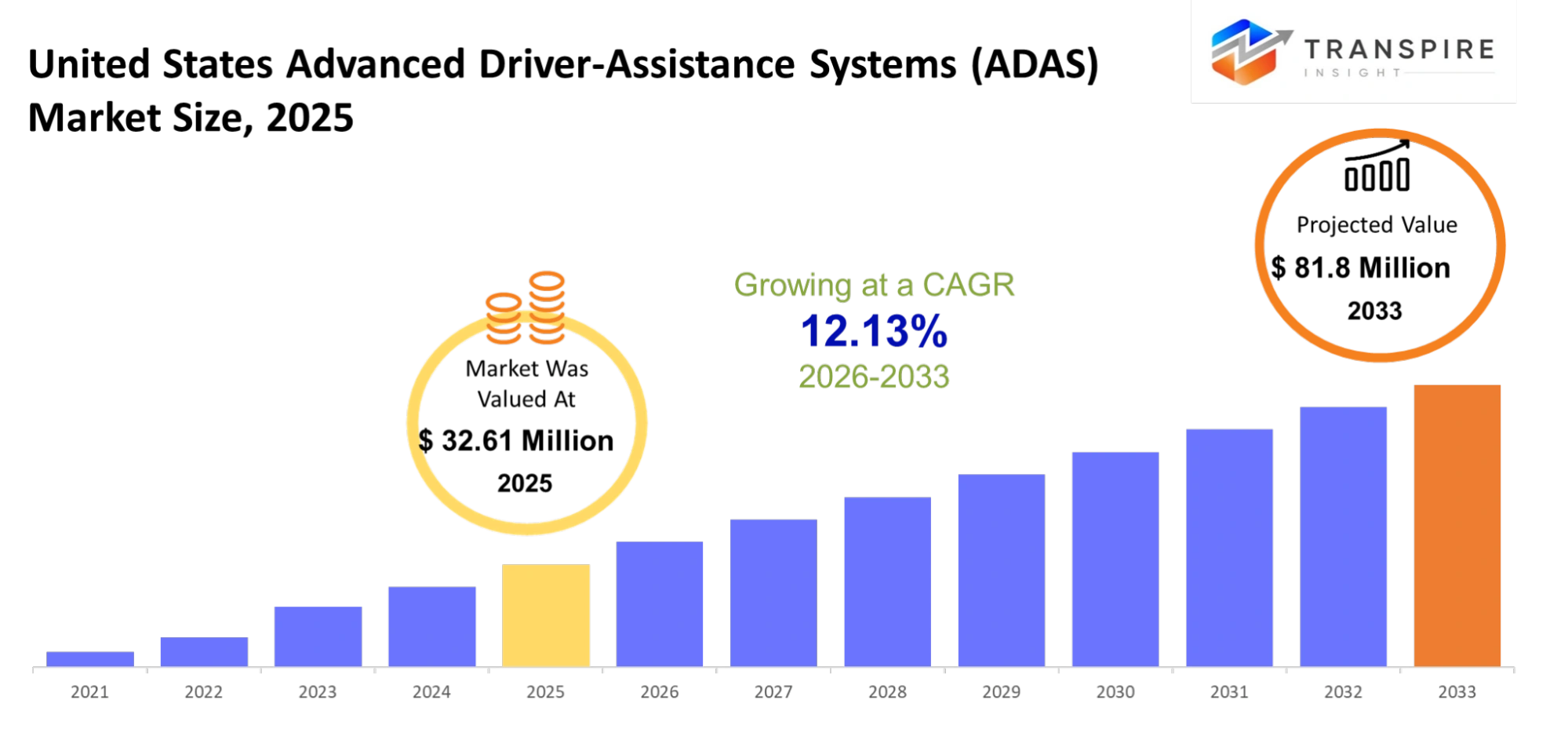
- United States Advanced Driver-Assistance Systems (ADAS) Market Size 2025: USD 32.61 Million
- United States Advanced Driver-Assistance Systems (ADAS) Market Size 2033: USD 81.8 Million
- United States Advanced Driver-Assistance Systems (ADAS) Market CAGR: 12.13%
- United States Advanced Driver-Assistance Systems (ADAS) Market Segments:By System Type (Adaptive Cruise Control, Lane Departure Warning, Automatic Emergency Braking, Parking Assistance), By Vehicle Type (Passenger Cars, Commercial Vehicles).
To learn more about this report,  Download Free Sample Report
United States Advanced Driver-Assistance Systems (ADAS) Market Summary:
The United States Advanced Driver-Assistance Systems (ADAS) market size is estimated at USD 32.61 million in 2025 and is anticipated to reach USD 81.8 million by 2033, growing at a CAGR of 12.13% from 2026 to 2033. The United States Advanced Driver-Assistance Systems (ADAS) market shows continuous development because modern driving needs safety features and driving ease and automated systems. The automotive industry is developing new safety technologies because customer awareness and safety regulations have become more stringent. The development of sensors together with artificial intelligence and connectivity technology has led to better system performance through improved accuracy and trustworthiness. The growing adoption of electric and autonomous vehicles will make ADAS a key factor that develops a safer and advanced transportation system.
Key Market Trends & Insights:
- Consumers express heightened safety concerns which drive their interest in automatic emergency braking systems and blind-spot detection systems. The automotive industry now requires manufacturers to provide advanced driver assistance systems as standard equipment.
- The implementation of ADAS technologies is being promoted by safety regulations and mandatory safety requirements. Agencies are promoting advanced safety systems to reduce road accidents and improve overall driving standards.
- The performance of ADAS systems is being enhanced by improvements in artificial intelligence and camera systems and radar technology and LiDAR systems. These technologies enable vehicles to better comprehend their environment while they achieve faster and more precise decision-making abilities.
- ADAS functions as a pathway to achieve fully autonomous vehicles because it contains lane centring and adaptive cruise control features that drivers increasingly want. The gradual process of automation implementation establishes consumer confidence in automated systems.
- Electric vehicle manufacturers are increasingly adopting advanced ADAS technology for their vehicles, which has led to a rise in electric vehicle adoption. The combination of these two technologies improves both sustainable practices and user-friendly smart driving experiences.
- The expenses associated with ADAS components have been decreasing because of technological progress and increased production capabilities. The new development enables mid-range and entry-level vehicles to use these systems for their operations.
United States Advanced Driver-Assistance Systems (ADAS) Market Segmentation
By System Type
- Adaptive Cruise Control (ACC): Adaptive Cruise Control is a rising star among frequent drivers attending long journeys or trapped in jammed traffic. The system uses automatic vehicle speed adjustments to keep safe distance from other vehicles. Greater highway usage together with increased interest in semi-autonomous driving technology makes ACC the most preferred driving solution for contemporary automobile consumers.
- Lane Departure Warning (LDW): Lane departure warning systems have become essential components for modern drivers because road safety needs have increased. The systems provide drivers with warning signals which activate when the vehicle starts to leave its intended lane. LDW serves a vital function on highways because it helps drivers maintain focus while preventing accidents through its mobile usage.
- Automatic Emergency Braking (AEB): The automatic emergency braking system functions as an important safety technology because it successfully decreases head-on vehicle collisions. The system detects possible road obstacles and begins braking operations whenever necessary. AEB systems are becoming more popular across different vehicle types because regulatory bodies and consumers show increased interest in advanced safety features.
- Parking Assistance: Parking assistance systems enable drivers to park their vehicles in small urban spaces by providing them with parking assistance features which make the process easier. The systems use sensors and cameras to create two operation modes, which include guidance mode and automated control mode. The usage of parking assistance systems is growing because they offer more convenience to drivers who face less stress during their parking activities.
By Vehicle Type
- Passenger Cars: Consumers prefer safety features and convenience features which drive passenger cars to become the main vehicles used for advanced driver assistance systems. Manufacturers now offer advanced features through their mid-range vehicle models to maintain market competition. The increasing need for connected and intelligent vehicles drives the faster implementation of advanced driver assistance systems in this vehicle category.
- Commercial Vehicles: The growing significance of advanced driver assistance systems in commercial vehicles exists because these systems enhance fleet security and boost operational performance. The system provides collision avoidance features together with driver monitoring functions which help decrease both accidents and operational interruptions. Logistics companies implement these systems to achieve safer transportation methods while meeting the new safety regulations that have emerged throughout the United States.

To learn more about this report, Download Free Sample Report
Country Insights
The United States Advanced Driver-Assistance Systems (ADAS) market shows a dynamic combination of new technological developments and existing industry regulations and growing public knowledge about the systems. The country's strong automotive industry, three major car manufacturers and various technology companies drive the fast adoption of advanced safety technologies. The increasing public demand for road safety and accident prevention forces both government agencies and consumers to support the implementation of ADAS systems. The combination of government programmes that support safety assessments and their assessment programmes which provide safety evaluations currently drives car manufacturers to make these systems standard features in their upcoming vehicle models.
Urbanisation combined with heavy traffic in major cities creates a growing need for driving features which include adaptive cruise control and parking assistance technology. The rising popularity of electric vehicles and connected vehicles creates a stronger demand for ADAS systems which drive current transportation solutions. The United States market progresses toward developing automated driving systems which enhance road safety through artificial intelligence and sensor technology advancements.
Recent Development News
In January 2026, Mobileye Secures Major U.S. Automaker Deal for ADAS Chips: Mobileye signed an extensive agreement with a United States automotive manufacturer to deliver advanced driver assistance system chips. The agreement demonstrates increased consumer interest in vehicle safety systems which combine elements of automation and safety technology.
In February 2026, U.S. Automakers Accelerate Hands-Free Driving Technologies: Automakers are developing hands-free highway driving systems which bring advanced driver assistance systems closer to achieving semi-autonomous driving. This trend is gaining traction across premium and mid-range vehicles.
|
Report Metrics |
Details |
|
Market size value in 2025 |
USD 32.61 Million |
|
Market size value in 2026 |
USD 36.7 Million |
|
Revenue forecast in 2033 |
USD 81.8 Million |
|
Growth rate |
CAGR of 12.13% from 2026 to 2033 |
|
Base year |
2025 |
|
Historical data |
2021 – 2024 |
|
Forecast period |
2026 – 2033 |
|
Report coverage |
Revenue forecast, competitive landscape, growth factors, and trends |
|
Country scope |
United States |
|
Key company profiled |
Robert Bosch GmbH, Continental AG, Denso Corporation, ZF Friedrichshafen AG, Aptiv PLC, Magna International Inc., Valeo SA, Mobileye Global Inc., NVIDIA Corporation, Texas Instruments Inc., Renesas Electronics Corporation, Panasonic Automotive Systems, Autoliv Inc., Hyundai Mobis Co. Ltd., Hitachi Astemo Ltd. |
|
Customization scope |
Free report customization (country, regional & segment scope). Avail customized purchase options to meet your exact research needs. |
|
Report Segmentation |
By System Type (Adaptive Cruise Control, Lane Departure Warning, Automatic Emergency Braking, Parking Assistance), By Vehicle Type (Passenger Cars, Commercial Vehicles). |
Key United States Advanced Driver-Assistance Systems (ADAS) Company Insights
The United States Advanced Driver-Assistance Systems (ADAS) market is shaped by a mix of established automotive leaders and innovative technology firms which work together to develop new vehicle safety systems. Companies dedicate substantial resources to research and development activities which aim to improve sensor performance and software capabilities and real-time data handling. The automotive industry is experiencing a growing trend in which car manufacturers establish partnerships with technology companies to expedite the development and launch of new vehicle technologies. The increasing market rivalry forces companies to develop cost-effective solutions which can be applied to more vehicle models while they work to enhance the effectiveness and dependability of their ADAS technologies.
Company List
- Robert Bosch GmbH
- Continental AG
- Denso Corporation
- ZF Friedrichshafen AG
- Aptiv PLC
- Magna International Inc.
- Valeo SA
- Mobileye Global Inc.
- NVIDIA Corporation
- Texas Instruments Inc.
- Renesas Electronics Corporation
- Panasonic Automotive Systems
- Autoliv Inc.
- Hyundai Mobis Co. Ltd.
- Hitachi Astemo Ltd.
United States Advanced Driver-Assistance Systems (ADAS) Market Report Segmentation
By System Type
- Adaptive Cruise Control
- Lane Departure Warning
- Automatic Emergency Braking
- Parking Assistance
By Vehicle Type
- Passenger Cars
- Commercial Vehicles
Frequently Asked Questions
Find quick answers to common questions.
The approximate United States Advanced Driver-Assistance Systems (ADAS) market size for the Market will be USD 81.8 million in 2033.
The key segments of the United States Advanced Driver-Assistance Systems (ADAS) Market are By System Type (Adaptive Cruise Control, Lane Departure Warning, Automatic Emergency Braking, Parking Assistance), By Vehicle Type (Passenger Cars, Commercial Vehicles).
Major players in the United States Advanced Driver-Assistance Systems (ADAS) Market are Robert Bosch GmbH, Continental AG, Denso Corporation, ZF Friedrichshafen AG, Aptiv PLC, Magna International Inc., Valeo SA, Mobileye Global Inc., NVIDIA Corporation, Texas Instruments Inc., Renesas Electronics Corporation, Panasonic Automotive Systems, Autoliv Inc., Hyundai Mobis Co. Ltd., Hitachi Astemo Ltd.
The current market size of the United States Advanced Driver-Assistance Systems (ADAS) Market is USD 32.61 million in 2025.
The United States Advanced Driver-Assistance Systems (ADAS) Market CAGR is 12.13%.
- Robert Bosch GmbH
- Continental AG
- Denso Corporation
- ZF Friedrichshafen AG
- Aptiv PLC
- Magna International Inc.
- Valeo SA
- Mobileye Global Inc.
- NVIDIA Corporation
- Texas Instruments Inc.
- Renesas Electronics Corporation
- Panasonic Automotive Systems
- Autoliv Inc.
- Hyundai Mobis Co. Ltd.
- Hitachi Astemo Ltd.
Recently Published Reports
-
Apr 2026
ATV & UTV Market
ATV & UTV Market Size, Share & Analysis Report By Type (ATV, and UTV), By Variants (Less Than 400 CC, 400 CC To 800 CC, and More Than 800 CC), and Geography (North America, Europe, Asia-Pacific, Middle East and Africa, South and Central America), 2021 - 2031
-
Apr 2026
Automotive Central Gateway Module Market
Automotive Central Gateway Module Market Size, Share & Analysis Report By Type (Ethernet Central Gateway Module, CAN Central Gateway Module, LIN Central Gateway Module, and FlexRay), By Application (Powertrain Control, Body Control, Infotainment System, Advanced Driver Assistance Systems (ADAS), and Others), By End User (Passenger Vehicles, and Commercial Vehicles), and Geography (North America, Europe, Asia-Pacific, Middle East and Africa, South and Central America), 2021 - 2031
-
Apr 2026
Automotive Engine Oil Filter Market
Automotive Engine Oil Filter Market Size, Share & Analysis Report By Filter Type (Fuel Filter, Engine Oil Filter, Hydraulic Oil Filter, and Others), By Filter Media (Cellulose, Synthetic, and Micro), By Sales Channel (OEMs, and Aftermarket), By Vehicle Type (Passenger Cars, Light Commercial Vehicles, Heavy Duty Trucks, Buses and Coaches, and Off-road Vehicles), and Geography (North America, Europe, Asia-Pacific, Middle East and Africa, South and Central America), 2021 - 2031
-
Apr 2026
Automotive Parts Aluminium Die Casting Market
Automotive Parts Aluminium Die Casting Market Size, Share & Analysis Report By Production Process (Pressure Die Casting, Vacuum Die Casting, Squeeze Die Casting, Gravity Die Casting), By Application (Body Parts, Engine Parts, Transmission Parts, Battery And Related Components, Other Application Types), and Geography (North America, Europe, Asia-Pacific, Middle East and Africa, South and Central America), 2021 - 2031
Our Clients