

United States Gasoline Market Size & Forecast:
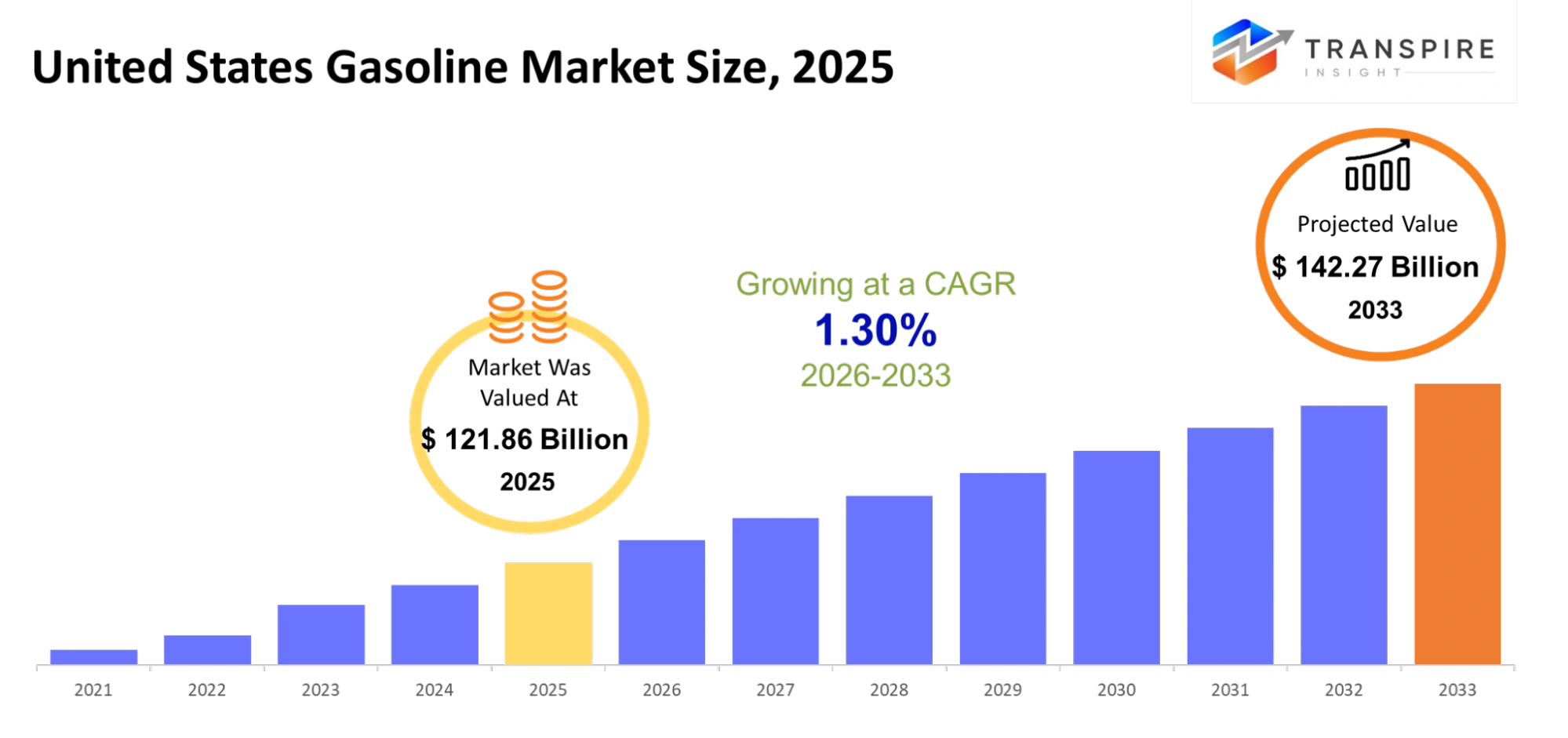
- United States Gasoline Market Size 2025: USD 121.86 Billion
- United States Gasoline Market Size 2033: USD 142.27 Billion
- United States Gasoline Market CAGR: 1.30%
- United States Gasoline Market Segments:By Type (Regular, Mid-grade, Premium, Reformulated), By Application (Transportation, Industrial, Aviation, Marine), By Distribution Channel (Retail, Wholesale, Direct Sales, Online), By End-User (Consumers, Logistics Companies, Industries, Government), By Formulation (Conventional, Oxygenated, Ethanol-blended, Additive-based).
To learn more about this report,  Download Free Sample Report
United States Gasoline Market Summary:
The United States Gasoline market size is estimated at USD 121.86 Billion in 2025 and is anticipated to reach USD 142.27 Billion by 2033, growing at a CAGR of 1.30% from 2026 to 2033. The US gasoline market functions as a crucial energy sector in the United States because constant transportation needs and changing consumer preferences drive its operations. The market currently follows two forces, which include persistent traditional fuel usage and the market's transition to electric vehicles and emerging fuel efficiency standards. Consumer purchasing patterns are affected by price changes which result from crude oil market movements and international political developments. The United States gasoline market maintains its importance because people drive across the country while economic growth sustains gasoline needs.
Key Market Trends & Insights:
- The United States maintains constant gasoline demand because people need gasoline for their daily work commuting and their transportation requirements. The consumption pattern shows an increase during the summer travel season while a small decrease occurs during the winter months.
- Gasoline prices at gas stations respond directly to changes in crude oil market values. Geopolitical conflicts and supply chain interruptions lead to pricing uncertainty which affects customer purchasing behaviour.
- Automakers are focusing their efforts on creating vehicles that consume less fuel which leads to a decline in gasoline usage per person. The present trend establishes permanent buying patterns which will determine how markets function in the future.
- The rising popularity of electric vehicles results in a steady reduction of gasoline usage. The current impact of the situation remains small however it will evolve into a major force during the next several years.
- Refiners must produce cleaner gasoline blends because government policies aim to decrease emissions. The need to meet these regulations creates more operational difficulties while increasing total costs.
- The United States maintains a complete refining system which undergoes temporary supply interruptions when refineries shut down for maintenance. Current fuel standards and industry needs require essential infrastructure improvements.
- Gasoline prices show substantial variations between states because of state taxes and the expenses of transporting fuel and the specific regulations in each state. Coastal areas usually face higher costs than communities situated farther from the coast.
- Drivers now show greater sensitivity to price changes, which makes them change their driving patterns. Gasoline usage patterns develop through three main factors, which include carpooling, public transportation, and remote work.
United States Gasoline Market Segmentation
By Type
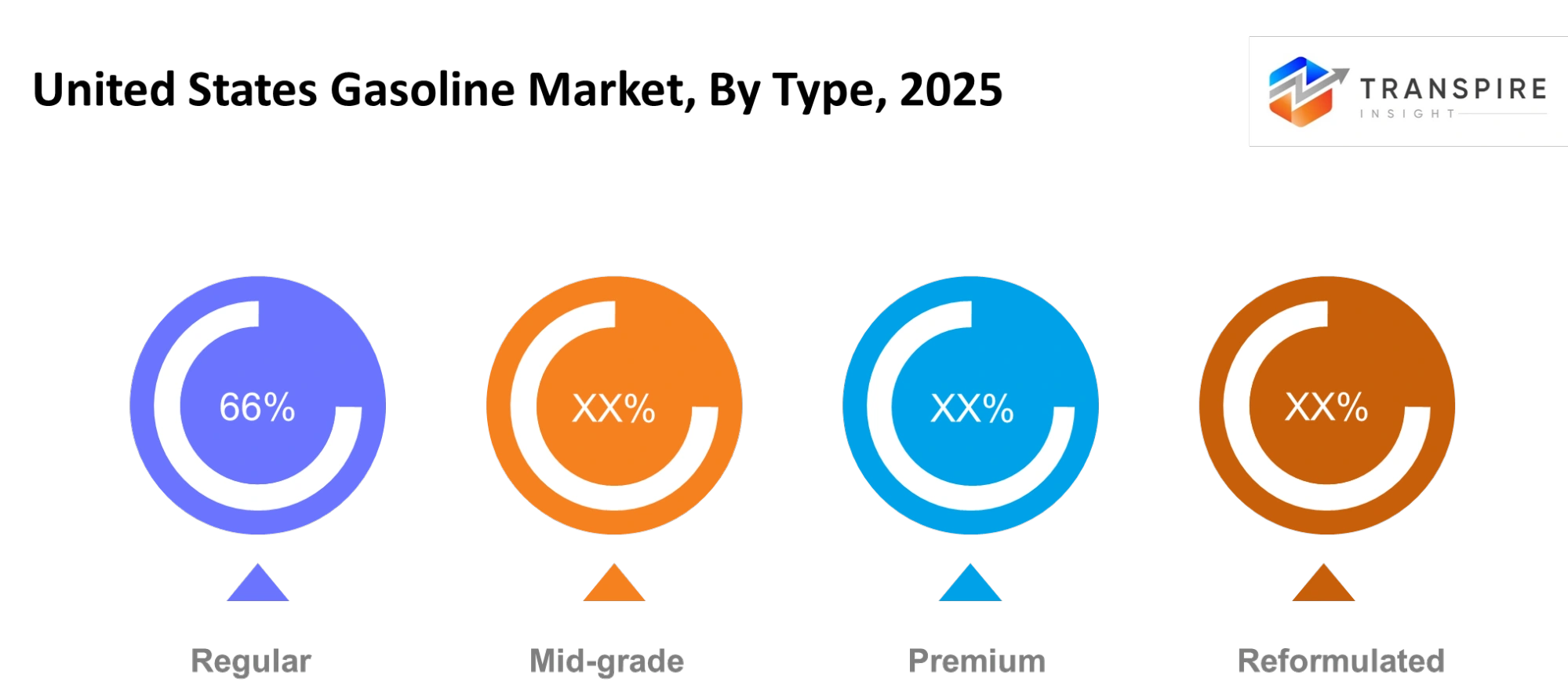
- Regular: The United States maintains regular gasoline as its primary fuel choice because it offers low prices and works with most automotive models. The market segment leads through its ability to meet the needs of daily commuters and customers who want to save money. The product maintains steady demand throughout the country because it remains accessible and affordable to consumers.
- Mid-grade: Mid-grade gasoline serves drivers who want to enhance their engine performance without paying extra costs. The fuel handles particular automotive needs which require octane between standard grades and premium grades to enable optimal engine function.
- Premium: Premium gasoline serves high-performance vehicles together with luxury cars which need fuel that contains higher octane levels. The product helps engines operate better while it decreases engine knocking. The product costs more, but it attracts customers who want to maintain their vehicles for better performance and longer use, which creates a steady market share in the industry.
- Reformulated: Reformulated gasoline exists as a special fuel blend which decreases harmful emissions to enhance air quality. The fuel represents a common choice for areas that enforce strict environmental protection measures. The product costs slightly more, but its ability to decrease pollution makes it essential for environmentally sensitive urban regions.
To learn more about this report, Download Free Sample Report
By Application
- Transportation: Gasoline in the United States serves three primary transportation purposes which include personal vehicles and trucking and public transit systems. The gasoline market depends on this segment as its primary source of demand because people need gasoline for both daily commuting and their long-distance journeys which create ongoing requirements for fuel.
- Industrial: Industrial operations rely on gasoline to power their small machinery and equipment needs. The fuel consumption from this source has less impact on transportation operations, yet it provides essential support to construction and agricultural work and maintenance tasks.
- Aviation: Gasoline in aviation is mainly used for smaller aircraft and private planes. The aviation industry relies on jet fuel as its primary fuel source, yet gasoline maintains its importance for specific activities which include pilot training and recreational flying and certain specialised aviation operations.
- Marine: The marine sector uses gasoline to operate small boats and recreational watercraft. The need for these services increases during the warmer months because people use them more. The United States has a small yet valuable market which people use for their recreational activities and which supports the economic activities of coastal regions.
By Distribution Channel
- Retail: The primary method of retail distribution operates through gas stations which serve as the principal route for customer access to products. The system provides direct customer access because it operates as a two-way system that enables users to enter and exit the premises. The segment maintains its presence because the network of fuelling stations extends throughout both metropolitan cities and remote rural locations.
- Wholesale: The wholesale channels provide bulk gasoline deliveries to business customers, distributors and industrial customers who operate large facilities. The system guarantees commercial operations receive necessary fuel supplies while establishing essential pathways that maintain industrial operations which depend on regular fuel delivery.
- Direct Sales: The process of direct sales transmits fuel from its source through producers and distributors directly to major customers, which include both corporate entities and governmental organisations. The channel establishes direct fuel delivery for operational needs which require substantial fuel quantities while minimising expenses through intermediary cost elimination.
- Online: The emergence of online channels enables businesses to place fuel delivery orders through digital platforms. The developing market segment provides three advantages, which include convenient access to products, better price comparison options and simplified purchase processes, while demonstrating how digital transformation affects traditional fuel markets.
By End-User
- Consumers: The primary user group of the product consists of individual consumers who require transportation services throughout their daily activities. The consumer behaviour of gasoline demand in the United States results from three factors which determine their fuel selections according to vehicle specifications and available fuel options and current fuel prices.
- Logistics Companies: Gasoline functions as the primary fuel source for logistics companies which operate their delivery vans and light-duty vehicles during their fleet activities. Companies must focus on two essential objectives because their operational success depends on achieving fuel efficiency and controlling expenses while gasoline costs create major financial challenges.
- Industries: Gasoline serves as the primary fuel source which industries utilise to power their equipment and backup power systems and their daily operations. The energy source supports multiple operations, although it does not serve as the main power supply for smaller facilities and remote areas where other fuelling options are not accessible.
- Government: Gasoline serves as the fuel source which government agencies use to operate their public service vehicles and law enforcement units and to maintain their infrastructure systems. The organisation shows constant fuel needs which respond to governmental policy changes that establish sustainability targets and direct funding distribution.
By Formulation
- Conventional: The fuel used throughout most areas of the world functions as the typical gasoline fuel which provides dependable operation and lower expenses. The product maintains a strong market presence because it continues to be the preferred choice for areas that lack strict environmental protection laws.
- Oxygenated: Oxygenated gasoline contains additives which reduce carbon monoxide emissions through their chemical properties. The product serves as a winter solution which helps improve air quality in cold regions during the winter season.
- Ethanol-blended: The widespread use of ethanol-blended gasoline occurs because E10 and E15 gasoline contain a renewable fuel element which delivers environmental benefits. The product helps decrease fossil fuel usage while it supports agricultural businesses which leads to its increasing acceptance across the United States.
- Additive-based: Gasoline, which relies on additives, contains special chemicals that improve engine operation and engine cleanliness and engine efficiency. The market segment attracts consumers who want to maintain better vehicle performance and extended vehicle lifespan through these product formulations.
Country Insights
The gasoline market in the United States operates as a developed market which continues to change because of strong demand for transportation services and evolving consumer behaviour. The country has one of the biggest vehicle fleets, which leads to continuous gasoline consumption for both daily travel and extended road trips. The market undergoes slow transformation because of two factors, which include increasing fuel efficiency standards and growing electric vehicle market share. Fuel prices and consumption patterns change because different states establish their own tax systems and infrastructure development programmes and environmental protection measures. The implementation of strict regulations together with complex supply chain operations leads to increased operational costs in coastal and urban areas. The market environment receives changes because of both refined technology advancements and the development of cleaner fuel products. Gasoline remains a vital energy resource for the country because economic development and transportation requirements together with the national automotive culture sustain its demand through growing sustainability initiatives.
Recent Development News
In March 2026, Gas Prices Surge Above $4 Per Gallon: US gasoline prices crossed $4 per gallon for the first time in years, driven by global oil supply disruptions. This sudden rise is putting pressure on household budgets and small businesses.
In April 2026, Iran Conflict Pushes Oil Above $100, Impacting Gasoline: Geopolitical tensions have driven crude oil prices sharply higher, directly increasing gasoline prices in the U.S. Consumers are already feeling the ripple effects.
|
Report Metrics |
Details |
|
Market size value in 2025 |
USD 121.86 Billion |
|
Market size value in 2026 |
USD 123.45 Billion |
|
Revenue forecast in 2033 |
USD 142.27 Billion |
|
Growth rate |
CAGR of 1.30% from 2026 to 2033 |
|
Base year |
2025 |
|
Historical data |
2021 – 2024 |
|
Forecast period |
2026 – 2033 |
|
Report coverage |
Revenue forecast, competitive landscape, growth factors, and trends |
|
Country scope |
United States |
|
Key company profiled |
ExxonMobil, Chevron, Shell, BP, Marathon Petroleum, Valero, Phillips 66, ConocoPhillips, CITGO, Hess, Sunoco, Murphy USA, PBF Energy, HF Sinclair, Sinclair Oil |
|
Customization scope |
Free report customization (country, regional & segment scope). Avail customized purchase options to meet your exact research needs. |
|
Report Segmentation |
By Type (Regular, Mid-grade, Premium, Reformulated), By Application (Transportation, Industrial, Aviation, Marine), By Distribution Channel (Retail, Wholesale, Direct Sales, Online), By End-User (Consumers, Logistics Companies, Industries, Government), By Formulation (Conventional, Oxygenated, Ethanol-blended, Additive-based). |
Key United States Gasoline Company Insights
The gasoline market in the United States operates through a combination of major oil companies and local fuel distributors who compete to deliver efficient services while expanding their market presence. The main companies maintain their market position through their focus on improvements in refining capacity and their development of distribution systems and new fuel technologies. Companies make investments to develop environmentally friendly fuel solutions while they increase the availability of convenience retail services at their gas station locations. Strategic partnerships together with supply chain improvements and digital payment systems have emerged as essential factors that create competitive advantages. The companies continue to adjust their operations according to changing energy patterns while they meet existing fuel requirements and pursue sustainable energy alternatives.
Company List
- ExxonMobil
- Chevron
- Shell
- BP
- Marathon Petroleum
- Valero
- Phillips 66
- ConocoPhillips
- CITGO
- Hess
- Sunoco
- Murphy USA
- PBF Energy
- HF Sinclair
- Sinclair Oil
United States Gasoline Market Report Segmentation
By Type
- Regular
- Mid-grade
- Premium
- Reformulated
By Application
- Transportation
- Industrial
- Aviation
- Marine
By Distribution Channel
- Retail
- Wholesale
- Direct Sales
- Online
By End-User
- Consumers
- Logistics Companies
- Industries
- Government
By Formulation
- Conventional
- Oxygenated
- Ethanol-blended
- Additive-based
Frequently Asked Questions
Find quick answers to common questions.
The approximate United States Gasoline Market size for the market will be USD 142.27 Billion in 2033.
The key segments of the United States Gasoline Market are By Type (Regular, Mid-grade, Premium, Reformulated), By Application (Transportation, Industrial, Aviation, Marine), By Distribution Channel (Retail, Wholesale, Direct Sales, Online), By End-User (Consumers, Logistics Companies, Industries, Government), By Formulation (Conventional, Oxygenated, Ethanol-blended, Additive-based).
Major players in the United States Gasoline Market are ExxonMobil, Chevron, Shell, BP, Marathon Petroleum, Valero, Phillips 66, ConocoPhillips, CITGO, Hess, Sunoco, Murphy USA, PBF Energy, HF Sinclair, Sinclair Oil.
The current market size of the United States Gasoline Market is USD 121.86 Billion in 2025.
The United States Gasoline Market CAGR is 1.30%.
- ExxonMobil
- Chevron
- Shell
- BP
- Marathon Petroleum
- Valero
- Phillips 66
- ConocoPhillips
- CITGO
- Hess
- Sunoco
- Murphy USA
- PBF Energy
- HF Sinclair
- Sinclair Oil
Recently Published Reports
-
May 2026
Healthcare Polymer Packaging Market
Healthcare Polymer Packaging Market Size, Share & Analysis Report By Packaging Type (Syringes, IV Bottles and Pouches, Clamshells, Blisters, Bottles & Jars, Containers, Tubes, IV Parental Packaging, Others), By Type (Regulated, Non-regulated), By Polymer Type (LDPE (Low-Density Polyethylene), HDPE (High-Density Polyethylene), Homo-polymer (Homo), Random Copolymer (Random), Block Copolymer (Block), PET, Polystyrene, Polyvinyl Chloride, Polyamide/EVOH, Others), and Geography (North America, Europe, Asia-Pacific, Middle East and Africa, South and Central America), 2021 - 2031
-
Apr 2026
Hydrophilic Tape (Waterstop) Market
Hydrophilic Tape (Waterstop) Market Size, Share & Analysis Report By Type (Bentonite-Based Hydrophilic Tape, Rubber-Based Hydrophilic Tape), By Application (Residential Buildings, Commercial Buildings, Infrastructure Projects), and Geography (North America, Europe, Asia-Pacific, Middle East and Africa, South and Central America), 2021 - 2031
-
Apr 2026
Metalens Market
Metalens Market Size, Share & Analysis Report By Type (Visible Light Metalens, and Infrared Metalens), By Application (Consumer Electronics, Automotive Electronics, Industrial, Medical, and Others), and Geography (North America, Europe, Asia-Pacific, Middle East and Africa, South and Central America), 2021 - 2031
-
Apr 2026
PBT Resin Market
PBT Resin Market Size, Share & Analysis Report By Type (Reinforced PBT Resin, Unreinforced PBT Resin), By Processing Method (Injection Molding, Extrusion, Blow Molding, Others), By End-User (Automotive, Electrical & Electronics, Consumer Appliances, Industrial Machinery, Medical Devices, Packaging, Others), and Geography (North America, Europe, Asia-Pacific, Middle East and Africa, South and Central America), 2021 - 2031