

North America Fixed Human Anesthesia Workstation Market Size & Forecast:
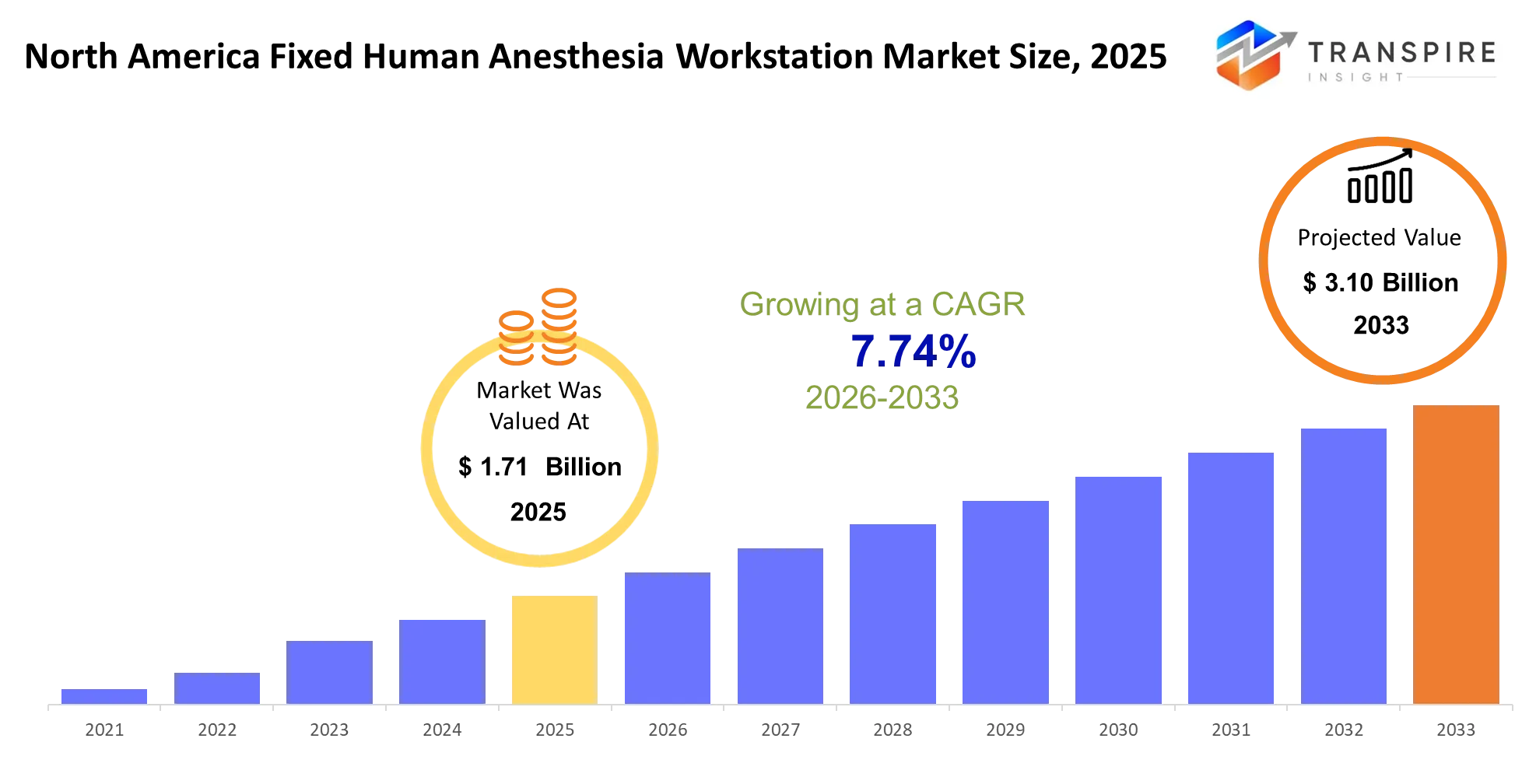
- North America Fixed Human Anesthesia Workstation Market Size 2025: USD 1.71 Billion
- North America Fixed Human Anesthesia Workstation Market Size 2033: USD 3.10 Billion
- North America Fixed Human Anesthesia Workstation Market CAGR: 7.74%
- North America Fixed Human Anesthesia Workstation Market Segments: By Product Type (Integrated Anesthesia Workstations, Modular Workstations, Compact Workstations, Others); By Application (General Surgery, Orthopedic Surgery, Cardiac Surgery, Ambulatory Surgery, Others); By End User (Hospitals, Ambulatory Surgical Centers, Specialty Clinics, Others); By Technology (Digital Monitoring Systems, AI-enabled Systems, Gas Monitoring Systems, Others)
To learn more about this report,  Download Free Sample Report
North America Fixed Human Anesthesia Workstation Market Summary
The North America Fixed Human Anesthesia Workstation Market was valued at USD1.71 Billion in 2025. It is forecast to reach USD 3.10 Billion by 2033. That is a CAGR of 7.74% over the period.
The North America fixed human anesthesia workstation market, sort of revolves around the equipment used in operating rooms, for delivering exact blends of anesthetic gases, keeping patient ventilation going, and constantly checking key vital parameters during surgery. This kind of setup helps surgeons and anesthesiologists hold a steady level of controlled sedation and physiological balance through many types of cases, from everyday procedures, to more demanding critical care situations. Over the past 3-5 years, there’s been a noticeable shift away from standalone anesthesia machines, toward integrated digital workstations that bundle ventilation, patient monitoring, and electronic health record connectivity. One big structural shift, has been the uptake of low-flow together with closed-loop anesthesia solutions, intended to make drug use more efficient and at the same time lower environmental emissions. The COVID-19 pandemic was a major push, it revealed capacity limits and sped up hospital buying cycles while surgical backlogs built up, plus ongoing supply chain disruptions. Because of that, many healthcare systems are now stressing fleet modernization, better interoperability, and safety focused upgrades, and that mix is driving replacement led revenue, growth more quickly than before.
Key Market Insights
- North America is basically dominating the North America Fixed Human Anesthesia Workstation Market with around a 38% share in 2025, it is driven by advanced hospital infrastructure, and also early tech adoption.
- The United States seems to lead in demand since surgical procedure volumes are high and investment in operating room automation systems stays strong.
- Canada is actually the fastest-growing regional market through 2025–2030, supported by healthcare modernization efforts and surgical capacity expansion programs.
- Integrated anesthesia workstations are taking the lead because of real-time monitoring, plus ventilator integration which makes things smoother during procedures.
- Standalone anesthesia machines are still the second-largest group, they remain common in mid-tier and cost sensitive healthcare facilities.
- Smart anesthesia workstations with AI-assisted monitoring are the fastest growing segment through 2030, mostly due to precision dosing demand, and more accurate control expectations.
- General surgery dominates use with roughly 45% share in the North America Fixed Human Anesthesia Workstation Market, largely because procedure frequency is so high.
- Cardiac and neurosurgery applications are growing quickly, pushed by the need for precise anesthesia control in high-risk operations.
- Outpatient surgical centers are increasingly leaning on compact systems, for faster patient turnover and practical operational efficiency.
- Hospitals hold the leading portion, nearing 70% of the North America Fixed Human Anesthesia Workstation Market, since surgical infrastructure is centralized and scale matters there.
What are the Key Drivers, Restraints, and Opportunities in the North America Fixed Human Anesthesia Workstation Market?
Driver:
The main force that is pushing the North America Fixed Human Anesthesia Workstation Market is kinda the accelerated modernization of operating rooms across big hospital networks. The shift started when healthcare providers were dealing with post-pandemic surgical backlogs, plus tighter perioperative safety routines demanded by regulators like the FDA and various accreditation agencies. Hospitals are now trading older anesthesia setups for integrated workstations that sort of bundle ventilation , gas delivery , and real-time patient monitoring into one single platform. This change tends to raise capital equipment spend right away, because organizations want systems that cut intraoperative risk and also improve day to day workflow efficiency. In turn, that means more purchasing volumes and steadier recurring service revenue.
Restraint:
The biggest brake on this market is the high upfront acquisition price, as well as the lifecycle maintenance cost, for these advanced anesthesia workstations. This limitation feels structural because procurement is tied to multi-year hospital budgeting cycles and capital approval processes, and those just do not pivot fast when new technology arrives. Smaller regional hospitals, plus ambulatory centers, frequently postpone replacement, so they keep using refurbished units or semi-digital systems. Therefore adoption becomes uneven, and a noticeable slice of potential revenue stays pushed out, especially inside cost-sensitive healthcare networks.
Opportunity:
One of the clearer growth openings is AI-enabled anesthesia delivery, specifically when it is tied to predictive patient monitoring. Early rollouts in U.S. academic hospitals , including pilot programs using closed-loop anesthesia control algorithms, are already showing better dosage precision and less drug waste.As reimbursement models start to reward outcome efficiency more and more, this technology is expected to kick off a kind of new upgrade cycle, across high volume surgical centers. In a way it feels like the workflow is gonna be nudged, into faster and sharper results, without all the extra lag.
What Has the Impact of Artificial Intelligence Been on the North America Fixed Human Anesthesia Workstation Market?
Artificial intelligence along with more advanced digital technologies are quietly reshaping anesthesia workstation ecosystems in North America, sort of moving away from manually supervised delivery, toward semi autonomous perioperative control spaces. In today’s operating rooms, AI enabled control systems help with things like gas flow regulation, ventilator setting adjustments, and anesthesia depth tuning, all while continuously looking at patient vitals in real time. At the same time, hospitals are rolling out digital fleet management platforms that handle calibration tracking, equipment usage logging, and compliance paperwork across networks of anesthesia devices. This, in practice, trims the administrative weight a lot, and it also strengthens regulatory readiness.
On the predictive side, machine learning is being applied more and more to predictive maintenance of anesthesia machines. The idea is to spot early warning signs like vaporizer wear, sensor drift, or ventilation inefficiencies, before any clinical failure shows up. There’s also a forecasting angle, where these systems guide anesthetic agent consumption estimates, so volatile gas wastage can be reduced and overall operating room cost efficiency can improve. In terms of results, many reports describe clear drops in equipment downtime and, in digitally mature hospital networks, double digit percentage gains in resource utilization efficiency.
Still, uptake isn’t smooth everywhere, because integration can get messy with legacy hospital IT systems, plus data quality varies across operating rooms. Quite a few facilities keep fragmented monitoring infrastructure running, and that limitation can reduce the reliability of AI driven models. As a result, full scale deployment across the North America anesthesia workstation landscape tends to move slower, than people might expect.
Key Market Trends
- Between 2021 and 2025, lots of hospitals kinda replaced standalone anesthesia units with integrated workstations that connect ventilation, monitoring, and electronic health records… so it looks more like one seamless setup, not separate bits.
- Since 2022, regulators really leaned into perioperative safety, and that nudge pushed FDA compliant digital anesthesia systems into normal hospital buying cycles.
- By 2024, GE HealthCare and Dräger expanded AI assisted anesthesia platforms, and suddenly the competition felt less about the device itself, more about software based clinical decision support tools.
- After 2020, surgical backlogs stretched out, and hospitals responded by squeezing more OR throughput out of the same spaces, which made them adopt anesthesia delivery systems that calibrate faster.
- Between 2023 and 2026, ambulatory surgical centers moved away from refurbished units, toward compact digital workstations that can handle high patient turnover without that much hassle.
- Mindray and Philips Healthcare put more money into predictive maintenance modules, and that reduced unplanned equipment downtime across bigger hospital fleets, I guess it makes operations steadier.
- Low flow anesthesia adoption grew after 2022, mainly because hospitals aimed at lower anesthetic gas consumption and a more careful operating cost optimization strategy.
- Supply chain disruptions in 2021–2022 also pushed North American buyers to lean toward vendors who can service locally, instead of relying on imported anesthesia workstation models.
- From 2023 onward, AI driven monitoring integration reduced the amount of manual tweaking anesthesiologists had to do, which helped intraoperative stability during complex surgical procedures.
- Hospital procurement behavior shifted too, like toward subscription based maintenance contracts rather than one time purchases, and that helped stabilize vendor revenue streams after 2024.
North America Fixed Human Anesthesia Workstation Market Segmentation
By Product Type
Integrated anesthesia workstations are still kinda leading the product landscape, mostly because they can blend ventilation, gas delivery, plus monitoring into one clinical platform. Hospitals tend to favor these setups, because they cut down on the scatter of equipment, and they help perioperative efficiency especially in busy , high-volume operating rooms. Their strong position also hints at procurement turning more toward multi-functional machines that let surgical departments run standardized workflows, together.
Modular workstations sit in a solid secondary role too, since many healthcare facilities keep upgrading what they already have, without going for a full legacy system replacement. These arrangements make incremental improvements easier, particularly for mid-tier hospitals that are managing tighter budgets. Compact workstations show the quickest momentum as ambulatory centers choose space-efficient designs for outpatient procedures. Through the forecast period, integrated systems should keep their lead, while compact systems are expected to pick up share as decentralized surgical care keeps expanding.
By Application
General surgery leads application demand, largely due to steady procedure volumes across facilities, and anesthesia requirements that stay fairly consistent. This slice also benefits from standardized protocols that support dependable workstation utilization. Orthopedic and cardiac surgeries create meaningful value demand, because anesthesia complexity tends to be higher, and procedures usually run longer, so equipment reliance rises per case.
Ambulatory surgery seems to show the fastest kind of structural shift, as outpatient procedures increase and hospitals kind of offload those non-critical surgeries. In that way it mirrors payer pressure to reduce inpatient costs, and to help shorten recovery cycles too. And over time, cardiac and ambulatory applications will probably pull in more high-tech investments, which pushes manufacturers to put focus on precision dosing, and quicker system responsiveness.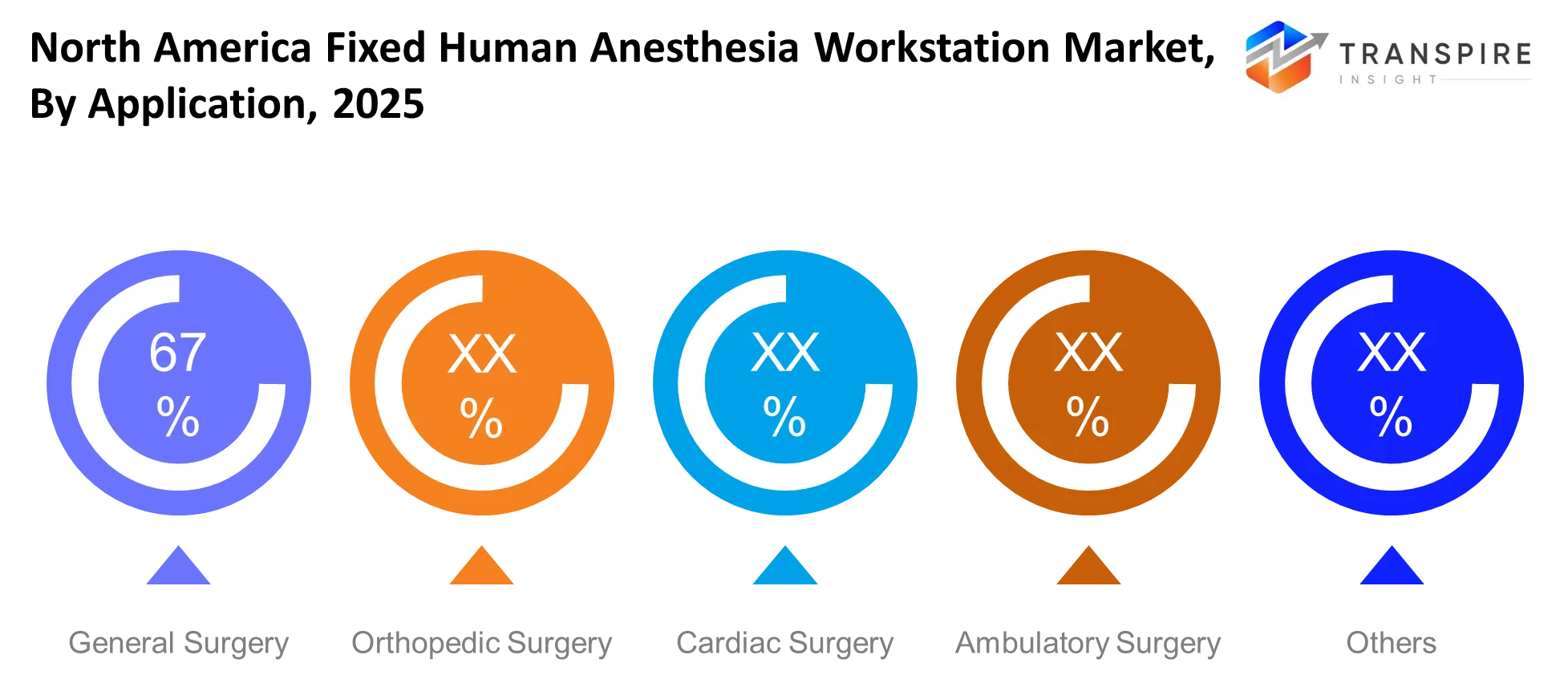
To learn more about this report, Download Free Sample Report
By End User
Hospitals lead in end user adoption, mostly because there is centralized surgical infrastructure, plus really high procedural throughput. Big health systems pour money into advanced anesthesia platforms so they can run multi specialty operating rooms while keeping critical care tightly connected. That kind of dominance is usually tied to strong capital budgets, also regulatory compliance demands , that can be non optional.
Ambulatory surgical centers come in as the fastest-growing end user group as care models keep shifting toward outpatient delivery. Specialty clinics tend to pick these systems only when they need them, aiming for compact solutions that stay cost efficient for specific kinds of procedures. Through the forecast period, ASC demand is expected to speed up equipment standardization, which basically nudges manufacturers toward lower-cost high-efficiency workstation concepts, designed for swift patient turnover.
By Technology
Digital monitoring systems sit in the leading position, because hospitals want real-time patient data connected across surgical settings. These tools help perioperative decisions by collecting key parameters into one consolidated dashboard. Gas monitoring systems still matter a lot too, mainly due to strict rules around anesthetic agent control, plus environmental safety compliance.
AI-enabled systems are the fastest-growing technology segment, since predictive algorithms can support anesthesia depth control and also help with maintenance forecasting. Uptake is mostly seen in advanced hospitals that already have strong digital infrastructure in place. Over time, AI use will steer procurement toward software-driven platforms, and that raises value capture for manufacturers who provide cloud-connected anesthesia ecosystems, along with lifecycle analytics tooling.
What are the Key Use Cases Driving the North America Fixed Human Anesthesia Workstation Market?
Demand for fixed anesthesia workstations in North America is mostly pushed by hospital operating rooms doing cardiac, orthopedic, and neurosurgical cases, where exact medication delivery and nonstop monitoring are, in a practical sense, crucial for patient safety, regulatory compliance , and smoother surgical workflows.
The expanding footprint is also noticeable in ambulatory surgical centers, and outpatient clinics, where anesthesia workstations help manage gastroenterology and ophthalmology procedures. More adoption is showing up in hospital endoscopy suites and emergency departments too, because clinicians need rapid induction, steady ventilation, and that stable setup for short interventions use.
Newer directions are coming from AI assisted anesthesia delivery, closed loop drug systems, and perioperative analytics aimed at real time dosing optimization. Digitally connected operating rooms are further changing things, by allowing remote observation and data driven anesthesia management across networks, hospital systems, and integration programs.
|
Report Metrics |
Details |
|
Market size value in 2025 |
USD1.71 Billion |
|
Market size value in 2026 |
USD 1.84 Billion |
|
Revenue forecast in 2033 |
USD 3.10 Billion |
|
Growth rate |
CAGR of 7.74% from 2026 to 2033 |
|
Base year |
2025 |
|
Historical data |
2021 - 2024 |
|
Forecast period |
2026 - 2033 |
|
Report coverage |
Revenue forecast, competitive landscape, growth factors, and trends |
|
Regional scope |
North America (Canada, The United States, and Mexico) |
|
Key company profiled |
GE HealthCare, Dräger, Medtronic, Mindray, Philips Healthcare, Smiths Medical, Penlon, Spacelabs Healthcare, Dameca, Heyer Medical, Becton Dickinson, Nihon Kohden, Shenzhen Comen, Heal Force, Infinium Medical |
|
Customization scope |
Free report customization (country, regional & segment scope). Avail customized purchase options to meet your exact research needs. |
|
Report Segmentation |
By Product Type (Integrated Anesthesia Workstations, Modular Workstations, Compact Workstations, Others); By Application (General Surgery, Orthopedic Surgery, Cardiac Surgery, Ambulatory Surgery, Others); By End User (Hospitals, Ambulatory Surgical Centers, Specialty Clinics, Others); By Technology (Digital Monitoring Systems, AI-enabled Systems, Gas Monitoring Systems, Others) |
Which Regions are Driving the North America Fixed Human Anesthesia Workstation Market Growth?
North America stays, kinda the top region still, pushed by strict regulatory enforcement , upgraded maritime safety practices , and ports that are pretty well developed across the big coastal hubs. Its lead is also reinforced by a massive commercial fleet and, frankly, the kind of compliance expectations that keep forcing equipment and technology improvements on a steady basis. Add integrated logistics networks, plus strong coordination between ports, shipping operators and regulatory bodies, and you get better day to day operational efficiency. This kind of mature ecosystem then supports steady demand , and it also helps keep long term market stability.
Europe comes next, more of a steady and mature contributor, mainly supported by strict environmental regulations and shipping finance systems that are already well in place. But unlike North America where the whole thing leans on infrastructure, Europe’s advantage feels more like consistent policy rollouts for emissions control, paired with ongoing capital from shipowners for fleet retrofitting. The major shipping lanes , together with diversified trade relationships, help keep demand fairly predictable even when the economy wobbles. That regulatory and financial toughness keeps Europe acting as a dependable revenue source for the market.
Asia-Pacific is the one that’s growing the quickest, driven by rapid port expansion, increasing shipbuilding capacity, and fleet modernization programs on large scale terms. Newer infrastructure spending, plus tighter connection to global trade corridors, has already boosted shipping activity in several key economies. At the same time, governments are tightening compliance frameworks while still expanding maritime capacity, so it becomes like a double push , growth plus upgrades. For new market participants and investors, this momentum is basically a signal for strong expansion opportunities between 2026 and 2033, especially in high volume trade hubs.
Who are the Key Players in the North America Fixed Human Anesthesia Workstation Market and How Do They Compete?
North America fixed human anesthesia workstation market is kind of moderately consolidated, basically run by a small set of global medical device manufacturers. The contest, I mean the whole vibe of it, usually goes around service contracts, making sure the system talks well with hospital systems, and yes regulatory compliance too. The existing companies try to hold their share via continuous upgrades, and also by leaning on support networks , while newer players come in with lower-cost digital systems and more flexible procurement terms.
GE HealthCare stands out with Carestation anesthesia platforms , they integrate monitoring and hospital data systems so perioperative workflow feels faster and smoother. Dräger is more about precision ventilation engineering and safety-first design, it’s already broadly used in high-acuity places and academic surgical centers, mainly where clinical training support is strong. Mindray tends to compete with cost-efficient A7 and A9 anesthesia systems, and it is growing in North America via distributor partnerships , plus value-based hospital procurement contracts.
Fresenius Kabi competes with its Leon anesthesia workstation, focusing on cost efficiency and also bundled perioperative consumables, which helps lower procurement hassle. It often targets mid-sized hospitals looking for lower capital cost anesthesia delivery systems. Getinge also works on integration, it links anesthesia workstations with operating room and ICU workflow systems, especially in hybrid surgical suites. Their growth is helped by hospital system contracts and cross-selling across surgical and critical care portfolios, so it’s sort of everything together.
Company List
- GE HealthCare
- Dräger
- Medtronic
- Mindray
- Philips Healthcare
- Smiths Medical
- Penlon
- Spacelabs Healthcare
- Dameca
- Heyer Medical
- Becton Dickinson
- Nihon Kohden
- Shenzhen Comen
- Heal Force
- Infinium Medical
Recent Development News
“In June 2024, GE HealthCare announced FDA clearance and U.S. launch expansion of its Carestation™ 750 anesthesia delivery system updates. The update strengthened GE’s fixed anesthesia workstation portfolio by improving digital integration and ventilation performance, supporting continued hospital adoption of integrated operating room anesthesia systems in North America.https://www.gehealthcare.com/ (GE HealthCare)”
“In 2024, Dräger announced expanded availability of the Perseus® A500 anesthesia workstation enhancements in North America, focusing on advanced ventilation modes and improved digital anesthesia workflow integration. The development reinforced Dräger’s competitive positioning in high-end fixed anesthesia workstation installations across U.S. hospitals and surgical centers.https://www.draeger.com/en-us_us/Home (Dräger)”
What Strategic Insights Define the Future of the North America Fixed Human Anesthesia Workstation Market?
North America fixed human anesthesia workstation market is kinda moving, toward digitally integrated, data-led perioperative ecosystems, where anesthesia delivery gets tied up with hospital information systems and real time clinical analytics. And well, this shift is being pushed by rising surgical volumes, staffing strain inside operating rooms, and the need for better procedural velocity with less clinical misstep.
There is also a quieter risk, procurement centralization across big hospital networks, which can squeeze vendor margins and make organizations way more dependent on long term bundled contracts. Meanwhile, a rapid overlap between anesthesia workstations and the wider operating room platforms could lower demand for standalone equipment, if software-led anesthesia management starts taking over some of the hardware role.
Still, there is an emerging opening here: adoption of closed loop anesthesia delivery systems, powered by AI assisted dosing algorithms especially in high throughput ambulatory surgical centers. Vendors that jump early into validated clinical decision support and regulatory cleared automation might end up with a kind of long lasting edge. Market players should lean on software interoperability and value tied to outcomes, not only hardware differentiation.
North America Fixed Human Anesthesia Workstation Market Report Segmentation
By Product Type
- Integrated Anesthesia Workstations
- Modular Workstations
- Compact Workstations
- Others
By Application
- General Surgery
- Orthopedic Surgery
- Cardiac Surgery
- Ambulatory Surgery
- Others
By End User
- Hospitals
- Ambulatory Surgical Centers
- Specialty Clinics
- Others
By Technology
- Digital Monitoring Systems
- AI-enabled Systems
- Gas Monitoring Systems
- Others
Frequently Asked Questions
Find quick answers to common questions.
The North America Fixed Human Anesthesia Workstation Market size is USD 3.10 Billion in 2033.
Key segments for the North America Fixed Human Anesthesia Workstation Market are By Product Type (Integrated Anesthesia Workstations, Modular Workstations, Compact Workstations, Others); By Application (General Surgery, Orthopedic Surgery, Cardiac Surgery, Ambulatory Surgery, Others); By End User (Hospitals, Ambulatory Surgical Centers, Specialty Clinics, Others); By Technology (Digital Monitoring Systems, AI-enabled Systems, Gas Monitoring Systems, Others).
Major North America Fixed Human Anesthesia Workstation Market players are GE HealthCare, Dräger, Medtronic, Mindray, Philips Healthcare, Smiths Medical, Penlon, Spacelabs Healthcare, Dameca, Heyer Medical, Becton Dickinson, Nihon Kohden, Shenzhen Comen, Heal Force, Infinium Medical
The Current North America Fixed Human Anesthesia Workstation Market size is USD1.71 Billion in 2025.
The North America Fixed Human Anesthesia Workstation Market CAGR is 7.74% from 2026 to 2033.
- GE HealthCare
- Dräger
- Medtronic
- Mindray
- Philips Healthcare
- Smiths Medical
- Penlon
- Spacelabs Healthcare
- Dameca
- Heyer Medical
- Becton Dickinson
- Nihon Kohden
- Shenzhen Comen
- Heal Force
- Infinium Medical
About the Authors

Pankaj Ghogare Patil
I am Pankaj Ghogare Patil, a Senior Research Analyst at Transpire Insight, specializing in the Pharmaceutical, Chemicals & Materials, Healthcare IT, and Biotechnology industry. My expertise lies in conducting comprehensive market research, analyzing industry trends, evaluating competitive landscapes, and translating complex data into actionable insights. At Transpire Insight, I closely follow emerging technologies, regulatory developments, and market innovations to create accurate, well-researched, and informative content that helps businesses and professionals make informed decisions. I am committed to producing credible, evidence-based articles that reflect industry best practices while making technical topics accessible and valuable for a broad audience.

Chakradhar Khansole
Chakradhar serves as the Research Director at Transpire Insight, bringing over 8 years of experience in technology, innovation, and strategic market intelligence. He specializes in transforming complex market data into actionable business insights that enable organizations to make informed, growth-oriented decisions. Recognized for his strategic vision and analytical expertise, Chakradhar leads high-impact research initiatives, delivering comprehensive market assessments, competitive intelligence, and forward-looking industry analysis.
Recently Published Reports
-
Jul 2026
Alopecia Treatment Market
Alopecia Treatment Market Size, Share & Analysis Report By Disease Type (Alopecia Areata, Cicatricial Alopecia, Traction Alopecia, Alopecia Totalis, Androgenetic Alopecia, Alopecia Universalis, and Other Disease Types), By Treatment Type (Topical Treatments, Oral Medications, Injectable Therapies, and Hair Transplantation), By Gender (Male, and Female), By Distribution Channel (Hospitals and Clinics, Retail Pharmacies, and Online Retailers), and Geography (North America, Europe, Asia-Pacific, Middle East and Africa, South and Central America), 2021 - 2031
-
Jul 2026
Medical Ultrasound Probe Market
Medical Ultrasound Probe Market Size, Share & Analysis Report By Type (Linear Type, Convex Type, Endocavitary Probe, Phased Array/Cardiac Probe, Transesophageal (TEE) Probe, and Others), By Application (Ophthalmology, Cardiology, Musculoskeletal, Oncology, Obstetrics & Gynecology, General Imaging, and Others), By End User (Hospitals & Clinics, Diagnostic Centers, Ambulatory Surgical Centers, and Others), and Geography (North America, Europe, Asia-Pacific, Middle East and Africa, South and Central America), 2021 – 2031
-
May 2026
Biosimilars Market
Biosimilars Market By Product Type (Monoclonal Antibodies, Recombinant Hormones, Erythropoietin, G-CSF, Others), By Indication (Oncology, Autoimmune Diseases, Blood Disorders, Diabetes, Others), By Manufacturing Type (In-House Manufacturing, Contract Manufacturing), By Distribution Channel (Hospital Pharmacies, Retail Pharmacies, Online Pharmacies), By Industry Analysis, Size, Share, Growth, Trends, and Forecasts 2021-2033
-
Apr 2026
Gastrointestinal Endoscopy Market
Gastrointestinal Endoscopy Market By Type (Rigid Gastrointestinal Endoscope, Flexible Gastrointestinal Endoscopes, Disposable Gastrointestinal Endoscope), By Procedure Type (Colonoscopy, Gastroscopy, Duodenoscopy, Enteroscopy, Flexible Sigmoidoscopy, Others), By Application (Diagnosis, Treatment), By End-Users (Hospitals, Ambulatory Surgical Centers, Specialty Clinics, Laboratories, Others), By Industry Analysis, Size, Share, Growth, Trends, and Forecasts 2021-2033