

United Kingdom Ambulatory Surgery Centers Market Size & Forecast:
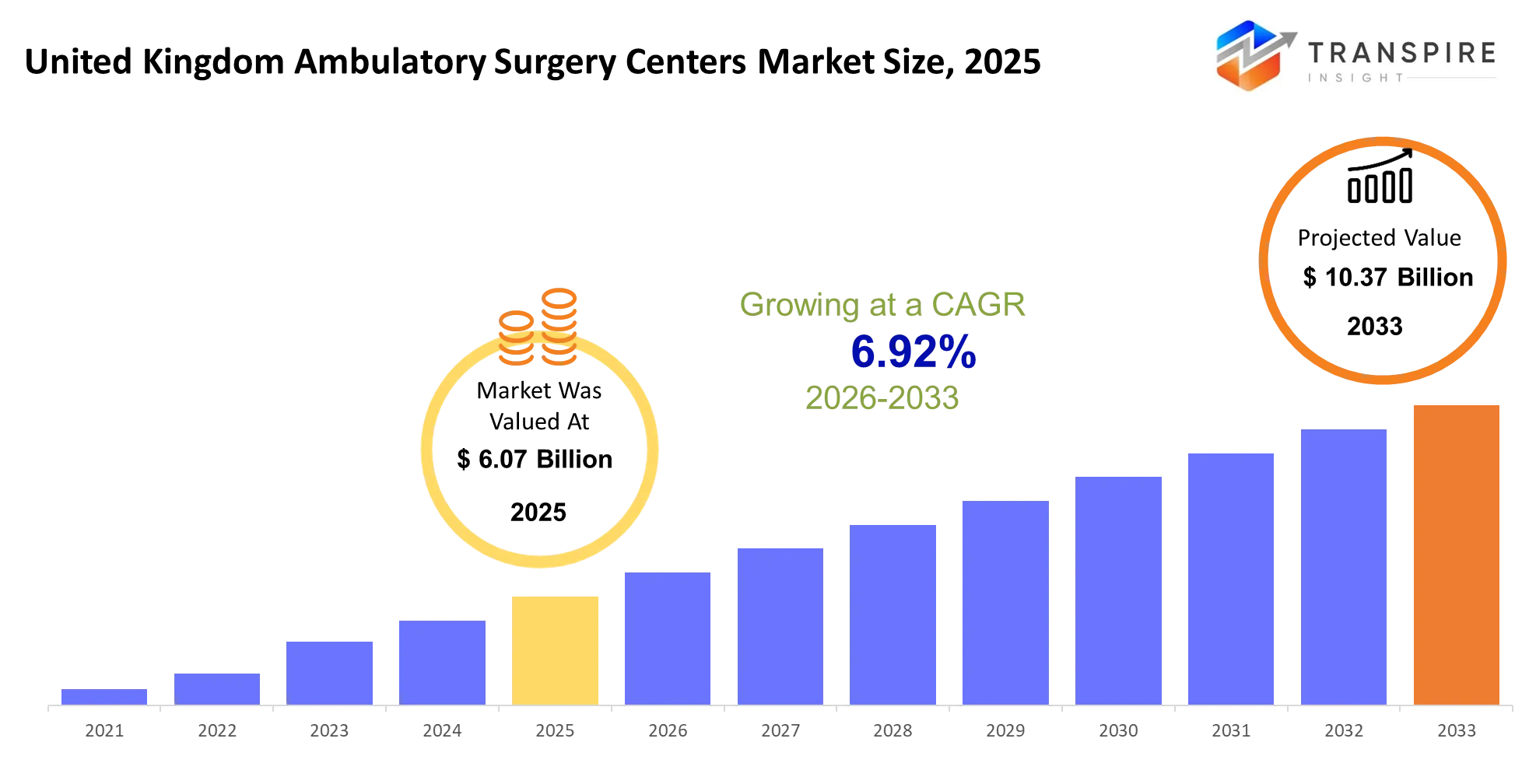
- United Kingdom Ambulatory Surgery Centers Market Size 2025: USD 6.07 Billion
- United Kingdom Ambulatory Surgery Centers Market Size 2033: USD 10.37 Billion
- United Kingdom Ambulatory Surgery Centers Market CAGR: 6.92%
- United Kingdom Ambulatory Surgery Centers Market Segments: By Specialty (Orthopedic Surgery, Ophthalmology Surgery, Gastroenterology Procedures, Pain Management, Cosmetic Surgery, ENT Procedures, Urology Procedures, Others); By Ownership (Hospital-owned ASCs, Physician-owned ASCs, Corporate-owned ASCs, Joint Venture ASCs, Others); By Application (Same-day Surgical Procedures, Diagnostic Procedures, Minimally Invasive Surgeries, Preventive Care, Others); By Facility Type (Single-specialty Centers, Multi-specialty Centers, Standalone Centers, Others)
To learn more about this report,  Download Free Sample Report
United Kingdom Ambulatory Surgery Centers Market Summary
The United Kingdom Ambulatory Surgery Centers Market was valued at USD 6.07 Billionin 2025. It is forecast to reach USD 10.37 Billion by 2033. That is a CAGR of 6.92% over the period.
In practice, ambulatory surgery centers in the United Kingdom kinda work like high-efficiency outpatient surgical hubs, where they move the right kinds of procedures away from overcrowded NHS hospitals and into dedicated same-day care settings. This helps lessen the inpatient load, because elective operations like orthopedics, ophthalmology, and gastroenterology get handled with quicker turnaround and more standardized clinical pathways. Over the last 3–5 years, the market has been shifting in a more structural way toward digitized perioperative workflows, with electronic patient scheduling and outcome tracking systems that give better throughput visibility. One big trigger that really accelerated this shift was the post-pandemic surgical backlog,which basically pushed both public and private providers to outsource elective procedures to independent centers, just to regain capacity. That reallocation of surgical volume has then improved utilization rates and revenue stability for the operators in a pretty direct way. So now investment has leaned toward scalable outpatient infrastructure that emphasizes cost efficiency, shorter recovery cycles, and more predictable procedural scheduling across integrated care networks.
Key Market Insights
- The United Kingdom Ambulatory Surgery Centers Market is steadily moving elective procedures into outpatient hubs, which in a way, cuts down NHS inpatient pressure a lot, after the 2023 reform acceleration. And yeah, it feels like this is happening faster than before.
- Now, private providers grab more than 40% of elective orthopaedic outpatient volumes, which helps the United Kingdom Ambulatory Surgery Centers Market strengthen its position in those higher value procedures.
- Southern England still leads, with close to 45% share, mainly because there are so many hospital networks and the private healthcare infrastructure is heavily concentrated there by 2025.
- London stays the quickest growth cluster with double digit expansion, largely tied to premium private surgical demand and specialist consultant availability.
- For the clinical side, orthopaedics sits at the front with roughly 30% procedural share, driven by an ageing population and also rising sports injury cases across the UK.
- Ophthalmology comes in as the second largest segment, supported by cataract surgery demand, plus same day discharge protocols that are moving quickly.
- Gastrointestinal procedures are the fastest growing slice too, as minimally invasive endoscopy adoption keeps widening.
- When you look at end users, private hospitals remain the leading category, and they account for over 55% of ambulatory surgical volumes.
- At the same time, NHS outsourcing partnerships are expanding rapidly—this helps improve capacity utilisation, and it tends to reduce elective waiting times.
- Key players like Spire Healthcare, Nuffield Health, HCA Healthcare, Tenet Healthcare, and Ramsay Health Care are pushing ahead through facility upgrades, NHS collaboration, and also digital surgery pathway integration.
What are the Key Drivers, Restraints, and Opportunities in the United Kingdom Ambulatory Surgery Centers Market?
The main engine of the United Kingdom Ambulatory Surgery Centers Market is really the ongoing push to cut NHS elective care backlogs, which got stronger after the pandemic, disrupted the surgery calendar, kind of overall. So health authorities and insurers, they start redirecting eligible procedures toward outpatient surgical centers that can turn cases around quicker and at lower costs per patient. Also the big move toward day case surgery models, backed by minimally invasive techniques, has helped patient flow, and it makes ambulatory care feel more profitable for both public and private operators. Because of that, revenue growth is now more connected to optimizing procedure volume, rather than adding inpatient beds.
One notable brake is the limited capacity expansion, and it’s tied to who’s actually available in the operating room workforce , especially anesthetists and specialist nurses. This is more of a structural snag since the training pipelines inside the UK healthcare system can’t react fast to sudden surges in demand. So even if the physical setup is there, you still get long lasting pinch points. That, in turn, holds back scaling efficiency and slows down full utilization of these ambulatory centers, and it reduces the amount of revenue that can really be realized.
A more recent opportunity shows up in hybrid public-private surgical outsourcing frameworks, where NHS trusts pay for dedicated ambulatory capacity from private providers. Early movement in places like Greater London and the Midlands suggests that more integrated scheduling tools, can reduce waiting lists quite a bit, and at the same time improve asset utilization for the service operators.
What Has the Impact of Artificial Intelligence Been on the United Kingdom Ambulatory Surgery Centers Market?
Artificial intelligence is kind of reshaping of operational efficiency inside United Kingdom ambulatory surgery centers , mostly by making scheduling more precise , coordinating surgical flow better , and also helping with post-operative monitoring in a smoother way. AI-driven scheduling systems are getting used more and more to improve operating theatre utilization, sort of aligning surgeon availability, patient readiness , and procedure complexity so there is less idle time and more overall throughput. Predictive analytics models are also showing up to estimate surgical demand patterns, which in turn supports smarter staffing assignment and resource planning across outpatient facilities.
In day to day clinical operations, machine learning tools back pre-operative risk sorting by reviewing patient history and flagging potential complications , which improves safety and reduces those last-minute cancellations that nobody wants. Some advanced centers are using AI-enabled monitoring systems to follow recovery indicators and anticipate readmission risk , this can help lower post-surgical complications and make discharge planning more efficient. Altogether these uses seem to support measurable improvements, like better operating room utilization and a reduction in cost per procedure.
Still, there is a big limitation: the integration costs are high, and the data setup is fragmented across NHS linked and private providers. When electronic health record systems are inconsistent, model accuracy drops , and real-time interoperability is limited, so broad AI deployment slows down even if pilot results look strong.
Key Market Trends
- Surgeons are starting to favor ambulatory settings more and more, and they’ve been moving about 25–35% of elective procedures away from inpatient hospitals since 2023 .
- At the same time, digital theatre management systems are cutting operating room idle time by roughly 20% across some leading UK private centers , so that the downtime isn’t sitting there as much .
- Also, NHS outsourcing of elective surgeries to private centers really took off after the 2024 backlog recovery initiatives , it seemed like a notable jump right after that .
- Spire Healthcare, for instance , boosted same-day surgical capacity across multiple UK regions in 2025 , mainly via facility upgrades that were planned and rolled out pretty quickly .
- If you look at what’s actually driving most of the movement, cataract and orthopedic outpatient procedures make up the bulk of the high-volume surgical demand shifts, almost like the main stream .
- Private insurers are also pushing ambulatory care pathways more often , partly to reduce claim costs , and partly because they’re also chasing quicker recovery times .
- London-based surgical hubs have been expanding capacity faster than the national average , likely because of specialist concentration there , you see the clustering effect .
- And AI-enabled scheduling tools are improving theatre utilization efficiency across major private providers by as much as 15% , depending on how the sites implement things .
- Multispecialty ambulatory centers are gradually replacing single-specialty clinics , especially since demand for integrated care keeps rising and people want it all in one place .
- Lastly , the regulatory focus on shorter patient recovery time is speeding up adoption of minimally invasive surgical techniques, so surgeons have more incentive to lean that direction .
United Kingdom Ambulatory Surgery Centers Market Segmentation
By Specialty
Orthopedic Surgery sort of holds the dominant position because there are consistently high procedure volumes tied to joint replacements, sports injuries, and age related musculoskeletal problems. The NHS referral pipelines are strong, and private insurance coverage keeps the patient inflow steady, so orthopedic procedures become the main revenue driver across outpatient surgical networks. Ophthalmology Surgery is in second place, mainly from frequent cataract operations and standardized surgical protocols that make rapid same day discharge possible. ENT and Urology Procedures keep relatively stable shares since minimally invasive techniques help, and recovery tends to follow pretty predictable pathways. Cosmetic Surgery, though it exists there, stays more demand sensitive and it depends a lot on discretionary spending patterns
Looking ahead Orthopedic Surgery is expected to keep leading because aging demographics and mobility related conditions keep expanding overall procedure demand. Ophthalmology Surgery should grow faster as technology keeps improving laser assisted approaches, and as surgical efficiency increases. Gastroenterology Procedures are likely to build extra momentum from diagnostic endoscopic convergence, which reduces how much they rely on traditional hospital dependence. Market participants are expected to invest in high throughput surgical systems , and also in specialized clinical teams, so they can support efficiency driven outpatient expansion across services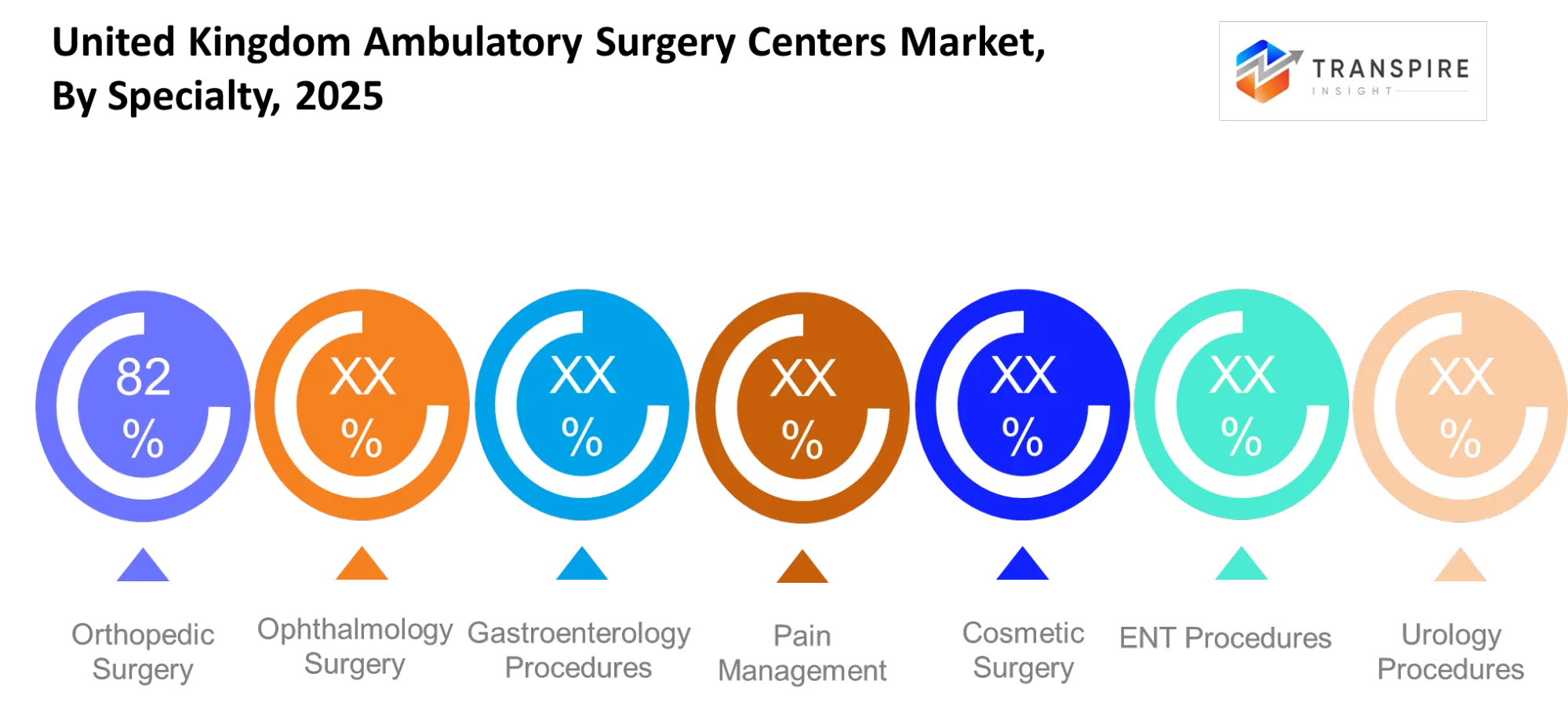
To learn more about this report, Download Free Sample Report
By Ownership
Hospital-owned ASCs kind of hold the lead, mainly because there’s already clinical infrastructure in place,plus they have those connected referral pathways and a good alignment with NHS commissioning routes. On top of that they can lean on direct access to hospital specialists, and they share diagnostic tools too,so day to day usage tends to be higher. Physician-owned ASCs come in next, still the second-largest, because they tend to move with more operational wiggle room and quicker approvals when elective procedures get scheduled. Corporate-owned ASCs are growing at a steady clip as they use consolidation tactics and standardized care approaches, which is meant to support better cost efficiency across several locations
For the future, hospital-owned ASCs are likely to keep their top position as health systems push harder for integrated care delivery and more efficient use of resources. Physician-owned ASCs are expected to expand gradually too, partly because more surgeons are joining outpatient ownership arrangements,and because revenue-sharing incentives make participation feel more worthwhile. Joint Venture ASCs may speed up growth as public–private collaboration structures keep strengthening across elective services. Investors, meanwhile, are anticipated to concentrate on ownership models that are scalable, and that still balance clinical oversight with operational smoothness.
By Application
Same-day Surgical Procedures sort of hold the dominant position, with healthcare systems pushing rapid discharge models to reduce in-patient burden,and also to speed up surgical throughput. A lot of the adoption is being helped by minimally invasive techniques and pretty standardized post-operative care routes, even if the exact pathway can vary. Minimally Invasive Surgeries seem to hold onto that second largest spot, since the recovery time is shorter and the complication exposure risk stays lower, so it matches outpatient environments pretty well. Diagnostic Procedures are moving up too, step by step, because endoscopy and image guided interventions increasingly lean toward ambulatory setups, maybe even by default in some hospitals.
Same day Surgical Procedures should stay the primary growth driver, especially while capacity optimization becomes a real piece of how care is organized. Minimally Invasive Surgeries are expected to grow the fastest, partly because surgical robotics keep improving and precision instruments keep getting more refined. Preventive Care applications are also inching into greater relevance, given that early intervention approaches can reduce the need for longer-term treatment spending, overall. For what comes next, development will likely focus on integrated procedural pathways that blend diagnosis, intervention, and recuperation into a single outpatient workflow, as if everything happens in a single coordinated flow.
By Facility Type
Single-specialty Centers basically hold the dominant position, because they have focused expertise, smoother operations, and higher procedural efficiency in particular surgical areas like orthopedics or ophthalmology. In practice, these centers get strong utilization rates by using standardized workflows, and also specialized clinical staffing models, which tends to make everything feel more predictable.
Multi-specialty Centers sit in the second-largest position, kind of by default , since they provide diversified service offerings. That usually pulls in a wider set of patients and builds stronger referral networks. Standalone Centers keep moving outward too, especially in regions where hospital access is limited or where private healthcare demand stays high.
Single-specialty Centers are expected to stay on top as the need for high-efficiency surgical units keeps increasing. Multi-specialty Centers are projected to grow faster, mainly due to the rising preference for integrated care delivery, all within one facility. Standalone Centers are likely to expand in suburban and semi-urban zones where outpatient infrastructure is still catching up. Market participants are expected to emphasize modular facility design and scalable infrastructure so they can support flexible expansion strategies later on, without too much disruption.
What are the Key Use Cases Driving the United Kingdom Ambulatory Surgery Centers Market?
In the United Kingdom Ambulatory Surgery Centers Market, the main use case is basically same day elective surgery for orthopaedics and ophthalmology, where you get predictable procedures so patients can turn over quickly , and the whole idea helps cut down hospital congestion. They tend to create the biggest demand because it matches NHS backlog reduction goals and also fits the private insurer cost control models.
On top of that, the expanding applications are things like gastrointestinal endoscopy, and also mixed diagnostic-intervention cases , which are being used more and more by private hospital groups and specialist clinics that want better procedural throughput. This is picking up because minimally invasive methods keep recovery shorter, and they make discharge cycles faster , or at least smoother.
Then there are emerging use cases such as more complex pain management procedures, along with robotic assisted minor surgeries. These are being supported by newer surgical technologies and improvements in outpatient anesthesia, so the setup keeps getting more workable. They are still in the scaling phase, but the outlook seems solid as clinical confidence grows and the local infrastructure becomes more mature.
|
Report Metrics |
Details |
|
Market size value in 2025 |
USD 6.07 Billion |
|
Market size value in 2026 |
USD 6.49 Billion |
|
Revenue forecast in 2033 |
USD 10.37 Billion |
|
Growth rate |
CAGR of 6.92% from 2026 to 2033 |
|
Base year |
2025 |
|
Historical data |
2021 - 2024 |
|
Forecast period |
2026 - 2033 |
|
Report coverage |
Revenue forecast, competitive landscape, growth factors, and trends |
|
Regional scope |
United Kingdom |
|
Key company profiled |
Surgery Partners, HCA Healthcare, Tenet Healthcare, Ramsay Health Care, Spire Healthcare, Nuffield Health, Circle Health, AmSurg, USPI, Aspen Healthcare, Vanguard, Practice Plus, BMI Healthcare, Mediclinic, Healthway |
|
Customization scope |
Free report customization (country, regional & segment scope). Avail customized purchase options to meet your exact research needs. |
|
Report Segmentation |
By Speciality (Orthopedic Surgery, Ophthalmology Surgery, Gastroenterology Procedures, Pain Management, Cosmetic Surgery, ENT Procedures, Urology Procedures, Others); By Ownership (Hospital-owned ASCs, Physician-owned ASCs, Corporate-owned ASCs, Joint Venture ASCs, Others); By Application (Same-day Surgical Procedures, Diagnostic Procedures, Minimally Invasive Surgeries, Preventive Care, Others); By Facility Type (Single-specialty Centers, Multi-specialty Centers, Standalone Centers, Others) |
Which Regions are Driving the United Kingdom Ambulatory Surgery Centers Market Growth?
Southern England, in a sort of natural way, is leading the United Kingdom Ambulatory Surgery Centers Market, mostly because it has a dense concentration of private hospitals, plus a pretty strong advanced diagnostic infrastructure, and also solid referral ties between the NHS and private providers. In practice, you achieve high patient throughput, and the proximity to leading surgical consultants really helps keep procedure volumes consistent. On top of that, there’s alignment with elective care outsourcing frameworks, and that extra policy fit makes it even harder to shift dominance. You can also point to established healthcare clusters around cities like London and Oxford, which kind of lock in long-term capacity stability over time.
The Midlands is more of a steady, structurally resilient player rather than a premium specialization hotspot. Compared with the South, it leans more on NHS collaboration agreements and on regional hospital partnerships to keep surgical volumes moving. Its movement is tied to consistent infrastructure expansion, and demand stays moderate but stable across general surgery and orthopaedics. So overall, it feels like a reliable revenue base, not exactly a high-growth cluster, though it does keep performing.
Scotland is growing the fastest, largely because it’s receiving targeted investment in elective care recovery programs and in the development of new outpatient surgical facilities. Lately, healthcare modernization initiatives have improved theatre capacity and reduced waiting lists in a noticeable way. That change is pulling in private operators who want expansion openings , especially beyond the more saturated southern markets. So Scotland is becoming a strategic entry point for long-term growth through 2033.
Who are the Key Players in the United Kingdom Ambulatory Surgery Centers Market and How Do They Compete?
The United Kingdom Ambulatory Surgery Centers Market is kinda moderately consolidated, with big private hospital groups usually taking most of the procedural volumes while the smaller specialist centers kind of hustle, competing via focused know-how and localized service delivery. You could say competition is driven mostly by cost efficiency, surgeon availability, and access to NHS referral pipelines, not just “pricing”, if we’re being honest. And operators are increasingly standing apart by using integrated care pathways and digital surgical management systems, as if they really want smoother end-to-end coordination.
HCA Healthcare maintains a strong standing, mainly because it has high-acuity surgical capabilities and premium facility infrastructure. They tend to target complex outpatient procedures where advanced clinical support is a must, not just “nice to have”. Spire Healthcare competes with wide geographic coverage and NHS partnership agreements, which helps keep elective procedure inflows steadier. Nuffield Health does things a bit differently by integrating preventive healthcare with surgical services, so they can improve patient loyalty throughout the entire care journey, not just at the moment of surgery.
Ramsay Health Care grows by acquisitions and by modernizing facilities, which reinforces its outpatient surgical presence across several UK regions. Tenet Healthcare leans on operational efficiency models and ambulatory specialization approaches in order to scale procedural throughput, especially within partnership based care structures.
Company List
- Surgery Partners
- HCA Healthcare
- Tenet Healthcare
- Ramsay Health Care
- Spire Healthcare
- Nuffield Health
- Circle Health
- AmSurg
- USPI
- Aspen Healthcare
- Vanguard
- Practice Plus
- BMI Healthcare
- Mediclinic
- Healthway
Recent Development News
In June 2025, Smith+Nephew and Standard Health entered a strategic partnership to develop the UK’s first Orthopaedic Ambulatory Surgery Centre in Poole, Dorset. The initiative introduces a dedicated outpatient orthopaedic hub for joint repair and replacement procedures, strengthening same-day surgery capacity and easing NHS elective backlogs through expanded private-NHS collaboration.http://www.smith-nephew.com
In October 2025, Narayana Health announced the acquisition of Practice Plus Group Hospitals from Bridgepoint Group. The deal expands its entry into the UK outpatient and elective care ecosystem, increasing ambulatory surgical capacity and strengthening cost-efficient surgery delivery across NHS-commissioned and private patient pathways.https://www.economictimes.indiatimes.com
In May 2026, Toscafund Asset Management proposed a £1 billion acquisition of Spire Healthcare, the UK’s largest private hospital operator. The proposed transaction, if completed, would consolidate ambulatory and elective surgical capacity under a major private operator, strengthening outpatient surgical infrastructure and accelerating NHS-private procedure outsourcing.https://www.theguardian.com
What Strategic Insights Define the Future of the United Kingdom Ambulatory Surgery Centers Market?
Over the next 5–7 years, the United Kingdom Ambulatory Surgery Centers Market is, kinda, structurally moving toward a distributed surgical ecosystem, where outpatient centers take up more and more of elective procedures away from traditional hospitals. This change is being pushed by ongoing NHS capacity limits and by the same continued demand for faster surgical turnaround times. There’s also a risk that people don’t always notice: a quiet sort of overdependence on NHS referral pipelines, which means private operators can get hit when policy-driven volume fluctuations show up if outsourcing frameworks tighten or if funding priorities shift.
At the same time, there is a pretty strong emerging opportunity in AI-enabled autonomous scheduling and robotic-assisted outpatient procedures. These tools can really improve throughput efficiency, basically making the whole workflow move more smoothly. Market participants should focus on integrated digital surgical platforms and also expand NHS-aligned partnerships so they can secure steady patient inflows while at the same time preparing for a gradual shift toward technology-driven surgical standardization.
United Kingdom Ambulatory Surgery Centers Market Report Segmentation
By Specialty
- Orthopedic Surgery
- Ophthalmology Surgery
- Gastroenterology Procedures
- Pain Management
- Cosmetic Surgery
- ENT Procedures
- Urology Procedures
- Others
By Ownership
- Hospital-owned ASCs
- Physician-owned ASCs
- Corporate-owned ASCs
- Joint Venture ASCs
- Others
By Application
- Same-day Surgical Procedures
- Diagnostic Procedures
- Minimally Invasive Surgeries
- Preventive Care
- Others
By Facility Type
- Single-specialty Centers
- Multi-specialty Centers
- Standalone Centers
- Others
Frequently Asked Questions
Find quick answers to common questions.
The Expected United Kingdom Ambulatory Surgery Centers Market size for the Market will be USD 10.37 Billion in 2033.
Key Segments for the United Kingdom Ambulatory Surgery Centers Market are By Specialty (Orthopedic Surgery, Ophthalmology Surgery, Gastroenterology Procedures, Pain Management, Cosmetic Surgery, ENT Procedures, Urology Procedures, Others); By Ownership (Hospital-owned ASCs, Physician-owned ASCs, Corporate-owned ASCs, Joint Venture ASCs, Others); By Application (Same-day Surgical Procedures, Diagnostic Procedures, Minimally Invasive Surgeries, Preventive Care, Others); By Facility Type (Single-specialty Centers, Multi-specialty Centers, Standalone Centers, Others).
Major United Kingdom Ambulatory Surgery Centers Market Players are Surgery Partners, HCA Healthcare, Tenet Healthcare, Ramsay Health Care, Spire Healthcare, Nuffield Health, Circle Health, AmSurg, USPI, Aspen Healthcare, Vanguard, Practice Plus, BMI Healthcare, Mediclinic, Healthway.
The Current United Kingdom Ambulatory Surgery Centers Market size is USD 6.07 Billion in 2025.
The United Kingdom Ambulatory Surgery Centers Market CAGR is 6.92% from 2026 to 2033.
- Surgery Partners
- HCA Healthcare
- Tenet Healthcare
- Ramsay Health Care
- Spire Healthcare
- Nuffield Health
- Circle Health
- AmSurg
- USPI
- Aspen Healthcare
- Vanguard
- Practice Plus
- BMI Healthcare
- Mediclinic
- Healthway
About the Authors

Pankaj Ghogare Patil
I am Pankaj Ghogare Patil, a Senior Research Analyst at Transpire Insight, specializing in the Pharmaceutical, Chemicals & Materials, Healthcare IT, and Biotechnology industry. My expertise lies in conducting comprehensive market research, analyzing industry trends, evaluating competitive landscapes, and translating complex data into actionable insights. At Transpire Insight, I closely follow emerging technologies, regulatory developments, and market innovations to create accurate, well-researched, and informative content that helps businesses and professionals make informed decisions. I am committed to producing credible, evidence-based articles that reflect industry best practices while making technical topics accessible and valuable for a broad audience.

Chakradhar Khansole
Chakradhar serves as the Research Director at Transpire Insight, bringing over 8 years of experience in technology, innovation, and strategic market intelligence. He specializes in transforming complex market data into actionable business insights that enable organizations to make informed, growth-oriented decisions. Recognized for his strategic vision and analytical expertise, Chakradhar leads high-impact research initiatives, delivering comprehensive market assessments, competitive intelligence, and forward-looking industry analysis.
Recently Published Reports
-
Jul 2026
Alopecia Treatment Market
Alopecia Treatment Market Size, Share & Analysis Report By Disease Type (Alopecia Areata, Cicatricial Alopecia, Traction Alopecia, Alopecia Totalis, Androgenetic Alopecia, Alopecia Universalis, and Other Disease Types), By Treatment Type (Topical Treatments, Oral Medications, Injectable Therapies, and Hair Transplantation), By Gender (Male, and Female), By Distribution Channel (Hospitals and Clinics, Retail Pharmacies, and Online Retailers), and Geography (North America, Europe, Asia-Pacific, Middle East and Africa, South and Central America), 2021 - 2031
-
Jul 2026
Medical Ultrasound Probe Market
Medical Ultrasound Probe Market Size, Share & Analysis Report By Type (Linear Type, Convex Type, Endocavitary Probe, Phased Array/Cardiac Probe, Transesophageal (TEE) Probe, and Others), By Application (Ophthalmology, Cardiology, Musculoskeletal, Oncology, Obstetrics & Gynecology, General Imaging, and Others), By End User (Hospitals & Clinics, Diagnostic Centers, Ambulatory Surgical Centers, and Others), and Geography (North America, Europe, Asia-Pacific, Middle East and Africa, South and Central America), 2021 – 2031
-
May 2026
Biosimilars Market
Biosimilars Market By Product Type (Monoclonal Antibodies, Recombinant Hormones, Erythropoietin, G-CSF, Others), By Indication (Oncology, Autoimmune Diseases, Blood Disorders, Diabetes, Others), By Manufacturing Type (In-House Manufacturing, Contract Manufacturing), By Distribution Channel (Hospital Pharmacies, Retail Pharmacies, Online Pharmacies), By Industry Analysis, Size, Share, Growth, Trends, and Forecasts 2021-2033
-
Apr 2026
Gastrointestinal Endoscopy Market
Gastrointestinal Endoscopy Market By Type (Rigid Gastrointestinal Endoscope, Flexible Gastrointestinal Endoscopes, Disposable Gastrointestinal Endoscope), By Procedure Type (Colonoscopy, Gastroscopy, Duodenoscopy, Enteroscopy, Flexible Sigmoidoscopy, Others), By Application (Diagnosis, Treatment), By End-Users (Hospitals, Ambulatory Surgical Centers, Specialty Clinics, Laboratories, Others), By Industry Analysis, Size, Share, Growth, Trends, and Forecasts 2021-2033