

North America Expectorant Drugs Market Size & Forecast:
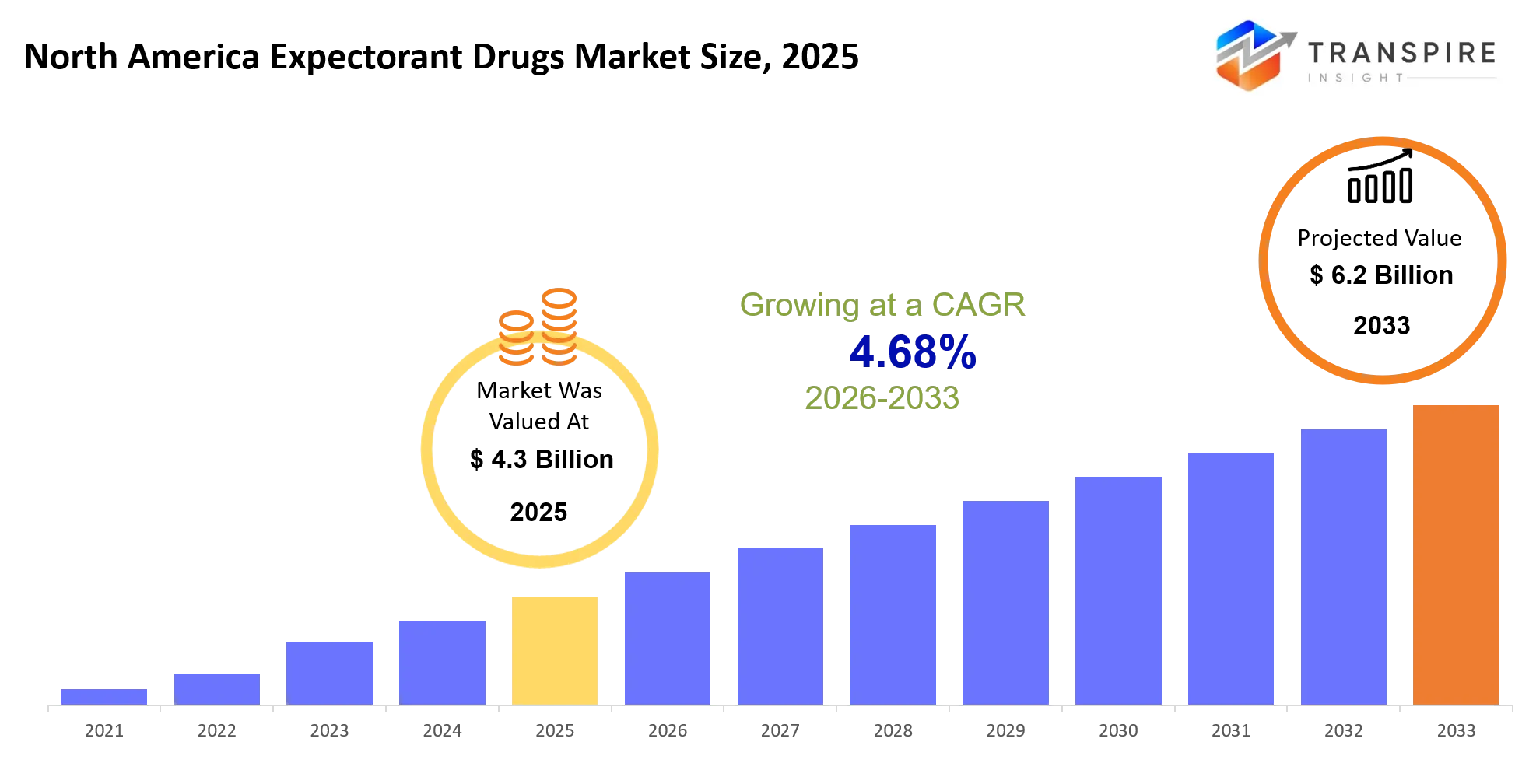
- North America Expectorant Drugs Market Size 2025: USD 4.3 Billion
- North America Expectorant Drugs Market Size 2033: USD 6.2 Billion
- North America Expectorant Drugs Market CAGR: 4.68%
- North America Expectorant Drugs Market Segments: By Drug Type (Guaifenesin-based Drugs, Bromhexine-based Drugs, Ambroxol-based Drugs, Herbal Expectorants, Others), By Application (Productive Cough, Bronchitis, COPD, Respiratory Infections, Others), By Distribution Channel (Hospital Pharmacies, Retail Pharmacies, Online Pharmacies, Others), By End User (Hospitals, Clinics, Home Care Settings, Others).
To learn more about this report,  Download Free Sample Report
North America Expectorant Drugs Market Summary:
The North America Expectorant Drugs Market size is estimated at USD 4.3 Billion in 2025 and is anticipated to reach USD 6.2 Billion by 2033, growing at a CAGR of 4.68% from 2026 to 2033. In North America, the Expectorant Drugs Market seems to play a pretty practical role in respiratory care, basically by helping patients clear mucus out of the airways so breathing feels more efficient, and so the usual complications from respiratory infections don’t spiral as much. You also see benefits tied to chronic bronchitis , chronic obstructive pulmonary disease (COPD), and seasonal respiratory illnesses. People use these products in a lot of places too, like outpatient clinics, retail pharmacies, and hospital- based treatment routes, so it becomes this important part of symptom management approaches, even when the symptoms are mild or moderate.
Over the last five years , the market has also gone through a real structural change that’s more consumer-led. There’s been more reliance on over-the-counter formulations, plus digital health guidance, and a kind of self management for milder respiratory conditions. Then COVID-19 shows up as a major trigger , it changed how healthcare gets used and it pushed more focus onto relief for respiratory symptoms. When healthcare systems encouraged home-based care for non-severe cases, the adoption of expectorant drugs grew. And that has kind of fed into broader retail distribution, better product accessibility, and more revenue room for manufacturers who concentrate on respiratory wellness, plus seasonal illness management.
Key Market Insights
- The United States kind of dominates the North America Expectorant Drugs Market, bringing in roughly 80% of the regional revenue by 2025, mainly because it has a very broad pharmaceutical distribution network that just keeps going.
- Canada sits in the second spot, largely supported by better healthcare access and the rising use of respiratory symptom management products, you know those everyday treatments people end up picking more often.
- Mexico is the fastest-growing regional market over the forecast period, pushed forward by an expanding healthcare infrastructure and easier access to OTC respiratory medications, it’s gaining momentum steadily.
- OTC expectorant drugs pretty much lead the overall market, with an estimated 65% share in 2025, helped by easy convenience and strong consumer take up.
- Prescription expectorants are still the second-largest slice, especially where chronic respiratory disease treatment is happening and clinicians are more focused on longer term management.
- Combination respiratory formulations are described as the fastest-growing segment through 2030, because manufacturers are leaning into multi-symptom relief products that target more than one issue at a time.
- Acute respiratory infections remain the dominant application segment, accounting for nearly 45% of market demand in 2025, and that number stays pretty stubborn.
- Chronic obstructive pulmonary disease, or COPD management, is emerging as the fastest-growing application too, driven by the expanding aging population and the higher prevalence of long-term lung conditions.
- Seasonal respiratory illness treatment keeps generating strong sales volumes across retail and pharmacy channels, so it does not really slow down much.
- Retail pharmacies lead the North America Expectorant Drugs Market with about 55% market share, and this is supported by the widespread availability of OTC products.
- Hospital pharmacies are the next biggest end-user segment, largely due to prescribed respiratory therapies being delivered inside hospital settings.
- Online pharmacies are the fastest-growing distribution channel through 2030, benefiting from digital healthcare adoption, along with home delivery services that people like using.
What are the Key Drivers, Restraints, and Opportunities in the North America Expectorant Drugs Market?
The most powerful factor pushing the North America Expectorant Drugs Market forward is kind of a shift toward outpatient, and this self-managed respiratory care idea. It really picked up speed after the COVID-19 pandemic, when healthcare systems tried to cut back on non-essential hospital visits, and at the same time encouraged people to handle mild respiratory symptoms at home. Retail pharmacies, plus online health platforms, expanded access to expectorant products so they’re easier for consumers to get. So in the end manufacturers have seen bigger sales volumes through over-the-counter channels, and because products are easier to access, more patients are adopting them for quick relief from cough and mucus related issues.
The biggest obstacle to market growth is the widespread presence of low cost generic formulations. This problem feels structural, because a lot of expectorant drug ingredients already have long standing regulatory approvals, and not much product differentiation happens. In practice, manufacturer s end up competing mostly on price, rather than on innovation, or so it goes. This kinda situation squeezes profit margins and makes companies, less likely to invest in new formulations. The downstream effect is slower revenue growth in mature product categories, and fewer incentives to bring in more premium respiratory therapies.
A major growth chance is the creation of combo respiratory products that blend expectorants with cough suppressants, antihistamines, or anti-inflammatory agents. More and more pharmaceutical companies are putting money into multi-symptom treatments, mostly because they simplify how patients manage their regimen and boost convenience. And as personalized consumer health keeps expanding across North America, these enhanced formulations could win higher value market segments, while also opening up brand new revenue streams for manufacturers.
What Has the Impact of Artificial Intelligence Been on the North America Expectorant Drugs Market?
Artificial intelligence and advanced digital technologies are, increasingly, reshaping the North America Expectorant Drugs Market in a way that quietly helps with drug development, supply chain management and commercial decision making. In practice, pharmaceutical manufacturers are leaning on AI driven analytics to sort of automate demand forecasting, inventory planning, and distribution control across retail pharmacies , hospitals and the e-commerce routes. These kinds of systems look at prescription signals, the seasonal rhythm of respiratory illnesses, and regional buying tendencies to keep product on shelves and reduce the chance of stockouts or shortages.
Meanwhile machine learning models are also adding stronger predictive muscle across the whole value chain. Firms apply predictive analytics to anticipate respiratory disease surges, estimate what future consumption will look like, and flag possible supply disruptions early so they don’t really hit market results. On the drug development side, AI assisted screening tools help researchers evaluate formulation candidates faster and with more consistency, which can shorten development timelines and make resource allocation feel more precise.
All of this tends to show up as operational gains you can measure, like lower inventory carrying costs, quicker replenishment cycles, improved forecast accuracy, and better product availability when peak respiratory illness season shows up. There’s also a commercial upside, since enhanced targeting supports higher sales conversion and more effective marketing spend.
Still though, one major issue stays there. The integration of fragmented healthcare and pharmacy datasets is not always seamless. A lot of organizations still run across disconnected data systems, and that can lower model accuracy, and limit the full commercial payoff of AI driven decision-making within respiratory therapeutics.
Key Market Trends
- Since 2020 , online pharmacy sales kinda took off, because more shoppers now buy respiratory medications via digital healthcare, plus those home-delivery platforms , like it’s everyday.
- Manufacturers also seemed to redirect investment away from single-ingredient products and toward combination formulations , which made use easier and helped them grab more of the respiratory treatment spending.
- Between 2021 and 2025 , retail pharmacy chains leaned harder into private-label offerings , leading to sharper price competition, and honestly it starts squeezing branded expectorant drug margins a bit.
- After the whole post-pandemic healthcare shift , people got more into self-treatment behavior, so they depended less on physician visits when symptoms were mild and manageable at home.
- Companies like Haleon and Johnson & Johnson expanded their consumer health portfolios too, to match changing preferences in respiratory care, not just the old playbook.
- From 2020 to 2022 , supply chain disruptions pushed manufacturers to diversify sourcing, and they also boosted inventory resilience for the really critical active ingredients , so they wouldn’t get stuck.
- After 2021, data-driven demand forecasting became more normal, and it gave pharmaceutical companies a better way to align output with seasonal respiratory illness trends.
- Sugar-free and alcohol-free options, plus more patient-friendly formulations , started showing up more prominently in the market, as manufacturers tried to reach a wider crowd, including health-conscious demographic groups.
- Regulatory scrutiny around product labeling and ingredient transparency also increased, so firms strengthened compliance processes and tightened up how they communicate with consumers.
- And overall, competitive differentiation moved away from brand recognition only, toward formulation innovation, digital engagement, and omnichannel distribution abilities across North America, not just simple shelf presence .
North America Expectorant Drugs Market Segmentation
By Drug Type
In terms of drug type, guaifenesin-based products seem to hold the leading place, mostly because physicians have been using them for years, they’re widely found over the counter, and they work well for mucus buildup that comes with everyday respiratory issues. Bromhexine-based and ambroxol-based medicines still sit in those key spots too, especially when treatment relies more on prescriptions, or when chronic respiratory care is involved. At the same time herbal expectorants have been getting noticed, since lots of consumers are looking toward plant-derived options and they think these are gentler or offer added wellness value.
Beyond that, there are other formulations that keep showing up for very specific needs but they make up a smaller slice of total sales. Demand is shifting more and more toward combination products, the kind that mix expectorant action with cough calming, or sometimes allergy relief too. That direction is kind of pushing manufacturers to widen their formulation lineups and to stand out, not just for basic mucus clearing. Going forward, growth will likely lean toward companies that can blend real clinical results with day-to-day convenience and brand credibility, all while keeping up with what people want for multi-symptom respiratory management.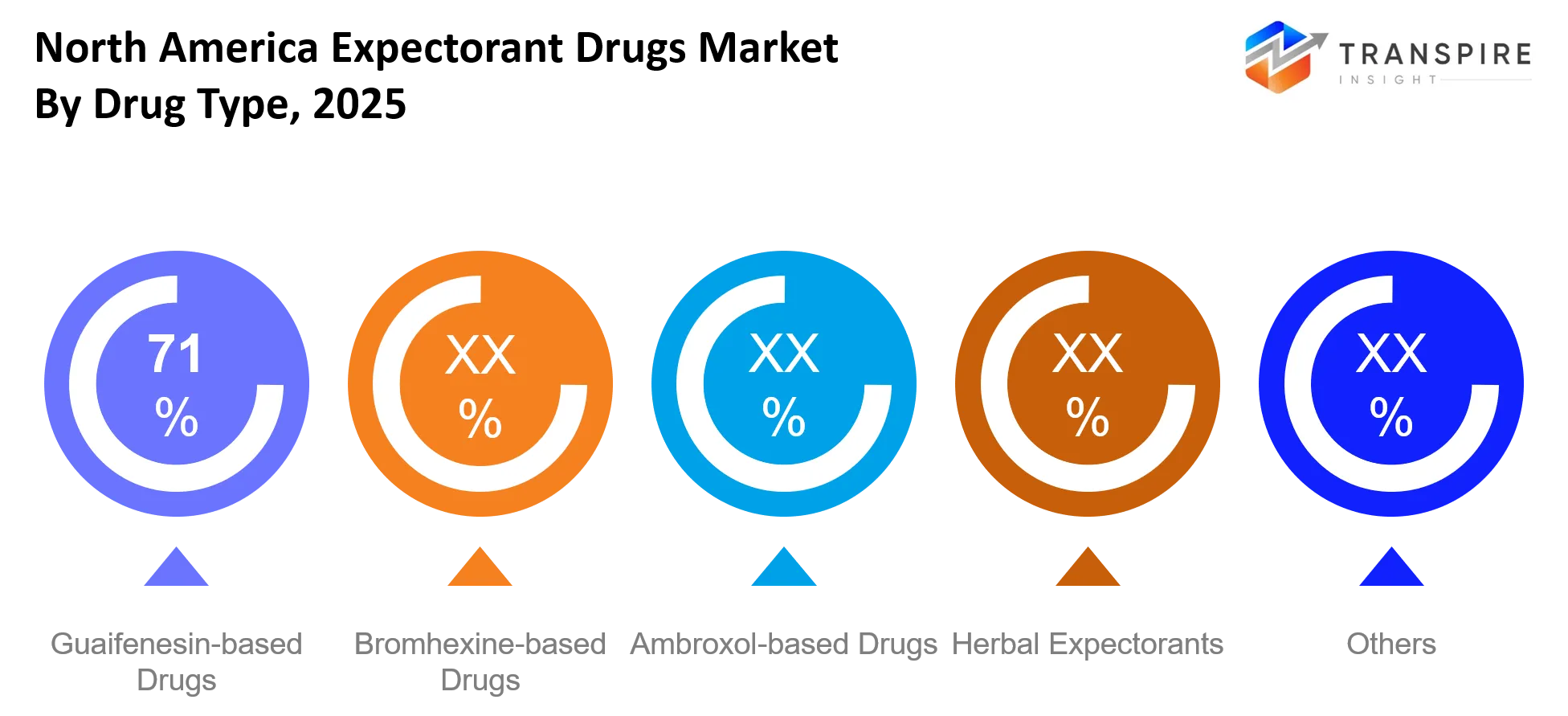
To learn more about this report, Download Free Sample Report
By Application
In application terms, a productive cough ends up being the more dominant segment, because expectorant drugs are mainly made to help move mucus out, and also to support airway function. Bronchitis adds a meaningful slice too , since both acute and chronic variants often involve careful mucus management as part of symptom control. COPD-related use keeps growing , partly from the larger aging population, and the long term burden of respiratory disease across North America.
Respiratory infections keep acting as a key demand driver, especially during seasonal spikes when patients want fast symptom relief products through retail outlets. A few other applications bring in incremental revenue but typically they don’t reach the same volume as the major respiratory conditions. Looking ahead, this segment seems to lean toward more targeted treatment paths , tuned to specific patient groups. Manufacturers and investors are expected to double down on differentiated therapies, matching disease severity, treatment duration, and the practical reality of patient adherence.
By Distribution Channel
By way of distribution channel , retail pharmacies still lead most market activity, mainly because consumers can reach them easily, brands tend to show up more often, and non-prescription expectorant items are basically everywhere . Hospital pharmacies take the next spot, mostly due to prescription dispensing, plus the reality that more complicated respiratory cases are managed there. Online pharmacies are the fastest growing part right now, since digital health adoption keeps rising and home delivery keeps reshaping how people buy, like really changing the usual routine. The other channels stick around as backup support but they’re only a smaller slice of total revenue, compared to the big three.
Overall demand has been leaning more toward convenience, quicker product access , and smoother digital purchasing experiences that feel connected . Because of that, manufacturers are being pushed to firm up their omnichannel plans and also spend more on direct consumer engagement, not just broad advertising . Looking ahead, competition will probably depend more on distribution efficiency, inventory visibility, and digital commerce strength , which should open new opportunities for companies that can connect physical sales and online networks without friction .
By End-User
By end user , home care settings take the lead in terms of the largest share, simply because a lot of respiratory symptoms are handled outside institutional healthcare environments, often using over the counter medications. Hospitals stay a big deal as well, they keep consuming expectorant therapies for patients who need supervised respiratory care, this part is steady. Clinics also matter, they bring meaningful demand via outpatient treatment and physician guided medication recommendations. Then you have other end users, like long term care facilities and specialized healthcare providers, which are a smaller but still consistent slice.
In general the demand dynamics are starting to mirror a broader move toward self managed healthcare and decentralized treatment models. People want accessible symptom relief options, so they can reduce the need for clinical intervention when their condition is mild or moderate, and honestly that happens more often lately. Looking ahead, market growth is expected to lean toward products that are easier to use, easier to stick with, and better integrated with remote healthcare. That creates room for manufacturers to build consumer focused respiratory therapies, while at the same time helping healthcare systems find more cost effective care pathways.
What are the Key Use Cases Driving the North America Expectorant Drugs Market?
The main purpose of expectorant medications is kind of for the treatment of a productive cough linked to respiratory infections like influenza, the common cold, and acute bronchitis. In practice, this is usually the biggest driver, because people want fast mucus clearing and a bit of relief from symptoms, mostly using over-the-counter options that are easy to find.
Then there are broader use patterns, for example chronic respiratory disease support, especially for COPD patients or recurrent bronchitis cases where care happens in clinics, hospitals, and long term care facilities. Also home care situations seem to be pushing adoption, since healthcare systems are leaning more toward outpatient symptom handling and lowering how much people rely on hospital based treatment.
More new and emerging applications are starting to show up too, like personalized respiratory care programs where expectorants are paired with digital health monitoring tools and telehealth visits. Another developing direction is more sophisticated combination treatments, aimed at aging populations who often deal with several respiratory symptoms at once, and that may open doors for higher value treatment solutions across the forecast period.
|
Report Metrics |
Details |
|
Market size value in 2025 |
USD 4.3 Billion |
|
Market size value in 2026 |
USD 4.5 Billion |
|
Revenue forecast in 2033 |
USD 6.2 Billion |
|
Growth rate |
CAGR of 4.68% from 2026 to 2033 |
|
Base year |
2025 |
|
Historical data |
2021 - 2024 |
|
Forecast period |
2026 - 2033 |
|
Report coverage |
Revenue forecast, competitive landscape, growth factors, and trends |
|
Country scope |
North America (Canada, The United States, and Mexico) |
|
Key company profiled |
Reckitt Benckiser, Pfizer, GSK, Sanofi, Bayer, Johnson & Johnson, Procter & Gamble, Teva Pharmaceuticals, Sun Pharmaceutical, Cipla, Hikma Pharmaceuticals, Perrigo, Viatris, Novartis, Bausch Health |
|
Customization scope |
Free report customization (country, regional & segment scope). Avail customized purchase options to meet your exact research needs. |
|
Report Segmentation |
By Drug Type (Guaifenesin-based Drugs, Bromhexine-based Drugs, Ambroxol-based Drugs, Herbal Expectorants, Others), By Application (Productive Cough, Bronchitis, COPD, Respiratory Infections, Others), By Distribution Channel (Hospital Pharmacies, Retail Pharmacies, Online Pharmacies, Others), By End User (Hospitals, Clinics, Home Care Settings, Others) |
Which Regions are Driving the North America Expectorant Drugs Market Growth?
The United States still comes in as the top region in the North America Expectorant Drugs Market, largely because it has a huge patient population, a very broad retail pharmacy network, and strong day-to-day consumer spending on healthcare. There’s also a pretty well set regulatory setup that helps keep prescription and over-the-counter respiratory medications widely available, more or less without friction. Beyond that, the country leans on a seasoned medicine manufacturing base, plus a smoothed out distribution logistics system, and broad health coverage that, honestly, makes respiratory treatments more reachable. All these pieces in one place help enable faster product launches, strong brand take up, and a long run market lead across the biggest therapeutic categories.
Canada sits as the second largest regional market, but the momentum is not exactly the same as the U.S. Market stability here is driven by a publicly financed healthcare system, steady medication availability, and reimbursement patterns that feel more predictable, so respiratory disease management doesn’t swing as much. On top of that Canadian consumers often keep using pharmacy-led healthcare services, so demand for expectorant therapies stays relatively dependable. In the end, this makes Canada a steady contributor to regional revenue, with less volatility and a heavier focus on treatment continuity.
Mexico is the fastest growing market because healthcare access keeps widening and pharmaceutical distribution channels keep reaching more people. More recently, investments in healthcare infrastructure and retail pharmacy growth have made it easier to obtain respiratory medications in cities, plus also in semi urban zones. At the same time, people are leaning more toward self-care strategies and over-the-counter respiratory products, and that added adoption is speeding up market activity.
Who are the Key Players in the North America Expectorant Drugs Market and How Do They Compete?
Competition in the North America Expectorant Drugs Market is kind of moderately consolidated, in a way, with a mix of global consumer health players, pharmaceutical manufacturers and even private label suppliers all pushing across both retail and prescription channels. Most companies seem to win not by a big “breakthrough” therapeutic twist, but more by brand awareness, formulation innovation, how far their distribution goes, and what pricing approach they use, you know. The more established manufacturers still try to hold on to market share by growing their respiratory care lineup and tightening up omnichannel distribution. At the same time retailer-owned brands are steadily adding pressure, especially in the cheaper value oriented product baskets. So, in practice, competitive outcomes are getting tied more and more to product accessibility, consumer confidence, and the capability to handle multiple respiratory symptoms using one single formulation.
Haleon stands out , mostly, with a clear emphasis on consumer respiratory well-being products and a broad retail pharmacy presence. It leans into formulation tweaks, consumer education, and strong brand visibility to stay relevant in these very crowded over the counter categories. Johnson & Johnson, on the other hand, leans on broad healthcare know-how plus a diversified product selection, which helps it keep brand recognition alive across different therapeutic zones. Ongoing investment in digital touchpoints and consumer centered product development also keeps pushing its market coverage forward and supports durable brand loyalty.
Sanofi kinda works by mixing pharmaceutical expertise with consumer healthcare strengths, so they can handle both Rx and self care respiratory treatment needs , pretty much at the same time. Bayer AG leans into science-backed formulations and trusted healthcare branding, and that helps it show up as something different in busy retail landscapes where everyone is crowded together. Pfizer, in turn, takes advantage of deep clinical development capabilities and solid relationships across healthcare systems, which helps it move toward wider respiratory care opportunities, not just the usual lane. And yeah, the overall growth push still leans on things like strategic partnerships, portfolio optimization initiatives, plus targeted investments into fast-growing consumer health channels.
Company List
- Reckitt Benckiser
- Pfizer
- GSK
- Sanofi
- Bayer
- Johnson & Johnson
- Procter & Gamble
- Teva Pharmaceuticals
- Sun Pharmaceutical
- Cipla
- Hikma Pharmaceuticals
- Perrigo
- Viatris
- Novartis
- Bausch Health
Recent Development News
In April 2026, Sensodyne maker Haleon keeps 2026 outlook as North America returns to growth: Haleon, owner of major respiratory and cough-relief brands including Robitussin, reported that North American revenue returned to growth in Q1 2026 despite a weak cold-and-flu season. The company maintained its full-year outlook and highlighted continued execution of growth initiatives in the region. This is significant for the OTC cough and expectorant category because seasonal respiratory demand remains a key market driver.
Source: https://www.reuters.com
In June 2026, FDA to take action against companies marketing unapproved guaifenesin products: The FDA announced plans to take enforcement action against companies marketing unapproved timed-release guaifenesin products. Guaifenesin is the active ingredient used in many expectorant medicines sold in North America. The move may affect competitive dynamics by reinforcing regulatory standards for manufacturers operating in the category.
Source: https://www.pharmtech.com
What Strategic Insights Define the Future of the North America Expectorant Drugs Market?
The North America Expectorant Drugs Market is kind of moving, not exactly in a straight line, toward integrated respiratory wellness solutions more than just standalone mucus relief products. Over the next five to seven years, value creation is likely to slide toward combination therapies, digitally supported self care models, and more consumer centered formulations that tackle several respiratory symptoms in one treatment pathway. The main reason for this shift is that routine respiratory care keeps moving out of clinics, and into pharmacies, online platforms and even home based treatment settings.
There is also a quieter danger that doesn’t get much attention. Market concentration is building around a fairly small set of active pharmaceutical ingredients and manufacturing sources. If something disrupts key raw material suppliers or contract manufacturing networks, supply stability can take a hit. This could show up hard during seasonal respiratory illness surges, so revenue capture gets limited even when end market demand stays strong.
Still, an opportunity is showing up, it’s pretty clear too, especially where respiratory therapeutics meet digital health platforms. Think symptom tracking applications, plus telehealth supported treatment recommendations. Market players should focus on differentiated combination products that are backed by digital engagement ecosystems. This kind of setup can help keep consumers more consistently involved, sharpen brand differentiation, and also lower the chance of being pulled into price based competition.
North America Expectorant Drugs Market Report Segmentation
By Drug Type
- Guaifenesin-based Drugs
- Bromhexine-based Drugs
- Ambroxol-based Drugs
- Herbal Expectorants
- Others
By Application
- Productive Cough
- Bronchitis
- COPD
- Respiratory Infections
- Others
By Distribution Channel
- Hospital Pharmacies
- Retail Pharmacies
- Online Pharmacies
- Others
By End User
- Hospitals
- Clinics
- Home Care Settings
- Others
Frequently Asked Questions
Find quick answers to common questions.
The Approximate North America Expectorant Drugs Market size for the Market will be USD 6.2 Billion in 2033.
The key Segments of the North America Expectorant Drugs Market are By Drug Type (Guaifenesin-based Drugs, Bromhexine-based Drugs, Ambroxol-based Drugs, Herbal Expectorants, Others), By Application (Productive Cough, Bronchitis, COPD, Respiratory Infections, Others), By Distribution Channel (Hospital Pharmacies, Retail Pharmacies, Online Pharmacies, Others), By End User (Hospitals, Clinics, Home Care Settings, Others).
Major Players in the North America Expectorant Drugs Market are Reckitt Benckiser, Pfizer, GSK, Sanofi, Bayer, Johnson & Johnson, Procter & Gamble, Teva Pharmaceuticals, Sun Pharmaceutical, Cipla, Hikma Pharmaceuticals, Perrigo, Viatris, Novartis, Bausch Health.
The Current Market size of the North America Expectorant Drugs Market is USD 4.3 Billion in 2025.
The North America Expectorant Drugs Market CAGR is 4.68%.
- Reckitt Benckiser
- Pfizer
- GSK
- Sanofi
- Bayer
- Johnson & Johnson
- Procter & Gamble
- Teva Pharmaceuticals
- Sun Pharmaceutical
- Cipla
- Hikma Pharmaceuticals
- Perrigo
- Viatris
- Novartis
- Bausch Health
About the Authors

Pankaj Ghogare Patil
I am Pankaj Ghogare Patil, a Senior Research Analyst at Transpire Insight, specializing in the Pharmaceutical, Chemicals & Materials, Healthcare IT, and Biotechnology industry. My expertise lies in conducting comprehensive market research, analyzing industry trends, evaluating competitive landscapes, and translating complex data into actionable insights. At Transpire Insight, I closely follow emerging technologies, regulatory developments, and market innovations to create accurate, well-researched, and informative content that helps businesses and professionals make informed decisions. I am committed to producing credible, evidence-based articles that reflect industry best practices while making technical topics accessible and valuable for a broad audience.

Chakradhar Khansole
Chakradhar serves as the Research Director at Transpire Insight, bringing over 8 years of experience in technology, innovation, and strategic market intelligence. He specializes in transforming complex market data into actionable business insights that enable organizations to make informed, growth-oriented decisions. Recognized for his strategic vision and analytical expertise, Chakradhar leads high-impact research initiatives, delivering comprehensive market assessments, competitive intelligence, and forward-looking industry analysis.
Recently Published Reports
-
Jul 2026
Alopecia Treatment Market
Alopecia Treatment Market Size, Share & Analysis Report By Disease Type (Alopecia Areata, Cicatricial Alopecia, Traction Alopecia, Alopecia Totalis, Androgenetic Alopecia, Alopecia Universalis, and Other Disease Types), By Treatment Type (Topical Treatments, Oral Medications, Injectable Therapies, and Hair Transplantation), By Gender (Male, and Female), By Distribution Channel (Hospitals and Clinics, Retail Pharmacies, and Online Retailers), and Geography (North America, Europe, Asia-Pacific, Middle East and Africa, South and Central America), 2021 - 2031
-
Jul 2026
Medical Ultrasound Probe Market
Medical Ultrasound Probe Market Size, Share & Analysis Report By Type (Linear Type, Convex Type, Endocavitary Probe, Phased Array/Cardiac Probe, Transesophageal (TEE) Probe, and Others), By Application (Ophthalmology, Cardiology, Musculoskeletal, Oncology, Obstetrics & Gynecology, General Imaging, and Others), By End User (Hospitals & Clinics, Diagnostic Centers, Ambulatory Surgical Centers, and Others), and Geography (North America, Europe, Asia-Pacific, Middle East and Africa, South and Central America), 2021 – 2031
-
May 2026
Biosimilars Market
Biosimilars Market By Product Type (Monoclonal Antibodies, Recombinant Hormones, Erythropoietin, G-CSF, Others), By Indication (Oncology, Autoimmune Diseases, Blood Disorders, Diabetes, Others), By Manufacturing Type (In-House Manufacturing, Contract Manufacturing), By Distribution Channel (Hospital Pharmacies, Retail Pharmacies, Online Pharmacies), By Industry Analysis, Size, Share, Growth, Trends, and Forecasts 2021-2033
-
Apr 2026
Gastrointestinal Endoscopy Market
Gastrointestinal Endoscopy Market By Type (Rigid Gastrointestinal Endoscope, Flexible Gastrointestinal Endoscopes, Disposable Gastrointestinal Endoscope), By Procedure Type (Colonoscopy, Gastroscopy, Duodenoscopy, Enteroscopy, Flexible Sigmoidoscopy, Others), By Application (Diagnosis, Treatment), By End-Users (Hospitals, Ambulatory Surgical Centers, Specialty Clinics, Laboratories, Others), By Industry Analysis, Size, Share, Growth, Trends, and Forecasts 2021-2033