

North America Cardiorespiratory Assessment Units Market Size & Forecast:
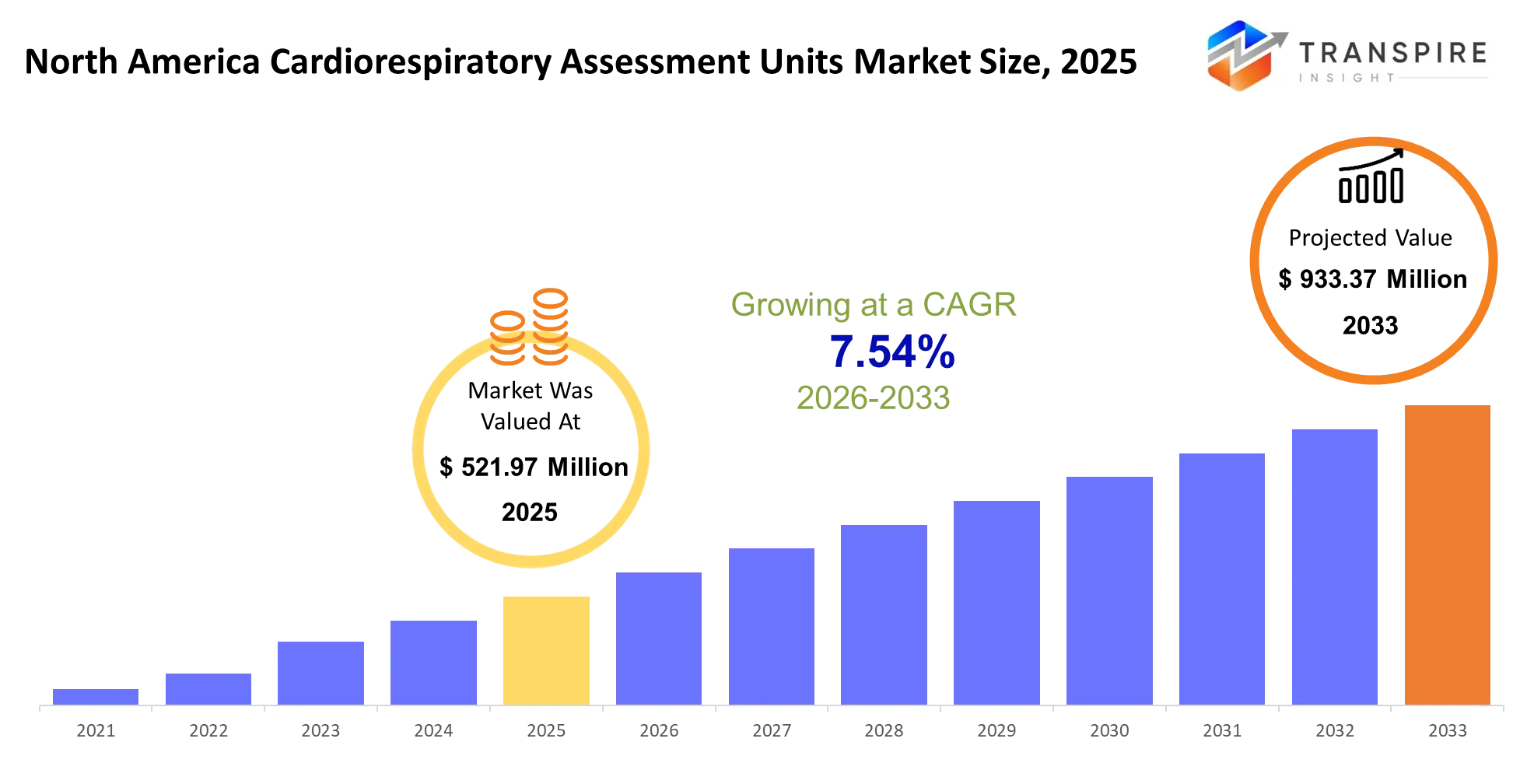
- North America Cardiorespiratory Assessment Units Market Size 2025: USD 521.97 Million
- North America Cardiorespiratory Assessment Units Market Size 2033: USD 933.37 Million
- North America Cardiorespiratory Assessment Units Market CAGR: 7.54%
- North America Cardiorespiratory Assessment Units Market Segments: By Type (Spirometers, ECG Systems, Stress Testing Systems, Pulse Oximeters, Others), By Application (Cardiology, Pulmonology, Diagnostics, Monitoring, Others), By End-User (Hospitals, Clinics, Labs, Others), By Technology (Portable, Fixed, AI-enabled, Others).
To learn more about this report,  Download Free Sample Report
North America Cardiorespiratory Assessment Units Market Summary:
The North America Cardiorespiratory Assessment Units Market size is estimated at USD 521.97 Million in 2025 and is anticipated to reach USD 933.37 Million by 2033, growing at a CAGR of 7.54% from 2026 to 2033.North America cardiorespiratory assessment units are slowly becoming more central in the way hospitals, ambulatory clinics, and rehab centers handle high-acuity respiratory plus cardiac cases… without basically overwhelming the intensive care infrastructure. In practice, these setups mix pulmonary function testing , ECG monitoring, stress testing, and real-time physiological analytics, so clinicians can spot worsening conditions sooner, speed up the diagnostic cycle, and guide treatment choices especially for chronic disease management. Their importance really ramped up after healthcare providers got hit with capacity strain during the COVID-19 period, which sort of revealed weaknesses in respiratory surveillance and more decentralized patient evaluation workflows
In the last three to five years, the market direction has changed from standalone diagnostic gear to connected assessment platforms that plug into electronic health records, and also remote monitoring ecosystems. This shift sort of got stronger when healthcare systems leaned into outpatient, and home- based cardiopulmonary evaluation , trying to cut back on hospitals, and handle aging patient groups more efficiently. And at the same time, semiconductor shortages plus wider supply chain disruptions, like for a moment, limited how many devices were actually delivered, so manufacturers had to rework their sourcing approaches and also put real money into domestic production resilience. Meanwhile, as reimbursement models increasingly reward preventive monitoring and early action, providers are putting resources into multi-parameter assessment units. The idea is that they can raise throughput, lower the chance of readmission, and generate clear operational savings that administrators can actually measure.
Key Market Insights
- The United States basically dominated the North America Cardiorespiratory Assessment Units Market, holding almost 78% market share in 2025, as a result of more advanced hospital infrastructure, which kinda makes adoption easier.
- Canada is showing the fastest growth trend all the way through 2032, driven by more telehealth funding and increasing screening activities for respiratory illnesses, these programs are getting attention.
- Meanwhile, cross border healthcare technology collaborations are helping companies push deeper into regional markets, and also speeding up the uptake of connected diagnostic assessment systems.
- At the same time, healthcare digitization efforts across North America keep pushing the market growth rate forward and boosting demand for AI powered respiratory monitoring platforms.
- Integrated cardiorespiratory diagnostic systems captured more than 42% of the industry share in 2025, because hospitals now prefer multi parameter evaluation platforms.
- Portable assessment units sit as the second largest segment, mainly tied to outpatient monitoring growth and the wider use of ambulatory care center setups.
- Wireless plus cloud-connected assessment devices are expected to be the fastest growing segment from 2026 to 2032.
- Key demand levers include faster patient throughput, better diagnostic precision, plus lower hospital readmission costs across healthcare networks.
- Chronic obstructive pulmonary disease diagnostics and cardiac disease diagnostics together made up nearly 48% of total North America Cardiorespiratory Assessment Units Market revenue in 2025.
- Remote patient monitoring came up as the fastest growing application segment, as providers roll out more home based cardiopulmonary evaluation services.
- Stress testing, and pulmonary function evaluation are still gaining momentum, especially within preventive healthcare approaches, plus rehabilitation programs too.
What are the Key Drivers, Restraints, and Opportunities in the North America Cardiorespiratory Assessment Units Market?
The strongest force that is pushing the North America Cardiorespiratory Assessment Units Market forward, seems to be the healthcare system’s move toward preventive and more decentralized patient management, kind of a steady change over time. This shift picked up real speed after hospitals ran into serious respiratory care bottlenecks during the COVID-19 period, and they started putting money into earlier-stage cardiopulmonary diagnostics that sit outside the intensive care setting. Meanwhile the reimbursement side too, especially for remote physiological monitoring across the United States, helped the business case for connected assessment systems. In practice, healthcare providers are now leaning on integrated cardiorespiratory units to cut down emergency admissions, speed up diagnostic timelines, and keep an eye on chronic disease progression in a more efficient way. And that ripple effect shows up pretty clearly as higher equipment procurement budgets, plus expanding recurring revenue from software integration, data analytics, and ongoing service contracts.
Still, the biggest structural snag remains the expensive integration work tied to hospital IT infrastructure and all the interoperability requirements. A lot of healthcare facilities, still run on fragmented electronic health record systems, that can’t easily talk to newer multi-parameter diagnostic platforms, without heavy customization. The upgrades therefore need major capital spending, plus cybersecurity validation, and then workforce retraining that takes time, not just a quick switch. On top of that, hospital procurement cycles can stretch across multiple fiscal years. So manufacturers often get stuck with delayed purchasing decisions, and slower large-scale deployments, especially among mid-sized healthcare networks.
A big opportunity is kind of building in AI enabled remote heart and lung monitoring for older people all across North America. Health organizations are putting more money into predictive check platforms, where wearable sensors plus cloud based analytics come together, and then an automated risk score is produced. In Canada, the whole virtual care setup keeps getting bigger, and at the same time the home based programs for ongoing chronic issues are growing fast, so the conditions feel pretty right for rolling this out at scale. The firms that can offer interoperable, portable assessment systems with real time clinical insights are, in my view, best placed to catch that next long run market expansion wave.
What Has the Impact of Artificial Intelligence Been on the North America Cardiorespiratory Assessment Units Market?
Artificial intelligence plus more advanced digital tech are changing, in a sort of day to day way, how healthcare providers handle cardiorespiratory assessment units in hospitals, outpatient clinics and even home monitoring setups across North America. The AI enabled diagnostic platforms are now doing a lot of the work on respiratory pattern analysis, ECG interpretation, pulmonary function assessment, and also patient risk ranking. Because of this, clinicians are spending less time on manual review, kind of freeing them up for other decisions. A lot of the newer systems also connect right into electronic health records and cloud based monitoring platforms so providers can follow cardiopulmonary condition more or less continuously across huge patient groups.
Machine learning models are also getting used in predictive care workflows more and more. In many hospitals, these algorithms help spot early signs of respiratory worsening, flag arrhythmia risk, and estimate what cardiac complications might come next, before acute hospitalization becomes unavoidable. A few healthcare networks report practical improvements from AI supported triage systems, such as quicker diagnostic turnaround, fewer readmissions, and better use of critical care resources. For remote monitoring programs, automated alert mechanisms can help too— they sort of triage high risk patients first, which can reduce unnecessary emergency visits.
On top of that, advanced analytics are being used to sharpen operational efficiency, for example by extending device uptime through predictive maintenance plus automated calibration checks. Still, there is a big sticking point for broad AI adoption: fragmented healthcare IT infrastructure. Many facilities keep legacy electronic record systems that do not connect smoothly with newer AI driven assessment platforms. That creates interoperability problems, delays implementation, and often drives the overall cost up more than teams expect.
Key Market Trends
- Between 2021 and 2025, hospitals started swapping out single use diagnostic gadgets for more unified cardiopulmonary evaluation platforms , that can back centralized patient tracking workflows, and honestly it feels like this shift happened faster than anyone expected.
- Remote patient monitoring uptake jumped pretty sharply once U.S. reimbursement rules started covering connected physiologic assessment services across chronic respiratory plus cardiac care programs.
- After 2022, big names like GE HealthCare and Philips moved product planning toward AI assisted analytics, and cloud based diagnostic interoperability, in a way that made earlier device models seem kind of limited.
- During 2021 and 2022, supply chain disruptions made a dent, so manufacturers diversified their semiconductor sourcing and bumped up North American component procurement capacity, because relying on one route was risky.
- Ambulatory care networks increased their buying of portable assessment units by more than 30% since 2020, mainly so they could reduce dependence on inpatient diagnostic infrastructure.
- Healthcare organizations also leaned harder into predictive monitoring algorithms that spot respiratory decline earlier , which in turn helps teams cut down on avoidable emergency admissions and ICU use.
- Cardiorespiratory assessment vendors upped cybersecurity spending after ransomware incidents in 2023 revealed weak points in connected diagnostic monitoring ecosystems.
- Home healthcare providers also became major tech buyers, partly because aging demographics pushed longer term demand for decentralized cardiopulmonary disease management solutions.
- In Canada, healthcare systems accelerated virtual care spending between 2022 and 2025, which created stronger demand for wireless pulmonary plus cardiac assessment technologies, and the momentum stayed there.
North America Cardiorespiratory Assessment Units Market Segmentation
By Type
In terms of category, ECG systems alongside integrated stress testing systems, seem to have the better market foothold, because hospitals and those more specialty cardiac centers lean on uninterrupted cardiac diagnostics for big patient throughput. Spirometers still show solid uptake in pulmonary clinics too, largely with those widening chronic obstructive pulmonary disease, and asthma workup initiatives in place. Pulse oximeters actually saw faster buying after the pandemic phase , since the renewed attention on respiratory monitoring got carried into outpatient care and homecare programs.
More lately, multi-function assessment units are getting chosen more often than standalone systems, not just because they work better but because providers want workflow efficiency, centralized data management , and less equipment sprawl. Even so, pricing pressure is still an issue, especially for smaller clinics that keep legacy diagnostic platforms rather than swapping the whole setup at once.Looking ahead, the market direction appears to be toward compact connected devices, with cloud reporting plus predictive analytics features. Firms that bring interoperability together with wireless connectivity, and AI-supported interpretation capabilities, should end up landing sturdier procurement deals with large health networks and ambulatory care operators.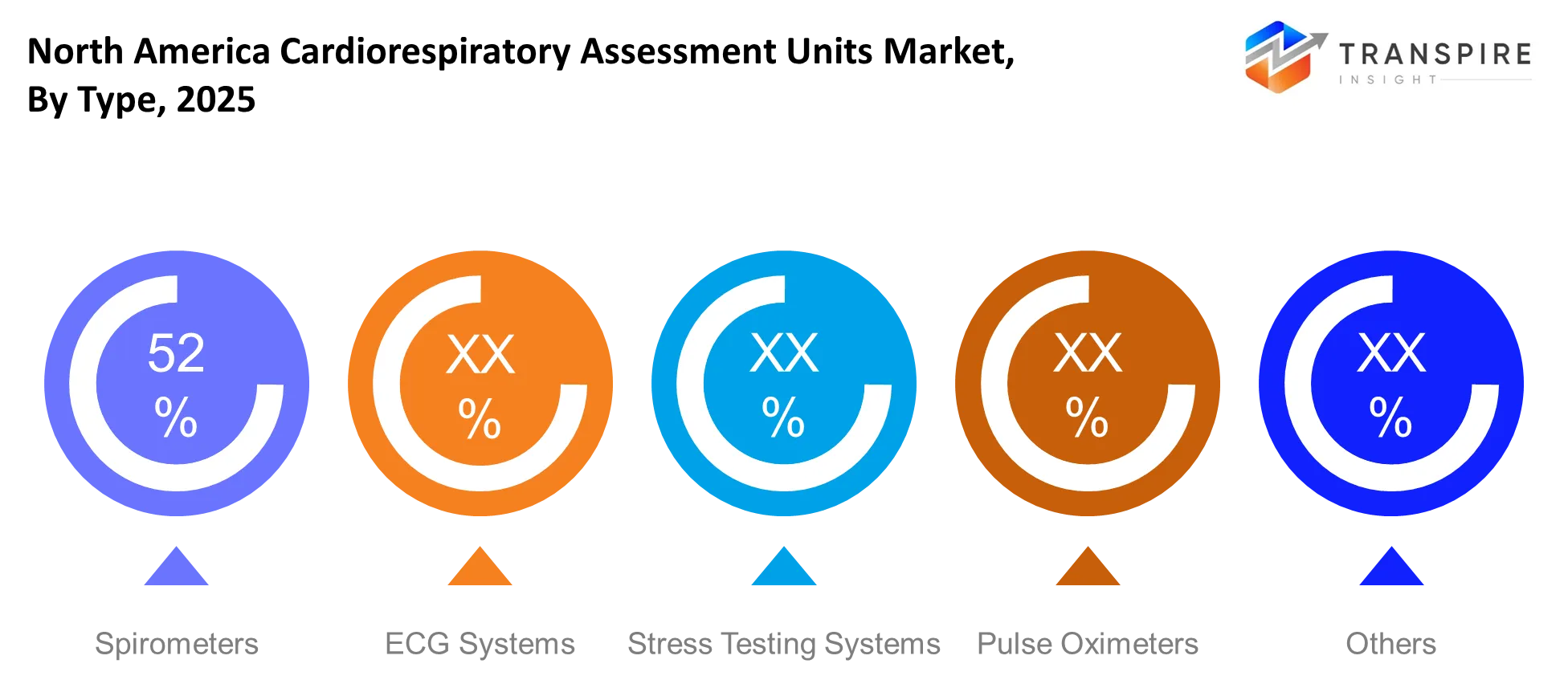
By Application
To learn more about this report, Download Free Sample Report
By application, cardiology is still the main segment or something like that, since cardiovascular disease keeps generating big diagnostic volumes through North America. Stress testing systems, ECG monitoring platforms, and integrated cardiac assessment units keep getting steady budgets from hospitals trying to trim emergency admissions and also boost preventive screening efforts. Pulmonology apps also look quite strong, largely because respiratory disease prevalence is rising , and there are longer- lasting post-viral respiratory effects too.
Diagnostic applications seem to do better than the older style monitoring systems, mainly because clinicians want quicker patient evaluation and tighter clinical decision timing. Monitoring apps, especially remote physiological tracking, are probably the fastest growing spot as home-based chronic condition management spreads among aging populations. At the demand level, people are increasingly buying solutions that can bundle respiratory and cardiac evaluation in one single workflow. Looking ahead, newer chances may come from predictive diagnostic software plus real-time patient monitoring platforms, the ones that help decentralized care delivery and keep improving long term patient outcome management.
By End-User
By end user, hospitals kind of dominate overall revenue because large healthcare systems run advanced diagnostic infrastructure and they handle high acuity cardiac and respiratory cases, all the time. Specialty clinics also have a solid footprint in the market via outpatient cardiology , and pulmonology services that need regular physiological assessment along with long term, chronic disease follow up. Diagnostic laboratories add a more constant stream of demand for pulmonary function testing plus advanced cardiopulmonary evaluation, especially across urban healthcare networks.
Home healthcare providers and rehabilitation centers now look like the fastest growing end user group as care models move toward decentralized patient management. Cost efficiency and reimbursement optimization keep pushing providers to lower their inpatient dependency, mostly by leaning into remote monitoring and outpatient diagnostics. Smaller clinics still hit financial friction, related to software integration , and the modernization costs for devices, which is not trivial.Looking ahead, procurement choices will rely more and more on interoperability, remote connectivity, and automated reporting capabilities. Vendors who can support integrated clinical workflows and scalable digital infrastructure are expected to stick around longer with healthcare organizations, and keep building durable partnerships.
By Technology
By technology, fixed assessment setups keep outpacing most of the market, because hospitals really need high-capacity diagnostic platforms for intense cardio pulmonary review and steady patient flow, all the time. Meanwhile, portable systems have picked up serious momentum—outpatient centers, emergency departments, and homecare programs want mobility plus easier, quicker deployment. AI enabled solutions show the most rapid growth, since many care organizations are now pushing for automated reading, forward-looking risk assessment, and live patient analytics.
Cloud connected platforms also see stronger uptake, as telehealth keeps expanding and teams need more centralized data management. Still, some facilities get stuck, since interoperability gaps between older hospital information systems and newer digital tools can slow down wider rollout. Overall, demand is shifting more toward wireless, multi parameter assessment technologies that can back remote diagnostics and these decentralized care programs. Going forward, competitive edge will probably hinge on software intelligence , strong cybersecurity defenses, and smooth integration with electronic health record ecosystems, not only on hardware muscle.
What are the Key Use Cases Driving the North America Cardiorespiratory Assessment Units Market?
Hospitals and, specialty cardiac centers kinda are the main use case for cardiorespiratory assessment units, because cardiovascular and respiratory disease diagnostics need continuous physiological evaluation, all the way through. Stress testing systems, ECG monitoring platforms, and pulmonary assessment tools keep getting used, since they feed steady demand via emergency care, surgical preparation, and chronic disease management processes.
Outpatient clinics and home healthcare providers now use portable assessment systems too, for remote patient monitoring, and also for post-discharge rehabilitation programs. Pulmonology clinics deploy connected spirometry and oxygen monitoring devices as well , so they can manage chronic obstructive pulmonary disease and long-term respiratory complications more efficiently, even outside inpatient settings.
Newer applications include AI-assisted predictive monitoring and integrated virtual care diagnostics for aging populations. Rehabilitation networks and telehealth providers are starting to adopt cloud-connected cardiopulmonary assessment platforms that help with real-time patient tracking, automated risk scoring, and early action strategies, before acute hospitalization becomes necessary.
|
Report Metrics |
Details |
|
Market size value in 2025 |
USD 521.97 Million |
|
Market size value in 2026 |
USD 561.31 Million |
|
Revenue forecast in 2033 |
USD 933.37 Million |
|
Growth rate |
CAGR of 7.54% from 2026 to 2033 |
|
Base year |
2025 |
|
Historical data |
2021 - 2024 |
|
Forecast period |
2026 - 2033 |
|
Report coverage |
Revenue forecast, competitive landscape, growth factors, and trends |
|
Country scope |
North America (Canada, The United States, and Mexico) |
|
Key company profiled |
Philips, GE Healthcare, Siemens Healthineers, Medtronic, Abbott, Nihon Kohden, Schiller, Hill-Rom, Masimo, Welch Allyn, Dräger, CareFusion, Fukuda Denshi, COSMED, BD |
|
Customization scope |
Free report customization (country, regional & segment scope). Avail customized purchase options to meet your exact research needs. |
|
Report Segmentation |
By Type (Spirometers, ECG Systems, Stress Testing Systems, Pulse Oximeters, Others), By Application (Cardiology, Pulmonology, Diagnostics, Monitoring, Others), By End-User (Hospitals, Clinics, Labs, Others), By Technology (Portable, Fixed, AI-enabled, Others) |
Which Regions are Driving the North America Cardiorespiratory Assessment Units Market Growth?
The United States, honestly, tends to lead the regional landscape mainly because big hospital networks keep investing quite a lot in advanced cardiopulmonary diagnostics, outpatient monitoring infrastructure, and AI-enabled healthcare systems. There’s also federal reimbursement backing for remote physiological monitoring and preventive cardiac care, which has helped adoption across hospitals, specialty clinics, and even home healthcare providers. In addition, there is strong integration between medical device manufacturers, cloud software providers, and healthcare systems, that supports fast rollout of connected assessment technologies. Academic medical centers and big research hospitals keep the momentum too, through ongoing clinical validation, technology trials, and purchasing high-end diagnostic platforms.
Canada still shows up as a stable contributor because healthcare providers focus on long-term operational efficiency, and on equitable access to diagnostic services for populations spread across large areas. But unlike the United States, Canada’s adoption patterns lean more on public healthcare investment, plus province-level virtual care expansion programs. Steady funding for telehealth infrastructure and chronic disease management has encouraged hospitals and rehabilitation centers to put portable cardiorespiratory monitoring systems into everyday use. Regulatory oversight stays steady, and centralized healthcare procurement practices also help create predictable demand for manufacturers, and for long-term technology suppliers.
Mexico is basically the fastest-growing regional market, mainly because healthcare infrastructure modernization keeps rolling ahead and private hospital investment keeps widening. In the past years, many urban healthcare providers rushed into the purchase of portable diagnostic systems so they can boost cardiac as well as respiratory screening ability, but not only inside the overcrowded public hospitals… more like around them, in other settings too. At the same time, global medical device firms grew their distribution relationships, then they also put more emphasis on local service operations. This is to make market entry easier across the biggest metro areas.So, this whole momentum is creating really solid openings for investors and fresh entrants between 2026 and 2033. Especially where it is about affordable connected diagnostics, outpatient monitoring technologies, and digitally integrated rehab services.
Who are the Key Players in the North America Cardiorespiratory Assessment Units Market and How Do They Compete?
The competitive environment stays kind of moderately consolidated, with this small set of multinational medical technology firms that sort of control a big share of advanced cardiopulmonary diagnostics across North America. You can see that rivalry is leaning more toward software integration , AI-assisted interpretation, remote monitoring ability and interoperability with hospital information systems, instead of only raw hardware performance. Even so , established manufacturers keep defending their positions via long-term hospital agreements, service ecosystems, and those integrated digital platforms. Meanwhile smaller entrants usually gravitate to portable diagnostics and cloud based monitoring solutions. In practice, procurement choices now really hinge on cybersecurity readiness, workflow efficiency, and whether the vendor can actually support decentralized patient management across outpatient care and homecare environments.
GE HealthCare stands out by tying together imaging, cardiac monitoring, and hospital data management systems so clinicians can streamline diagnostic tasks within one single platform. The company is also continuing to extend AI enabled cardiology analytics , plus remote patient monitoring, using strategic digital health partnerships. Philips competes through connected care infrastructure and cloud patient monitoring ecosystems that are tailored for big hospital networks and virtual care programs. Their telehealth integration strength is a key part, and the centralized clinical data handling also adds leverage in long-term enterprise healthcare contracts.
Masimo is really into noninvasive physiological monitoring tech , with lots of uptake in critical care and home respiratory check ups. They use more advanced signal processing methods, plus wear able friendly monitoring setups, so they can push further into decentralized healthcare places. Nihon Kohden stands out with high reliability patient monitoring systems , and they’re everywhere in acute care and emergency medicine environments. The firm keeps beefing up its North American distribution routes and also improves software integration options, so it can compete better against bigger multinational rivals. Schiller AG , meanwhile , keeps a kind of niche edge in portable cardiopulmonary diagnostics and stress testing systems, these support outpatient and ambulatory care expansion with regional healthcare providers .
Company List
- Philips
- GE Healthcare
- Siemens Healthineers
- Medtronic
- Abbott
- Nihon Kohden
- Schiller
- Hill-Rom
- Masimo
- Welch Allyn
- Dräger
- CareFusion
- Fukuda Denshi
- COSMED
- BD
Recent Development News
In February 2026, GE HealthCare Raises 2026 Outlook on Strong Demand for Monitoring and Diagnostic Systems: GE HealthCare reported stronger-than-expected 2026 profit guidance driven by sustained demand for hospital monitoring, diagnostic cardiology, and patient care technologies across North America. The update highlighted continued investment by U.S. hospitals in connected care and cardiorespiratory assessment infrastructure, supporting growth in critical care and monitoring segments.
Source: https://www.reuters.com
In May 2026, Philips Reports Strong Q1 2026 Growth Led by North American Hospital Demand: Philips announced strong first-quarter 2026 results, citing growth in North America and increased hospital spending on patient monitoring and connected care technologies. The company emphasized improving order intake and margin expansion tied to critical care and cardiopulmonary monitoring solutions used in hospital assessment units.
Source: https://www.philips.com
What Strategic Insights Define the Future of the North America Cardiorespiratory Assessment Units Market?
Over the next five to seven years, the North America Cardiorespiratory Assessment Units Market is expected to wiggle over from mostly episodic diagnostics into more ongoing cardiopulmonary intelligence platforms, sort of woven across hospitals, outpatient centers, and homecare ecosystems. What’s pushing that change is the financial pressure on healthcare systems, to catch deterioration earlier, curb inpatient utilization, and handle aging populations via more distributed care delivery. AI-enabled monitoring, predictive analytics, and interoperable cloud infrastructure will start steering buying decisions, more than the simple “device-only” performance stuff that used to matter most.
There’s a hidden snag though, like a growing reliance on just a handful of software and semiconductor suppliers that back connected diagnostic systems. If anything goes off-track— cybersecurity regulation updates, component shortages, or interoperability standards not syncing right— then rollout timelines could stall, and operating costs can creep up across entire healthcare networks.
On the other side, there’s also a chance showing up in rural and underserved healthcare markets, where portable AI-assisted diagnostic platforms can help where specialists are thin, and boost remote cardiac and respiratory assessment capacity. Players in the market should focus on alliances with telehealth providers and electronic health record vendors, to lock in long-term integration advantages, before interoperability standards get even more consolidated and frankly harder for new entrants to squeeze into.
North America Cardiorespiratory Assessment Units Market Report Segmentation
By Type
- Spirometers
- ECG Systems
- Stress Testing Systems
- Pulse Oximeters
- Others
By Application
- Cardiology
- Pulmonology
- Diagnostics
- Monitoring
- Others
By End-User
- Hospitals
- Clinics
- Labs
- Others
By Technology
- Portable
- Fixed
- AI-enabled
- Others
Frequently Asked Questions
Find quick answers to common questions.
The Approximate North America Cardiorespiratory Assessment Units Market size for the Market will be USD 933.37 Million in 2033.
The key Segments of the North America Cardiorespiratory Assessment Units Market are By Type (Spirometers, ECG Systems, Stress Testing Systems, Pulse Oximeters, Others), By Application (Cardiology, Pulmonology, Diagnostics, Monitoring, Others), By End-User (Hospitals, Clinics, Labs, Others), By Technology (Portable, Fixed, AI-enabled, Others).
Major Players in the North America Cardiorespiratory Assessment Units Market are Philips, GE Healthcare, Siemens Healthineers, Medtronic, Abbott, Nihon Kohden, Schiller, Hill-Rom, Masimo, Welch Allyn, Dräger, CareFusion, Fukuda Denshi, COSMED, BD.
The Current Market size of the North America Cardiorespiratory Assessment Units Market is USD 521.97 Million in 2025.
The North America Cardiorespiratory Assessment Units Market CAGR is 7.54%.
- Philips
- GE Healthcare
- Siemens Healthineers
- Medtronic
- Abbott
- Nihon Kohden
- Schiller
- Hill-Rom
- Masimo
- Welch Allyn
- Dräger
- CareFusion
- Fukuda Denshi
- COSMED
- BD
Recently Published Reports
-
May 2026
Biosimilars Market
Biosimilars Market By Product Type (Monoclonal Antibodies, Recombinant Hormones, Erythropoietin, G-CSF, Others), By Indication (Oncology, Autoimmune Diseases, Blood Disorders, Diabetes, Others), By Manufacturing Type (In-House Manufacturing, Contract Manufacturing), By Distribution Channel (Hospital Pharmacies, Retail Pharmacies, Online Pharmacies), By Industry Analysis, Size, Share, Growth, Trends, and Forecasts 2021-2033
-
Apr 2026
Gastrointestinal Endoscopy Market
Gastrointestinal Endoscopy Market By Type (Rigid Gastrointestinal Endoscope, Flexible Gastrointestinal Endoscopes, Disposable Gastrointestinal Endoscope), By Procedure Type (Colonoscopy, Gastroscopy, Duodenoscopy, Enteroscopy, Flexible Sigmoidoscopy, Others), By Application (Diagnosis, Treatment), By End-Users (Hospitals, Ambulatory Surgical Centers, Specialty Clinics, Laboratories, Others), By Industry Analysis, Size, Share, Growth, Trends, and Forecasts 2021-2033
-
Apr 2026
Rare Inherited Metabolic Disorder Drug Market
Rare Inherited Metabolic Disorder Drug Market By Drug Class (Enzyme Replacement Drugs, Gene Therapy Drugs, Substrate Reduction Drugs, Small Module Drugs, Protein Drugs), By Route of Administration(Parenteral, Oral, Intrathecal), By Clinical Development (Marketed Drugs, Late Stage Clinical Phase III, Early Stage Clinical Phase I-II, Preclinical Candidates), By Indication (Lysosomal Storage Disorders, Urea Cycle Disorders, Amino Acid Metabolic Disorders, organic Acidemias, Peroximal Disorders), By Industry Analysis, Size, Share, Growth, Trends, and Forecasts 2021-2033
-
Jan 2026
Pharmaceutical Cleanroom Technology Market
Pharmaceutical Cleanroom Technology Market By Product (Equipment, Consumables, Services); By Cleanroom Type (Standard Cleanrooms, Modular Cleanrooms); By End Use (Pharmaceutical Companies, Biotechnology Companies), By Industry Analysis, Size, Share, Growth, Trends, and Forecasts 2021-2033