
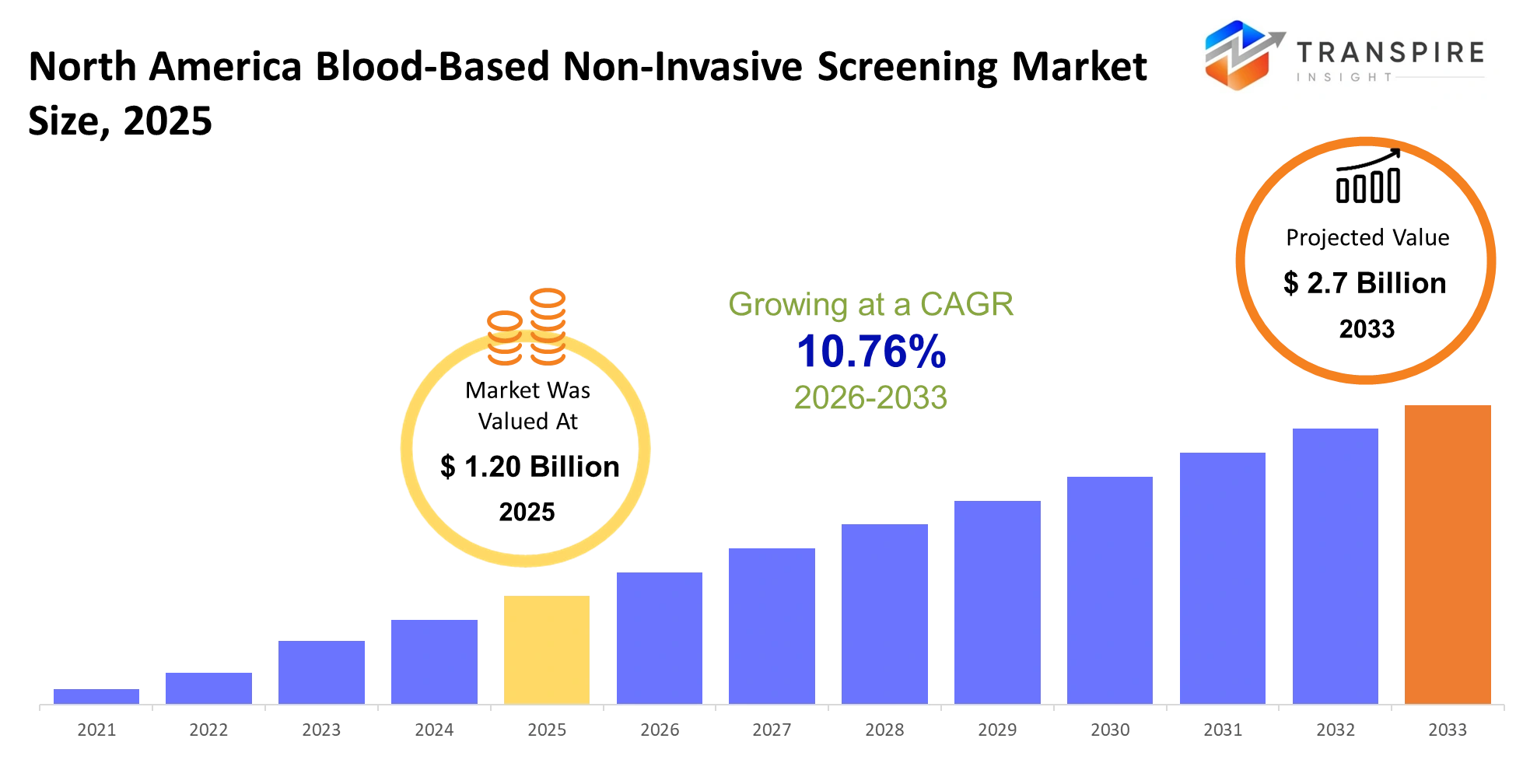
North America Blood-Based Non-Invasive Screening Market Size & Forecast:
- North America Blood-Based Non-Invasive Screening Market Size 2025: USD 1.20 Billion
- North America Blood-Based Non-Invasive Screening Market Size 2033: USD 2.7 Billion
- North America Blood-Based Non-Invasive Screening Market CAGR: 10.76%
- North America Blood-Based Non-Invasive Screening Market Segments: By Test Type (Liquid Biopsy Tests, Prenatal Screening Tests, Cancer Screening Tests, Infectious Disease Screening, Others); By Application (Oncology Screening, Prenatal Testing, Cardiovascular Disease Screening, Others); By End User (Hospitals, Diagnostic Laboratories, Research Institutes, Others); By Technology (NGS-based Testing, PCR-based Testing, AI-enabled Diagnostics, Others).
To learn more about this report,  Download Free Sample Report
North America Blood-Based Non-Invasive Screening Market Summary
The North America Blood-Based Non-Invasive Screening Market was valued at USD 1.20 Billion in 2025. It is forecast to reach USD 2.7 Billion by 2033. That is a CAGR of 10.76% over the period.
The North America Blood-Based Non-Invasive Screening Market, kind of plays a crucial role in helping healthcare providers detect cancer, genetic irregularities, and persistent illnesses sooner, without needing surgical biopsies or those invasive diagnostic steps. Basically you can see hospitals , diagnostic laboratories, and oncology networks leaning more and more on blood-based screening tools lately, mainly because they can speed up diagnosis timelines, boost patient willingness, and also reduce the overall procedural load on healthcare systems. Over the past few years, the market has gradually moved away from experimental precision medicine programs toward broader clinical adoption, especially after liquid biopsy technologies demonstrated solid accuracy , plus faster turnaround times in day-to-day oncology practice .
One major push behind this shift was the backlog in elective procedures and diagnostic testing during the COVID-19 pandemic. Because of that, patients and providers leaned harder into minimally invasive screening choices that can support more decentralized care delivery, rather than waiting for hospital-based workflows . At the same time, expanded reimbursement coverage along with regulatory support for companion diagnostics helped improve commercial readiness for test developers. So, this combination of clinical evidence, payer acceptance, and operational smoothness is gradually encouraging providers to introduce blood-based screening earlier in the patient care path, and that is building steadier revenue streams across diagnostics , laboratory services, and precision oncology platforms.
Key Market Insights
- In 2025, the United States really dominated the North America Blood-Based Non-Invasive Screening Market, with a market share of more than 82% ,mostly because of advanced oncology infrastructure that is already in place.
- Canada meanwhile shows the fastest expansion through 2033, driven by expanding genomic medicine programs and also by provincial healthcare funding efforts, that keep getting refreshed.
- Across North America ,big city healthcare networks are still speeding up the use of liquid biopsy in regular oncology screening pathways, not just special cases.
- In 2025, liquid biopsy tests made up close to 48% of the revenue share, largely due to broad oncology adoption and quicker clinical turnaround times.
- Circulating tumor DNA testing stays as the second-largest segment ,because more hospitals are leaning toward non-invasive genomic profiling tools.
- Looking ahead, multi-cancer early detection screening is projected to become the fastest-growing segment from 2026 to 2033.
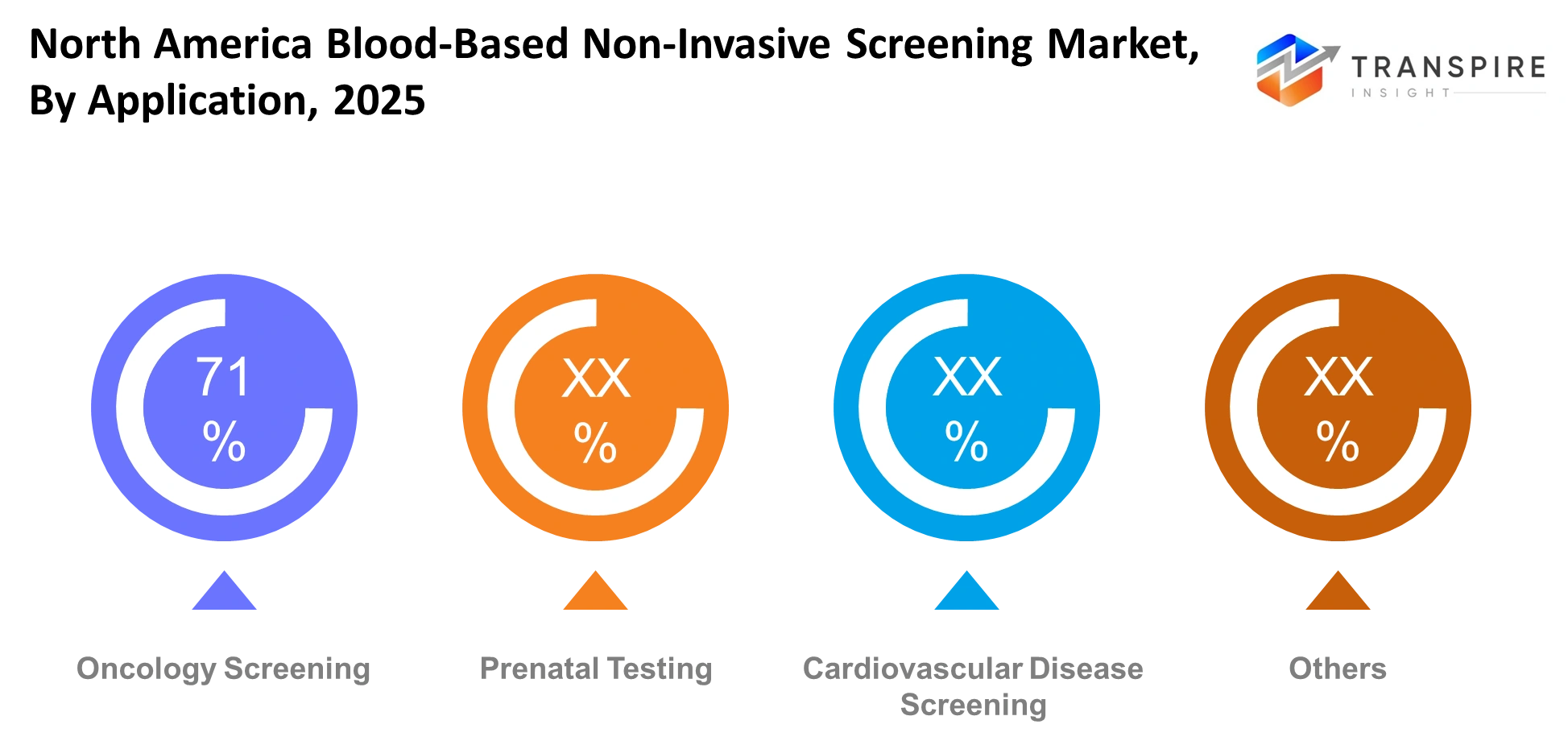
- For 2025, oncology screening held the lead in North America with around 61% share.
- Early-stage lung and colorectal cancer detection programs are continuing to act as strong demand generators for diagnostic laboratories and cancer centers alike.
- Prenatal genetic screening is also starting to look like a high-growth application, as more physicians prefer low-risk fetal testing methods.
- And overall, hospitals plus integrated healthcare systems took the largest market share in 2025, mainly because centralized cancer care infrastructure is more common there.
What are the Key Drivers, Restraints, and Opportunities in the North America Blood-Based Non-Invasive Screening Market?
The main driver pushing the North America Blood-Based Non-Invasive Screening Market, is the quick clinical buy in of liquid biopsy technologies inside oncology care pathways. Over the last five years, hospitals and cancer centers drifted toward blood-based diagnostics, after next-generation sequencing platforms delivered better sensitivity for catching circulating tumor DNA even in early-stage cancers. Also, expanded reimbursement coverage from both public and private payers, helped a lot, because providers can plug these tests into routine cancer monitoring without carrying too much financial burden. This shift bumped up testing volumes across diagnostic laboratories too, and it has been making recurring revenue, tied to ongoing patient surveillance and more precise treatment selection.
The market’s biggest “hold back” is still the uneven standardization of clinical validation and the regulatory approval routes across distinct screening use cases. A lot of blood-based screening tests still need large scale longitudinal evidence to demonstrate clinical utility, especially for multi-cancer detection programs. That becomes a structural barrier, since producing long-term patient outcome proof takes years of trials, major capital outlays, and coordination across healthcare systems. So, several promising technologies end up moving slower, with delayed commercialization schedules and calmer physician adoption even when the technical performance looks strong.
One noticeable opening is starting to show up via AI-powered biomarker analysis platforms, aimed at raising the accuracy of early-stage detection. Firms combining machine learning with multi-omics data are beginning to surface intricate cancer patterns that older screening approaches often overlook, or just fail to reliably capture.In the United States, venture capital funding and pharmaceutical partnerships are kinda accelerating commercialization right now, especially in decentralized diagnostic networks ,and for outpatient oncology programs. It’s moving fast, more operational focus is happening, and the whole push seems aimed at bringing products to market sooner, in that more agile way.
What Has the Impact of Artificial Intelligence Been on the North America Blood-Based Non-Invasive Screening Market?
Artificial intelligence and newer digital technologies are really, quietly boosting how effective marine emission control systems work across North America. More and more shipping operators are leaning on AI-enabled scrubber performance systems to automate exhaust gas cleaning tasks, keep track of sulfur oxide removal rates, and still stay aligned with International Maritime Organization emission rules in real time. An integrated bunch of sensors continuously gathers temperature, pressure, and washwater quality information, and then onboard control platforms, in a mostly hands-off way, automatically tune scrubber settings. That kind of automation lightens crew effort ,and also helps operators dodge expensive compliance breaches during port inspections and cross border operations.
On top of that, machine learning is slowly changing the whole predictive maintenance approach used in exhaust gas cleaning technology. Operators can now study past equipment records to spot recurring signals associated with pump failures, corrosion buildup, or filtration efficiency that’s starting to drift downward before any big malfunction shows up. Several fleet operators say they’ve seen fewer surprise maintenance events and better vessel availability after rolling out predictive analytics platforms connected to centralized fleet management systems. AI-assisted optimization tools are also acting like a second set of eyes, helping shipping companies cut fuel use and operational expenses by coordinating engine loads with scrubber usage behavior, rather than treating them separately.
Even with those gains, AI adoption still hits a major snag related to uneven data quality, especially on older vessel fleets. A lot of ships run with fragmented monitoring setups, so it becomes hard to train dependable machine learning models across all the different maritime operating conditions.High integration costs and intermittent onboard connectivity also continue slowing deployment across mid-sized commercial fleets.
Key Market Trends
- Since 2021, hospitals kinda pushed liquid biopsy adoption more, after pandemic-related diagnostic delays made it more obvious that traditional tissue based cancer testing workflows had limitations.
- Guardant Health and GRAIL, sort of sped up commercialization between 2022 and 2025, through multi cancer early detection trials aimed at asymptomatic patient groups, not just people already showing symptoms.
- Private insurers then expanded reimbursement coverage for circulating tumor DNA testing once the clinical studies looked convincing about stronger relapse monitoring accuracy in actual oncology care.
- Meanwhile, diagnostic laboratories started leaning into automated next generation sequencing platforms , which trimmed turnaround times by almost 30% compared with older more manual workflows.
- Pharmaceutical companies also began partnering with molecular diagnostics firms more often, because companion diagnostics became kind of essential for targeted oncology drug approvals.
- In Canada, provincial genomic medicine investments grew after 2023, and that made adoption pathways stronger, especially for decentralized blood based cancer screening programs.
- AI driven biomarker analysis platforms gained momentum too, since many healthcare providers wanted earlier detection of low signal cancers that conventional screening methods often miss.
- Multi cancer detection programs moved out of pure research environments after large oncology networks integrated blood based screening into preventive care pilot initiatives.
- At the same time, competition shifted away from standalone test accuracy , toward integrated clinical service models, combining diagnostics, patient monitoring, and precision treatment selection know how.
- Finally, independent diagnostic laboratories captured more testing volume as outpatient oncology care kept expanding, beyond centralized hospital based cancer treatment systems.
North America Blood-Based Non-Invasive Screening Market Segmentation
By Test Type
Liquid biopsy tests currently take the lead in market share because they are well integrated into oncology diagnostics and treatment monitoring programs across North America. Adoption rates stay high , largely because circulating tumor DNA can be detected via minimally invasive procedures, so clinicians rely less on surgical tissue biopsies. Big cancer centers and diagnostic laboratories increasingly choose these assays , mainly since faster turnaround helps with earlier treatment decisions as well as ongoing patient tracking over time. With the companion diagnostics and precision medicine programs that keep expanding, overall commercial demand is expected to keep rising through 2033.
Prenatal screening tests keep the second-largest slice of the market, since many healthcare providers keep folding non-invasive prenatal testing into everyday maternal care pathways. Providers favor lower-risk fetal genetic analysis , which helped adoption pick up across obstetric clinics and specialized diagnostic centers. Separately, cancer screening tests are starting to gather more momentum too, because multi-cancer early detection technologies are moving from pilot-style deployments into larger healthcare networks. Infectious disease screening still matters for hospital systems focused on rapid outbreak management and decentralized testing capabilities, but the growth pace is slower compared with the oncology driven categories.
By Application
Oncology screening takes the largest chunk of the application share , mostly because more clinicians are leaning on blood based diagnostics for early cancer finding, relapse monitoring, and also for targeted therapy selection. More reimbursement backing , along with growing trust from physicians in how accurate a liquid biopsy can be, basically boosted adoption through integrated healthcare systems. Big oncology networks now tend to use these screening platforms to squeeze out diagnostic delays and improve patient stratification, especially inside precision treatment programs. Ongoing spending on multi cancer detection technologies should further lock in long term revenue concentration for this portion.
Prenatal testing stays fairly stable and also delivers a high volume of demand, it’s supported by established clinical guidelines and by the continuing growth of maternal health screening efforts. Hospitals plus specialty clinics keep moving forward with adoption , since non invasive testing lowers procedural risks compared with traditional prenatal diagnostic approaches. Cardiovascular disease screening is more like an up and coming chance , as biomarker driven blood testing methods get better at predicting heart disease risk. Product developers and investors are increasingly focusing on this area too, partly because it offers strong future upside tied to preventive healthcare expansion and aging population demographics.
To learn more about this report, Download Free Sample Report
By End User
Hospitals currently dominate end-user demand, because big healthcare systems hold the right infrastructure for advanced molecular diagnostics, oncology treatment coordination, and the kind of high-volume patient testing that keeps moving. Centralized cancer care programs plus integrated laboratory operations still keep pulling strong procurement activity across hospital networks, so it mostly stays there. Diagnostic laboratories land in the second-largest slot as outpatient testing volumes keep climbing and decentralized diagnostic models keep spreading across more urban healthcare markets. At the same time, solid spending on laboratory automation helps speed up processing capacity, and it also broadens regional test availability.
Research institutes keep fueling market momentum via biomarker discovery programs clinical validation studies, and translational medicine initiatives connected to next-generation diagnostics. Academic partnerships with biotechnology firms and pharmaceutical companies are speeding up commercialization timelines for new screening technologies, or so it seems. Independent diagnostic service providers are expected to get more influence in the forecast period as healthcare systems lean toward cost-efficient outpatient testing models. That shift should open up fresh opportunities for scalable testing platforms and laboratory workflow optimization technologies.
By Technology
NGS-based testing, right now leads the technology segment, mainly because next-generation sequencing platforms make it possible to run highly detailed genomic analysis across oncology, prenatal care, and rare disease situations. With broad sequencing capabilities, healthcare providers can screen for several biomarkers at once, which helps raise diagnostic precision and makes treatment personalization more realistic. A lot of large diagnostic labs keep putting money into NGS infrastructure, partly because sequencing costs have been trending downward and reimbursement acceptance keeps getting broader. Going forward, technology providers should increasingly lean into automation plus data interpretation tools so they can scale more easily over the next years.
PCR-based testing still holds a notable market position, mostly due to lower operational costs, quick turnaround, and the fact that many clinicians and labs are already comfortable with the approach. Quite a few healthcare providers continue using PCR systems for targeted genetic analysis and for infectious disease screening, especially when speed matters. Meanwhile AI-enabled diagnostics are showing up as the fastest-growing technology segment, since machine learning platforms help refine biomarker interpretation and improve early disease detection accuracy. Ongoing improvements in computational pathology and multi-omics analytics are also likely to unlock solid investment chances for software developers, diagnostic firms, and precision medicine companies through 2033.
What are the Key Use Cases Driving the North America Blood-Based Non-Invasive Screening Market?
Oncology screening is still kinda the main thing, it drives market uptake across North America , mostly because hospitals and cancer centers are leaning more and more on blood based diagnostic testing for early tumor spotting and relapse tracking. The turnaround times feel faster, and there is less need for surgical biopsies which makes it possible for providers to start targeted therapies earlier, within the patient care cycle.
Prenatal genetic testing and infectious disease screening are also getting a stronger pull now, especially with diagnostic laboratories and outpatient healthcare networks. Maternal health clinics often prefer noninvasive prenatal testing to lower the procedure risks tied to standard fetal diagnostics , while decentralized lab systems keep growing their fast blood based infectious disease screening options.
Newer uses that are starting to show up include neurodegenerative disease detection, plus cardiovascular biomarker screening programs that are supported by AI enabled molecular analysis platforms. Research institutes and precision medicine developers are putting real weight into these themes , since healthcare systems are moving toward predictive diagnostics and more preventive disease management strategies through 2033.
|
Report Metrics |
Details |
|
Market size value in 2025 |
USD 1.20 Billion |
|
Market size value in 2026 |
USD 1.32 Billion |
|
Revenue forecast in 2033 |
USD 2.7 Billion |
|
Growth rate |
CAGR of 10.76% from 2026 to 2033 |
|
Base year |
2025 |
|
Historical data |
2021 - 2024 |
|
Forecast period |
2026 - 2033 |
|
Report coverage |
Revenue forecast, competitive landscape, growth factors, and trends |
|
Regional scope |
North America (Canada, The United States, and Mexico) |
|
Key company profiled |
Guardant Health, Illumina, Roche Diagnostics, Natera, Exact Sciences, Thermo Fisher Scientific, Bio-Rad Laboratories, QIAGEN, Freenome, Grail, Abbott Laboratories, Siemens Healthineers, Danaher Corporation, BGI Genomics, Sysmex Corporation. |
|
Customization scope |
Free report customization (country, regional & segment scope). Avail customized purchase options to meet your exact research needs. |
|
Report Segmentation |
By Test Type (Liquid Biopsy Tests, Prenatal Screening Tests, Cancer Screening Tests, Infectious Disease Screening, Others); By Application (Oncology Screening, Prenatal Testing, Cardiovascular Disease Screening, Others); By End User (Hospitals, Diagnostic Laboratories, Research Institutes, Others); By Technology (NGS-based Testing, PCR-based Testing, AI-enabled Diagnostics, Others). |
Which Regions are Driving the North America Blood-Based Non-Invasive Screening Market Growth?
Oncology screening is still kinda the main use case pushing market adoption across North America, because hospitals and cancer centers are leaning more and more on blood based diagnostics for early tumor finding and relapse tracking. The turnaround time is faster, and providers get to cut down on surgical biopsies , so they can start targeted treatment strategies sooner, earlier in the whole patient care cycle.
Prenatal genetic testing and infectious disease screening are also getting noticeable momentum now, especially with diagnostic labs and outpatient healthcare networks. Maternal health clinics increasingly turn to non-invasive prenatal testing to lower the procedural risks you see with conventional fetal diagnostics, while decentralized lab setups keep growing , and they keep expanding rapid blood based infectious disease screening options.
Other emerging directions include neurodegenerative disease detection and cardiovascular biomarker screening programs, usually powered by AI enabled molecular analysis platforms. Research institutes and precision medicine developers are putting a lot of investment into this, as healthcare systems shift toward predictive diagnostics and preventative disease management strategies through 2033.
Who are the Key Players in the North America Blood-Based Non-Invasive Screening Market and How Do They Compete?
The competitive landscape of the North America Blood-Based Non-Invasive Screening Market still looks moderately consolidated, yet the specialized biotechnology firms keep kinda nudging the traditional diagnostics companies out of place. This happens through rapid innovation cycles, so it not just “who has scale” anymore. More and more, competition leans on clinical accuracy, multi-cancer detection capability, reimbursement access, and the speed of data interpretation rather than pricing alone. Big diagnostics companies are defending their share using integrated sequencing platforms and physician network partnerships, while newer firms lean into AI-driven biomarker discovery and decentralized testing models. You can also see tighter rivalry around proprietary genomic databases and long-term patient monitoring services, because those create stronger, recurring revenue streams.
Guardant Health focuses heavily on technology innovation, particularly liquid biopsy platforms built for near real-time cancer monitoring and therapy selection. The company differentiates itself with extensive clinical validation data and a solid oncology network integration across the United States. GRAIL has also improved its position through multi-cancer early detection programs that can surface cancer signals before symptoms even show up , which gives it a noticeable preventive oncology screening edge. Its expansion efforts seem to center on strategic healthcare partnerships and broader commercialization agreements with hospital systems.
Exact Sciences keeps building market influence via colorectal cancer screening technologies paired with molecular diagnostics capabilities. Strong physician adoption and payer relationships support repeat test utilization across preventive care programs. Illumina maintains a competitive advantage through next-generation sequencing infrastructure that supports scalable genomic testing workflows for laboratories and research institutes. Roche is expanding precision diagnostics capabilities through integrated oncology platforms and companion diagnostic collaborations that improve treatment personalization and clinical decision support.
Company List
- Guardant Health
- Illumina
- Roche Diagnostics
- Natera
- Exact Sciences
- Thermo Fisher Scientific
- Bio-Rad Laboratories
- QIAGEN
- Freenome
- Grail
- Abbott Laboratories
- Siemens Healthineers
- Danaher Corporation
- BGI Genomics
- Sysmex Corporation
Recent Development News
In September 2025, Exact Sciences launched Cancerguard, a multi-cancer early detection blood test.
The launch expanded commercial availability of blood-based screening beyond single-cancer tests, enabling earlier detection of multiple high-mortality cancers through a single draw and strengthening MCED adoption pathways across U.S. provider networks.
Source: https://www.exactsciences.com
In September 2025, Guardant Health entered a strategic partnership with PathGroup.
This collaboration expands availability of the Shield blood test across 250+ hospitals and 25 U.S. states, integrating ordering into hospital workflows and accelerating adoption of blood-based screening in clinical practice.
Source: https://investors.guardanthealth.com
What Strategic Insights Define the Future of the North America Blood-Based Non-Invasive Screening Market?
North America Blood Based Non Invasive Screening Market looks like it is slowly, maybe not so cleanly, moving toward integrated, long-term disease tracking instead of that one-time “diagnose and done” testing style. There are these improvements in multi omics analysis, plus AI led ways to read biomarkers, and also decentralized lab infrastructure. Together they nudge healthcare systems into earlier intervention models that connect to preventive care economics. Over the next five to seven years, reimbursement that actually matches value based healthcare outcomes should become the main driver for commercial take up and for how companies end up competing.
There is also a not so obvious risk, kind of quietly growing. It is the increasing reliance on a small set of sequencing platform providers and proprietary genomic databases. When the infrastructure gets concentrated like that, it can bring pricing pressure, reduce interoperability, and it may even slow innovation across smaller diagnostic firms. Still, at the same time, there is an opening that is showing up more clearly. It is about blood based neurological disease screening, especially for Alzheimer’s risk assessment and early signals of cognitive decline. In practice, companies and investors should push for partnerships with regional healthcare networks and real world evidence programs because long-term clinical proof will likely be what matters most for payer approval and for sustainable revenue growth.
North America Blood-Based Non-Invasive Screening Market Report Segmentation
By Test Type
- Liquid Biopsy Tests
- Prenatal Screening Tests
- Cancer Screening Tests
- Infectious Disease Screening
- Others
By Application
- Oncology Screening
- Prenatal Testing
- Cardiovascular Disease Screening
- Others
By End User
- Hospitals
- Diagnostic Laboratories
- Research Institutes
- Others
By Technology
- NGS-based Testing
- PCR-based Testing
- AI-enabled Diagnostics
- Others
Frequently Asked Questions
Find quick answers to common questions.
The North America Blood-Based Non-Invasive Screening Market size is USD 2.7 Billion in 2033.
Key segments for the North America Blood-Based Non-Invasive Screening Market are By Test Type (Liquid Biopsy Tests, Prenatal Screening Tests, Cancer Screening Tests, Infectious Disease Screening, Others); By Application (Oncology Screening, Prenatal Testing, Cardiovascular Disease Screening, Others); By End User (Hospitals, Diagnostic Laboratories, Research Institutes, Others); By Technology (NGS-based Testing, PCR-based Testing, AI-enabled Diagnostics, Others).
Major North America Blood-Based Non-Invasive Screening Market players are Guardant Health, Illumina, Roche Diagnostics, Natera, Exact Sciences, Thermo Fisher Scientific, Bio-Rad Laboratories, QIAGEN, Freenome, Grail, Abbott Laboratories, Siemens Healthineers, Danaher Corporation, BGI Genomics, Sysmex Corporation.
The North America Blood-Based Non-Invasive Screening Market size is USD 1.20 Billion in 2025.
The North America Blood-Based Non-Invasive Screening Market CAGR is 10.76% from 2026 to 2033.
- Guardant Health
- Illumina
- Roche Diagnostics
- Natera
- Exact Sciences
- Thermo Fisher Scientific
- Bio-Rad Laboratories
- QIAGEN
- Freenome
- Grail
- Abbott Laboratories
- Siemens Healthineers
- Danaher Corporation
- BGI Genomics
- Sysmex Corporation
About the Authors

Pankaj Ghogare Patil
I am Pankaj Ghogare Patil, a Senior Research Analyst at Transpire Insight, specializing in the Pharmaceutical, Chemicals & Materials, Healthcare IT, and Biotechnology industry. My expertise lies in conducting comprehensive market research, analyzing industry trends, evaluating competitive landscapes, and translating complex data into actionable insights. At Transpire Insight, I closely follow emerging technologies, regulatory developments, and market innovations to create accurate, well-researched, and informative content that helps businesses and professionals make informed decisions. I am committed to producing credible, evidence-based articles that reflect industry best practices while making technical topics accessible and valuable for a broad audience.

Chakradhar Khansole
Chakradhar serves as the Research Director at Transpire Insight, bringing over 8 years of experience in technology, innovation, and strategic market intelligence. He specializes in transforming complex market data into actionable business insights that enable organizations to make informed, growth-oriented decisions. Recognized for his strategic vision and analytical expertise, Chakradhar leads high-impact research initiatives, delivering comprehensive market assessments, competitive intelligence, and forward-looking industry analysis.
Recently Published Reports
-
Apr 2026
AI in Diabetic Retinopathy Market
AI in Diabetic Retinopathy Market Size, Share & Analysis Report By Type (Screening AI Systems, Diagnostic AI Systems, and Predictive AI Models), By Application Segment (Hospitals, Ophthalmology Clinics, Diagnostic Centers, and Research and Development), and Geography (North America, Europe, Asia-Pacific, Middle East and Africa, South and Central America), 2021 - 2031
-
Apr 2026
Psychometric Tests Market
Psychometric Tests Market Size, Share & Analysis Report By Type (Personality Tests, Ability/Aptitude Tests, Skill/Knowledge Tests, and Others), By Application (Talent Acquisition and Talent Management), and Geography (North America, Europe, Asia-Pacific, Middle East and Africa, South and Central America), 2021 – 2031
-
Apr 2026
Rare Biological Sample Collection Market
Rare Biological Sample Collection Market Size, Share & Analysis Report By Type (Isolation Kits & Reagent, Blood Collection Tubes, and Others), By Application (Oncology, Transcriptomics, Pharmacogenomics, and Others), and Geography (North America, Europe, Asia-Pacific, Middle East and Africa, South and Central America), 2021 – 2031
-
Jul 2026
Diabetic Retinopathy Market
Diabetic Retinopathy Market Size, Share & Analysis Report By Type (Proliferative Diabetic Retinopathy, and Diabetic Macular Edema (DME)), By Treatment Type (Anti VEGF Drug, Steroid Implants, Laser Surgeries, and Vitrectomy), and Geography (North America, Europe, Asia-Pacific, Middle East and Africa, South and Central America), 2021 – 2031
Our Clients







