North America High Throughput Screening (HTS) Market Size & Forecast:
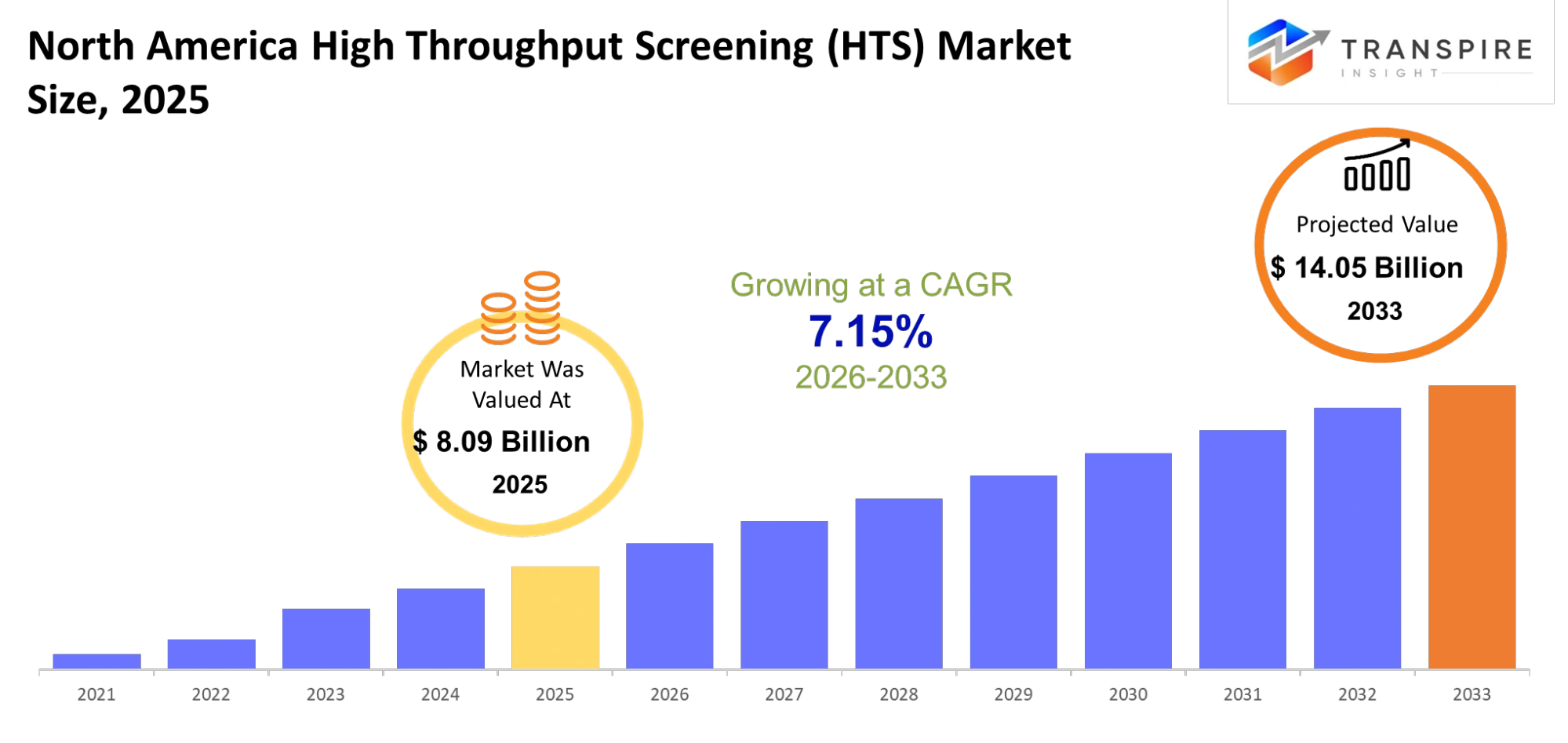
- North America High Throughput Screening (HTS) Market Size 2025: USD 8.09 Billion
- North America High Throughput Screening (HTS) Market Size 2033: USD 14.05 Billion
- North America High Throughput Screening (HTS) Market CAGR: 7.15%
- North America High Throughput Screening (HTS) Market Segments: By Type (Cell-based Assays, Biochemical Assays, Label-free Detection, Others), By Application (Drug Discovery, Genomics, Proteomics, Diagnostics, Others), By End-User (Pharma, Biotech, Research Institutes, CROs, Others), By Technology (Automation Systems, Robotics, Microplate Readers, Imaging Systems, Others).
To learn more about this report,  Download Free Sample Report
North America High Throughput Screening (HTS) Market Summary:
The North America High Throughput Screening (HTS) Market size is estimated at USD 8.09 Billion in 2025 and is anticipated to reach USD 14.05 Billion by 2033, growing at a CAGR of 7.15% from 2026 to 2033. The North America High Throughput Screening (HTS) Market experiences rapid growth because of increasing requirements for fast drug discovery and modern research methods.
Pharmaceutical and biotechnology companies use HTS technologies to speed up their compound screening process while they decrease their development times and boost their research accuracy during initial testing phases. The market expansion receives support from the increasing occurrence of chronic diseases and the demand for personalized medicine because HTS technology allows researchers to conduct extensive biological testing with precise results.
The North America High Throughput Screening (HTS) Market receives benefits from automation and robotics and data analytics advancements which improve operational processes and decrease mistakes made by individuals. Academic research institutes and contract research organizations (CROs) drive market expansion through their growing funding for high-throughput testing systems. The North America High Throughput Screening (HTS) Market will continue to function as an essential element in contemporary life sciences research because the industry maintains its dedication to developing affordable medication solutions through ongoing research activities.
What Has the Impact of Artificial Intelligence Been on the North America High Throughput Screening (HTS) Market?
AI technology is changing the North American high throughput screening market because it enables researchers to make data-based decisions while it enhances their research capabilities. The North American high throughput screening market uses AI applications to provide researchers with advanced data analysis tools which enable them to analyze large biological datasets more precisely and efficiently.
Through machine learning and predictive analytics, companies can identify viable drug candidates faster, optimize assay performance, and improve demand forecasting. The use of artificial intelligence in North America high throughput screening market operations helps organizations conduct market research better while discovering new business opportunities and tracking market development. The North American high throughput screening market experiences operational efficiency enhancements through smart automation systems that AI technology powers.
Automated screening platforms which use intelligent algorithms help organizations increase their production performance because these systems reduce human errors and improve their operational processes. AI-powered supply chain optimization enables businesses to cut costs through better inventory management and more effective resource distribution. The North American high throughput screening market sees its main companies use artificial intelligence because it helps them create new products and create customized drug discovery processes which lead to sustainable market advantages.
Key Market Trends & Insights:
- The United States dominates the north america high throughput screening (HTS) market which will reach 75% of market share through its strong research and development capabilities in 2025.
- The fastest-growing region in Canada benefits from increasing biotech investments which the government supports through its funding programs during the 2025 to 2030 period.
- Consumables dominate the north america high throughput screening (HTS) market which will reach 45% market share in 2025 because laboratories need to restock their equipment.
- The instruments market segment holds the second-highest market share because companies continue to develop better automation solutions and screening systems.
- The software solutions segment will experience the fastest growth until 2030 because AI applications and predictive analytics become more common in the north America high throughput screening (HTS) market.
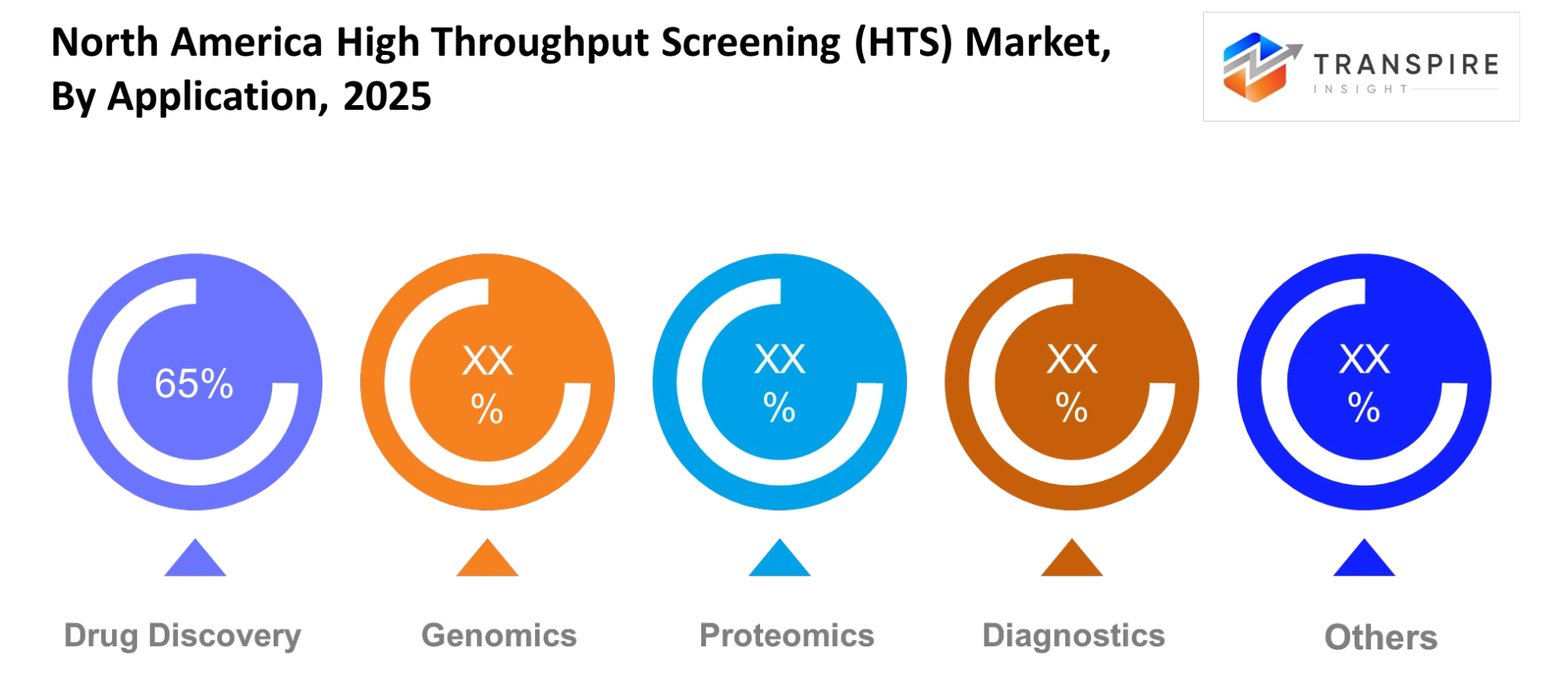
- The drug discovery process dominates all applications because it will reach 60% market share in 2025 due to increasing pharmaceutical research and development expenses.
- The north America high throughput screening (HTS) market experiences its fastest growth through toxicology screening application because of safety evaluation demands and regulatory requirements.
- Pharmaceutical companies lead the north America high throughput screening (HTS) market because their screening operations require more than 50% market share.
- Biotechnology companies that develop new drugs through their innovation pipelines for personalized medicine become the fastest-growing end-user segment.
North America High Throughput Screening (HTS) Market Segmentation
By Type
The screening process uses cell-based assays because these methods enable scientists to study drug effects on actual living cells. The research method enables scientists to study biological functions better which helps them to achieve better results in preliminary research work. Biochemical assays serve to study molecular interactions and enzyme functions while providing exact measurements and dependable outcomes. The testing method will continue to be popular because it offers testing facilities trustworthy results at an affordable price.
Label-free detection methods are gaining attention as these techniques will reduce dependency on chemical labels and allow real-time monitoring. The testing approach will boost testing accuracy while decreasing testing results interference. The testing method includes emerging hybrid technologies that will combine multiple detection systems for enhanced performance. The testing method includes multiple assay types because their ongoing development will improve laboratory testing processes.
By Application
The main purpose of screening systems in drug discovery research which will help researchers discover new drug candidates at a faster pace. The market for this segment will experience consistent growth because research work needs to be completed in shorter timeframes. The genomics applications will conduct gene analysis and sequencing studies to enable researchers to discover genetic differences and disease patterns.
The study of proteomics will analyze protein structures and functions to enhance our understanding of how diseases develop. The development of diagnostics applications will grow through screening tools which enable doctors to identify diseases earlier and create customized treatment plans. The segment will experience growth because more people will begin to focus on preventive health services.
The technology enables testing of environmental and agricultural samples through screening methods which allow scientists to conduct efficient analysis of biological specimens. The expansion of application base across different industries will continue to develop new use cases.
To learn more about this report, Download Free Sample Report
By End-User
Pharmaceutical companies represent a significant customer base because these companies will spend substantial funds on both drug creation and clinical testing. The utilization of screening technologies will enable quicker testing procedures which will lead to better outcomes during trials. The growth of biotech companies occurs through their research activities which develop new treatments for specific medical conditions.
The company will use advanced screening technology to improve its operational efficiency while decreasing the time needed for product development. Research institutes contribute substantial knowledge to the scientific community by performing academic research and clinical investigations.
The contract research organizations (CROs) will deliver outsourced solutions that enable businesses to decrease their expenses while increasing their operational productivity. Government laboratories and private research facilities represent additional customer segments that will use screening systems for various needs. The market will grow because these groups will increase their collaboration efforts.
By Technology
The modern screening processes depend on automation systems which create efficient workflows through automated systems that decrease the need for human work. Robotics technology will enable precise and swift operations because it allows high-volume sample processing with almost no mistakes. Microplate readers are used in laboratories to identify biological reactions because they provide dependable and fast data output.
These technologies will continue to be necessary because they help scientists keep their experiments uniform throughout large-scale testing. Imaging systems provide advanced visualization capabilities which enable scientists to conduct thorough research on human and molecular biological functions. These systems will enable scientists to obtain better results when they study complicated biological information.
The other technologies combine different tools into one platform which will streamline operations through their unified approach. The ongoing development of technology will lead to more people using research tools which will enable scientists to conduct more advanced studies.
What are the Main Challenges for the North America High Throughput Screening (HTS) Market Growth?
The north america high throughput screening (HTS) market growth faces major obstacles because of its technical and operational challenges. The system shows high testing sensitivity which causes unpredictable measurement outcomes while assay tests and data measurements show ongoing reliability problems.
Automation systems require advanced automation systems to achieve optimal results but their current setup creates major delays which impede workflow operations. The north america high throughput screening (HTS) market faces challenges because reagent and instrument supply chain interruptions disrupt its ability to grow and deliver consistent results. The north america high throughput screening (HTS) market expansion faces obstacles through manufacturing and commercialization restrictions.
The combination of high production expenses and GMP compliance requirements and extended validation timeframes creates obstacles that manufacturers must overcome to introduce their products into the market. The market faces limitations because companies must compete with pricing pressures while maintaining product quality. The combination of these elements makes it difficult for companies to introduce new products while creating obstacles that prevent advanced screening methods from reaching their target markets.
The north america high throughput screening (HTS) market faces adoption obstacles because of its inadequate infrastructure and shortage of qualified professionals. Many laboratories struggle with the high cost of implementation and maintenance of advanced screening systems. Small research organizations face adoption barriers because of funding shortages and technical knowledge deficiencies. The north america high throughput screening (HTS) market faces challenges that restrict access and prevent people from using the technology in more spaces.
Country Insights
The United States will drive regional development through its strong pharmaceutical research capabilities and its state-of-the-art laboratory facilities. The market will maintain steady demand because drug discovery investments continue to grow and major biotechnology companies establish operations in the area. The market will expand through research and clinical applications because organizations will use funding programs and they will implement new technology solutions.
Canada will experience continuous development because the government will increase its initiatives and the country will strengthen its research programs in life sciences. Biotechnology startups and academic partnerships will need screening systems because their collaborative efforts will lead to increased demand for those systems. Research organizations will adopt modern laboratory technologies because they will receive better funding options and research grants.
The rest of North America will experience moderate growth because it has insufficient infrastructure and its technology adoption rate progresses at a slow pace. The market will grow because healthcare research facilities improve and people become more aware of their existence. The research capabilities of the organization will grow because it establishes partnerships with external entities.
Recent Development News
In April 2026, Innovative Biotech Firms in the U.S. Drive Advanced Screening Technologies: A 2026 industry report highlighted leading U.S. biotech firms such as Enveda and Faeth Therapeutics for advancing drug discovery platforms. These companies are leveraging automation and data-driven screening methods to accelerate research pipelines and improve efficiency.
Source: https://www.fastcompany.com
In April 2026, Thermo Fisher Reports Strong Q1 2026 Results with Growth in Lab Solutions: Thermo Fisher Scientific announced strong first-quarter 2026 financial results, driven by growth in laboratory products and biopharma services used in drug discovery and screening workflows. The company highlighted steady expansion despite funding pressures in U.S. academic research.
Source: https://ir.thermofisher.com
|
Report Metrics |
Details |
|
Market size value in 2025 |
USD 8.09 Billion |
|
Market size value in 2026 |
USD 8.667 Billion |
|
Revenue forecast in 2033 |
USD 14.05 Billion |
|
Growth rate |
CAGR of 7.15% from 2026 to 2033 |
|
Base year |
2025 |
|
Historical data |
2021 – 2024 |
|
Forecast period |
2026 – 2033 |
|
Report coverage |
Revenue forecast, competitive landscape, growth factors, and trends |
|
Country scope |
North America (Canada, The United States, and Mexico) |
|
Key company profiled |
Thermo Fisher, PerkinElmer, Danaher, Agilent, Bio-Rad, Merck KGaA, Tecan, BMG Labtech, Hamilton, Beckman Coulter, Promega, Corning, Illumina, Qiagen, Sartorius |
|
Customization scope |
Free report customization (country, regional & segment scope). Avail customized purchase options to meet your exact research needs. |
|
Report Segmentation |
By Type (Cell-based Assays, Biochemical Assays, Label-free Detection, Others), By Application (Drug Discovery, Genomics, Proteomics, Diagnostics, Others), By End-User (Pharma, Biotech, Research Institutes, CROs, Others), By Technology (Automation Systems, Robotics, Microplate Readers, Imaging Systems, Others). |
How Can New Companies Establish a Strong Foothold in the North America High Throughput Screening (HTS) Market?
New entrants to the North America high throughput screening market should focus on small market segments which show significant unfulfilled market requirements for both rare disease research and personalized medicine applications. Businesses can create unique market positions through their specialized assessments and their economical testing service offerings which help them compete with other market players. The company will enhance its market position through its innovative implementation of artificial intelligence technologies and its development of miniaturized systems which will help the company achieve faster market expansion.
Businesses in the North America high throughput screening market must develop unique technological solutions in order to create a strong market position. Organizations that develop smart automation systems and machine learning algorithms and advanced data analytics solutions will be able to solve two main operational challenges which involve handling intricate data systems and optimizing operational processes.
The two new companies Insitro and Recursion Pharmaceuticals show how their technology which merges AI with high-throughput systems provides faster drug discovery results through better accuracy. Research organizations pharmaceutical companies and contract research organizations need to establish strategic alliances to expand their operations within the North America high throughput screening industry.
Through their shared efforts, the partners will gain access to financial resources institutional frameworks and specialized knowledge which will help them achieve their product development objectives sooner. Companies that develop solutions for healthcare problems through their quick diagnostic tests and their efficient compound screening methods will establish industry credibility, which will provide them with sustained market advantage.
Key North America High Throughput Screening (HTS) Market Company Insights
Global life science companies and specialized technology providers will create an environment that leads to intense competition. The competition between companies will depend on their product development work and their pricing methods. Companies will work to enhance their screening procedures by developing faster methods and more precise tools. Companies will need to develop their operations by implementing efficient methods which deliver better value to customers.
Companies will continue viewing innovation as their main focus while they put money into automation and data analytics and advanced screening tools. The introduction of faster and more dependable research platforms will enhance research outcomes. The integration of new technologies will enable companies to achieve competitive differentiation. The continuous development of product capabilities will enable a company to achieve sustained growth.
Partnerships will support expansion by providing access to research expertise and infrastructure. Pharmaceutical companies and research institutes will work together to improve their service delivery capabilities and establish their reputation. The use of joint ventures and agreements will lead to reduced expenses for running business operations. The establishment of strong networks will create better opportunities for companies to enter new markets and expand their business operations.
The company will implement expansion strategies which combine entry into new markets with direct research activities in emerging research fields. The company will focus on developing distribution networks and service capabilities to achieve maximum customer reach. Companies will achieve operational growth through an increase in funding and resource availability. The company will achieve its goals through expansion initiatives which will strengthen its market position.
Company List
- Thermo Fisher
- PerkinElmer
- Danaher
- Agilent
- Bio-Rad
- Merck KGaA
- Tecan
- BMG Labtech
- Hamilton
- Beckman Coulter
- Promega
- Corning
- Illumina
- Qiagen
- Sartorius
What are the Key Use-Cases Driving the Growth of the North America High Throughput Screening (HTS) Market?
The north america high throughput screening (HTS) market exists because it plays an essential role in drug discovery and development. Pharmaceutical and biotechnology companies use high-throughput platforms to test thousands of compounds within a short time frame which helps them develop new products faster while achieving higher success rates. The use case enables researchers to identify potential drug candidates more quickly which plays a critical role in developing treatments for chronic illnesses while advancing personalized medicine research.
The genomics and proteomics research use case serves as another important driver for the north america high throughput screening (HTS) market. The screening technologies allow scientists to examine entire gene and protein sequences in order to investigate how diseases work at their most basic molecular structures. The ability to identify specific disease mechanisms through this process enables scientists to create customized medical solutions. The rising funding for life sciences research enables academic and commercial laboratories to adopt these technologies at an increasing rate.
The North American high-throughput screening (HTS) market is expanding its presence in the fields of diagnostics and clinical testing. High-throughput systems enable healthcare personnel to detect diseases in their early stages while identifying biomarkers and processing multiple samples simultaneously which leads to better healthcare results. The growing need for fast and precise diagnostic tests particularly for monitoring infectious diseases is driving this market segment and supporting technological progress.
North America High Throughput Screening (HTS) Market Report Segmentation
By Type
- Cell-based Assays
- Biochemical Assays
- Label-free Detection
- Others
By Application
- Drug Discovery
- Genomics
- Proteomics
- Diagnostics
- Others
By End-User
- Pharma
- Biotech
- Research Institutes
- CROs
- Others
By Technology
- Automation Systems
- Robotics
- Microplate Readers
- Imaging Systems
- Others
Frequently Asked Questions
Find quick answers to common questions.
The approximate North America High Throughput Screening (HTS) Market size for the market will be USD 14.05 Billion in 2033.
The key segments of the North America High Throughput Screening (HTS) Market are By Type (Cell-based Assays, Biochemical Assays, Label-free Detection, Others), By Application (Drug Discovery, Genomics, Proteomics, Diagnostics, Others), By End-User (Pharma, Biotech, Research Institutes, CROs, Others), By Technology (Automation Systems, Robotics, Microplate Readers, Imaging Systems, Others).
Major players in the North America High Throughput Screening (HTS) Market are Thermo Fisher, PerkinElmer, Danaher, Agilent, Bio-Rad, Merck KGaA, Tecan, BMG Labtech, Hamilton, Beckman Coulter, Promega, Corning, Illumina, Qiagen, Sartorius.
The current market size of the North America High Throughput Screening (HTS) Market is USD 8.09 Billion in 2025.
The North America High Throughput Screening (HTS) Market CAGR is 7.15%.
- Thermo Fisher
- PerkinElmer
- Danaher
- Agilent
- Bio-Rad
- Merck KGaA
- Tecan
- BMG Labtech
- Hamilton
- Beckman Coulter
- Promega
- Corning
- Illumina
- Qiagen
- Sartorius
Recently Published Reports
-
Apr 2026
AI in Diabetic Retinopathy Market
AI in Diabetic Retinopathy Market Size, Share & Analysis Report By Type (Screening AI Systems, Diagnostic AI Systems, and Predictive AI Models), By Application Segment (Hospitals, Ophthalmology Clinics, Diagnostic Centers, and Research and Development), and Geography (North America, Europe, Asia-Pacific, Middle East and Africa, South and Central America), 2021 - 2031
-
Apr 2026
Psychometric Tests Market
Psychometric Tests Market Size, Share & Analysis Report By Type (Personality Tests, Ability/Aptitude Tests, Skill/Knowledge Tests, and Others), By Application (Talent Acquisition and Talent Management), and Geography (North America, Europe, Asia-Pacific, Middle East and Africa, South and Central America), 2021 – 2031
-
Apr 2026
Rare Biological Sample Collection Market
Rare Biological Sample Collection Market Size, Share & Analysis Report By Type (Isolation Kits & Reagent, Blood Collection Tubes, and Others), By Application (Oncology, Transcriptomics, Pharmacogenomics, and Others), and Geography (North America, Europe, Asia-Pacific, Middle East and Africa, South and Central America), 2021 – 2031
-
Apr 2026
Patient Lift Pendant Market
Patient Lift Pendant Market By Product Type (Wired Pendants, Wireless, Programmable), By Operation Type(Manual, Electric), By End-Users (Healthcare Professionals, Patients), By Application (Hospitals, Homecare, Rehabilitation Centers, Others), By Industry Analysis, Size, Share, Growth, Trends, and Forecasts 2021-2033
Our Clients
.jpg)