

North America Biological Indicators Market Size & Forecast:
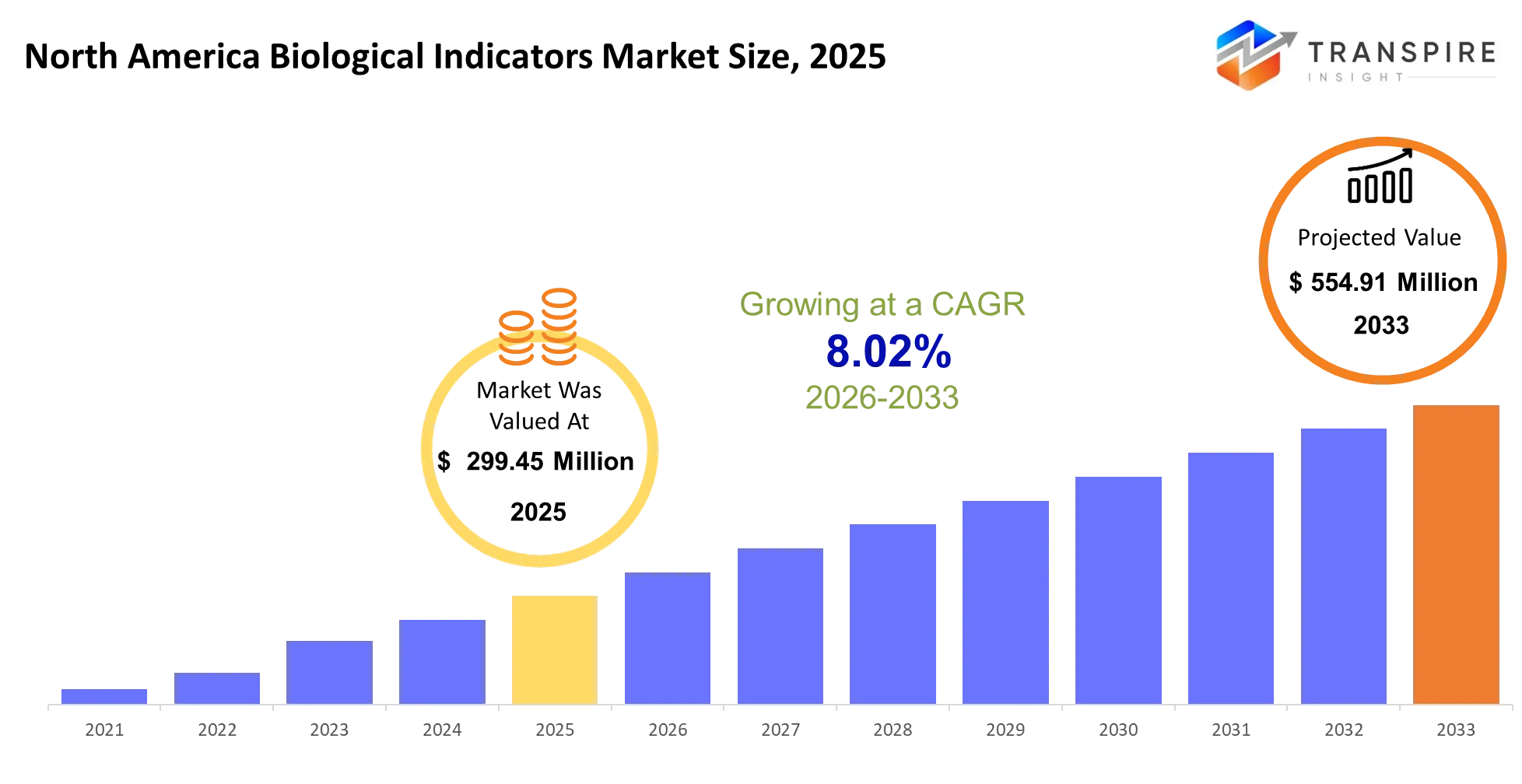
- North America Biological Indicators Market Size 2025: USD 299.45 Million
- North America Biological Indicators Market Size 2033: USD 554.91 Million
- North America Biological Indicators Market CAGR: 8.02%
- North America Biological Indicators Market Segments: By Product Type (Spore Strips, Self-contained Biological Indicators, Suspension Biological Indicators, Others), By Sterilization Method (Steam Sterilization, Ethylene Oxide Sterilization, Hydrogen Peroxide Sterilization, Others), By End User (Hospitals, Pharmaceutical Companies, Medical Device Manufacturers, Others), By Application (Sterility Testing, Validation Monitoring, Infection Control, Others).
To learn more about this report,  Download Free Sample Report
North America Biological Indicators Market Summary:
The North America Biological Indicators Market size is estimated at USD 299.45 Million in 2025 and is anticipated to reach USD 554.91 Million by 2033, growing at a CAGR of 8.02% from 2026 to 2033. In the North America Biological Indicators Market, this whole thing kinda has a big job, mainly to confirm whether sterilization processes in hospitals, pharmaceutical manufacturing facilities, biotechnology labs, and medical device production sites have really wiped out resistant microorganisms. In real practice, biological indicators end up being the last real proof point that a sterilization system is doing what it should be doing. That helps organizations dodge contamination incidents, product recalls, regulatory missteps, and patient safety issues, basically.
In the last three to five years, the market has shifted its shape toward rapid-readout, and also toward biological indicators that are more digitally integrated.The benefit is that validation cycles get shorter, and the compliance documentation becomes easier to automate, kinda like less friction overall. A big driver behind this transition was the sharper focus on infection prevention and sterilization assurance ,after the COVID-19 pandemic. Because of that healthcare providers and life sciences manufacturers started reinforcing their quality control routines more intensely than before. And as regulatory expectations keep getting stricter, and production environments become more complicated, organizations are putting more money into higher-frequency sterilization monitoring. That also means recurring indicator usage goes up, so it generates steady income opportunities across the region, pretty consistent, really.
Key Market Insights
- The United States kind of dominates the North America Biological Indicators Market, with over 80% or so of the regional market share in 2025.
- Canada is showing up as the fastest-growing region, largely backed by investments in healthcare infrastructure, and then also the expanding pharmaceutical manufacturing capacity too.
- Across North America, the regulatory watch stays strong and that keeps pushing demand for biological indicator testing as well as sterilization assurance solutions.
- When it comes to product type, self-contained biological indicators end up leading, and they capture roughly 45% of the total revenue, mainly because they are convenient to operate plus they fit into quicker testing workflows.
- Next in line, spore suspensions take the second-largest slice of the market, and that’s supported by their broad use for sterilization process validation applications.
- In the segments, rapid-readout biological indicators are the fastest-growing during the forecast window, because incubation time is shorter and compliance reporting comes out faster.
- For applications, healthcare and hospital sterilization monitoring still looks like the main driver, making up nearly 50% of the North America Biological Indicators Market revenue.
- On the application side, pharmaceutical manufacturing is described as the fastest-growing piece, since regulatory agencies keep tightening quality assurance expectations.
- Medical device sterilization validation continues to pull in significant demand, mostly due to rising production volumes and compliance duties that don’t really slow down.
- Hospitals and healthcare facilities lead the market, with more than 40% share, which basically reflects ongoing sterilization monitoring needs across facilities.
- Finally, pharmaceutical and biotechnology companies are turning into the fastest-growing end-user category through 2030.
What are the Key Drivers, Restraints, and Opportunities in the North America Biological Indicators Market?
The North America Biological Indicators Market gets its strongest push from the fact that sterilization validation requirements keep getting tighter across healthcare, pharmaceutical, and medical device industries. Regulatory agencies and accreditation bodies have been looking much more closely at contamination control, especially now that infection prevention and product quality are getting even more attention. So, hospitals, drug manufacturers, and device producers end up having to run sterilization verification more often, and with better documentation. Since biological indicators are still the go-to “gold standard” for proving sterilization works, more testing frequency can mean more recurring product use, which then builds a steadier revenue stream for the manufacturers.
The biggest problem, though , is the validation and qualification workload that facilities must complete before they can tweak sterilization monitoring protocols, or even switch to a different indicator approach. Sterilization systems sit inside regulated quality management frameworks, so operational adjustments tend to be slow and costly. Organizations typically need a lot of documentation, staff training, and regulatory checking before anything gets rolled out. Because of this, technology replacement cycles cool down, adoption of advanced biological indicators gets delayed, and near-term revenue growth remains limited even when new innovations are available.
A key growth opening looks like this: rapid-readout biological indicators getting integrated with digital compliance and data management platforms. Pharma and biotech sites are putting more money into automated quality assurance setups that reduce manual recordkeeping and also cut down the time spent preparing for audits.
What Has the Impact of Artificial Intelligence Been on the North America Biological Indicators Market?
Artificial intelligence together with advanced digital technologies are starting to rework the North America Biological Indicators Market, not just by straightening up sterilization monitoring but also by tightening quality assurance workflows and compliance management. In practice, healthcare facilities, pharmaceutical producers, and medical device firms are using AI-enabled quality management platforms more and more , to automate the collection, review and storage of biological indicator test results. These platforms reduce the usual manual paperwork burden and they help organizations keep ongoing regulatory compliance across all those layered sterilization operations, which frankly can get messy fast.
At the same time machine learning models are bringing predictive abilities into the picture, by studying past sterilization cycle records, equipment performance signals, and environmental conditions. Instead of waiting to notice a sterilizer failure after it already happened, facilities can spot recurring patterns that seem linked to process deviations and they can plan maintenance ahead of time before performance slips. This kind of forward-looking approach decreases the chance of surprise downtime, boosts sterilization cycle dependability, and brings down day to day operational expenses. In pharmaceutical manufacturing settings, sophisticated analytics can also fine tune sterilization parameters, and they can speed up batch release decisions, while still holding the quality line.
The operational effect is noticeable. Automated data capture improves audit readiness, cuts down administrative effort, and strengthens traceability across sterilization programs. Still, AI adoption has a real drawback. A lot of healthcare and life sciences facilities run on fragmented legacy systems, so the datasets end up inconsistent. Bringing these new platforms together takes major investment, and when standardized historical data is scarce, it can end up reducing model performance or overall usefulness.
Key Market Trends
- Since 2020, hospitals have been ratcheting up sterilization verification frequency, so biological indicators have moved from what used to be just periodic testing tools, to pretty much routine operational expectations.
- From around 2021 to 2025, rapid-readout biological indicators really started getting traction, mainly because facilities wanted shorter incubation windows, and faster go ahead release decisions.
- During regulatory inspections, the focus keeps leaning more and more toward documented sterilization proof, which in turn made manufacturers put more effort into automated compliance tracking, and electronic record systems more or less.
- Pharmaceutical firms also shifted their spend, away from standalone add ons and toward integrated quality platforms, where biological indicator outcomes are tied in with wider contamination-control efforts.
- Medical device manufacturers expanded their sterilization validation work after supply chain hiccups showed how much money can get lost due to production stops, delays, and recalls.
- Industry players like 3M, STERIS, and Mesa Laboratories have increased their investment in digital monitoring abilities, rather than trying to win purely by selling consumables by themselves.
- Contract sterilization providers leaned into more advanced biological indicators to speed turnaround, which supports the growing outsourcing activity happening across North America.
- Since 2022, healthcare networks have been consolidating procurement, and they tend to prefer vendors that can supply a full sterilization monitoring ecosystem, plus solid technical support, not just a box of indicators.
- Artificial intelligence and predictive analytics are showing up inside quality management systems too, and they help sites spot sterilization process deviations early, before compliance problems turn into actual issues.
- Meanwhile, Canadian pharmaceutical and biotechnology investments have boosted regional uptake, which has nudged demand away from the older hospital-centered buying pattern.
North America Biological Indicators Market Segmentation
By Product Type
In the product type segment, self contained biological indicators do hold the leading market position, mainly because healthcare facilities and life sciences manufacturers prefer integrated formats. They make things simpler for handling, incubation, and even how results get interpreted, more or less. That kind of faster workflow and the lower contamination risk helps, a lot, with broad adoption across routine sterilization validation programs. Spore strips still stay widely used in more established validation protocols, especially when cost sensitivity matters, and when standardized testing procedures set the pace for purchasing decisions. Suspension biological indicators also keep their spot, but more in specialized laboratory and research settings, where precise process assessment is basically non negotiable.
Some other product categories take up a smaller share, yet they do fill niche roles with their own validation requirements that can be pretty different. Over time, growth patterns increasingly swing toward rapid readout options and digitally compatible formats, because organizations want shorter verification cycles and better compliance paperwork. Looking ahead, future development seems to point toward enhanced automation, integrated data capture, and real time reporting capabilities. Manufacturers who align their product portfolios with digital quality systems are likely to improve their competitive positioning. Meanwhile buyers are also shifting priorities, they tend to choose operational efficiency over the initial product cost, even if that costs them a little time to compare.
By Sterilization Method
By sterilization method, steam sterilization kind of sits at the top , because hospitals, surgical centers and even pharmaceutical production sites rely on it heavily. The reliability , the cost effectiveness and the long‑standing regulatory go ahead for steam based processes all add up to steady demand for the related biological indicators. Ethylene oxide sterilization takes the second slot, mostly because a lot of heat sensitive medical devices need low temperature sterilization approaches.
Still, environmental and safety issues around ethylene oxide operations have been getting more attention, which in turn nudges how facilities decide to invest. Hydrogen peroxide sterilization is now looking like the fastest‑growing category as healthcare providers and manufacturers are searching for low temperature alternatives that can wrap up faster, with shorter processing times. Other sterilization methods stay in smaller application lanes but they’re still very relevant for certain materials and specific products. Overall market momentum is leaning toward technologies that blend sterilization effectiveness with operational flexibility. That change opens doors for suppliers working on indicators tuned for modern sterilization platforms and for new validation expectations that keep evolving.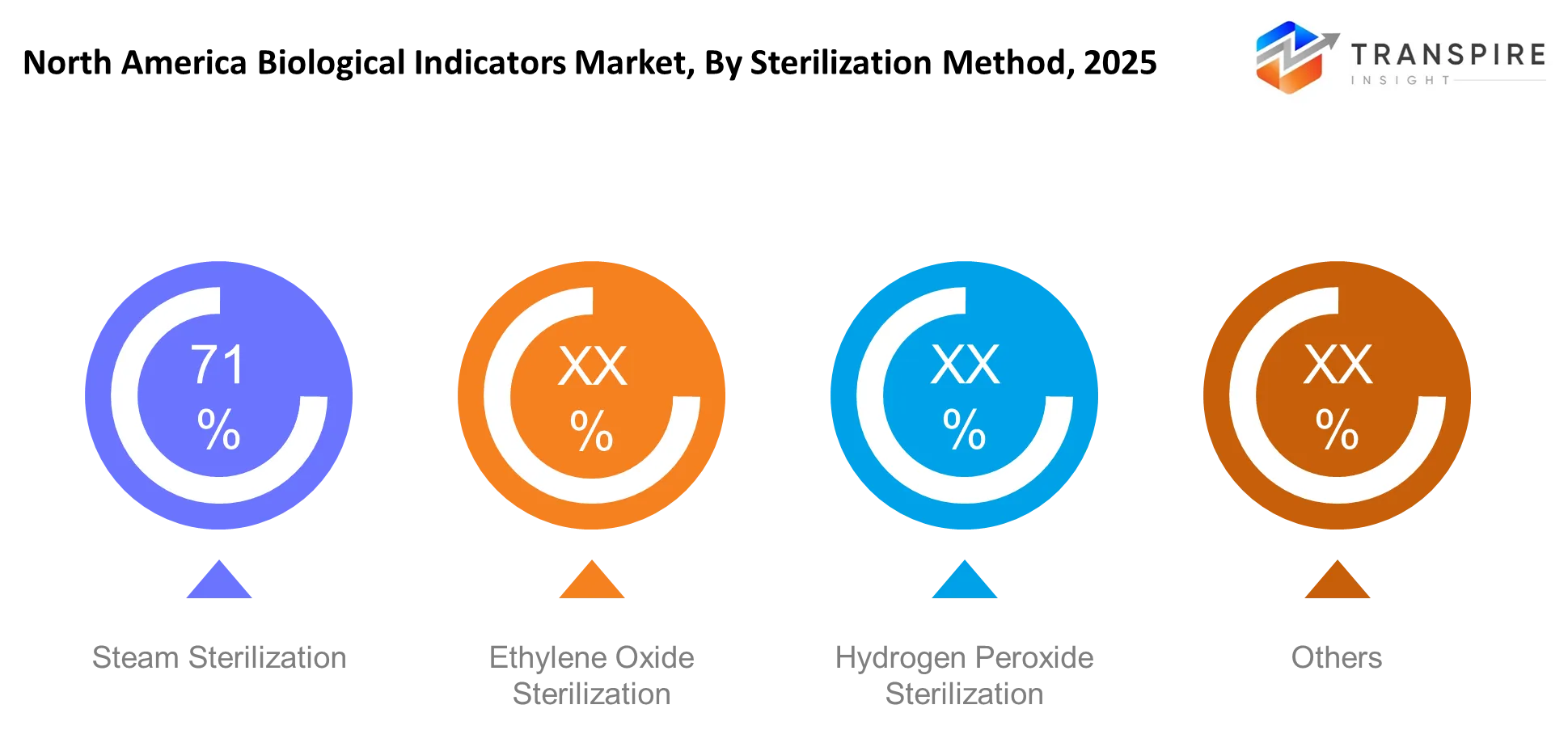
To learn more about this report, Download Free Sample Report
By End-User
The end user landscape is kind of led by hospitals , it’s mostly because they keep needing sterilization again and again, across surgical instruments, reusable medical equipment, and the whole infection prevention thing. Bigger healthcare systems tend to do monitoring activities a lot, so there’s this repeating need for biological indicators and the validation services that go with them , not just the products by themselves. Pharmaceutical companies also show up as a major segment since regulatory agencies keep a close watch over sterile manufacturing environments and contamination control practices.
Medical device manufacturers add meaningful revenue too, mainly from everyday process validation work and product safety verification. Then you have other end users, like research laboratories , contract sterilization providers , and biotechnology organizations. You can see different demand signals across these groups, hospitals often focus more on workflow efficiency , while life sciences groups lean toward regulatory compliance and traceability. Looking ahead , growth should tilt further toward pharmaceutical, biotechnology, and outsourced sterilization operations as production becomes more intricate and quality assurance requirements get more strict .
By Application
In the application segment, validation monitoring sort of takes over because sterilization process verification is still a mandatory requirement across healthcare , pharmaceutical , and medical device industries. Most organizations lean on biological indicators to make sure the process is actually working and to keep up with regulatory expectations, you know. Sterility testing stays pretty important too , especially in pharmaceutical manufacturing and laboratory settings where product safety really depends on a correct contamination assessment. Infection control applications keep growing as healthcare providers push harder on prevention strategies and try to collect measurable evidence of sterilization performance.
Beyond that, there are other uses that focus on specialized research, product development, and quality assurance needs, even the smaller ones. The demand drivers can differ from one application area to another, but in the end they all depend on accurate and reproducible biological verification methods. Looking ahead, market direction seems to point toward tighter integration of monitoring data with digital quality management platforms. These changes are expected to make documentation more efficient, help teams stay ready for audits, and open up new opportunities for suppliers who offer more advanced analytical and reporting capabilities.
What are the Key Use Cases Driving the North America Biological Indicators Market?
The main use case for biological indicators is sterilization validation , in hospitals and surgical centers. Healthcare providers use these small tools to confirm that steam and low temperature sterilization cycles actually wipe out stubborn microorganisms before the instruments can go back into clinical use. Because sterilization is happening all the time, and because accreditation requirements are very strict, this area still becomes the biggest recurring driver of demand.
At the same time, more applications keep showing up in pharmaceutical manufacturing and in medical device production. In practice, drug manufacturers lean on biological indicators to validate sterile manufacturing spaces, and to help with batch release paperwork. Device companies on their side use them to prove the effectiveness of ethylene oxide and hydrogen peroxide sterilization systems throughout production.
Some newer situations are also gaining attention in advanced biologics production facilities, cell and gene therapy manufacturing, and even outsourced sterilization service providers. In those settings, contamination control needs to be more rigorous than ever, and electronic quality documentation matters a lot, so there’s room for rapid readout indicators and digitally connected monitoring systems . These tools make it easier to handle complicated regulatory audits.
|
Report Metrics |
Details |
|---|---|
|
Market size value in 2025 |
USD 299.45 Million |
|
Market size value in 2026 |
USD 323.46 Million |
|
Revenue forecast in 2033 |
USD 554.91 Million |
|
Growth rate |
CAGR of 8.02% from 2026 to 2033 |
|
Base year |
2025 |
|
Historical data |
2021 - 2024 |
|
Forecast period |
2026 - 2033 |
|
Report coverage |
Revenue forecast, competitive landscape, growth factors, and trends |
|
Country scope |
North America (Canada, The United States, and Mexico) |
|
Key company profiled |
3M, Steris, Mesa Laboratories, Getinge, Crosstex International, Propper Manufacturing, Terragene, Cantel Medical, Andersen Products, Tuttnauer, Matachana Group, Hu-Friedy, ASP, Ecolab, GKE GmbH |
|
Customization scope |
Free report customization (country, regional & segment scope). Avail customized purchase options to meet your exact research needs. |
|
Report Segmentation |
By Product Type (Spore Strips, Self-contained Biological Indicators, Suspension Biological Indicators, Others), By Sterilization Method (Steam Sterilization, Ethylene Oxide Sterilization, Hydrogen Peroxide Sterilization, Others), By End User (Hospitals, Pharmaceutical Companies, Medical Device Manufacturers, Others), By Application (Sterility Testing, Validation Monitoring, Infection Control, Others) |
Which Regions are Driving the North America Biological Indicators Market Growth?
The United States still feels like the dominant area within the North America Biological Indicators Market, mostly because it has a very large healthcare infrastructure, a big pharmaceutical manufacturing base and strong regulatory monitoring that doesn’t really ease off. Bodies like the U.S. Food and Drug Administration push for strict sterilization validation rules ,and that ends up helping keep biological indicator usage pretty steady across many different industries. There’s also a well rounded ecosystem of hospitals, medical device companies, biotechnology businesses, along with contract sterilization providers that basically keeps the leadership in place. On top of that, ongoing investment in digital quality management systems and newer sterilization technologies keeps the country ahead.
Canada, meanwhile, is the second-largest regional market though the way it grows isn’t exactly the same as the United States. Expansion here leans less on pure scale and more on dependable healthcare funding, clear regulatory pathways and steady pharmaceutical output. Hospitals and life sciences organizations keep adopting sterilization monitoring solutions to satisfy national quality requirements. That kind of steadiness builds a reliable revenue base ,and it also lowers the chance of sudden procurement changes or compliance curve balls.
Mexico is moving up as the fastest growing region, largely tied to more medical device production and rising foreign investment in healthcare related manufacturing sites. As export focused manufacturing grows so does the need for sterilization validation processes that work internationally. Firms that sell into global markets are strengthening quality assurance systems too, so they match North American rules as well as broader international regulatory expectations.
Who are the Key Players in the North America Biological Indicators Market and How Do They Compete?
In the North America Biological Indicators market the competition is kind of moderately consolidated, not totally, but like a small group of very specialized sterilization and infection prevention companies keeps a big share of the industry revenue. Instead of price being the main thing, people seem to care more about technology performance, regulatory reliability,and how well the products fit into wider sterilization monitoring systems. Older suppliers usually keep their ground using product improvements and longer term customer ties. Meanwhile newer players tend to go after narrower testing needs, plus digital compliance tools, which feels more targeted. And honestly, the purchasing call is now often driven by validation speed, audit readiness, and whether it works with automated quality management platforms too.
3M stands out because of sterilization assurance ecosystems that feel pretty comprehensive, they bundle biological indicators, chemical indicators, monitoring equipment, and even workflow support. With that integrated style, procurement gets less tangled for healthcare networks and pharmaceutical manufacturers, or at least that is the whole pitch. STERIS leans more toward linking biological indicators with sterilization equipment, service contracts,and infection prevention programs, so customers get this bundled service model that supports staying longer. Both companies keep expanding, mostly through technology upgrades aimed at better digital documentation and quicker sterilization verification, even as requirements tighten up.
Mesa Laboratories keeps competing by focusing on biological monitoring and quality control, so they can push resources into rapid readout technologies and solutions that are tied to compliance demands. Getting kind of goes a different route, they mix sterilization equipment knowhow with validation products, which lets customers get a full sterilization workflow from just one supplier. Thermo Fisher Scientific leans on longstanding ties in pharmaceutical and biotechnology production circles, and in those settings the contamination control requirements are still getting tighter and more demanding, it seems. Together these firms are expanding via strategic collaborations, portfolio upgrades ,and getting deeper into pharmaceutical manufacturing, biotechnology, and even outsourced sterilization services, where quality assurance expectations are getting more and more sophisticated over time.
Company List
- 3M
- Steris
- Mesa Laboratories
- Getinge
- Crosstex International
- Propper Manufacturing
- Terragene
- Cantel Medical
- Andersen Products
- Tuttnauer
- Matachana Group
- Hu-Friedy
- ASP
- Ecolab
- GKE GmbH
Recent Development News
In May 2026, Mesa Laboratories Reports Strong Q4 and Fiscal 2026 Results: Mesa Laboratories announced its fourth-quarter and full-year fiscal 2026 financial results, reporting revenue growth of 3.4% year-over-year and a significant increase in operating income. The company highlighted continued demand across its biological indicator and sterilization monitoring businesses in North America, reflecting stable healthcare and pharmaceutical end markets.
Source: https://www.globenewswire.com
In February 2026, Mesa Laboratories announced Third-Quarter FY2026 Revenue Growth: In its third-quarter FY2026 earnings announcement, Mesa Laboratories reported organic revenue growth and strong performance in its Biopharmaceutical Development and Clinical Genomics segments. The company cited stable North American market conditions and continued execution of its sterilization and biological monitoring portfolio strategy.
Source: https://investors.mesalabs.com
What Strategic Insights Define the Future of the North America Biological Indicators Market?
The North America Biological Indicators Market is moving toward a more integrated sterilization assurance model, where biological indicators kind of work as part of a connected quality management ecosystem instead of really being only standalone testing products. The underlying push for this shift is, honestly, the growing need for traceable and audit-ready compliance across pharmaceutical manufacturing, biotechnology production, and even more and more across complex healthcare networks. And as regulatory attention keeps tightening, while production areas get more specialized , the value creation is expected to change. It will be less about consumable volume , and more about data integration, workflow automation, and validation efficiency.
There’s also a less obvious risk sitting in the background, which is market concentration plus technology substitution. Big buyers are starting to consolidate suppliers and they want integrated sterilization monitoring platforms. That can restrict access for smaller manufacturers, and it may also squeeze pricing on more commodity-type products. At the same time, advances in rapid microbiological methods may slowly reduce reliance on certain traditional validation approaches.
Still, a significant emerging opportunity shows up in cell and gene therapy manufacturing, because contamination control expectations there are exceptionally strict. Market participants should focus on partnerships with digital quality management providers, and develop data-enabled indicator solutions that reinforce compliance workflows. In other words, it should be less about competing mainly on product specifications or price, and more about strengthening how the whole compliance process actually runs.
North America Biological Indicators Market Report Segmentation
By Product Type
- Spore Strips
- Self-contained Biological Indicators
- Suspension Biological Indicators
- Others
By Sterilization Method
- Steam Sterilization
- Ethylene Oxide Sterilization
- Hydrogen Peroxide Sterilization
- Others
By End User
- Hospitals
- Pharmaceutical Companies
- Medical Device Manufacturers
- Others
By Application
- Sterility Testing
- Validation Monitoring
- Infection Control
- Others
Frequently Asked Questions
Find quick answers to common questions.
The Approximate North America Biological Indicators Market size for the Market will be USD 554.91 Million in 2033.
The key Segments of the North America Biological Indicators Market are By Product Type (Spore Strips, Self-contained Biological Indicators, Suspension Biological Indicators, Others), By Sterilization Method (Steam Sterilization, Ethylene Oxide Sterilization, Hydrogen Peroxide Sterilization, Others), By End User (Hospitals, Pharmaceutical Companies, Medical Device Manufacturers, Others), By Application (Sterility Testing, Validation Monitoring, Infection Control, Others).
Major players in the North America Biological Indicators Market are 3M, Steris, Mesa Laboratories, Getinge, Crosstex International, Propper Manufacturing, Terragene, Cantel Medical, Andersen Products, Tuttnauer, Matachana Group, Hu-Friedy, ASP, Ecolab, GKE GmbH.
The Current Market size of the North America Biological Indicators Market is USD 299.45 Million in 2025.
The North America Biological Indicators Market CAGR is 8.02%.
- 3M
- Steris
- Mesa Laboratories
- Getinge
- Crosstex International
- Propper Manufacturing
- Terragene
- Cantel Medical
- Andersen Products
- Tuttnauer
- Matachana Group
- Hu-Friedy
- ASP
- Ecolab
- GKE GmbH
About the Authors

Pankaj Ghogare Patil
I am Pankaj Ghogare Patil, a Senior Research Analyst at Transpire Insight, specializing in the Pharmaceutical, Chemicals & Materials, Healthcare IT, and Biotechnology industry. My expertise lies in conducting comprehensive market research, analyzing industry trends, evaluating competitive landscapes, and translating complex data into actionable insights. At Transpire Insight, I closely follow emerging technologies, regulatory developments, and market innovations to create accurate, well-researched, and informative content that helps businesses and professionals make informed decisions. I am committed to producing credible, evidence-based articles that reflect industry best practices while making technical topics accessible and valuable for a broad audience.

Chakradhar Khansole
Chakradhar serves as the Research Director at Transpire Insight, bringing over 8 years of experience in technology, innovation, and strategic market intelligence. He specializes in transforming complex market data into actionable business insights that enable organizations to make informed, growth-oriented decisions. Recognized for his strategic vision and analytical expertise, Chakradhar leads high-impact research initiatives, delivering comprehensive market assessments, competitive intelligence, and forward-looking industry analysis.
Recently Published Reports
-
Jul 2026
Alopecia Treatment Market
Alopecia Treatment Market Size, Share & Analysis Report By Disease Type (Alopecia Areata, Cicatricial Alopecia, Traction Alopecia, Alopecia Totalis, Androgenetic Alopecia, Alopecia Universalis, and Other Disease Types), By Treatment Type (Topical Treatments, Oral Medications, Injectable Therapies, and Hair Transplantation), By Gender (Male, and Female), By Distribution Channel (Hospitals and Clinics, Retail Pharmacies, and Online Retailers), and Geography (North America, Europe, Asia-Pacific, Middle East and Africa, South and Central America), 2021 - 2031
-
Jul 2026
Medical Ultrasound Probe Market
Medical Ultrasound Probe Market Size, Share & Analysis Report By Type (Linear Type, Convex Type, Endocavitary Probe, Phased Array/Cardiac Probe, Transesophageal (TEE) Probe, and Others), By Application (Ophthalmology, Cardiology, Musculoskeletal, Oncology, Obstetrics & Gynecology, General Imaging, and Others), By End User (Hospitals & Clinics, Diagnostic Centers, Ambulatory Surgical Centers, and Others), and Geography (North America, Europe, Asia-Pacific, Middle East and Africa, South and Central America), 2021 – 2031
-
May 2026
Biosimilars Market
Biosimilars Market By Product Type (Monoclonal Antibodies, Recombinant Hormones, Erythropoietin, G-CSF, Others), By Indication (Oncology, Autoimmune Diseases, Blood Disorders, Diabetes, Others), By Manufacturing Type (In-House Manufacturing, Contract Manufacturing), By Distribution Channel (Hospital Pharmacies, Retail Pharmacies, Online Pharmacies), By Industry Analysis, Size, Share, Growth, Trends, and Forecasts 2021-2033
-
Apr 2026
Gastrointestinal Endoscopy Market
Gastrointestinal Endoscopy Market By Type (Rigid Gastrointestinal Endoscope, Flexible Gastrointestinal Endoscopes, Disposable Gastrointestinal Endoscope), By Procedure Type (Colonoscopy, Gastroscopy, Duodenoscopy, Enteroscopy, Flexible Sigmoidoscopy, Others), By Application (Diagnosis, Treatment), By End-Users (Hospitals, Ambulatory Surgical Centers, Specialty Clinics, Laboratories, Others), By Industry Analysis, Size, Share, Growth, Trends, and Forecasts 2021-2033