

North America Antitussive Drugs Market Size & Forecast:
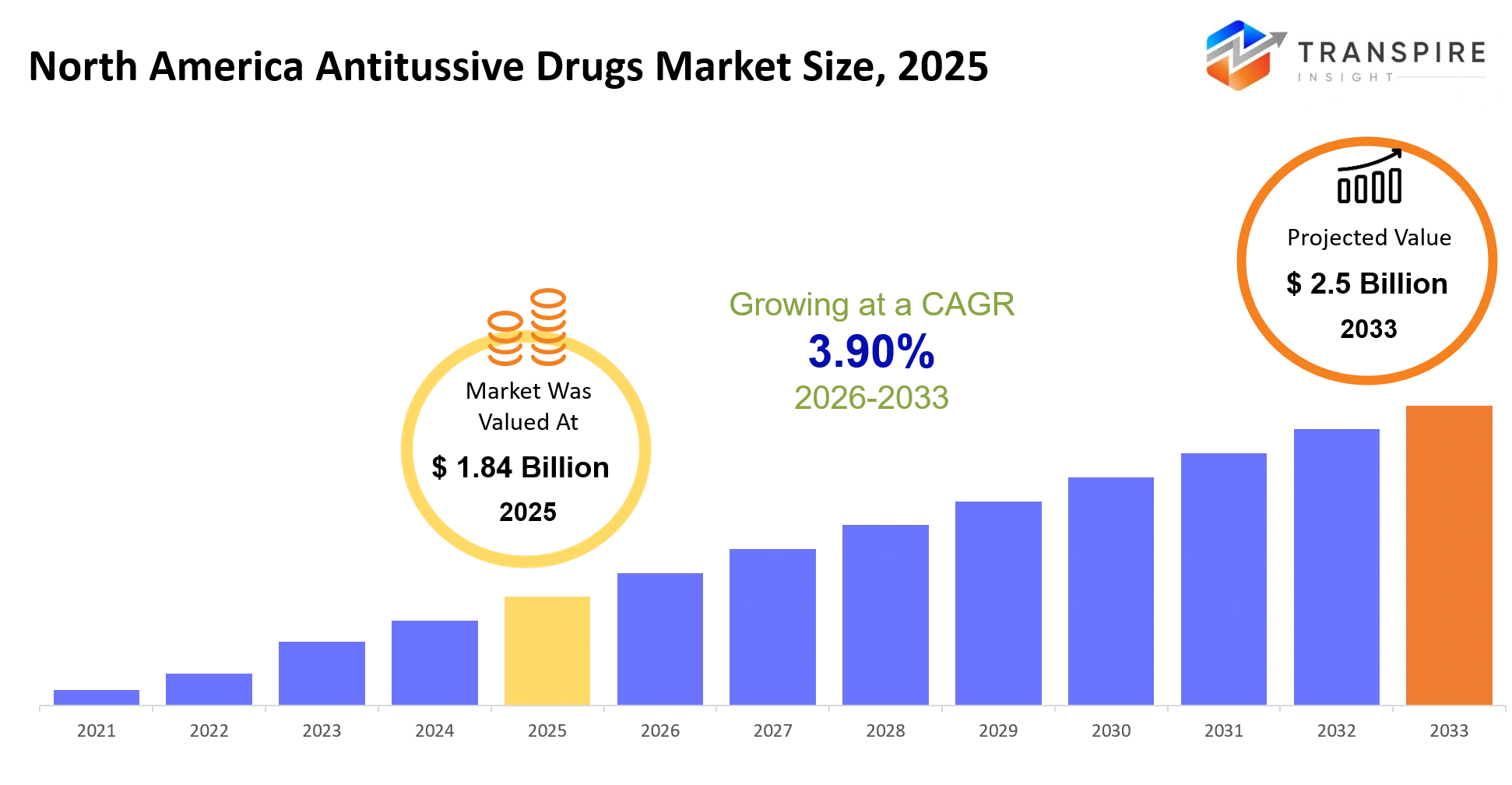
- North America Antitussive Drugs Market Size 2025: USD 1.84 Billion
- North America Antitussive Drugs Market Size 2033: USD 2.5 Billion
- North America Antitussive Drugs Market CAGR: 3.90%
- North America Antitussive Drugs Market Segments: By Drug Type (Dextromethorphan, Codeine-based Drugs, Benzonatate, Antihistamine-based Drugs, Others), By Application (Dry Cough, Chronic Cough, Common Cold, Respiratory Disorders, Others), By Distribution Channel (Hospital Pharmacies, Retail Pharmacies, Online Pharmacies, Others), By End User (Hospitals, Clinics, Home Care Settings, Others).
To learn more about this report,  Download Free Sample Report
North America Antitussive Drugs Market Summary:
The North America Antitussive Drugs Market size is estimated at USD 1.84 Billion in 2025 and is anticipated to reach USD 2.5 Billion by 2033, growing at a CAGR of 3.90% from 2026 to 2033.The North America antitussive drugs market matters a lot when it comes to handling cough symptoms tied to respiratory infections, long term lung conditions, allergies, and those seasonal illnesses that just show up. In real life, these medicines support patients to keep up with day to day activities, sleep a bit better, and also cut down on how much healthcare is used because persistent, or annoying coughing fits are being brought under control. This happens in outpatient places and in home-care routines too, so it feels pretty widespread.
In the last three to five years, the market has sort of changed its structure, moving more toward targeted and non-opioid cough options. Regulators, clinicians, and payers, they have been pushing for safer choices compared with older opioid antitussives. Because of that, product development has leaned into different mechanisms, and companies have put more resources into newer ways of acting. One big real world nudge was the COVID-19 pandemic, it pushed respiratory symptom handling much higher on the priority list, and it also made patients more involved with both prescription cough treatments and regular over the counter products. And as respiratory disease tracking gets more connected, telehealth becomes more normal, and people adopt self-care habits, manufacturers are finding extra revenue paths via easier access to treatment, more distinctive formulations, and a wider way to reach consumers.
Key Market Insights
- The United States kind of dominates the North America Antitussive Drugs Market, grabbing around 80% of the regional market share in 2025 or so.
- Canada stays in second place, backed by solid healthcare access and a steady ramp-up in respiratory care spend, with more and more clinics getting involved.
- Mexico is the fastest-moving regional market through 2032, mainly because healthcare infrastructure is improving , and treatment accessibility is getting wider for patients.
- Overall the North America Antitussive Drugs Market also benefits from established pharmaceutical distribution pathways across many major urban centers.
- Non-opioid antitussive drugs are still leading the pack, with an estimated 55% share in 2025, mostly tied to relatively favorable safety profiles and the usual consumer/clinician comfort.
- OTC cough suppressants sit as the second-largest segment, supported by consumer preference for self managed respiratory care, rather than waiting for appointments.
- Novel targeted antitussive therapies are projected to be the fastest-growing segment during the 2025–2032 forecast stretch.
- At the same time, demand for cough-and-cold combination formulations keeps gaining strength across retail pharmacy channels, even when people are just trying to handle symptoms quickly.
- For applications, acute cough treatment remains dominant, contributing nearly 60% of total market revenue in 2025.
- Chronic cough management is the fastest-growing application area too, driven by the rising diagnosis of respiratory disorders, and clinicians looking more closely.
- Plus, the growing clinical attention to refractory chronic cough is creating new momentum for advanced therapeutic options that go beyond basics.
- Respiratory infection related cough treatments keep generating substantial prescription volumes across North America, and that trend isn’t really fading.
- In terms of channels, retail pharmacies lead with about 48% revenue share, which tracks strongly with sales of OTC products.
- Hospitals and specialty clinics are next as the second-largest end-user group, largely because prescription based treatment demand stays higher there.
What are the Key Drivers, Restraints, and Opportunities in the North America Antitussive Drugs Market?
The strongest growth driver in the North America Antitussive Drugs Market is, sort of, the shift toward non-opioid cough therapies. You can see it in how regulatory scrutiny around opioid use has gotten tighter, plus the ongoing worries about dependency, and misuse, which makes healthcare providers lean toward safer alternatives for both acute and chronic cough management. This pivot has, in practice led to more investment in novel antitussive compounds and also more prescribing activity for non-opioid products. So when pharmaceutical companies roll out differentiated therapies with better safety profiles, they tend to reach larger patient pools and usually better pricing opportunities too which directly supports market revenue growth.
The biggest restraint is this complicated clinical side of chronic and refractory cough, honestly. A lot of patients deal with symptoms that seem tied to more than one underlying condition at once, like asthma, chronic obstructive pulmonary disease, and gastroesophageal reflux disease. That kind of creates a structural issue because effective management often hinges on pinning down and then treating the true cause , rather than just muting the cough reflex. As a result treatment timelines drag on, therapeutic outcomes can be a bit all over the place, and new product uptake tends to slow down in certain patient segments, which then kinda caps revenue expansion.
A key future opportunity comes from targeted therapies for chronic cough that are built around emerging neurosensory mechanisms. You can already see this direction in the investment into P2X3 receptor antagonists. As the clinical evidence keeps strengthening and regulatory approvals widen, these therapies may help patients who currently have few real options, and that could form a new, higher-value growth segment across North America.
What Has the Impact of Artificial Intelligence Been on the North America Antitussive Drugs Market?
Artificial intelligence and advanced digital technologies, kind of, are reshaping the North America Antitussive Drugs Market by enhancing drug discovery, speeding clinical development and also touching the commercial side of things. More and more pharmaceutical companies seem to be leaning on AI driven screening platforms, to parse big molecular datasets and lift cough suppression candidates faster than the older, more traditional pathway . This kind of automation trims early stage research timelines, and it also supports research groups in prioritizing compounds with better odds for clinical success , rather than burning time on the wrong leads.
Then there is machine learning, which is boosting predictive ability across the whole clinical development phase. In practice, researchers use AI to pick out patient subgroups that are most likely to respond to specific antitussive therapies, and that tweaks trial design in a favorable way. At the same time it reduces recruitment inefficiencies, which can be a huge pain during study execution. Real world evidence platforms also come into play , they analyze electronic health records and prescription data to anticipate treatment outcomes. From there they help optimize dosing strategies and strengthen post-market surveillance. These features can compress development timelines, strengthen regulatory submissions, and lower overall R&D costs.
On the operational level, advanced analytics kind of support manufacturers with inventory planning, demand projection, and supply chain oversight, all that. When forecasting is better, companies usually see fewer stockouts and less surplus inventory, and at the same time improve product availability across retail plus hospital channels. So it is not only about the science, but also about keeping the product where it really needs to be.
Still, one big obstacle stays data quality and integration. People who get chronic cough often have several underlying conditions at the same time, so the datasets can end up kind of fragmented across different healthcare systems. If the clinical data is messy or inconsistent, the model performance drops, and those AI powered predictions turn out to be less useful. That, in turn slows adoption more broadly, even if the technical potential looks very strong on paper.
Key Market Trends
- Since 2020, healthcare providers kinda seemed to favor non-opioid antitussives more and more, so in turn their reliance on codeine containing products dropped, especially once prescribing oversight got stricter.
- Between 2021 and 2025 , a bunch of clinical development activity sorta leaned toward P2X3 receptor antagonists, and that sideways shift opened up fresh treatment routes for people with refractory chronic cough, you know.
- Manufacturers increasingly lean on real world evidence along with electronic health record analytics, then it helps in regulatory filings while also fine tuning how they actually recruit trial participants.
- After the pandemic sped up the general move toward self managed respiratory symptom treatment, retail pharmacy channels gained more strength influence in the market.
- Telehealth adoption grew a lot after 2020, so diagnosis could happen faster, and prescription access for both acute and chronic cough conditions became easier, somehow.
- Pharmaceutical companies , including Pfizer, Sanofi, and GSK, ramped up investment in respiratory portfolios that feel more differentiated, so they can remain competitive.
- Regulatory scrutiny around opioid containing cough suppressants intensified, and as a knock on effect, manufacturers tried to reformulate products, plus they diversified their therapeutic lineups.
- Strategic partnerships between biotechnology firms and big pharmaceutical companies increased after 2022, mainly to speed up novel antitussive drug development, basically.
- Supply chain strategies also evolved, kind of, manufacturers started diversifying their active pharmaceutical ingredient sourcing to lower disruption risks and well, those risks became painfully obvious during COVID 19, sort of all at once.
- Then later, after 2021 AI enabled drug discovery platforms got broader adoption , which helped speed up candidate screening time lines and generally improved overall R and D productivity, you know.
North America Antitussive Drugs Market Segmentation
By Drug Type
For drug type, dextromethorphan keeps a kind of leading edge mostly because it is widely sold over the counter, it has solid track record for quelling acute cough signs, and consumers already know it well. Antihistamine-based products also grab a meaningful portion , since clinicians often steer patients toward combined formulations for coughs tied to allergies plus upper respiratory infections. Codeine-based options still matter for some patient groups, yet stricter prescribing rules and worries about misuse have slowed any broad growth.
Benzo natate has drawn more notice as a non-opioid prescription alternative, especially when the goal is to manage a cough that just will not go away . Other emerging therapies, even things like targeted approaches for chronic cough, are showing up as the fastest expanding lane, because pharmaceutical companies are investing in distinct mechanisms of action. Looking ahead, growth in this segment will likely hinge on safer formulations, better clinical results ,and newer therapies that can tackle chronic or refractory cough conditions that still are not well served by standard medications.
By Application
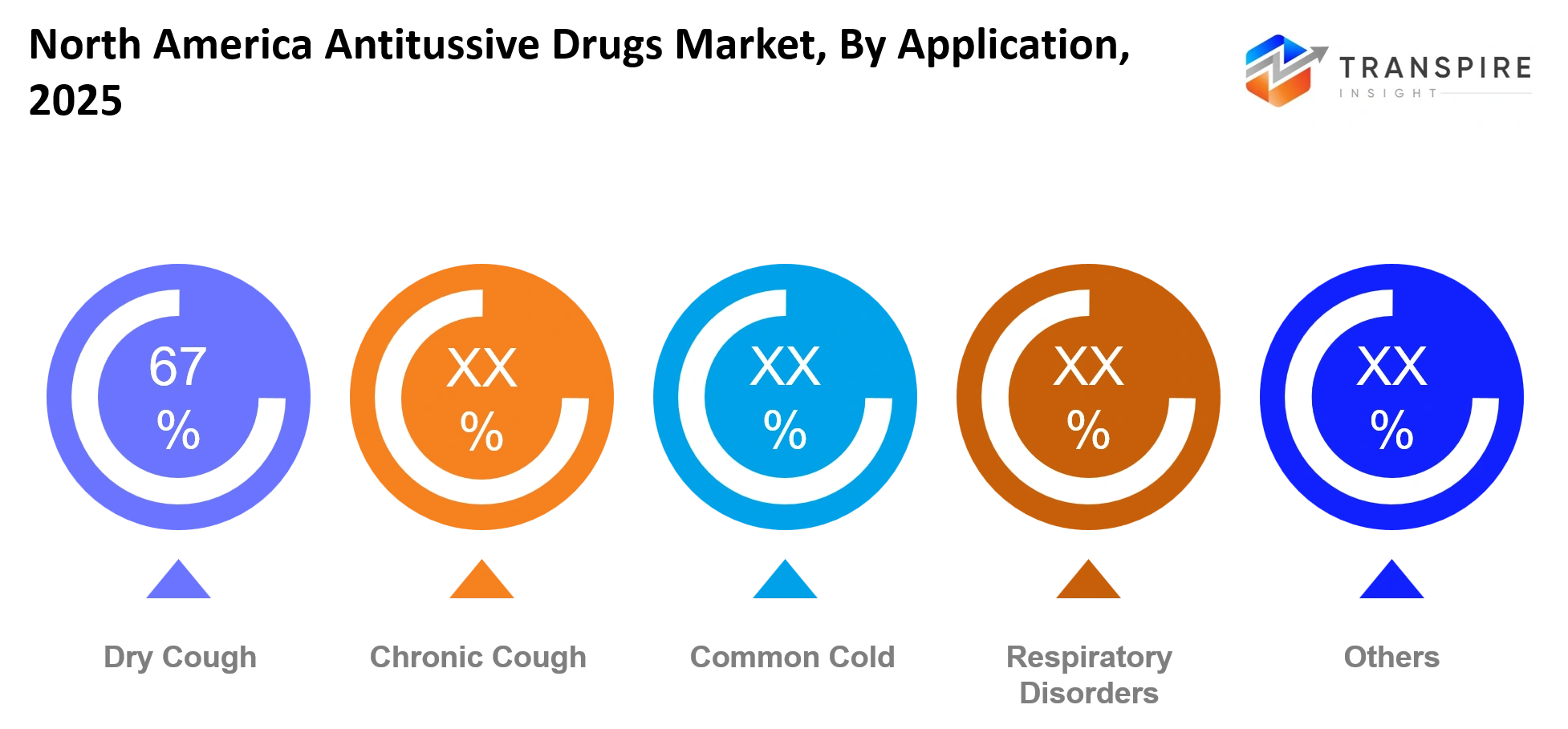
Through application, dry cough seems to take the largest share, mostly because it is tied to one of the usual signs seen with viral infections, seasonal illnesses, and that sort of environmental irritant stuff. The common cold cough treatment side also adds a lot to market revenue, since people keep coming back, and products stay broadly available. For respiratory disorders, like asthma and chronic obstructive pulmonary disease, there’s a fairly steady demand base for prescription antitussive therapies, while chronic cough is showing up as the quickest-growing application category.
This shift in chronic cough treatment really tracks better diagnosis rates, plus the growing acknowledgement of refractory cough as its own clinical entity. Still, the other applications keep offering smaller but useful openings, especially in focused respiratory care settings. Looking forward, companies are expected to concentrate on targeted therapies, and more precise treatment methods aimed at specific cough pathways, which should open up fresh business chances and help improve patient outcomes across a range of complicated respiratory problems.
To learn more about this report, Download Free Sample Report
By Distribution Channel
In terms of distribution channel , retail pharmacies still dominate the market a bit too, because most consumers keep buying cough medications without really going through heavy clinical intervention. They also benefit from strong geographic coverage trusted pharmacy brands, and of course the convenient access people want. Hospital pharmacies stay relevant as well, especially when it comes to prescription antitussives for more severe respiratory conditions, plus the after-therapy follow ups. Then online pharmacies are the fastest-growing path, mainly because digital healthcare adoption is expanding and people just want easier purchasing options.
With better e-commerce infrastructure , home-delivery services and telehealth integration basically working together, online access to medications has gotten a lot better across North America. A couple other distribution lanes still take a smaller slice, but they remain meaningful in those specialized healthcare settings. Looking ahead , the back and forth between channels will probably center on digital outreach, inventory efficiency, and more joined-up patient care services, which in turn nudges pharmaceutical companies toward omnichannel strategies that actually match how people are buying these products now.
By End User
By end user, hospitals seem to be the leading segment, mostly because complicated respiratory cases often need physician directed treatment , prescription therapies, and continuous clinical surveillance. Clinics, too, make up a sizeable portion, they tend to be the main touchpoints for assessing and handling acute as well as long term cough issues. Home care settings are moving the quickest these days. That is largely tied to healthcare systems pushing outpatient management, plus patients increasingly depend on self administered treatments, that are reinforced through telehealth support. Also, better access to effective over the counter products and remote consultation platforms has really helped this momentum.
Other end users, like long term care facilities and specialty respiratory centers, keep bringing steady demand for focused therapies. Going forward, market development will more and more lean toward solutions that back decentralized care delivery, raise treatment adherence, and lower the use of healthcare resources, which should open up opportunities for manufacturers that tune their product portfolios to the changing patient management models.
What are the Key Use Cases Driving the North America Antitussive Drugs Market?
So, the main use case for antitussive medicines is really about handling acute, dry cough that shows up with viral respiratory infections, seasonal influenza, and those common cold episodes . This kind of use case tends to be the biggest driver, mostly because it touches a huge number of people and it leads to repeat buying, especially through retail pharmacies and also primary care settings (which is where a lot of it starts, you know).
Then there’s expansion too, like chronic cough management in respiratory care. You also see it used for symptom control in patients with asthma, chronic obstructive pulmonary disease, and allergy related conditions. In other words, hospitals, specialty clinics and outpatient respiratory centers are prescribing more targeted cough therapies lately, aiming to improve patient comfort and lower the number of visits that happen just because symptoms keep flaring up.
And the emerging stuff, that’s more about refractory chronic cough and cough hypersensitivity syndrome. These are conditions that, historically , have had very limited workable treatment options. Newer developments in neurosensory targeted therapies and precision medicine strategies are making it more plausible to help those underserved groups, and that could, during the forecast period, create fresh high value segments .
|
Report Metrics |
Details |
|
Market size value in 2025 |
USD 1.84 Billion |
|
Market size value in 2026 |
USD 1.912 Billion |
|
Revenue forecast in 2033 |
USD 2.5 Billion |
|
Growth rate |
CAGR of 3.90% from 2026 to 2033 |
|
Base year |
2025 |
|
Historical data |
2021 - 2024 |
|
Forecast period |
2026 - 2033 |
|
Report coverage |
Revenue forecast, competitive landscape, growth factors, and trends |
|
Country scope |
North America (Canada, The United States, and Mexico) |
|
Key company profiled |
Pfizer, Johnson & Johnson, GSK, Sanofi, Reckitt Benckiser, Bayer, Procter & Gamble, Cipla, Teva Pharmaceuticals, Novartis, Sun Pharmaceutical, Hikma Pharmaceuticals, Bausch Health, Perrigo, Viatris. |
|
Customization scope |
Free report customization (country, regional & segment scope). Avail customized purchase options to meet your exact research needs. |
|
Report Segmentation |
By Drug Type (Dextromethorphan, Codeine-based Drugs, Benzonatate, Antihistamine-based Drugs, Others), By Application (Dry Cough, Chronic Cough, Common Cold, Respiratory Disorders, Others), By Distribution Channel (Hospital Pharmacies, Retail Pharmacies, Online Pharmacies, Others), By End User (Hospitals, Clinics, Home Care Settings, Others). |
Which Regions are Driving the North America Antitussive Drugs Market Growth?
The United States looks like the leading region in the North America Antitussive Drugs Market because it has a huge patient population, pretty advanced healthcare infrastructure, and a strong pharmaceutical innovation ecosystem. There is also extensive insurance coverage for prescription therapies and , on top of that , a wide retail pharmacy footprint, so treatment volumes stay high for both acute and chronic cough indications. On the clinical side the country benefits from a lot of ongoing research, which tends to speed up the arrival of fresh antitussive options. And with big pharmaceutical manufacturers plus specialty respiratory care providers staying involved, it keeps the market leadership pretty firmly in place, even when trends shift a bit.
Canada sits as the second-largest regional market, but the reason it grows is not only because of total size. Instead, growth comes from how stable the healthcare system feels day to day. Publicly funded healthcare programs keep access to respiratory treatments consistent, and that creates predictable demand across different provinces. Regulatory pathways also focus on patient safety and evidence-based prescribing, so adoption of newer therapies happens at a steadier pace. Overall this mix of economic staying power and organized healthcare delivery turns Canada into a dependable contributor to regional revenue.
Mexico, meanwhile, is emerging as the fastest-growing market. That happens as healthcare access expands and pharmaceutical distribution networks reach a wider patient base. Investments in healthcare infrastructure have helped, and the increasing availability of both prescription and over-the-counter respiratory treatments has improved market penetration in recent years. Diagnosis rates for respiratory conditions are rising, and multinational drug manufacturers are participating more , so the growth momentum keeps building. For investors and other market entrants, Mexico offers major expansion opportunities .
Who are the Key Players in the North America Antitussive Drugs Market and How Do They Compete?
In the North America Antitussive Drugs Market, competition is sort of moderately consolidated, with the large pharmaceutical and consumer health players holding onto a big slice of sales via established brands, distribution routes, and regulatory savvy. A lot of the rivalry now is more about product differentiation , whether the clinical outcome is solid, and how safe the options feel, not only about price. Incumbent companies tend to protect their market share by broadening non-opioid treatment collections and then putting money into therapies aimed at chronic cough or cough that just wont respond, so easy. Meanwhile, biotechnology firms that are building novel mechanisms of action add pressure too , by focusing on patient groups that have previously had few if any truly effective choices.
Pfizer leans hard into research led innovation and leans on its deep clinical development muscle to strengthen its respiratory offering. It differentiates itself through a big research setup and broad physician engagement initiatives that help new therapies get adopted. Sanofi kind of blends prescription know how with consumer healthcare experience, which lets it push further across both physician guided and self care channels. By making strategic investments in consumer health products and digital engagement tools, Sanofi stays visible for different patient segments at the same time. Bayer, on the other hand, keeps to a brand first posture built around over the counter respiratory products, and it leans on pharmacy relationships and consumer confidence to keep shelf space and drive repeat buying.
Company List
- Pfizer
- Johnson & Johnson
- GSK
- Sanofi
- Reckitt Benckiser
- Bayer
- Procter & Gamble
- Cipla
- Teva Pharmaceuticals
- Novartis
- Sun Pharmaceutical
- Hikma Pharmaceuticals
- Bausch Health
- Perrigo
- Viatris
Recent Development News
In April 2026, Sensodyne maker Haleon warned of rising costs, but kept 2026 outlook as U.S. rebounds: Haleon reported first-quarter 2026 results showing North American growth despite a weak respiratory season. The company highlighted continued investment in distribution expansion and commercial initiatives across its consumer health portfolio. The announcement is relevant to the antitussive market because cough and cold products remain an important component of seasonal OTC respiratory care demand in North America.
Source: https://www.reuters.com
In February 2026, Sensodyne maker Haleon forecast below-target 2026 growth on weak demand in the U.S.: Haleon, whose consumer healthcare portfolio includes respiratory and cough-related OTC products in North America, reported weaker U.S. demand following a mild cold and flu season. The company nevertheless maintained its long-term growth strategy and announced a £500 million share buyback program. The update is significant because seasonal respiratory illness trends directly influence demand for cough suppressants and related antitussive products in the U.S. and Canada.
Source: https://www.reuters.com
What Strategic Insights Define the Future of the North America Antitussive Drugs Market?
The North America Antitussive Drugs Market is sort of structurally shifting into precision led , non opioid respiratory therapies as clinical practice moves away from symptom suppression and toward treatment that’s more mechanism specific. Theres also a regulatory kind of caution on opioid exposure, and you see more biomarker informed respiratory diagnostics getting integrated into specialty care , and all of that pushes manufacturers into targeted innovation instead of broad spectrum formulations.
There’s a risk that’s less obvious but still real, it comes from substitution pressure by emerging biologics and neuromodulatory devices. They might bypass the usual antitussive pathways completely , and if clinicians start adopting these faster than expected , some chronic cough drug classes could get therapeutically displaced even though short term demand signals look strong right now.
Another opportunity is building around neurosensory targeted small molecules. In particular , P2X3 pathway inhibitors are moving through late stage trials and getting early commercialization in specialized respiratory centers. These options are likely to reshape treatment algorithms for refractory chronic cough, especially across tertiary care networks throughout the United States. Market participants should focus on portfolio repositioning toward mechanism specific respiratory assets and start investing early in real world evidence generation. The goal is to secure formulary access and gain physician trust before broader therapeutic disruption becomes more widespread.
North America Antitussive Drugs Market Report Segmentation
By Drug Type
- Dextromethorphan
- Codeine-based Drugs
- Benzonatate
- Antihistamine-based Drugs
- Others
By Application
- Dry Cough
- Chronic Cough
- Common Cold
- Respiratory Disorders
- Others
By Distribution Channel
- Hospital Pharmacies
- Retail Pharmacies
- Online Pharmacies
- Others
By End User
- Hospitals
- Clinics
- Home Care Settings
- Others
Frequently Asked Questions
Find quick answers to common questions.
The approximate North America Antitussive Drugs Market size for the market will be USD 2.5 Billion in 2033.
The key segments of the North America Antitussive Drugs Market are By Drug Type (Dextromethorphan, Codeine-based Drugs, Benzonatate, Antihistamine-based Drugs, Others), By Application (Dry Cough, Chronic Cough, Common Cold, Respiratory Disorders, Others), By Distribution Channel (Hospital Pharmacies, Retail Pharmacies, Online Pharmacies, Others), By End User (Hospitals, Clinics, Home Care Settings, Others).
Major players in the North America Antitussive Drugs Market are Pfizer, Johnson & Johnson, GSK, Sanofi, Reckitt Benckiser, Bayer, Procter & Gamble, Cipla, Teva Pharmaceuticals, Novartis, Sun Pharmaceutical, Hikma Pharmaceuticals, Bausch Health, Perrigo, Viatris.
The current market size of the North America Antitussive Drugs Market is USD 1.84 Billion in 2025.
The North America Antitussive Drugs Market CAGR is 3.90%.
- Pfizer
- Johnson & Johnson
- GSK
- Sanofi
- Reckitt Benckiser
- Bayer
- Procter & Gamble
- Cipla
- Teva Pharmaceuticals
- Novartis
- Sun Pharmaceutical
- Hikma Pharmaceuticals
- Bausch Health
- Perrigo
- Viatris
About the Authors

Pankaj Ghogare Patil
I am Pankaj Ghogare Patil, a Senior Research Analyst at Transpire Insight, specializing in the Pharmaceutical, Chemicals & Materials, Healthcare IT, and Biotechnology industry. My expertise lies in conducting comprehensive market research, analyzing industry trends, evaluating competitive landscapes, and translating complex data into actionable insights. At Transpire Insight, I closely follow emerging technologies, regulatory developments, and market innovations to create accurate, well-researched, and informative content that helps businesses and professionals make informed decisions. I am committed to producing credible, evidence-based articles that reflect industry best practices while making technical topics accessible and valuable for a broad audience.

Chakradhar Khansole
Chakradhar serves as the Research Director at Transpire Insight, bringing over 8 years of experience in technology, innovation, and strategic market intelligence. He specializes in transforming complex market data into actionable business insights that enable organizations to make informed, growth-oriented decisions. Recognized for his strategic vision and analytical expertise, Chakradhar leads high-impact research initiatives, delivering comprehensive market assessments, competitive intelligence, and forward-looking industry analysis.
Recently Published Reports
-
Jul 2026
Alopecia Treatment Market
Alopecia Treatment Market Size, Share & Analysis Report By Disease Type (Alopecia Areata, Cicatricial Alopecia, Traction Alopecia, Alopecia Totalis, Androgenetic Alopecia, Alopecia Universalis, and Other Disease Types), By Treatment Type (Topical Treatments, Oral Medications, Injectable Therapies, and Hair Transplantation), By Gender (Male, and Female), By Distribution Channel (Hospitals and Clinics, Retail Pharmacies, and Online Retailers), and Geography (North America, Europe, Asia-Pacific, Middle East and Africa, South and Central America), 2021 - 2031
-
Jul 2026
Medical Ultrasound Probe Market
Medical Ultrasound Probe Market Size, Share & Analysis Report By Type (Linear Type, Convex Type, Endocavitary Probe, Phased Array/Cardiac Probe, Transesophageal (TEE) Probe, and Others), By Application (Ophthalmology, Cardiology, Musculoskeletal, Oncology, Obstetrics & Gynecology, General Imaging, and Others), By End User (Hospitals & Clinics, Diagnostic Centers, Ambulatory Surgical Centers, and Others), and Geography (North America, Europe, Asia-Pacific, Middle East and Africa, South and Central America), 2021 – 2031
-
May 2026
Biosimilars Market
Biosimilars Market By Product Type (Monoclonal Antibodies, Recombinant Hormones, Erythropoietin, G-CSF, Others), By Indication (Oncology, Autoimmune Diseases, Blood Disorders, Diabetes, Others), By Manufacturing Type (In-House Manufacturing, Contract Manufacturing), By Distribution Channel (Hospital Pharmacies, Retail Pharmacies, Online Pharmacies), By Industry Analysis, Size, Share, Growth, Trends, and Forecasts 2021-2033
-
Apr 2026
Gastrointestinal Endoscopy Market
Gastrointestinal Endoscopy Market By Type (Rigid Gastrointestinal Endoscope, Flexible Gastrointestinal Endoscopes, Disposable Gastrointestinal Endoscope), By Procedure Type (Colonoscopy, Gastroscopy, Duodenoscopy, Enteroscopy, Flexible Sigmoidoscopy, Others), By Application (Diagnosis, Treatment), By End-Users (Hospitals, Ambulatory Surgical Centers, Specialty Clinics, Laboratories, Others), By Industry Analysis, Size, Share, Growth, Trends, and Forecasts 2021-2033