
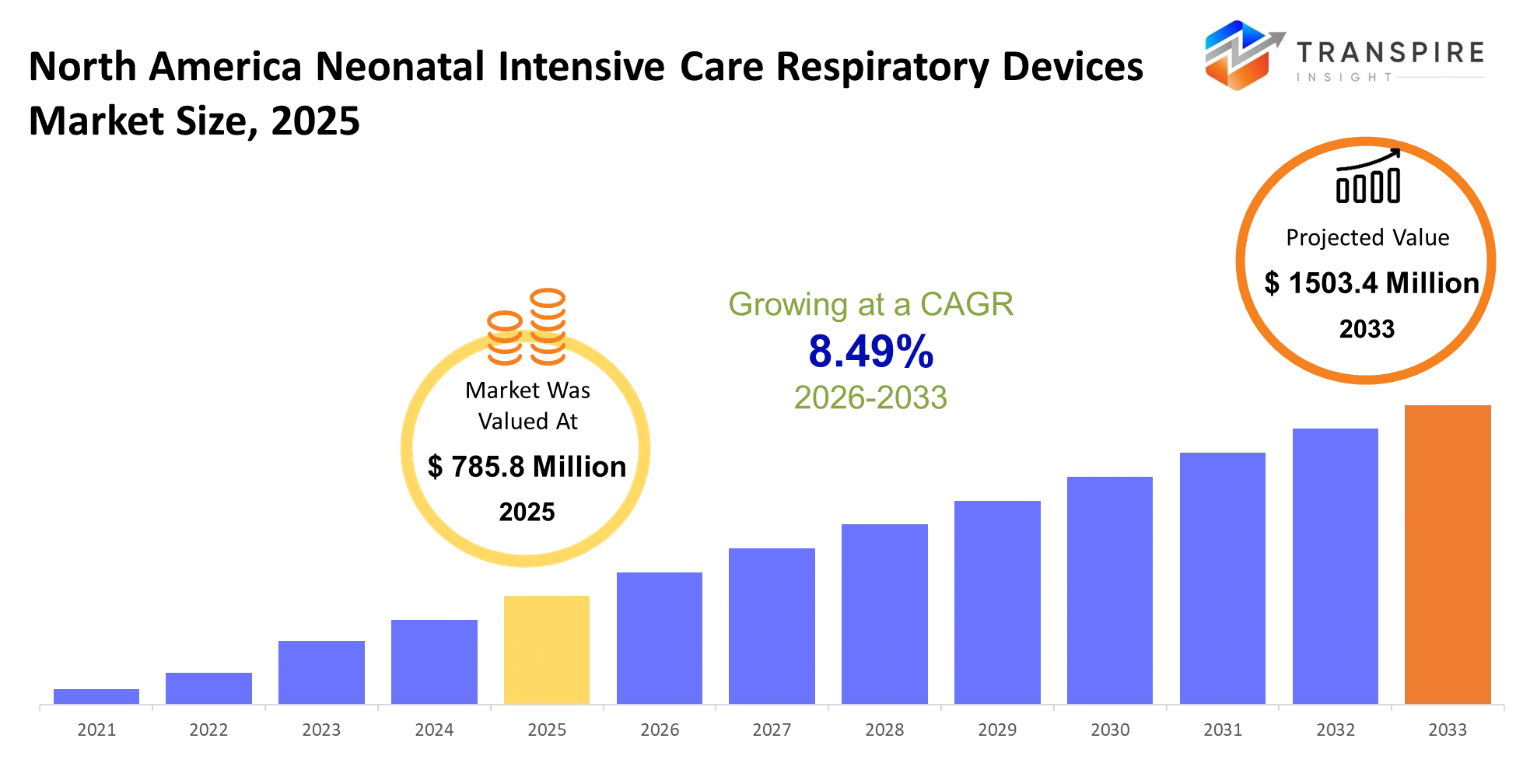
North America Neonatal Intensive Care Respiratory Devices Market Size & Forecast:
- North America Neonatal Intensive Care Respiratory Devices Market Size 2025: USD 785.8 Million
- North America Neonatal Intensive Care Respiratory Devices Market Size 2033: USD 1503.4 Million
- North America Neonatal Intensive Care Respiratory Devices Market CAGR: 8.49%
- North America Neonatal Intensive Care Respiratory Devices Market Segments: By Product Type (Ventilators, CPAP Devices, Resuscitators, Humidifiers, Oxygen Therapy Devices, Others); By Application (Respiratory Distress Syndrome, Apnea of Prematurity, Neonatal Resuscitation, Others); By End User (Hospitals, Neonatal Clinics, NICUs, Others); By Technology (Non-invasive Ventilation, Invasive Ventilation, Smart Monitoring Systems, Others).
To learn more about this report,  Download Free Sample Report
North America Neonatal Intensive Care Respiratory Devices Market Summary
The North America Neonatal Intensive Care Respiratory Devices Market was valued at USD 785.8 Million in 2025. It is forecast to reach USD 1503.4 Million by 2033. That is a CAGR of 8.49% over the period.
The North America Neonatal Intensive Care Respiratory Devices Market basically supports hospitals and neonatal intensive care units in keeping premature and critically ill babies stable when they can’t breathe well, without some kind of assisted respiratory intervention. Stuff like ventilators, CPAP systems, oxygen therapy devices, and respiratory monitoring technologies sit right at the center of this, helping lower neonatal mortality, handling respiratory distress syndrome, and also aiding post-surgical neonatal recovery. Over the last five years, the market kind of leaned away from standalone respiratory equipment, toward more integrated NICU respiratory ecosystems that bundle monitoring, predictive analytics, and automated respiratory adjustments, all within connected hospital platforms.
During the pandemic, this shift got faster, because it brought into focus staffing shortages, ICU capacity bottlenecks,and also the weak points of older respiratory infrastructure across multiple healthcare systems. Hospitals then began investing more in digitally connected respiratory technologies, trying to boost workflow efficiency, while also enabling earlier clinical action. At the same time, updated neonatal care protocols pushed for broader adoption of noninvasive respiratory support methods, so that long term lung problems in premature infants can be reduced. These kind of structural changes and day-to-day operational tweaks still keep procurement moving, sustain long-term service agreements,and shape technology replacement cycles across North American neonatal care networks.
Key Market Insights
- In 2025 the United States pretty much dominated, over 78% market share , mainly because of the advanced NICU infrastructure. There was also high healthcare spending and the adoption cycle for respiratory technology seems faster than others, sort of in every quarter.
- Canada, meanwhile, came forward as the fastest-growing regional market all the way through 2033 . This happened as provincial healthcare systems pushed more neonatal intensive care capacity and they kept investing in respiratory monitoring gear , not just basics.
- Ventilators made up nearly 34% of industry revenue share in 2025. The reason was pretty straightforward , tertiary hospitals kept prioritizing advanced neonatal respiratory stabilization systems, even when budgets were tight.
- CPAP devices also showed the quickest product demand growth between 2024 and 2033. Hospitals leaned more into noninvasive neonatal respiratory intervention technologies, you know, those options that can be used without going fully invasive.
- Humidification systems got major traction after clinicians connected controlled airway conditioning with better neonatal respiratory recovery , and fewer airway complications.
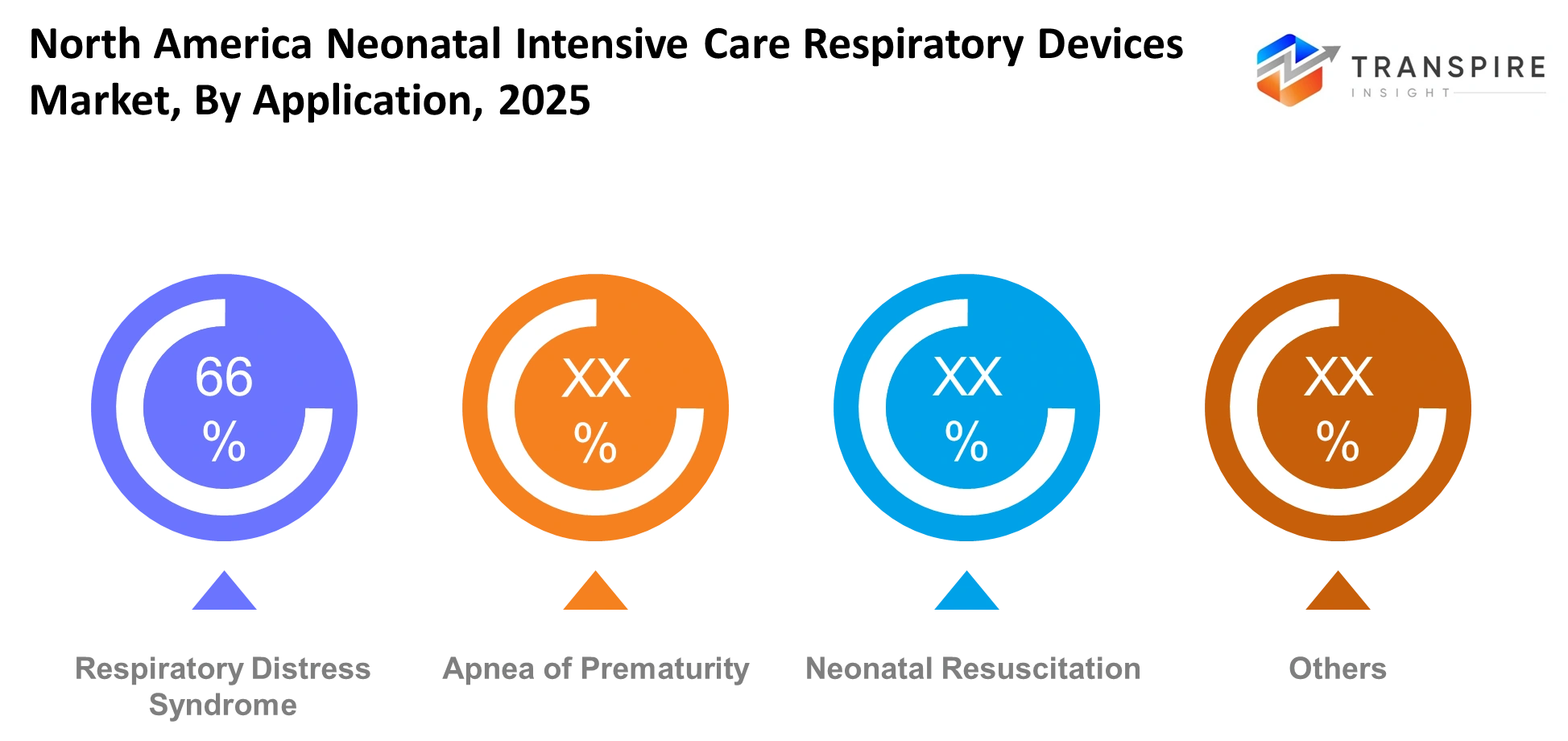
- For applications, respiratory distress syndrome represented more than 41% application share in 2025. This came from rising premature birth admissions across North American NICU facilities , and that continued to build momentum.
- Apnea of prematurity management accelerated after hospitals adopted continuous respiratory monitoring and predictive neonatal analytics systems starting in 2024. After that, the uptake kind of became steady and then faster again.
- Hospitals stayed the main end-user segment with over 64% market share. Large pediatric centers maintained higher respiratory device replacement rates, so demand kept rotating.
- Finally, regional neonatal clinics expanded their respiratory equipment procurement, especially after providers improved decentralized neonatal care access across underserved urban and rural areas.
- North America Neonatal Intensive Care Respiratory Devices Market is increasingly leaning toward smarter respiratory ecosystems that kinda bind ventilation together with oxygen therapy, plus real time neonatal analytics.
What are the Key Drivers, Restraints, and Opportunities in the North America Neonatal Intensive Care Respiratory Devices Market?
Advanced neonatal care modernization still shows itself as one of the strongest drivers, that really helps push market expansion across North America. After the pandemic period, healthcare networks dealt with capacity pressure and staffing shortages, and hospitals responded by putting more money into connected ventilators, non invasive respiratory systems, and AI assisted monitoring platforms. Newer neonatal treatment protocols now lean toward earlier respiratory intervention plus continuous monitoring for preterm infants, and that shift directly pulls up procurement activity for CPAP devices, ventilators and integrated NICU respiratory systems. Big pediatric hospitals too keep swapping out aging respiratory infrastructure, with digitally connected platforms that make the clinical workflow smoother, and in turn help lower rates of neonatal complications.
But, the big restraint is still the high acquisition and integration costs, which forms a structural limit especially for smaller healthcare facilities. Advanced neonatal respiratory systems are not just purchased and done, they need specialized installation, interoperability upgrades, clinical staff training, and ongoing maintenance support. Many regional hospitals can’t finance that quickly. On top of that, legacy infrastructure makes deployment drag, because older monitoring systems often don’t play nicely with modern respiratory analytics platforms. These hurdles end up slowing technology replacement cycles, and they also reduce access to advanced neonatal respiratory care outside the main urban healthcare networks.
AI enabled predictive respiratory monitoring, remains a major long term opportunity for device manufacturers and healthcare providers.Several North American hospitals are already piloting systems that try to read oxygen saturation patterns and ventilation stability, to get a sense of respiratory deterioration before an emergency intervention actually becomes necessary. If investment keeps going into remote NICU monitoring plus cloud-connected respiratory analytics , it might open up new revenue streams for companies working on integrated neonatal respiratory ecosystems. This window, between 2026 and 2033 , could be a really big push for that kind of equipment and software mix.
What Has the Impact of Artificial Intelligence Been on the North America Neonatal Intensive Care Respiratory Devices Market?
Artificial intelligence along with advanced digital tech is slowly but surely reshaping neonatal respiratory care, like, in a way that boosts automation, makes monitoring more precise, and pushes treatment speed up across intensive care spaces. More and more hospitals are rolling out AI based respiratory monitoring platforms that, based on ongoing patient data, can automatically tune oxygen delivery, ventilation pressure, and humidification settings. In several setups smart NICU systems pull ventilators pulse oximeters and monitoring software into one centralized dashboard, so clinicians can notice respiratory decline earlier , and they end up relying less on constant manual checks and interventions. A number of hospital networks across North America have said they see better alarm handling efficiency and faster response times after adding AI assisted respiratory analytics plus predictive monitoring tools.
Machine learning models are also helping forecast respiratory issues by spotting early indicators of apnea episodes, ventilation instability, and oxygen desaturation risks, all before things reach critical deterioration. At the same time, device manufacturers are adding predictive maintenance capabilities, kind of like continuously watching ventilator performance, checking airflow consistency, and validating sensor accuracy, so equipment downtime stays lower and maintenance interruptions don’t derail neonatal care. Advanced respiratory analytics platforms further assist hospitals with improving device utilization rates, smoothing staffing workflows, and reinforcing adherence to neonatal respiratory treatment protocols. Still, the big problems remain: high integration costs and inconsistent interoperability with older hospital systems keep narrowing wider AI adoption, especially for smaller neonatal centers that have limited budgets for digital infrastructure.
Key Market Trends
- Between 2023 and 2026, hospitals started moving faster on swapping invasive ventilators for CPAP and high-flow respiratory systems, to help lower neonatal lung problems, and it kind of builds on that idea of less trauma.
- Philips and Medtronic also put more money into interoperable NICU respiratory ecosystems after healthcare networks kept pushing for centralized tracking, plus real-time respiratory analytics.
- Since 2024, regional hospitals rolled out more neonatal transport respiratory capacity, using portable ventilators built for interfacility emergency infant transfers, which sounds simple but it isn’t.
- Fisher & Paykel Healthcare tightened its approach to humidification technology adoption, because clinicians more and more connected airway conditioning with better respiratory stabilization in premature infants.
- Smart respiratory monitoring systems gained traction after U.S. hospitals increased digital NICU modernization budgets, following post-pandemic critical care infrastructure reviews.
- From 2022 onward, procurement teams kind of changed their purchasing focus away from standalone devices, toward longer service agreements and integrated respiratory care platforms, so the buying logic shifts.
- FDA compliance scrutiny also ramped up on smaller respiratory device manufacturers, and that made hospitals lean toward vendors with stronger certification and clinical support, since the paperwork burden can be… a lot.
- Noninvasive ventilation usage grew across community neonatal centers after revised neonatal care protocols encouraged earlier respiratory intervention for premature births, instead of waiting and watching.
- Between 2025 and 2026, healthcare systems increased investment in AI-assisted respiratory monitoring tools, aiming to improve alarm management and predictive neonatal care workflows, with fewer annoying false triggers hopefully.
- Supply chain disruptions between 2022 and 2024 drove manufacturers to regionalize component sourcing, and at the same time strengthen North American respiratory device inventory capacity, just to keep continuity.
North America Neonatal Intensive Care Respiratory Devices Market Segmentation
By Product Type
Ventilators seem to take the biggest slice of revenue since tertiary hospitals and advanced NICUs rely on steady breathing assistance systems for critical newborn cases, and honestly the whole thing feels pretty dependent on constant respiratory support. Triage rates stay high across pediatric intensive care settings plus there is solid replacement need so the segment keeps leading. CPAP units keep gathering momentum too, mainly because many teams prefer noninvasive respiratory support that can lower complications linked to long term invasive ventilation. Humidifiers alongside oxygen therapy devices also keep fairly steady demand because neonatal respiratory management needs careful airway conditioning and properly controlled oxygen delivery, especially for premature infants.
Looking ahead the momentum should tilt toward compact ventilators with digital monitoring, plus automated pressure adjustment features. Product developers are placing more investment into portable respiratory support systems meant for neonatal transport and for regional hospital use. Resuscitators are likely to grow in a slower ,steady way as delivery centers strengthen neonatal emergency readiness protocols. Buyers too are increasingly selecting devices with interoperability options so they can connect straight into hospital monitoring platforms and electronic medical record systems.
By Application
Respiratory distress syndrome makes up the largest slice, mostly because premature babies often need fast respiratory handling right after birth. High admission numbers tied to not-yet matured lung function keep pushing steady requirements for ventilators, CPAP systems and oxygen therapy devices. Neonatal resuscitation also takes a noticeably big place, since in many higher-risk delivery environments respiratory stabilization steps are basically required. Apnea of prematurity use cases keep climbing too, as hospitals roll out continuous monitoring plus respiratory stimulation technologies, for longer-term neonatal care management.
What’s interesting is that growth directions across these applications are not the same, because every condition asks for a different level of care effort and different device usage cycles. For respiratory distress syndrome, treatment tends to bring back recurring demand for upgraded respiratory systems, while apnea management is moving more toward noninvasive approaches and monitoring-focused platforms. Looking ahead, investment will likely lean toward early intervention respiratory tools that are paired with predictive analytics and more integrated neonatal monitoring. Manufacturers that can match respiratory care systems to condition-specific protocols are expected to secure better procurement chances with hospitals, sooner rather than later.
To learn more about this report, Download Free Sample Report
By End User
Hospitals are the main end user group really, because major healthcare systems keep the densest concentration of advanced neonatal respiratory setup. In multispecialty hospitals you usually find specialized NICUs, and those units create steady demand for breathing devices due to large patient throughput,plus the complicated neonatal situations. Neonatal clinics then tend to grow bit by bit, since regional providers are gradually expanding access to focused infant respiratory care outside the biggest urban hospitals. Even standalone NICUs keep climbing too, because health networks are putting more money into dedicated neonatal treatment sites, complete with advanced respiratory support.
How buyers purchase is becoming tied more and more to operational efficiency, long-term maintenance help,and also the ability to integrate digitally. Big hospitals lean toward interoperable respiratory systems that can link with centralized patient monitoring infrastructure. Meanwhile neonatal clinics generally care more about compact respiratory technologies that also stay cost efficient. Looking ahead, market expansion should support more decentralized neonatal respiratory care models, which will help lower the load on tertiary hospitals. Investors along with manufacturers are likely to focus on regional NICU growth initiatives and on outpatient neonatal care centers that need respiratory support platforms that scale without too much hassle.
By Technology
Noninvasive ventilation takes the lead in technology share , since more hospitals are slowly choosing respiratory support approaches that cut down on lung injury risk and at the same time help speed up the rebound period for premature babies. CPAP units and high-flow oxygen therapies keep pushing the segment forward, because clinicians keep leaning toward neonatal care that is less invasive . Invasive ventilation still matters a lot for the most severe respiratory distress scenarios, where it really needs advanced airway handling and ongoing respiratory stabilization, without hesitation. Smart monitoring systems are also coming in fast , as NICUs adopt connected respiratory solutions that can provide real-time patient insights and automatic clinical notifications .
At the same time, competition is starting to move away from just standalone device power and toward integrated respiratory ecosystems. Noninvasive systems are expected to win wider adoption across regional hospitals, partly because care teams want fewer complications and better neonatal comfort . Smart monitoring platforms are likely to grow quickest as hospitals invest more in digital NICU infrastructure and data-guided respiratory management. Product teams that blend respiratory therapy with predictive monitoring and remote clinician access should pull in stronger long-term investment interest .
What are the Key Use Cases Driving the North America Neonatal Intensive Care Respiratory Devices Market?
Treatment for respiratory distress syndrome is still basically the main use case that keeps demand strong for neonatal intensive care respiratory devices across North America. NICUs lean on ventilators, CPAP systems, and oxygen delivery devices quite a lot, to help steady premature newborns whose lungs are still underdeveloped, especially during those first few critical days right after birth. With high preterm birth rates, and survival rates that keep moving upward, hospitals at the tertiary level plus pediatric care centers continue to use this equipment heavily.
Also, other applications are growing, especially in neonatal transport services and in post-surgical respiratory care inside specialized children’s hospitals. Portable respiratory support systems are getting more attention among emergency neonatal transfer teams, because they need something compact but still dependable for ventilation while moving the patient from facility to facility. At the same time, more hospitals are leaning toward noninvasive respiratory support technologies, for follow-up recovery care after neonatal cardiac and thoracic procedures.
Looking ahead, new use cases are starting to show up, like AI-assisted respiratory monitoring and remote NICU respiratory management platforms that connect through the hospital digital networks. These ideas look promising, as healthcare systems push for earlier intervention and smoother respiratory care coordination across regional neonatal centers, even when teams are not in the same building.
|
Report Metrics |
Details |
|
Market size value in 2025 |
USD 785.8 Million |
|
Market size value in 2026 |
USD 849.6 Million |
|
Revenue forecast in 2033 |
USD 1503.4 Million |
|
Growth rate |
CAGR of 8.49% from 2026 to 2033 |
|
Base year |
2025 |
|
Historical data |
2021 - 2024 |
|
Forecast period |
2026 - 2033 |
|
Report coverage |
Revenue forecast, competitive landscape, growth factors, and trends |
|
Regional scope |
North America (Canada, The United States, and Mexico) |
|
Key company profiled |
Dräger, Fisher & Paykel Healthcare, GE HealthCare, Philips Healthcare, Medtronic, ResMed, Vyaire Medical, Smiths Medical, Teleflex, Inspiration Healthcare, Atom Medical, Hamilton Medical, Ambu, Neotech Products, Allied Healthcare Products. |
|
Customization scope |
Free report customization (country, regional & segment scope). Avail customized purchase options to meet your exact research needs. |
|
Report Segmentation |
By Product Type (Ventilators, CPAP Devices, Resuscitators, Humidifiers, Oxygen Therapy Devices, Others); By Application (Respiratory Distress Syndrome, Apnea of Prematurity, Neonatal Resuscitation, Others); By End User (Hospitals, Neonatal Clinics, NICUs, Others); By Technology (Non-invasive Ventilation, Invasive Ventilation, Smart Monitoring Systems, Others). |
Which Regions are Driving the North America Neonatal Intensive Care Respiratory Devices Market Growth?
North America keeps leading the market, mostly due to its kind of highly structured healthcare reimbursement setup, plus more advanced neonatal care infrastructure and also that strong clustering of tertiary hospitals with specialized NICU units. The United States is really the main engine of regional demand, because it follows strict neonatal respiratory care requirements, and there is continuous funding for critical-care modernization in pediatric hospitals. Big healthcare systems often reach high adoption levels for integrated ventilation, patient monitoring, and humidification solutions, so that kind of keeps the procurement rhythm going over and over. The whole area also rides on a mature ecosystem, meaning you have medical device manufacturers, neonatal research groups, clinical training programs, and hospital purchasing networks all working together, which supports long-term expansion.
Europe still shows up as a dependable contributor to global revenue, mainly because its growth is more about institutional consistency, not fast or aggressive healthcare expansion. When you compare it with North America, European markets tend to lean harder on centralized healthcare planning, plus gradual regulatory rollouts, and this ends up producing pretty predictable purchasing patterns across public hospital systems. Nations like Germany, France, and the Nordic countries carry on investing steadily in neonatal respiratory care upgrades, even while the wider economy wobbles around. Reimbursement structures are solid, and long-term hospital budgeting habits give device makers clearer demand forecasts, which in turn reduces swings in procurement activity.
Asia Pacific is coming up as the fastest-growing region, sort of, because of rapid building out of healthcare infrastructure and the higher availability of neonatal intensive care in major urban areas. Governments in China, India and parts of Southeast Asia have lately sped up their spending on programs for maternal and newborn care, plus they are pushing wider access to advanced respiratory support devices in public hospitals. Also, more awareness about how to handle premature births, along with the roll-out of modern NICU standards, is motivating many hospitals to swap their older respiratory systems for more technologically advanced alternatives. This whole push should generate meaningful openings for manufacturers, distributors, and healthcare investors who are hunting for high-growth regional expansion from 2026 to 2033.
Who are the Key Players in the North America Neonatal Intensive Care Respiratory Devices Market and How Do They Compete?
North America Neonatal Intensive Care Respiratory Devices Market still looks pretty moderately consolidated, like there’s a small set of multinational medical technology companies that end up controlling a notable amount of hospital procurement contracts as well long-term service agreements, kind of thing. Here, competition tends not so much on plain price, but on tech integration, clinical reliability and also the ability to handle high acuity neonatal settings with connected monitoring systems. The big players keep defending their share by widening their product ecosystem and building hospital partnerships, while smaller respiratory technology firms lean into niche neonatal use cases where customization, plus workflow flexibility, opens the door. More and more, the market seems to reward companies that blend respiratory support devices with predictive analytics, remote monitoring and interoperability across the whole NICU infrastructure.
Philips shows up with integrated neonatal care platforms that bring together respiratory support, patient monitoring and hospital informatics, into one unified clinical workflow, basically. Its edge is largely tied to interoperability features, which let NICU teams centralize respiratory and vital sign data across intensive care locations without too much friction. Fisher & Paykel Healthcare, meanwhile, concentrates on humidified respiratory support systems and noninvasive ventilation technologies that are meant to make neonatal comfort better and also reduce airway complications. They push expansion through hospital adoption programs, and they keep rolling out continuous upgrades for humidification platforms, which helps clinicians stay familiar with the devices and can improve long term retention.
Dräger really puts a lot of emphasis on precision ventilation, and also neonatal-specific respiratory monitoring, especially in those high-acuity NICU setups where clinicians need advanced control over ventilation and careful alarm management, not just simple settings. Their edge is mostly tied to specialized neonatal ventilation engineering, plus long-standing relationships with tertiary care hospitals. Medtronic on the other hand competes by folding respiratory devices into a bigger acute care portfolio, so hospital systems can streamline procurement and maintenance across multiple areas, more or less without as much friction. They also keep expanding, with digital respiratory management features, and with partnerships that boost data connectivity inside critical care networks, so information flows more cleanly.
Company List
- Dräger
- Fisher & Paykel Healthcare
- GE HealthCare
- Philips Healthcare
- Medtronic
- ResMed
- Vyaire Medical
- Smiths Medical
- Teleflex
- Inspiration Healthcare
- Atom Medical
- Hamilton Medical
- Ambu
- Neotech Products
- Allied Healthcare Products
Recent Development News
“In May 2025, Fisher & Paykel Healthcare expanded the U.S. rollout of its F&P 950™ System and Airvo™ 3 respiratory care platforms. The expansion strengthened the company’s position in neonatal and hospital respiratory support by increasing adoption of advanced humidification and ventilation technologies across North American care settings.
Source: https://www.fphcare.com
“In March 2026, Philips announced new platform-based care intelligence integrations connecting patient monitoring and diagnostic systems at HIMSS26. The development supports future NICU respiratory workflows by improving interoperability, real-time monitoring, and data-driven respiratory management capabilities across acute care environments.
Source: https://www.philips.com
What Strategic Insights Define the Future of the North America Neonatal Intensive Care Respiratory Devices Market?
The North America Neonatal Intensive Care Respiratory Devices Market is moving toward integrated, data-driven respiratory care ecosystems where predictive monitoring, automated ventilation adjustments, and remote NICU connectivity will shape competitive advantage over the next five to seven years. This direction is being driven by rising premature birth survival rates, increasing pressure on hospital staffing efficiency, and the growing adoption of AI-enabled clinical decision support systems. However, a less visible risk is the increasing concentration of advanced respiratory device manufacturing among a limited group of suppliers, which could expose hospitals to procurement disruptions, pricing pressure, and delayed technology upgrades during supply chain instability. An emerging opportunity is the development of compact noninvasive respiratory support systems designed for community hospitals and regional neonatal centers that lack full-scale NICU infrastructure. Companies should prioritize partnerships with hospital networks and digital health providers to build interoperable respiratory platforms rather than competing solely on standalone device performance.
North America Neonatal Intensive Care Respiratory Devices Market Report Segmentation
By Product Type
- Ventilators
- CPAP Devices
- Resuscitators
- Humidifiers
- Oxygen Therapy Devices
- Others
By Application
- Respiratory Distress Syndrome
- Apnea of Prematurity
- Neonatal Resuscitation
- Others
By End User
- Hospitals
- Neonatal Clinics
- NICUs
- Others
By Technology
- Non-invasive Ventilation
- Invasive Ventilation
- Smart Monitoring Systems
- Others
Frequently Asked Questions
Find quick answers to common questions.
The expected North America Neonatal Intensive Care Respiratory Devices Market size is USD 1503.4 Million in 2033.
Key segments for the North America Neonatal Intensive Care Respiratory Devices Market are By Product Type (Ventilators, CPAP Devices, Resuscitators, Humidifiers, Oxygen Therapy Devices, Others); By Application (Respiratory Distress Syndrome, Apnea of Prematurity, Neonatal Resuscitation, Others); By End User (Hospitals, Neonatal Clinics, NICUs, Others); By Technology (Non-invasive Ventilation, Invasive Ventilation, Smart Monitoring Systems, Others).
Major North America Neonatal Intensive Care Respiratory Devices Market players are Dräger, Fisher & Paykel Healthcare, GE HealthCare, Philips Healthcare, Medtronic, ResMed, Vyaire Medical, Smiths Medical, Teleflex, Inspiration Healthcare, Atom Medical, Hamilton Medical, Ambu, Neotech Products, Allied Healthcare Products.
The North America Neonatal Intensive Care Respiratory Devices Market size is USD 785.8 Million in 2025.
The North America Neonatal Intensive Care Respiratory Devices Market CAGR is 8.49% from 2026 to 2033.
- Dräger
- Fisher & Paykel Healthcare
- GE HealthCare
- Philips Healthcare
- Medtronic
- ResMed
- Vyaire Medical
- Smiths Medical
- Teleflex
- Inspiration Healthcare
- Atom Medical
- Hamilton Medical
- Ambu
- Neotech Products
- Allied Healthcare Products
About the Authors

Pankaj Ghogare Patil
I am Pankaj Ghogare Patil, a Senior Research Analyst at Transpire Insight, specializing in the Pharmaceutical, Chemicals & Materials, Healthcare IT, and Biotechnology industry. My expertise lies in conducting comprehensive market research, analyzing industry trends, evaluating competitive landscapes, and translating complex data into actionable insights. At Transpire Insight, I closely follow emerging technologies, regulatory developments, and market innovations to create accurate, well-researched, and informative content that helps businesses and professionals make informed decisions. I am committed to producing credible, evidence-based articles that reflect industry best practices while making technical topics accessible and valuable for a broad audience.

Chakradhar Khansole
Chakradhar serves as the Research Director at Transpire Insight, bringing over 8 years of experience in technology, innovation, and strategic market intelligence. He specializes in transforming complex market data into actionable business insights that enable organizations to make informed, growth-oriented decisions. Recognized for his strategic vision and analytical expertise, Chakradhar leads high-impact research initiatives, delivering comprehensive market assessments, competitive intelligence, and forward-looking industry analysis.
Recently Published Reports
-
Apr 2026
AI in Diabetic Retinopathy Market
AI in Diabetic Retinopathy Market Size, Share & Analysis Report By Type (Screening AI Systems, Diagnostic AI Systems, and Predictive AI Models), By Application Segment (Hospitals, Ophthalmology Clinics, Diagnostic Centers, and Research and Development), and Geography (North America, Europe, Asia-Pacific, Middle East and Africa, South and Central America), 2021 - 2031
-
Apr 2026
Psychometric Tests Market
Psychometric Tests Market Size, Share & Analysis Report By Type (Personality Tests, Ability/Aptitude Tests, Skill/Knowledge Tests, and Others), By Application (Talent Acquisition and Talent Management), and Geography (North America, Europe, Asia-Pacific, Middle East and Africa, South and Central America), 2021 – 2031
-
Apr 2026
Rare Biological Sample Collection Market
Rare Biological Sample Collection Market Size, Share & Analysis Report By Type (Isolation Kits & Reagent, Blood Collection Tubes, and Others), By Application (Oncology, Transcriptomics, Pharmacogenomics, and Others), and Geography (North America, Europe, Asia-Pacific, Middle East and Africa, South and Central America), 2021 – 2031
-
Jul 2026
Diabetic Retinopathy Market
Diabetic Retinopathy Market Size, Share & Analysis Report By Type (Proliferative Diabetic Retinopathy, and Diabetic Macular Edema (DME)), By Treatment Type (Anti VEGF Drug, Steroid Implants, Laser Surgeries, and Vitrectomy), and Geography (North America, Europe, Asia-Pacific, Middle East and Africa, South and Central America), 2021 – 2031
Our Clients







