

North America Anti-Biofilm Agents Market Size & Forecast:
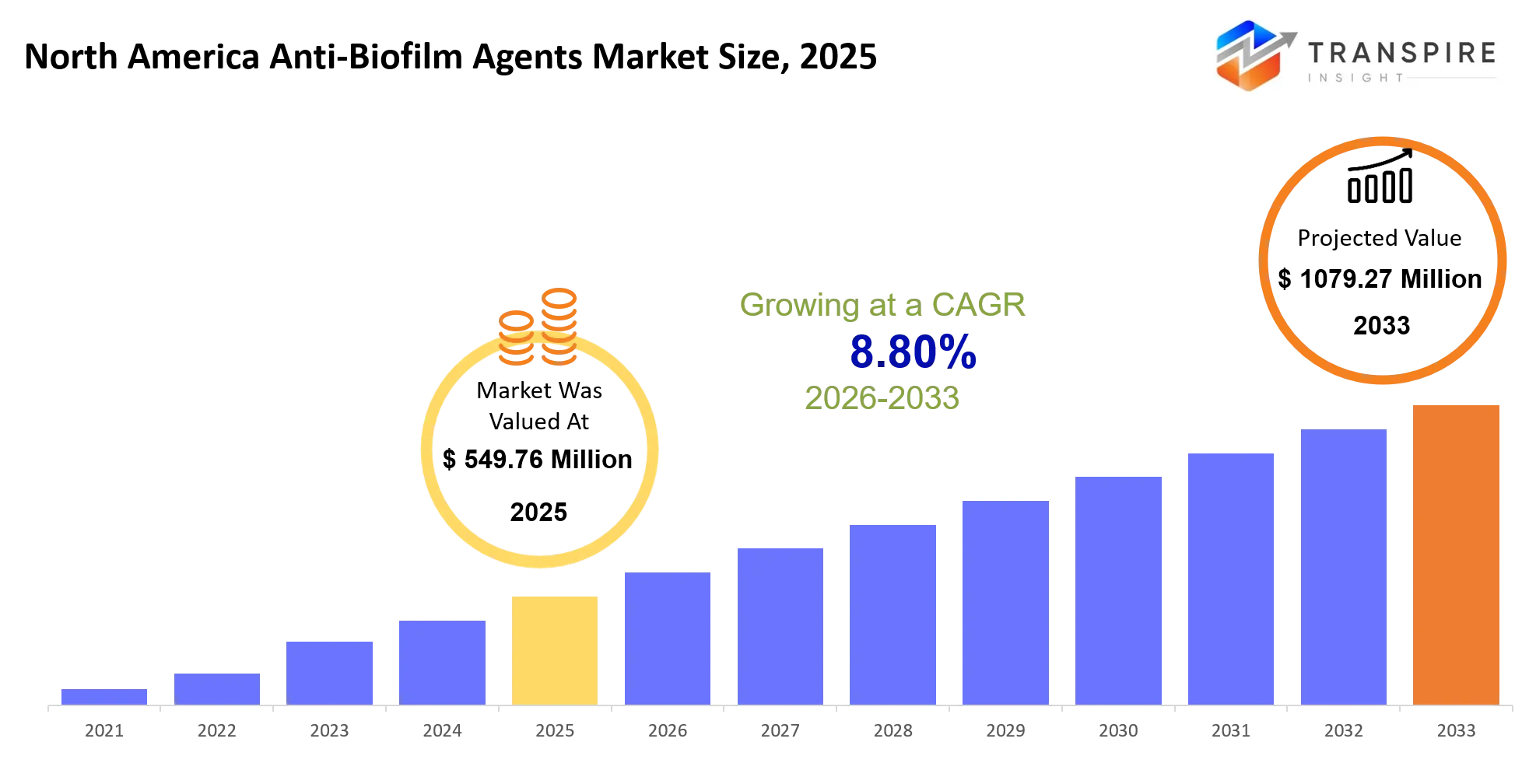
- North America Anti-Biofilm Agents Market Size 2025: USD 549.76 Million
- North America Anti-Biofilm Agents Market Size 2033: USD 1079.27 Million
- North America Anti-Biofilm Agents Market CAGR: 8.80%
- North America Anti-Biofilm Agents Market Segments: By Product Type (Antimicrobial Peptides, Enzymatic Agents, Chelating Agents, Quorum Sensing Inhibitors, Others), By Application (Wound Care, Medical Device Coatings, Dental Care, Water Treatment, Others), By End User (Hospitals, Pharmaceutical Companies, Research Institutes, Others), By Form (Gels, Sprays, Solutions, Coatings, Others).
To learn more about this report,  Download Free Sample Report
North America Anti-Biofilm Agents Market Summary:
The North America Anti-Biofilm Agents Market size is estimated at USD 549.76 Million in 2025 and is anticipated to reach USD 1079.27 Million by 2033, growing at a CAGR of 8.80% from 2026 to 2033. The North America Anti-Biofilm Agents Market is dealing with a kind of stubborn problem that keeps showing up across healthcare, food processing, water treatment, and industrial operations—biofilms forming, basically these microbial blankets that help microorganisms shrug off normal cleaning , disinfectants, and other antimicrobial treatments. Once those protective layers get disturbed, anti-biofilm agents can lower contamination, reduce equipment fouling, minimize infection risks , and cut down on operational downtime too.
In the last five years, the market has shifted in a more structural way, away from just broad-spectrum antimicrobial approaches and more toward sharper biofilm disruption tools. That includes enzyme-based formulations, antimicrobial peptides, and also surface modification solutions. A lot of this change is tied to rising worries about antimicrobial resistance and the fact that traditional disinfectants don’t always perform as expected. Another strong driver was the increased attention to infection prevention and sanitation protocols after the COVID-19 pandemic. It kind of revealed weaknesses in contamination control systems, and that made operators take the whole issue more seriously. With stricter performance and compliance obligations coming in , investments are leaning toward preventive biofilm management. This trend is widening adoption across end-use sectors and also opening up higher-value revenue streams for specialized anti-biofilm technologies.
Key Market Insights
- The United States kind of dominates the North America Anti Biofilm Agents Market and accounts for about 78% of regional revenue in 2025, or something close like that.
- Canada is showing the fastest growth across the forecast, largely because healthcare infrastructure is expanding , and there are more industrial hygiene investments getting put in place.
- A strong regulatory push on infection prevention keeps improving market penetration across North American end use industries, and it really does matter.
- Enzyme based anti biofilm agents are leading overall with nearly 35% share. This is mainly backed by better biofilm disruption capabilities.
- Chemical anti biofilm formulations stay in second place as the next biggest segment , largely due to their long standing industrial and healthcare applications.
- Antimicrobial peptide based solutions are projected to be the fastest growing segment from 2025 thru 2032, fairly quickly.
- Meanwhile, the general demand for more precise biofilm control technologies is reshaping industry size and long term market share dynamics, step by step, bit by bit it seems.
- In 2025 healthcare and medical device applications lead the way with roughly 42% market share.
- Water treatment applications are expected to grow the quickest, driven by modernization projects that keep showing up.
- Industrial cleaning and food processing sectors continue to create new demand for advanced anti biofilm technologies, especially where reliability is needed.
- Hospitals and healthcare facilities hold the largest end user share, at over 38% of total market revenue.
- Water and wastewater utilities operators are expected to show the top growth rate in the forecast period, like the big one.
- Manufacturing facilities are increasingly tilting toward preventive biofilm management approaches, mostly because it helps lessen operational disruptions and avoid any downtime, in practice.
What are the Key Drivers, Restraints, and Opportunities in the North America Anti-Biofilm Agents Market?
The most powerful force driving the North America Anti-Biofilm Agents Market is this tighter, almost obsessively focused attention on healthcare-associated infections and contamination control throughout key infrastructure. Hospitals, medical device makers, and water treatment operators are seeing tougher performance expectations, so they’re pushing toward proactive biofilm management , not just occasional disinfection. This change really got stronger after the COVID-19 period , when many operators reviewed their weak points in sanitation systems and infection prevention routines. Because of that, end users are putting more money toward targeted anti-biofilm technologies, the kind that can curb equipment fouling , stretch asset life, and also cut infection-related expenses. The straightforward result is better adoption of more advanced formulations and steady recurring income chances for suppliers.
In contrast, the market’s biggest drag is the awkward complexity of proving anti-biofilm performance across different settings and microbial communities. Biofilms act differently on medical devices, inside industrial pipelines, and across water systems, so real standardization becomes difficult. On top of that, regulatory approval paths, mandatory field validation, and long procurement timelines form a stubborn structural wall that can’t be fixed overnight. Many end users also want a lot of proof before they will replace their tried and trusted treatment programs , so this slows commercialization and limits how fast new solutions can scale, which in turn dampens revenue momentum for newer technologies.
A pretty big opportunity sits in merging anti-biofilm agents with smart monitoring and predictive upkeep platforms, in a way that feels almost, well necessary. More and more sensors that can spot early stage biofilm formation are showing up in water treatment and in industrial processing facilities too. Once those detections get paired with targeted anti-biofilm treatments, the idea is you can intervene before the contamination starts to really escalate, or spread. Also, the growing investment in digital water infrastructure across North America makes the whole convergence feel a lot easier, like the market is ready. That should open up new service based revenue models and, in the long run, expand market value quite a bit.
What Has the Impact of Artificial Intelligence Been on the North America Anti-Biofilm Agents Market?
Artificial intelligence and advanced digital technologies are starting to shift how biofilm risk is recognized, tracked, and managed across healthcare, water treatment , and industrial operations in North America. In practice, AI driven monitoring platforms can automatically pull in sensor signals from pipelines, filtration units, and production machinery, then flag the kinds of conditions that show up during early-stage biofilm formation. This level of automation ends up lowering the need for constant human walkthroughs and it also helps operators tune dosing routines for anti biofilm agents in near real time which is kind of a big deal.
At the same time, machine learning models are getting better at forecasting. They sift through past operating conditions along with microbial activity traces, flow rates and water quality measures. From that they estimate where biofilm buildup is more likely to happen. Then facilities can use those estimates to plan focused cleaning and treatment cycles, before performance starts slipping in a noticeable way. In water treatment and industrial processing settings, predictive maintenance has reportedly reduced unexpected shutdowns, lengthened equipment service life, and cut back on maintenance spending. Meanwhile healthcare organizations are also leaning on data informed contamination monitoring to support infection control goals, and to guide how staff and resources should be assigned.
Still though, AI use is not fully smooth everywhere because data quality and system integration are limiting factors. A lot of facilities are stuck with older infrastructure, with sensor coverage that is thin, so training datasets end up incomplete. Because of that, predictive models may look strong in controlled test conditions but then they need a lot of re tuning, and calibration, before they deliver stable accuracy across different day to day operating realities in the field.
Key Market Trends
- Since 2020, hospitals have been moving procurement toward biofilm specific treatments, as infection prevention programs increasingly go after those stubborn microbial reservoirs, that kind of stuff.
- Enzyme based formulations started taking more share between 2021 and 2025, because operators were looking for something other than repeating the same high dose chemical disinfection cycles over and over.
- Water utilities also began adopting continuous biofilm monitoring systems more often, especially after modernization funding sped up across North America, and honestly it all looked more feasible.
- Manufacturers changed course from broad spectrum antimicrobial products toward more targeted biofilm disruption platforms, and this improved results when it came to resistant microbial communities, rather than just generic kill steps.
- Regulatory audits starting in 2021 pushed healthcare facilities to document contamination control performance in a more rigorous way, which then strengthened uptake of validated anti biofilm technologies in practice.
- Firms like Ecolab, Solenis, and BASF expanded application specific portfolios, showing that buyers really like customized treatment strategies, not one size fixes.
- Meanwhile industrial operators have been integrating predictive analytics with their treatment programs more and more often, which lowered unplanned maintenance incidents and helped asset utilization rates, stay healthier.
- Supply chain disruptions during 2020–2022 nudged manufacturers to diversify sourcing for raw materials, and they even localized parts of production capacity, too.
- Strategic partnerships between technology developers and healthcare systems grew, because end users wanted real world efficacy evidence before they would roll anything out at scale.
- Investment has increasingly leaned into preventive maintenance models, with facility managers placing more weight on long term contamination control, rather than periodic remediation programs that only show up after things drift.
North America Anti-Biofilm Agents Market Segmentation
By Product Type
Product type segmentation seems to show a shift, away from standard antimicrobial tactics and more toward focused biofilm disruption methods that are, kinda specific. Enzymatic agents have the strongest market stance right now since enzymes can break down the shielding matrix around microbial communities, which then boosts treatment performance in both healthcare and industrial environments. Antimicrobial peptides are another big category, backed by heavy research momentum and the possibility of working well even against hard-to-treat microorganisms.
Chelating agents stay steady in position because they help destabilize biofilm structures, and quorum sensing inhibitors are drawing extra attention too, mainly because they can interrupt microbial signaling pathways before mature biofilms really take hold. Beyond that, other newer products keep entering the market, often via specialized applications. Demand is moving more and more toward options that balance strong action with lower resistance risk. What comes next will probably lean into multi mechanism formulations, which opens room for manufacturers to distinguish their products, while also giving buyers more exact and longer lasting biofilm control strategies.
By Application
Application patterns, kinda show the big part wound care plays here , because persistent infections and delayed healing still keep coming back, so there s a real pull toward better biofilm management. Medical device coatings are another main piece, since infections tied to devices stay a major headache for clinicians and care teams. Dental care applications keep growing too, as practitioners try to handle plaque related biofilms and oral infections with more refined methods. Water treatment is also one of the quickest moving areas, helped by infrastructure modernization and tighter operating standards, that are meant to keep system performance steady. Beyond that, there are other settings like industrial processing and food production environments that add more demand.
The reasons for growth are different across each sector , patient results tend to guide healthcare adoption, while day to day operational efficiency tends to steer industrial buying choices. Looking ahead, what happens next in the market will rely more and more on solutions that are built for each specific application, so they can handle unique performance demands while still aligning with regulatory requirements and practical operating expectations.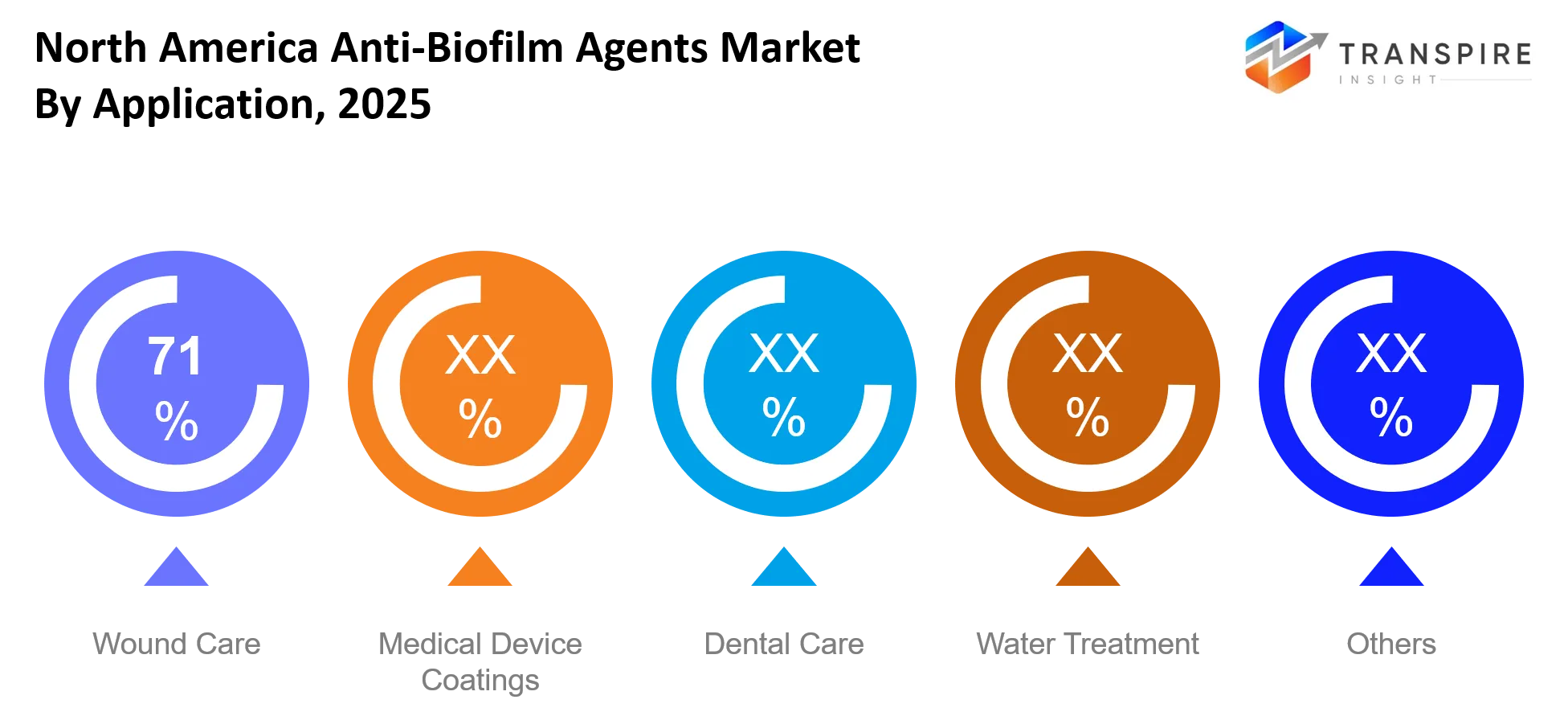
To learn more about this report, Download Free Sample Report
By End-User
End-user dynamics position hospitals as the biggest revenue creator segment , since infection prevention programs kinda steer purchasing choices and also affect whether treatment gets adopted. Pharmaceutical companies are another major customer group, especially when they put money into research, formulation development, and more advanced therapeutic applications. Research institutes matter a lot too , because they help innovation move along, they validate new technologies, and they broaden the scientific picture behind biofilm behavior.
Then there are other end users, like water utilities and industrial operators, who keep pushing adoption forward as the operational costs tied to biofilms become more clear to everyone. Procurement cycles, regulatory requirements, and performance validation standards all end up shaping how these groups buy. Hospitals usually lean toward proven clinical results, while industrial organizations often care more about maintenance savings and uninterrupted operations. Going forward, new opportunities should show up through tighter collaboration between technology developers, healthcare institutions, and industrial stakeholders , which can speed commercialization and support broader adoption across multiple end-user categories.
By Form
Form-based segmentation is mostly led by solutions, that still keep the strongest market position because liquid formulations slip in easily into cleaning systems, wound management protocols and water treatment processes. Coatings also take a substantial chunk, specially in medical devices and industrial equipment where long-term surface protection gives a real, measurable payoff. Gels remain very relevant in wound care and other localized treatment uses, since the contact stays longer and the delivery is more controlled, so it sort of makes sense. Sprays keep gaining acceptance too, for the simple reason that they’re easy to apply and they fit large surface areas in healthcare and industrial settings.
Beyond that, other specialized forms support more niche needs across research and manufacturing, where you might not want the usual formats. Picking a product often comes down to the application environment, how often treatment is needed, and the operational constraints you’re stuck with. In the future, innovation is expected to lean toward more advanced delivery systems, aimed at improving persistence, tuning targeting accuracy, and making day-to-day use easier, which should open new competitive opportunities and at the same time improve treatment outcomes for end users.
What are the Key Use Cases Driving the North America Anti-Biofilm Agents Market?
Anti-biofilm agents, they’re mainly for wound care and infection management in hospitals, like that. In particular, chronic wounds , surgical sites , and device-associated infections frequently host tough biofilms that end up lowering how well treatment works. So healthcare providers turn to specialized anti-biofilm formulations—kind of targeted blends really—to help healing move along, reduce complications, and strengthen infection control programs overall.
And it does not stop in hospitals either. Outside those clinical spaces, the adoption is widening in water treatment systems plus in the manufacture of medical devices. Water utilities use anti-biofilm technologies to keep pipelines performing properly, and also to keep water quality up to those standards people expect. Meanwhile, device manufacturers add protective coatings aimed at lowering microbial colonization, and that also helps with regulatory compliance obligations.
There are also emerging directions, like biofilm control in advanced pharmaceutical production facilities and in smart industrial processing environments. With integration into sensor-based monitoring platforms, microbial buildup can be noticed earlier. That creates chances for preventive treatment approaches, which then reduce contamination risks and avoid operational disruptions over the forecast period.
|
Report Metrics |
Details |
|
Market size value in 2025 |
USD 549.76 Million |
|
Market size value in 2026 |
USD 598.13 Million |
|
Revenue forecast in 2033 |
USD 1079.27 Million |
|
Growth rate |
CAGR of 8.80% from 2026 to 2033 |
|
Base year |
2025 |
|
Historical data |
2021 - 2024 |
|
Forecast period |
2026 - 2033 |
|
Report coverage |
Revenue forecast, competitive landscape, growth factors, and trends |
|
Country scope |
North America (Canada, The United States, and Mexico) |
|
Key company profiled |
Smith & Nephew, Mölnlycke Health Care, Convatec, 3M, BioFilm Inc., Kane Biotech, Next Science, Bausch Health, Coloplast, Organogenesis, Johnson & Johnson, Medline Industries, Solenic Medical, NovaBay Pharmaceuticals, Arch Therapeutics |
|
Customization scope |
Free report customization (country, regional & segment scope). Avail customized purchase options to meet your exact research needs. |
|
Report Segmentation |
By Product Type (Antimicrobial Peptides, Enzymatic Agents, Chelating Agents, Quorum Sensing Inhibitors, Others), By Application (Wound Care, Medical Device Coatings, Dental Care, Water Treatment, Others), By End User (Hospitals, Pharmaceutical Companies, Research Institutes, Others), By Form (Gels, Sprays, Solutions, Coatings, Others) |
Which Regions are Driving the North America Anti-Biofilm Agents Market Growth?
The United States is the dominant regional market, mostly because of stringent healthcare standards, strong research know how, and a really large healthcare infrastructure. Hospitals, pharmaceutical manufacturers ,and water treatment operators put serious budgets toward contamination control and infection prevention programing. Also the regulatory oversight is pretty strict so it helps push validated anti-biofilm technologies into both clinical and industrial environments. There’s also an established loop of biotechnology firms, academic research centers, and specialized solution providers, which sort of keeps reinforcing the market lead.
Canada sits in second place, though its momentum comes from a slightly different mix of things. Healthcare funding stays stable, regulation is applied in a consistent way, and long term infrastructure spending helps make adoption feel predictable. Modernizing water treatment facilities and public health projects keep the demand steady for biofilm control solutions across several sectors. Because of that, Canada looks more like a dependable source of recurring revenue, not a market that lives and dies by fast expansion cycles.
Mexico is starting to look like the fastest-growing regional market, as healthcare capacity keeps expanding and industrial facilities invest more in higher operational standards, kinda. Lately, investments in pharmaceutical manufacturing, medical device production , and water infrastructure have pushed the need for more advanced contamination management tools. On top of that, regulatory alignment with international quality standards has made organizations more willing to adopt specialized anti-biofilm agents. Over the 2026–2033 period, growth is expected to open up attractive pathways for manufacturers, distributors, and investors who want entry to an expanding customer pool with relatively low market saturation level.
Who are the Key Players in the North America Anti-Biofilm Agents Market and How Do They Compete?
In the North America Anti-Biofilm Agents Market, competition still looks fairly moderately fragmented, where bigger specialty chemical firms sit next to biotech innovators , and then there are also application centered solution providers. In practice, it seems like technology performance beats plain price, because most buyers are now looking for things that are already proven : biofilm disruption that works, regulatory compliance that holds up, and longer term operating results they can actually plan around. The more established players keep trying to hold their ground via continued research spend, wide distribution coverage, and bundled service offerings that feel integrated. Meanwhile, smaller firms are getting noticed too , mainly by creating highly targeted formulations that tackle particular microbial issues across healthcare, water treatment, and even industrial sites.
Ecolab, for example, differentiates with a service first model that blends anti-biofilm chemistry with monitoring, sanitation, and operational support programs. This sort of combined approach helps customers track whether treatment is really effective and, at the same time, lift compliance performance. Solenis leans heavily into water intensive industries, and it leans on process chemistry knowhow to fine tune biofilm control inside complicated treatment setups. The company also keeps expanding, often by building strategic partnerships with industrial operators and by investing in digital monitoring technologies, which supports customer loyalty and gives better visibility into day to day performance.
Evonik Industries puts a big emphasis on technology driven innovation, especially across advanced antimicrobial and specialty chemistry platforms that can really help next generation biofilm management solutions . They back that up with strong research capabilities, so they are able to craft differentiated formulations, with application specific performance cues. BASF meanwhile leans on its wide chemical portfolio plus a global manufacturing footprint, to provide scalable solutions across multiple end use sectors, which ends up giving it advantages in supply reliability, and also in technical support. BioSurface Technologies takes more of a niche specialization approach, focusing on biofilm oriented products and research led solutions. That lets them adapt quicker to new contamination challenges, and it opens doors for specialized healthcare and industrial applications.
Company List
- Smith & Nephew
- Mölnlycke Health Care
- Convatec
- 3M
- BioFilm Inc.
- Kane Biotech
- Next Science
- Bausch Health
- Coloplast
- Organogenesis
- Johnson & Johnson
- Medline Industries
- Solenic Medical
- NovaBay Pharmaceuticals
- Arch Therapeutics
Recent Development News
In March 2026, Kane Biotech Announces Publication Highlighting Advancements in Treating Antibiotic-Tolerant Biofilms: Kane Biotech reported publication of peer-reviewed research in Frontiers in Antibiotics demonstrating that its revyve® Antimicrobial Wound Gel showed strong activity against antibiotic-tolerant biofilms, including mature Staphylococcus aureus and Pseudomonas aeruginosa biofilms. The publication provides scientific validation supporting the commercial adoption of the company’s anti-biofilm products.
Source: https://www.nasdaq.com
In March 2026, Positive Clinical Results Presented for ViaCLYR™ Wound Irrigation Solution: BioLargo subsidiary Clyra Medical announced positive clinical experience data for ViaCLYR™, an antimicrobial wound irrigation solution designed to suppress biofilms in chronic wounds. Results presented at a wound-care symposium highlighted favorable healing outcomes and strong antimicrobial performance, supporting the company's commercialization efforts in the North American wound-care market.
Source: https://www.reddit.com
What Strategic Insights Define the Future of the North America Anti-Biofilm Agents Market?
The North America Anti-Biofilm Agents Market is shifting, toward more precision biofilm management rather than broad-spectrum microbial control, kinda like a calmer approach. Over the next five to seven years, growth will be more and more driven by the coming together of targeted anti-biofilm formulations, real-time monitoring systems,and data-driven maintenance strategies. Buyers are expected to lean into measurable performance outcomes, which ends up making demand stronger for solutions that stop biofilm formation before contamination starts or before equipment degradation really takes hold.
There is also a quieter risk, kinda hiding in plain sight, market concentration around a limited number of specialized active ingredients and advanced formulation technologies. When a manufacturer depends on a narrow supplier base, it could get exposed to raw material disruptions, pricing swings and commercialization delays. At the same time, there’s an emerging opportunity forming in smart water infrastructure where sensor-enabled monitoring platforms can be paired with anti-biofilm treatments, to enable predictive contamination-control programs.
For market participants, the best practical move is to invest in integrated solution models that blend treatment products, monitoring capabilities,and performance analytics. Companies that can show quantifiable operational or clinical outcomes will likely be better placed to lock in longer-term contracts and defend margins, as competition intensifies.
North America Anti-Biofilm Agents Market Report Segmentation
By Product Type
- Antimicrobial Peptides
- Enzymatic Agents
- Chelating Agents
- Quorum Sensing Inhibitors
- Others
By Application
- Wound Care
- Medical Device Coatings
- Dental Care
- Water Treatment
- Others
By End User
- Hospitals
- Pharmaceutical Companies
- Research Institutes
- Others
By Form
- Gels
- Sprays
- Solutions
- Coatings
- Others
Frequently Asked Questions
Find quick answers to common questions.
The Approximate North America Anti-Biofilm Agents Market size for the Market will be USD 1079.27 Million in 2033.
The key Segments of the North America Anti-Biofilm Agents Market are By Product Type (Antimicrobial Peptides, Enzymatic Agents, Chelating Agents, Quorum Sensing Inhibitors, Others), By Application (Wound Care, Medical Device Coatings, Dental Care, Water Treatment, Others), By End User (Hospitals, Pharmaceutical Companies, Research Institutes, Others), By Form (Gels, Sprays, Solutions, Coatings, Others).
Major Players in the North America Anti-Biofilm Agents Market are Smith & Nephew, Mölnlycke Health Care, Convatec, 3M, BioFilm Inc., Kane Biotech, Next Science, Bausch Health, Coloplast, Organogenesis, Johnson & Johnson, Medline Industries, Solenic Medical, NovaBay Pharmaceuticals, Arch Therapeutics.
The Current Market size of the North America Anti-Biofilm Agents Market is USD 549.76 Million in 2025.
The North America Anti-Biofilm Agents Market CAGR is 8.80%.
- Smith & Nephew
- Mölnlycke Health Care
- Convatec
- 3M
- BioFilm Inc.
- Kane Biotech
- Next Science
- Bausch Health
- Coloplast
- Organogenesis
- Johnson & Johnson
- Medline Industries
- Solenic Medical
- NovaBay Pharmaceuticals
- Arch Therapeutics
About the Authors

Pankaj Ghogare Patil
I am Pankaj Ghogare Patil, a Senior Research Analyst at Transpire Insight, specializing in the Pharmaceutical, Chemicals & Materials, Healthcare IT, and Biotechnology industry. My expertise lies in conducting comprehensive market research, analyzing industry trends, evaluating competitive landscapes, and translating complex data into actionable insights. At Transpire Insight, I closely follow emerging technologies, regulatory developments, and market innovations to create accurate, well-researched, and informative content that helps businesses and professionals make informed decisions. I am committed to producing credible, evidence-based articles that reflect industry best practices while making technical topics accessible and valuable for a broad audience.

Chakradhar Khansole
Chakradhar serves as the Research Director at Transpire Insight, bringing over 8 years of experience in technology, innovation, and strategic market intelligence. He specializes in transforming complex market data into actionable business insights that enable organizations to make informed, growth-oriented decisions. Recognized for his strategic vision and analytical expertise, Chakradhar leads high-impact research initiatives, delivering comprehensive market assessments, competitive intelligence, and forward-looking industry analysis.
Recently Published Reports
-
Jul 2026
Alopecia Treatment Market
Alopecia Treatment Market Size, Share & Analysis Report By Disease Type (Alopecia Areata, Cicatricial Alopecia, Traction Alopecia, Alopecia Totalis, Androgenetic Alopecia, Alopecia Universalis, and Other Disease Types), By Treatment Type (Topical Treatments, Oral Medications, Injectable Therapies, and Hair Transplantation), By Gender (Male, and Female), By Distribution Channel (Hospitals and Clinics, Retail Pharmacies, and Online Retailers), and Geography (North America, Europe, Asia-Pacific, Middle East and Africa, South and Central America), 2021 - 2031
-
Jul 2026
Medical Ultrasound Probe Market
Medical Ultrasound Probe Market Size, Share & Analysis Report By Type (Linear Type, Convex Type, Endocavitary Probe, Phased Array/Cardiac Probe, Transesophageal (TEE) Probe, and Others), By Application (Ophthalmology, Cardiology, Musculoskeletal, Oncology, Obstetrics & Gynecology, General Imaging, and Others), By End User (Hospitals & Clinics, Diagnostic Centers, Ambulatory Surgical Centers, and Others), and Geography (North America, Europe, Asia-Pacific, Middle East and Africa, South and Central America), 2021 – 2031
-
May 2026
Biosimilars Market
Biosimilars Market By Product Type (Monoclonal Antibodies, Recombinant Hormones, Erythropoietin, G-CSF, Others), By Indication (Oncology, Autoimmune Diseases, Blood Disorders, Diabetes, Others), By Manufacturing Type (In-House Manufacturing, Contract Manufacturing), By Distribution Channel (Hospital Pharmacies, Retail Pharmacies, Online Pharmacies), By Industry Analysis, Size, Share, Growth, Trends, and Forecasts 2021-2033
-
Apr 2026
Gastrointestinal Endoscopy Market
Gastrointestinal Endoscopy Market By Type (Rigid Gastrointestinal Endoscope, Flexible Gastrointestinal Endoscopes, Disposable Gastrointestinal Endoscope), By Procedure Type (Colonoscopy, Gastroscopy, Duodenoscopy, Enteroscopy, Flexible Sigmoidoscopy, Others), By Application (Diagnosis, Treatment), By End-Users (Hospitals, Ambulatory Surgical Centers, Specialty Clinics, Laboratories, Others), By Industry Analysis, Size, Share, Growth, Trends, and Forecasts 2021-2033