

Middle East and Africa Wood Bio-Products Market Size & Forecast:
- Middle East and Africa Wood Bio-Products Market Size 2025: USD 3.38 Billion
- Middle East and Africa Wood Bio-Products Market Size 2033: USD 5.55 Billion
- Middle East and Africa Wood Bio-Products Market CAGR: 6.42%
- Middle East and Africa Wood Bio-Products Market Segments: By Product Type (Biofuels, Biochemicals, Biomaterials, Wood Pellets, Others); By Feedstock (Forest Residues, Sawdust, Wood Chips, Others); By Application (Energy, Construction, Packaging, Chemicals, Others); By End User (Industrial, Commercial, Residential, Others)
To learn more about this report,  Download Free Sample Report
Middle East and Africa Wood Bio-Products Market Summary
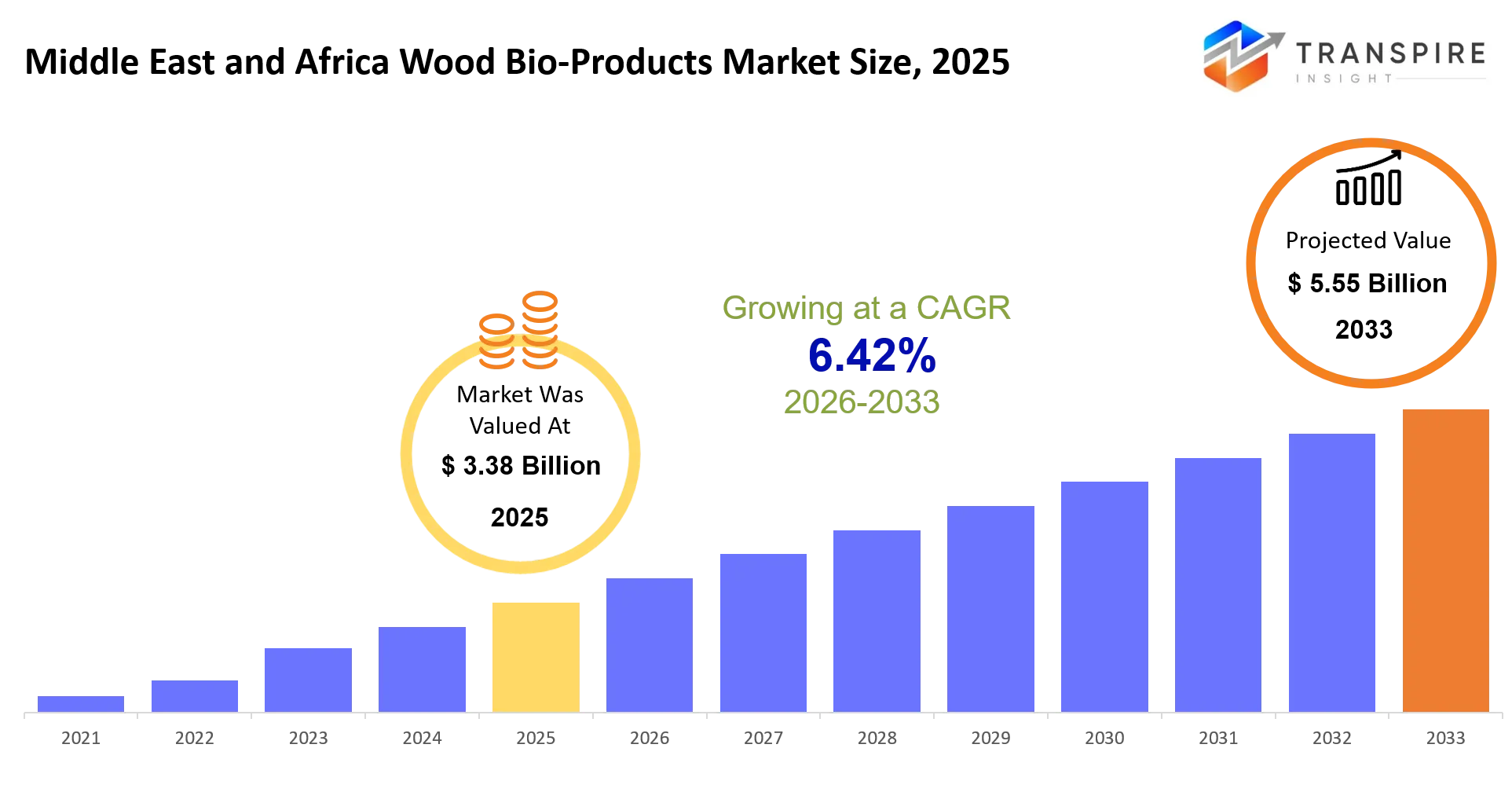
The Middle East and Africa Wood Bio-Products Market was valued at USD 3.38 Billion in 2025. It is forecast to reach USD 5.55 Billion by 2033. That is a CAGR of6.42% over the period.
Wood bio-products turn forest-based resources into fuels , chemicals, construction materials, packaging inputs, and industrial feedstocks that help manufacturers loosen their reliance on fossil derived raw materials, in a practical way. Across the Middle East and Africa these offerings also back energy generation packaging production, construction work, and industrial processing, while turning forestry residues plus wood-processing by-products into something usable and valuable.
Over the past five years, the market sort of drifted away from the usual wood items, and leaned more toward biomaterials with higher value, plus biochemicals. One big structural change is that circular bioeconomy policies and carbon reduction targets have been plugged into industrial procurement strategies, more or less directly. At the same time supply chain disruptions, and the energy market wobble after global geopolitical tensions, revealed how fragile fossil based inputs can be. So manufacturers started to diversify feedstock sources, not just as a theory but as an operational move. This shift is now opening new revenue streams for producers of wood-derived fuels, chemicals, and advanced materials. And as industrial users look for steadier and locally sourced alternatives, adoption keeps stretching across energy, packaging, and construction sectors, which supports longer term market growth and ongoing investment activity.
Key Market Insights
- South Africa kind of dominates the regional revenue scene, with an estimated 34% market share in 2025 , and this is backed by forestry and pulp processing infrastructure that’s already well in place.
- Meanwhile, the Gulf Cooperation Council countries are the fastest-grow ing regional market through 2033, mainly due to bioeconomy investments and industrial diversification programs.
- On the product side, biofuels take the lead in demand, roughly 31% share, supported by things like industrial heating , and renewable energy projects that keep expanding.
- Wood pellets sit in the second-largest segment, mostly because of utility scale biomass co-firing plus commercial energy use cases that are becoming more common.
- Biochemicals are forecast to show the quickest growth through 2033, driven by the replacement of petroleum based industrial inputs.
- Energy applications hold close to 38% market share, so power generation and industrial heating end up as the dominant consumption categories.
- Packaging applications are expanding quickly too, as manufacturers swap conventional plastics for fiber based alternatives across a lot of consumer goods.
- Industrial end users contribute more than 45% of market revenue, which points to broad adoption in manufacturing and processing facilities.
- Residential biomass heating and cooking are also gaining traction in certain African markets , especially where pellet availability keeps improving.
- Companies like Stora Enso, UPM, Sappi, Enviva, Drax , and Suzano are pushing ahead by leaning into biomaterial innovation, strategic partnerships and advanced processing technologies.
What are the Key Drivers, Restraints, and Opportunities in the Middle East and Africa Wood Bio-Products Market?
Industrial decarbonization commitments really do act as the strongest growth catalyst, or at least thats how it often feels in practice. Manufacturing companies , utilities, and construction material producers are under more and more pressure to reduce lifecycle emissions while still keeping production efficiency in check. Because of that, this whole movement has sped up investment in wood-derived fuels , biomaterials, and biochemical feedstocks that can fit into existing industrial processes with fewer changes than starting from scratch with totally new technologies. And when more organizations set carbon reduction targets, procurement teams tend to redirect budgets toward renewable material alternatives, which then supports market revenues and also helps production capacity expand, kinda directly.
Still though, limited sustainable feedstock availability is probably the biggest structural bottleneck. Forestry resources need long growth cycles, and harvesting has to follow environmental standards , plus the usual certification requirements. So even if someone wants to increase production capacity, they cannot do it without holding the sustainability line. That leads to supply limitations which cant be fixed quickly, or not in any realistic short timeframe. When feedstock shortages show up, raw material costs go up, processing margins get squeezed, and large scale conversion facilities get delayed. In the end that chain reaction limits revenue potential across the whole value chain, not just one segment.
Looking ahead, advanced wood biochemicals feel like a big future opportunity. Lignin-based materials, renewable industrial chemicals, and wood-derived specialty ingredients are gaining higher-value uses than the older traditional biomass markets. Also, countries that push industrial diversification , especially within the Gulf region, are putting together conditions that look promising for new processing facilities.
What Has the Impact of Artificial Intelligence Been on the Middle East and Africa Wood Bio-Products Market?
Artificial intelligence is steadily getting better at operational efficiency across forestry, biomass processing, and bio-product manufacturing operations, so firms can keep things running smoother. A lot of companies now deploy AI powered monitoring systems to optimize the whole feedstock procurement , inventory management, and the production schedule planning. The automated control systems look at moisture content, processing temperatures , and conversion efficiency right in real time. That basically helps facilities cut down on waste and keep the output steadier, even when conditions shift a little.
On the other hand, machine learning models are also showing up in predictive maintenance programs. These systems watch equipment vibration patterns, operating temperatures , plus past performance records. Then they flag potential failures before unplanned shutdowns happen, rather than waiting for the obvious signs. Many facilities claim there are measurable gains in equipment uptime and lower maintenance expenses after predictive analytics rolls in. Also, AI-driven forecasting tools support producers estimate feedstock availability, energy yields, and production performance under different operating conditions, not just one “normal” scenario.
Further, advanced digital technologies help a lot with logistics planning and supply chain visibility. That tends to reduce transportation costs and helps avoid inventory imbalances. Still, adoption is kinda constrained by high integration expenses and the limited availability of really good operational data. Many biomass facilities run with fragmented digital infrastructure which makes AI deployment more complicated, and it slows down how fast the full operational benefits show up industry wide.
Key Market Trends
Since 2021, projects around lignin-based bi o material development have kinda expanded, as some manufacturers look for alternatives to petroleum-derived industrial inputs, maybe to stabilize costs too.
Between 2022 and 2025, wood pellet investments went up by more than 20% across several biomass energy supply chains, not just one region.
Packaging manufacturers started to lean more into molded fiber solutions, which in turn cut down dependence on single-use plastic packaging formats , quite a bit.
Industrial users changed their procurement strategies after global energy price volatility showed how risky it is to rely on fossil-based feedstocks.
Digital forestry platforms got wider deployment since then , helping with harvest planning and making feedstock traceability easier across certified supply chains.
Since 2023, biomass processing facilities have kept putting more money into automation investments for yield optimization and to reduce production waste, overall.
In 2025, Stora Enso expanded bio-based material partnerships, aiming to speed up commercialization of advanced fiber applications , faster maybe.
UPM also pushed forward commercialization of wood-based biochemical production through its industrial-scale biorefinery operations in 2025.
Construction markets increasingly adopted engineered wood products, especially as carbon accounting requirements became more prominent, and more strict.
Buyers more and more now prioritize certified feedstocks, which strengthens demand for traceable and sustainably sourced forestry resources, basically.
Middle East and Africa Wood Bio-Products Market Segmentation
By Product Type
Biofuels still count as a key product category because they show up in industrial boilers, in combined heat and power sites, and in renewable energy setups. Commercial users often care a lot about having a stable fuel supply , and also about whether it works with what they already have in place. Biomass based energy solutions keep getting used as part of industrial decarbonization playbooks, across different sectors , not just one.
Biochemicals really make value happen by turning wood derived inputs into industrial chemicals, specialty ingredients, and even renewable substitutes for petroleum based materials. Biomaterials help with packaging, construction and manufacturing because they replace materials in a more renewable way, it’s kind of the point. Wood pellets keep strong adoption for heating and power generation , mainly for storage convenience , and because transport tends to be easier. Others cover various niche products too, like specialty wood derived goods that are built for specific industrial and commercial uses, those that are a bit less obvious.
To learn more about this report, Download Free Sample Report
By Feedstock
Forest Residues kind of provide this important raw material source, by using branches, tops, and the harvesting leftovers that otherwise would just stay unused. Over time better collection practices plus logistics networks have improved the feedstock utilization rates across forestry operations. So this category backs circular resource management, while also giving conversion facilities cost-effective inputs, without much drama.
Sawdust still gets used a lot, mainly because wood processing facilities keep generating steady volumes, through the year too. Wood Chips are used for big scale energy and industrial conversion uses, since the availability is dependable and the processing efficiency stays solid. Other examples are bark, recycled wood materials, and mixed biomass resources, which support specialized production requirements and local supply strategies.
By Application
Energy applications account for quite a bit of consumption because biomass fuels still help with electricity generation, district heating, and industrial energy production. Utilities as well as manufacturing facilities keep integrating renewable fuel alternatives into their ongoing work, even when it is a bit tricky. In the long run , energy security targets also keep pushing utilization across multiple countries.
Construction applications profit from the broader use of engineered wood products, wood-based panels, plus other sustainable building materials. Packaging applications are expanding too, through fiber based alternatives and renewable material solutions. Chemicals applications, meanwhile, tend to lean on renewable feedstocks for industrial processing. There are also the other areas, like agriculture, consumer goods, and specialty manufacturing activities.
By End User
Industrial users show up as the biggest consuming crowd, mostly because manufacturing , processing, and energy plants need pretty significant volumes of bio-based fuels along with materials. There’s an operational scale factor, plus long- term procurement contracts that help keep the market demand steady, not too spiky. On top of that, industrial decarbonization programs keep pushing for more widespread adoption, even when timelines get messy.
For Commercial users, wood bio-products get applied in hospitality, retail, offices, and institutional settings. And then Residential users add their own share, through heating, cooking, and day to day household energy uses where biomass solutions stay economically appealing. The rest is kinda everything else , like government projects, community energy schemes, and specialized sector applications where the fit needs to be pretty specific, you know.
What are the Key Use Cases Driving the Middle East and Africa Wood Bio-Products Market?
Energy generation is still the main thing,especially for industrial sites looking for a dependable alternative to standard fossil fuels. Biomass fuels and wood pellets help with electricity production, industrial heating, and combined heat and power systems. In practice this use case ends up driving the biggest consumption volumes, since big factories usually need a steady fuel feed and costs they can forecast without surprises.
Packaging and construction show up as key secondary areas too. For packaging, companies are turning more toward fiber-based materials , both to match sustainability commitments and because purchasing rules are shifting. In construction, firms increasingly use engineered wood products along with renewable building materials, especially in commercial builds.
Then there are the newer directions, like lignin-derived industrial chemicals,advanced biomaterials, and niche biochemical products. A lot of research plus commercialization work is opening doors for renewable composites, performance materials, and industrial inputs. Today these lines are still relatively modest in scale but they could generate meaningful value across most of the forecast horizon.
|
Report Metrics |
Details |
|
Market size value in 2025 |
USD 3.38 Billion |
|
Market size value in 2026 |
USD 3.59 Billion |
|
Revenue forecast in 2033 |
USD 5.55 Billion |
|
Growth rate |
CAGR of6.42%from 2026 to 2033 |
|
Base year |
2025 |
|
Historical data |
2021 - 2024 |
|
Forecast period |
2026 - 2033 |
|
Report coverage |
Revenue forecast, competitive landscape, growth factors, and trends |
|
Regional scope |
Middle East and Africa (Saudi Arabia, United Arab Emirates, South Africa, Rest of Middle East and Africa) |
|
Key company profiled |
Stora Enso, UPM, Metsa Group, Sappi, West Fraser, Canfor, Weyerhaeuser, Enviva, Drax, Binderholz, Mercer, Holmen, Sodra, Suzano, CMPC |
|
Customization scope |
Free report customization (country, regional & segment scope). Avail customized purchase options to meet your exact research needs. |
|
Report Segmentation |
By Product Type (Biofuels, Biochemicals, Biomaterials, Wood Pellets, Others); By Feedstock (Forest Residues, Sawdust, Wood Chips, Others); By Application (Energy, Construction, Packaging, Chemicals, Others); By End User (Industrial, Commercial, Residential, Others) |
Which Regions are Driving the Middle East and Africa Wood Bio-Products Market Growth?
South Africa, it really does stay out in front when it comes to regional revenue because its forestry sector is more mature, plus it already has a solid pulp and paper industry, and it can handle extensive biomass processing too. There are strong certification practices and sort of integrated supply chain workflows , which then helps with efficient feedstock utilization. On top of that, industrial infrastructure makes it easier to run large-scale production of bio based materials and fuels. Then you get a manufacturing ecosystem that’s pretty well developed, and it kinda keeps the long term market leadership going.
The Middle East shows up as the second-largest contributor, but the growth drivers aren’t the same as South Africa’s. Industrial diversification programs, and investment led development strategies , are helping create steady demand for renewable materials and alternative feedstocks. Government backed sustainability initiatives also bring policy stability, so long term project development feels more reliable. Big industrial users are increasingly looking at bio based alternatives too, but usually within wider decarbonization programs.
The Gulf region is expected to see the fastest expansion through 2033. New investments tied to renewable energy, circular economy initiatives, and sustainable manufacturing projects have basically opened up stronger market opportunities. Industrial modernization programs are pushing demand for advanced biomaterials and bio based industrial inputs. And this overall momentum should end up creating pretty attractive entry points for investors, technology providers, and processing companies during the forecast period.
Who are the Key Players in the Middle East and Africa Wood Bio-Products Market and How Do They Compete?
The competition still feels moderately consolidated, with global firms in forestry, pulp, biomaterials, and renewable energy kinds of business areas, holding a meaningful portion of the advanced production capacity. In practice companies tend to go at it mainly through things like feedstock security , processing know-how, product novelty, sustainability certifications, and simply how wide their geographic reach is. Over the long term , stable raw material access stays a big competitive edge, since what’s available on the supply side tends to steer profitability and expansion paths, pretty directly.
Stora Enso, for example, sort of differentiates via advanced lignin-based biomaterials, plus fiber packaging innovation, and renewable construction materials. They’ve also grown partnerships, aimed at bio-based packaging and those more advanced material applications.
UPM leans into commercial-scale biochemical manufacturing and integrated forest resource management. The Leuna biorefinery helps it stay in a stronger spot, by enabling production of renewable industrial chemicals made from wood feedstocks.
Sappi tends to use regional manufacturing muscle and specialty cellulose knowledge to serve higher-value industrial markets. Enviva, instead, puts weight on large-scale pellet supply networks and longer-term energy agreements. Drax is more about biomass energy integration and the production of renewable power. Taken together, these differing plays let companies chase distinct customer segments, while also reinforcing their longer-run market positions.
Company List
- UPM
- Sappi
- Canfor
- Enviva
- Drax
- Binderholz
- Mercer
- Holmen
- Sodra
- Suzano
- CMPC
Recent Development News
In June 2025, Stora Enso entered a partnership with Matrix Pack. The collaboration accelerates development of formed fiber packaging solutions and expands commercialization of renewable packaging materials.https://www.storaenso.com
In December 2025, UPM launched commercial production from its Leuna biorefinery. The milestone enabled industrial-scale production of wood-based biochemical products and strengthened the transition toward renewable chemical feedstocks.https://www.upm.com/
What Strategic Insights Define the Future of the Middle East and Africa Wood Bio-Products Market?
The market is kind of structurally shifting, towards higher value applications instead of just expanding raw volume. Over the next five to seven years growth will come more and more from biochemicals, engineered biomaterials, and advanced fiber solutions, which tend to deliver stronger margins than the classic biomass products. At the same time industrial decarbonization needs and circular manufacturing goals will still be the main drivers steering investment decisions, even if it feels slower sometimes.
There is also a less obvious risk, feedstock concentration and resource competition. When more different sectors chase wood based substitutes at the same time, the pressure on certified forestry resources might rise too, and that can push procurement costs up, while also squeezing supply availability. In other words this issue could become bigger than the usual uncertainty on the demand side, because it’s not only about “if” customers buy, but about whether material can even be sourced reliably.
One emerging upside is lignin based specialty materials plus renewable chemical platforms, aimed at packaging, automotive, and other industrial manufacturing uses. Early commercialization efforts are starting to point toward real long term potential, not just hype. Of course timing and scale will still matter, but the direction looks fairly clear.
Market participants should therefore prioritize investments that lock in feedstock access while simultaneously strengthening advanced processing capabilities. The groups that combine sustainable resource ownership, with high value product innovation will likely end up with the best competitive position through 2033, somewhat regardless of minor market swings.
Middle East and Africa Wood Bio-Products Market Report Segmentation
-
By Product Type
Biofuels
Biochemicals
Biomaterials
Wood Pellets
Others -
By Feedstock
Forest Residues
Sawdust
Wood Chips
Others -
By Application
Energy
Construction
Packaging
Chemicals
Others -
By End User
Industrial
Commercial
Residential
Others
Frequently Asked Questions
Find quick answers to common questions.
The Expected Middle East and Africa Wood Bio-Products Market size for the Market will be USD 5.55 Billion in 2033.
Key Segments for the Middle East and Africa Wood Bio-Products Market are By Product Type (Biofuels, Biochemicals, Biomaterials, Wood Pellets, Others); By Feedstock (Forest Residues, Sawdust, Wood Chips, Others); By Application (Energy, Construction, Packaging, Chemicals, Others); By End User (Industrial, Commercial, Residential, Others).
Major Middle East and Africa Wood Bio-Products Market Players are Stora Enso, UPM, Metsa Group, Sappi, West Fraser, Canfor, Weyerhaeuser, Enviva, Drax, Binderholz, Mercer, Holmen, Sodra, Suzano, CMPC.
The Current Middle East and Africa Wood Bio-Products Market size is USD 3.38 Billion in 2025.
The Middle East and Africa Wood Bio-Products Market CAGR is 6.42% from 2026 to 2033.
- Stora Enso
- UPM
- Metsa Group
- Sappi
- West Fraser
- Canfor
- Weyerhaeuser
- Enviva
- Drax
- Binderholz
- Mercer
- Holmen
- Sodra
- Suzano
- CMPC
About the Authors

Pankaj Ghogare Patil
I am Pankaj Ghogare Patil, a Senior Research Analyst at Transpire Insight, specializing in the Pharmaceutical, Chemicals & Materials, Healthcare IT, and Biotechnology industry. My expertise lies in conducting comprehensive market research, analyzing industry trends, evaluating competitive landscapes, and translating complex data into actionable insights. At Transpire Insight, I closely follow emerging technologies, regulatory developments, and market innovations to create accurate, well-researched, and informative content that helps businesses and professionals make informed decisions. I am committed to producing credible, evidence-based articles that reflect industry best practices while making technical topics accessible and valuable for a broad audience.

Chakradhar Khansole
Chakradhar serves as the Research Director at Transpire Insight, bringing over 8 years of experience in technology, innovation, and strategic market intelligence. He specializes in transforming complex market data into actionable business insights that enable organizations to make informed, growth-oriented decisions. Recognized for his strategic vision and analytical expertise, Chakradhar leads high-impact research initiatives, delivering comprehensive market assessments, competitive intelligence, and forward-looking industry analysis.
Recently Published Reports
-
May 2026
Healthcare Polymer Packaging Market
Healthcare Polymer Packaging Market Size, Share & Analysis Report By Packaging Type (Syringes, IV Bottles and Pouches, Clamshells, Blisters, Bottles & Jars, Containers, Tubes, IV Parental Packaging, Others), By Type (Regulated, Non-regulated), By Polymer Type (LDPE (Low-Density Polyethylene), HDPE (High-Density Polyethylene), Homo-polymer (Homo), Random Copolymer (Random), Block Copolymer (Block), PET, Polystyrene, Polyvinyl Chloride, Polyamide/EVOH, Others), and Geography (North America, Europe, Asia-Pacific, Middle East and Africa, South and Central America), 2021 - 2031
-
Apr 2026
Hydrophilic Tape (Waterstop) Market
Hydrophilic Tape (Waterstop) Market Size, Share & Analysis Report By Type (Bentonite-Based Hydrophilic Tape, Rubber-Based Hydrophilic Tape), By Application (Residential Buildings, Commercial Buildings, Infrastructure Projects), and Geography (North America, Europe, Asia-Pacific, Middle East and Africa, South and Central America), 2021 - 2031
-
Apr 2026
Metalens Market
Metalens Market Size, Share & Analysis Report By Type (Visible Light Metalens, and Infrared Metalens), By Application (Consumer Electronics, Automotive Electronics, Industrial, Medical, and Others), and Geography (North America, Europe, Asia-Pacific, Middle East and Africa, South and Central America), 2021 - 2031
-
Apr 2026
PBT Resin Market
PBT Resin Market Size, Share & Analysis Report By Type (Reinforced PBT Resin, Unreinforced PBT Resin), By Processing Method (Injection Molding, Extrusion, Blow Molding, Others), By End-User (Automotive, Electrical & Electronics, Consumer Appliances, Industrial Machinery, Medical Devices, Packaging, Others), and Geography (North America, Europe, Asia-Pacific, Middle East and Africa, South and Central America), 2021 - 2031