

Middle East and Africa Aluminum Clad Wood Windows Market Size & Forecast:
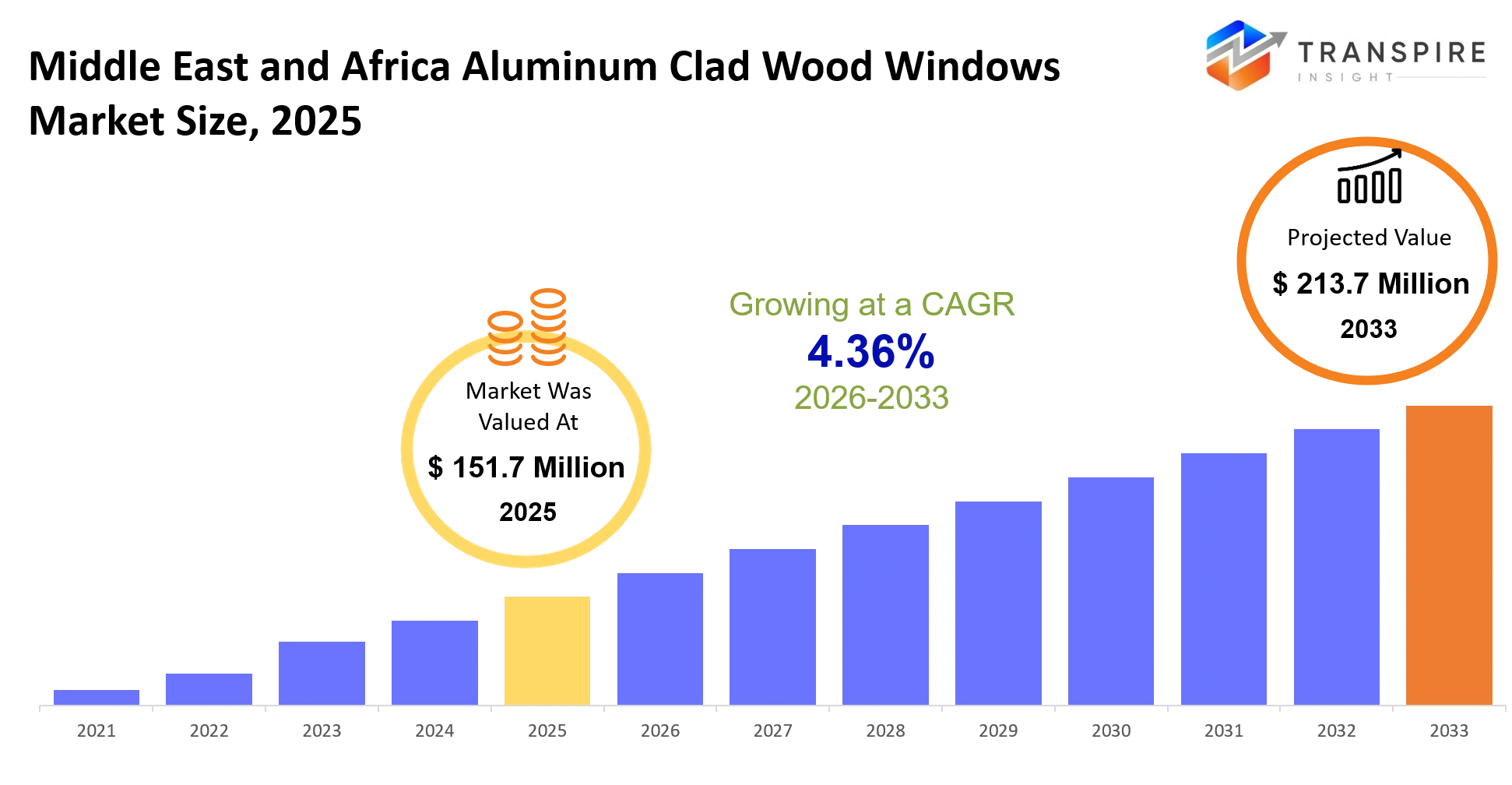
- Middle East and Africa Aluminum Clad Wood Windows Market Size 2025: USD 151.7 Million
- Middle East and Africa Aluminum Clad Wood Windows Market Size 2033: USD 213.7 Million
- Middle East and Africa Aluminum Clad Wood Windows Market CAGR: 4.36%
- Middle East and Africa Aluminum Clad Wood Windows Market Segments: By Product Type (Casement Windows, Sliding Windows, Fixed Windows, Awning Windows, Tilt & Turn Windows, Others); By Application (Residential Buildings, Commercial Buildings, Institutional Buildings, Others); By Distribution Channel (Direct Sales, Dealers & Distributors, Online Channels, Others); By End User (Homeowners, Builders, Contractors, Others).
To learn more about this report,  Download Free Sample Report
Middle East and Africa Aluminum Clad Wood Windows Market Summary
The Middle East and Africa Aluminum Clad Wood Windows Market was valued at USD 151.7 Million in 2025. It is forecast to reach USD 213.7 Million by 2033. That is a CAGR of 4.36% over the period.
Aluminum clad wood windows kinda solve a pretty practical problem in today’s building, because they mix the natural warmth insulation and that premium wood look on the inside with the tough weather resistance that aluminum gives outside. In the Middle East and Africa, you see these window systems more and more in luxury housing , commercial spaces, hospitality venues and even in high-performance projects where a long service life matters and people really want lower upkeep costs too.
Over the past five years, it feels like the market moved from choosing them just for appearance, to more performance driven buying decisions. Newer and stricter building efficiency rules, more spending on premium real estate, and the steady spread of green building certification programs have made architects and developers lean toward better, more advanced window systems. Also, the supply chain disruptions during and after the pandemic kind of forced builders to rethink priorities, so durable products with lower lifecycle costs started winning more bids.
Now that developers are focused on energy efficiency, thermal insulation, and long-term asset value, aluminum clad wood windows are getting a bigger piece of premium construction budgets. That’s turning into stronger market revenues and a broader, wider adoption across the region.
Key Market Insights
- The Middle East and Africa Aluminum Clad Wood Windows market is set to hit around USD 213.7 million by 2033, up from USD 151.7 million in 2025.
- In 2025 Gulf countries lead the regional revenue picture, with something like 45%+ market share, largely tied to big premium construction efforts.
- Saudi Arabia is also projected to be the fastest-moving national market through 2033, driven by mega development programs and tourism infrastructure spend, (so yeah it keeps building momentum).
- On the product side, casement windows still take the lead in demand, holding roughly 34.8% share in 2025, mainly for better sealing results and stronger energy efficiency.
- Sliding windows are the next biggest slice too especially for hospitality use and high-rise residential placements, where the layout matters.
- Interestingly casement windows are forecast to be the fastest-growing product category across the entire forecast period as well.
- When it comes to applications, residential construction dominates overall, with nearly 67% share globally, and that same direction is visible across premium MEA housing developments.
- The quickest expansion is being seen in luxury villas, branded residences, and mixed use developments across GCC countries.
- For end users, higher income residential buyers stay on top, while luxury hospitality operators are becoming a fast growing customer group.
- Major companies like Pella Corporation, Andersen Windows, Marvin, JELD-WEN, Schüco, and Reynaers are putting money into advanced glazing, more customization options, regional collaborations, and energy saving design approaches, all to sharpen their competitive stance.
What are the Key Drivers, Restraints, and Opportunities in the Middle East and Africa Aluminum Clad Wood Windows Market?
The main driver that pushes market expansion forward is that more attention is being placed on energy-efficient building envelopes across premium housing and commercial building work. In the Gulf, governments have tightened the rules for building performance and developers, at the same time, are aiming for international sustainability certifications more often. Because of this , people have been leaning toward window systems that cut down heat transfer, without fully changing the look. Aluminum clad wood windows kind of cover both things, so developers can push better efficiency while still keeping the premium architectural feel. And as more bigger projects start to specify high performance materials, manufacturers tend to get better value deals and steadier revenue paths.
Still, one of the biggest brakes is the high start-up cost of aluminum clad wood windows compared to ordinary aluminum or uPVC options. This issue is not just marketing, it is structural because it connects to raw material costs, more specialized fabrication steps, imported components, and the need for skilled installers. Even if the lifecycle savings make sense over time, many projects are still boxed in by what their capital budgets allow. So adoption mostly stays in the premium tier of construction, which narrows market reach, and also slows down how fast revenue can realistically grow.
A strong opening is the growth of luxury tourism and mixed-use developments across Saudi Arabia, the UAE and other Gulf markets. Big investments in hospitality, waterfront communities, and smart city initiatives are pulling demand up for premium façade solutions. In those cases, advanced glazing systems that are designed to work with aluminum clad wood frames can fit well, and they become a persuasive option for these developments.
What Has the Impact of Artificial Intelligence Been on the Middle East and Africa Aluminum Clad Wood Windows Market?
Artificial intelligence is starting to reshape the aluminum clad wood window industry, mostly by nudging manufacturing precision, project planning, and building performance analysis in the right direction. A lot of manufacturers are turning to AI enabled production setups to fine tune material cutting, shrink waste, and automate quality checks. And it’s not just “faster”, computer vision systems can spot surface defects, coating inconsistencies, and even small dimensional shifts more reliably than people doing it by hand, or at least the older manual inspection habits.
On the design and specification side, machine learning models are getting used more and more. Digital simulation platforms look at thermal behavior, solar heat gain, and building energy usage before anything is installed. That way architects and developers can compare window styles and pick products that actually hit performance targets while still keeping costs in check. Then inside manufacturing facilities, predictive maintenance systems help curb equipment downtime , which tends to lift production efficiency overall.
There’s also building information modeling platforms that add AI capabilities which makes it easier to handle project scheduling and procurement decisions. In practice that means fewer construction slowdowns and better coordination between suppliers and contractors, even when the workflow gets messy. Taken together these tools support day to day operational efficiency, reduce material waste, and strengthen compliance with energy-performance standards.
Still, AI adoption isn’t fully smooth, it’s kind of limited by the integration costs and by fragmented digital infrastructure across parts of the regional construction ecosystem. Some manufacturers still run legacy production environments, and that usually means you need a pretty serious investment before advanced analytics and automation can deliver the full value that people expect.
Key Market Trends
- Since 2021, developers have increasingly drifted away from “standard” aluminum systems toward hybrid window solutions, with the goal of better insulation results , maybe not always dramatic but noticeable.
- By 2025, casement window installations were already over 34% of the market, which signals a stronger appetite for airtight building envelopes.
- On another front, smart city programs rolling out across Saudi Arabia and the UAE have, since 2023, pushed specification rates higher for premium façade parts.
- At the same time manufacturers started putting more money into advanced glazing tech from 2022 through 2026, aiming for thermal efficiency gains in double digit territory.
- Sustainability and building certification rules also started shaping procurement choices across big commercial projects since 2021, not just minor tweaks.
- In luxury residential segments, custom color finishes, concealed hardware, and bigger glass panels are becoming usual rather than special , you see it more and more.
- Regional distributors have also broadened alliances with European system suppliers, so that premium options stay easier to access across GCC markets.
- Hospitality developers likewise increased adoption rates, especially as tourism driven infrastructure projects picked up speed after 2022.
- And yes, digital design tools together with BIM integration have basically turned into standard specification habits for top architecture firms.
- Companies such as Andersen, Schüco, Reynaers, Marvin and JELD-WEN keep extending their premium product range too, in order to match the latest performance expectations.
Middle East and Africa Aluminum Clad Wood Windows Market Segmentation
By Product Type
The product type segment kind of shows the range of window setups used across home, office, and institutional projects. Casement Windows kinda hold a major spot, mainly due to their solid sealing capabilities, reliable air exchange, and energy efficiency which, together, help when these are installed in high-end developments. So demand keeps being supported by building work that leans into indoor coziness, thermal steadiness, and years of durability.
Sliding windows keep getting chosen because they operate in a space-conscious way, and they fit apartments , hotels, and modern commercial spaces pretty well. Fixed Windows pull attention when daylight, broad panorama views, and overall architecture looks are still key design points. Awning Windows help with ventilation while also giving weather shielding, so installation feels practical across different climates. Tilt & Turn Windows are gaining momentum because multiple opening modes add convenience, improve how ventilation is managed, and add safety benefits too. Other options include specialty window designs created for specific architectural needs and functional goals.
By Application
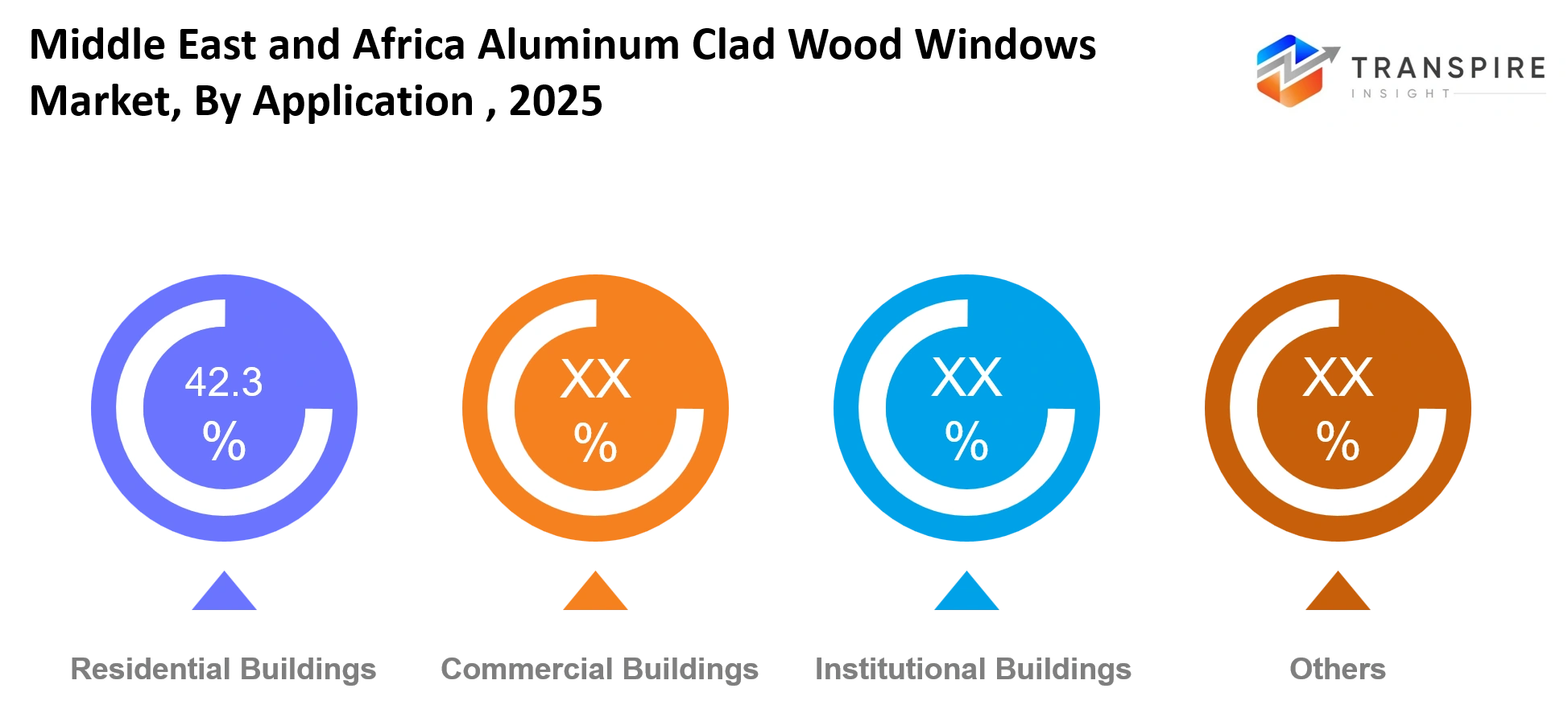
The app segment kind of mirrors how aluminum clad wood windows get used a lot across various building categories. In the residential bit, there s a big share, mainly because homeowners developers want windows that feel nice, insulate well and last longer, you know, the whole blend. Premium housing projects are still expanding, so installs keep showing up in villas, apartment blocks, and those luxury residential communities too.
On the commercial side, demand looks really steady. Offices, hotels, retail centers, and mixed use developments tend to prioritize energy efficiency, plus modern architectural looks, so the product fits there. For institutional buildings, facilities lean on advanced window systems that meet performance targets, especially in schools, healthcare buildings, and government properties. Then there s the other group, where you get specialized structures, and it s durability plus appearance and environmental performance that steer what materials get chosen during project planning.
To learn more about this report, Download Free Sample Report
By Distribution Channel
The distribution channel segment kind of shows the routes by which products reach construction sites and final users. Direct Sales still play a very important role, since manufacturers can bring tailored solutions, technical guidance, and even project-focused assistance for bigger developments. At the same time, good relationships between suppliers and the people involved in projects keep backing growth in this channel.
Dealers & Distributors also help a lot, because they widen product availability across local and regional markets, and they handle on the ground customer needs. Online Channels are becoming more visible, as digital platforms make it easier to look up products, check specifications, and move through purchasing. Others, for example specialized sales networks, or procurement methods that are developed to meet unusual project requirements, as well as regional market conditions.
By End User
The end user segment kind of mirrors the different customer groups that actually steer purchasing choices throughout the construction industry. Homeowners show up as a major slice, mostly because renovation work and new housing developments often include these higher end window solutions, which in turn add comfort, better efficiency, and a bump in property value. There’s also ongoing demand for durable and good looking building materials, and that keeps the overall market activity moving forward.
Builders make up a big portion too, since they’re involved in residential communities, commercial complexes, and large development efforts. Contractors matter in a more hands on way, they’re the ones who pick and mount the window systems that have to match the project requirements, hit performance goals, and stay within construction schedules. Then there are others, like property developers, institutional buyers, and specialized construction firms, who still need dependable solutions across a wide variety of building uses, sometimes even for niche or fast moving job types.
What are the Key Use Cases Driving the Middle East and Africa Aluminum Clad Wood Windows Market?
The biggest use case still looks like premium residential construction, mainly luxury villas, high-end apartments, and gated communities. In these places they really care about appearance, thermal behavior, and long-term staying power, so aluminum clad wood windows feel like a natural pick. The way these systems blend premium interior looks with weather-resistant outer layers keeps demand steady, kinda dependable.
Also, adoption is getting broader in hospitality and commercial real estate. Luxury hotels, resorts, office towers, and mixed-use developments are turning to these setups more often, mostly to help energy performance while still keeping the architectural look. Developers tend to see them as a durable investment, something that supports property value and even improves the guest atmosphere
More new applications are showing up too, like smart city rollouts, sustainable neighborhood initiatives, and upgraded healthcare facilities. Since governments, and private builders keep pushing for energy-saving infrastructure, these specialized builds are opening fresh doors for advanced window solutions that juggle aesthetics, efficiency, and lifecycle returns, all at once.
|
Report Metrics |
Details |
|
Market size value in 2025 |
USD 151.7 Million |
|
Market size value in 2026 |
USD 158.5 Million |
|
Revenue forecast in 2033 |
USD 213.7 Million |
|
Growth rate |
CAGR of 4.36% from 2026 to 2033 |
|
Base year |
2025 |
|
Historical data |
2021 - 2024 |
|
Forecast period |
2026 - 2033 |
|
Report coverage |
Revenue forecast, competitive landscape, growth factors, and trends |
|
Regional scope |
Middle East and Africa (Saudi Arabia, United Arab Emirates, South Africa, Rest of Middle East and Africa) |
|
Key company profiled |
Pella Corporation, Andersen Windows, Marvin, JELD-WEN, Velux, Internorm, Reynaers, Schuco, Aluprof, Sierra Pacific Windows, YKK AP, NorDan, Roto Frank, Ply Gem, Inwido. |
|
Customization scope |
Free report customization (country, regional & segment scope). Avail customized purchase options to meet your exact research needs. |
|
Report Segmentation |
By Product Type (Casement Windows, Sliding Windows, Fixed Windows, Awning Windows, Tilt & Turn Windows, Others); By Application (Residential Buildings, Commercial Buildings, Institutional Buildings, Others); By Distribution Channel (Direct Sales, Dealers & Distributors, Online Channels, Others); By End User (Homeowners, Builders, Contractors, Others). |
Which Regions are Driving the Middle East and Africa Aluminum Clad Wood Windows Market Growth?
The Gulf Cooperation Council region is basically leading the market because it has a big bunch of premium residential developments, hospitality projects, and large urban plans all clumped together, more or less. Places like Saudi Arabia and the UAE still put serious money into luxury construction plus tourism infrastructure. At the same time the building performance standards are getting way more sophisticated, so developers are pushing for better window systems. There’s also this sort of mature ecosystem of architects, contractors, and distributors around, and it kinda keeps the regional leadership steady and reinforced.
South Africa comes in as the second most important contributor, but its growth track is not the same as the Gulf. Here the demand is driven mostly by renovation work, premium housing programs, and upgrades in commercial properties, not mega-project builds. The market is helped by building methods that are relatively established, plus a stable pool of professional contractors. That steadiness tends to keep revenue generation reliable, even if overall expansion moves at a slower pace, you know.
Saudi Arabia is also getting recognized as the fastest-growing national market across the region. Big development programs, tourism investments, and smart city initiatives have pushed demand higher for advanced construction materials. And because the planned projects are so massive there’s more room for manufacturers to form local partnerships, plus widen their regional operations. From 2026 through 2033 this growth momentum is expected to pull in international suppliers and new entrants too, all aiming for longer-term expansion chances.
Who are the Key Players in the Middle East and Africa Aluminum Clad Wood Windows Market and How Do They Compete?
Competition is still pretty fragmented ,where global window manufacturers stand shoulder to shoulder with regional distributors and system folks . Most of the time the fight is less about price by itself and more about how well the product actually performs, how flexible the architecture can be, energy efficiency , and even how strong their project support really is. In the premium construction lane, customers usually look at lifecycle value, thermal results, and design flexibility first, which leaves room for firms that can genuinely separate themselves through tech and service ,not just marketing.
Andersen Windows keeps its attention on high-performance window systems and it keeps putting money into manufacturing capacity, to keep up with the rising demand for premium building products. The focus on advanced engineering and customization, sort of tightens its position in bigger residential developments where timelines and specifications matter. Marvin, for its part, leans into architectural customization and premium design strengths. They target luxury residential jobs, where bespoke dimensions, surface finishes and performance requirements become the deciding factors, not afterthoughts.
Schüco and Reynaers draw from strong façade engineering know-how, plus a clear advantage in energy-efficient building envelopes. You’ll commonly see their solutions named in commercial projects that need advanced performance certifications ,and also longer-term durability, over the long run. Pella Corporation and JELD-WEN compete by offering a wide set of products, using extensive distribution channels, and continuing steady product development. Their ability to cover multiple building segments while still providing premium solutions gives them flexibility that smaller competitors often can’t match as easily.
Company List
- Pella Corporation
- Andersen Windows
- Marvin
- JELD-WEN
- Velux
- Internorm
- Reynaers
- Schüco
- Aluprof
- Sierra Pacific Windows
- YKK AP
- NorDan
- Roto Frank
- Ply Gem
- Inwido
Recent Development News
In July 2025, Pella Corporation announced the acquisition of Weather Shield, a manufacturer of architectural wood and aluminum window and door solutions. The acquisition expanded Pella's presence in the premium residential and architectural fenestration segment while strengthening its portfolio of high-end aluminum clad wood products.
Source: https://www.woodworkingnetwork.com
In March 2026, Schüco International presented new window, door, sliding door, and digital project management solutions at Fensterbau Frontale 2026 in Nuremberg. The showcase highlighted the company's focus on integrated building envelope technologies, renovation solutions, and digital tools supporting the full construction lifecycle.
Source: https://www.schueco.com/
In November 2023, Andersen Corporation's Renewal by Andersen division began construction of its new manufacturing and distribution facility in Locust Grove, Georgia, following a USD 420 million investment commitment. The facility increases production capacity, supports future product line expansion, and strengthens supply capabilities across North America.
Source: https://www.andersenwindows.com
What Strategic Insights Define the Future of the Middle East and Africa Aluminum Clad Wood Windows Market?
Over the next five to seven years, the market is moving in a very structural way toward performance focused building envelope solutions, not just nice looking window systems. The real driver is basically the meeting of stricter building efficiency requirements, premium real estate investments, and more attention on long term asset worth. When developers look for materials that boost thermal performance while still keeping architectural character , aluminum clad wood windows are likely to take a bigger slice of high end construction work.
There’s also a quieter risk you almost don’t see, which is exposure to swings in aluminum prices and the imported timber supply chain. Material cost volatility can change project math fast and it can reduce adoption in developments that are more price sensitive. At the same time, a real opportunity is starting to show up around smart glazing integration and digitally tuned building envelopes, especially in Gulf smart city projects.
Market players should really lean into regional manufacturing partnerships, advanced glazing innovation, and local product tuning, because customization matters in practice. The firms that match their solutions to the changing building performance expectations, while also tightening up their regional supply networks , should be in a stronger spot to win future growth and protect margins in an environment that’s getting more competitive every year.
Middle East and Africa Aluminum Clad Wood Windows Market Report Segmentation
By Product Type
- Casement Windows
- Sliding Windows
- Fixed Windows
- Awning Windows
- Tilt & Turn Windows
- Others
By Application
- Residential Buildings
- Commercial Buildings
- Institutional Buildings
- Others
By Distribution Channel
- Direct Sales
- Dealers & Distributors
- Online Channels
- Others
By End User
- Homeowners
- Builders
- Contractors
- Others
Frequently Asked Questions
Find quick answers to common questions.
The expected Middle East and Africa Aluminum Clad Wood Windows Market size for the market will be USD 213.7 Million in 2033.
Key segments for the Middle East and Africa Aluminum Clad Wood Windows Market are By Product Type (Casement Windows, Sliding Windows, Fixed Windows, Awning Windows, Tilt & Turn Windows, Others); By Application (Residential Buildings, Commercial Buildings, Institutional Buildings, Others); By Distribution Channel (Direct Sales, Dealers & Distributors, Online Channels, Others); By End User (Homeowners, Builders, Contractors, Others).
Major Middle East and Africa Aluminum Clad Wood Windows Market players are Pella Corporation, Andersen Windows, Marvin, JELD-WEN, Velux, Internorm, Reynaers, Schuco, Aluprof, Sierra Pacific Windows, YKK AP, NorDan, Roto Frank, Ply Gem, Inwido.
The Middle East and Africa Aluminum Clad Wood Windows Market size is USD 151.7 Million in 2025.
The Middle East and Africa Aluminum Clad Wood Windows Market CAGR is 4.36% from 2026 to 2033.
- Pella Corporation
- Andersen Windows
- Marvin
- JELD-WEN
- Velux
- Internorm
- Reynaers
- Schüco
- Aluprof
- Sierra Pacific Windows
- YKK AP
- NorDan
- Roto Frank
- Ply Gem
- Inwido
About the Authors

Kartik bhong
I am Kartik Bhong, a Senior Research Analyst at Transpire Insight, specializing in the Packaging, Manufacturing, and Construction industry. My work focuses on analyzing market trends, emerging technologies, industry regulations, and competitive landscapes to deliver accurate, data-driven insights. I am passionate about transforming complex industry information into clear, practical content that helps businesses, professionals, and decision-makers stay informed and make confident strategic decisions. Through continuous research and a strong commitment to accuracy, I strive to create reliable, well-researched content that reflects the latest developments across these dynamic industries and supports the vision of Transpire Insight in delivering valuable market intelligence.

Chakradhar Khansole
Chakradhar serves as the Research Director at Transpire Insight, bringing over 8 years of experience in technology, innovation, and strategic market intelligence. He specializes in transforming complex market data into actionable business insights that enable organizations to make informed, growth-oriented decisions. Recognized for his strategic vision and analytical expertise, Chakradhar leads high-impact research initiatives, delivering comprehensive market assessments, competitive intelligence, and forward-looking industry analysis.
Recently Published Reports
-
Apr 2026
Handling and Lifting Equipment Market
Handling and Lifting Equipment Market Size, Share & Analysis Report By Product (Cranes and Hoists, Forklifts, Conveyor Systems, Aerial Work Platforms, Others), By Application (E-Commerce, Automotive and Railway, Food and Beverages, Aviation, Others), and Geography (North America, Europe, Asia-Pacific, Middle East and Africa, South and Central America), 2021 - 2031
-
Apr 2026
HVAC Equipment Market
HVAC Equipment Market Size, Share & Analysis Report By Heating Equipment Type (Boilers and Furnaces, Heat Pumps, and Unitary Heaters), By Ventilation Equipment (Air Handling Units, Humidifiers and Dehumidifiers, Air Filters, and Fan Coiling Units), By Air Conditioning Equipment (Unitary Air Conditioners, Room Air Conditioners, Packaged Terminal Air Conditioners, and Chillers), By End User (Commercial, Residential, Industrial, and others), and Geography (North America, Europe, Asia-Pacific, Middle East and Africa, South and Central America), 2021 – 2031
-
Apr 2026
Refrigeration Valves Market
Refrigeration Valves Market Size, Share & Analysis Report By Type (Solenoid Valves, Expansion Valves, Check Valves, Service Valves, Others), By Application (Commercial Refrigeration, Industrial Refrigeration, Transport Refrigeration, Residential Refrigeration, Air Conditioning Systems), By End User (Food and Beverage Industry, Pharmaceutical Industry, HVAC Industry, Chemical Industry, Others), and Geography (North America, Europe, Asia-Pacific, Middle East and Africa, South and Central America), 2021 – 2031
-
Apr 2026
E-Commerce Packaging Materials Market
E-Commerce Packaging Materials Market By Material Type (Corrugated Boxes, Paper & Paperboard, Foam & Cushioning Materials, Plastic Packaging, Flexible Packaging, Protective Packaging, Others), By Product(Primary Packaging, Secondary Packaging, Tertiary Packaging), By Packaging Function (Protective Packaging, Branding & Presentation Packaging, Transit & Logistic Packaging, Sustainable Packaging, Tamper Evidence Packaging), By End-User (Retail & Consumer Goods, Electronic Appliances, Food & Beverages, Healthcare & Pharmaceutical, Fashion & Apparel, Home & Furnishing, Others); By Industry Analysis, Size, Share, Growth, Trends, and Forecasts 2021-2033