

Asia Pacific Wood And Timber Products Market Size & Forecast:
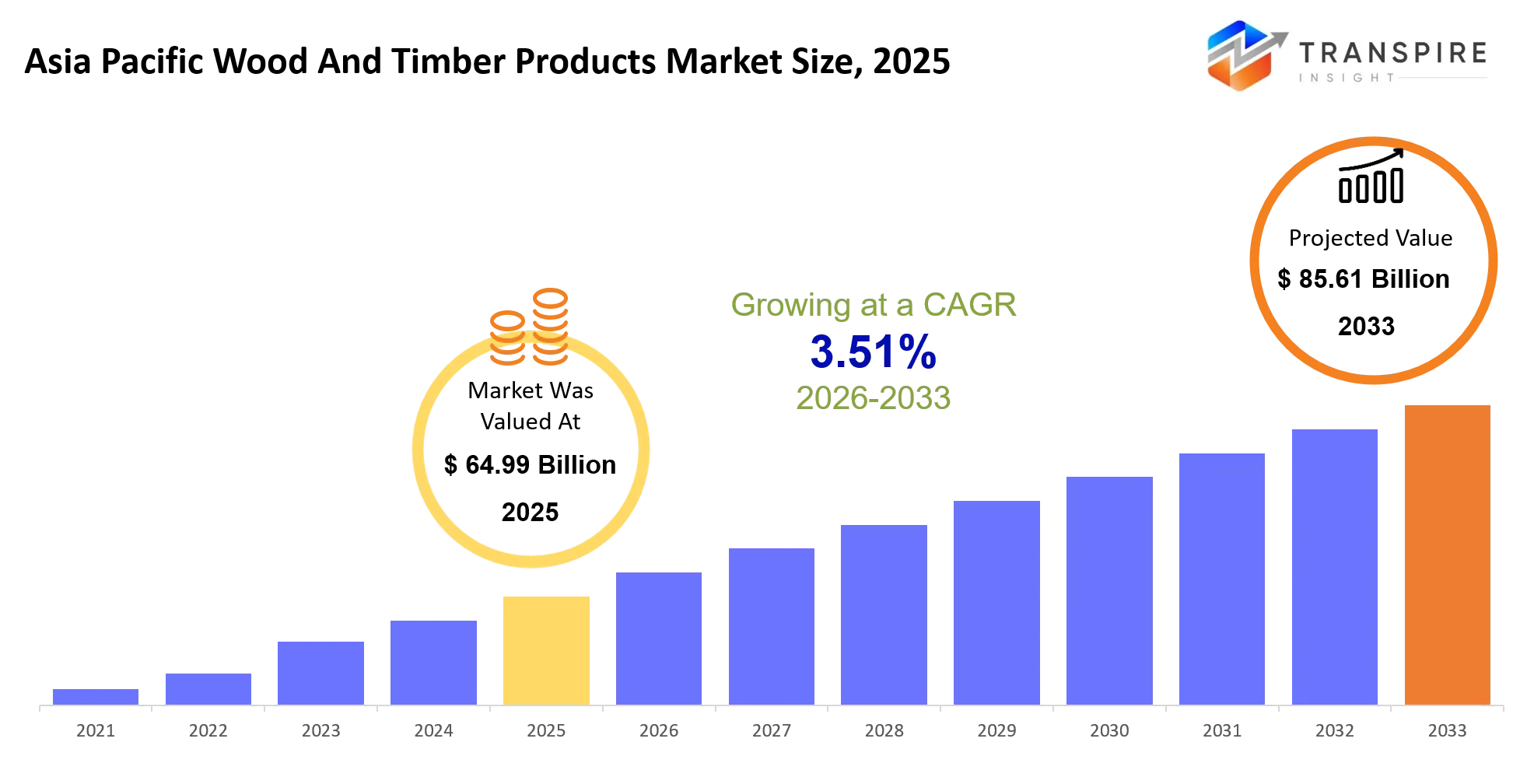
- Asia Pacific Wood And Timber Products Market Size 2025: USD 64.99 Billion
- Asia Pacific Wood And Timber Products Market Size 2033: USD 85.61 Billion
- Asia Pacific Wood And Timber Products Market CAGR: 3.51%
- Asia Pacific Wood And Timber Products Market Segments:By Product Type (Sawn Timber, Plywood, MDF, Particleboard, Veneer, Laminated Timber, Engineered Wood, Others); By Application (Construction, Furniture, Packaging, Flooring, Interior Design, Others); By Wood Type (Hardwood, Softwood, Bamboo, Reclaimed Wood, Others); By End User (Residential, Commercial, Industrial, Government, Others)
To learn more about this report,  Download Free Sample Report
Asia Pacific Wood And Timber Products Market Summary
The Asia Pacific Wood And Timber Products Market was valued at USD 64.99 billion in 2025. It is forecast to reach USD 85.61 billion by 2033. That is a CAGR of 3.51% over the period.
The Asia Pacific Wood and Timber Products Market is really important for construction and furniture making and packaging and industrial infrastructure. It gives them the wood materials they need for houses and buildings and other things. The Asia Pacific Wood and Timber Products Market helps people build things in a way that does not cost much money and it helps them use materials that are better for the earth than steel and concrete.
The Asia Pacific Wood and Timber Products Market has changed a lot in the last few years. Now it is more about using engineered wood like -laminated timber and laminated veneer lumber. This is because people want to be more sustainable and they want to use materials that're more efficient. The Asia Pacific Wood and Timber Products Market is doing this because of the rules that say we have to reduce carbon.
Something big that made this happen is that the pandemic messed up the way materials are sent around the world. This made countries like Japan and Australia and China realize they need to make their materials instead of relying on other countries. At the time the rules about reducing carbon are making builders use materials that are better for the earth. This is good for the Asia Pacific Wood and Timber Products Market because now people know they will be able to sell their certified timber and this will help them make money for a time. The Asia Pacific Wood and Timber Products Market is getting stronger because of this. It will keep growing in the future for big projects and for homes.
Key Market Insights
- The Asia Pacific Wood And Timber Products Market is changing the way it does things. Now people are using engineered wood. Trying to be more sustainable when they build things in the Asia Pacific.
- The Asia Pacific Wood And Timber Products Market is still growing really strong. It is going to keep growing until 2030 because more people are moving to cities and the government wants buildings to be greener.
- China is the player in the Asia Pacific Wood And Timber Products Market. It has 40 percent of the market because it builds a lot of things, makes a lot of products and imports a lot of timber.
- India is the growing market in the Asia Pacific right now. This is because people need houses. The government is building infrastructure and they have programs to make housing more affordable.
- People use sawn timber the most, but engineered wood is also really popular.. Cross-laminated timber is growing really fast in the Asia Pacific Wood And Timber Products Market.
- Most of the wood and timber products in the Asia Pacific are used for building things.. People are also starting to use them for packaging and making modular buildings.
- The Asia Pacific Wood And Timber Products Market is mostly used for building houses and offices.. People are also starting to use them for industrial logistics and making prefab houses really fast.
- Companies like Stora Enso, UPM and West Fraser are making engineered wood products and trying to be more sustainable all around the world.
- Companies like Weyerhaeuser, Canfor and Greenply are trying to be more competitive by expanding to places working with other companies and making new products that are better for the environment.
- To be successful in the Asia Pacific Wood And Timber Products Market companies need to make sure they get their wood from sources, use machines to make things more efficient and use the best technologies to make engineered wood products.
What are the Key Drivers, Restraints, and Opportunities in the Asia Pacific Wood And Timber Products Market?
Drivers
The Asia Pacific Wood And Timber Products Market is mainly driven by people using low-carbon building materials. This is because building emission standards and green certifications are getting stricter in economies. Governments and big infrastructure developers are now choosing certified timber and engineered wood for city residential and commercial projects. This shift towards low-carbon materials has reduced the use of steel and concrete in some cases directly increasing revenue for engineered wood producers and making demand more predictable across the supply chain.
Restraints
The Asia Pacific Wood And Timber Products Market is having a time. This is because of problems with getting materials and taking care of forests in the region. A lot of countries still get logs or timber from places, which means the people making things have to deal with prices going up and down, issues with shipping and problems with getting the right papers. It is hard to make things better because trees take time to grow. Also different countries have rules. This makes it slow to make things. It is hard for the people making things in the Asia Pacific Wood And Timber Products Market to decide on prices that're the same everywhere. The Asia Pacific Wood And Timber Products Market is really affected by these problems.
Opportunities
A big opportunity is emerging in the form of investments in engineered wood manufacturing hubs especially in India and Southeast Asia. Countries like Vietnam and Indonesia are setting up processing centers with the help of foreign investment and technology transfer agreements. For instance the use of -laminated timber systems in mid-rise city housing projects is becoming more popular. This creates a way for faster construction and higher-margin industrial applications. The Asia Pacific Wood And Timber Products Market can benefit from this trend.
What Has the Impact of Artificial Intelligence Been on the Asia Pacific Wood And Timber Products Market?
The Asia Pacific Wood And Timber Products Market is changing because of intelligence and new digital technologies. These things are helping to manage forest resources. They are also helping to process and distribute wood and timber products across the industry.In forestry operations computers with special vision systems and drones are used to keep track of the trees and see how healthy they are. This helps to figure out how much wood can be harvested. It saves time. Helps to harvest the wood more precisely. This means that producers can use the materials better and do not waste as much wood when they are cutting it.
Companies are also using machine learning to predict when machines will break down. This helps to keep the machines running and reduces the time they are not working. The companies can look at things like how the machines are vibrating and how hot they are getting. They can also look at how work the machines are doing. This helps them to know when a machine might break down before it actually does.At the time artificial intelligence is helping with the supply chain. It is helping companies to know when they will need wood and timber products. This means they can make more when they need to and not make much when they do not need it. This saves them money. Helps them to manage their resources better.
The Asia Pacific Wood And Timber Products Market is seeing some results from using artificial intelligence and new digital technologies. Companies have time when their machines are working and they are spending less money on maintenance. They are also using their resources better. Cutting the wood more accurately.
However it is still hard for some companies to use these technologies because they are expensive to set up. They also need data to make the systems work properly. Sometimes the forests are in areas and it is hard to get a good internet connection. This makes it hard to send data in time and it reduces the effectiveness of the systems in the Asia Pacific Wood And Timber Products Market.
Key Market Trends
- In 2020 builders started to use engineered wood of regular timber in buildings that are not too tall and in homes that are made in factories in big cities in Asia.
- Between 2021 and 2025 the government made rules to reduce things we release into the air so builders had to use wood that is certified in big projects.
- After the pandemic it was hard to get timber from countries so people in Southeast Asia and China started to get wood from their own countries and make it into things they need.
- China was in charge of 40 percent of the wood business in the area after 2022 because people were building again and they needed a lot of wood for factories.
- India started to grow fast after 2023 because they were building new roads and homes that people could afford and they were using prefab timber more often.
- New tools that use computers to help with forestry came out after 2022. They made it easier to know how much wood we would get from the trees and reduced waste when we cut them down and made them into lumber.
- Websites that help with getting wood from one place to another got better at knowing how wood we would need and when so we did not make too much or too little and this helped since 2021.
- The construction business started to use materials that're not bad for the earth and they have used less steel and more timber in some things since 2021.
- Companies like Stora Enso and UPM and West Fraser made engineered wood by investing money and buying other companies between 2022 and 2025.
- Weyerhaeuser and Canfor got better at competing with companies by getting wood from certified.
Asia Pacific Wood And Timber Products Market Segmentation
By Product Type:
The Asia Pacific Wood And Timber Products Market has a lot of demand for sawn timber. This is because sawn timber is very useful for construction activities in homes and offices. As more roads and houses are built, sawn timber is still very useful because it is cheap and easy to get.
Engineered wood and laminated timber are getting more popular because people want plywood and MDF and engineered wood that are strong and good for the environment.People in cities like engineered wood and laminated timber because engineered wood is strong.People are still using particleboard and veneer to make furniture and decorate homes in developing countries because people need furniture and people like to decorate homes, with plywood and MDF and particleboard.
By Application:
The biggest use of wood and timber products in the Asia Pacific Wood And Timber Products Market is for construction. This is because many people are moving to cities and there is a lot of building work going on. As more homes and offices are built there is a need for wood.
People are also using wood to make furniture and decorate their homes. This is because many people in cities want to live in spaces that are easy to organize. The packaging and flooring industries are also using wood because of online shopping and the need for lightweight materials.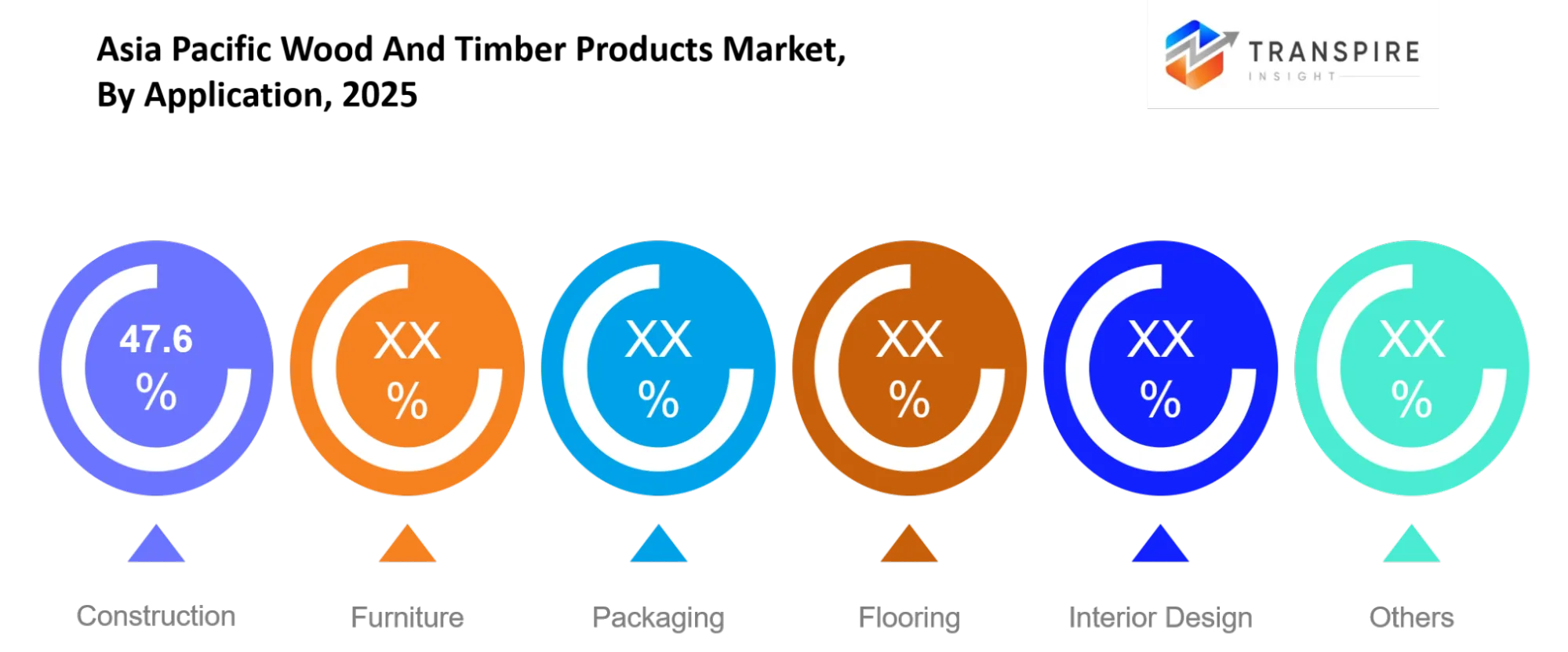
To learn more about this report, Download Free Sample Report
By Wood Type:
Hardwood is still very popular for making furniture and floors because hardwood is very strong and hardwood lasts a time.Softwood is widely used for building homes and offices because softwood's cheap and people can get softwood easily.
Bamboo is becoming more popular because bamboo is a material that's good for the environment.Bamboo is a choice for people who want to help the environment.Reclaimed wood is also being used often to renovate buildings and make new eco-friendly buildings with reclaimed wood.
By End User:
The residential sector is the user of wood and timber products in the Asia Pacific Wood And Timber Products Market. This is because many people are building homes and the population in cities is growing. The demand for housing and mid-rise buildings means that people are constantly using timber products.
Office buildings, warehouses and shops are also using engineered wood and processed timber products. Government projects are also using a lot of wood and timber products to build roads, bridges and public buildings that're strong and last a long time.
What are the Key Use Cases Driving the Asia Pacific Wood And Timber Products Market?
The Asia Pacific Wood And Timber Products Market is mostly used for construction. This is because cities are growing fast and people need new homes and buildings. Timber is a choice for construction because it is cheap and easy to use. It is also faster to install than materials.People are building a lot of houses and offices so they need a lot of timber. Furniture making and interior design are also using a lot of wood. This is because people in cities want homes and offices. They like to use plywood and other types of wood because it looks good and lasts a long time.
Some companies are also using wood for packaging because it is light and can be recycled. The Asia Pacific Wood And Timber Products Market is also used for making prefabricated homes and renovating buildings to make them more environmentally friendly. People are using engineered wood for floors, in sized buildings because it is strong and looks good. The Asia Pacific Wood And Timber Products Market will keep growing as people want to build things and in a more sustainable way.
|
Report Metrics |
Details |
|
Market size value in 2025 |
USD 64.99 Billion |
|
Market size value in 2026 |
USD 67.24 Billion |
|
Revenue forecast in 2033 |
USD 85.61 Billion |
|
Growth rate |
CAGR of 3.51% from 2026 to 2033 |
|
Base year |
2025 |
|
Historical data |
2021 - 2024 |
|
Forecast period |
2026 - 2033 |
|
Report coverage |
Revenue forecast, competitive landscape, growth factors, and trends |
|
Regional scope |
Asia Pacific |
|
Key company profiled |
West Fraser, Weyerhaeuser, Stora Enso, UPM, SCA, Georgia-Pacific, Sumitomo Forestry, Canfor, Holmen, Metsa Group, Greenply, Century Plyboards, Boise Cascade, Interfor, Norbord |
|
Customization scope |
Free report customization (country, regional & segment scope). Avail customized purchase options to meet your exact research needs. |
|
Report Segmentation |
By Product Type (Sawn Timber, Plywood, MDF, Particleboard, Veneer, Laminated Timber, Engineered Wood, Others); By Application (Construction, Furniture, Packaging, Flooring, Interior Design, Others); By Wood Type (Hardwood, Softwood, Bamboo, Reclaimed Wood, Others); By End User (Residential, Commercial, Industrial, Government, Others) |
Which Regions are Driving the Asia Pacific Wood And Timber Products Market Growth?
China is the leader of the Asia Pacific Wood And Timber Products Market. This is because China has a construction base and a strong manufacturing ecosystem. China also uses a lot of timber. The cities in China are always. This means people need more wood for building. The government is also helping by making infrastructure programs and housing expansion policies. This means people will buy timber products. China has a processing industry and a supply chain network that works well. This helps to turn wood into materials that can be used for construction.
Japan is a market with a lot of technology. People in Japan need wood because they want to build houses. Japan has urban redevelopment projects that go on for a long time. Japan is different from other countries because it uses engineered wood in a very precise way. This is because Japan has to make houses that can resist earthquakes. The government in Japan makes sure that the wood used is of quality. This means that people know when they will buy wood and it is always quality. Japan has construction companies that always buy wood.
Southeast Asia is growing fast. This is because many people are moving to the cities and there is a lot of investment. Countries like Vietnam and Indonesia are making timber products. They are doing this by building mills and making special zones for manufacturing. These countries are also making infrastructure and housing programs. This means they are using wood. This is an opportunity for new companies to come in and invest in the wood business. This will happen from 2026 to 2033.
There are ways that wood is being used. For example people are making prefabricated houses and green buildings. This is because the government is making rules to protect the environment. People are also using engineered wood for flooring in -rise buildings. This is because it is strong and looks good. These new ways of using wood will become more popular as people want to build and be more sustainable. The Asia Pacific Wood And Timber Products Market will see a lot of changes in the coming years. China and Japan and Southeast Asia will all be a part of this change. The wood business will. New companies will come in. The Asia Pacific Wood And Timber Products Market will be very different, in the future.
Who are the Key Players in the Asia Pacific Wood And Timber Products Market and How Do They Compete?
The Asia Pacific Wood And Timber Products Market is pretty crowded. You have global companies and strong local manufacturers all competing with each other. They are competing to sell timber, engineered wood and special panels. The big companies try to keep their share of the market by being big and having a lot of resources. They own a lot of forests, have factories and can get their products to customers easily. The smaller local companies try to compete by being cheap and getting their products to customers quickly.Some companies are trying to stand out by being more environmentally friendly. For example Stora Enso is using technology to make kinds of wood that are good for the environment. They are making something called -laminated timber that is used in buildings that are trying to be more green. They are also working with companies to make sure their wood is sustainable.
UPM is another company that is trying to be more innovative. They are making kinds of wood products that are certified to be sustainable. They are working with construction and industrial companies to provide them with wood that is good for the environment. They are also trying to make renewable materials and get them to customers all over the world.Some companies are trying to compete by being cheap. West Fraser is one of them. They are good at making lumber and getting it to customers in North America. They can keep their prices stable when the price of raw materials goes up. Greenply is a company that is focusing on making plywood and special panels for houses in India. They are trying to get their products to customers by building up their distribution network and making new kinds of products.
Weyerhaeuser is a company that owns a lot of land with trees on it. They are trying to make sure they can keep supplying wood to customers for a time. They are using systems to make sure they are harvesting the trees in a sustainable way. This helps them make wood products efficiently. The Asia Pacific Wood And Timber Products Market is very competitive. Companies have to be creative to stand out.
Company List
- SCA
- Georgia-Pacific
- Sumitomo Forestry
- Canfor
- Holmen
- Metsa Group
- Greenply
- Century Plyboards
- Boise Cascade
- Interfor
- Norbord
Recent Development News
"In October 2025, Rayonier and PotlatchDeltic announced the merger of equals to create a combined timberland and wood products company. The $8.2 billion transaction expands their forest asset base and lumber production capacity, strengthening scale-driven competitiveness in North America and influencing global timber supply dynamics.https://www.reuters.com
"In November 2025, Stora Enso announced expansion of its engineered wood manufacturing capacity in Europe and Asia to meet rising demand for cross-laminated timber solutions. The investment supports low-carbon construction adoption and improves supply availability for mass timber building projects across international markets.https://www.storaenso.com
"In February 2026, Metsä Group confirmed a new strategic investment in upgraded wood processing facilities aimed at improving efficiency and increasing value-added timber output. The initiative enhances production automation and supports sustainable sourcing requirements across global construction supply chains.https://www.metsagroup.com
What Strategic Insights Define the Future of the Asia Pacific Wood And Timber Products Market?
The Asia Pacific Wood And Timber Products Market is moving toward a structurally engineered and compliance-led ecosystem, where demand growth will be shaped less by raw timber volume and more by certified, value-added wood systems. Over the next 5–7 years, construction decarbonization policies and fast-track urban housing programs will steadily shift procurement toward engineered wood and modular building materials. This transition is being driven by regulatory pressure on carbon intensity in buildings and the need to reduce construction timelines in high-density cities.
A less visible risk is the growing concentration of supply within a limited group of large integrated producers, which may create pricing rigidity and reduce flexibility during regional demand shocks. At the same time, substitution risk from alternative materials such as low-carbon concrete and steel composites could gradually limit timber share in certain infrastructure segments if cost advantages narrow.
A key emerging opportunity lies in mass timber adoption for mid-rise urban housing in Southeast Asia, where policy support for green buildings is gaining momentum. Market participants should invest early in certified engineered wood capacity and localized production hubs to secure long-term contracts with developers and public infrastructure programs, ensuring stable positioning as demand shifts toward sustainable construction systems.
Asia Pacific Wood And Timber Products Market Report Segmentation
-
By Product Type
- Sawn Timber
- Plywood
- MDF
- Particleboard
- Veneer
- Laminated Timber
- Engineered Wood
- Others
-
By Application
- Construction
- Furniture
- Packaging
- Flooring
- Interior Design
- Others
-
By Wood Type
- Hardwood
- Softwood
- Bamboo
- Reclaimed Wood
- Others
-
By End User
- Residential
- Commercial
- Industrial
- Government
- Others
Frequently Asked Questions
Find quick answers to common questions.
The Expected Asia Pacific Wood And Timber Products Market size for the Market will be USD 85.61 Billion in 2033.
Key Segments for the Asia Pacific Wood And Timber Products Market are By Product Type (Sawn Timber, Plywood, MDF, Particleboard, Veneer, Laminated Timber, Engineered Wood, Others); By Application (Construction, Furniture, Packaging, Flooring, Interior Design, Others); By Wood Type (Hardwood, Softwood, Bamboo, Reclaimed Wood, Others); By End User (Residential, Commercial, Industrial, Government, Others).
Major Asia Pacific Wood And Timber Products Market players are West Fraser, Weyerhaeuser, Stora Enso, UPM, SCA, Georgia-Pacific, Sumitomo Forestry, Canfor, Holmen, Metsa Group, Greenply, Century Plyboards, Boise Cascade, Interfor, Norbord.
The Current Asia Pacific Wood And Timber Products Market size is USD 64.99 Billion in 2025.
The Asia Pacific Wood And Timber Products Market CAGR is 3.51% from 2026 to 2033.
- West Fraser
- Weyerhaeuser
- Stora Enso
- UPM
- SCA
- Georgia-Pacific
- Sumitomo Forestry
- Canfor
- Holmen
- Metsa Group
- Greenply
- Century Plyboards
- Boise Cascade
- Interfor
- Norbord
About the Authors

Pankaj Ghogare Patil
I am Pankaj Ghogare Patil, a Senior Research Analyst at Transpire Insight, specializing in the Pharmaceutical, Chemicals & Materials, Healthcare IT, and Biotechnology industry. My expertise lies in conducting comprehensive market research, analyzing industry trends, evaluating competitive landscapes, and translating complex data into actionable insights. At Transpire Insight, I closely follow emerging technologies, regulatory developments, and market innovations to create accurate, well-researched, and informative content that helps businesses and professionals make informed decisions. I am committed to producing credible, evidence-based articles that reflect industry best practices while making technical topics accessible and valuable for a broad audience.

Chakradhar Khansole
Chakradhar serves as the Research Director at Transpire Insight, bringing over 8 years of experience in technology, innovation, and strategic market intelligence. He specializes in transforming complex market data into actionable business insights that enable organizations to make informed, growth-oriented decisions. Recognized for his strategic vision and analytical expertise, Chakradhar leads high-impact research initiatives, delivering comprehensive market assessments, competitive intelligence, and forward-looking industry analysis.
Recently Published Reports
-
May 2026
Healthcare Polymer Packaging Market
Healthcare Polymer Packaging Market Size, Share & Analysis Report By Packaging Type (Syringes, IV Bottles and Pouches, Clamshells, Blisters, Bottles & Jars, Containers, Tubes, IV Parental Packaging, Others), By Type (Regulated, Non-regulated), By Polymer Type (LDPE (Low-Density Polyethylene), HDPE (High-Density Polyethylene), Homo-polymer (Homo), Random Copolymer (Random), Block Copolymer (Block), PET, Polystyrene, Polyvinyl Chloride, Polyamide/EVOH, Others), and Geography (North America, Europe, Asia-Pacific, Middle East and Africa, South and Central America), 2021 - 2031
-
Apr 2026
Hydrophilic Tape (Waterstop) Market
Hydrophilic Tape (Waterstop) Market Size, Share & Analysis Report By Type (Bentonite-Based Hydrophilic Tape, Rubber-Based Hydrophilic Tape), By Application (Residential Buildings, Commercial Buildings, Infrastructure Projects), and Geography (North America, Europe, Asia-Pacific, Middle East and Africa, South and Central America), 2021 - 2031
-
Apr 2026
Metalens Market
Metalens Market Size, Share & Analysis Report By Type (Visible Light Metalens, and Infrared Metalens), By Application (Consumer Electronics, Automotive Electronics, Industrial, Medical, and Others), and Geography (North America, Europe, Asia-Pacific, Middle East and Africa, South and Central America), 2021 - 2031
-
Apr 2026
PBT Resin Market
PBT Resin Market Size, Share & Analysis Report By Type (Reinforced PBT Resin, Unreinforced PBT Resin), By Processing Method (Injection Molding, Extrusion, Blow Molding, Others), By End-User (Automotive, Electrical & Electronics, Consumer Appliances, Industrial Machinery, Medical Devices, Packaging, Others), and Geography (North America, Europe, Asia-Pacific, Middle East and Africa, South and Central America), 2021 - 2031