

France Eco-friendly Furniture Market Size & Forecast:
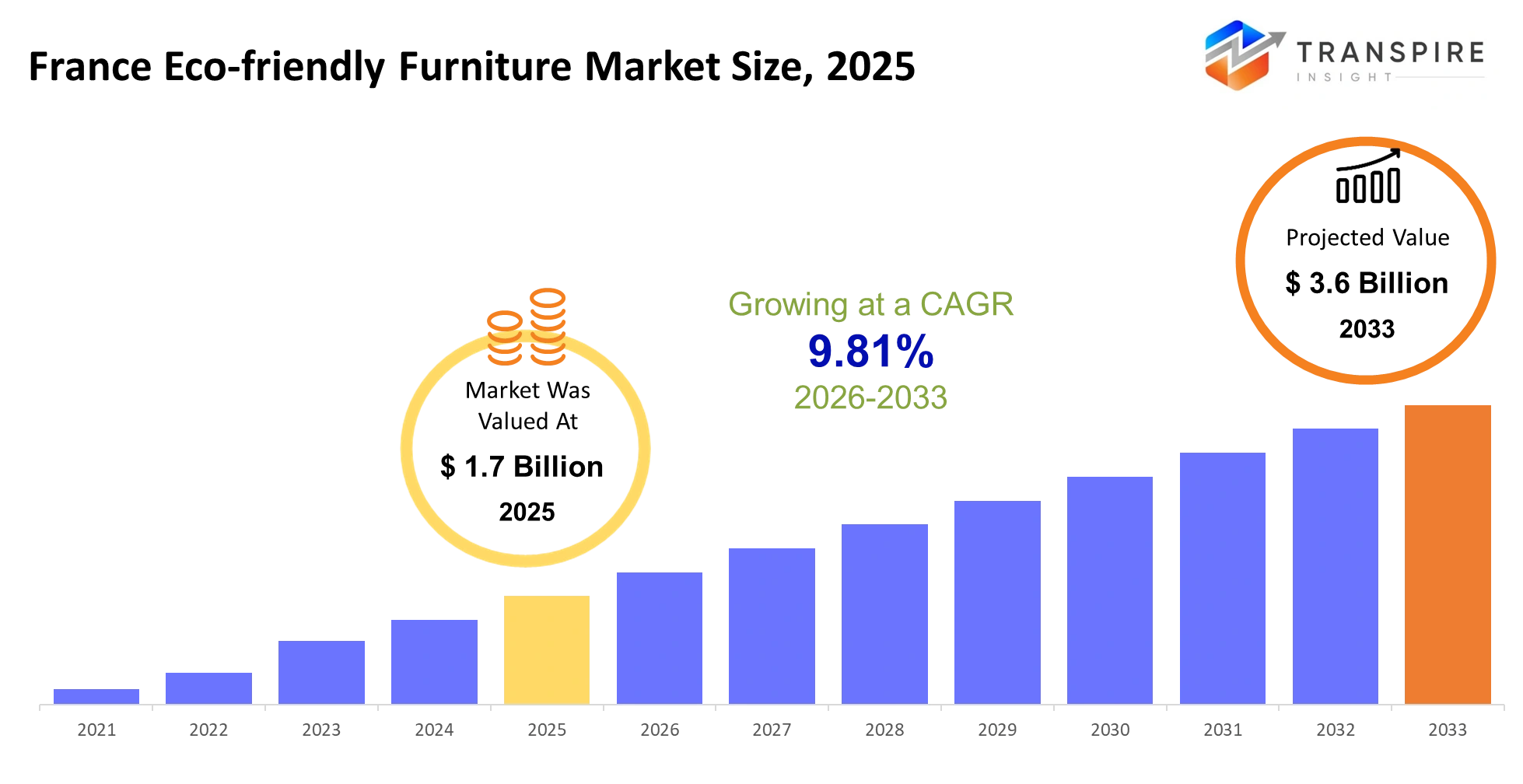
- France Eco-friendly Furniture Market Size 2025: USD 1.7 Billion
- France Eco-friendly Furniture Market Size 2033: USD 3.6 Billion
- France Eco-friendly Furniture Market CAGR: 9.81%
- France Eco-friendly Furniture Market Segments: By Type (Wood Furniture, Bamboo Furniture, Recycled Furniture, Others); By Application (Residential, Commercial, Outdoor, Office, Others); By End-User (Households, Offices, Hospitality, Retail, Others); By Material (Sustainable Wood, Recycled Plastic, Metal, Others).
To learn more about this report,  Download Free Sample Report
France Eco-friendly Furniture Market Summary
The France Eco-friendly Furniture Market was valued at USD 1.7 Billion in 2025. It is forecast to reach USD 3.6 Billion by 2033. That is a CAGR of 9.81% over the period.
The France eco-friendly furniture market sort of tackles a real, practical problem that shows up in commercial interiors, residential building and hospitality day to day: trying to lower the environmental footprint of furnishing without really giving up durability , design quality, or that lifecycle cost efficiency angle. In other words, the manufacturers here tend to build furniture with certified wood, recycled metals, low-VOC finishes, bamboo composites, plus circular production routines, all of which support businesses in meeting carbon reduction goals and green building requirements.
Over the last five years, things moved from smaller, niche sustainable collections into more mainstream procurement, especially when corporate offices are involved, and also in premium housing projects plus public infrastructure. France, with stronger circular economy rules and expanded producer responsibility frameworks, kind of sped the change along, by forcing producers to rethink sourcing and waste handling systems. Then the post-pandemic recovery had supply chain disruptions too, so buyers leaned even more toward locally sourced materials and regional manufacturing.
Today, decision makers want traceable materials and longer product lifecycles, and manufacturers who can merge sustainability certification with scalable production are more likely to win higher-value agreements, and also boost recurring revenue chances.
Key Market Insights
- Northern France sort of dominated the France Eco-friendly Furniture Market, with nearly 38% share in 2025, mainly from concentrated urban renovation and commercial office projects which is… you know, very targeted.
- Western France should be the fastest-growing regional cluster through 2033, backed by sustainable tourism infrastructure plus eco-certified hospitality investments that keep stacking up.
- In 2025, wooden eco-friendly furniture held the largest industry portion because FSC-certified timber stays strongly favored in both residential and office uses.
- Recycled metal furniture, meanwhile, landed as the second-largest segment as producers started using industrial scrap recovery more often and leaned into low-carbon fabrication methods.
- Bamboo composite furniture is projected to deliver the quickest forecast growth too, mainly due to shorter raw material cycles and lower embedded carbon intensity compared with hardwood alternatives that everybody keeps mentioning.
- Residential applications made up over 46% market share in 2025 as energy-efficient housing developments folded sustainable furnishing procurement standards into their plans.
- For applications, commercial office interiors became the fastest-expanding segment after hybrid workplace redesign sped up ergonomic-focused and low-emission furniture installations.
- And hospitality operators have increased their buying of recyclable furniture materials since 2023, aligning with EU sustainability disclosure standards, as well as eco-tourism positioning that they talk about in press releases.
- Millennials and Gen Z homeowners also pushed premium sustainable furniture purchases harder through online direct-to-consumer channels, emphasizing traceability and lifecycle transparency.
- Finally, leading companies built stronger competitive edges via modular product innovation, carbon-neutral logistics partnerships, and AI-enabled inventory optimization across European distribution networks that are getting more interconnected every year.
What are the Key Drivers, Restraints, and Opportunities in the France Eco-friendly Furniture Market?
The main thing pushing the France eco-friendly furniture market forward is, like, the tightening of sustainability compliance being baked into commercial procurement and construction standards, sort of “right now” kind of way. France’s circular economy legislation, plus tougher carbon reporting requirements across real estate and hospitality, has already changed how companies judge where they source furniture from. Developers, hotel operators, and corporate buyers are more often asking for FSC certified wood, recyclable materials, and low emission finishes, basically to stay eligible for green building certifications and ESG reporting checks. This evolution, in a direct kind of chain reaction, increases revenue potential for manufacturers that can show transparent supply chains and run certified sustainable production systems.
The biggest brake though is the structural cost imbalance between eco furniture manufacturing and standard mass production models. Eco certified raw materials, localized sourcing, and recyclable component design tend to cost more in procurement and processing. And smaller manufacturers end up with weaker economies of scale, plus supplier networks that are more fragmented, harder to coordinate. These issues don’t get fixed fast either, because they rely on long term investments in forestry certification, recycling infrastructure, and manufacturing upgrades. So, higher retail prices still slow down uptake among residential buyers who are price sensitive, and also among smaller businesses.
A big future opening could be circular furniture as service models enabled by digital lifecycle tracking technologies. Commercial clients are increasingly interested in leasing setups that include refurbishment, material recovery, and resale pathways.
What Has the Impact of Artificial Intelligence Been on the France Eco-friendly Furniture Market?
Artificial intelligence, along with other advanced digital tech, is kind of quietly reshaping the France eco-friendly furniture market mainly because it helps production run more efficiently , backs smarter use of materials and also makes circular supply chain management feel more doable, overall. Furniture makers increasingly lean on AI driven design tools, these help them cut down raw material waste during cutting, assembly, and even packaging tasks. Meanwhile machine learning models sort through production numbers to push wood utilization rates upward, cut scrap production, and also steady energy consumption across manufacturing sites. A few major European furniture producers have gone ahead and built predictive maintenance into automated production lines, which helps with less equipment downtime and, in turn, supports a longer machinery lifespan
On another front AI powered demand forecasting tools are improving inventory control and procurement plans too. When you look at seasonal purchasing patterns, renovation timelines, and how people act online, manufacturers can sort of trim the overproduction a bit, and keep warehouse costs lower. With digital twin technology it adds this extra layer too, kind of strengthening product lifecycle management. Like it can simulate durability, stress performance, and even recyclability before actual physical manufacturing really gets going. So overall, these approaches lift operational efficiency while also backing compliance with French and EU circular economy expectations.
Retailers are also using advanced analytics platforms to tailor product suggestions and refine omnichannel sales strategies, which tends to increase the conversion rate for premium sustainable furniture collections. Still there is a notable obstacle, AI adoption can get stuck because tying advanced analytics into fragmented supplier networks is often expensive and technically complicated, and this slows down scaling across the whole ecosystem
Key Market Trends
- Since 2022, French manufacturers are drifting toward timber that’s sourced closer to home, so they can cut import dependency and keep the supply chain more resilient, you know.
- Commercial office buyers are also leaning more and more toward modular furniture systems, because they make refurbishment easier and recycling smoother, plus reconfiguring flexible workspaces becomes less of a pain.
- After the EU carbon disclosure rules got tighter across manufacturing industries, recycled aluminum and reclaimed wood went up, like noticeably and fairly quickly.
- Online direct-to-consumer sales for sustainable furniture really picked up too, mainly as younger buyers cared a lot about material traceability, and they wanted carbon footprint transparency, up front.
- Hospitality groups started adopting low-VOC , and recyclable furnishing standards after stronger eco-certification requirements rolled out across tourism and accommodation , which then pushed vendors to comply.
- Between 2021 and 2025, manufacturers reduced plastic packaging volumes using biodegradable alternatives and AI optimized logistics systems, which sounded simple but it actually required a bunch of coordination.
- Steelcase and Herman Miller expanded their circular product take-back programs across European commercial furnishing operations, and that didn’t stay small for long.
- Demand for bamboo composite furniture grew as buyers looked for faster-renewable options, instead of sticking with the usual traditional hardwood-based product types.
- Investments in smart manufacturing improved production precision, reduced raw material waste, through predictive analytics and automated cutting technologies, giving fewer leftovers on the shop floor.
- Retailers are also increasingly rolling out augmented reality visualization tools, so customers can assess sustainable furniture products before purchase decisions, without guessing as much.
France Eco-friendly Furniture Market Segmentation
By Type
Wood Furniture keeps the lead in the market because certified timber products stay strongly favored across residential interiors, hospitality jobs, and even premium office setups. The long running lifespan , the natural look, and the way it fits with circular design expectations still back big scale take up by both commercial buyers and household customers. At the same time, sustainable forestry certifications plus better local sourcing connections add extra buyer comfort across France, and furniture makers are slowly shifting toward modular wood layouts and recyclable finishing systems. This is mainly to lift lifecycle value and make regulatory compliance easier, or at least less complicated.
Bamboo Furniture is kinda getting momentum too, because bamboo renews pretty quickly and the carbon footprint tends to be lower than a lot of traditional hardwood options. In compact urban housing projects and in eco certified hospitality developments, you see bamboo products more often, mostly because of the lighter build and that more contemporary, visual appeal. It’s like, the material just makes sense for modern spaces, even if people don’t always think about it directly.Recycled Furniture, meanwhile, keeps growing in a steady way since commercial buyers focus on waste reduction targets and circular purchasing rules. During the forecast period, the other furniture types—like hybrid composite options and reclaimed material collections—are expected to open up niche opportunities for premium interior developers and sustainability minded retail brands.
By Application
Residential applications still hold the largest market share, mostly because apartment renovation initiatives and energy-efficient housing upgrades keep blending sustainable furnishing benchmarks into the buying decisions, sort of continuously. The demand stays especially high in metropolitan zones where people really like low-emission materials, compact multifunction pieces, and fixtures that last a long time. Homeowners further feed recurring spending via interior refreshing and tailored décor changes, which also fits the environmental certification trends that are showing up more and more . Also, remote and hybrid work routines, they kind of push the replacement cycles for home furniture, more or less, on a regular basis.
Commercial applications remain important too, largely because hotels, retail venues, and mixed-use projects are increasingly choosing recyclable modular furnishing systems so they can stay aligned with ESG reporting expectations. Outdoor usage is moving ahead a bit slower, but it’s getting stronger through eco-tourism infrastructure, public seating installations, and landscaping initiatives that call for weather-ready recycled materials. Office applications are gaining momentum as companies redesign workspaces for adaptable layouts and employee wellbeing goals. Other niche applications, such as schools and healthcare interiors, are expected to enable selective growth—mainly around antimicrobial materials and circular furnishing systems that don’t waste as much.

To learn more about this report, Download Free Sample Report
By End-User
Households kind of dominate the end-user segment, because residential consumers account for most of the sustainable furniture purchases across France. Urban homeowners increasingly pick certified wood, recycled inputs, and low-VOC products , which back indoor air quality expectations and long-run cost effectiveness. There is also premiumization momentum pushing more spend toward multifunctional, custom-made furniture solutions for tight living quarters. And the ongoing home renovation push plus hybrid lifestyle adjustments seems to keep replacement demand steady inside the household category.
Offices still keep a strong market footprint because corporate employers more and more weave sustainable procurement requirements into workspace upgrades and modernization. Hospitality operators just keep moving forward with eco-certified hotels, resorts, and serviced apartments, which mostly need sturdy, recyclable furnishing systems that match sustainable tourism positioning, or something close to it. Retail businesses are also gradually putting more budget into environmentally responsible store layouts and display frameworks, so they can strengthen their brand image with sustainability-minded shoppers. Meanwhile other end users , like schools and public infrastructure initiatives, are projected to open new doors for modular designs , and refurbishment-friendly furniture concepts, basically.
By Material
Sustainable Wood kinda represents the leading material segment, mostly because FSC-certified timber and responsibly sourced hardwood products stay broadly trusted across residential, and commercial furnishing uses. There is still a strong pull from consumers toward natural finishes, durability, and that long lifecycle performance which keeps procurement volumes steady. Makers also seem to get a real advantage from existing supply networks and a good fit with premium interior design fashions. It looks like ongoing investment in engineered wood technologies, and recyclable coatings should further boost product novelty during the forecast window.
Recycled Plastic materials are picking up speed, since commercial developers plus outdoor infrastructure projects increasingly favor lightweight furnishing systems that resist moisture. Ongoing progress in polymer recycling technology and circular manufacturing practices keeps improving both durability and visual polish within this segment. Metal-based materials also keep a fairly steady demand, because structural strength, industrial design compatibility, and a long operating lifespan matter a lot in office and hospitality environments. Other material categories, including reclaimed textiles, and composite blends are expected to help with more niche product ideas and tailored sustainable furniture collections over the next several years.
What are the Key Use Cases Driving the France Eco-friendly Furniture Market?
Residential interiors still feel like the main spotlight for eco-friendly furniture in France, especially in those dense urban apartments , high-end housing builds and energy-saving residential programs. Many homeowners seem to go for pieces made from certified wood, recycled inputs, and low-VOC coatings because it fits the tighter indoor air quality rules and the idea of lasting durability over time. Honestly this corner of the market brings the biggest demand , since the ongoing renovation wave in Paris, Lyon and Marseille keeps nudging buyers toward sustainable interior sourcing.
Then there are the business settings which are slowly getting more attention. Office spaces for corporate sites and hospitality venues are seeing wider adoption, in part because employers redesigning hybrid work layouts want modular furniture that can be recycled later, and also because that helps them show ESG progress more cleanly. Hotels, plus eco-tourism properties often choose sustainable furnishing systems too, to reinforce environmental certifications and make the guest experience feel more distinct, or at least more aligned with their branding.
Less common but rising use cases are starting to show up as well. For example , furniture leasing by subscription for co-living developments, and circular furniture models that are digitally traceable. Universities, startup ecosystems and short-term commercial installs are beginning to trial refurbishment-based procurement approaches, which aim to cut down on material waste while stretching the product lifecycle value much further.
|
Report Metrics |
Details |
|
Market size value in 2025 |
USD 1.7 Billion |
|
Market size value in 2026 |
USD 1.87 Billion |
|
Revenue forecast in 2033 |
USD 3.6 Billion |
|
Growth rate |
CAGR of 9.81% from 2026 to 2033 |
|
Base year |
2025 |
|
Historical data |
2021 - 2024 |
|
Forecast period |
2026 - 2033 |
|
Report coverage |
Revenue forecast, competitive landscape, growth factors, and trends |
|
Regional scope |
France |
|
Key company profiled |
IKEA, Steelcase, Herman Miller, Haworth, Ashley Furniture, La-Z-Boy, Vitra, HNI Corp, Kimball, Teknion, Okamura, Godrej Interio, Inter IKEA, Flexsteel, Hooker Furniture. |
|
Customization scope |
Free report customization (country, regional & segment scope). Avail customized purchase options to meet your exact research needs. |
|
Report Segmentation |
By Type (Wood Furniture, Bamboo Furniture, Recycled Furniture, Others); By Application (Residential, Commercial, Outdoor, Office, Others); By End-User (Households, Offices, Hospitality, Retail, Others); By Material (Sustainable Wood, Recycled Plastic, Metal, Others). |
Which Regions are Driving the France Eco-friendly Furniture Market Growth?
Île-de-France stays kinda the main regional market since it sorta mixes high levels of commercial real estate activity with strict sustainability compliance duties. The Paris-based corporate office segment, along with luxury residential projects and hospitality developments, keeps folding recyclable and low-emission furnishing systems into procurement frameworks. You also get help from the region’s mature logistics infrastructure, premium interior design networks, and those clustered distribution channels that allow quicker product deployment. On top of that, the green building standards that are supported by the government, plus ESG-driven commercial investment, keep long-term purchasing energy going for both residential and commercial uses.
Then Auvergne-Rhône-Alpes shows up as the second most influential region, though its momentum isn’t quite the same as Île-de-France because it leans more on industrial steadiness and local manufacturing ecosystems. Cities like Lyon and Grenoble keep demand fairly consistent through office modernization, educational infrastructure undertakings, and mid-sized residential construction. The area can also lean on proven furniture manufacturing strengths and it’s near sustainable timber supply routes across central Europe. Basically, this interplay between production efficiency, and stable commercial uptake makes it a solid contributor to overall national market revenue.
Provence-Alpes-Côte d’Azur is, well, emerging as the fastest-growing regional market because sustainable tourism infrastructure is expanding and luxury hospitality is getting more attention. From 2024 onward, developers along the Mediterranean coastline have been speeding up the uptake of eco-certified interiors, in order to improve environmental credibility in high-end resorts and mixed-use properties.
Who are the Key Players in the France Eco-friendly Furniture Market and How Do They Compete?
The France eco-friendly furniture market still looks moderately fragmented, so you get global furniture manufacturers trading space with regional sustainable design specialists, plus digitally native furnishing brands, in the same arena. Lately, rivalry is less about simple price positioning, more about how well companies can prove material traceability, show circular production capability, and deliver modular product innovation that actually works in everyday rooms. The established players defend their market share using certified sourcing systems, recyclable product engineering, and an omnichannel distribution push, while the newer entrants tend to chase narrower sustainability categories, and lean into direct-to-consumer customization models that feel more personal
IKEA kind of stands apart via scalable democratic design and the broad adoption of recyclable materials across its residential furnishing collections. Its edge comes from vertically integrated sourcing, flat-pack logistics efficiency and ongoing investment in circular manufacturing systems. Also , the company extended its sustainability focused product pipeline through the IKEA PS 2026 collection, which put emphasis on multifunctional , space efficient furniture concepts
Steelcase and Herman Miller, instead compete more through premium commercial workspace solutions aimed at ESG-driven office redesign projects. Both stress ergonomic design, recyclable materials, and long lifecycle product engineering meant for corporate buyers. Their advantage comes from servicing enterprise scale office transformations, where sustainability reporting and employee wellness standards directly steer procurement decisions , not just “nice to have” features
Company List
- IKEA
- Steelcase
- Herman Miller
- Haworth
- Ashley Furniture
- La-Z-Boy
- Vitra
- HNI Corporation
- Kimball
- Teknion
- Okamura
- Godrej Interio
- Inter IKEA
- Flexsteel
- Hooker Furniture
Recent Development News
“In April 2026, IKEA previewed three designs from its upcoming IKEA PS 2026 collection ahead of the global rollout. The announcement highlighted the company’s strategic focus on modular, compact-living furniture solutions designed for modern urban households.
Source: http://www.ikea.com
“In May 2026, IKEA expanded distribution visibility for the IKEA PS 2026 collection across European markets including Germany, Belgium, and the Netherlands. The broader rollout reinforced IKEA’s regional expansion strategy for sustainable and multifunctional furniture categories.
Source: http://www.ikea.com
What Strategic Insights Define the Future of the France Eco-friendly Furniture Market?
In France the eco-friendly furniture market is slowly but still, structurally shifting toward circular and service based furnishing ecosystems, pushed by tighter carbon responsibility rules , better use of urban space, and procurement that really focuses on the full lifecycle. In the next five to seven years , the competitive edge will be less about traditional manufacturing volume alone and more about material lineage traceability, the ability to refurbish rather than simply replace, and the digital lifecycle management layer that ties everything together.
One kind of risk that people often gloss over, is the rising pressure on certified timber supply chains, which can end up creating raw material jams and pricing swing for manufacturers that rely heavily on FSC certified wood sourcing. At the same time modular furniture leasing arrangements, linked to co living zones, hybrid offices, and hospitality renovation cycles, are showing up as a meaningful but still under tapped revenue opportunity. Firms that start early with remanufacturing capacity, AI enabled stock forecasting planning , and proper take back logistics systems will probably sit in a better spot to win recurring income while still matching France’s circular economy rules that keep evolving.
France Eco-friendly Furniture Market Report Segmentation
By Type
- Wood Furniture
- Bamboo Furniture
- Recycled Furniture
- Others
By Application
- Residential
- Commercial
- Outdoor
- Office
- Others
By End-User
- Households
- Offices
- Hospitality
- Retail
- Others
By Material
- Sustainable Wood
- Recycled Plastic
- Metal
- Others
Frequently Asked Questions
Find quick answers to common questions.
The approximate France Eco-friendly Furniture Market size for the market will be USD 3.6 Billion in 2033.
Key segments for the France Eco-friendly Furniture Market are By Type (Wood Furniture, Bamboo Furniture, Recycled Furniture, Others); By Application (Residential, Commercial, Outdoor, Office, Others); By End-User (Households, Offices, Hospitality, Retail, Others); By Material (Sustainable Wood, Recycled Plastic, Metal, Others).
Major France Eco-friendly Furniture Market players are IKEA, Steelcase, Herman Miller, Haworth, Ashley Furniture, La-Z-Boy, Vitra, HNI Corp, Kimball, Teknion, Okamura, Godrej Interio, Inter IKEA, Flexsteel, Hooker Furniture.
The France Eco-friendly Furniture Market size is USD 1.7 Billion in 2025.
The France Eco-friendly Furniture Market CAGR is 9.81% from 2026 to 2033.
- IKEA
- Steelcase
- Herman Miller
- Haworth
- Ashley Furniture
- La-Z-Boy
- Vitra
- HNI Corporation
- Kimball
- Teknion
- Okamura
- Godrej Interio
- Inter IKEA
- Flexsteel
- Hooker Furniture
Recently Published Reports
-
Apr 2026
Bottled Water Market
Bottled Water Market Size, Share & Analysis Report By Product Type (Still Bottled Water, Carbonated Bottled Water, Functional Bottled Water, and Others), By Packaging (PET, Cans, and Others), By Sales Channel (Supermarkets/Hypermarkets, Convenience Stores/Drug Stores, Grocery Stores/Club Stores, Foodservice, and Others) and Geography (North America, Europe, Asia-Pacific, Middle East and Africa, South and Central America), 2021 - 2032
-
Apr 2026
Color Cosmetic Packaging Market
Color Cosmetic Packaging Market Size, Share & Analysis Report By Application (Mascara Packaging, Liquid Packaging, and Liquid Face), By Type (Tubes & Bottles, Pens & Markers, Compacts & Containers, and Droppers & Pumps), and Geography (North America, Europe, Asia-Pacific, Middle East and Africa, South and Central America), 2021 - 2031
-
Apr 2026
External Microphone For Camera Market
External Microphone For Camera Market Size, Share & Analysis Report By Type (Shotgun Microphone, Lavalier Microphone, and Others), By Application (Digital Camera, Professional Video Camera, and Others), and Geography (North America, Europe, Asia-Pacific, Middle East and Africa, South and Central America), 2021 - 2031
-
Apr 2026
Foot Orthotic Insoles Market
Foot Orthotic Insoles Market Size, Share & Analysis Report By Type (Pre-fabricated, and Custom-made), By Material (Thermoplastic, Composite Carbon Fiber, and Others), By Distribution Channel (Drug Stores, Hospitals & Clinics, and Others), and Geography (North America, Europe, Asia-Pacific, Middle East and Africa, South and Central America), 2021 - 2031