
Middle East and Africa Temperature Modulation Devices Market Size & Forecast:
- Middle East and Africa Temperature Modulation Devices Market Size 2025: USD 1.64 Billion
- Middle East and Africa Temperature Modulation Devices Market Size 2033: USD 2.71 Billion
- Middle East and Africa Temperature Modulation Devices Market CAGR: 6.53%
- Middle East and Africa Temperature Modulation Devices Market Segments: By Product Type (Surface Cooling Systems, Intravascular Cooling Systems, Warming Systems, Consumables, Others); By Application (Cardiac Care, Neurology, Surgery, Critical Care, Others); By End User (Hospitals, Clinics, Ambulatory Centers, Others); By Technology (Automated, Manual, Others).

Middle East and Africa Temperature Modulation Devices Market Summary
The Middle East and Africa Temperature Modulation Devices Market was valued at USD 1.64 Billion in 2025. It is forecast to reach USD 2.71 Billion by 2033. That is a CAGR of 6.53% over the period.
Temperature modulation devices, in hospitals, kinda do a big job when it comes to keeping or changing a patient’s body temperature during surgery, cardiac arrest response, neurological support, trauma care and even intensive care work. They help avoid the nasty complications connected with hypothermia or hyperthermia, they also help clinical results, and they tend to support recovery when patients are in critical conditions. In the last five years, the market sort of moved away from basic warming tools, and it started leaning more toward connected, automated cooling-and-warming platforms that can maintain very specific temperature control. One of the biggest drivers for that shift is the growth of critical care infrastructure after the COVID-19 pandemic, which then pushed more spending on intensive care units and on patient monitoring technologies throughout the Middle East and Africa. More cardiovascular procedures are happening, plus neurological procedures and complicated surgeries, so the need for steady, accurate temperature handling keeps rising. And as hospitals adopt updated temperature regulation protocols, the demand keeps shifting toward automated systems. That, in turn, boosts equipment utilization rates, and it opens up more revenue possibilities for manufacturers as well as healthcare providers.
Key Market Insights
- Saudi Arabia and the UAE together kinda own the largest slice of the region, backed by big healthcare modernization plans and some specialty hospital investments.
- In general the Gulf Cooperation Council area is leading the market revenue, with an estimated 45%+ share, mainly because the tertiary care base is more developed and the procedure counts stay high.
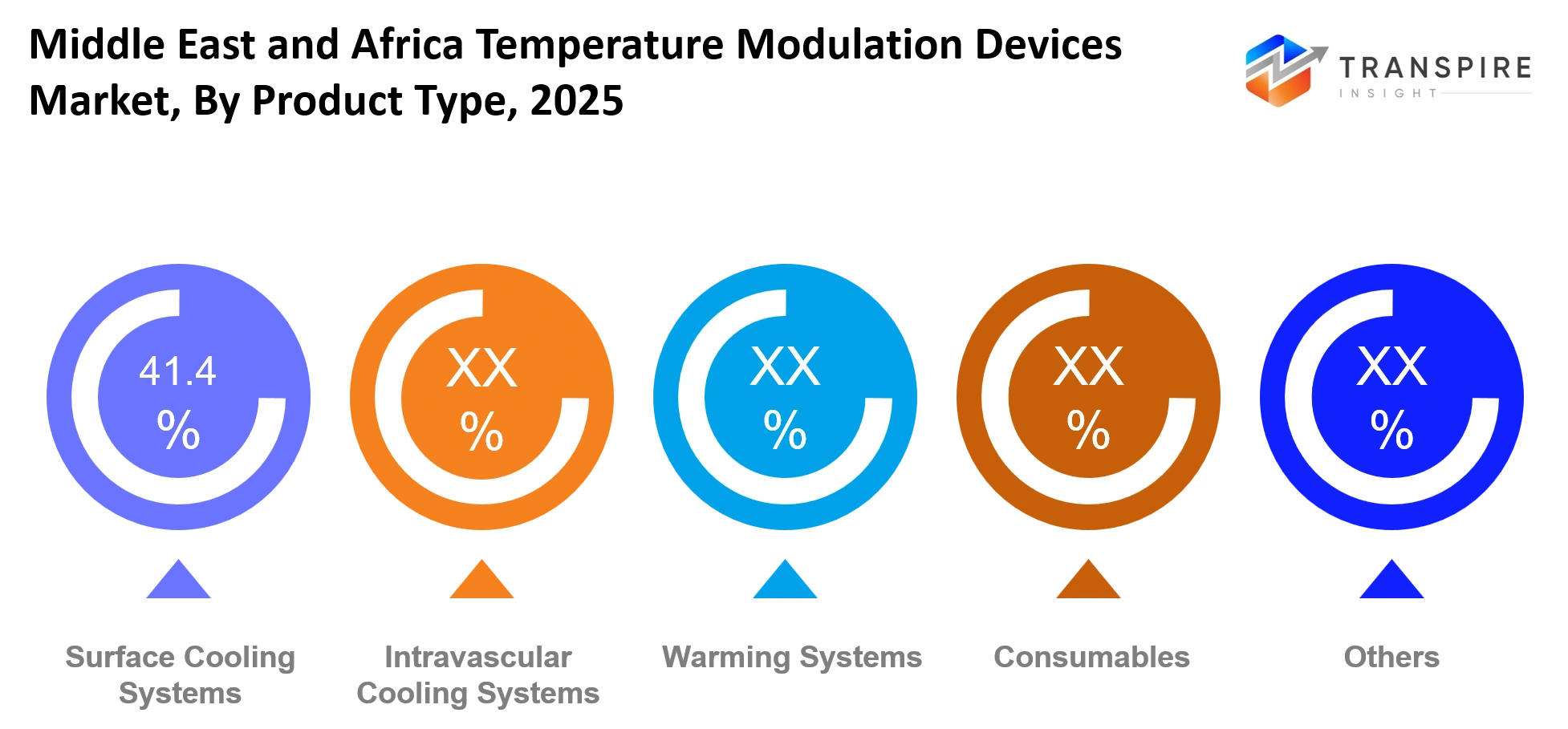
- Surface cooling systems are still pulling in the most demand, roughly 30% market share, not because its just easy, but because the operation is non-invasive and adoption across ICUs is pretty broad.
- Meanwhile intravascular cooling systems are the second biggest part, especially in advanced cardiac and neurological treatment centers where precision really matters.
- Automated temperature management platforms are showing up as the fastest-growing technology group through 2033, driven by tighter precision control, and better workflow efficiency too.
- Cardiac care sits at over 35% of application demand, largely due to post cardiac arrest temperature management protocols.
- Critical care applications are also expanding quickly as ICU capacity ramps up across GCC countries along with South Africa. In terms of deployment, hospitals account for more than 70% of device rollout, mostly since they have better access to specialized staff and intensive care facilities.
- Key competitors include Zoll Medical, Stryker, Medtronic, BD, and ICU Medical. Lastly, firms are trying to strengthen their positions via automated platforms, acquisition activity, ICU focused product innovation, and regional distribution partnerships.
What are the Key Drivers, Restraints, and Opportunities in the Middle East and Africa Temperature Modulation Devices Market?
The most powerful push behind this growth is sort of the expansion of advanced critical care alongside surgical services across Middle East and Africa, not just one slice. In Saudi Arabia, the UAE, South Africa, and several other regional markets, governments have kept raising healthcare spending, to shore up intensive care capability and add specialty care centers. As more cardiac interventions happen, plus neurological procedures and more trauma cases, hospitals started to put in place formal temperature management protocols. That movement, kind of straight, keeps feeding equipment buying, consumable usage, and ongoing service agreements, and it ends up creating recurring income for manufacturers.
Still, the biggest hurdle is the high acquisition cost and ongoing operating expense of advanced intravascular and automated temperature management systems. The issue feels structural because healthcare budgets are uneven in many African countries, and the training needs for specialized staff bring added financial weight. On top of that, reimbursement rules are often limited and hospital capital spending stays constrained, so procurement decisions get pushed back, again and again. Because of this, a lot of facilities continue with more conventional warming methods, which reduces possible market reach and can slow revenue momentum.
A real future opening is the integration of intelligent monitoring, automated temperature regulation, and connected ICU technologies. Hospitals that are investing in digital critical care infrastructure increasingly want solutions that can link patient monitoring signals with therapeutic temperature control. In the Gulf, especially the UAE and Saudi Arabia, adoption conditions look favorable due to ongoing hospital modernization efforts and continued healthcare technology investment.
What Has the Impact of Artificial Intelligence Been on the Middle East and Africa Temperature Modulation Devices Market?
Artificial intelligence along with advanced analytics are slowly, kind of quietly changing how patient temperature management works in intensive care and surgical settings. Lately, temperature control platforms use automated algorithm s more and more, and they keep changing cooling or warming rates by looking at patient data in real time. In practice this cuts down on manual fiddling and lets clinicians hold target temperatures more consistently, especially when the treatment window is really critical.
Machine learning models are also playing a role in predictive maintenance for this kind of temperature management equipment. They look at operational data, and then hospitals can spot performance oddities before a real failure shows up. That tends to mean less downtime, and better equipment availability, which sounds simple but it matters a lot when units are busy. On top of that, advanced analytics can help clinicians refine treatment protocols, because it evaluates how patients respond and suggests temperature adjustment tactics that are more likely to support better clinical outcomes.
On the operational side, these tools bring more treatment precision, smoother workflow efficiency, and also stronger adherence to therapeutic temperature management guidelines. When they integrate with ICU monitoring platforms, decision-making becomes faster, and the clinical team doesn’t have to wait as long to act, or double-check as much.
Still, adoption isn’t fully widespread. The major brakes are high implementation costs and the fact that digital infrastructure can be thin in many healthcare facilities across Africa. Data interoperability is messy in real life, historical datasets are often insufficient, and there’s a shortage of specialized technical expertise, so AI driven temperature management solutions don’t always fully roll out everywhere.
Key Market Trends
- Since 2021, hospitals have been really moving fast on automated temperature control platforms, and in turn they cut down reliance on manually run warming and cooling setups , a bit more each year.
- Between 2022 and 2025 , modernization efforts in ICU units across GCC nations helped push up purchases of integrated patient monitoring along with temperature regulation tech.
- Within advanced cardiac care centers, intravascular cooling spread further, as therapeutic temperature management protocols got more consistent, more or less everywhere.
- Manufacturers also started bundling software analytics, monitoring integration, and service support together, so differentiation is no longer only about hardware performance , but about the whole package, kind of.
- Product development has shifted toward closed loop temperature management systems that can hold target temperatures with less clinician involvement.
- Across African healthcare networks, regional distributors strengthened ties with global manufacturers, mainly to improve device availability , plus after sales support.
- Healthcare providers now more often prefer one platform that can do both cooling and warming functions, because it helps optimize capital spending in a cleaner way.
- During 2024–2026 , acquisitions and portfolio consolidation picked up, as firms tried to broaden their temperature management technology offerings.
Middle East and Africa Temperature Modulation Devices Market Segmentation
By Product Type
Surface Cooling Systems are kinda a big deal, because they get used a lot in intensive care units, emergency departments, and for post-cardiac arrest treatment too. They basically deliver non-invasive temperature control, and they’re considered useful for quick setup in those kinds of urgent moments. Intravascular Cooling Systems get picked for more advanced cardiac and neurological care settings, since tight and exact temperature regulation still matters a lot there. Better precision, plus consistent cooling control , helps adoption in specialized healthcare facilities.
Warming Systems also matter during surgical procedures, and during recovery phases, since they help keep core body temperature stable. Consumables keep creating recurring demand, because regular replacement is still required throughout the patient care cycles. Other items include specialized accessories, and hybrid temperature management solutions, made for those particular clinical needs. Ongoing improvements in product effectiveness and day-to-day usability should further encourage use across healthcare facilities.
By Application
Cardiac Care is still one of the bigger application areas, temperature management kind of helps recovery after cardiac arrest and it also backs recovery following complex cardiovascular procedures. In clinical protocols, you’ll often see controlled temperature therapy, because it can improve overall treatment results and make things more consistent. Neurology uses keep growing too, especially across stroke management, treatment for traumatic brain injury, and neurocritical care services. Temperature control stays a key piece in advanced neurological treatment routes, even when the rest of the plan changes.
Surgery is another strong driver, since healthcare providers keep emphasizing the prevention of perioperative hypothermia and the complications that come with it. Critical Care wards depend on temperature modulation devices for patients who are unstable, and they need continuous monitoring and quick intervention. Other areas include trauma care, emergency medicine , neonatal treatment, and specialized recovery programs. As treatment abilities keep getting broader across healthcare systems, that will likely continue supporting application growth over time.
By End User
Hospitals are still taking the largest share because most major operations—surgical cardiac neurological, and intensive care procedures—happen right there. With strong infrastructure, specialized medical professionals, and access to advanced tech, adoption stays pretty widespread. There’s also ongoing funding for healthcare modernization efforts in multiple countries, which keeps boosting purchasing activity across hospital networks. On top of that, large patient volumes help keep temperature management systems consistently in use.
Clinics, meanwhile, use temperature modulation equipment for chosen procedures plus patient observation and recovery support. Ambulatory centers are moving toward compact portable systems that are easier to place in outpatient settings, and they also match shorter procedure durations. Other sites cover rehabilitation establishments, specialty treatment centers, and emergency care units. As alternate healthcare delivery models keep expanding, that will open even more doorways for deployment.
By Technology
Automated technology keeps gaining preference because integrated sensors and software algorithms handle target temperatures with strong precision. In practice these systems trim down manual adjustments, boost workflow efficiency and support adherence to treatment protocols. More advanced hospitals are choosing automated platforms as a piece of wider digital healthcare initiatives , and they also benefit when integration with patient monitoring systems goes smoothly. That connection tends to add more operational value.
Manual technology is still meaningful too especially in facilities where budget limits shape what equipment can be purchased. Because the operation is simpler and the acquisition costs stay lower, it makes sense that these tools remain in use across a broad range of healthcare settings. Some sites even go with hybrid solutions, meaning they blend automated features with manual control options. Continued innovation should nudge gradual movement toward more connected and intelligent temperature management technologies, over time.
What are the Key Use Cases Driving the Middle East and Africa Temperature Modulation Devices Market?
Cardiac care still ends up being the main use case that keeps pushing market adoption forward, mostly . After cardiac arrest, therapeutic temperature management can help lessen the neurological damage and generally support better recovery results. So, big hospitals and those specialized cardiac centers kinda become the biggest reason equipment demand stays high.
At the same time, neurology combined with critical care is starting to gain real momentum across more advanced healthcare facilities. In practice, stroke management programs, traumatic brain injury treatment, and even intensive care protocols are putting controlled temperature regulation more and more into the workflow. Specialty hospitals, plus tertiary care institutions, are also widening rollout as the treatment guidelines get more and more organized.
Some newer, emerging use cases are showing up too, like neonatal intensive care, trauma stabilization, and more precise perioperative management. With more investments going into specialized pediatric care and also into digital ICU infrastructure, there are fresh opportunities for advanced temperature modulation technologies during the forecast period.
|
Report Metrics |
Details |
|
Market size value in 2025 |
USD 1.64 Billion |
|
Market size value in 2026 |
USD 1.74 Billion |
|
Revenue forecast in 2033 |
USD 2.71 Billion |
|
Growth rate |
CAGR of 6.53% from 2026 to 2033 |
|
Base year |
2025 |
|
Historical data |
2021 - 2024 |
|
Forecast period |
2026 - 2033 |
|
Report coverage |
Revenue forecast, competitive landscape, growth factors, and trends |
|
Regional scope |
United States; Canada; Mexico; United Kingdom; Germany; France; Italy; Spain; Denmark; Sweden; Norway; China; Japan; India; Australia; South Korea; Thailand; Brazil; Argentina; South Africa; Saudi Arabia; United Arab Emirates |
|
Key company profiled |
Zoll Medical, Stryker, Medtronic, BD, Gentherm, Smiths Medical, ICU Medical, Belmont Medical, Geratherm, Inspiration Healthcare, Barkey, Cincinnati Sub-Zero, Philips, GE HealthCare, 3M. |
|
Customization scope |
Free report customization (country, regional & segment scope). Avail customized purchase options to meet your exact research needs. |
|
Report Segmentation |
By Product Type (Surface Cooling Systems, Intravascular Cooling Systems, Warming Systems, Consumables, Others); By Application (Cardiac Care, Neurology, Surgery, Critical Care, Others); By End User (Hospitals, Clinics, Ambulatory Centers, Others); By Technology (Automated, Manual, Others). |
Which Regions are Driving the Middle East and Africa Temperature Modulation Devices Market Growth?
In the Gulf Cooperation Council region, the market basically leads in revenue generation, like it’s really driving the whole thing. Saudi Arabia and the UAE keep on investing heavily into hospital modernization, specialty care facilities, and more advanced critical care infrastructure. National healthcare transformation programs also back the procurement of sophisticated patient management technologies. With strong reimbursement climates, plus high procedure volumes, the region stays in a leadership position.
South Africa ends up as the second-largest contributor, if you look at it overall. Its growth doesn’t depend as much on fast infrastructure expansion, instead it leans on established healthcare networks and a steady uptake of advanced medical technologies. Big private hospital groups continue to keep stable purchasing activity. As a result, manufacturers and distributors get a dependable revenue base.
Meanwhile, the Rest of Africa shows up as the fastest-growing regional opportunity. Newer investments in healthcare infrastructure, critical care capacity, and specialized treatment centers have already improved the market atmosphere. At the same time, international healthcare funding and modernization initiatives are expanding access to advanced technologies. Over the 2026–2033 period, those shifts should open up attractive opportunities for new entrants aiming for long-term growth.
Who are the Key Players in the Middle East and Africa Temperature Modulation Devices Market and How Do They Compete?
Competition is still kinda moderately consolidated, like a limited set of multinational med tech companies controlling a big chunk of the revenue, not everyone though. In practice, technology performance, clinical proof, product dependability and service support tend to be the main ways firms compete. Lately, manufacturers often go after integrated platforms instead of relying on just standalone warming or cooling devices, even when it feels like the old category is still there.
Zoll Medical really sets itself apart via broad temperature management platforms such as Thermogard and IQool technologies. These tools back both cooling and warming therapies, with an emphasis on precision control , closed loop operation, and also alignment with critical care workflows. In other words, they do not just sell hardware, they try to make the whole process behave.
Stryker historically has pushed forward using sophisticated patient temperature management technologies along with very solid relationships in hospitals. Strategic portfolio optimization remains a central part of that playbook, and you can see it in the divestiture of the Altrix system.BD keeps expanding its critical care footprint using acquisitions and by weaving monitoring technology into existing offerings. The acquisition of Edwards Lifesciences' Critical Care business boosted monitoring capabilities, and that complements the temperature management applications pretty directly.
Medtronic, ICU Medical, and 3M meanwhile put more emphasis on critical care overall, surgical workflow integration, plus wide healthcare distribution networks. That combination helps their regional expansion strategies , they basically cover more ground while staying relevant to clinicians.
Company List
- Zoll Medical
- Stryker
- Medtronic
- BD
- Gentherm
- Smiths Medical
- ICU Medical
- Belmont Medical
- Geratherm
- Inspiration Healthcare
- Barkey
- Cincinnati Sub-Zero
- Philips
- GE HealthCare
- 3M
Recent Development News
In June 2025, 3T Medical Systems announced acquisition of Stryker's Altrix Precision Temperature Management System. The transaction expanded 3T Medical's temperature management portfolio and strengthened its position in critical care and perioperative thermal management solutions.
Source: https://3tmedical.com/news/ (3T Medical).
In September 2024, BD completed acquisition of the Critical Care business from Edwards Lifesciences. The transaction expanded BD's advanced monitoring portfolio and strengthened capabilities supporting critical care and temperature management workflows.
Source: https://news.bd.com (BD).
What Strategic Insights Define the Future of the Middle East and Africa Temperature Modulation Devices Market?
The market is sliding toward smarter, protocol-led temperature management platforms, kind of combining automated control, patient monitoring tie-ins, and data analytics. The real push behind this move is the growing focus on outcome based critical care, where hospitals are looking for hard results like better survival rates, faster recovery, and more consistent treatment workflows. A more quiet risk though, is that advanced tech supply can get concentrated among only a few multinational manufacturers, and that could put healthcare providers under pricing pressure or even create procurement headaches.
There’s also a chance showing up, AI enabled temperature management systems that plug into digital ICU infrastructure, specially in Saudi Arabia and the UAE, where hospital modernization programs still keep ramping up. Market players should really aim for partnerships with regional healthcare networks and put money into interoperable platforms that work right alongside monitoring tools, electronic health records, and broader critical care ecosystems. If they do this, it should help long term competitiveness, while setting companies up for the next wave of precision patient management solutions.
Middle East and Africa Temperature Modulation Devices Market Report Segmentation
By Product Type
- Surface Cooling Systems
- Intravascular Cooling Systems
- Warming Systems
- Consumables
- Others
By Application
- Cardiac Care
- Neurology
- Surgery
- Critical Care
- Others
By End User
- Hospitals
- Clinics
- Ambulatory Centers
- Others
By Technology
- Automated
- Manual
- Others
Frequently Asked Questions
Find quick answers to common questions.
The expected Middle East and Africa Temperature Modulation Devices Market size for the market will be USD 2.71 Billion in 2033.
Key segments for the Middle East and Africa Temperature Modulation Devices Market are By Product Type (Surface Cooling Systems, Intravascular Cooling Systems, Warming Systems, Consumables, Others); By Application (Cardiac Care, Neurology, Surgery, Critical Care, Others); By End User (Hospitals, Clinics, Ambulatory Centers, Others); By Technology (Automated, Manual, Others).
Major Middle East and Africa Temperature Modulation Devices Market players are Zoll Medical, Stryker, Medtronic, BD, Gentherm, Smiths Medical, ICU Medical, Belmont Medical, Geratherm, Inspiration Healthcare, Barkey, Cincinnati Sub-Zero, Philips, GE HealthCare, 3M.
The Middle East and Africa Temperature Modulation Devices Market size is USD 1.64 Billion in 2025.
The Middle East and Africa Temperature Modulation Devices Market CAGR is 6.53% from 2026 to 2033.
- Zoll Medical
- Stryker
- Medtronic
- BD
- Gentherm
- Smiths Medical
- ICU Medical
- Belmont Medical
- Geratherm
- Inspiration Healthcare
- Barkey
- Cincinnati Sub-Zero
- Philips
- GE HealthCare
- 3M
About the Authors

Pankaj Ghogare Patil
I am Pankaj Ghogare Patil, a Senior Research Analyst at Transpire Insight, specializing in the Pharmaceutical, Chemicals & Materials, Healthcare IT, and Biotechnology industry. My expertise lies in conducting comprehensive market research, analyzing industry trends, evaluating competitive landscapes, and translating complex data into actionable insights. At Transpire Insight, I closely follow emerging technologies, regulatory developments, and market innovations to create accurate, well-researched, and informative content that helps businesses and professionals make informed decisions. I am committed to producing credible, evidence-based articles that reflect industry best practices while making technical topics accessible and valuable for a broad audience.

Chakradhar Khansole
Chakradhar serves as the Research Director at Transpire Insight, bringing over 8 years of experience in technology, innovation, and strategic market intelligence. He specializes in transforming complex market data into actionable business insights that enable organizations to make informed, growth-oriented decisions. Recognized for his strategic vision and analytical expertise, Chakradhar leads high-impact research initiatives, delivering comprehensive market assessments, competitive intelligence, and forward-looking industry analysis.
Recently Published Reports
-
Apr 2026
AI in Diabetic Retinopathy Market
AI in Diabetic Retinopathy Market Size, Share & Analysis Report By Type (Screening AI Systems, Diagnostic AI Systems, and Predictive AI Models), By Application Segment (Hospitals, Ophthalmology Clinics, Diagnostic Centers, and Research and Development), and Geography (North America, Europe, Asia-Pacific, Middle East and Africa, South and Central America), 2021 - 2031
-
Apr 2026
Psychometric Tests Market
Psychometric Tests Market Size, Share & Analysis Report By Type (Personality Tests, Ability/Aptitude Tests, Skill/Knowledge Tests, and Others), By Application (Talent Acquisition and Talent Management), and Geography (North America, Europe, Asia-Pacific, Middle East and Africa, South and Central America), 2021 – 2031
-
Apr 2026
Rare Biological Sample Collection Market
Rare Biological Sample Collection Market Size, Share & Analysis Report By Type (Isolation Kits & Reagent, Blood Collection Tubes, and Others), By Application (Oncology, Transcriptomics, Pharmacogenomics, and Others), and Geography (North America, Europe, Asia-Pacific, Middle East and Africa, South and Central America), 2021 – 2031
-
Jul 2026
Diabetic Retinopathy Market
Diabetic Retinopathy Market Size, Share & Analysis Report By Type (Proliferative Diabetic Retinopathy, and Diabetic Macular Edema (DME)), By Treatment Type (Anti VEGF Drug, Steroid Implants, Laser Surgeries, and Vitrectomy), and Geography (North America, Europe, Asia-Pacific, Middle East and Africa, South and Central America), 2021 – 2031
Our Clients







