
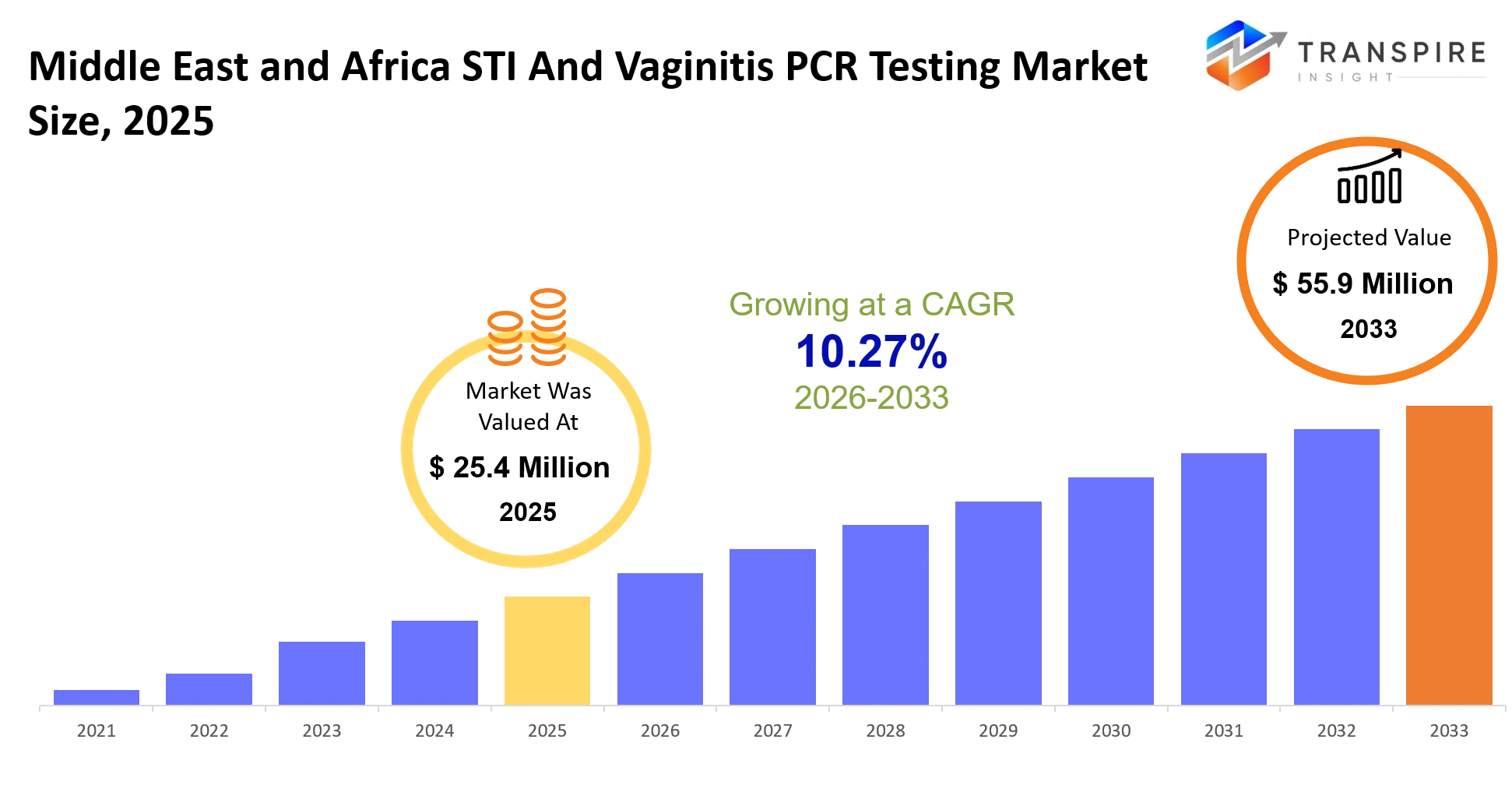
Middle East and Africa STI And Vaginitis PCR Testing Market Size & Forecast:
- Middle East and Africa STI And Vaginitis PCR Testing Market Size 2025: USD 25.4 Million
- Middle East and Africa STI And Vaginitis PCR Testing Market Size 2033: USD 55.9 Million
- Middle East and Africa STI And Vaginitis PCR Testing Market CAGR: 10.27%
- Middle East and Africa STI And Vaginitis PCR Testing Market Segments: By Test Type (STI PCR Testing, Vaginitis PCR Testing, Multiplex PCR Testing, Point-of-Care PCR Testing, Others); By Application (Chlamydia Testing, Gonorrhea Testing, HPV Testing, Vaginitis Detection, Others); By End User (Hospitals, Diagnostic Laboratories, Clinics, Others); By Technology (Real-Time PCR, Multiplex PCR, Digital PCR, Others).
To learn more about this report,  Download Free Sample Report
Middle East and Africa STI And Vaginitis PCR Testing Market Summary
The Middle East and Africa STI And Vaginitis PCR Testing Market was valued at USD 25.4 Million in 2025. It is forecast to reach USD 55.9 Million by 2033. That is a CAGR of 10.27%over the period.
The Middle East and Africa STI and vaginitis PCR testing market kind of helps clinical laboratories as well as hospitals by enabling them to quickly identify sexually transmitted and vaginal infections, using molecular diagnostic platforms. In the day to day setting it cuts down the time between when a patient comes in and when they actually get the targeted treatment. This matters a lot in urban hospitals , fertility clinics , and also in public health screening programs where a late diagnosis can cause complications and also push treatment costs higher. Over roughly the last five years, the market seems to move away from conventional culture based diagnostics and toward fully automated multiplex PCR systems that provide faster yet more precise pathogen detection.
That change has been bolstered by broader public health screening initiatives and by tighter infection control protocols in post pandemic healthcare systems. One of the bigger acceleration signals is the way women’s health programs have strengthened, alongside STI surveillance frameworks across GCC countries and some areas of Africa, which then boosted laboratory testing volumes. So because of that, diagnostic networks are investing into higher throughput molecular platforms, mainly to handle the increased clinical workload in a more efficient manner.
Key Market Insights
- The Middle East and Africa STI and Vaginitis PCR testing Market is slowly moving away from manual assays toward fully automated multiplex PCR platforms in more than 60% of urban diagnostics
- In the Gulf countries, the share is almost 38% in 2025 , largely because advanced hospital infrastructure keeps improving and mandatory STI screening policies are getting tighter each year.
- Africa is emerging as the fastest-growing region through 2033, fueled by broader diagnostic access programs and donor-supported laboratory networks that keep getting extended to new areas.
- Multiplex PCR test panels currently take the biggest product share, and they cut turnaround time by nearly 45% versus the older culture-based approach, which is still used in some places but less each year.
- Point-of-care PCR systems are seeing the quickest adoption growth, mainly because decentralized testing needs are rising in rural and semi-urban healthcare facilities, so people don’t have to wait as long.
- Hospitals are the main end users with over 50% share, supported by integrated infectious disease management protocols that are becoming standard.
- Diagnostic laboratories are also growing the fastest, largely due to more outsourcing of molecular testing, especially when labs want quicker results without building everything internally.
- For applications, STI detection stays the leader, while vaginitis testing is expanding at a faster pace within women’s health clinics, including routine screening programs.
- Companies like Roche, Abbott, and Qiagen are expanding automated PCR offerings across emerging MEA healthcare systems, often with upgrades to their instrument lines.
- Finally, strategic partnerships with regional labs, plus digital diagnostic integration , are helping companies strengthen their competitive position across MEA markets overall.
What are the Key Drivers, Restraints, and Opportunities in the Middle East and Africa STI And Vaginitis PCR Testing Market?
The main engine behind the Middle East and Africa STI and vaginitis PCR testing market is the swift shift toward more modern infectious disease diagnostics inside hospital and reference lab networks. In other words, Governments and private care providers have gradually leaned into molecular testing after noticing the limits of culture based approaches, especially when you need to catch more than one pathogen at the same time. This whole change seems to be pushed even further by the growth of centralized laboratory facilities in Gulf nations, plus donor backed diagnostic initiatives across African healthcare systems. So overall test volumes are climbing, and labs are putting money into high throughput PCR platforms to cut the turnaround interval and make clinical choices come faster, and more efficiently , in practice.
Still, there is a stubborn drag in the way—advanced diagnostic infrastructure is not evenly spread. This is most visible in low income areas of Africa, where PCR setups depend on dependable electricity, trained technicians , and a steady reagent supply line. Those real-world constraints slow down adoption, and they also nudge providers toward centralized, urban labs, which then limits wider market reach and holds back quicker revenue capture in rural care environments.
On the opportunity side, there’s a strong push for decentralized molecular diagnostics using smaller compact, cartridge based PCR systems. For example, countries like Saudi Arabia and South Africa are funding mobile and near patient testing models focused on women’s health and infectious disease screening. That approach supports faster diagnosis in outpatient settings, and it also creates fresh demand for portable PCR solutions, particularly within fertility clinics and primary healthcare centers.
What Has the Impact of Artificial Intelligence Been on the Middle East and Africa STI And Vaginitis PCR Testing Market?
Artificial intelligence is getting woven more and more into molecular diagnostic routines across the Middle East and Africa, including parts of the STI and vaginitis PCR testing market. The goal is mostly to boost lab efficiency, and also make result reading a bit less messy for staff. On automated PCR setups, AI algorithms can help sort out sample processing queues, cut down on human slips during reagent handling, and generally make test routing feel smoother between busy diagnostic labs. That tends to make day-to-day operations more stable, especially in centralized reference centers where they run big STI screening programs.
Then, there are machine learning models for pattern recognition in multiplex PCR outputs. These tools help clinicians interpret co-infections with more detail, and they also seem to lower the chances of false-positive chatter being reported. In big hospital networks, predictive analytics are sometimes used to estimate when demand will jump, based on seasonal infection cycles and outpatient flow figures—so reagent inventory planning becomes more reasonable, and wastage goes down.
From an operational side, AI-enabled lab management systems have been linked to quicker turnaround times and better use of resources. Some labs even mention roughly 20–30% efficiency gains from workflow coordination, though the numbers vary. Still, there’s a major catch: there aren’t enough standardized regional datasets for training AI models, especially across the very diverse African healthcare settings. This kind of data inconsistency can weaken algorithm accuracy, and it slows the push toward full-scale deployment in decentralized diagnostic environments, so the broader automation momentum is, at least for now, limited.
Key Market Trends
- The Middle East and Africa STI and vaginitis PCR Testing Market is sort of moving away from just single-pathogen tests, and more toward multiplex panels covering over 5–10 infections in one sample, by 2025.
- Hospital labs have boosted PCR adoption rates by almost 40% from 2022 to 2025, mostly because diagnostic timeliness is getting more strict.
- In Africa, point-of-care PCR setups have been expanding too, and in a few selected facilities turnaround times dropped from about 48 hours down to under 2 hours, which is pretty fast.
- Meanwhile women's health clinics are pushing up vaginitis testing volumes, especially across urban GCC healthcare networks since 2023.
- Also, digital lab integration with LIS systems is improving sample traceability and moving things faster, with efficiency up around 25% across major diagnostic chains.
- Private diagnostic groups in South Africa and UAE grew quickly, so local testing capacity has jumped quite a bit. BioMérieux and Cepheid meanwhile are working on cartridge-based PCR approaches, aimed at more decentralized testing.
- Regional collaborations between big diagnostics companies and local labs are helping with technology transfer plus infrastructure upgrades, step by step.
- And with rising antimicrobial resistance monitoring becoming more common, hospitals across MEA are leaning more on PCR based pathogen identification methods.
- Finally, tighter infection control regulations are basically nudging labs into using standardized molecular testing platforms, rather than scattered setups.
Middle East and Africa STI And Vaginitis PCR Testing Market Segmentation
By Test Type
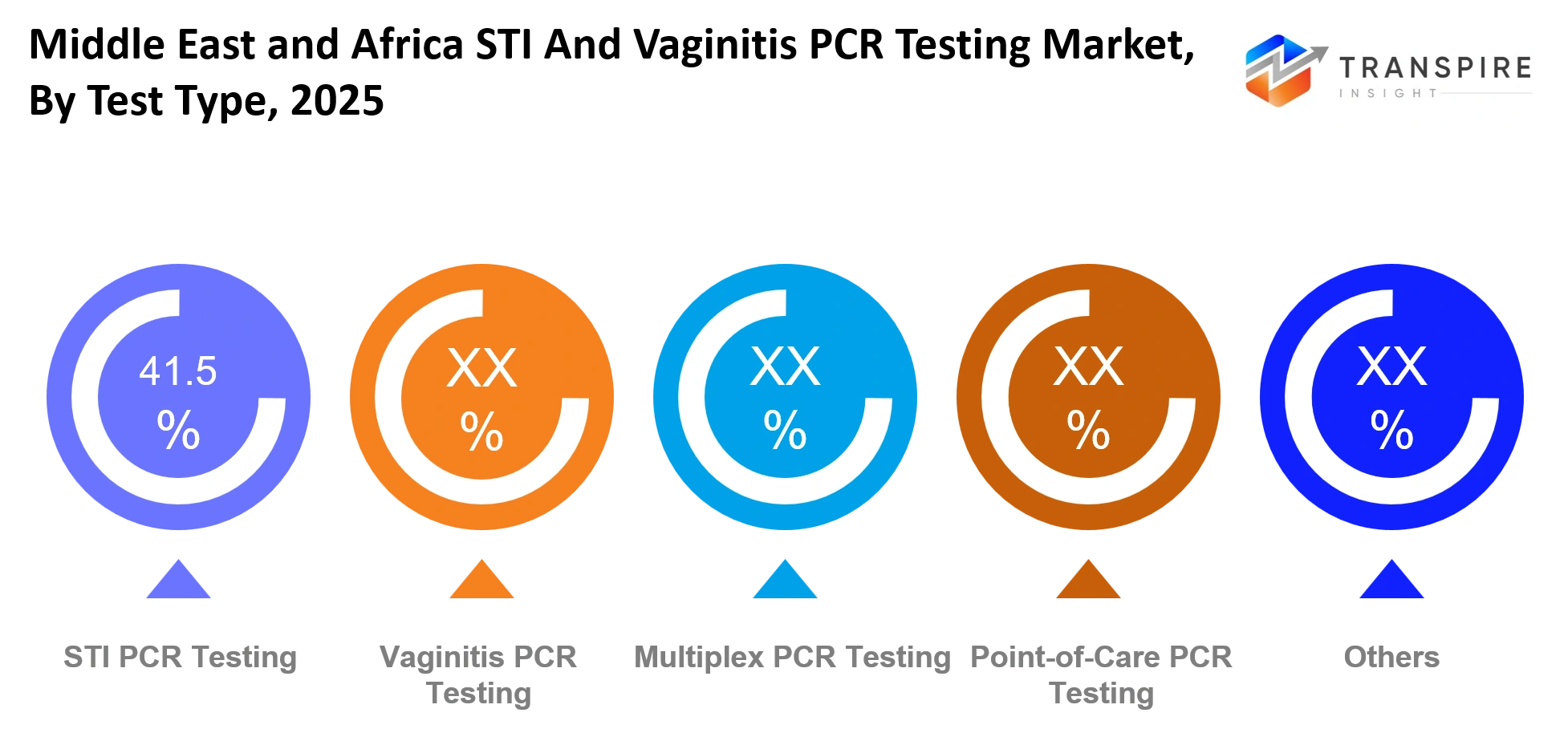
That test type segment kind of shows the different molecular diagnostic options used for infection detection, plus patient screening. The STI PCR Testing slice probably takes a big share because when it comes to accurate and fast identification of sexually transmitted infections, clinicians can make quicker treatment choices in hospitals and diagnostic centers. Also, the more molecular platforms get adopted, the more testing precision tends to go up and the reporting delays feel smaller across everyday clinical steps, you know.
Vaginitis PCR Testing, meanwhile, backs up a more detailed readout for bacterial and fungal infections tied to vaginal health conditions. Multiplex PCR Testing seems to be getting a lot of traction, since it can spot several pathogens at once in one test, which is helpful for laboratory throughput. Point-of-Care PCR Testing is still expanding too, because more healthcare facilities are rolling out faster diagnostic tools closer to patients, particularly in outpatient areas and emergency units. Other formats cover specialized PCR setups for niche diagnostic needs, plus new clinical uses that are still showing up.
To learn more about this report, Download Free Sample Report
By Application
The application section points to important disease territories where PCR testing kinda really matters for diagnosis, also for monitoring over time. Chlamydia Testing has a strong standing, because prevalence stays high, and early detection helps stop downstream complications. Gonorrhea testing still counts a lot, especially now since antibiotic resistance is getting worse, so you need precise, fast molecular confirmation, not just guessing.
HPV Testing backs early screening efforts that connect to cervical health management, and it shows up a lot in women’s health programs across hospitals, clinics. Vaginitis Detection keeps climbing too, partly because clinicians pay more attention to recurring infections, and the microbiome related conditions. There are also other directions like emerging infectious disease uses, plus wider STI screening initiatives tied to prevention based healthcare plans, more broadly speaking.
By End User
The end user segment shows the healthcare settings where molecular PCR testing is actually used, for diagnosis and also for disease management in an everyday way. Hospitals make up the biggest share, mainly because they manage high patient volumes and they need advanced diagnostic systems so detection stays accurate, and fast. There is strong integration across lab networks as well, which basically keeps the demand stable all the time.
Diagnostic Laboratories are expanding quickly too, especially as more outsourcing of complex molecular testing is happening across different healthcare systems. Clinics add a lot through outpatient testing services, plus routine screening programs that really depend on quick turnaround times . Other players in this space include research centers, and specialized healthcare facilities, these support more targeted diagnostic studies and ongoing surveillance programs.
By Technology
The tech segment centers on molecular methods for catching infectious pathogens. Real-Time PCR still gets used a lot, because it offers strong accuracy, quicker detection cycles, and solid clinical validation in many diagnostic uses. At the same time, ongoing upgrades in automation kinda reinforce how often it gets chosen in high-volume labs
Multiplex PCR is now picking up speed, since it can catch several infections in one reaction, which cuts cost and boosts efficiency. Digital PCR is also showing up as a more advanced approach, with better sensitivity for low-level pathogen finding, mainly when the clinical picture is complicated. Other options may include hybrid PCR technologies and tailor-made molecular platforms built for specialized diagnostic needs
What are the Key Use Cases Driving the Middle East and Africa STI And Vaginitis PCR Testing Market?
In the Middle East and Africa STI and vaginitis PCR testing market the biggest use case is basically hospital based infectious disease diagnosis, where quick pathogen identification directly helps clinicians pick the right treatment for STI and vaginal infection situations. This particular use case tends to pull in the most demand, since doctors need fast multi pathogen results, so they can lower the risk of complications and also stop further transmission.
After that, secondary applications are steadily showing up in fertility clinics, and women’s health centers too, where PCR testing supports infertility workups, plus it helps with recurrent infection handling. Diagnostic laboratories then act as a sort of central service backbone for outpatient testing initiatives, especially across city focused health care networks.
More emerging use cases are starting to appear as well, like tying PCR testing into public health surveillance programs for antimicrobial resistance monitoring, and also using mobile screening units across remote parts of Africa. Those options are starting to gain momentum, as governments widen decentralized diagnostic reach and put extra emphasis on early infection detection in underserved groups.
|
Report Metrics |
Details |
|
Market size value in 2025 |
USD 25.4 Million |
|
Market size value in 2026 |
USD 28.2 Million |
|
Revenue forecast in 2033 |
USD 55.9 Million |
|
Growth rate |
CAGR of 10.27%from 2026 to 2033 |
|
Base year |
2025 |
|
Historical data |
2021 - 2024 |
|
Forecast period |
2026 - 2033 |
|
Report coverage |
Revenue forecast, competitive landscape, growth factors, and trends |
|
Regional scope |
Middle East and Africa (Saudi Arabia, United Arab Emirates, South Africa, Rest of Middle East and Africa) |
|
Key company profiled |
Roche, Abbott, Thermo Fisher Scientific, Bio-Rad, Hologic, Qiagen, Becton Dickinson, Danaher, Seegene, BioMérieux, PerkinElmer, Cepheid, Agilent, Sysmex, Fujirebio. |
|
Customization scope |
Free report customization (country, regional & segment scope). Avail customized purchase options to meet your exact research needs. |
|
Report Segmentation |
By Test Type (STI PCR Testing, Vaginitis PCR Testing, Multiplex PCR Testing, Point-of-Care PCR Testing, Others); By Application (Chlamydia Testing, Gonorrhea Testing, HPV Testing, Vaginitis Detection, Others); By End User (Hospitals, Diagnostic Laboratories, Clinics, Others); By Technology (Real-Time PCR, Multiplex PCR, Digital PCR, Others). |
Which Regions are Driving the Middle East and Africa STI And Vaginitis PCR Testing Market Growth?
The Middle East kinda leads the region in using STI and vaginitis PCR testing, mostly because of decent healthcare infrastructure, lots of lab automation, and infection screening programs that are mandatory. Places like the United Arab Emirates and Saudi Arabia keep building pretty advanced diagnostic ecosystems, backed by government spending on molecular testing platforms, and that matters. Big hospital groups, plus private diagnostic networks, also boost testing capacity and help people adopt multiplex PCR technologies fast. In practice this whole setup drives a steady pull for high-throughput diagnostic systems, time after time.
North Africa looks more stable, but it is still sort of moderately developing, in the sense that healthcare systems are slowly moving molecular diagnostics into public hospitals and reference labs. Compared with the Gulf, the momentum here comes less from premium-grade infrastructure and more from incremental, day to day modernization inside national healthcare programs. Countries like Egypt and Morocco tend to expand testing access using public–private collaborations. So the demand that forms is steady, but it’s more structured toward cost-effective PCR systems, rather than the top tier automation platforms.
Sub-Saharan Africa is the fastest-growing area, since investment keeps rising in infectious disease control programs, and donor-funded projects are expanding laboratories too. Over the last several years, upgrades in healthcare infrastructure in particular in South Africa and Nigeria, have made PCR testing more widely available. On top of that, mobile and decentralized diagnostic efforts are getting more attention, in order to reach rural populations where access used to be harder. This quick rollout suggests strong, long-term opportunities for diagnostic manufacturers and investors spanning 2026 through 2033.
Who are the Key Players in the Middle East and Africa STI And Vaginitis PCR Testing Market and How Do They Compete?
The Middle East and Africa STI and vaginitis PCR testing market still feels sort of moderately consolidated, like the biggest global molecular diagnostics leaders run most of the heavy high-throughput laboratory systems, while the regional guys mostly stay in distribution modes and try to bundle service integration as best they can. What really pushes competition here isn’t only price, it’s more about technology updates, assay accuracy, and how well automation works across different workflows. In hospitals and diagnostic chains, buyers tend to choose vendors that provide integrated platforms, with quicker turnaround times and testing volume that can scale without too much hassle.
Roche plays it strong with high-precision automated PCR platforms and a pretty wide infectious disease test portfolio, so it keeps getting picked for large hospital laboratories. Abbott leans into rapid molecular diagnostics and compact systems that fit decentralized testing environments better, so it reaches more mid-tier healthcare facilities. Qiagen, meanwhile, tries to stand out by emphasizing sample preparation technologies that make workflow efficiency feel smoother in high-volume settings.
Thermo Fisher Scientific uses its wider lab infrastructure capabilities and reagent supply chains, which helps it lock in long-term arrangements with diagnostic networks. Hologic reinforces its presence in women’s health diagnostics by offering specialized vaginitis and STI testing panels. Overall, these firms are expanding via regional collaborations, distributor coverage, and localized laboratory partnerships, and that’s helping them push deeper across a lot of the newer diagnostic markets in Africa.
Company List
- Roche
- Abbott
- Thermo Fisher Scientific
- Bio-Rad
- Hologic
- Qiagen
- Becton Dickinson
- Danaher
- Seegene
- BioMérieux
- PerkinElmer
- Cepheid
- Agilent
- Sysmex
- Fujirebio
Recent Development News
In December 2025, Roche announced the launch of a new PCR test for vaginitis diagnostics. The company introduced a CE-marked molecular assay designed to detect bacterial vaginosis and Candida-related infections using a single vaginal swab, improving diagnostic accuracy and workflow efficiency in women’s health testing programs. This launch strengthens adoption of multiplex PCR testing in hospital and laboratory networks across Europe and MEA-linked distribution markets.
Source: http://www.roche.com
In January 2025, Cepheid (Danaher) expanded its GeneXpert Women’s & Sexual Health testing portfolio. Cepheid introduced enhanced cartridge-based PCR assays for sexually transmitted infections and vaginal infections, supporting faster near-patient diagnosis in decentralized clinical settings. This expansion improves access to rapid molecular testing across emerging healthcare systems in the Middle East and Africa through portable GeneXpert platforms.
Source: https://info.cepheid.com
What Strategic Insights Define the Future of the Middle East and Africa STI And Vaginitis PCR Testing Market?
The Middle East and Africa STI and vaginitis PCR testing market is sort of structurally shifting toward decentralized , high speed molecular diagnostics that are backed by integrated lab networks and digital health systems. The growth path will be tied more and more to how well healthcare systems move testing closer to patients while still holding on to accuracy and cost efficiency. There is also a less visible risk though, like the supply chain getting too concentrated for PCR reagents and cartridge based consumables. That kind of concentration can easily trip up testing continuity when there are global shortages, or when logistics hit delays.
At the same time there is an emerging opening, in expanding portable multiplex PCR platforms in outpatient settings and women’s health clinics, especially across North Africa and Sub Saharan Africa. These units can basically reveal new demand areas outside the usual hospital laboratory model. For market participants, the play should be a strong strategy around regional partnerships , with public health programs and private diagnostic chains, so they can lock in long term testing contracts and speed up technology adoption across healthcare ecosystems that are pretty fragmented.
Middle East and Africa STI And Vaginitis PCR Testing Market Report Segmentation
By Test Type
- STI PCR Testing
- Vaginitis PCR Testing
- Multiplex PCR Testing
- Point-of-Care PCR Testing
- Others
By Application
- Chlamydia Testing
- Gonorrhea Testing
- HPV Testing
- Vaginitis Detection
- Others
By End User
- Hospitals
- Diagnostic Laboratories
- Clinics
- Others
By Technology
- Real-Time PCR
- Multiplex PCR
- Digital PCR
- Others
Frequently Asked Questions
Find quick answers to common questions.
The expected Middle East and Africa STI And Vaginitis PCR Testing Market size for the market will be USD 55.9 Million in 2033.
Key segments for the Middle East and Africa STI And Vaginitis PCR Testing Market are By Test Type (STI PCR Testing, Vaginitis PCR Testing, Multiplex PCR Testing, Point-of-Care PCR Testing, Others); By Application (Chlamydia Testing, Gonorrhea Testing, HPV Testing, Vaginitis Detection, Others); By End User (Hospitals, Diagnostic Laboratories, Clinics, Others); By Technology (Real-Time PCR, Multiplex PCR, Digital PCR, Others).
Major Middle East and Africa STI And Vaginitis PCR Testing Market players are Roche, Abbott, Thermo Fisher Scientific, Bio-Rad, Hologic, Qiagen, Becton Dickinson, Danaher, Seegene, BioMérieux, PerkinElmer, Cepheid, Agilent, Sysmex, Fujirebio.
The Middle East and Africa STI And Vaginitis PCR Testing Market size is USD 25.4 Million in 2025.
The Middle East and Africa STI And Vaginitis PCR Testing Market CAGR is 10.27% from 2026 to 2033.
- Roche
- Abbott
- Thermo Fisher Scientific
- Bio-Rad
- Hologic
- Qiagen
- Becton Dickinson
- Danaher
- Seegene
- BioMérieux
- PerkinElmer
- Cepheid
- Agilent
- Sysmex
- Fujirebio
About the Authors

Pankaj Ghogare Patil
I am Pankaj Ghogare Patil, a Senior Research Analyst at Transpire Insight, specializing in the Pharmaceutical, Chemicals & Materials, Healthcare IT, and Biotechnology industry. My expertise lies in conducting comprehensive market research, analyzing industry trends, evaluating competitive landscapes, and translating complex data into actionable insights. At Transpire Insight, I closely follow emerging technologies, regulatory developments, and market innovations to create accurate, well-researched, and informative content that helps businesses and professionals make informed decisions. I am committed to producing credible, evidence-based articles that reflect industry best practices while making technical topics accessible and valuable for a broad audience.

Chakradhar Khansole
Chakradhar serves as the Research Director at Transpire Insight, bringing over 8 years of experience in technology, innovation, and strategic market intelligence. He specializes in transforming complex market data into actionable business insights that enable organizations to make informed, growth-oriented decisions. Recognized for his strategic vision and analytical expertise, Chakradhar leads high-impact research initiatives, delivering comprehensive market assessments, competitive intelligence, and forward-looking industry analysis.
Recently Published Reports
-
Apr 2026
AI in Diabetic Retinopathy Market
AI in Diabetic Retinopathy Market Size, Share & Analysis Report By Type (Screening AI Systems, Diagnostic AI Systems, and Predictive AI Models), By Application Segment (Hospitals, Ophthalmology Clinics, Diagnostic Centers, and Research and Development), and Geography (North America, Europe, Asia-Pacific, Middle East and Africa, South and Central America), 2021 - 2031
-
Apr 2026
Psychometric Tests Market
Psychometric Tests Market Size, Share & Analysis Report By Type (Personality Tests, Ability/Aptitude Tests, Skill/Knowledge Tests, and Others), By Application (Talent Acquisition and Talent Management), and Geography (North America, Europe, Asia-Pacific, Middle East and Africa, South and Central America), 2021 – 2031
-
Apr 2026
Rare Biological Sample Collection Market
Rare Biological Sample Collection Market Size, Share & Analysis Report By Type (Isolation Kits & Reagent, Blood Collection Tubes, and Others), By Application (Oncology, Transcriptomics, Pharmacogenomics, and Others), and Geography (North America, Europe, Asia-Pacific, Middle East and Africa, South and Central America), 2021 – 2031
-
Jul 2026
Diabetic Retinopathy Market
Diabetic Retinopathy Market Size, Share & Analysis Report By Type (Proliferative Diabetic Retinopathy, and Diabetic Macular Edema (DME)), By Treatment Type (Anti VEGF Drug, Steroid Implants, Laser Surgeries, and Vitrectomy), and Geography (North America, Europe, Asia-Pacific, Middle East and Africa, South and Central America), 2021 – 2031
Our Clients







