

North America Fertility Market Size & Forecast:
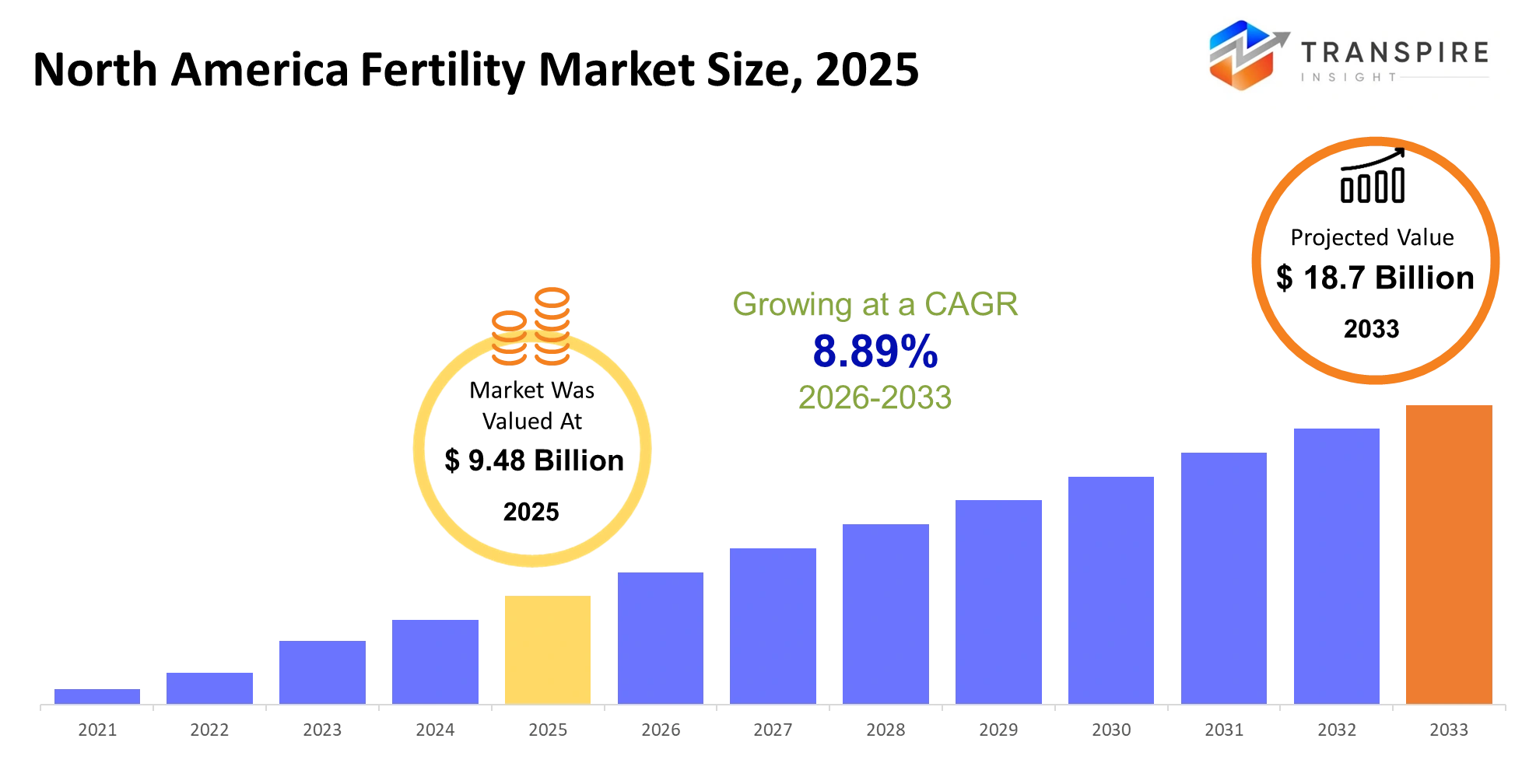
- North America Fertility Market Size 2025: USD 9.48 Billion
- North America Fertility Market Size 2033: USD 18.7 Billion
- North America Fertility Market CAGR: 8.89%
- North America Fertility Market Segments: By Type (IVF, IUI, Fertility Drugs, Equipment, Services, Genetic Testing, Cryopreservation); By Application (Male Infertility, Female Infertility, Combined, Genetic Disorders, Hormonal Issues, Age-related, Others); By End-User (Hospitals, Fertility Clinics, Research Centers, Labs, Patients, Healthcare Providers, Govt); By Treatment (Assisted Reproduction, Medication, Surgery, Counseling, Hormonal Therapy, Egg/Sperm Donation, Surrogacy); By Distribution (Direct, Clinics, Online, Hospitals, Pharmacies, Specialized Centers, Research)
To learn more about this report,  Download Free Sample Report
North America Fertility Market Summary:
The North America Fertility Market size is estimated at USD 9.48 Billion in 2025 and is anticipated to reach USD 18.7 Billion by 2033, growing at a CAGR of 8.89% from 2026 to 2033.
The North American fertility market experiences transformation because of evolving family planning practices and new reproductive technology developments. Clinics are developing customized treatment solutions which match the increasing demand for less invasive procedures and later-life parenthood options. The application of digital technologies will enhance both patient monitoring processes and laboratory operations through automated systems.
The operational standards of assisted reproduction services will experience changes because of new regulatory requirements while insurance companies will modify their coverage policies. The growing demand for transparent pricing together with ethically responsible medical practices has led consumers to pressure clinics into improving their communication methods and data protection standards.
What Has the Impact of Artificial Intelligence Been on the North America Fertility Market?
Artificial intelligence has become a defining force that changes the North America Fertility Market by providing better business insights and faster decision-making capabilities throughout the entire industry. The application of artificial intelligence in the North America Fertility Market enables clinics and pharmaceutical companies and diagnostic providers to process intricate patient treatment information.
North America Fertility Market stakeholders use advanced machine learning models with predictive analytics because they need to study large datasets which reveal their treatment success patterns and patient selection methods and clinical results. The data-driven approach improves market research capabilities because it helps businesses forecast demand and track market trend changes.
Artificial intelligence systems in North America Fertility Market operations use advanced automation technologies to create efficient workflow systems. Artificial intelligence systems in fertility treatments use embryo selection algorithms and automated lab monitoring systems which help to decrease human error while achieving better treatment accuracy and treatment consistency.
AI-powered supply chain optimization enables organizations to control inventory and forecast fertility drug demand while decreasing operational expenses, which results in better accessibility and scalability, throughout the North America Fertility Market. The demand for services needs these efficiencies because demographic changes and rising infertility rates create increased service requirements.
The use of personalized treatment plans which utilize predictive analytics together with patient-specific data results in better treatment outcomes and increased patient satisfaction. The North America Fertility Market will become a technologically advanced and patient-centered industry because AI will drive research development and improve diagnostic and care delivery processes.
Key Market Trends & Insights:
- The United States controls more than 80 percent of the North America Fertility Market in 2025 because its advanced healthcare infrastructure enables most patients to receive treatment.
- Canada operates as the fastest-growing area within the North America Fertility Market which will maintain its growth until 2030 because of its reimbursement policies and rising public knowledge.
- The North America Fertility Market depends on Assisted Reproductive Technology (ART) services which will control almost 60% of the market in 2025 because of high demand for IVF procedures.
- The second largest market segment consists of fertility drugs which receive support from increasing hormonal treatment usage and expanding patient base.
- The genetic testing services market segment represents the fastest-growing area which will expand quickly until 2030 because of rising demand for embryo screening technology.
- The North America Fertility Market is mainly controlled by female infertility treatment which holds a 65% market share because more women are confirmed as infertile and choose to receive medical care.
- The fastest-growing area of male infertility treatment shows increasing growth because people know more about the condition and there are better ways to diagnose it.
- Fertility clinics will hold the dominant position in the North America Fertility Market because they provide specialized medical services which will enable them to capture almost 70% of the market in 2025.
- The end-user group which shows the quickest development is hospitals which grow through partnerships and their complete reproductive health service offerings.
- The North America Fertility Market features Thermo Fisher Scientific CooperSurgical Vitrolife Cook Medical and FUJIFILM Irvine Scientific as its main business competitors.
North America Fertility Market Segmentation
By Type:
The main types of North America fertility market research study show the following categories which include IVF IUI fertility drugs and equipment and services and genetic testing and cryopreservation. IVF will remain a key method for assisted conception due to higher success rates. IUI establishes the first path of treatment because patients use fertility drugs to achieve their initial fertility goals. The combination of genetic testing and cryopreservation will help individuals develop their reproductive plans which extend beyond their current life span.
The use of services and equipment will enable fertility centers to continue their clinical activities. The process of cryopreservation will enable the long-term storage of eggs and sperm until their future application. Genetic testing will support detection of inherited conditions before implantation. Doctors will use IVF and IUI to treat all patients who have different fertility problems while drugs and services will enhance both treatment accessibility and patient results.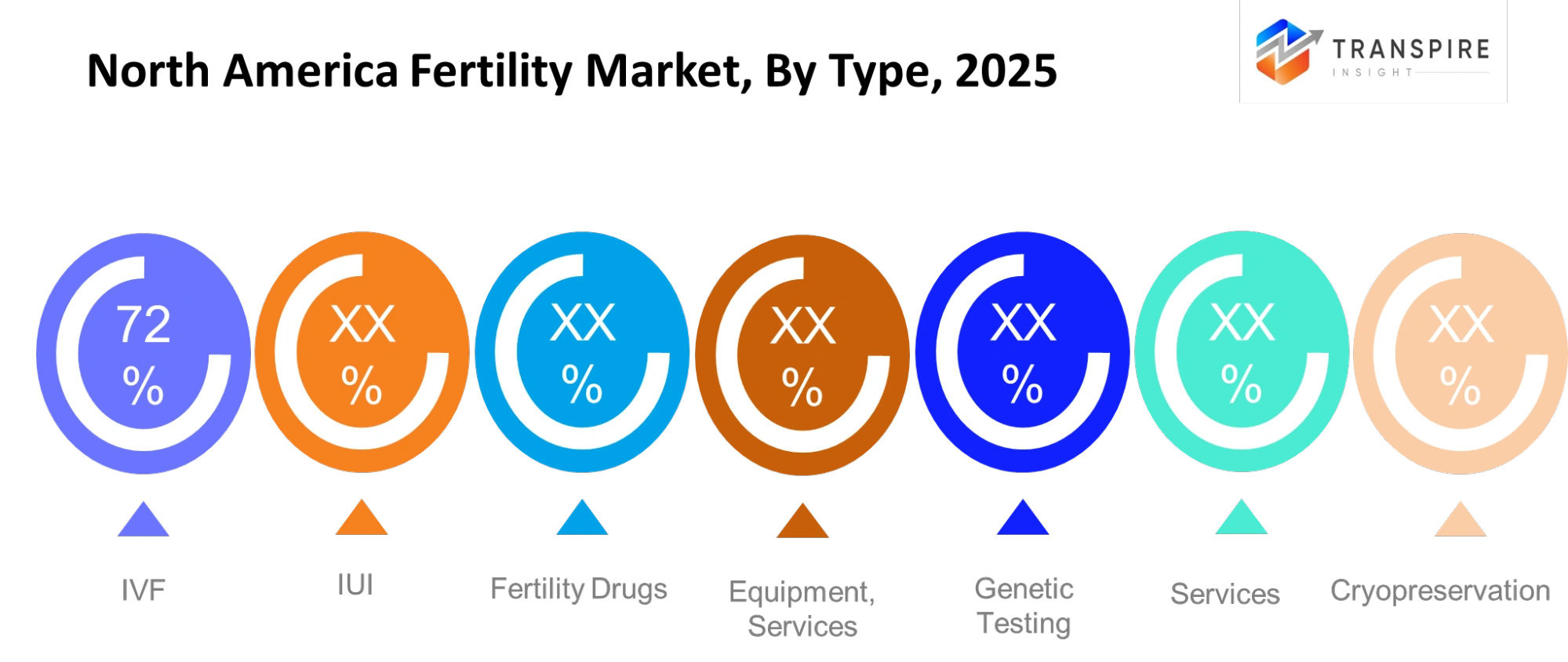
To learn more about this report, Download Free Sample Report
By Application:
The main areas of application are defined by male infertility and female infertility and combined infertility and genetic disorders and hormonal issues and age-related factors and other medical conditions. Age-related decline and hormonal imbalance together will continue to drive research efforts dedicated to female infertility. The research focus on male infertility will increase because lifestyle choices have negative effects on reproductive health in different communities.
Healthcare providers need to implement multiple treatment methods which require treatment of both partners in combined infertility situations. The increase in genetic disorders will create a higher need for preconception testing. The prevalence of hormonal issues will lead to greater reliance on medication-based treatment methods. The increasing number of people who delay starting families will result in more cases of age-related infertility. The medical field needs to establish a system for dealing with unexplained infertility cases which will use diagnostic data to create personalized treatment strategies that hospitals and clinics will implement.
By End-User:
The primary user group consists of hospitals, fertility clinics, research centers, laboratories, patients, healthcare providers, and government bodies. Fertility clinics will continue to operate as the primary treatment centers because they possess specific medical equipment needed for their specialized services. Hospitals will handle difficult medical situations in which patients need both advanced treatment methods and surgical operations.
The testing process and new developments in fertility treatment will receive support from research facilities and laboratory environments. Patients will increasingly access direct consultation and treatment services. Healthcare providers will develop coordinated care plans that cover multiple treatment facilities. Government support will enhance public knowledge and service access, while hospitals and clinics will collaborate to extend treatment services into both urban and semi-urban regions.
By Treatment:
Important methods of treatment include assisted reproduction which consists of all medical procedures and all counseling services and all hormonal treatment methods and all egg and sperm donation activities and all surrogacy procedures. Complex infertility cases will rely on assisted reproduction methods which include IVF as their primary treatment solution. The initial treatment process will use medication together with hormonal therapy to manage treatment needs and menstrual cycle control.
The surgical procedures will correct existing problems which affect reproductive system functions. The counseling process will help patients meet their psychological and emotional needs throughout their entire treatment journey. Egg and sperm donation will assist individuals who have difficulty reproducing. Surrogacy will assist patients who face difficulties getting pregnant. The combination of different treatment methods will result in higher success rates for patients with various medical conditions.
By Distribution:
The distribution network includes direct services together with clinics and online platforms and hospitals and pharmacies and specialized centers and research-linked channels. The primary treatment locations for patients will continue to be fertility clinics and hospitals. Direct services will enable delivery of personalized treatment through established operational procedures.
The online platforms will provide users with the ability to schedule consultations while accessing information. Pharmacies will provide fertility medications together with hormonal treatments. Specialized centers will focus on advanced reproductive procedures. The research-linked channels will enable clinical trials while providing access to innovative treatments. The combined distribution systems will enhance accessibility to fertility treatments which will benefit various patient populations.
What are the Main Challenges for the North America Fertility Market Growth?
The North America Fertility Market experiences multiple technical and operational obstacles which hinder its expansion even though demand is increasing. Assistive reproductive methods require medical staff to perform their duties with precise execution in specialized laboratory environments that need continuous quality assessment to succeed. The success of IVF treatments varies because of unpredictable factors which leads to both decreased patient trust and lower operational performance in clinics. The North America Fertility Market experiences barriers to its expansion because of supply chain problems which affect essential fertility medications and cryopreservation materials and laboratory instruments.
The North America Fertility Market experiences market growth restrictions because of manufacturing and product distribution limitations. The operational expenses of businesses increase because they have to comply with strict regulatory requirements which include Good Manufacturing Practices (GMP) and changing clinical standards for product approval processes. The high cost of fertility treatments, combined with limited insurance coverage in several regions, creates affordability concerns. The financial demands and extended time required to bring new reproductive technologies to the market create major restrictions for the market.
The North America Fertility Market faces its most critical challenge through adoption difficulties. Service availability becomes limited because rural areas and underserved regions lack advanced fertility clinics and do not have enough qualified embryologists and specialists. The social stigma which exists together with public ignorance about fertility treatments affects how people choose to receive treatments. The North America Fertility Market faces multiple obstacles to its growth because of rising competition from alternative reproductive technologies and ongoing pressure to decrease prices.
Country Insights
The North America fertility market experiences growth as people adopt different lifestyle patterns which lead them to postpone having children and develop greater knowledge of reproductive health services. The need for assisted reproductive technologies has grown continuously because success rates have improved and more patients now choose medical assistance to solve their fertility problems.
The market experienced growth through better clinical practices and increased access to fertility treatment facilities.Financial aid programs together with insurance plans in particular areas have driven more people to seek medical treatment. The research progress in reproductive science enables scientists to develop new medical treatments which lead to better patient results and increased trust in available medical options. The United States dominates the regional market because of its excellent healthcare facilities and numerous dedicated fertility treatment centers.
Canada experiences continuous development because its healthcare system supports fertility preservation services which have become more recognized. People in different regions experience different levels of service accessibility and treatment costs because metropolitan areas develop at a faster rate than rural regions. The government-supported awareness programs and educational programs are helping to decrease these treatment access gaps. This development enables more people in North America to receive fertility treatments.
Recent Development News
In April 2026, Sunfish launched an AI-powered egg-freezing program to improve cost predictability in fertility treatments. The platform uses predictive modeling based on historical IVF cycle data to estimate outcomes and offer cost guarantees for patients undergoing egg freezing in the U.S. Source https://www.axios.com/
In March 2026, WIN (formerly WINFertility) expanded its platform into a comprehensive family-building benefits solution. The company broadened services beyond IVF to include surrogacy, adoption, and menopause care, driven by rising employer demand for holistic reproductive health benefits. Source https://www.businessinsider.com/
|
Report Metrics |
Details |
|
Market size value in 2025 |
USD 9.48 Billion |
|
Market size value in 2026 |
USD 10.3 Billion |
|
Revenue forecast in 2033 |
USD 18.7 Billion |
|
Growth rate |
CAGR of 8.89% from 2026 to 2033 |
|
Base year |
2025 |
|
Historical data |
2021 - 2024 |
|
Forecast period |
2026 - 2033 |
|
Report coverage |
Revenue forecast, competitive landscape, growth factors, and trends |
|
Regional scope |
North America (Canada, The United States, and Mexico) |
|
Key company profiled |
Merck, Ferring, Vitrolife, Cooper Surgical, Thermo Fisher, Cook Medical, Genea, IVFtech, Esco Medical, FUJIFILM Irvine Scientific, Hamilton Thorne, Cryos International, Progyny, OvaScience, Natera |
|
Customization scope |
Free report customization (country, regional & segment scope). Avail customized purchase options to meet your exact research needs. |
|
Report Segmentation |
By Type (IVF, IUI, Fertility Drugs, Equipment, Services, Genetic Testing, Cryopreservation); By Application (Male Infertility, Female Infertility, Combined, Genetic Disorders, Hormonal Issues, Age-related, Others); By End-User (Hospitals, Fertility Clinics, Research Centers, Labs, Patients, Healthcare Providers, Govt); By Treatment (Assisted Reproduction, Medication, Surgery, Counseling, Hormonal Therapy, Egg/Sperm Donation, Surrogacy); By Distribution (Direct, Clinics, Online, Hospitals, Pharmacies, Specialized Centers, Research) |
How Can New Companies Establish a Strong Foothold in the North America Fertility Market?
New entrants can establish a strong foothold in the North America Fertility Market by focusing on niche segments where unmet clinical and operational needs remain high. Companies can establish themselves in the market by investigating male infertility diagnostics and fertility preservation and genetic screening. The North America Fertility Market allows companies to create competitive advantages through their innovation strategies which use AI-powered embryo selection and predictive analytics and personalized treatment plans to decrease success rate variability and enhance patient results.
Companies need to establish strategic partnerships in order to grow their North America Fertility Market business operations. Organizations can achieve quicker market penetration through their partnerships with fertility clinics and research centers and pharmaceutical companies which also provide access to patient databases.
The implementation of smart automation and cloud-based lab management systems and integrated patient platforms as technology differentiators enables businesses to enhance their operations while decreasing expenses which addresses major industry challenges. The market growth strategies of these approaches match better market growth trends which establish operational efficiency and accuracy as main factors for market competition.
Emerging players are already demonstrating how innovation can reshape the North America Fertility Market. Alife Health uses machine learning to enhance IVF decision-making processes while Future Fertility analyzes oocyte quality through its advanced imaging technology. New companies can build their market presence by utilizing technology and data-driven insights and patient-focused solutions to achieve their business targets and study market trends.
Key North America Fertility Market Company Insights
The North American fertility industry experiences consistent expansion which benefits from people choosing to have children later in life and increased public knowledge and better access to medical services. People will start to use advanced medical technologies which include IVF and egg freezing procedures more frequently. People will need to pay for treatment costs because they will drive their choice of medical facilities despite some regions offering better insurance coverage.
The organization will enhance its service delivery through ongoing development of clinical systems and laboratory equipment. The population in urban centers will maintain their need for medical services because they can access doctors and treatment facilities with greater convenience. The combination of educational programs and social acceptance will make fertility treatments more common which will lead to more people and couples seeking medical help at earlier times in their fertility journey.
The competitive environment shows strong competition between dedicated fertility clinics and hospital-based treatment centers and new market entrants. Market leaders will base their competitive strategy on their success rates and pricing transparency and patient satisfaction. The core elements of competitive strategies will include strategic partnerships and clinic network expansion and advanced reproductive technology implementation.
Market participants will increasingly invest in digital tools for consultation monitoring and patient engagement. Patient acquisition will depend on brand trust and clinical outcomes. Smaller clinics will compete through personalized care while larger networks will use their research capacity and geographic coverage to retain their position in the market.
Company List
- Merck
- Ferring
- Vitrolife
- Cooper Surgical
- Thermo Fisher
- Cook Medical
- Genea
- IVFtech
- Esco Medical
- FUJIFILM Irvine Scientific
- Hamilton Thorne
- Cryos International
- Progyny
- OvaScience
- Natera
What are the Key Use-Cases Driving the Growth of North America Fertility Market?
The North America Fertility Market is expanding because of multiple important medical applications which provide solutions to increasing infertility problems and growing rates of postponed parenthood. The main engine of growth for the market comes from assisted reproductive technologies which include in vitro fertilization as people seek better embryo selection methods and more efficient implantation procedures. The North American Fertility Market experiences growing adoption of genetic screening, together with preimplantation genetic testing which enables doctors to enhance success rates while decreasing inherited disease transmission risks.
The North America Fertility Market receives its main push from fertility preservation services which enable cancer patients and people who want to start families at a later time to protect their ability to reproduce. Technological progress in cryopreservation has made egg and sperm freezing services more accessible to people who need these services. AI-based semen analysis and hormone testing now serve as vital male infertility diagnostic tools which enhance diagnostic precision while creating new treatment options.
Digital health platforms together with AI-based fertility tracking systems operate outside conventional medical facilities to enhance patient involvement and medical treatment strategies within the North America Fertility Market. The solutions provide capabilities for monitoring patient status in real time together with customized treatment strategies and improved clinical collaboration. The scalable data-driven use cases will enhance accessibility and improve results while they support ongoing market expansion according to future innovation developments.
North America Fertility Market Report Segmentation
By Type
- IVF
- IUI
- Fertility Drugs
- Equipment
- Services
- Genetic Testing
- Cryopreservation
By Application
- Male Infertility
- Female Infertility
- Combined
- Genetic Disorders
- Hormonal Issues
- Age-related
By End-User
- Hospitals
- Fertility Clinics
- Research Centers
- Labs
- Patients
- Healthcare Providers
- Govt
By Treatment
- Assisted Reproduction
- Medication
- Surgery
- Counseling
- Hormonal Therapy
- Egg/Sperm Donation
- Surrogacy
By Distribution
- Direct
- Clinics
- Online
- Hospitals
- Pharmacies
- Specialized Centers
- Research
Frequently Asked Questions
Find quick answers to common questions.
The Approximate North America Fertility Market size for the Market will be USD 18.7 Billion in 2033.
Key Segments for the North America Fertility Market are By Type (IVF, IUI, Fertility Drugs, Equipment, Services, Genetic Testing, Cryopreservation); By Application (Male Infertility, Female Infertility, Combined, Genetic Disorders, Hormonal Issues, Age-related, Others); By End-User (Hospitals, Fertility Clinics, Research Centers, Labs, Patients, Healthcare Providers, Govt); By Treatment (Assisted Reproduction, Medication, Surgery, Counseling, Hormonal Therapy, Egg/Sperm Donation, Surrogacy); By Distribution (Direct, Clinics, Online, Hospitals, Pharmacies, Specialized Centers, Research).
Ans: Major North America Fertility Market players are Merck, Ferring, Vitrolife, Cooper Surgical, Thermo Fisher, Cook Medical, Genea, IVFtech, Esco Medical, FUJIFILM Irvine Scientific, Hamilton Thorne, Cryos International, Progyny, OvaScience, Natera.
The Current North America Fertility Market size is USD 9.48 Billion in 2025.
The North America Fertility Market CAGR is 8.89%
- Merck
- Ferring
- Vitrolife
- Cooper Surgical
- Thermo Fisher
- Cook Medical
- Genea
- IVFtech
- Esco Medical
- FUJIFILM Irvine Scientific
- Hamilton Thorne
- Cryos International
- Progyny
- OvaScience
- Natera
Recently Published Reports
-
Dec 2025
Biosimilars Market
Biosimilars Market By Product Type (Monoclonal Antibodies, Recombinant Hormones, Erythropoietin, G-CSF, Others), By Indication (Oncology, Autoimmune Diseases, Blood Disorders, Diabetes, Others), By Manufacturing Type (In-House Manufacturing, Contract Manufacturing), By Distribution Channel (Hospital Pharmacies, Retail Pharmacies, Online Pharmacies), By Industry Analysis, Size, Share, Growth, Trends, and Forecasts 2021-2033
-
Dec 2025
Gastrointestinal Endoscopy Market
Gastrointestinal Endoscopy Market By Type (Rigid Gastrointestinal Endoscope, Flexible Gastrointestinal Endoscopes, Disposable Gastrointestinal Endoscope), By Procedure Type (Colonoscopy, Gastroscopy, Duodenoscopy, Enteroscopy, Flexible Sigmoidoscopy, Others), By Application (Diagnosis, Treatment), By End-Users (Hospitals, Ambulatory Surgical Centers, Specialty Clinics, Laboratories, Others), By Industry Analysis, Size, Share, Growth, Trends, and Forecasts 2021-2033
-
Jan 2026
Rare Inherited Metabolic Disorder Drug Market
Rare Inherited Metabolic Disorder Drug Market By Drug Class (Enzyme Replacement Drugs, Gene Therapy Drugs, Substrate Reduction Drugs, Small Module Drugs, Protein Drugs), By Route of Administration(Parenteral, Oral, Intrathecal), By Clinical Development (Marketed Drugs, Late Stage Clinical Phase III, Early Stage Clinical Phase I-II, Preclinical Candidates), By Indication (Lysosomal Storage Disorders, Urea Cycle Disorders, Amino Acid Metabolic Disorders, organic Acidemias, Peroximal Disorders), By Industry Analysis, Size, Share, Growth, Trends, and Forecasts 2021-2033
-
Jan 2026
Pharmaceutical Cleanroom Technology Market
Pharmaceutical Cleanroom Technology Market By Product (Equipment, Consumables, Services); By Cleanroom Type (Standard Cleanrooms, Modular Cleanrooms); By End Use (Pharmaceutical Companies, Biotechnology Companies), By Industry Analysis, Size, Share, Growth, Trends, and Forecasts 2021-2033