
Middle East and Africa Security Orchestration Automation & Response Market Size & Forecast:
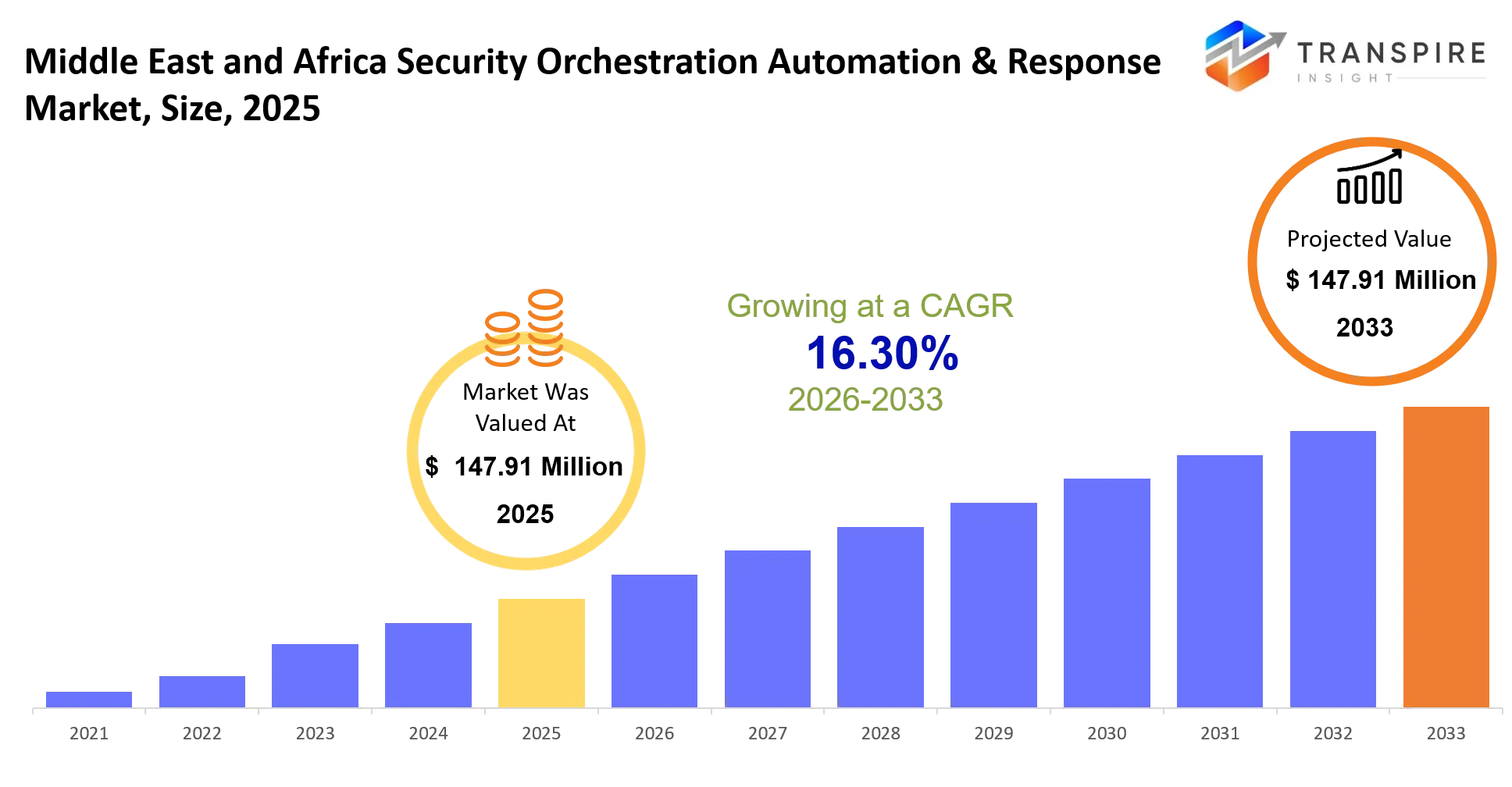
- Middle East and Africa Security Orchestration Automation & Response Market Size 2025: USD 147.91 Million
- Middle East and Africa Security Orchestration Automation & Response Market Size 2033: USD 147.91 Million
- Middle East and Africa Security Orchestration Automation & Response Market CAGR: 16.30%
- Middle East and Africa Security Orchestration Automation & Response Market Segments: By Component (Software, Services, Managed Services, Professional Services, Consulting, Integration Services, Support Services, Others); By Deployment (Cloud-Based, On-Premise, Hybrid Cloud, Private Cloud, Public Cloud, SaaS, Multi-Cloud, Others); By Enterprise Size (Large Enterprises, SMEs, Government Organizations, BFSI Institutions, Healthcare Organizations, Telecom Operators, Retail Enterprises, Others); By Industry Vertical (BFSI, Healthcare, IT & Telecom, Government, Energy & Utilities, Retail, Manufacturing, Others)
Middle East and Africa Security Orchestration Automation & Response Market Summary
The Middle East and Africa Security Orchestration Automation & Response Market was valued at USD 147.91 Million in 2025. It is forecast to reach USD 147.91 Million by 2033. That is a CAGR of 16.30% over the period.
Security Orchestration, Automation, and Response (SOAR) platform *helps* security teams manage big piles of cyber threats by tying together security tools, automating the same repetitive bits, and speeding up incident response. In real life these platforms tends to cut down on alert fatigue , speed up the whole investigation loop. and let security operations centers deal with nasty incidents without just hiring more people in the same ratio. In the Middle East and Africa, SOAR solutions have gotten more important, especially as organizations push deeper into cloud environments, expand remote work infrastructure, and roll out more digital services.
Over the last five years, the market feels like it moved away from “standalone incident response tools” and toward a more unified security operations platform, where orchestration, threat intelligence, analytics, and automation all sit together. A key reason for this shift was the rise in ransomware attacks and state-sponsored cyber activity, hitting critical infrastructure financial firms, and government networks. When the attack volume keeps rising, manual security workflows become hard to keep up with, kind of quickly. So enterprises are leaning toward automated response systems, which reduce detection and remediation times, rather than letting incidents drag on. The outcome looks like broader platform adoption, more recurring software revenue, and extra investment in managed security services across the region, steadily.
Key Market Insights
- Saudi Arabia along with the UAE are roughly 38% of the regional market revenue by 2025, and they are backed by cybersecurity modernization programs.
- Meanwhile Gulf Cooperation Council countries still hold the leading position, largely driven by smart city spending and protective measures for critical infrastructure.
- In 2025, software solutions will take up nearly 52% market share, this is tied to platform consolidation across enterprise security operations centers , sort of a “one place to manage everything” approach.
- Services stay the second-largest slice as organizations keep chasing deployment, systems integration and ongoing managed security expertise, because in-house teams can be hard to scale quickly.
- Cloud based deployment is expected to grow the quickest through 2033, with multi cloud security management requirements acting like the main fuel. For demand, BFSI pushes past 24% , it mirrors the elevated risk landscape tied to fraud ransomware and mandatory compliance rules.
- Government agencies still maintain a noticeable share too, since national cybersecurity frameworks and sovereign security initiatives keep getting reinforced.
- Also, AI-assisted threat investigation tools have cut down security analyst workloads by around 30–40% among early adopters, which is why teams are paying attention.
- Managed SOAR platforms are getting more traction especially among SMEs that don’t really have a dedicated security operations center workforce.
- On top of that, vendors are increasingly combining SOAR, XDR, SIEM, and threat intelligence inside a single unified security operations platform, instead of keeping everything separate.
What are the Key Drivers, Restraints, and Opportunities in the Middle East and Africa Security Orchestration Automation & Response Market?
The strongest growth driver is that move toward automated security operations, and honestly it feels like everyone is dealing with it at once. Organizations in banking, government, telecommunications, and energy are seeing more and more security alerts coming from cloud applications, endpoint devices, and the connected infrastructure around them. With hybrid cloud setups becoming more common, the security monitoring needs stack up, and older manual workflows just cant keep up, not efficient at all. So, enterprises are putting money into orchestration platforms that handle threat triage, investigation, and remediation with less human effort. In practice this helps operational efficiency a lot, and it also pushes higher spending on software subscriptions , managed services, and platform integration.
The biggest restraint is still the shortage of experienced cybersecurity professionals who can really manage advanced security automation environments. This is kind of structural because building local talent takes years of education, certification, and workforce expansion. A lot of organizations have trouble designing the automation workflows, and then wiring together several security tools. On top of that, they need to keep security operations architectures running, which is not simple, even with good vendors. As a consequence deployment cycles slow down, procurement decisions get delayed, and platform features end up underused which then limits revenue capture in parts of the market.
A major opportunity shows up in AI-driven security operations platforms. More organizations are looking for solutions that blend orchestration , analytics, and autonomous threat response in one place, basically a single environment instead of scattered components. Meanwhile countries like Saudi Arabia and the UAE keep investing strongly in digital transformation, smart city projects, and protection for critical infrastructure.
What Has the Impact of Artificial Intelligence Been on the Middle East and Africa Security Orchestration Automation & Response Market?
Artificial intelligence has kind of transformed security operations,by automating a bunch of tasks that used to need manual analyst attention. Today’s SOAR platforms lean on AI to push alerts to the top in a smarter order, connect security events across several data sources, and carry out response playbooks automatically. Security teams end up investigating incidents quicker ,because machine learning models spot strange or suspicious patterns across networks, endpoint systems, cloud spaces,and even user activity.
The predictive angle is getting more and more important too. Machine learning algorithms sift through old attack behavior, threat intelligence sources,and behavioral indicators to project what might happen next, before it turns into a bigger problem. In practice, these models help organizations sharpen threat detection precision, fine tune response workflows, and also reduce incident dwell times. Some early adopters mention real drops in manual investigation work ,plus better overall operational efficiency .
On top of that, AI-enabled automation backs up faster compliance reporting, clearer security visibility,and more steady enforcement of security policies. Organizations can see lower operational costs as fewer hand driven processes are needed to handle the ever-growing alert firehose.
Still, AI adoption has limitations that can’t be ignored. Integration costs stay high ,especially when enterprises are juggling multiple older security platforms. On the model side, data quality problems, uneven telemetry, and a shortage of cybersecurity know-how can all shake up accuracy. Because of these issues, some organizations move slower toward full-scale deployment even if the long-term potential looks strong.
Key Market Trends
- Organizations have reduced the hand worked incident triage work by around 30% compared with what they used back in the pre-2023 security operations models, you know the old way.
- AI driven security operations platforms picked up hard between 2024 and 2026 as alert volumes really started to climb.
- Cloud based deployments rolled out faster than on premise setups, mostly because multi cloud security monitoring needs keep growing and changing all the time.
- In another shift GCC cybersecurity investments jumped by more than 20% from 2023 to 2025, which in turn helped regional adoption feel way more natural.
- Security teams now seem to lean toward unified platforms that combine SIEM with XDR, plus threat intelligence and SOAR bits too, it’s kind of a one stop situation for them.
- Also managed security providers kept expanding their automation centered service portfolios, largely to help with cybersecurity talent shortages that just don’t really go away.
- Government cybersecurity frameworks started putting in place tougher incident reporting requirements, and that push helped accelerate deployment of orchestration platforms.
- Major vendors like Palo Alto Networks, Microsoft, IBM, and Cisco have been extending AI based security automation capabilities, so the tooling feels more “alive” than before.
- Security operations centers are increasingly deploying automated playbooks, to shrink investigation and containment timelines.
- Finally cross platform integrations have become a strong purchasing criterion, because organizations are trying to consolidate security operations instead of stitching everything together piece by piece.
Middle East and Africa Security Orchestration Automation & Response Market Segmentation
By Component
Software is kind of the base that security orchestration and response environments stand on, it does this by hooking up security tools , running automated workflows , and also supporting a more centralized threat handling approach. Most organizations depend on software platforms to make things more visible, coordinate incoming alerts, and speed up incident resolution through all sorts of tangled digital setups. More advanced analysis, orchestration engines , and automation playbooks keep boosting how useful the platform feels, even for big or mid sized enterprises.
Services then back that up for real implementation and day to day performance. Managed Services allow organizations to run these security platforms ,without building a huge internal team. Professional Services, Consulting, Integration Services ,and Support Services help with deployment , customizing, workflow tuning, compliance alignment, maintenance, and ongoing improvement. There are also other options like specialized training, assessments, and advisory offerings aimed at operational needs that are a bit more unique ,or just harder to fit into a standard plan.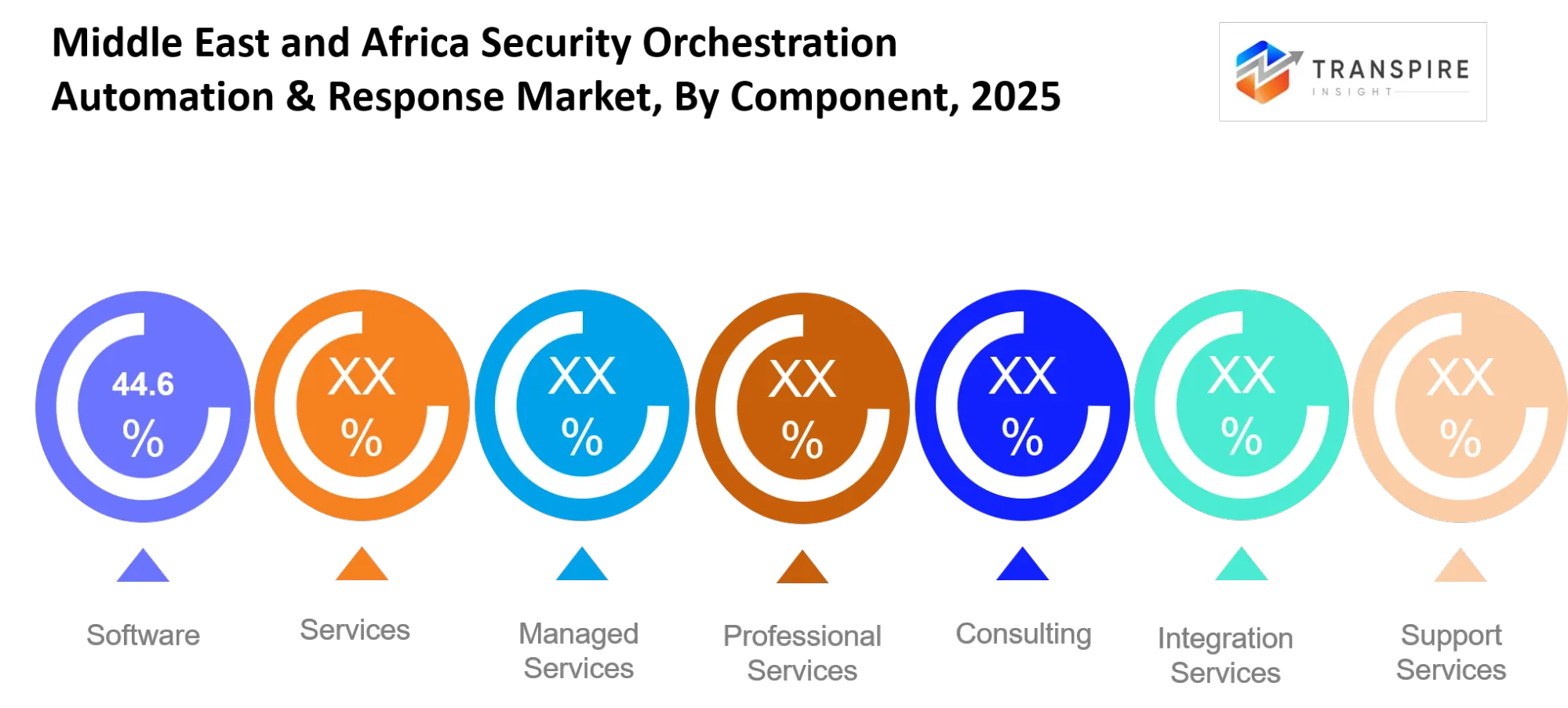
By Deployment
Cloud based deployment keeps getting more traction, because orgs want flexible security operations tools that can scale with them. In public cloud setups, teams can launch faster and the infrastructure burden is usually lower, meanwhile private cloud models give more governance for sectors that are highly regulated. With SaaS delivery, it becomes easier to set things up, and also to keep everything running over time with less effort.
Still, on premise deployment matters a lot for organizations that deal with sensitive data, or they have hard compliance rules. Hybrid cloud environments sort of blend flexibility with tighter control and can support gradual modernization too. Multi cloud architectures also show up, so enterprises can run security operations across multiple providers without too much friction. Beyond that, there are customized deployment patterns that are designed around the specific operational realities, plus the regulatory framework , in question.
By Enterprise Size
Large Enterprises account for a significant share because extensive digital infrastructure creates rather complex needs for security monitoring, and honestly it can get messy quickly. In general, BFSI Institutions, Healthcare Organizations , Telecom Operators, and Government Organizations often maintain broad technology ecosystems where automated security workflows and centralized threat management actually help a lot.
SMEs are moving toward security automation platforms more and more, using cloud-based as well as managed service models that keep operational overhead down, less friction. Retail Enterprises, meanwhile, look for stronger defense of customer data, payment systems , and digital channels. Other sectors like education, transportation, logistics, and emerging technology organizations also show up here, since they need scalable cybersecurity operations, but without large internal security teams , most times.
By Industry Vertical
BFSI still remains a big adopter because of fraud prevention needs, regulatory obligations, and the presence of high value digital assets. In healthcare, organizations keep investing in security automation, meant to protect patient records and those connected medical systems too, you know. For IT & Telecom, teams use orchestration platforms to secure broad networks, cloud services, and customer facing infrastructure, all at once.
Government agencies put extra attention on protecting critical services, plus national digital assets. Energy & Utilities operators lean into advanced security monitoring to guard operational technology environments. Retail organizations are also tightening defenses across digital commerce channels, while Manufacturing facilities increasingly secure connected production settings and industrial control systems.
There are others as well, like transportation, education and professional services sectors, each with their own pressures and exposure points.
What are the Key Use Cases Driving the Middle East and Africa Security Orchestration Automation & Response Market?
The main use case seems to be about automated incident detection , investigation and response, inside security operations centers. Like, financial institutions, telecom providers, and government agencies churn out huge amounts of security alerts every single day. Automated orchestration platforms give security teams a way to sort, rank incidents, run response steps , and shorten containment periods, so honestly this becomes the biggest driver for market demand.
Then there’s the secondary angle, which covers cloud security operations and compliance management. Healthcare organizations are using orchestration platforms to keep an eye on patient data environments , and telecommunications operators are tying in automation to counter network threats. These scenarios have picked up momentum, partly because organizations keep expanding cloud infrastructure and now they have more strict cybersecurity obligations to deal with.
For emerging applications, you start seeing AI-assisted threat hunting, plus more autonomous security operations. Critical infrastructure operators are looking at advanced automation features that could flag questionable behavior early, and then also suggest what to do next. These particular use cases are still kind of early, but they look promising for the long run as AI technologies keep maturing.
|
Report Metrics |
Details |
|
Market size value in 2025 |
USD 147.91 Million |
|
Market size value in 2026 |
USD 172.02 Million |
|
Revenue forecast in 2033 |
USD 495.05 Million |
|
Growth rate |
CAGR of 16.30% from 2026 to 2033 |
|
Base year |
2025 |
|
Historical data |
2021 - 2024 |
|
Forecast period |
2026 - 2033 |
|
Report coverage |
Revenue forecast, competitive landscape, growth factors, and trends |
|
Regional scope |
United States; Canada; Mexico; United Kingdom; Germany; France; Italy; Spain; Denmark; Sweden; Norway; China; Japan; India; Australia; South Korea; Thailand; Brazil; Argentina; South Africa; Saudi Arabia; United Arab Emirates |
|
Key company profiled |
Palo Alto Networks, IBM, Cisco, Microsoft, Splunk, Fortinet, Check Point, CrowdStrike, SentinelOne, Rapid7, Exabeam, Swimlane, Securonix, Trellix, Google |
|
Customization scope |
Free report customization (country, regional & segment scope). Avail customized purchase options to meet your exact research needs. |
|
Report Segmentation |
By Component (Software, Services, Managed Services, Professional Services, Consulting, Integration Services, Support Services, Others); By Deployment (Cloud-Based, On-Premise, Hybrid Cloud, Private Cloud, Public Cloud, SaaS, Multi-Cloud, Others); By Enterprise Size (Large Enterprises, SMEs, Government Organizations, BFSI Institutions, Healthcare Organizations, Telecom Operators, Retail Enterprises, Others); By Industry Vertical (BFSI, Healthcare, IT & Telecom, Government, Energy & Utilities, Retail, Manufacturing, Others) |
Which Regions are Driving the Middle East and Africa Security Orchestration Automation & Response Market Growth?
In the Gulf Cooperation Council region the market stays ahead , because there are big scale investments going into cybersecurity modernization, digital government efforts and protection of critical infrastructure. Saudi Arabia along with the United Arab Emirates keep rolling out national cybersecurity strategies , and these push for stronger security operations capabilities. Also cloud adoption is strong, and the smart city initiatives really help, they nudge demand for automation driven security platforms. There’s also a mature ecosystem around it, with technology providers, managed security firms, and public programs all reinforcing that regional leadership, even if it looks a bit fragmented.
South Africa is basically the second largest contributor and it feels different from the Gulf because there is more enterprise led adoption, less government led transformation. Here, financial institutions, telecommunications providers, and multinational corporations are the ones that pull the spending toward security orchestration technologies. Digital infrastructure is relatively stable, and cybersecurity practices are already in place, so investment patterns stay consistent. As a result, vendors that operate across the region get a dependable revenue foundation and a clearer pathway to scale.
Now the wider African market is projected to grow the quickest through 2033. Cloud uptake keeps rising, digital services are spreading, and cybersecurity regulations are getting stricter, so new opportunities keep appearing across emerging economies. Meanwhile, investments in digital infrastructure, and also in capacity building for cybersecurity, are improving overall market readiness. For vendors and investors , that growth momentum can mean serious expansion possibilities outside the usual cybersecurity hubs, even when budgets feel tight.
Who are the Key Players in the Middle East and Africa Security Orchestration Automation & Response Market and How Do They Compete?
Competition is kind of moderately concentrated around global cybersecurity vendors with solid automation, analytics and threat intelligence capabilities. I mean , technology innovation still is the main thing behind competition, yet service integration, cloud compatibility and AI functionality are also pulling more weight in purchasing choices. Meanwhile, established providers keep widening their platform abilities, and the more specialized players tend to go deeper into automation, plus operational efficiency, not just surface level features.
Palo Alto Networks stands out with Cortex XSOAR and XSIAM, sorta combining security orchestration, analytics, plus automated response, all in one unified platform, which sounds simple but really isn’t. The company keeps investing in AI-assisted security operations and those autonomous security workflows. IBM, on the other hand, competes via QRadar SOAR, and it leans hard on enterprise integration, threat intelligence, and management for large-scale security operations. Their move is broad ecosystem compatibility and operational flexibility, so teams can fit it into different environments without too much friction.
Cisco improves its position by tying together Splunk security platforms with the wider networking infrastructure. They push for unified visibility, AI-enabled operations, and data integration capabilities. Microsoft leans on cloud ecosystem strengths and tight security platform integration across enterprise setups. Fortinet emphasizes an integrated security architecture that merges network security, automation and centralized management. Overall, these plays help vendors increase adoption while also boosting platform stickiness and recurring revenue, which is usually what everyone cares about in the end.
Company List
- Palo Alto Networks
- IBM
- Cisco
- Microsoft
- Splunk
- Fortinet
- Check Point
- CrowdStrike
- SentinelOne
- Rapid7
- Exabeam
- Swimlane
- Securonix
- Trellix
Recent Development News
"In February 2026, Palo Alto Networks launched Unit 42 Managed XSIAM 2.0 with an expanded AI-driven managed SOC offering and breach response guarantee. The launch strengthens automated threat detection and response capabilities for enterprise security operations.https://investors.paloaltonetworks.com
"In May 2026, IBM released QRadar SOAR V51.0.10.0 with enhanced playbook tracking and more granular notification controls. The update improves automation visibility and operational efficiency within security response workflows.https://www.ibm.com
"In September 2025, Cisco introduced Splunk Enterprise Security Premier Edition and Essentials Edition with agentic AI-powered security operations capabilities. The launch advances unified threat detection, investigation, and response across enterprise environments.https://investor.cisco.com
What Strategic Insights Define the Future of the Middle East and Africa Security Orchestration Automation & Response Market?
The market is heading toward autonomous security operations where AI, analytics, threat intelligence, and orchestration abilities run inside one unified platform, not those separate point tools. This change is being pulled by a bunch of factors, like attack complexity that keeps getting more intricate , more cloud infrastructure to cover, and the plain economic need to manage higher security workloads without proportional increases in cybersecurity headcount.
One risk that is more sort of quiet, is platform concentration. Many organizations are leaning on only a few integrated security ecosystems, so there’s a real chance of vendor dependence and less day to day flexibility when the technology roadmap shifts. Another worry has to do with automation accuracy, especially if teams lean a lot on AI generated suggestions, like they trust the output too quickly .
A bigger and more interesting opening is in AI-native security operations platforms, built with cloud-first thinking and critical infrastructure settings in mind. The countries that are investing strongly in digital transformation and also in national cybersecurity capabilities are likely to turn into major adoption hubs.
For market players it helps to push for open architectures, solid integration features, and AI-assisted automation that is still transparent and auditable. Vendors that strike a balance between automation efficiency and real human oversight should be in a better place to benefit from the long term growth through 2033.
Middle East and Africa Security Orchestration Automation & Response Market Report Segmentation
-
By Component
Software
Services
Managed Services
Professional Services
Consulting
Integration Services
Support Services
Others -
By Deployment
Cloud-Based
On-Premise
Hybrid Cloud
Private Cloud
Public Cloud
SaaS
Multi-Cloud
Others -
By Enterprise Size
Large Enterprises
SMEs
Government Organizations
BFSI Institutions
Healthcare Organizations
Telecom Operators
Retail Enterprises
Others -
By Industry Vertical
BFSI
Healthcare
IT & Telecom
Government
Energy & Utilities
Retail
Manufacturing
Others
Frequently Asked Questions
Find quick answers to common questions.
The Expected Middle East and Africa Security Orchestration Automation & Response Market size for the market will be USD 147.91 Million in 2033.
Key Segments for the Middle East and Africa Security Orchestration Automation & Response Market are By Component (Software, Services, Managed Services, Professional Services, Consulting, Integration Services, Support Services, Others); By Deployment (Cloud-Based, On-Premise, Hybrid Cloud, Private Cloud, Public Cloud, SaaS, Multi-Cloud, Others); By Enterprise Size (Large Enterprises, SMEs, Government Organizations, BFSI Institutions, Healthcare Organizations, Telecom Operators, Retail Enterprises, Others); By Industry Vertical (BFSI, Healthcare, IT & Telecom, Government, Energy & Utilities, Retail, Manufacturing, Others).
Major Middle East and Africa Security Orchestration Automation & Response Market players are Palo Alto Networks, IBM, Cisco, Microsoft, Splunk, Fortinet, Check Point, CrowdStrike, SentinelOne, Rapid7, Exabeam, Swimlane, Securonix, Trellix, Google.
The Current Middle East and Africa Security Orchestration Automation & Response Market size is USD 147.91 Million in 2025.
The Middle East and Africa Security Orchestration Automation & Response Market CAGR is 16.30% from 2026 to 2033.
- Palo Alto Networks
- IBM
- Cisco
- Microsoft
- Splunk
- Fortinet
- Check Point
- CrowdStrike
- SentinelOne
- Rapid7
- Exabeam
- Swimlane
- Securonix
- Trellix
About the Authors

Mayur Shinde
I am Mayur Shinde, a Senior Research Analyst at Transpire Insight, specializing in the Automotive & Transportation and Information & Communication Technology (ICT) Industry. My work focuses on analyzing emerging market trends, technological advancements, competitive landscapes, and industry developments to deliver accurate, data-driven insights. I am passionate about transforming complex market information into clear, actionable content that helps businesses, professionals, and decision-makers stay informed and make confident strategic decisions.

Chakradhar Khansole
Chakradhar serves as the Research Director at Transpire Insight, bringing over 8 years of experience in technology, innovation, and strategic market intelligence. He specializes in transforming complex market data into actionable business insights that enable organizations to make informed, growth-oriented decisions. Recognized for his strategic vision and analytical expertise, Chakradhar leads high-impact research initiatives, delivering comprehensive market assessments, competitive intelligence, and forward-looking industry analysis.
Recently Published Reports
-
Apr 2026
3D Optical Profiler Market
3D Optical Profiler Market Size, Share & Analysis Report By Type (Desktop 3D Optical Profiler, and Portable 3D Optical Profiler), By Technology (Confocal Technology, and White Light Interference), By End-Use Industry (Manufacturing, Research Institutions, Automotive, Aerospace and Defense, Medical Devices, and Other), and Geography (North America, Europe, Asia-Pacific, Middle East and Africa, South and Central America), 2021 - 2031
-
Apr 2026
Depth Sensor Market
Depth Sensor Market Size, Share & Analysis Report By Type (Infrared Depth Sensors, Time-of-Flight (ToF) Sensors, Stereo Vision Sensors, Structured Light Sensors, Ultrasonic Depth Sensors), By Application (Automotive, Robotics, Gaming, Consumer Electronics, Industrial Automation, Healthcare, Security & Surveillance, Others), By End Users (Automotive Manufacturers, Consumer Electronics Companies, Healthcare Providers, Industrial Companies, Security Agencies, Gaming Companies, Robotics Companies, Others), and Geography (North America, Europe, Asia-Pacific, Middle East and Africa, South and Central America), 2021 – 2031
-
Apr 2026
Digital Manufacturing Market
Digital Manufacturing Market Size, Share & Analysis Report By Component (Hardware, Software, and Services), By Technology (Robotics, 3D Printing, Internet of Things (IoT), and Others), By Application (Automotive and Transportation, Aerospace and Defense, Consumer Electronics, Industrial Machinery, and Others), By Process Type (Computer-Based Designing, Computer-Based Simulation, Computer 3D Visualization, Analytics, and Others), and Geography (North America, Europe, Asia-Pacific, Middle East and Africa, South and Central America), 2021 – 2031
-
Apr 2026
Digital Visa Services Market
Digital Visa Services Market Size, Share & Analysis Report By Type (Individual Travelers, Group Travelers), By Application (Tourism, Business Travel, Others), and Geography (North America, Europe, Asia-Pacific, Middle East and Africa, South and Central America), 2021 – 2031