
Middle East and Africa Satellite Manufacturing Market Size & Forecast:
- Middle East and Africa Satellite Manufacturing Market Size 2025: USD 2.08 Billion
- Middle East and Africa Satellite Manufacturing Market Size 2033: USD 4.52 Billion
- Middle East and Africa Satellite Manufacturing Market CAGR: 10.20%
- Middle East and Africa Satellite Manufacturing Market Segments: By Satellite Type: Communication, Earth Observation, Navigation, Scientific, Military, Weather, Small Satellites, Others | By Component: Payloads, Solar Panels, Antennas, Propulsion, Avionics, Structures, Batteries, Others | By Orbit: LEO, MEO, GEO, Polar, SSO, HEO, Others |By End User: Commercial, Government, Defense, Research, Space Agencies, Others).
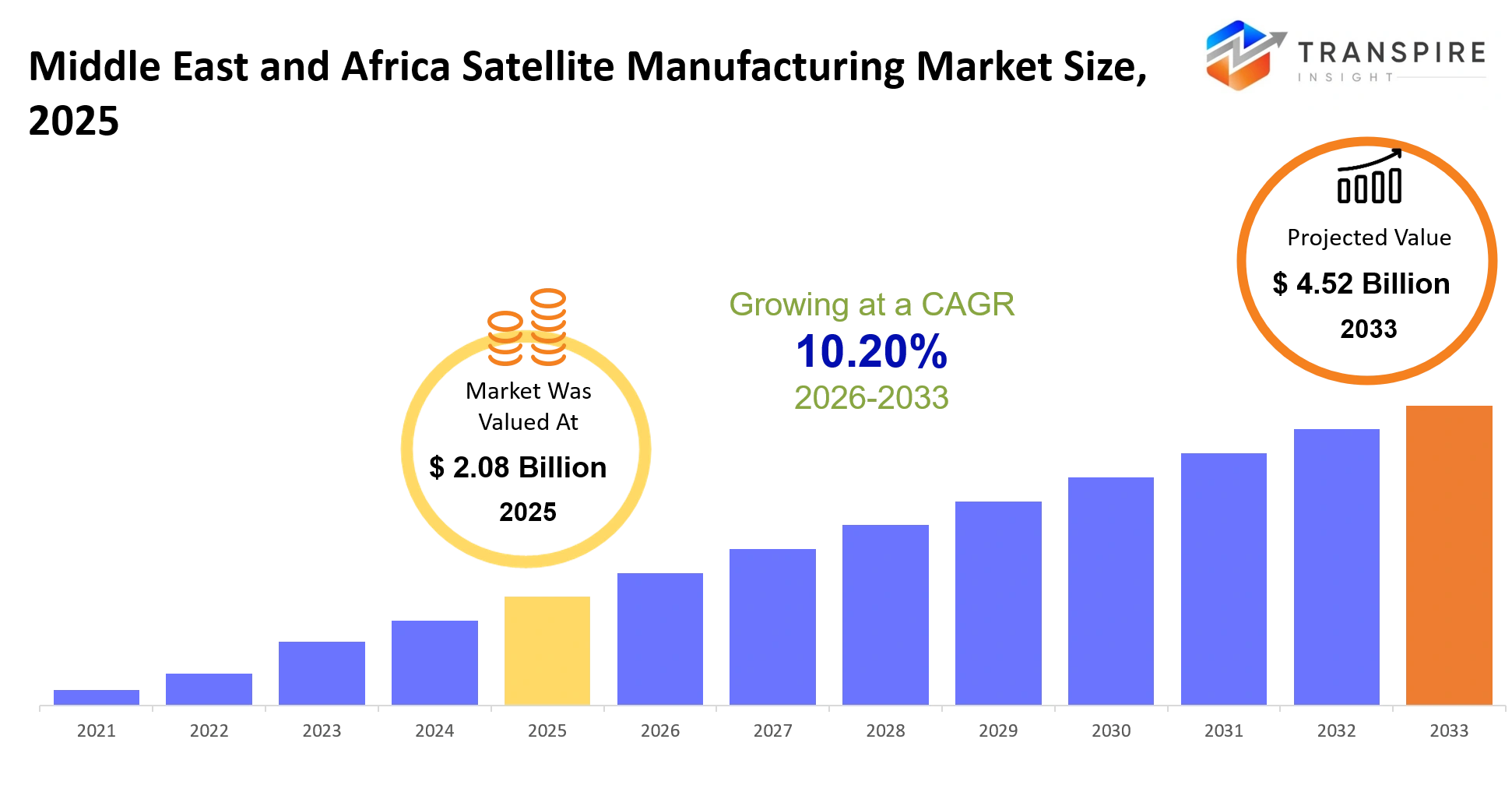
Middle East and Africa Satellite Manufacturing Market Summary
The Middle East and Africa Satellite Manufacturing Market was valued at USD 2.08 Billion in 2025. It is forecast to reach USD 4.52 Billion by 2033. That is a CAGR of 10.20% over the period.
The Middle East and Africa Satellite Manufacturing Market has a big part in boosting communications, Earth observation, guidance, defense monitoring, and remote connectivity in places where building terrestrial infrastructure is often limited or just too expensive to get going. Satellites assist ministries, defense organizations, telecom operators, and private companies deliver more dependable services across wide deserts, offshore areas and far away settlements.
In the last five years , the market kind of moved away from depending on big high cost satellite platforms, and instead leaned toward smaller, quicker satellites that can be assembled and put in orbit sooner. That shift lowered the entry barriers and let regional space initiatives speed up domestic satellite programs. There was also a visible push after rising geopolitical tensions and security worries, governments then started to fortify sovereign space abilities , and to pour money into independent monitoring and communication resources. With that, funding is no longer only centered on defense , it is also spreading into commercial and civil schemes. This wider spending pool is opening up fresh manufacturing opportunities, improving technology transfer and even helping the regional satellite value chain build steadier long term revenue.
Key Market Insights
- Satellites that observe the earth are the second most popular. People use them to check on resources, farms and the environment.
- Small satellites are becoming really popular too; they will be the growing type of satellite by 2033. This is because companies want satellites that're cheaper and can be put into space quickly.
- Communication services are the part of the market they will have about 42 percent of the revenue by 2025. This is because people need to be connected to the internet in remote areas.
- Defense and surveillance are also parts of the market. Countries use satellites to watch their borders and keep their people safe.
- Satellites that observe the earth are the growing type of application governments want to know more about the earth and its geography.
- Government and defense organizations are the users of satellites; they will have about 55 percent of the market by 2025. This is because they spend a lot of money on satellite programs.
- Companies that operate satellites for use are the second biggest users; they use satellites to provide services like broadband internet.
- Telecommunications companies are growing fast. They use satellites to provide the internet to people who do not have access to it otherwise.
- Some of the companies that make satellites are Airbus, Thales Alenia Space, Boeing, Lockheed Martin, Northrop Grumman and Maxar Technologies.
- These companies are doing well because they make satellites that're affordable, can be made quickly and work really well.
What are the Key Drivers, Restraints, and Opportunities in the Middle East and Africa Satellite Manufacturing Market?
Driver
The biggest push that accelerates the Middle East and Africa Satellite Manufacturing Market is basically this drive for sovereign space capabilities and dependable secure communications setups. Many governments across the area have started to see that leaning on foreign satellite systems brings real weak points , especially for defense, telecoms, and Earth observation work. That awareness seems to have kicked off major funding for home-grown satellite efforts , new manufacturing sites, and various space technology partnerships. Meanwhile, improvements in small satellite design have made the whole process less expensive and the production timeline shorter. So satellite rollout is getting more and more practical, financially speaking. All of this is showing up in higher contract values for manufacturers, longer order backlogs, and more involvement from regional suppliers.
Restraint
The main thing that still holds the market back is the lack of advanced manufacturing infrastructure and specialized aerospace know how. Making satellites depends on precision engineering, very skilled technical staff, testing environments and also reliable access to sophisticated electronic parts. But setting up those capabilities takes years of investment and careful knowledge transfer. So the issue feels more structural than temporary. Because of that, a lot of initiatives keep relying on outside technology vendors, which in turn stretches development timelines and raises production costs. This reliance also makes market maturity slower, and it limits the revenue growth that could come from truly localized manufacturing.
Opportunity
A major opening is in the fast growth of low Earth orbit satellite constellations, for broadband connectivity ,and Earth observation services. Some African nations are also pushing their digital infrastructure plans, while private backers are more often funding space technology ventures. As launch costs come down, and as satellite miniaturization keeps improving , regional manufacturers can get involved by supplying components, subassemblies and even full small satellite platforms; this could kick off a new phase of commercial expansion and technical progress.
What Has the Impact of Artificial Intelligence Been on the Middle East and Africa Satellite Manufacturing Market?
Artificial intelligence and advanced digital technologies are getting more and more important in the Middle East and Africa Satellite Manufacturing Market , as companies try to shorten the making period, boost mission dependability, and fine tune day to day operating results. You can see AI based automation showing up in satellite assembly, testing, and even in quality assurance tasks. Computer vision solutions can look at parts for defects with steadier consistency than humans doing it by hand, also digital twins let engineers model or rehearse satellite performance before launch , so there are fewer expensive design rewrites.
At the same time, machine learning models are strengthening predictive abilities across the entire satellite life. Manufacturers pull in sensor data from the production machinery to estimate when maintenance is needed and to limit surprise stoppages. After launch, AI algorithms work through telemetry information to anticipate component aging, manage and optimize power use, and upgrade satellite health stewardship. Because of this, operators can push mission duration further, use their assets more effectively , and keep operational costs under control.
On top of that, advanced analytics platforms help with supply chain efficiency, inventory roadmapping, and production sequencing, which basically supports quicker delivery for satellite programs. The overall outcome is better manufacturing productivity, enhanced reliability, and tougher adherence to mission performance requirements.
Still, one big constraint is the expensive effort required to integrate AI systems with existing aerospace manufacturing infrastructure. Also there is limited availability in the region of specialized datasets and AI experts, which can slow down rollout, and can lower model accuracy during the early deployment stretch.
Key Market Trends
- Since 2020 several Gulf countries have started to give money to making their own satellites and sharing technology instead of just buying them from other countries.
- This change is happening because manufacturers now prefer to make satellites and CubeSats.
- These smaller satellites can be made faster. Up to 50% quicker. Then the traditional big ones.
- Countries' defense agencies are investing more in satellites because of security worries in the region.
- This means they need satellites that can help with surveillance and secure communication.
- Now companies that make satellites are using intelligence to help process data on the satellite itself.
- This makes it possible to analyze data faster and not have to rely much on systems on the ground.
- In 2021 space agencies in the region started working with big companies like Airbus, Thales Alenia Space and Boeing.
- This way they are less affected by problems with getting semiconductors from around the world.
- These projects help with things like watching crops keeping an eye on borders and checking the environment
Middle East and Africa Satellite Manufacturing Market Segmentation
By Satellite Type
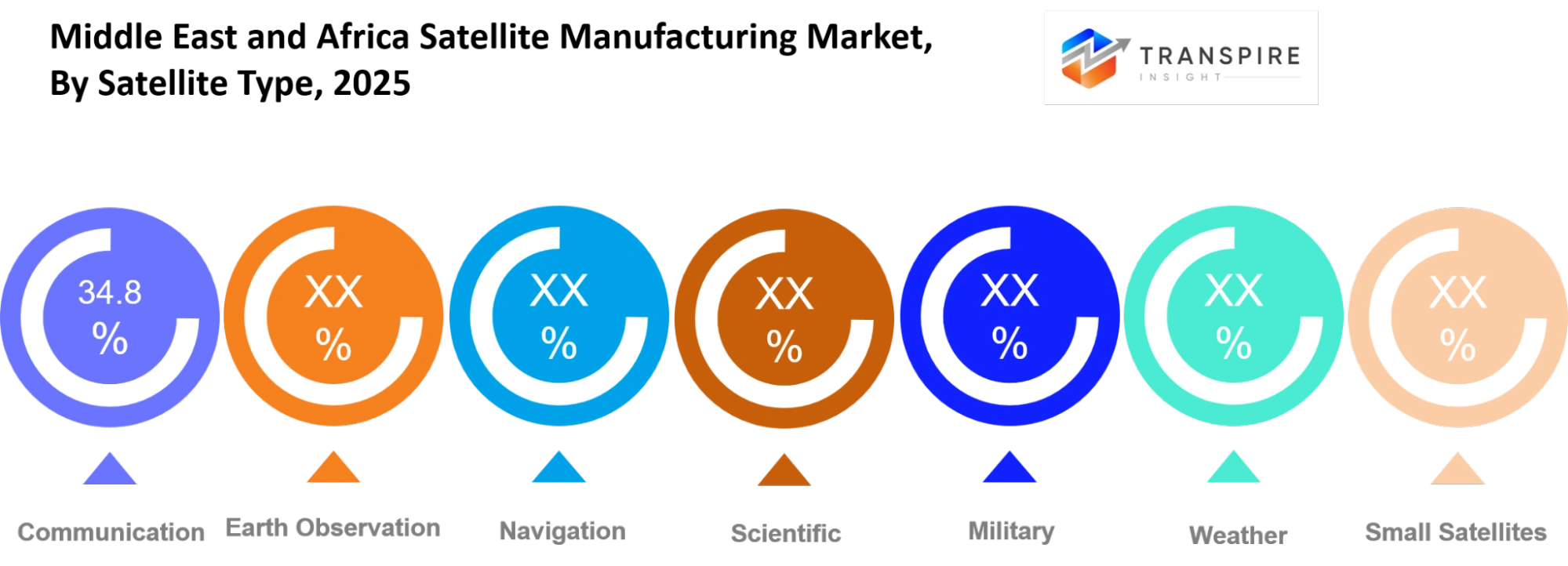
Communication satellites kinda hold a central place in regional space programs, mainly because reliable connectivity stays the priority even across those big geographic stretches. Ongoing investments in broadband coverage, secure government communications, and enterprise networks continue to back deployment activity, and honestly this part is still moving forward. Earth observation satellites also get a lot of attention, since they’re used for agriculture, environmental monitoring, resource management, and border surveillance.
Navigation, scientific, and weather satellites support those specialized missions that strengthen national infrastructure while also pushing research capabilities. Military satellites remain important, because defense organizations keep expanding intelligence, surveillance, and secure communication assets, but it’s not just one thing. Small satellites have gained strong momentum because lower manufacturing costs and shorter development cycles make deployment feel more accessible. Other satellite categories continue serving niche operational and research requirements, which ends up contributing to a more varied industry landscape, overall.
By Component
Payloads are a key area of value creation, because mission performance depends a lot on sensing, communication, and data collection capabilities. Antennas and solar panels remain essential for keeping communication links up, and for powering generation during the whole satellite lifecycle, yes. As mission complexity increases, manufacturers have been encouraged to develop more efficient and lighter component systems, step by step.
Propulsion systems keep moving forward, as operators try for more maneuverability and an extended operational life span. Avionics , of course, back up navigation and the command/ control functions, so reliability turns into this key design priority that nobody can really ignore. Meanwhile, structures plus batteries are getting ongoing attention too, to boost durability, cut down mass and generally lift mission performance overall. Other supporting bits kind of fill in the gaps as well—helping with system integration and operational efficiency across different satellite platforms, yes.
By Orbit
Low Earth Orbit satellites keep gaining attention, largely because lower launch costs and less latency help communication and observation missions run smoother. A lot of fresh constellations are aiming at LEO deployment, mainly to cover more ground and push faster data transmission. Sun-synchronous orbit platforms also stay quite relevant for Earth observation work, especially when the task needs consistent imaging conditions over time.
Medium Earth Orbit and Geostationary Earth Orbit systems are still important for navigation and communication services that require very wide area coverage. Polar orbit satellites support environmental monitoring and scientific research by enabling access to global observation data. Highly Elliptical Orbit missions cover specialized operational needs, particularly when geographic regions are difficult or unpredictable. Other orbital layouts still pop up as well, because they support distinct mission goals and some new, emerging applications that keep showing up.
By End User
Commercial organizations keep increasing their satellite investments to strengthen connectivity, data services and communication capabilities. Private sector involvement is growing too, partly because manufacturing costs keep trending down and launch services become more reachable. Also, business interest in Earth observation data, plus satellite-enabled applications, has stayed strong which keeps the market activity moving.
Government institutions are still major stakeholders, because national development programs basically lean on communications, navigation, and monitoring capabilities. Defense organizations invest a lot in secure communications , surveillance systems, and intelligence gathering assets, which back up their strategic objectives, you know. Research institutions and space agencies keep pushing forward with scientific exploration and technology development, along with innovation programs of their own. Then other end users add extra demand too, through specialized operational satellite applications, and industry specific ones as well.
What are the Key Use Cases Driving the Middle East and Africa Satellite Manufacturing Market?
Communication services still seem to be the main reason satellite manufacturing keeps moving across the region. Governments, telecommunications providers, and commercial operators depend on space assets to stretch connectivity out into far off deserts, offshore energy sites, and other areas that don’t get enough from terrestrial infrastructure. In practice this need keeps encouraging investment into new communication satellite development and actual deployment.
At the same time earth observation work is getting more traction, especially with government agencies and private organizations. For instance agricultural monitoring, water management, disaster assessment , and border security are more and more tied to satellite produced information. Defense groups are also leaning further into satellites for surveillance, intelligence collection, and secure communication tasks , sometimes in combinations that are hard to replicate any other way.
Now there are also emerging openings around low Earth orbit constellations and more advanced climate monitoring missions. Research groups and space agencies are looking at next generation satellites meant for near real time environmental analysis, improved planning for smart infrastructure, and more capable geospatial services. The whole set of use cases is still pretty early, but there’s a strong chance it grows over the long term as regional space capabilities mature.
|
Report Metrics |
Details |
|
Market size value in 2025 |
USD 2.08 Billion |
|
Market size value in 2026 |
USD 2.29 Billion |
|
Revenue forecast in 2033 |
USD 4.52 Billion |
|
Growth rate |
CAGR of 10.20% from 2026 to 2033 |
|
Base year |
2025 |
|
Historical data |
2021 - 2024 |
|
Forecast period |
2026 - 2033 |
|
Report coverage |
Revenue forecast, competitive landscape, growth factors, and trends |
|
Regional scope |
Middle East and Africa Satellite Manufacturing Market |
|
Key company profiled |
Airbus, Thales Alenia, Boeing, Lockheed Martin, Northrop Grumman, Maxar, Mitsubishi Electric, IAI, L3Harris, OHB, Ball Aerospace, SSTL, Sierra Space, Terran Orbital, CASC. |
|
Customization scope |
Free report customization (country, regional & segment scope). Avail customized purchase options to meet your exact research needs. |
|
Report Segmentation |
By Satellite Type: (Communication, Earth Observation, Navigation, Scientific, Military, Weather, Small Satellites, Others) | By Component: (Payloads, Solar Panels, Antennas, Propulsion, Avionics, Structures, Batteries, Others) | By Orbit: (LEO, MEO, GEO, Polar, SSO, HEO, Others) | By End User: (Commercial, Government, Defense, Research, Space Agencies, Others). |
Which Regions are Driving the Middle East and Africa Satellite Manufacturing Market Growth?
The Middle East kind of dominates the whole regional satellite manufacturing space because governments keep backing it heavily, there are long-running national space strategies, and domestic aerospace capability is getting serious funding . A lot of Gulf countries have also set up space agencies, research centers, and satellite development tracks , with the idea of supporting local production, not just importing everything . On top of that, defense modernization work and secure communication needs keep feeding fairly steady project pipelines. There’s also a decent ecosystem of international partnerships and technology transfer agreements, plus specialized infrastructure that, in practice, helps the region stay ahead.
North Africa is still the second most established contributor, but the growth path looks a bit different from the Gulf states . Here, market activity tends to get support from consistent public sector spending, more research programs, and continued cooperation with overseas aerospace organizations. Economic diversification is pushing broader participation in satellite work, and related technologies too. That kind of controlled approach builds a more stable setting, which supports ongoing manufacturing activity and makes revenue feel more reliable, overall.
Sub-Saharan Africa is now showing up as the fastest-growing region, especially as digital connectivity goals and Earth observation requirements receive more policy attention. Some countries have increased their space program investments to better handle agricultural monitoring, disaster response, and telecommunications coverage. Also, satellite development costs are coming down, while commercial launch services are more available, so barriers for new market entrants have softened. Between 2026 and 2033, the overall expansion should open room for manufacturers, component suppliers , and technology partners trying to join the satellite ecosystem as it develops further.
Who are the Key Players in the Middle East and Africa Satellite Manufacturing Market and How Do They Compete?
Competition in the Middle East and Africa satellite manufacturing sector is still, kind of moderately concentrated, and a select group of global aerospace companies tend to snag a big portion of the high value government, defense, and commercial wins. In practice, technology capability is the real yardstick for competition, especially when it comes to satellite payload performance, mission reliability, and manufacturing efficiency. Older, established manufacturers keep their grip via long-term institutional connections. Newer players, however, often try to squeeze into niches with smaller satellite platforms and more specialized mission needs. Overall, the playing field is shifting so that the companies that can mix manufacturing know-how with integration, launch support, and data service offerings seem to get rewarded more often.
Airbus leans into technology innovation by using flexible satellite platforms that can cover communication, Earth observation, and defense type missions. It differentiates largely through modular designs, so customers can reconfigure systems for different operational requirements. Thales Alenia Space, meanwhile, improves competitiveness through advanced payload technologies and what you might call real depth of experience in thorny space missions. Their expansion efforts frequently revolve around partnerships with regional space agencies and collaborative technology development programs. Those programs help build local capability, and, in some cases, make the adoption path easier.
Boeing puts emphasis on high performance communication and defense satellite systems for critical government and commercial use. Lockheed Martin holds an edge through secure military satellite technologies, plus mission specific solutions shaped around national security expectations. Maxar stands out with high resolution Earth observation capabilities and more advanced geospatial intelligence services.
Company List
- Northrop Grumman
- Maxar Technologies
- Mitsubishi Electric
- Israel Aerospace Industries (IAI)
- L3Harris Technologies
- OHB SE
- Ball Aerospace
- Surrey Satellite Technology Limited (SSTL)
- Sierra Space
- Terran Orbital
- China Aerospace Science and Technology Corporation (CASC)
Recent Development News
"In April 2026, Airbus Defence and Space, Thales Alenia Space, and RADMOR entered a strategic partnership to develop Poland’s sovereign defence telecommunications satellite. The agreement strengthens advanced satellite manufacturing capabilities and highlights continued investment in secure satellite infrastructure and defense-focused space programs.
Source: https://www.airbus.com
"In October 2025, Airbus, Leonardo, and Thales signed a memorandum of understanding to create a new European space player by combining selected satellite and space systems activities. The initiative aims to increase scale, improve competitiveness, and strengthen technological capabilities across satellite manufacturing and related space programs.
Source: https://www.thalesgroup.com
"In September 2025, Israel Aerospace Industries supported the launch of the Ofek 19 surveillance satellite for Israel’s defense sector. The deployment expanded regional Earth observation and intelligence-gathering capabilities while reinforcing demand for advanced satellite manufacturing technologies and high-performance payload systems.
Source: https://apnews.com
What Strategic Insights Define the Future of the Middle East and Africa Satellite Manufacturing Market?
Over the next five to seven years, the Middle East and Africa Satellite Manufacturing Market is slowly shifting into a more localized, sort of self-reliant and technologically independent setup. The main driver, behind all of this, is the rising strategic weight of sovereign space resources for communications, security, environmental tracking, and digital infrastructure progress. Market money is expected to move away from pure satellite purchasing and instead toward domestic design work, manufacturing routines, systems integration, and data-anchored service know-how.
There’s also a risk that is a bit harder to notice at first. It comes from still relying on imported, high-value pieces like advanced semiconductors, sensing systems, and propulsion know-how. Even if regional production grows, supply chain disruptions, or export limits could still push timelines out and raise production expenses. When so many critical technologies stay concentrated beyond the region, the industry may not be able to grow as fast as it otherwise could.
At the same time, an opportunity is beginning to show up, and it’s pretty interesting. Low Earth orbit satellite constellations, built specifically for African connectivity and geospatial intelligence needs, could gain momentum. As launch prices keep dropping and digital infrastructure programs keep expanding, demand for specialized small satellite platforms will likely pick up pace. Market players should consider partnerships that blend local manufacturing strength with deeper technology transfer, so they build sturdier long-term competitiveness while also reducing the usual supply chain exposure.
Middle East and Africa Satellite Manufacturing Market Report Segmentation
By Satellite Type
- Communication Satellites
- Earth Observation Satellites
- Navigation Satellites
- Scientific Satellites
- Military Satellites
- Weather Satellites
- Small Satellites
- Others
By Component
- Payloads
- Solar Panels
- Antennas
- Propulsion Systems
- Avionics
- Structures
- Batteries
- Others
By Orbit
- Low Earth Orbit (LEO)
- Medium Earth Orbit (MEO)
- Geostationary Earth Orbit (GEO)
- Polar Orbit
- Sun-Synchronous Orbit (SSO)
- Highly Elliptical Orbit (HEO)
- Others
By End User
- Commercial
- Government
- Defense
- Research Institutions
- Space Agencies
- Others
Frequently Asked Questions
Find quick answers to common questions.
The expected Middle East and Africa Satellite Manufacturing Market size for the market will be USD 4.52 Billion in 2033.
Key segments for the Middle East and Africa Satellite Manufacturing Market are Type By Satellite Type: Communication, Earth Observation, Navigation, Scientific, Military, Weather, Small Satellites, Others | By Component: Payloads, Solar Panels, Antennas, Propulsion, Avionics, Structures, Batteries, Others | By Orbit: LEO, MEO, GEO, Polar, SSO, HEO, Others | By End User: Commercial, Government, Defense, Research, Space Agencies, Others.
Major Middle East and Africa Satellite Manufacturing Market players areAirbus, Thales Alenia, Boeing, Lockheed Martin, Northrop Grumman, Maxar, Mitsubishi Electric, IAI, L3Harris, OHB, Ball Aerospace, SSTL, Sierra Space, Terran Orbital, CASC. give in points.
The Middle East and Africa Satellite Manufacturing Market size is USD 2.08 Billion in 2025.
The Middle East and Africa Satellite Manufacturing Market CAGR is 10.20% from 2026 to 2033.
- Airbus
- Thales Alenia Space
- Boeing
- Lockheed Martin
- Northrop Grumman
- Maxar Technologies
- Mitsubishi Electric
- Israel Aerospace Industries (IAI)
- L3Harris Technologies
- OHB SE
- Ball Aerospace
- Surrey Satellite Technology Limited (SSTL)
- Sierra Space
- Terran Orbital
- China Aerospace Science and Technology Corporation (CASC)
About the Authors

Tejashri Dhatrak
I am Tejashri Dhatrak, a Senior Research Analyst at Transpire Insight, specializing in the Aerospace and Defence sector. My work focuses on analyzing industry trends, defence technologies, market developments, and emerging innovations that shape the global aerospace and security landscape. At Transpire Insight, I research complex topics, evaluate credible sources, and transform technical insights into accurate, well-structured, and easy-to-understand content for industry professionals and decision-makers. My goal is to provide reliable, research-backed information that helps readers stay informed about defence capabilities, aerospace advancements, strategic developments, and the evolving dynamics of the global defence ecosystem.

Chakradhar Khansole
Chakradhar serves as the Research Director at Transpire Insight, bringing over 8 years of experience in technology, innovation, and strategic market intelligence. He specializes in transforming complex market data into actionable business insights that enable organizations to make informed, growth-oriented decisions. Recognized for his strategic vision and analytical expertise, Chakradhar leads high-impact research initiatives, delivering comprehensive market assessments, competitive intelligence, and forward-looking industry analysis.
Recently Published Reports
-
Apr 2026
Aerospace Fluoropolymers Market
Aerospace Fluoropolymers Market Size, Share & Analysis Report By Type (PTFE, FEP, PFA, ETFE, and Others), By Application (Electrical Insulation, Seals & Gaskets, Coatings, and Others), By End User (Commercial Aviation, Military Aviation, General Aviation, and Others), and Geography (North America, Europe, Asia-Pacific, Middle East and Africa, South and Central America), 2021 - 2031
-
Apr 2026
Airborne SATCOM System Market
Airborne SATCOM System Market Size, Share & Analysis Report By Type (SATCOM Terminals, Transceivers, Airborne Radio, Modems and Routers, SATCOM Radomes, and Other), By Application (Government and Defense and Commercial), and Geography (North America, Europe, Asia-Pacific, Middle East and Africa, South and Central America), 2021 – 2031
-
Apr 2026
Ship Leasing Market
Ship Leasing Market Size, Share & Analysis Report By Vessel Type (Container Ships, Bulk Carriers, Tankers, and Specialized Vessels), By Lease Duration (Short-Term Lease (Less than 1 year), Medium-Term Lease (1-5 years), and Long-Term Lease (More than 5 years)), By Lease Type (Bareboat Charter, Time Charter, Financial Lease, and Others), By End-User Industry (Oil and Gas, Manufacturing and Industrial, Automotive, Agriculture and Food, Retail and Consumer Goods, and Others), and Geography (North America, Europe, Asia-Pacific, Middle East and Africa, South and Central America), 2021 – 2031
-
Apr 2026
Thread Rolling Dies Market
Thread Rolling Dies Market Size, Share & Analysis Report By Type (Flat Thread Rolling Dies, Circular (Cylindrical) Dies, Tangential Thread Rolling Dies, Planetary Thread Rolling Dies, and Other Types), By Material Type (High-Speed Steel (HSS), Carbide, Tool Steel, Alloy Steel, and Other Specialized Alloys), By Distribution Channel (Direct Sales, Distributors and Dealers, and Online Platforms), By Application (Automotive Industry, Aerospace and Defense, Construction and Infrastructure, Industrial Machinery, Electronics and Electrical Components, Medical Devices, and Fastener Production), and Geography (North America, Europe, Asia-Pacific, Middle East and Africa, South and Central America), 2021 – 2031
Our Clients