
Middle East and Africa Solar Panel Market Size & Forecast:
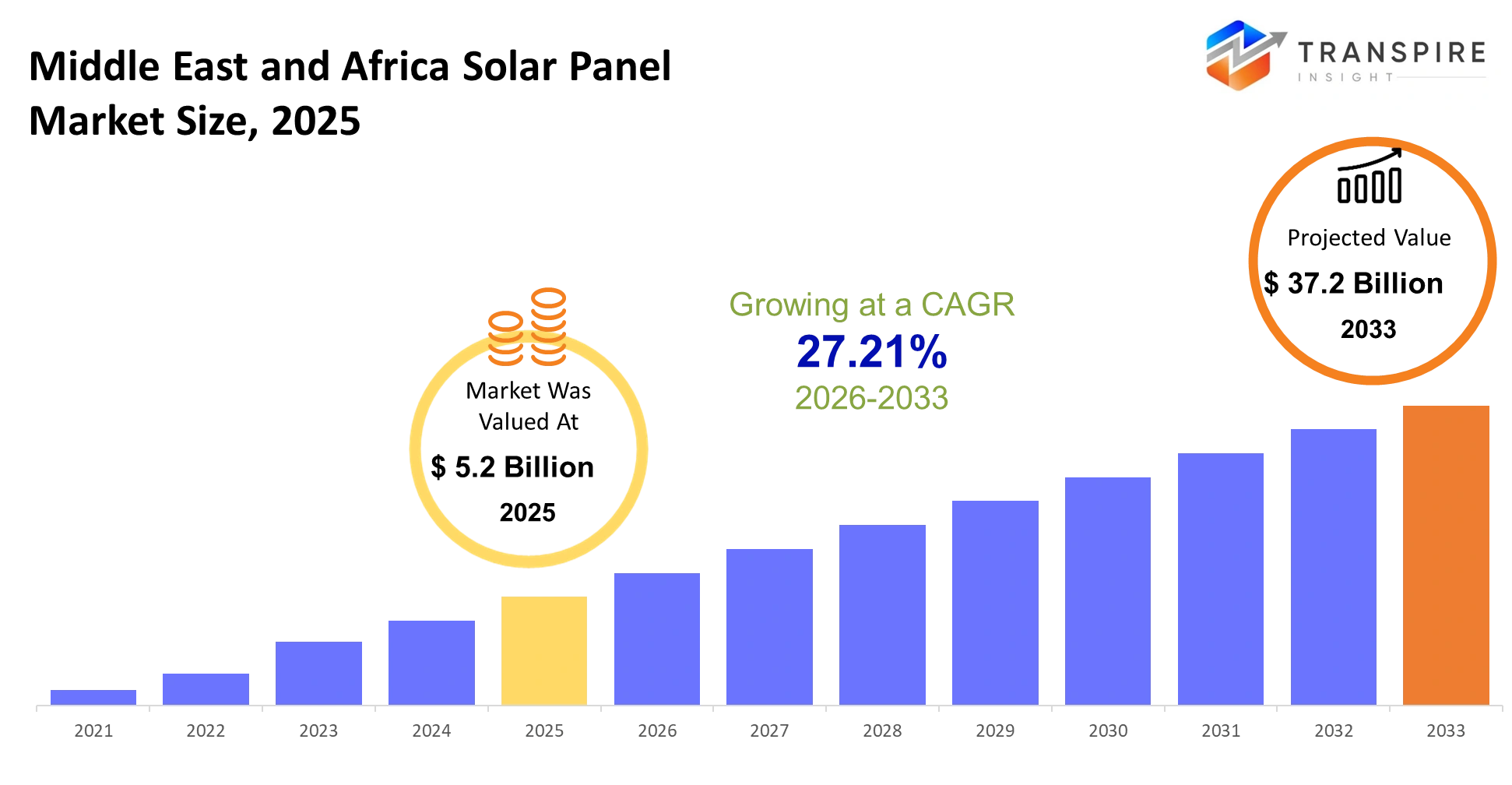
- Middle East and Africa Solar Panel Market Size 2025: USD 5.4 Billion
- Middle East and Africa Solar Panel Market Size 2033: USD 37.2 Billion
- Middle East and Africa Solar Panel Market CAGR: 27.21%
- Middle East and Africa Solar Panel Market Segments: By Type (Monocrystalline, Polycrystalline, Thin Film, Others); By Application (Residential, Commercial, Utility-scale, Industrial, Others); By End-User (Households, Businesses, Utilities, Government, Industrial Firms, Others); By Component (Modules, Inverters, Batteries, Others)
To learn more about this report,  Download Free Sample Report
Middle East and Africa Solar Panel Market Summary
The Middle East and Africa Solar Panel Market was valued at USD 5.4 Billion in 2025. It is forecast to reach USD 37.2 Billion by 2033. That is a CAGR of 27.21% over the period.
The Middle East and Africa solar panel market is kind of reshaping the way utilities, industrial operators, and commercial facilities get electricity in places where grid instability, fuel import dependence, and extreme daytime cooling demand put pressure on the traditional power systems. Solar deployments are now showing up across mining sites, desalination plants, logistics hubs, telecom towers, and big city developments that want more predictable long run energy costs, plus stronger energy security.
Over the last five years, the whole market has moved away from subsidy-led pilot runs towards utility scale and corporate procurement approaches backed by competitive auctions, and private power purchase agreements . This change picked up speed when energy price volatility, linked to the Russia-Ukraine conflict, highlighted the financial exposure of sticking to imported fossil fuels. Governments across Saudi Arabia, the UAE, South Africa, and Egypt have responded by pushing renewable targets further, and also ramping up grid investment programs. With panel costs down, and financing structures getting steadier, developers started to push bigger projects into execution. That, in turn, improved project bankability, and it is helping spread adoption among both industrial and commercial end users.
Key Market Insights
- The Gulf Cooperation Council region kind of dominated the Middle East and Africa Solar Panel Market, holding close to 48% market share in 2025.
- Saudi Arabia and the UAE seem to lead regional solar industry size, mainly via giga-scale renewable projects ,and national energy diversification playbooks too.
- Africa is showing up as the fastest-growing regional market during the 2025–2030 forecast window ,because rural electrification and mining-sector demand keep pulling on capacity.
- South Africa also logged notable solar panel market growth after energy shortages nudged private-sector renewable investments into more commercial facilities.
- For module type, monocrystalline solar panels stayed on top in the Middle East and Africa Solar Panel Market ,with over 62% revenue share in 2025.
- Polycrystalline modules are still second in line, largely because they’re cost-effective for deployment across public infrastructure and utility projects.
- Thin-film solar technology is projected as the fastest-growing segment through 2030, since it brings strong high-temperature performance in desert climates.
- On applications, power generation dominated, taking roughly 58% market share in 2025 ,tied to large-scale grid integration efforts.
- Commercial and industrial rooftop installations actually posted the quickest growth pace, as manufacturers tried reducing dependence on diesel-based electricity systems.
- Utilities continued as the leading end-user group, with more than 50% share of regional solar panel demand in 2025 .
What are the Key Drivers, Restraints, and Opportunities in the Middle East and Africa Solar Panel Market?
In the Middle East and Africa Solar Panel Market, the most powerful push behind growth is basically the rapid drop in solar electricity generation costs, plus a pretty determined push for energy diversification, at national level. So places like Saudi Arabia, the UAE, and Egypt, they widened competitive renewable energy auctions after oil price volatility made the financial danger of relying on fossil fuels much more visible. Now, utility scale solar projects are managing to deliver electricity at lower overall costs than gas-fired generation, in a number of nearby markets. That change in pricing has been reshaping how utilities, industrial operators, and commercial developers buy power. Even large mining firms, desalination facilities, and manufacturing sites are signing longer term solar power agreements, mainly to keep operating expenses steadier, which in turn backs up project revenues and adds momentum to installation volumes.
Still, grid infrastructure limitations stay the biggest structural obstacle, and it’s what keeps broader market expansion from happening across Africa and in parts of the Middle East. Quite a lot of transmission networks don’t have enough headroom to absorb intermittent renewable output coming from big solar installations, especially when those sites sit far from where urban demand is concentrated. Upgrading substations, transmission corridors, and storage frameworks needs investments in the multi billion-dollar range, and it also tends to come with long regulatory timelines. Because of that, some projects that were already approved end up with commissioning delays, limited power offtake, or lower-than-expected generation capacity which then reduces revenue capture for developers and slows down deployment across the region.
Opportunity is pretty clear when you look at hybrid solar-plus-storage systems , they seem to be the most obvious path for the next growth stage in the regional solar business. Battery costs have dropped a lot, so utilities and industrial users can tackle the intermittency issue while also making grid reliability better. South Africa is a solid example too, persistent power shortages sort of pushed investment in commercial solar that is then paired with battery energy storage systems.
What Has the Impact of Artificial Intelligence Been on the Middle East and Africa Solar Panel Market?
Artificial intelligence and advanced digital technologies are slowly changing the way solar assets are watched, run, and cared for across the Middle East and Africa. Utility operators more and more use AI powered energy management platforms to automate how panel performance is tracked, how inverter balancing is handled, and how grid load is tuned across bigger photovoltaic sites. In desert areas like Saudi Arabia and the UAE, computer vision systems can now spot dust buildup, and even signs of panel degradation in near real time. This enables automated cleaning routines, which can raise energy yield and curb that extra water usage that honestly adds up fast.
Machine learning models also back predictive maintenance. They do this by looking at weather inputs, temperature shifts , voltage irregularities, and equipment vibration signatures. In practice, these systems can flag likely inverter failures or panel efficiency losses before any breakdown happens, so operators are able to cut unplanned downtime, and improve overall plant availability. A few utility-scale deployments also report tangible operational wins from AI based forecasting tools. Those tools tend to make solar generation estimates more precise, which helps the grid stay stable while integration proceeds. Better forecasting also reduces curtailment exposure and supports smarter battery storage dispatch, bringing operating costs down for both developers and utilities.
Still, AI uptake doesn’t move evenly everywhere, there are structural constraints in parts of Africa and the Middle East. A lot of solar sites run in areas with patchy digital infrastructure, limited sensor connectivity , and not enough historical performance records. Because of that, forecasting quality drops, and overall system integration expenses climb.
Key Market Trends
- Since 2021, Saudi Arabia and the UAE kind of accelerated giga scale solar auctions, pushing renewable electricity tariffs down below several gas fired generation costs in the region, not always by much but enough to matter.
- Monocrystalline modules replaced polycrystalline setups across the big projects after efficiency jumps—over 22%—started holding up even under high temperature operating conditions, by 2025.
- South African manufacturers and mining operators went harder on rooftop solar installs after recurring grid outages messed with industrial output, between 2022 and 2025 and yes it was disruptive.
- Chinese suppliers, including JinkoSolar and LONGi Green Energy Technology , expanded their local partnerships so they could lock in long term utility procurement agreements, basically better certainty for years ahead.
- Developers also began weaving in battery storage into solar projects, because lithium ion system costs eased by nearly 40% worldwide from 2020 through 2025.
- African governments then adjusted procurement rules toward private power purchase deals , so commercial users could step around financially constrained public utilities after 2023.
- More desert based solar developments started relying on robotic panel cleaning systems too, cutting water use and minimizing operational delays across Gulf utility scale plants since 2024.
- Meanwhile industrial operators gradually swapped diesel captive generation for hybrid solar solutions, because fuel import volatility kept lifting operating expenses at remote sites.
- Regional developers moved module assembly and component sourcing closer to Gulf markets after pandemic era shipping disruptions made supply chain concentration risks very obvious.
- And utilities between 2023 and 2026 increasingly used AI forecasting platforms, to help grid balancing, reduce curtailment of renewable power, and keep dispatch more stable overall.
Middle East and Africa Solar Panel Market Segmentation
By Type
Monocrystalline panels hold the leading position across regional installs, largely because their conversion efficiency stays higher and they keep performing better when things get extreme, like very hot weather. Utility developers and industrial operators now lean more toward monocrystalline technology for big scale projects, mainly since land availability and output optimization, they basically decide the economics. Production costs have been dropping since 2021 , and that momentum helped adoption across Saudi Arabia, the UAE, and South Africa, where high capacity installations are expected to run long operational lifecycles, with steady energy yields.
Polycrystalline modules stay in a solid secondary slot, because public infrastructure projects and budget-sensitive buyers still prioritize lower upfront procurement costs. Thin film technology represents a smaller slice of the total share, though there is continuing growth potential, especially for desert applications where heat resistance plus lighter installation steps can matter a lot. Product manufacturers are also putting more effort into advanced cell architectures and bifacial technologies, so competition will likely intensify and efficiency-focused buying decisions should accelerate throughout the forecast window.
By Application
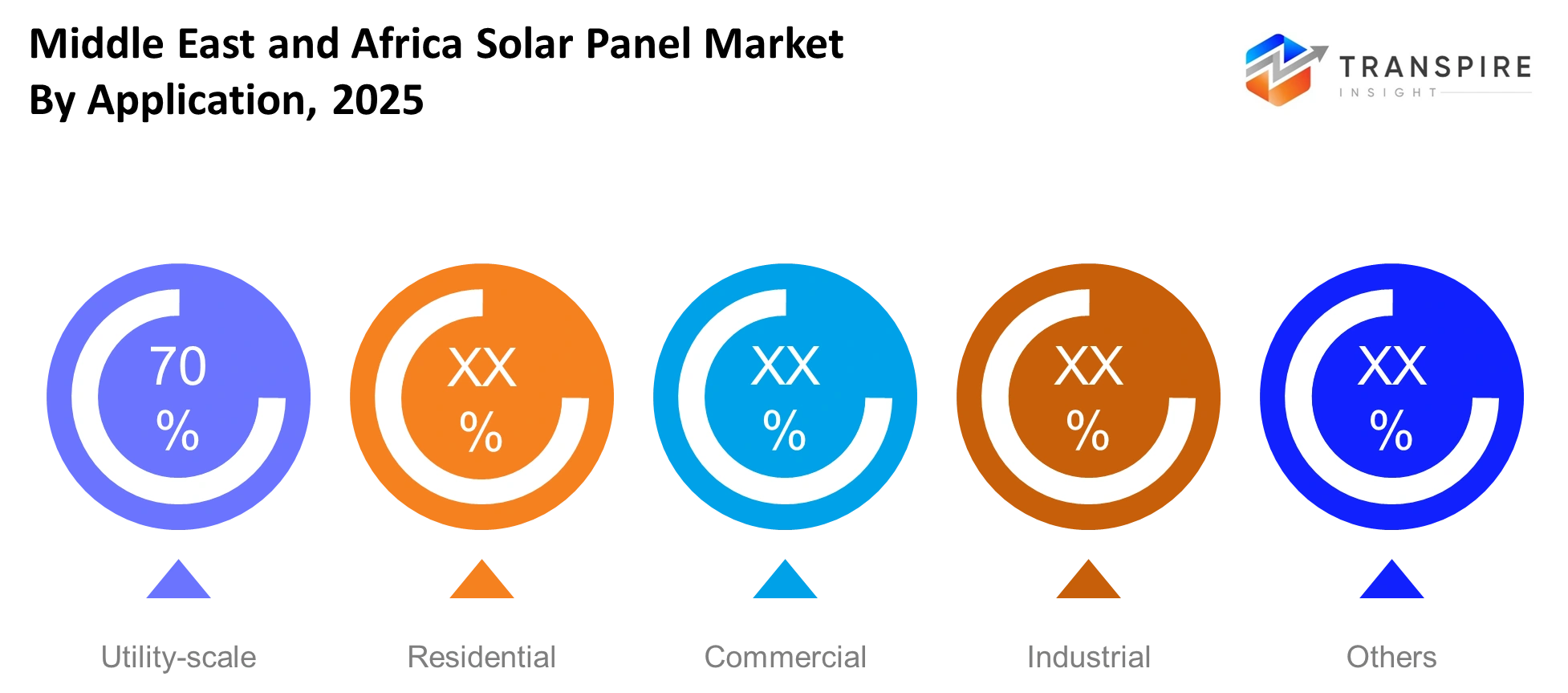
Utility scale installations dominate regional deployment because governments keep expanding renewable generation capacity through competitive auctions, and long term power purchase agreements. Large solar parks across Gulf countries and North Africa keep driving substantial procurement volumes for high capacity photovoltaic systems. Industrial facilities and mining operations also add meaningful demand, since energy intensive sectors look for better protection from fuel price volatility and the reality of unstable grid supply.
Commercial rooftop systems kinda represent the fastest moving application segment, mostly because electricity tariffs are rising and people are concerned with operational reliability, you know, in a practical sense. Shopping centers, logistics hubs, and manufacturing facilities are increasingly using distributed solar setups to keep long-term operating expenses more predictable. Residential adoption is still slower though, since financing access and grid interconnection rules vary quite a bit between regions. During the forecast period battery integrated rooftop systems, plus hybrid commercial configurations, are expected to pull stronger demand for adaptable energy control and decentralized electricity supply.
To learn more about this report, Download Free Sample Report
By End-User
Utilities have the largest share of solar procurement because national energy transition programs keep emphasizing grid-scale renewable capacity additions. State-backed utilities across the Gulf and North Africa back long-run infrastructure investments via renewable procurement commitments, and also through international financing partnerships. Industrial firms are another important end-user group, mainly due to added pressure to manage energy spending and reduce diesel reliance in off-site or remote production locations.
Businesses and commercial property operators are ramping up solar uptake as power reliability is becoming a real day-to-day operational worry. Government agencies keep expanding renewables across airports, transport corridors, and public facilities to align with national sustainability strategies. Home adoption is smaller but it’s gradually improving in urban areas where rooftop financing initiatives and net metering policies are broadening. Equipment suppliers and project developers will likely tailor financing schemes and storage-adjacent solutions toward dec, or at least more towards that direction, as the market matures.
By Component
Modules are basically the key component category here, mainly because photovoltaic panels take up most of the total project procurement spend. Ongoing gains in cell efficiency, durability, and temperature endurance have… you know, basically pushed module demand upward for utility-scale projects and also industrial setups. More manufacturers are leaning into high efficiency monocrystalline, and bifacial offerings, since they tend to raise output performance, even in high radiation conditions that are common across Gulf areas and parts of Africa.
Meanwhile, inverters and battery systems are getting more strategic weight as renewable integration rules keep getting harder. Grid operators and commercial customers are asking for advanced inverters, they want voltage stability features, remote monitoring, and basically smart grid compatibility, too. Battery installation also picked up pace once concerns around power reliability got louder, and that increased the appetite for energy storage across industrial and commercial sites. Through the forecast window, combined solar plus storage configurations, along with AI enabled energy management tools, should open better chances for companies that focus on system optimization and long duration energy resilience, overall.
What are the Key Use Cases Driving the Middle East and Africa Solar Panel Market?
Utility-scale electricity generation is still basically the main reason solar panel deployment keeps going across the Middle East and Africa. National utilities in Saudi Arabia , the UAE , Egypt, and Morocco are still pushing ahead with big photovoltaic parks, to lower the costs of gas-fired generation and to back up longer-term energy security. Big procurement programs also keep creating meaningful pull for high-efficiency modules , plus inverters and the whole grid integration set up.
Commercial and industrial uses are growing fast too, especially around mining operations , logistics hubs, cement plants and manufacturing sites. Companies are increasingly putting in rooftop or hybrid solar systems—mostly to cut down exposure to fuel price swings and to deal with repeat grid outages. And telecom tower operators in Sub-Saharan Africa, they’ve also sped up off-grid solar adoption to reduce diesel burn and to keep operations steadier in remote areas.
Newer applications are showing up as well, like solar-powered desalination facilities and battery-integrated smart infrastructure projects. There are also green hydrogen production hubs in Saudi Arabia and the UAE, and those look like a developing angle as governments pour money into export-oriented clean energy ecosystems, and into long-duration renewable power capacity.
|
Report Metrics |
Details |
|
Market size value in 2025 |
USD 5.4 Billion |
|
Market size value in 2026 |
USD 6.9 Billion |
|
Revenue forecast in 2033 |
USD 37.2 Billion |
|
Growth rate |
CAGR of 27.21% from 2026 to 2033 |
|
Base year |
2025 |
|
Historical data |
2021 - 2024 |
|
Forecast period |
2026 - 2033 |
|
Report coverage |
Revenue forecast, competitive landscape, growth factors, and trends |
|
Regional scope |
Middle East and Africa (Saudi Arabia, United Arab Emirates, South Africa, Rest of Middle East and Africa) |
|
Key company profiled |
JinkoSolar, Trina Solar, Canadian Solar, First Solar, LONGi, JA Solar, SunPower, REC Group, Hanwha Q Cells, Sharp, Panasonic, Tata Power Solar, Vikram Solar, Risen Energy, Enphase |
|
Customization scope |
Free report customization (country, regional & segment scope). Avail customized purchase options to meet your exact research needs. |
|
Report Segmentation |
By Type (Monocrystalline, Polycrystalline, Thin Film, Others); By Application (Residential, Commercial, Utility-scale, Industrial, Others); By End-User (Households, Businesses, Utilities, Government, Industrial Firms, Others); By Component (Modules, Inverters, Batteries, Others) |
Which Regions are Driving the Middle East and Africa Solar Panel Market Growth?
The Gulf region kinda leads the Middle East and Africa solar panel market, in a way, because many national governments keep treating renewable energy as some long-term economic diversification plan, not really as a quick energy fix. Saudi Arabia and the UAE expanded utility-scale procurement with state-backed auctions, sovereign investment funds,and even policies that make land easier to allocate. At the same time strong transmission infrastructure , high solar irradiation, plus access to international project financing, keeps enabling bigger photovoltaic developments all across the region. On top of that, local manufacturing initiatives, grid modernization efforts, and partnerships with global suppliers also nudge the regional ecosystem into a stronger shape, and keep those large project pipelines moving.
North Africa is still a fairly steady contributor to regional solar revenue, largely because energy policy frameworks lean hard into export-driven electricity generation and long-range infrastructure planning. Egypt and Morocco continue drawing international developers, mainly through organized renewable procurement arrangements and cross-border energy partnerships with Europe. But unlike the Gulf, North African growth depends more on juggling domestic electricity demand alongside industrial expansion, plus transmission interconnectivity projects. Because regulators implement rules in a consistent manner, and multilateral financing remains available, investors get a bit more predictability for utility operators and infrastructure developers.
Sub-Saharan Africa, meanwhile, shows the quickest momentum, mostly tied to electrification programs speeding up, ongoing grid instability, and the rapid uptake of decentralized energy systems.South Africa experienced a major investment surge after recurring power shortages pushed businesses and industrial operators toward private solar procurement after 2022. Mining companies, telecom operators, and manufacturing facilities increasingly deploy hybrid solar-plus-storage systems to secure reliable electricity supply in remote locations. This growth momentum creates substantial opportunities for equipment suppliers, storage providers, and project financiers targeting distributed energy infrastructure between 2026 and 2033.
Who are the Key Players in the Middle East and Africa Solar Panel Market and How Do They Compete?
Competition across the Middle East and Africa solar panel market is still pretty moderately consolidated on the utility-scale side, while on the distributed and commercial side you see more and more involvement from regional engineering firms and newer technology providers, yes. Chinese manufacturers keep leaning on aggressive pricing and vertically integrated production models, basically that lowers procurement costs for developers and makes it easier for everyone to bid fast. Lately the fight is less “just price” and more about efficiency performance, financing flexibility, localized technical support, and whether a supplier can actually execute projects in high temperature desert environments without drama. On top of that regional governments seem to prefer vendors that can back domestic manufacturing aspirations, handle grid integration requirements, and also offer long-term service agreements that don’t feel like a short-lived promise.
JinkoSolar stays competitive by combining large-scale manufacturing efficiency with strong pricing leverage, so utility developers can trim project capex across Gulf and African markets. It also keeps expanding regional partnerships with engineering and procurement contractors, so it gets tighter access to government-backed renewables. LONGi Green Energy Technology differentiates with high efficiency monocrystalline and bifacial modules, built with extreme heat conditions in mind. Their push and investment in N-type cell technology supports better energy yield, which has helped them win major utility deals in Saudi Arabia and the UAE, despite the usual contracting pressure.
First Solar leans into thin-film photovoltaic technology that works well in hot climates and in dusty operating setups that are common across the region. That specialization gives it a real edge for desert-based utility projects, because temperature tolerance ends up influencing long-term output more than people think, especially after the first couple years.Trina Solar continues expanding through integrated solar-plus-storage solutions and smart energy management systems tailored for commercial and industrial users. Canadian Solar strengthened regional market presence through battery storage partnerships and hybrid energy projects targeting mining operators and remote industrial facilities across Sub-Saharan Africa.
Company List
- JinkoSolar
- Trina Solar
- Canadian Solar
- First Solar
- LONGi
- JA Solar
- SunPower
- REC Group
- Hanwha Q Cells
- Sharp
- Panasonic
- Tata Power Solar
- Vikram Solar
- Risen Energy
- Enphase
Recent Development News
In May 2026, JinkoSolar secured a strategic 2GW module supply agreement with Masdar for Abu Dhabi’s round-the-clock renewable energy project. The deal strengthens utility-scale solar deployment in the Gulf and expands demand for high-efficiency Tiger Neo modules integrated with large battery storage infrastructure. https://www.saudigulfprojects.com
In March 2026, LONGi Green Energy Technology secured photovoltaic module orders exceeding 1.3GW during a renewable energy exhibition in South Africa. The agreement strengthened LONGi’s position in the African utility-scale solar sector and accelerated adoption of high-efficiency N-type photovoltaic technology across large infrastructure projects. https://www.energytrend.com
What Strategic Insights Define the Future of the Middle East and Africa Solar Panel Market?
The Middle East and Africa solar panel market is kinda moving fast toward integrated energy ecosystems, that combine photovoltaics generation, battery storage, smart grid management, and industrial electrification. Energy security worries, grid instability, and those longer-horizon fuel diversification plans will still be pushing this change over the next five to seven years. In the Gulf, economies are expected to speed up utility-scale rollouts, while in Africa many buyers lean more toward decentralized solar plus storage setups, basically skipping weaker transmission links.
There’s also a less visible kind of risk that doesn’t get as much attention, supply chain concentration around a fairly small club of Asian module and inverter manufacturers. If developers keep relying on imported photovoltaic parts, the whole region can get hit by trade restrictions, shipping headaches, and sudden pricing swings, which could slow down big infrastructure efforts or squeeze developer margins. Meanwhile, green hydrogen production that ties to dedicated solar generation capacity is starting to look like a meaningful long-term opening, especially in Saudi Arabia, Egypt, and Morocco where export-focused clean energy investments are picking up momentum.
So market participants should place emphasis on localized partnerships, regional assembly operations, and storage integrated project models, because that helps resilience and also helps secure steady procurement pathways for the future.
Middle East and Africa Solar Panel Market Report Segmentation
By Type
- Monocrystalline
- Polycrystalline
- Thin Film
- Others
By Application
- Residential
- Commercial
- Utility-scale
- Industrial
- Others
By End-User
- Households
- Businesses
- Utilities
- Government
- Industrial Firms
- Others
By Component
- Modules
- Inverters
- Batteries
- Others
Frequently Asked Questions
Find quick answers to common questions.
The Middle East and Africa Solar Panel Market size is USD 37.2 Billion in 2033.
Key segments for the Middle East and Africa Solar Panel Market are By Type (Monocrystalline, Polycrystalline, Thin Film, Others); By Application (Residential, Commercial, Utility-scale, Industrial, Others); By End-User (Households, Businesses, Utilities, Government, Industrial Firms, Others); By Component (Modules, Inverters, Batteries, Others).
Major Middle East and Africa Solar Panel Market players are JinkoSolar, Trina Solar, Canadian Solar, First Solar, LONGi, JA Solar, SunPower, REC Group, Hanwha Q Cells, Sharp, Panasonic, Tata Power Solar, Vikram Solar, Risen Energy, Enphase.
The Middle East and Africa Solar Panel Market size is USD 5.4 Billion in 2025.
The Middle East and Africa Solar Panel Market CAGR is 27.21% from 2026 to 2033.
- JinkoSolar
- Trina Solar
- Canadian Solar
- First Solar
- LONGi
- JA Solar
- SunPower
- REC Group
- Hanwha Q Cells
- Sharp
- Panasonic
- Tata Power Solar
- Vikram Solar
- Risen Energy
- Enphase
Recently Published Reports
-
Apr 2026
Active Power Filter Market
Active Power Filter Market Size, Share & Analysis Report By Type (Shunt Active Power Filters, Series Active Power Filter, Hybrid Active Power Filter), By Application (Harmonics Mitigation, Reactive Power Compensation, Voltage Regulation, Power Factor Correction), By Phase (Single Phase, Three Phase), By End-User Industry (Manufacturing, Healthcare, Commercial, Automotive, Oil and Gas, Others), and Geography (North America, Europe, Asia-Pacific, Middle East and Africa, South and Central America), 2021 - 2031
-
Apr 2026
Electrical Transformer Market
Electrical Transformer Market Size, Share & Analysis Report By Core (Closed, Shell, and Berry), By Insulation (Gas, Oil, Solid, Air, and Other), By Phase (Single, and Three), By Rating (100 MVA to 500 MVA, 501 MVA to 800 MVA, and 801 MVA to 1200 MVA), and Geography (North America, Europe, Asia-Pacific, Middle East and Africa, South and Central America), 2021 – 2031
-
Apr 2026
Hydraulic Piston Pumps Market
Hydraulic Piston Pumps Market Size, Share & Analysis Report By Type (Axial Piston Pumps, Radial Piston Pumps), By Operating Pressure (Low Pressure, Medium Pressure, High Pressure), By Application (Construction, Mining, Agriculture, Automotive, Oil & Gas, Industrial Machinery, Others), By End-User (OEMs, Aftermarket), and Geography (North America, Europe, Asia-Pacific, Middle East and Africa, South and Central America), 2021 – 2031
-
Apr 2026
Laboratory Gas Generators Market
Laboratory Gas Generators Market Size, Share & Analysis Report By Product (Nitrogen Gas Generator, Hydrogen Gas Generator, Zero Air Gas Generator, Purge Gas Generator, TOC Gas Generators, Others), By Application (Gas Chromatography, Liquid Chromatography-mass Spectrometry (LC-MS), Gas Analyzers, Others), By End-user (Life Science, Chemical & Petrochemical, Food & Beverage, Others), and Geography (North America, Europe, Asia-Pacific, Middle East and Africa, South and Central America), 2021 – 2031