
Global Electric Propulsion Satellites Market Size & Forecast:
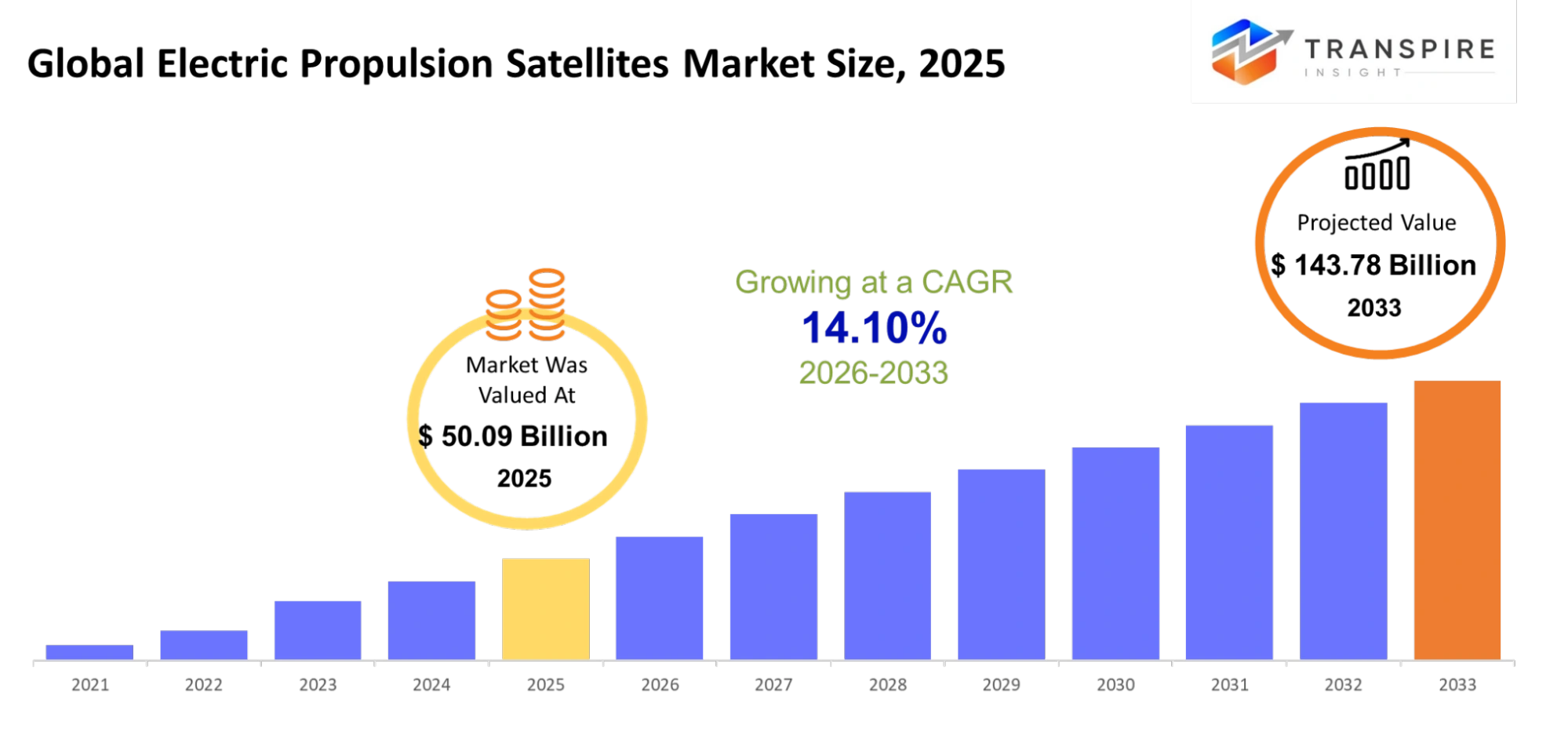
Global Electric Propulsion Satellites Market Size 2025: USD 50.09 Billion
· Global Electric Propulsion Satellites Market Size 2033: USD 143.78 Billion
· Global Electric Propulsion Satellites Market CAGR: 14.10%
· Global Electric Propulsion Satellites Market Segments: By Propulsion Type (Electrothermal, Electrostatic, & Electromagnetic Propulsion), By Satellite Type (Small Satellites, Medium Satellites, Large Satellites), By Orbit (Low Earth Orbit, Medium Earth Orbit, Geostationary Orbit), By Application (Earth observation, Navigation, Communication, Weather monitoring), By End-User (Commercial, Government & Defense).
To learn more about this report,  Download Free Sample Report
Global Electric Propulsion Satellites Market Summary:
The Global Electric Propulsion Satellites Market size is estimated at USD 50.09 billion in 2025 and is anticipated to reach USD 143.78 billion by 2033, growing at a CAGR of 14.10% from 2026 to 2033. The market is witnessing strong momentum as satellite manufacturers and space agencies increasingly shift from traditional chemical propulsion systems to electric propulsion technologies due to their higher efficiency, reduced fuel consumption, and extended mission lifespans.
Electric propulsion systems enable satellites to carry less propellant while maximizing payload capacity, making them particularly suitable for modern satellite constellations and long-duration missions. The rapid expansion of commercial satellite deployments, especially for communication and Earth observation purposes, is significantly contributing to market growth.
In addition, advancements in miniaturization, power systems, and ion propulsion technologies are enabling wider adoption across small, medium, and large satellite platforms. Governments and private space companies are investing heavily in next-generation propulsion systems to improve orbital maneuverability, reduce operational costs, and enhance mission flexibility.
Key Market Trends & Insights:
- The increasing deployment of large-scale satellite constellations for global internet connectivity and Earth observation is significantly accelerating the demand for electric propulsion systems, as these systems provide efficient station-keeping, orbit raising, and longer operational lifespans compared to traditional propulsion technologies.
- Commercial space companies are rapidly adopting electric propulsion to reduce launch mass and overall mission costs, allowing them to deploy multiple satellites in a single launch while maintaining optimal performance and fuel efficiency over extended mission durations.
- Continuous advancements in ion thrusters, Hall-effect thrusters, and plasma propulsion technologies are enhancing thrust efficiency, reliability, and scalability, enabling their integration across different satellite sizes and mission requirements.
- Governments and defense organizations are increasingly investing in electric propulsion-based satellites to improve space situational awareness, navigation accuracy, and secure communication capabilities, particularly in geostationary and low Earth orbits.
- The growing trend toward reusable launch vehicles and cost-efficient space missions is further driving the adoption of electric propulsion systems, as they align with the broader objective of reducing operational costs while improving mission sustainability and performance.
Global Electric Propulsion Satellites Market Segmentation
By Propulsion Type
- Electrothermal: Electrothermal propulsion systems use electrical energy to heat propellant and generate thrust, offering a balance between performance and efficiency. These systems are commonly used in small and medium satellites where moderate thrust and simplicity are required. Their relatively lower complexity and cost make them suitable for missions that require reliable and consistent propulsion without high power demands.
- Electrostatic: Electrostatic propulsion, including ion thrusters, is widely adopted for high-efficiency, long-duration missions. These systems accelerate ions using electric fields to produce thrust, enabling precise control and excellent fuel efficiency. They are extensively used in geostationary satellites and deep-space missions where long operational lifespans and minimal propellant usage are critical.
- Electromagnetic Propulsion: Electromagnetic propulsion systems, such as Hall-effect thrusters, use magnetic and electric fields to accelerate plasma and generate thrust. These systems offer higher thrust levels compared to electrostatic propulsion and are increasingly being used in both commercial and defense satellite applications due to their performance reliability and scalability.
By Satellite Type
- Small Satellites: Small satellites are rapidly adopting electric propulsion systems due to their compact size and need for efficient power utilization. These satellites are widely used in large constellations for Earth observation, communication, and data collection, where electric propulsion enables precise orbit control and extended mission life.
- Medium Satellites: Medium-sized satellites benefit from electric propulsion by achieving a balance between payload capacity and propulsion efficiency. These satellites are often used in navigation, communication, and scientific missions where moderate thrust and long operational duration are required.
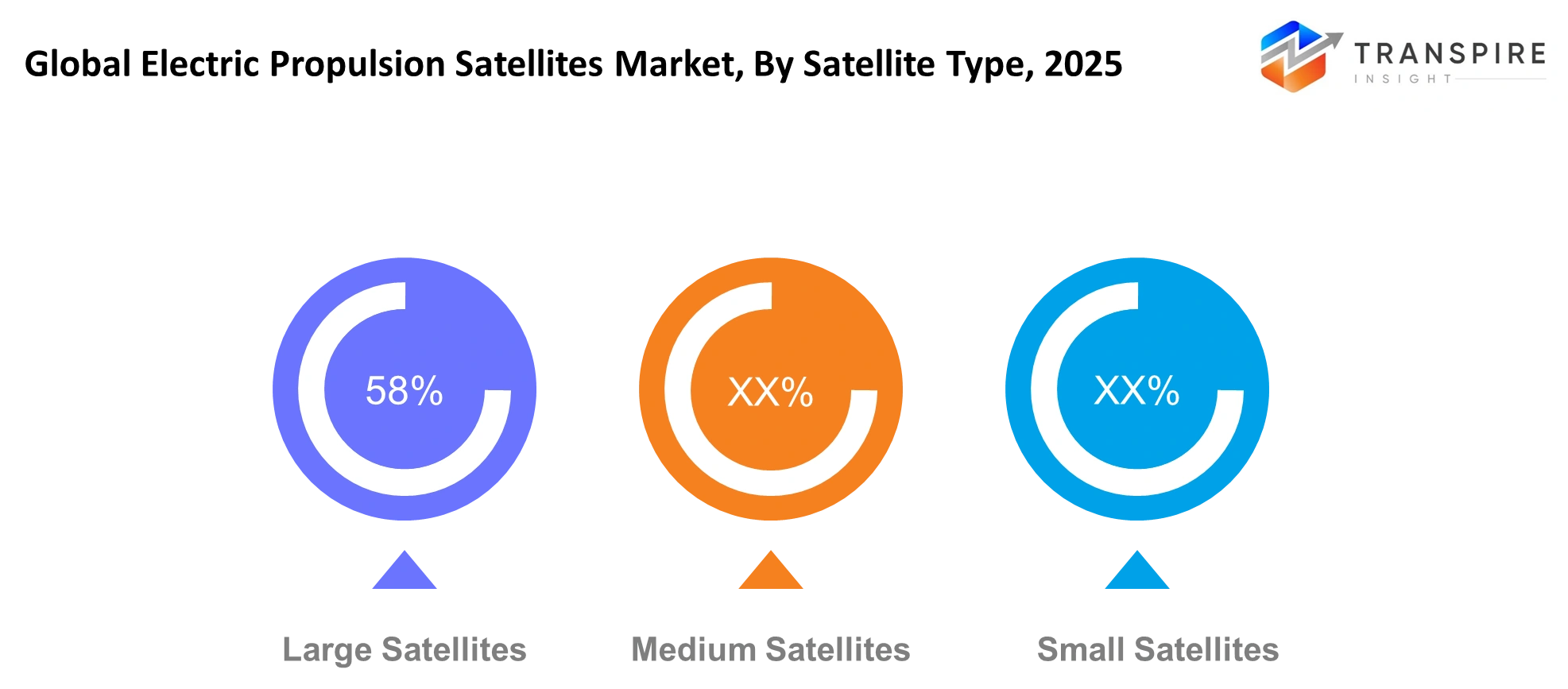
- Large Satellites: Large satellites dominate the market as they require advanced propulsion systems for orbit raising, station keeping, and maneuverability. Electric propulsion enables these satellites to significantly reduce fuel mass while increasing payload capacity, making them highly efficient for communication and defense applications.
To learn more about this report, Download Free Sample Report
By Orbit
- Low Earth Orbit: Low Earth Orbit is witnessing significant growth due to the increasing number of satellite constellations for broadband internet and Earth observation. Electric propulsion systems are essential in this orbit for collision avoidance, station keeping, and orbit adjustments.
- Medium Earth Orbit: Medium Earth Orbit satellites rely on electric propulsion for navigation systems and communication services, where efficient fuel usage and long operational life are critical for maintaining consistent performance.
- Geostationary Orbit: Geostationary Orbit remains a key segment where electric propulsion is widely used for orbit raising and station keeping. Satellites in this orbit require highly efficient propulsion systems to maintain their fixed position relative to the Earth.
By Application
- Earth Observation: Electric propulsion supports precise positioning and long-term operation of satellites used for environmental monitoring, agriculture, and surveillance applications.
- Navigation: Navigation satellites rely on electric propulsion to maintain accurate positioning and ensure reliable global navigation services.
- Communication: Communication satellites represent a major application area, where electric propulsion enables efficient orbit management and extended service life.
- Weather Monitoring: Weather satellites utilize electric propulsion to maintain stable orbits and provide continuous monitoring of atmospheric conditions.
By End-User
- Commercial: The commercial segment dominates the market as private companies deploy satellite constellations for communication, Earth observation, and data services. Electric propulsion helps reduce operational costs and improve scalability.
- Government & Defense: Government and defense agencies use electric propulsion satellites for secure communication, surveillance, and navigation, where reliability and long mission durations are essential.
Country Insights
The global market for electric propulsion satellites is driven by strong investments from countries such as the United States, members of the European Union, China, and India, all of which are actively expanding their space capabilities. The United States leads the market due to the presence of major aerospace companies and private space firms that are continuously innovating in propulsion technologies.
Europe is also a significant contributor, with strong participation from satellite manufacturers and propulsion technology providers focusing on sustainability and efficiency. Meanwhile, emerging space nations are increasingly adopting electric propulsion systems to enhance their satellite capabilities and reduce mission costs.
The global push toward space commercialization, combined with government-backed space programs, is creating a highly competitive and innovation-driven market landscape for electric propulsion satellites.
To learn more about this report, Download Free Sample Report
Recent Development News
Electric Propulsion Gains Momentum as Satellite Operators Focus on Cost Efficiency and Long-Duration Missions
Major Aerospace Companies Invest in Advanced Ion and Hall-Effect Thruster Technologies to Enhance Satellite Performance
|
Report Metrics |
Details |
|
Market size value in 2025 |
USD 50.09 Billion |
|
Market size value in 2026 |
USD 57.11 Billion |
|
Revenue forecast in 2033 |
USD 143.78 Billion |
|
Growth rate |
CAGR of 14.10% from 2026 to 2033 |
|
Base year |
2025 |
|
Historical data |
2021 - 2024 |
|
Forecast period |
2026 - 2033 |
|
Report coverage |
Revenue forecast, competitive landscape, growth factors, and trends |
|
Country scope |
Global |
|
Key company profiled |
15 Companies: Airbus SE, Boeing Company, Thales Alenia Space, Northrop Grumman Corporation, Lockheed Martin Corporation, Maxar Technologies Inc., L3Harris Technologies Inc., OHB SE, Safran Group, Busek Co. Inc., Accion Systems Inc., Sitael S.p.A., Exotrail SA, ArianeGroup, Moog Inc. |
|
Customization scope |
Free report customization (country, regional & segment scope). Avail customized purchase options to meet your exact research needs. |
|
Report Segmentation |
By Propulsion Type (Electrothermal, Electrostatic, & Electromagnetic Propulsion) By Satellite Type (Small Satellites, Medium Satellites, Large Satellites), By Orbit (Low Earth Orbit, Medium Earth Orbit, Geostationary Orbit), By Application (Earth observation, Navigation, Communication, Weather monitoring) By End-User (Commercial, Government & Defense). |
Key Global Electric Propulsion Satellites Company Insights
Leading companies in the global electric propulsion satellites market are focusing on technological innovation, strategic collaborations, and increased investments in research and development to strengthen their market position. These companies are developing advanced propulsion systems that offer higher efficiency, reduced weight, and improved operational reliability.
Partnerships between satellite manufacturers and propulsion system providers are becoming increasingly common, enabling the integration of cutting-edge technologies into next-generation satellite platforms. Additionally, companies are expanding their production capabilities and entering new markets to meet the growing demand for electric propulsion solutions across commercial and government sectors.
Company List
- Airbus SE
- Boeing Company
- Thales Alenia Space
- Northrop Grumman Corporation
- Lockheed Martin Corporation
- Maxar Technologies Inc.
- L3Harris Technologies Inc.
- OHB SE
- Safran Group
- Busek Co. Inc.
- Accion Systems Inc.
- Sitael S.p.A.
- Exotrail SA
- ArianeGroup
- Moog Inc.
Global Electric Propulsion Satellites Market Report Segmentation
By Propulsion Type
- Electrothermal
- Electrostatic
- Electromagnetic Propulsion
By Satellite Type
- Small Satellites
- Medium Satellites
- Large Satellites
By Orbit
- Low Earth Orbit
- Medium Earth Orbit
- Geostationary Orbit
By Application
- Earth Observation
- Navigation
- Communication
- Weather Monitoring
By End-User
- Commercial
- Government & Defense
Frequently Asked Questions
Find quick answers to common questions.
The approximate Global Electric Propulsion Satellites Market size will be USD 143.78 billion in 2033.
The key segments include propulsion type, satellite type, orbit, application, and end-user categories.
Major players include Airbus SE, Boeing Company, Thales Alenia Space, Northrop Grumman Corporation, Lockheed Martin Corporation, and others.
The current Global Electric Propulsion Satellites Market size is USD 50.09 billion in 2025.
The Global Electric Propulsion Satellites Market is growing at a CAGR of 14.10%.
- Airbus SE
- Boeing Company
- Thales Alenia Space
- Northrop Grumman Corporation
- Lockheed Martin Corporation
- Maxar Technologies Inc.
- L3Harris Technologies Inc.
- OHB SE
- Safran Group
- Busek Co. Inc.
- Accion Systems Inc.
- Sitael S.p.A.
- Exotrail SA
- ArianeGroup
- Moog Inc.
Recently Published Reports
-
Apr 2026
Aerospace Fluoropolymers Market
Aerospace Fluoropolymers Market Size, Share & Analysis Report By Type (PTFE, FEP, PFA, ETFE, and Others), By Application (Electrical Insulation, Seals & Gaskets, Coatings, and Others), By End User (Commercial Aviation, Military Aviation, General Aviation, and Others), and Geography (North America, Europe, Asia-Pacific, Middle East and Africa, South and Central America), 2021 - 2031
-
Apr 2026
Airborne SATCOM System Market
Airborne SATCOM System Market Size, Share & Analysis Report By Type (SATCOM Terminals, Transceivers, Airborne Radio, Modems and Routers, SATCOM Radomes, and Other), By Application (Government and Defense and Commercial), and Geography (North America, Europe, Asia-Pacific, Middle East and Africa, South and Central America), 2021 – 2031
-
Apr 2026
Ship Leasing Market
Ship Leasing Market Size, Share & Analysis Report By Vessel Type (Container Ships, Bulk Carriers, Tankers, and Specialized Vessels), By Lease Duration (Short-Term Lease (Less than 1 year), Medium-Term Lease (1-5 years), and Long-Term Lease (More than 5 years)), By Lease Type (Bareboat Charter, Time Charter, Financial Lease, and Others), By End-User Industry (Oil and Gas, Manufacturing and Industrial, Automotive, Agriculture and Food, Retail and Consumer Goods, and Others), and Geography (North America, Europe, Asia-Pacific, Middle East and Africa, South and Central America), 2021 – 2031
-
Apr 2026
Thread Rolling Dies Market
Thread Rolling Dies Market Size, Share & Analysis Report By Type (Flat Thread Rolling Dies, Circular (Cylindrical) Dies, Tangential Thread Rolling Dies, Planetary Thread Rolling Dies, and Other Types), By Material Type (High-Speed Steel (HSS), Carbide, Tool Steel, Alloy Steel, and Other Specialized Alloys), By Distribution Channel (Direct Sales, Distributors and Dealers, and Online Platforms), By Application (Automotive Industry, Aerospace and Defense, Construction and Infrastructure, Industrial Machinery, Electronics and Electrical Components, Medical Devices, and Fastener Production), and Geography (North America, Europe, Asia-Pacific, Middle East and Africa, South and Central America), 2021 – 2031
Our Clients