
Middle East and Africa Next Generation Network Market Summary
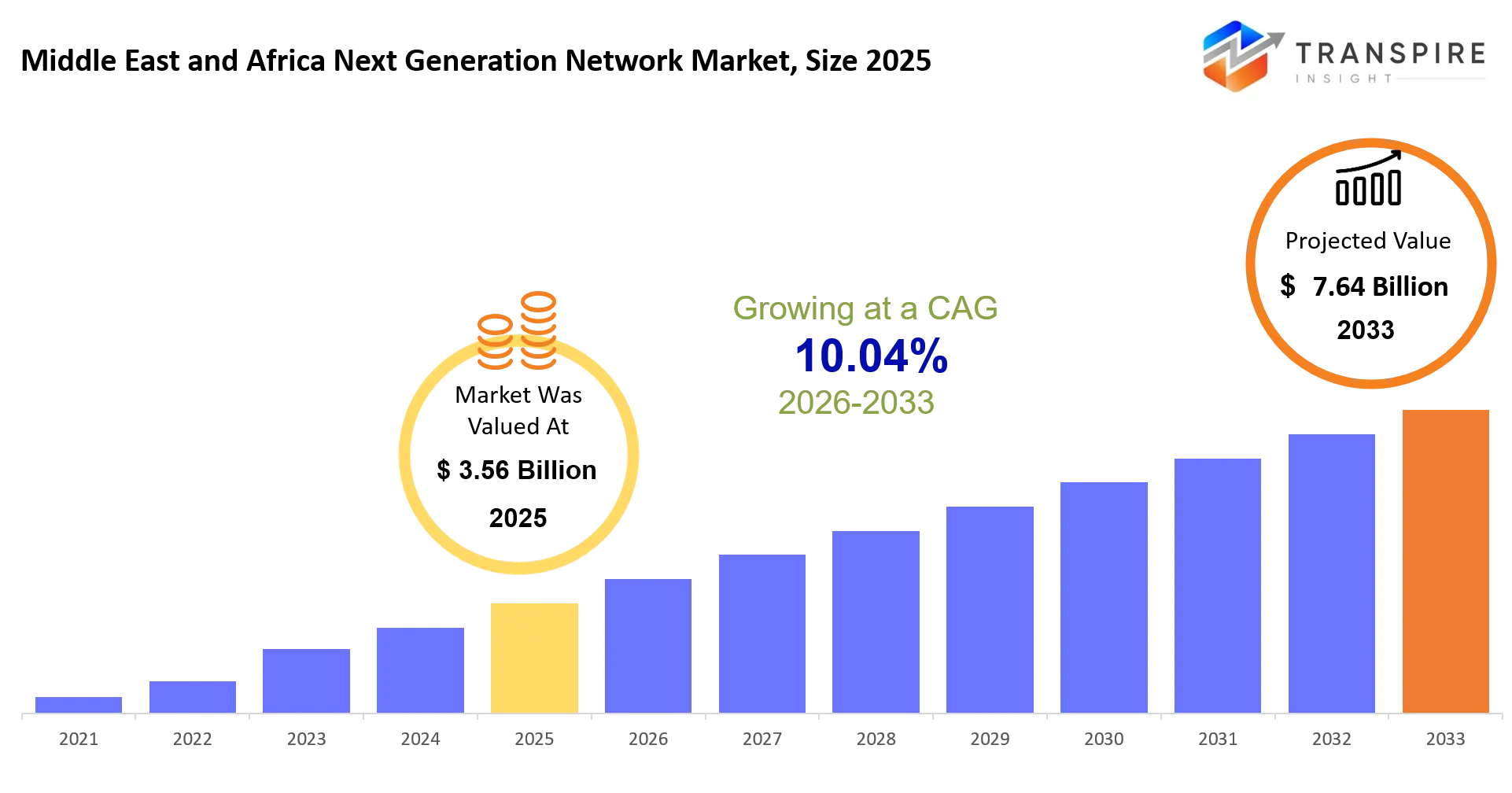
As per Transpire Insight Analysis the Middle East and Africa Next Generation Network Market size is estimated at USD 3.56 Billion in 2025 and is anticipated to reach USD 7.64 Billion by 2033, growing at a CAGR of 10.04% from 2026 to 2033.
The Middle East and Africa Next Generation Network Market helps telecom operators, enterprises, and public agencies deliver faster, low delay, and software driven connectivity that backs digital services, cloud computing, industrial automation, and smart city operations. Rather than leaning on older infrastructure, organizations are using next generation networks to make better use of bandwidth, automate network oversight, and enable newer use cases like private 5G and edge computing. In the last five years, things kinda moved away from a hardware centered view of telecom infrastructure toward more virtualized, cloud native network designs, powered by software defined networking (SDN) and network function virtualization (NFV). Big 5G rollouts picked up pace after the COVID-19 pandemic, which made clear the need for robust digital infrastructure, and at the same time national digital transformation programs across Gulf countries kept investment energy strong. Now, as operators modernize legacy networks and enterprises roll out mission critical digital applications, the recurring income from software, cloud, and managed services keeps rising, right alongside ongoing infrastructure spending.
Middle East and Africa Next Generation Network Market Size & Forecast:
- Middle East and Africa Next Generation Network Market Size 2025: USD 3.56 Billion
- Expected Market Value 2033: USD 7.64 Billion
- Forecast CAGR: 10.04%
- Leading region in 2025:Gulf Cooperation Council (GCC), led by Saudi Arabia
- Fastest Growing region:Rest of Africa, led by Egypt
- Key Profile: Nokia, Ericsson, Huawei, Cisco, Juniper Networks, Ciena, NEC Corporation, ZTE, Samsung Networks, Oracle, VMware, IBM, Hewlett Packard Enterprise, Mavenir, Ribbon Communications
Key Market Insights
- So, the Middle East and Africa Next Generation Network market revenue is kind of supported by telecom modernization, cloud-native architectures slowly replacing legacy network infrastructure across various regional operators, not all at once of course.
- For the leading region, Saudi Arabia is taking the lead with roughly 34% market share in 2025, and it’s backed by Vision 2030 type investments plus nationwide 5G deployment.
- The fastest growing region should be the United Arab Emirates, and it’s projected to move the quickest through 2033, mainly because of smart city programs, AI infrastructure work, and enterprise cloud adoption.
- When it comes to segments, Software lands as the leading one with nearly 42% market share in 2025, basically showing how fast SDN, NFV, and network orchestration platforms are being adopted.
- Then, Network Services stay as the second-largest segment and they continue to grow as operators increasingly outsource deployment, integration and lifecycle management.
- For fastest growth by segment, edge computing combined with cloud-native networking solutions is expected to post the strongest momentum during 2026–2033.
- On applications, Telecommunications is the dominant use case at about 48% of market revenue, helped by nationwide 5G rollout plus core network modernization too. On the other hand, Industrial private 5G is emerging, with deployments for manufacturing, logistics, ports, mining, and energy facilities spreading across the region.
- Looking at end users, telecom operators hold more than 55% market share, while enterprises adopting private wireless networks are the fastest-growing customer group, kind of like the more agile buyers.
- Key companies such as Nokia, Ericsson, Huawei, Cisco, Ciena, and Juniper Networks are competing using cloud-native core solutions, Open RAN development, AI driven automation, strategic partnerships, and ongoing regional expansion initiatives.
What are the Key Drivers, Restraints, and Opportunities in the Middle East and Africa Next Generation Network Market?
The strongest growth driver is that rapid migration from old legacy telecom infrastructure toward cloud-native, software defined networks, backed by national digital transformation programs and also commercial 5G rollouts. In Saudi Arabia, the UAE, Qatar and South Africa, governments keep putting money into digital infrastructure for economic diversification and to broaden digital public services. Meanwhile, telecom operators are virtualizing network functions, rolling out standalone 5G cores, and bringing in edge computing platforms, all to cut operating costs while still enabling those enterprise applications. Overall, these moves keep generating recurring revenue via managed services, software licensing, cloud networking, and private wireless deployments.
The main restraint stays the same, namely the big capital spend needed to modernize legacy infrastructure without breaking service continuity. A lot of operators end up doing several things at once supporting aging 3G and 4G networks, while also deploying cloud-native cores, fiber backhaul, and edge data centers. That dual-network workload raises Opex, makes the nationwide schedules slip, and pushes back returns on investment, especially across parts of developing Africa, where spectrum access and fiber reach can be uneven.
Private 5G and edge networking, in the next decade, look like one of the more promising growth opportunities. Mining sites, ports, manufacturing plants, airports, and oil and gas operators are increasingly asking for ultra-reliable low-latency connectivity, mostly for autonomous machinery, industrial automation, and real time analytics.
What Has the Impact of Artificial Intelligence Been on the Middle East and Africa Next Generation Network Market?
Artificial intelligence has basically changed how modern communication networks are designed, managed, and optimized across most of the Middle East and Africa. Telecom operators are now rolling out AI driven network management platforms that can spot congestion on their own, balance the traffic loads, sort out network resources, and fine tune radio performance without that constant manual touch. In parallel, machine learning models chew through millions of network events to forecast equipment failures before any real service disruption happens, so operators can plan maintenance early and boost network availability. On top of that, AI helps strengthen cybersecurity by spotting odd traffic patterns and reacting to likely threats in real time, which is kind of a big deal. When you combine all of this with digital twin tools and more advanced analytics, operators tend to get better spectrum efficiency, reduced operating expenses, and quicker fault resolution, while still supporting the rapid growth of 5G plus enterprise connectivity services.
Also, AI improves the customer experience via intelligent service assurance, automated fault diagnosis, and predictive capacity planning. Those features help operators push service quality higher, cut down downtime, and speed up new service rollouts, especially across cloud native infrastructures. Still, broad AI adoption is not fully smooth because of integration complexity, fragmented legacy systems, and uneven data quality across multi vendor environments. Plus many regional operators struggle with shortages of AI networking specialists, and that makes advanced automation projects cost more, and sometimes it stretches deployment timelines too, even if the long term operational payoff is pretty strong.
Key Market Trends
- Between 2021 and 2025, many telecom operators shifted from proprietary hardware to cloud-native core networks, and it was supposed to cut deployment time , also made operational flexibility feel more natural in day to day work.
- After 2022, standalone 5G rollout really picked up, which helped unlock ultra-low latency services for manufacturing , logistics , healthcare, and those smart city use cases too.
- At the same time , AI-driven network automation started replacing manual network tuning and optimization processes more and more often, so fault detection got sharper and service restoration time got shorter.
- Open RAN partnerships also grew steadily as operators diversified suppliers and tried to reduce reliance on single-vendor infrastructure ecosystems, rather than staying locked in one place.
- Edge computing deployments increased across industrial facilities, moving compute resources closer to users, and that improved application responsiveness in practice.
- Meanwhile, enterprise customers leaned into private 5G networks for autonomous operations, industrial IoT, and communications that must be mission-critical.
- Optical transport spending grew alongside hyperscale data center momentum, which supported higher bandwidth requirements across regional cloud ecosystems.
- Governments meanwhile strengthened digital transformation pushes via national broadband programs and smart city initiatives, which in turn accelerated telecom infrastructure investment.
- Vendors such as Nokia, Ericsson, Huawei, Cisco ,and Ciena expanded their AI-enabled software offerings, cloud-native core platforms, and regional strategic partnerships too.
- Finally, sustainability goals nudged operators toward energy-efficient network equipment, AI-powered power management, and virtualized infrastructure, all of which helped reduce operational energy consumption, even if the improvements were incremental at first.
Middle East and Africa Next Generation Network Market Segmentation
By Network Type
Network type choosing kind of depends on coverage needs , bandwidth requirements latency targets, and also long-term infrastructure planning, sort of overall strategy. 5G Networks can support ultra-low latency services, industrial automation, and more advanced enterprise applications too. LTE Advanced still delivers dependable mobile broadband, especially in places where full 5G rollout is still being worked on. Fiber Networks provide high-capacity backhaul and help with data-heavy services, while SDN boosts network control via centralized management , like a single brain for the routing side.
NFV takes the place of dedicated hardware with virtual network functions , which can cut operational costs and make deployment feel more flexible. Optical Networks also enable fast data movement over long distances with minimal signal loss. Converged Networks blend fixed and mobile connectivity into one unified platform, for smoother service delivery. Other options include satellite-supported and specialized communication technologies, targeting remote locations, industrial facilities, and those particular connectivity needs across the region.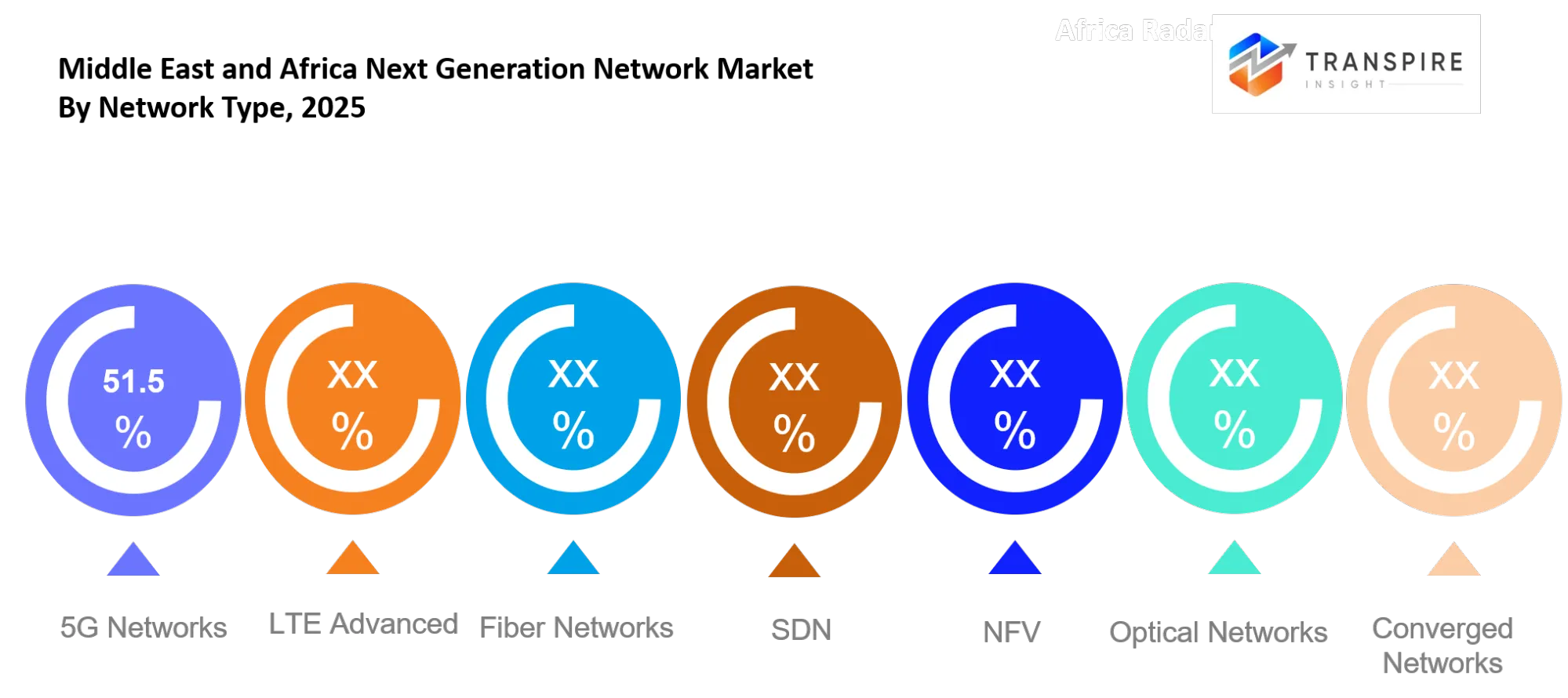
By Component
Component selection is basically about striking that awkward balance between physical groundwork, software intelligence, and how services actually get delivered. On the hardware side you’ve got routers, switches, servers, antennas, and different transmission equipment that really act as the base layer for modern communication infrastructure. The software portion meanwhile helps with network orchestration, virtualization, automation, and some centralized command, working across those distributed environments.
As for Network Services , they back deployment and integration, plus consulting work, maintenance tasks, and lifecycle management for telecom operators as well as enterprise customers. Network Security covers the whole protection angle for the communication infrastructure, using threat detection, encryption, identity management, and secure access controls so stuff doesn’t get in where it shouldn’t. Then Edge Computing Solutions handle the data processing nearer to the connected devices, which cuts down latency especially for real-time use cases. Cloud Networking boosts scalability by linking cloud resources to distributed network infrastructure.
Network Analytics gives performance monitoring and operational visibility. The “Others” part is more like specialized management platforms and supporting technologies, all of that together helps network efficiency, and keeps the system more responsive.
By Application
Application diversity mirrors how advanced communication infrastructure keeps getting involved in more sectors, and not just one or two. Telecommunications is still the biggest application type, because mobile operators keep upgrading their core networks, extending 5G footprint , and pushing higher broadband capacity. Enterprise Networking meanwhile backs digital workplaces, adds guarded connectivity, and ties cloud services into private organizations with less friction. Smart Cities rely on communications that are basically “thinking”, where transportation, utilities, surveillance, and public services all connect through intelligent systems.
Industrial IoT lets manufacturing equipment be online, supports predictive service, and runs automated production environments with tighter control. Healthcare uses this for telemedicine, networked medical devices, and safe sharing of patient records , especially when data exchange has to be consistent. Government Communications supports public safety, emergency response, and protected administrative operations. Media & Entertainment gets a boost from high bandwidth content delivery, while Others covers education, financial services, logistics, and also transportation use cases in practice.
By End User
End-user demand keep on expanding as digital transformation projects speed up across both public and private sectors. Telecom Operators still stay as the biggest users, because nationwide infrastructure rollouts demand continuous capital into modern network technologies. Enterprises are adopting advanced networking solutions so they can get better operational efficiency, strengthen business continuity and keep digital connectivity more secure in general. Government Agencies are modernizing comms platforms to back public administration, public safety, and emergency response too.
Healthcare Providers are putting in dependable connectivity for digital health services, plus connected medical equipment and related devices. Manufacturing Companies deploy advanced communication systems for industrial automation and smart factory operations, basically turning lines into something smoother. Educational Institutions focus on reinforcing online learning setups, research collaboration, and overall campus connectivity. Others, like financial organizations, transportation providers, utilities and energy companies, are also rolling out newer communication infrastructure, often with a more unified architecture.
By Deployment
Deployment strategy really depends on the operational necessities, the security priorities involved, plus what scalability objectives are in view. Cloud based deployment, for a lot of organizations, enables a kind of flexible scaling, more centralized oversight, and often lower infrastructure costs. On premise deployment is still very relevant when strict data security , compliance obligations, or tight operational control are required. Hybrid deployment tries to merge the cloud’s agility with dedicated infrastructure so performance stays steady and security stays tight.
Private Networks give dedicated connectivity for industrial plants, enterprises, and mission critical operations where high reliability matters most. Public Networks cover a much broader reach for consumers , businesses, and government users using commercial telecom infrastructure. Edge Networks boost application performance by handling information closer to the end devices, which cuts down the response time for latency sensitive services. Other approaches can also exist, such as bespoke deployment patterns designed for specialized operational settings.
What are the Key Use Cases Driving the Middle East and Africa Next Generation Network Market?
Telecommunications is still basically the main use case, though, because nationwide 5G rollout, fiber expansion, and cloud native core modernization all keep needing serious network infrastructure. Mobile operators use these kinds of platforms to bump up network capacity, lower latency , and handle the growing data traffic from consumers, and businesses as well. And then continuous service upgrades keep rolling out, so you end up with sustained investment across regional communication infrastructure, in a very steady way.
Enterprise networking and industrial IoT are also picking up speed, especially across manufacturing, logistics, mining, and energy operations. Government agencies meanwhile expand secure digital communication systems, for public safety, border management, and emergency response, kind of in parallel. In healthcare, providers deploy stronger connectivity to back telemedicine, connected medical equipment , and secure clinical data exchange.
Private 5G networks and edge computing look like the emerging use cases with solid long term potential. For smart city platforms, they increasingly pull together intelligent traffic management, connected infrastructure, and environmental monitoring, all enabled through high speed communication systems. On top of that, artificial intelligence enabled network automation and autonomous industrial operations will open extra opportunities as digital transformation programs mature across the Middle East and Africa .
|
Report Metrics |
Details |
|
Market size value in 2025 |
USD 3.56 Billion |
|
Market size value in 2026 |
USD 3.91 Billion |
|
Revenue forecast in 2033 |
USD 7.64 Billion |
|
Growth rate |
CAGR of 10.04% from 2026 to 2033 |
|
Base year |
2025 |
|
Historical data |
2021 - 2024 |
|
Forecast period |
2026 - 2033 |
|
Report coverage |
Revenue forecast, competitive landscape, growth factors, and trends |
|
Regional scope |
Middle East and Africa (Saudi Arabia, United Arab Emirates, South Africa, Rest of Middle East and Africa) |
|
Key company profiled |
Nokia, Ericsson, Huawei, Cisco, Juniper Networks, Ciena, NEC Corporation, ZTE, Samsung Networks, Oracle, VMware, IBM, Hewlett Packard Enterprise, Mavenir, Ribbon Communications |
|
Customization scope |
Free report customization (country, regional & segment scope). Avail customized purchase options to meet your exact research needs. |
|
Report Segmentation |
By Network Type (5G Networks, LTE Advanced, Fiber Networks, SDN, NFV, Optical Networks, Converged Networks, Others); By Component (Hardware, Software, Network Services, Network Security, Edge Computing Solutions, Cloud Networking, Network Analytics, Others); By Application (Telecommunications, Enterprise Networking, Smart Cities, Industrial IoT, Healthcare, Government Communications, Media & Entertainment, Others); By End User (Telecom Operators, Enterprises, Government Agencies, Healthcare Providers, Manufacturing Companies, Educational Institutions, Others); By Deployment (Cloud-Based, On-Premise, Hybrid, Private Networks, Public Networks, Edge Networks, Others) |
Which Regions are Driving the Middle East and Africa Next Generation Network Market Growth?
The Gulf Cooperation Council, led by Saudi Arabia, and the United Arab Emirates, basically represents the biggest regional market for next generation network deployment, like it’s already there. National digital transformation programs along with broad 5G spectrum allocation and sustained investment under initiatives such as Saudi Vision 2030, have sped up cloud native network modernization and fiber expansion. Big hyperscale data center projects, smart city developments, and more sophisticated enterprise connectivity form a kind of strong ecosystem, that keeps enabling ongoing infrastructure upgrades. Also, close coordination between governments, telecom operators, cloud providers, and global equipment vendors reinforces regional influence, and it brings in long term technology investment
South Africa shows up as the second most important regional contributor, mainly because market expansion is backed by steady infrastructure spending rather than a quick “greenfield” rush. A mature telecommunications sector, growing fiber broadband reach, and continued enterprise digital transformation drive reliable demand for software defined networking, cloud networking, and advanced transport infrastructure. Financial institutions, mining companies, manufacturing sites, and public sector bodies keep modernizing communication systems, mostly to boost operational efficiency. This mix of customers means more predictable revenue streams, and it lowers the reliance on just one industry or a single government investment plan
Elsewhere across the larger African growth markets Egypt, Kenya, Nigeria, and Morocco in particular—are projected to see the most rapid expansion during the 2026–2033 period, no real surprise there.
Who are the Key Players in the Middle East and Africa Next Generation Network Market and How Do They Compete?
Competition is still fairly consolidated, mainly because only a handful of large global technology companies provide the core pieces core network equipment, optical transport systems, virtualization platforms, and the network management software. What really drives competitive advantage is less about hardware pricing by itself, and more about cloud-native design, AI-enabled automation, Open RAN compatibility, cybersecurity strengths, and those long-term service contracts. Meanwhile, well known vendors keep pushing their positions by investing in software innovation, and also by rolling out managed services plus regional partnerships, so telecom operators have support during the whole digital transformation journey.
Nokia, for example, sets itself apart with cloud-native packet core technology, optical networking, and autonomous network management solutions. It basically makes migration from legacy infrastructure a smoother process, step by step, not a big disruptive event. Ericsson instead leans harder into advanced radio access technology, AI-driven network automation, and more intelligent network management platforms, these are meant to lift operational efficiency for mobile operators. Then in March 2026, both companies expanded their collaboration by stitching together their automation ecosystems, so interoperability improves across multivendor Open RAN settings. That change gives communication service providers more deployment flexibility than before.
Huawei stays strong with integrated end-to-end networking offerings, especially across mobile access, transport, and cloud infrastructure. This is reinforced by competitive deployment costs, plus a wide range of technology options. Cisco, on the other hand, improves its visibility via enterprise networking, cloud security, and software-defined networking that fits neatly into hybrid cloud environments.
Company List
• Nokia
• Ericsson
• Huawei
• Cisco
• Juniper Networks
• Ciena
• NEC Corporation
• ZTE
• Samsung Networks
• Oracle
• VMware
• IBM
• Hewlett Packard Enterprise (HPE)
• Mavenir
• Ribbon Communications
Recent Development News
In March 2026, Ericsson and Nokia entered a strategic collaboration to strengthen autonomous network ecosystems. The partnership enables interoperability between both companies' rApp platforms and accelerates AI-driven automation across multivendor Open RAN deployments.https://www.ericsson.com
In March 2026, Nokia announced the same strategic partnership with Ericsson to connect Nokia's SMO Marketplace and Ericsson's rApp Ecosystem. The collaboration gives communication service providers greater flexibility while supporting open standards for autonomous network management.https://www.nokia.com
In April 2025, Nokia expanded its core network partnership with Bharti Airtel by deploying Packet Core and Fixed Wireless Access solutions. The agreement strengthens 5G Standalone readiness, improves network automation, and accelerates service delivery while reducing operating costs.https://www.nokia.com
What Strategic Insights Define the Future of the Middle East and Africa Next Generation Network Market?
Over the next five to seven years, the market will move in the direction of fully software-defined, AI-managed, and cloud-native communication infrastructure, as operators slide past the usual 5G deployments toward more autonomous network operations. The biggest structural push, you could say, is the coming together of artificial intelligence, edge computing, Open RAN, and enterprise private networks, and that mix will let communication providers roll out very automated, service oriented business models.
There is also a less visible risk, namely dependence on a small number of infrastructure vendors, which can drive up procurement costs and bring on supply chain friction if geopolitical restrictions, or even component shortages, start to intensify.
A newer and emerging chance is the expansion of private 5G networks across mining, energy, logistics, and industrial manufacturing across Africa. Market participants should focus on investing in interoperable software platforms, AI enabled automation, and strategic partnerships that lower vendor lock-in, while still getting positioned for longer term enterprise connectivity demand.
Middle East and Africa Next Generation Network Market Report Segmentation
By Network Type
• 5G Networks
• LTE Advanced
• Fiber Networks
• SDN
• NFV
• Optical Networks
• Converged Networks
• Others
By Component
• Hardware
• Software
• Network Services
• Network Security
• Edge Computing Solutions
• Cloud Networking
• Network Analytics
• Others
By Application
• Telecommunications
• Enterprise Networking
• Smart Cities
• Industrial IoT
• Healthcare
• Government Communications
• Media & Entertainment
• Others
By End User
• Telecom Operators
• Enterprises
• Government Agencies
• Healthcare Providers
• Manufacturing Companies
• Educational Institutions
• Others
By Deployment
• Cloud-Based
• On-Premise
• Hybrid
• Private Networks
• Public Networks
• Edge Networks
• Others
Frequently Asked Questions
Find quick answers to common questions.
The Expected Middle East and Africa Next Generation Network Market size for the Market will be USD 7.64 Billion in 2033.
Key segments for the Middle East and Africa Next Generation Network Market are By Network Type (5G Networks, LTE Advanced, Fiber Networks, SDN, NFV, Optical Networks, Converged Networks, Others); By Component (Hardware, Software, Network Services, Network Security, Edge Computing Solutions, Cloud Networking, Network Analytics, Others); By Application (Telecommunications, Enterprise Networking, Smart Cities, Industrial IoT, Healthcare, Government Communications, Media & Entertainment, Others); By End User (Telecom Operators, Enterprises, Government Agencies, Healthcare Providers, Manufacturing Companies, Educational Institutions, Others); By Deployment (Cloud-Based, On-Premise, Hybrid, Private Networks, Public Networks, Edge Networks, Others).
Major Middle East and Africa Next Generation Network Market Players are Nokia, Ericsson, Huawei, Cisco, Juniper Networks, Ciena, NEC Corporation, ZTE, Samsung Networks, Oracle, VMware, IBM, Hewlett Packard Enterprise, Mavenir, Ribbon Communications.
The Current Middle East and Africa Next Generation Network Market size is USD 3.56 Billion in 2025.
The Middle East and Africa Next Generation Network Market CAGR is 10.04% from 2026 to 2033.
• Nokia
• Ericsson
• Huawei
• Cisco
• Juniper Networks
• Ciena
• NEC Corporation
• ZTE
• Samsung Networks
• Oracle
• VMware
• IBM
• Hewlett Packard Enterprise (HPE)
• Mavenir
• Ribbon Communications
About the Authors

Mayur Shinde
I am Mayur Shinde, a Senior Research Analyst at Transpire Insight, specializing in the Automotive & Transportation and Information & Communication Technology (ICT) Industry. My work focuses on analyzing emerging market trends, technological advancements, competitive landscapes, and industry developments to deliver accurate, data-driven insights. I am passionate about transforming complex market information into clear, actionable content that helps businesses, professionals, and decision-makers stay informed and make confident strategic decisions.

Chakradhar Khansole
Chakradhar serves as the Research Director at Transpire Insight, bringing over 8 years of experience in technology, innovation, and strategic market intelligence. He specializes in transforming complex market data into actionable business insights that enable organizations to make informed, growth-oriented decisions. Recognized for his strategic vision and analytical expertise, Chakradhar leads high-impact research initiatives, delivering comprehensive market assessments, competitive intelligence, and forward-looking industry analysis.
Recently Published Reports
-
Apr 2026
3D Optical Profiler Market
3D Optical Profiler Market Size, Share & Analysis Report By Type (Desktop 3D Optical Profiler, and Portable 3D Optical Profiler), By Technology (Confocal Technology, and White Light Interference), By End-Use Industry (Manufacturing, Research Institutions, Automotive, Aerospace and Defense, Medical Devices, and Other), and Geography (North America, Europe, Asia-Pacific, Middle East and Africa, South and Central America), 2021 - 2031
-
Apr 2026
Depth Sensor Market
Depth Sensor Market Size, Share & Analysis Report By Type (Infrared Depth Sensors, Time-of-Flight (ToF) Sensors, Stereo Vision Sensors, Structured Light Sensors, Ultrasonic Depth Sensors), By Application (Automotive, Robotics, Gaming, Consumer Electronics, Industrial Automation, Healthcare, Security & Surveillance, Others), By End Users (Automotive Manufacturers, Consumer Electronics Companies, Healthcare Providers, Industrial Companies, Security Agencies, Gaming Companies, Robotics Companies, Others), and Geography (North America, Europe, Asia-Pacific, Middle East and Africa, South and Central America), 2021 – 2031
-
Apr 2026
Digital Manufacturing Market
Digital Manufacturing Market Size, Share & Analysis Report By Component (Hardware, Software, and Services), By Technology (Robotics, 3D Printing, Internet of Things (IoT), and Others), By Application (Automotive and Transportation, Aerospace and Defense, Consumer Electronics, Industrial Machinery, and Others), By Process Type (Computer-Based Designing, Computer-Based Simulation, Computer 3D Visualization, Analytics, and Others), and Geography (North America, Europe, Asia-Pacific, Middle East and Africa, South and Central America), 2021 – 2031
-
Apr 2026
Digital Visa Services Market
Digital Visa Services Market Size, Share & Analysis Report By Type (Individual Travelers, Group Travelers), By Application (Tourism, Business Travel, Others), and Geography (North America, Europe, Asia-Pacific, Middle East and Africa, South and Central America), 2021 – 2031