
Global Telecom Tower Power System Market Size & Forecast:
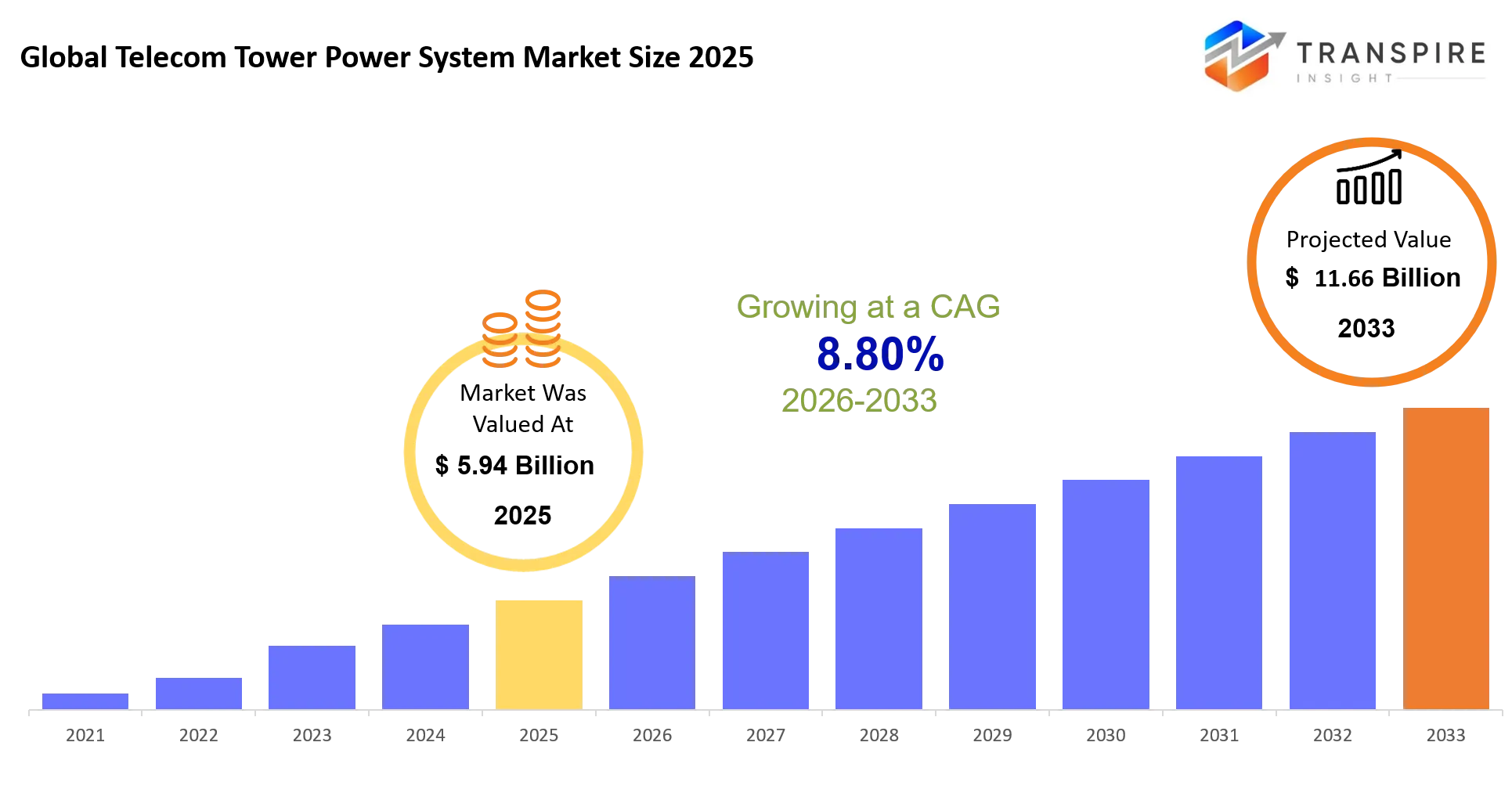
- Global Telecom Tower Power System Market Size 2025: USD 5.94 Billion
- Global Telecom Tower Power System Market Size 2033: USD 11.66 Billion
- Global Telecom Tower Power System Market CAGR: 8.80%
- Global Telecom Tower Power System Market Segments: By Component (Rectifiers, Power Controllers, Lithium-ion Batteries, Lead-acid Batteries, Diesel Generators, Hybrid Power Systems, Solar Power Systems, Others); By Power Source (Grid Power, Diesel Power, Solar Power, Wind Power, Hybrid Power, Fuel Cell Systems, Battery Backup Systems, Others); By Tower Type (Macro Towers, Rooftop Towers, Monopoles, Guyed Towers, Small Cell Towers, Camouflaged Towers, Distributed Towers, Others); By End User (Telecom Operators, Tower Infrastructure Companies, Internet Service Providers, Government Organizations, Private Network Operators, Rural Connectivity Providers, Defense Networks, Others); By Application (4G Networks, 5G Networks, Rural Connectivity, Urban Networks, Smart City Infrastructure, Emergency Communication, Private LTE Networks, Others)
Global Telecom Tower Power System Market Summary:
As per Transpire Insight Analysis, the Global Telecom Tower Power System Market size is estimated at USD 5.94 billion in 2025 and is anticipated to reach USD 11.66 billion by 2033, growing at a CAGR of 8.80% from 2026 to 2033.
The global telecom tower power system market is transforming from backup-power to continuous energy-management solutions providers, maintaining connectivity in all-remote to all-remote and urban environments. Three to five years ago, the speed of 4G/5G deployment, an increase in fuel costs, and a focus on the reduction of operational costs in towers brought hybrid power solutions, LI batteries, and solar-enabled tower solutions to the limelight. One of the important structural changes is moving from diesel-driven towers to Smart Hybrid Tower Power Solution Architecture incorporating Grid, Battery & Renewable source. A significant real trigger was the accelerated 5G rollout by mobile network operators after the COVID period, thus elevating the power demand and, at the same time, managing energy costs and site uptimes.
In summary, more networks are equal to more towers and increased power demands, thus creating opportunities in energy management solutions for the tower market.
Key Global Telecom Tower Power System Market Insights:
Vendors offer hardware, but it's not what's driving competition, as the market moves away from traditional backup infrastructure and towards intelligent, low-carbon energy ecosystems. In today's hyper-expansion era, tower energy usage is increasing, and lifecycle cost reduction, remote asset management, and renewable integration are the top telecom operators' priorities.
- Hybrid Power Systems lead the charge by 40%, as Huawei and Vertiv introduce AI-based hybrid controllers for multi-source power management.
- Cummins's low-emission generators enable longer backup times, as do diesel generators, which are still 21% critical.
- Solar Power Systems have been growing by 14%, reducing the reliance on towers that are off the grid and powered by diesel.
- As Narada Power is pushing for high-cycle battery storage to replace lead-acid storage, Lithium-ion Batteries are 10% faster.
- Asia Pacific is the top region for deployment, with ZTE driving integrated telecom energy solutions in high-density 5G markets.
- North America focuses 21% on smart energy management, and ABB boosts digital power monitoring for distributed tower networks.
- Europe furthers sustainable infrastructure by 20% with high-efficiency rectifiers for carbon-reduction projects, as Delta Electronics develops them.
- Middle East & Africa (+10%) is the fastest infrastructure shift, with Hitachi Energy growing its renewable-powered telecom systems for remote connectivity.
What are the Key Drivers, Restraints, and Opportunities in the Global Telecom Tower Power System Market?
Driver:
Energy intensity, driven by the rollout of more power-consuming 4G/5G in less grid-reliable areas - rural, semi-urban - is now triggering increased energy investment from telecom. Mobile video/data consumption/streaming/cloud/enterprise usage has increased significantly, pushing telcos to upgrade the uptime of their networks. As telcos scale up their tower sites, they are leveraging hybrid power systems with lithium-ion batteries and remote management platforms that slash their fuel and Opex. This increases the power system supplier's revenue and accelerates smart energy use.
In April 2026, Amara Raja Energy & Mobility expanded lithium energy storage across 50,000 telecom sites. This milestone achieved over 1 GWh of deployment, increasing network reliability and cementing the company's 35% market share.
Restraint:
The high capital expense associated with upscaling and overhauling modern tower power infrastructure. It requires substantial outlays for lithium-ion batteries, solar, a sophisticated controller, power management equipment, and remote monitoring. But many tower operators still maintain huge fleets of legacy diesel sites. This challenge is still very real in some of the world’s most immature markets, where cash flow is strained.
Opportunity:
A prime area of growth is to move toward green and smart towers operating on renewable energy and artificial intelligence. Hybrids powered by solar energy, batteries, and smart control will trim operating costs and cut carbon emissions. China and Africa's extensive tower upgradation initiatives offer new demand and market opportunities in solar-hybrid towers and AI-based monitoring & predictive maintenance for towers for the equipment players as well as for the energy-service companies.
In June 2026, EdgePoint Infrastructure partnered with NEXSYS-ONE. The partnership involves integrating advanced AI algorithms into NEXSYS-ONE's enterprise SaaS platform, enabling real-time monitoring and predictive maintenance that will significantly boost operational efficiencies.
What Has the Impact of Artificial Intelligence Been on the Global Telecom Tower Power System Market?
AI shifts the focus from maintaining telecom tower power to managing and controlling it like a dynamic energy platform. AI analyses factors like network traffic, weather, and energy prices to automatically optimize energy source selection between grid electricity, battery, solar and diesel, leading to lower fuel usage and better tower uptime. The most crucial of these applications is prediction. The predictive power of AI for tower operations is best demonstrated with battery health prediction and generator failure prediction by analysing battery condition, generator load, past temperatures and fault histories to proactively predict failures and schedule repairs before they result in downtime. Predictive maintenance allows telcos to save on costly emergency repair expenses and network downtime. AI also provides remote management of vast tower portfolios with features like detecting power theft or identifying unusual power consumption patterns at the remote end, reducing the need for many site visits.
In the case of renewable energy integrated sites, it can predict solar production and manage battery life to maximise renewable energy use. In February 2026, the International Solar Alliance launched a global AI-for-Energy mission. The initiative accelerates clean energy integration and sustainable technology planning in energy-deficient environments.
Key Global Telecom Tower Power System Market Trends:
Diesel-dominated towers are giving way to intelligent hybrid energy networks focusing on uptime, fuel savings, and carbon reduction. These days, the market is about controlling energy remotely, adopting Lithium-ion, and integrating renewables, not just deploying backup power.
- Hybrid tower solutions (solar+ grid+ battery) are gradually replacing diesel-only towers.
- More and more remote monitoring platforms are now being used to operate large tower portfolios that require fewer visits.
- Operators prefer lithium-ion systems due to longer service life and reduced maintenance.
- Energy-management software has matured beyond simple monitoring to predictive fault detection and optimisation through AI.
- Fuel logistics are a major issue for rural deployments, which is why solar-hybrid systems are being more and more widely used.
- Tower modernisation efforts are being tied to corporate carbon reduction efforts in telecom.
- Smarter power controllers and higher-capacity rectifiers are both in demand as a result of 5G site upgrades.
- Energy-service providers are increasingly providing outsourcing services to tower companies.
Global Telecom Tower Power System Market Segmentation
By Component:
Hybrid Power Systems dominates with 40% share in the growing telecom space, with providers integrating grid power, solar, batteries and diesel backup in one setup to maximise uptime and minimise fuel expenses and pollution emissions. Diesel Generators come next at 21% of the market, still serving as critical backup options for sectors experiencing an unstable supply, while Solar Power Systems form 14% due to the growing popularity of renewable solutions. Lithium-ion Batteries at 10%, however, are expected to exhibit a higher CAGR of 17.5% due to prolonged service lifespan, higher charging speed, and negligible maintenance. Rectifiers and Others segment the balance 7% and 8%, respectively.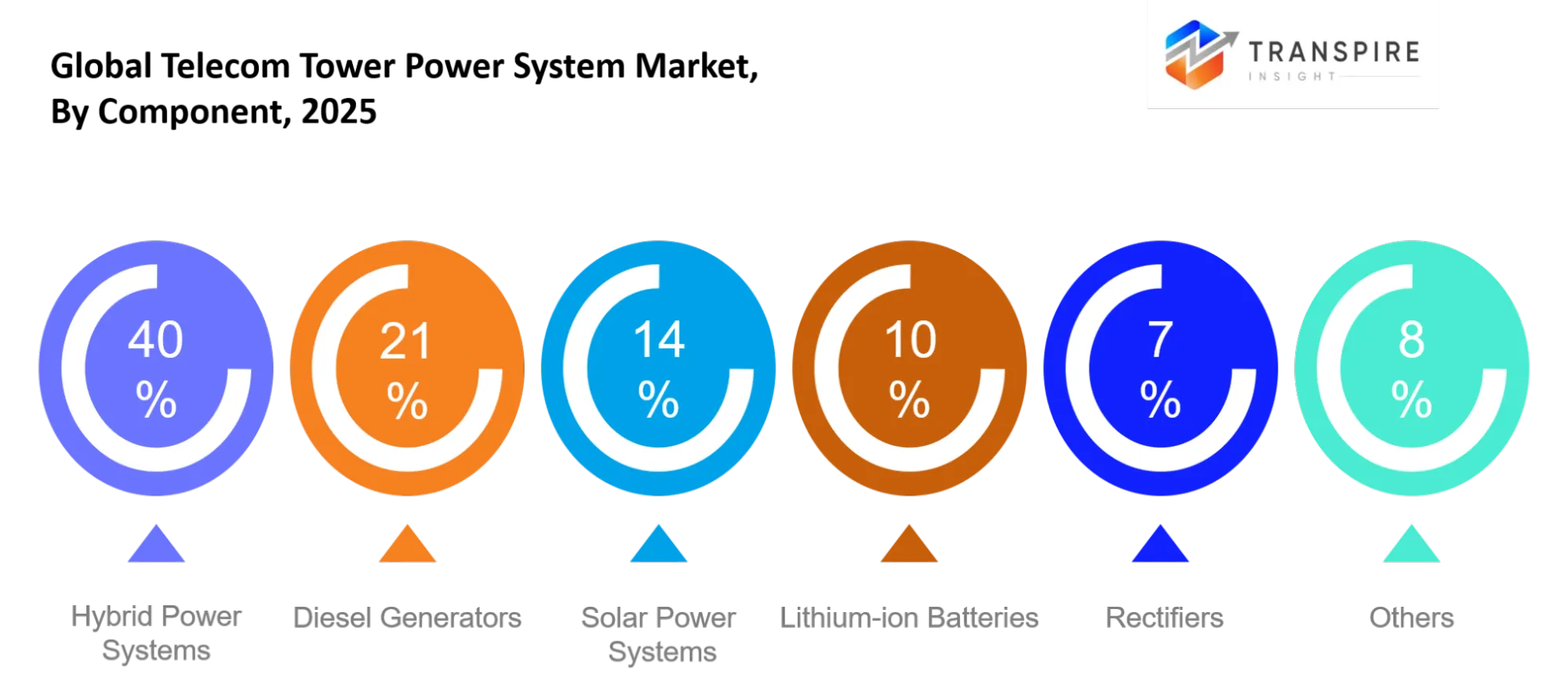
By Power Source:
Grid Power remains the dominant option for urban telecom sites because of its cost efficiency and stable supply, whereas Hybrid Power is expanding rapidly by combining multiple energy sources for uninterrupted operations. Solar Power, Wind Power, Fuel Cell Systems, and Battery Backup Systems are gaining momentum as operators pursue sustainability and lower operating costs.
By Tower Type:
While Macro Towers continue to hold the greatest market share due to supporting wide-reaching 4G and 5G network coverage, Small Cell Towers and Rooftop Towers are gradually increasing their market share with network densification happening in major cities.
By End User:
Telecom Operators remain the primary investors owing to continuous network expansion, followed by Tower Infrastructure Companies that increasingly adopt shared, energy-efficient tower models. Government Organisations, Internet Service Providers, Rural Connectivity Providers, Defence Networks, and Private Network Operators are also expanding investments to strengthen digital infrastructure.
By Application:
4G Networks continue to represent the largest installed base, while 5G Networks are emerging as the fastest-growing application due to higher power requirements and dense network deployment. Rural Connectivity, Smart City Infrastructure, Emergency Communication, Urban Networks, and Private LTE Networks are expected to generate sustained demand for intelligent, resilient, and renewable-powered telecom tower energy systems over the coming years.
What are the Key Use Cases Driving the Global Telecom Tower Power System Market?
The primary use case for this technology is to support the 4G and 5G telecom towers where the usage of hybrid power systems (40%) for network resilience, while consuming less diesel and maintaining lower operation costs, is becoming critical to operate networks reliably.
Additional use cases of the same hybrid power system can be for the implementation of rural connectivity, smart city deployment, rooftop towers, and shared towers, where the telecom operators blend Solar, battery, and grid power for more reliable solutions.
Private LTE, Defense networks, emergency communication networks, and smart tower management (AI-based energy management, monitoring, etc.) are some emerging applications.
|
Report Metrics |
Details |
|
Market size value in 2025 |
USD 5.94 Billion |
|
Market size value in 2026 |
USD 6.46 Billion |
|
Revenue forecast in 2033 |
USD 11.66 Billion |
|
Growth rate |
CAGR of 8.80% from 2026 to 2033 |
|
Base year |
2025 |
|
Historical data |
2021 - 2024 |
|
Forecast period |
2026 - 2033 |
|
Report coverage |
Revenue forecast, competitive landscape, growth factors, and trends |
|
Regional scope |
United States; Canada; Mexico; United Kingdom; Germany; France; Italy; Spain; Denmark; Sweden; Norway; China; Japan; India; Australia; South Korea; Thailand; Brazil; Argentina; South Africa; Saudi Arabia; United Arab Emirates |
|
Key company profiled |
Huawei, Vertiv, Delta Electronics, Schneider Electric, Eaton, Cummins, ABB, Eltek, Nokia, ZTE, Narada Power, Hitachi Energy, Mitsubishi Electric, Alpha Technologies, Delta Power Solutions. |
|
Customization scope |
Free report customization (country, regional & segment scope). Avail customized purchase options to meet your exact research needs. |
|
Report Segmentation |
By Component (Rectifiers, Power Controllers, Lithium-ion Batteries, Lead-acid Batteries, Diesel Generators, Hybrid Power Systems, Solar Power Systems, Others); By Power Source (Grid Power, Diesel Power, Solar Power, Wind Power, Hybrid Power, Fuel Cell Systems, Battery Backup Systems, Others); By Tower Type (Macro Towers, Rooftop Towers, Monopoles, Guyed Towers, Small Cell Towers, Camouflaged Towers, Distributed Towers, Others); By End User (Telecom Operators, Tower Infrastructure Companies, Internet Service Providers, Government Organizations, Private Network Operators, Rural Connectivity Providers, Defense Networks, Others); By Application (4G Networks, 5G Networks, Rural Connectivity, Urban Networks, Smart City Infrastructure, Emergency Communication, Private LTE Networks, Others) |
Which Regions are Driving the Global Telecom Tower Power System Market?
The Asia Pacific region accounted for the biggest market share of around 44% due to widespread expansion in telecom infrastructure, implementation of large 4G/5G projects, and active government initiatives on digital connectivity. Countries in this region, such as China, Japan, India, and Southeast Asian countries, continue to focus on the modernisation of towers and broadband connectivity in rural areas. Availability of a mature battery manufacturing industry and robust hybrid power ecosystem in this region strengthens long-term leadership prospects for the market. In June 2026, Japan launched the Digital Corridor Concept, funding eight major infrastructure projects connecting Taiwan and India to enhance supply chain resilience.
The region makes up 21% of global spending with a largely developed telecommunications infrastructure that incentivises upgrades and consolidation over new tower deployments. Similar to Asia Pacific, North America shows a clear emphasis on operational efficiency, power consumption, and resilience in operations. Environmental policies are driving demand for smart power management and hybrid power solutions in these areas. With robust grid reliability, a well-established digital ecosystem, and high tech adoption rates, steady growth is expected in tower additions in this region.
In February 2026, Infineon invested €500 million to expand manufacturing capacity for data centre and smart power management chips. This expansion provides the high-efficiency components required by hyperscalers and telecom providers to meet their power consumption needs.
The MEA region is the fastest-growing market, growing at an 18.1% CAGR due to rural connectivity growth plans and accelerated investment in telecom across underserviced markets. Private sector operators and the government are increasingly deploying hybrid solar solutions to power off-grid towers and cope with unreliability. Digital and green initiatives supported by international investment have created a favourable operating environment. We anticipate opportunities in off-grid tower growth, AI-powered remote tower monitoring, and green energy solutions for emerging markets.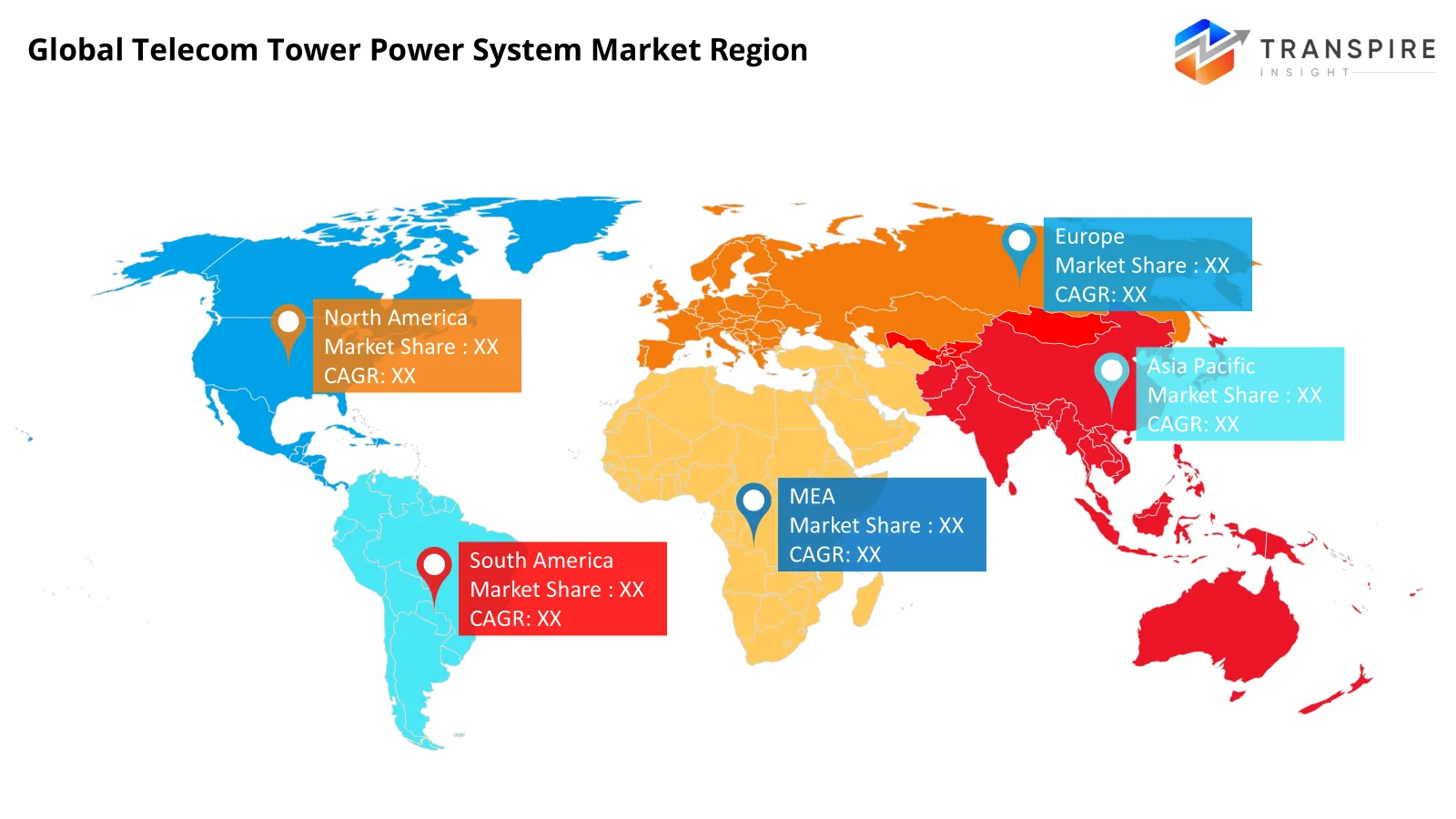
Who are the Key Players in the Global Telecom Tower Power System Market, and how do they compete?
Power is shifting from backup devices toward an emphasis on energy efficiency, intelligent management, renewability, and lifecycle cost. Digital offerings, batteries,s and hybrid energy architectures are a growing focus as vendors look to support expanding 5G deployment. Huawei, Vertiv, Delta Electronics, Schneider Electric, Eaton, Cummins, ABB and Eltek differentiate through the implementation of digital technology and the delivery of complete energy management solutions, with Huawei expanding AI capabilities to hybrid power systems, while Vertiv develops flexible infrastructure and remotely monitored solutions.
Schneider Electric and ABB offer broadened digital energy ecosystems; Eaton enhances resilient power protection solutions; Cummins drives more eco-friendly backup generation technologies; Delta Electronics refines high-efficiency rectifiers; and Eltek provides modular solutions for tight power demands within telecommunications equipment spaces.
Nokia, ZTE, Narada Power, Hitachi Energy, Mitsubishi Electric, Alpha Technologies and Delta Power Solutions leverage telecommunications and renewable based energy to expand, with Nokia, ZTE embedding energy systems with networking infrastructure, Narada Power improving battery technology to high efficiency Lithium ones, Hitachi Energy concentrating on grid integrated renewable infrastructure, Mitsubishi Electric with highly efficient electronics and Alpha Technologies and Delta Power Solutions developing regional focused energy services.
Key Players are:
- Huawei
- Vertiv
- Delta Electronics
- Schneider Electric
- Eaton
- Cummins
- ABB
- Eltek
- Nokia
- ZTE
- Narada Power
- Hitachi Energy
- Mitsubishi Electric
- Alpha Technologies
- Delta Power Solutions.
Recent Development News
- In June 2026, nVent Electric plc launched its newly engineered nVent SCHROFF Smart DC Distribution Unit (DCDU). This product launch introduces billing-grade measurement, remote management, and advanced cybersecurity protocols at the individual circuit level.
- In July 2026, Stellantis N.V. entered into a definitive manufacturing joint venture and capital partnership with solid-state battery pioneer Factorial Energy. This long-term industrial commitment injects heavy capital into high-volume battery cell manufacturing lines.
https://ir.factorialenergy.com
What Strategic Insights Define the Future of the Global Telecom Tower Power System Market?
The world is shifting toward a fully autonomous, renewable, and software-defined infrastructure needed for higher power demands by 5G and tomorrow's 6G networks. A shift in competitive advantage will be made away from selling discrete pieces of hardware to a complete energy system, including artificial intelligence, hybrid power sources, storage batteries, and the capability to monitor remotely. Unforeseen risks are associated with relying on batteries with finite and essential mineral components, as well as semiconductor supply chains. However, AI could provide an answer as an orchestration layer managing power demand at literally thousands of telecom towers and increasing the use of clean energy sources. AI-powered systems will grow to dominate the market, combined with hybrid system designs and pay-as-you-go business models. Those that invest in manufacturing capabilities regionally, offer secure energy systems, and reliable storage will be able to benefit most from future growth in telco power.
Key Segmentations are:
By Component
- Rectifiers
- Power Controllers
- Lithium-ion Batteries
- Lead-acid Batteries
- Diesel Generators
- Hybrid Power Systems
- Solar Power Systems
- Others
By Power Source
- Grid Power
- Diesel Power
- Solar Power
- Wind Power
- Hybrid Power
- Fuel Cell Systems
- Battery Backup Systems
- Others
By Tower Type
- Macro Towers
- Rooftop Towers
- Monopoles
- Guyed Towers
- Small Cell Towers
- Camouflaged Towers
- Distributed Towers
- Others
By End User
- Telecom Operators
- Tower Infrastructure Companies
- Internet Service Providers
- Government Organizations
- Private Network Operators
- Rural Connectivity Providers
- Defense Networks
- Others
By Application
- 4G Networks
- 5G Networks
- Rural Connectivity, Urban Networks
- Smart City Infrastructure
- Emergency Communication
- Private LTE Networks
- Others
Regional Outlook
North America
- United States
- Canada
- Mexico
Europe
- Germany
- United Kingdom
- France
- Spain
- Italy
- Rest of Europe
Asia Pacific
- Japan
- China
- Australia & New Zealand
- South Korea
- India
- Rest of Asia Pacific
South America
- Brazil
- Argentina
- Rest of South America
Middle East & Africa
- Saudi Arabia
- United Arab Emirates
- South Africa
- Rest of the Middle East & Africa
Frequently Asked Questions
Find quick answers to common questions.
The Global Telecom Tower Power System Market size was valued at USD 5.94 billion in 2025 and is poised to reach USD 11.66 billion by 2033, expanding at an 8.80% CAGR.
Key segments for the Global Telecom Tower Power System Market are By Component (Rectifiers, Power Controllers, Lithium-ion Batteries, Lead-acid Batteries, Diesel Generators, Hybrid Power Systems, Solar Power Systems, Others); By Power Source (Grid Power, Diesel Power, Solar Power, Wind Power, Hybrid Power, Fuel Cell Systems, Battery Backup Systems, Others); By Tower Type (Macro Towers, Rooftop Towers, Monopoles, Guyed Towers, Small Cell Towers, Camouflaged Towers, Distributed Towers, Others); By End User (Telecom Operators, Tower Infrastructure Companies, Internet Service Providers, Government Organizations, Private Network Operators, Rural Connectivity Providers, Defense Networks, Others); By Application (4G Networks, 5G Networks, Rural Connectivity, Urban Networks, Smart City Infrastructure, Emergency Communication, Private LTE Networks, Others).
Growth is primarily driven by rapid 4G and 5G network expansion, increasing rural connectivity projects, rising adoption of hybrid and renewable power systems, and investments in energy-efficient telecom infrastructure.
The Global Telecom Tower Power System Market is led by major manufacturers, including Huawei, Vertiv, Delta Electronics, Schneider Electric, Eaton, Cummins, ABB, Eltek, Nokia, ZTE, Narada Power, Hitachi Energy, Mitsubishi Electric, Alpha Technologies, and Delta Power Solutions.
Asia Pacific, holding 44% of the market, leads through large-scale telecom tower deployments, strong 5G investments, expanding rural broadband programs, and a well-established manufacturing ecosystem for telecom power equipment.
Commercial opportunities are emerging in AI-enabled energy management, solar-hybrid telecom towers, lithium-ion battery deployment, energy-as-a-service models, and telecom infrastructure expansion across emerging economies.
- Huawei
- Vertiv
- Delta Electronics
- Schneider Electric
- Eaton
- Cummins
- ABB
- Eltek
- Nokia
- ZTE
- Narada Power
- Hitachi Energy
- Mitsubishi Electric
- Alpha Technologies
- Delta Power Solutions.
About the Authors

Mayur Shinde
I am Mayur Shinde, a Senior Research Analyst at Transpire Insight, specializing in the Automotive & Transportation and Information & Communication Technology (ICT) Industry. My work focuses on analyzing emerging market trends, technological advancements, competitive landscapes, and industry developments to deliver accurate, data-driven insights. I am passionate about transforming complex market information into clear, actionable content that helps businesses, professionals, and decision-makers stay informed and make confident strategic decisions.

Chakradhar Khansole
Chakradhar serves as the Research Director at Transpire Insight, bringing over 8 years of experience in technology, innovation, and strategic market intelligence. He specializes in transforming complex market data into actionable business insights that enable organizations to make informed, growth-oriented decisions. Recognized for his strategic vision and analytical expertise, Chakradhar leads high-impact research initiatives, delivering comprehensive market assessments, competitive intelligence, and forward-looking industry analysis.
Recently Published Reports
-
Apr 2026
3D Optical Profiler Market
3D Optical Profiler Market Size, Share & Analysis Report By Type (Desktop 3D Optical Profiler, and Portable 3D Optical Profiler), By Technology (Confocal Technology, and White Light Interference), By End-Use Industry (Manufacturing, Research Institutions, Automotive, Aerospace and Defense, Medical Devices, and Other), and Geography (North America, Europe, Asia-Pacific, Middle East and Africa, South and Central America), 2021 - 2031
-
Apr 2026
Depth Sensor Market
Depth Sensor Market Size, Share & Analysis Report By Type (Infrared Depth Sensors, Time-of-Flight (ToF) Sensors, Stereo Vision Sensors, Structured Light Sensors, Ultrasonic Depth Sensors), By Application (Automotive, Robotics, Gaming, Consumer Electronics, Industrial Automation, Healthcare, Security & Surveillance, Others), By End Users (Automotive Manufacturers, Consumer Electronics Companies, Healthcare Providers, Industrial Companies, Security Agencies, Gaming Companies, Robotics Companies, Others), and Geography (North America, Europe, Asia-Pacific, Middle East and Africa, South and Central America), 2021 – 2031
-
Apr 2026
Digital Manufacturing Market
Digital Manufacturing Market Size, Share & Analysis Report By Component (Hardware, Software, and Services), By Technology (Robotics, 3D Printing, Internet of Things (IoT), and Others), By Application (Automotive and Transportation, Aerospace and Defense, Consumer Electronics, Industrial Machinery, and Others), By Process Type (Computer-Based Designing, Computer-Based Simulation, Computer 3D Visualization, Analytics, and Others), and Geography (North America, Europe, Asia-Pacific, Middle East and Africa, South and Central America), 2021 – 2031
-
Apr 2026
Digital Visa Services Market
Digital Visa Services Market Size, Share & Analysis Report By Type (Individual Travelers, Group Travelers), By Application (Tourism, Business Travel, Others), and Geography (North America, Europe, Asia-Pacific, Middle East and Africa, South and Central America), 2021 – 2031