
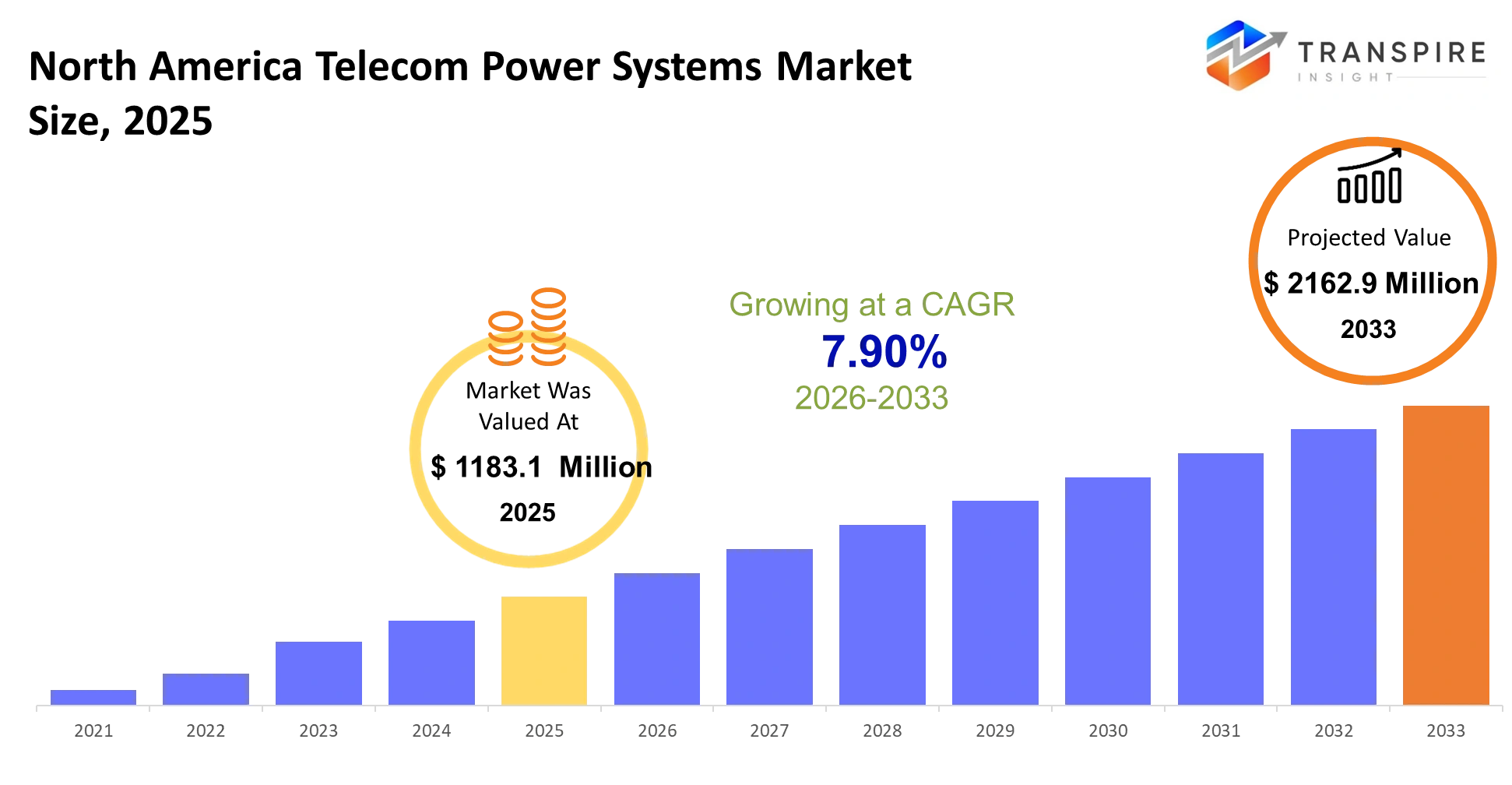
North America Telecom Power Systems Market Size & Forecast:
- North America Telecom Power Systems Market Size 2025: USD 1183.1 Million
- North America Telecom Power Systems Market Size 2033: USD 2162.9 Million
- North America Telecom Power Systems Market CAGR: 7.90%
- North America Telecom Power Systems Market Segments: By Component (Rectifiers, Batteries, Controllers), By Power Source (Grid, Renewable, Hybrid), By End-User (Telecom Operators, Data Centers).
To learn more about this report,  Download Free Sample Report
North America Telecom Power Systems Market Summary:
The North America Telecom Power Systems Market size is estimated at USD 1183.1 Million in 2025 and is anticipated to reach USD 2162.9 Million by 2033, growing at a CAGR of 7.90% from 2026 to 2033. The North America (Canada, the United States, and Mexico) Telecom Power Systems Market functions as part of the telecommunications infrastructure sector which requires continuous power supply to maintain network operational reliability. The upcoming 5G expansion together with edge computing will create a data consumption surge which will make operators need to invest in backup systems that provide both reliability and energy efficiency. Service providers must update their power infrastructure to include lithium-ion batteries and hybrid systems because consumers now demand uninterrupted connectivity. The regulation of emissions will drive businesses to implement cleaner energy solutions while remote monitoring systems will create new methods for equipment maintenance. The market will develop according to digital requirements and sustainability standards which will determine the design of upcoming telecom networks.
Key Market Trends & Insights:
The Telecom Power Systems Market in North America which includes Canada the United States and Mexico sees operators moving toward energy storage systems which provide operational cost efficiency and dependable service. Network providers will start using lithium-ion batteries because they need equipment that lasts longer and needs less maintenance. The new procurement approach will consist of vendors providing systems which can be expanded and modified to meet city population needs and remote area service demands.
Telecom providers will start using more renewable energy sources in their power systems because their sustainability goals become more important. Solar-powered base stations together with hybrid energy systems will become standard equipment in areas that lack power grids and in rural areas. The United States and Canada will back cleaner technology deployments through regulatory measures while Mexico will modify its policies to draw infrastructure investments which meet environmental protection and energy efficiency requirements.
Telecom networks will implement remote monitoring together with intelligent power management as common operational methods. Operators will use predictive analytics to detect impending failures which will enable them to maintain service availability while cutting their operational expenses. Organizations will obtain centralized management capabilities through cloud-based control systems which will enable them to monitor remote assets and achieve faster operational response times while optimizing network energy usage across extensive infrastructure systems.
Infrastructure decisions will be shaped by consumer demand for constant connectivity because people increasingly use digital services and mobile applications. Telecom companies will invest in more resilient backup systems to handle extreme weather conditions and grid instability. The demand for reliability will drive development of compact power systems which deliver high capacity power to urban networks and support rural network expansion efforts.
North America Telecom Power Systems Market Segmentation
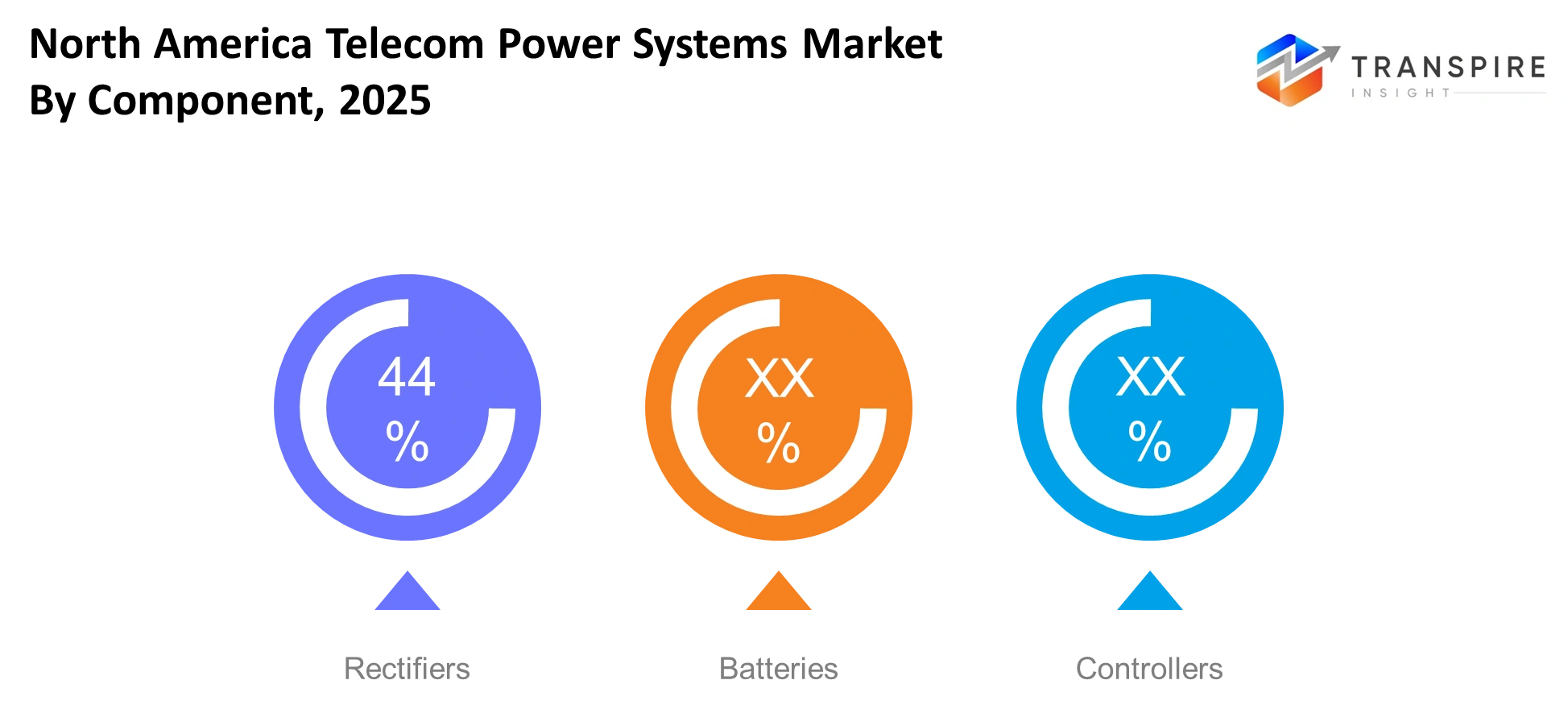
By Component
Rectifiers- Telecom energy systems will depend on rectifiers because they transform alternating current into direct current which network equipment needs for operation. Future networks will require two design elements which include increased efficiency and smaller equipment footprints to handle high traffic volumes. The market will develop smart rectifiers which include performance tracking systems to enable operators to monitor system operations from distant locations. The demands of network traffic which will increase because of data growth require organizations to implement adaptive rectification systems which maintain consistent power supply.
Batteries- Telecom services will depend on batteries to maintain operations during times when electricity grids encounter failures or when demand reaches its highest point. Lithium-ion technology will continue to dominate the market because it outperforms traditional battery systems through extended lifespan and faster charging capabilities and smaller size. The operators will select battery systems which enable them to grow their operations because the systems require no additional work after installation. The telecom sector will develop recycling programs to address environmental issues while creating safe storage methods which produce sustainable results for their infrastructure.
Controllers- Telecom power systems will use controllers as their main intelligence system which controls electricity distribution while maintaining operational safety. These units will support real-time power and network demand adjustments through their advanced software capabilities which will be part of their future development. The development of remote automated operations will enable controllers to perform two main tasks which involve detecting faults and conducting predictive maintenance. Operators will need to improve operational efficiency while decreasing downtime which will require better connections between digital network management systems and their operations.
To learn more about this report, Download Free Sample Report
By Power Source
Grid- Telecom networks in urban and suburban areas will rely on grid-based power as their main energy source. The operators will increase their grid usage because they want to improve their backup systems which will help them handle power outages and voltage changes. Smart grid technology will enable telecom systems to work better with power distribution networks. The operators will implement advanced monitoring systems to track power usage while maintaining network stability because of ongoing electricity price increases and power supply reliability issues.
Renewable- Telecom companies will rely on renewable sources of energy because they will need to fulfill their environmental requirements. Solar power will be the main source of electricity in the remote sites because it provides these sites with electricity without the need to use diesel generators. Energy storage innovations will enable continuous renewable energy usage even when renewable energy supply experiences fluctuations. Telecom operators will increasingly view renewable integration as both a sustainability measure and a long-term cost management strategy.
Hybrid- Hybrid power systems will use both grid power and renewable energy sources to provide operators with flexible and resilient energy solutions. These setups enable telecom operators to control power distribution in various operational contexts which include busy urban areas and remote rural locations. The system will achieve maximum operational effectiveness by using intelligent power source switching methods that guarantee stable performance. Hybrid systems will enable operators to decrease their fuel usage and greenhouse gas emissions which makes them an effective solution for operators who want to achieve their operational targets while protecting the environment.
By End-User
Telecom Operators- Telecom operators will continue to use advanced power systems because they need to provide continuous network service throughout their growing service areas. Operators will spend money on energy solutions which can handle their increasing data traffic and expanding 5G network deployment. The company will select systems which deliver monitoring capabilities at present time and decrease operational interruptions and enable them to handle different weight situations. The company will use this approach to determine its future infrastructure development needs and its selection of technology vendors.
Data Centers- Data centers will increasingly rely on robust telecom power systems to support continuous data processing and storage demands. The facilities need backup systems which can operate at a high level of reliability while their digital services continue to grow. The operators will implement advanced battery storage systems together with intelligent control technologies to decrease their downtime risk. Data center operations will be designed to achieve business goals and environmental objectives through the use of renewable power sources and hybrid energy systems.
Regional Insights
Telecom infrastructure development in the United States will continue because digital consumption growth and 5G technology implementation. Power system strategies will shift toward higher efficiency and resilience as operators prepare for heavier network loads. Extreme weather patterns will push organizations to invest in stronger backup solutions while regulatory pressure on emissions will guide them toward cleaner energy adoption. Vendors will respond by offering smarter compact systems that operate in both dense urban areas and dispersed network spaces.
Telecom energy systems in Canada will undergo continuous change because of the country's extensive land area and its various climate conditions. The demand for hybrid and renewable-powered installations will rise in remote areas because they provide an alternative to diesel-based systems. Operators will choose advanced battery storage and remote monitoring tools because their main requirement is to maintain operations during severe weather conditions. Government policies that support clean energy will direct infrastructure development plans while they link telecom operations to national sustainability objectives.
Mexico will modernize its telecom power networks through better infrastructure delivery which will meet growing connectivity demands in both urban centers and rural areas. The funding will target two main objectives which are to enhance network reliability and to provide service to areas that currently lack connectivity. The market will show increased interest in hybrid power systems because of different levels of grid power availability, while organizations that need to control expenses will choose their technological solutions based on their financial requirements. Telecom companies will receive policy changes that create investment opportunities which will lead to better infrastructure development and the adoption of sustainable energy solutions.
Service providers will work together with technology vendors at the regional level because network systems become increasingly complicated and interconnected. North American operators will need to implement advanced energy management systems which will enable them to provide constant network service to their customers. The three nations will develop their systems according to their regulatory differences and infrastructure evolution stages but they will maintain a common goal of implementing efficient sustainable systems which can maintain operational stability throughout their development process.
Recent Development News
United States: Large-Scale Network Modernization and Energy Resilience Push
Recent developments in the United States highlight aggressive investment in telecom infrastructure, with major operators committing billions toward upgrading networks for AI-driven data demand. These upgrades will require more advanced and reliable power systems to support dense fiber and 5G deployments. At the same time, increasing weather-related disruptions have pushed telecom companies to strengthen backup energy strategies, including batteries and mobile power units, ensuring faster recovery and improved service continuity.
Canada: Telecom Expansion Aligned with AI and Clean Energy Goals
Canada has witnessed significant commitments from telecom providers to expand infrastructure while integrating advanced technologies such as artificial intelligence and data centers. These developments will increase pressure on telecom power systems to deliver consistent and efficient energy. At the same time, national priorities around sustainability are encouraging operators to adopt cleaner energy solutions, ensuring that network expansion aligns with long-term environmental targets and supports reliable connectivity across both urban and remote regions.
Mexico & Regional Trend: Hybrid Energy and Smart Power Innovation
Across Mexico and the broader North American region, telecom energy systems are evolving with a focus on hybrid power integration and intelligent energy use. Innovations such as converting backup batteries into active energy assets and the growing adoption of distributed energy systems are reshaping infrastructure planning. These changes will support more flexible and efficient operations, particularly in areas where grid reliability varies, while also preparing telecom networks for increasing digital and connectivity demands.
|
Report Metrics |
Details |
|
Market size value in 2025 |
USD 1183.1 Million |
|
Market size value in 2026 |
USD 1270.6 Million |
|
Revenue forecast in 2033 |
USD 2162.9 Million |
|
Growth rate |
CAGR of 7.90% from 2026 to 2033 |
|
Base year |
2025 |
|
Historical data |
2021 – 2024 |
|
Forecast period |
2026 – 2033 |
|
Report coverage |
Revenue forecast, competitive landscape, growth factors, and trends |
|
Country scope |
North America (Canada, The United States, and Mexico) |
|
Key company profiled |
Huawei Technologies Co. Ltd., Ericsson AB, Nokia Corporation, Schneider Electric SE, Delta Electronics Inc., Eaton Corporation plc, Vertiv Holdings Co., ABB Ltd., ZTE Corporation, Cummins Inc., Siemens AG, General Electric Company, Mitsubishi Electric Corporation, Eltek Ltd., Alpha Technologies Ltd. |
|
Customization scope |
Free report customization (country, regional & segment scope). Avail customized purchase options to meet your exact research needs. |
|
Report Segmentation |
By Component (Rectifiers, Batteries, Controllers), By Power Source (Grid, Renewable, Hybrid), By End-User (Telecom Operators, Data Centers). |
Key North America Telecom Power Systems Market Company Insights
The North America (Canada, the United States, and Mexico) aircraft windows and windshields market will be shaped by a competitive group of companies focusing on advanced transparency systems and long-term performance. PPG Industries, Gentex Corporation, GKN Aerospace, Saint-Gobain, and NORDAM will maintain their market positions through the development of new materials and their partnerships with aircraft manufacturers. The companies will dedicate financial resources to research electrochromic technologies and lightweight laminates and durability enhancement technologies. At the same time, smaller specialized suppliers will compete in retrofit and niche applications, which will lead to ongoing product development and technology progress.
Company List
- Huawei Technologies Co. Ltd.
- Ericsson AB
- Nokia Corporation
- Schneider Electric SE
- Delta Electronics Inc.
- Eaton Corporation plc
- Vertiv Holdings Co.
- ABB Ltd.
- ZTE Corporation
- Cummins Inc.
- Siemens AG
- General Electric Company
- Mitsubishi Electric Corporation
- Eltek Ltd.
- Alpha Technologies Ltd.
North America Telecom Power Systems Market Report Segmentation
By Component
- Rectifiers
- Batteries
- Controllers
By Power Source
- Grid
- Renewable
- Hybrid
By End-User
- Telecom Operators
- Data Centers
Frequently Asked Questions
Find quick answers to common questions.
The approximate North America Telecom Power Systems Market size for the market will be USD 2162.9 Million in 2033.
Key segments for the North America Telecom Power Systems Market By Component (Rectifiers, Batteries, Controllers), By Power Source (Grid, Renewable, Hybrid), By End-User (Telecom Operators, Data Centers).
Major players in the North America Telecom Power Systems Market are Huawei Technologies Co. Ltd., Ericsson AB, Nokia Corporation, Schneider Electric SE, Delta Electronics Inc., Eaton Corporation plc, Vertiv Holdings Co., ABB Ltd., ZTE Corporation, Cummins Inc., Siemens AG, General Electric Company, Mitsubishi Electric Corporation, Eltek Ltd., Alpha Technologies Ltd.
The North America Telecom Power Systems Market size is USD 1183.1 Million in 2025.
The North America Telecom Power Systems Market CAGR is 7.90%.
- Huawei Technologies Co. Ltd.,
- Ericsson AB
- Nokia Corporation
- Schneider Electric SE
- Delta Electronics Inc.
- Eaton Corporation plc
- Vertiv Holdings Co.
- ABB Ltd.
- ZTE Corporation
- Cummins Inc.
- Siemens AG
- General Electric Company
- Mitsubishi Electric Corporation
- Eltek Ltd.
- Alpha Technologies Ltd.
Recently Published Reports
-
Apr 2026
3D Optical Profiler Market
3D Optical Profiler Market Size, Share & Analysis Report By Type (Desktop 3D Optical Profiler, and Portable 3D Optical Profiler), By Technology (Confocal Technology, and White Light Interference), By End-Use Industry (Manufacturing, Research Institutions, Automotive, Aerospace and Defense, Medical Devices, and Other), and Geography (North America, Europe, Asia-Pacific, Middle East and Africa, South and Central America), 2021 - 2031
-
Apr 2026
Depth Sensor Market
Depth Sensor Market Size, Share & Analysis Report By Type (Infrared Depth Sensors, Time-of-Flight (ToF) Sensors, Stereo Vision Sensors, Structured Light Sensors, Ultrasonic Depth Sensors), By Application (Automotive, Robotics, Gaming, Consumer Electronics, Industrial Automation, Healthcare, Security & Surveillance, Others), By End Users (Automotive Manufacturers, Consumer Electronics Companies, Healthcare Providers, Industrial Companies, Security Agencies, Gaming Companies, Robotics Companies, Others), and Geography (North America, Europe, Asia-Pacific, Middle East and Africa, South and Central America), 2021 – 2031
-
Apr 2026
Digital Manufacturing Market
Digital Manufacturing Market Size, Share & Analysis Report By Component (Hardware, Software, and Services), By Technology (Robotics, 3D Printing, Internet of Things (IoT), and Others), By Application (Automotive and Transportation, Aerospace and Defense, Consumer Electronics, Industrial Machinery, and Others), By Process Type (Computer-Based Designing, Computer-Based Simulation, Computer 3D Visualization, Analytics, and Others), and Geography (North America, Europe, Asia-Pacific, Middle East and Africa, South and Central America), 2021 – 2031
-
Apr 2026
Digital Visa Services Market
Digital Visa Services Market Size, Share & Analysis Report By Type (Individual Travelers, Group Travelers), By Application (Tourism, Business Travel, Others), and Geography (North America, Europe, Asia-Pacific, Middle East and Africa, South and Central America), 2021 – 2031