
Market Summary
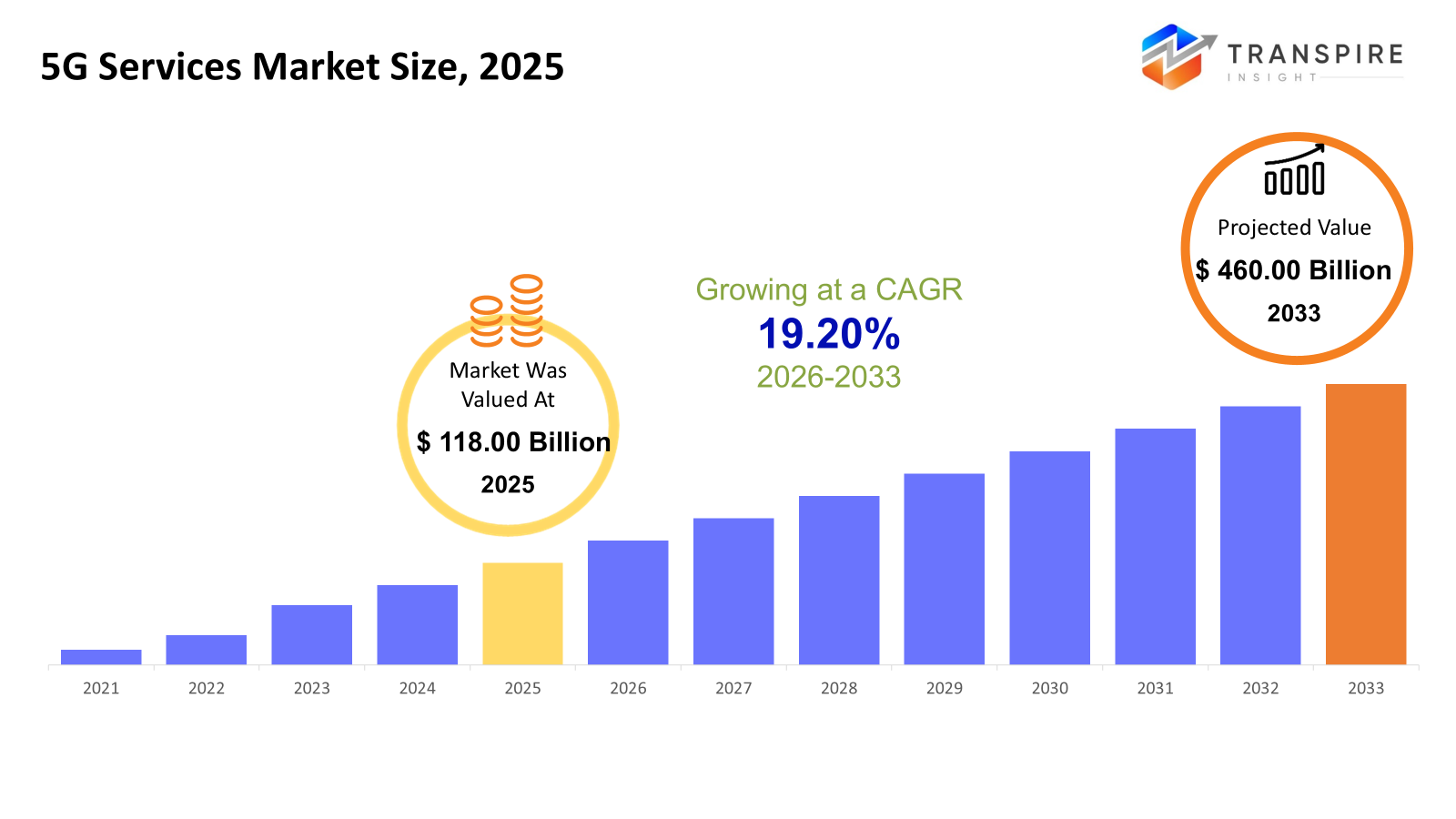
The global 5G Services market size was valued at USD 118.00 billion in 2025 and is projected to reach USD 460.00 billion by 2033, growing at a CAGR of 19.20% from 2026 to 2033. The 5G services market is witnessing high CAGR growth on account of the growing demand for high-speed and low-latency networks, while the growing trend of industrial digitalization, including automation, Internet of Things, and the development of private 5G networks, is further contributing to the growing demand for 5G services in the enterprise sector. Spectrum allocation by governments, development, and smart city projects are further supplementing the development of 5G networks across the world. The integration of 5G networks and cloud, edge, and artificial intelligence technologies is further opening up new avenues for the development of 5G services.
Market Size & Forecast
- 2025 Market Size: USD 118.00 Billion
- 2033 Projected Market Size: USD 460.00 Billion
- CAGR (2026-2033): 19.20%
- North America: Largest Market in 2026
- Asia Pacific: Fastest Growing Market
To learn more about this report,  Download Free Sample Report
Key Market Trends Analysis
- In North America, the incumbent carriers are focusing on improved mobile broadband along with private enterprise networks. The infrastructure expenditure in North America is encouraging the adoption of 5G technology.
- The United States maintains leadership in terms of growth in the region, especially through their efficient use of the spectrum, the rollout of fixed wireless access, as well as demands from companies for low-latency networks to facilitate cloud computing, automation, and immersive digital experiences.
- The Asia Pacific is seeing a rapid growth of 5G networks in China, Japan, and South Korea, where it is buoyed by support and smart city projects as well as a huge number of industrial automation activities.
- Enhanced Mobile Broadband has been identified as the leading communications segment due to the increased demand for high-speed data, immersive media experiences, cloud-based collaboration solutions, and the need for constant connectivity in the mobile world.
- Manufacturing is the most prominent industry vertical where businesses have adopted the use of private 5G networks to enable various use cases such as the use of automation, robots, predictive maintenance, and digital twins.
So, The 5G service market is inclusive of the commercial provision of next-generation wireless networking capability. This is intended to provide ultra-fast speeds of data transfer along with low latency results. The services are also inclusive of communications models. These may vary from mobile broadband communications through to mission-critical communication. They also extend to massive machine-type communications. The services may be used both by individuals as well as businesses. Market demand is influenced by increasing mobile data traffic volumes, the growing need for cloud-based applications, and the increasing use of connected devices. Consumers enjoy improved streaming services, gaming capabilities, and immersive experiences, while businesses can use the power of 5G networks to provide the avenues needed for automation, analytics, and remote delivery. The capabilities of 5G networks to provide stable performance under dense usage are contributing to their utility in urban and industrial environments. Continuous investment in telecom infrastructure, along with technology development in network slicing and edge computing, enables the scaling of services and personalization. The strategic collaboration of telecom operators with cloud providers and technology vendors has further accelerated the deployment and innovation processes. The 5G services market is projected to emerge as a foundational enabler for next-generation connectivity in mature digital ecosystems across the world.
5G Services Market Segmentation
By Communication Type
- Fixed Wireless Access (FWA)
This provides broadband connectivity with no requirement for physical cables. The ideal areas where it can be used are suburban and rural. It will allow residence homes and small businesses to connect safely and economically with high-speed internet by replacing the divergences in digital divides. Adopted as an alternative to traditional wired broadband in regions where fiber rollout is moving slowly
- Enhanced Mobile Broadband (eMBB)
Ultra-high-speed mobile broadband for applications like high definition streaming, cloud services, AR/VR, and gaming. It finds applications in high demand for wireless connectivity both in routine life and enterprise. It will change the user experience by reducing buffering, increasing download speed, and allowing data-intensive applications
- Ultra Reliable Low Latency Communications (uRLLC)
uRLLC is focused on providing instant and highly reliable wireless communication for use cases such as autonomous vehicles, industrial robots, and telemedicine. The latency involved in this type of communication is minimal, measured in milliseconds, which is extremely important for applications related to real time decision-making, mainly in industrial sectors.
- Massive Machine-Type Communications (mMTC)
This technology enables the connection of a massive number of IoT devices. This is needed in smart homes, smart cities, as well as in automated factories. Its application in massive IoT is critical due to the increasing use of IoT.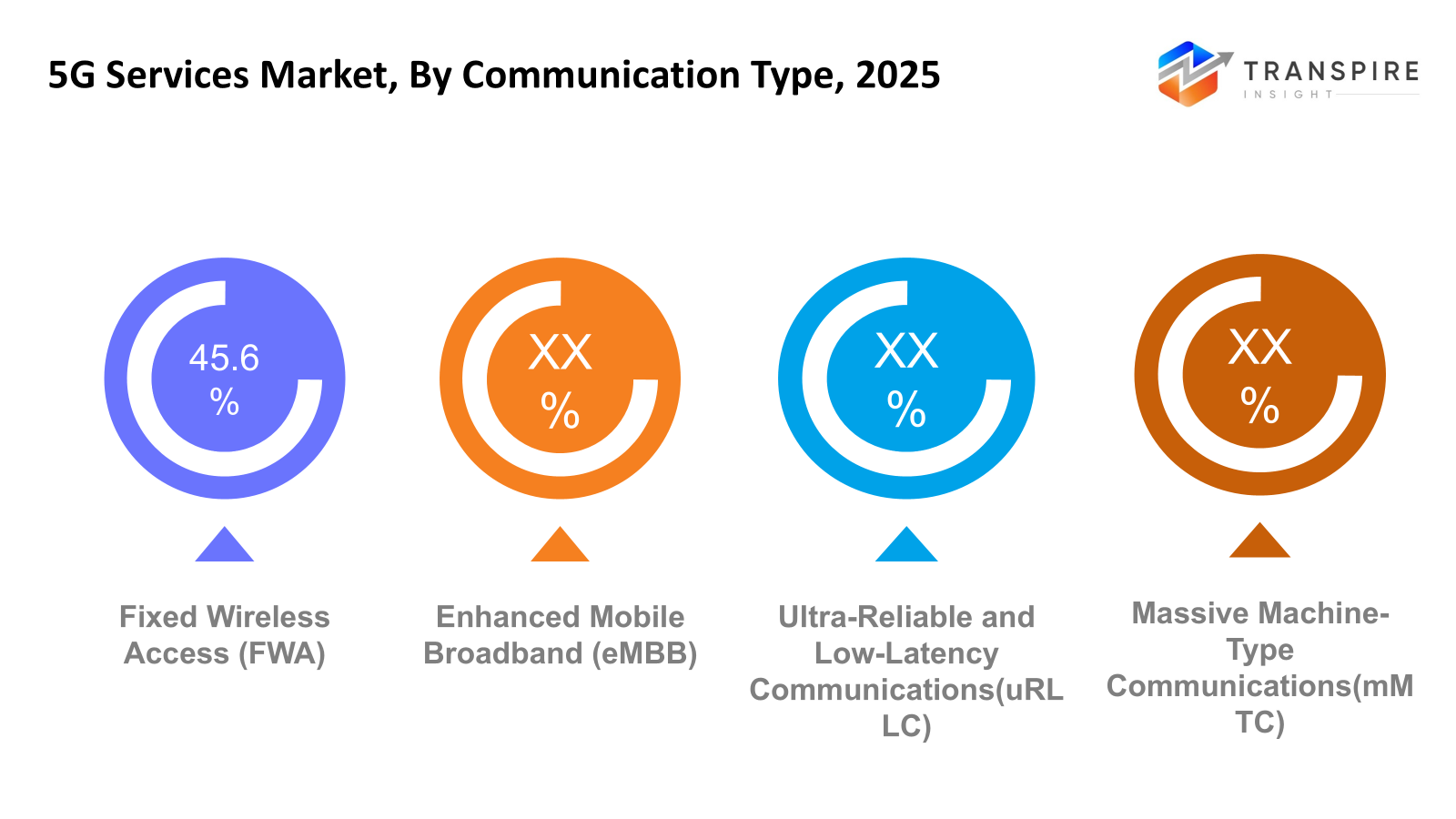
To learn more about this report, Download Free Sample Report
By Industrial Vertical
- Consumer
It improves online experiences by enabling fast streaming and download capabilities as well as device connectivity within a smart home setup. With 5G networks devices can have stable connectivity for a seamless viewing experience with applications such as streaming and gaming.
- Enterprises
5G helps in IoT-enabled business operations and collaboration platforms will enable 5G networks for enterprises. Businesses can enjoy the benefits of data connectivity and automation for increased efficiency and innovation.
- Manufacturing
- 5G Drives industrial automation, robotics, predictive maintenances, and real-time monitoring. The use of 5G networks cuts down downtime, increase productivity and facilitates smart manufacturing facilities by transforming conventional factories.
- Public Safety
5G enables instant communication, video communication, and situational awareness for first responders. Enhances response capabilities for crisis situations, thus contributing to saving lives.
- Healthcare & Social Work
It helps in telemedicine, remote surgeries, patient wearable systems, and AI-based diagnosis. Healthcare can be made significantly more accessible and responsive, especially in areas that have limited healthcare infrastructure.
- Media & Entertainment
Ultra-high-definition streaming, AR/VR experiences, and cloud gaming. This creates immersive, seamless entertainment experiences for consumers, all while improving innovative content creation.
- Energy & Utility
Helps in smart grids, predictive maintenance, and real-time monitoring of energy systems. 5G enhances operational efficiency; it reduces outages and allows resource management in a very sustainable manner.
- IT & Telecom
5G accelerates cloud computing, AI, and edge computing applications. It provides strong, low-latency services to the telecom and IT provider for large-scale digital transformation initiatives.
- Transportation & Logistics
Enhanced fleet tracking, autonomous vehicle operations, and route optimization will be facilitated. 5G will help in ensuring safety and reducing delays, while smart logistics can be managed with the help of data.
- Aerospace & Defense
It enables secure, high-speed communication, real-time data processing, and operations of autonomous systems. 5G is critical in mission-critical situations in defense and aerospace applications to enhance operational safety and efficiency.
- BFSI
Supports real time trading, secure mobile transactions and improved customer services. Financial institutions have adopted 5G for faster, secure and efficient transactions.
- Government
Empowers e-governance, smart cities and the effectiveness of public services. The citizens receive accelerated digital services for better convenience and transparency.
- Retail
Facilitates smart checkouts, AR-based shopping and inventory management. 5G transforms the customer experience and optimizes supply chain management.
- Mining
Enables remote control of heavy machinery, real-time observation, and predictive maintenance. The innovation enhances labor safety as well as efficiency in dangerous settings.
- Oil & Gas Industry
Enables distant exploration, automated drilling, as well as pipeline surveillance. 5G networks lower risks and down time, as well as enhance the work efficacy within difficult terrains.
- Construction
Enables collaboration and autonomous equipment. 5G enables safe and efficient construction at a lower cost. In addition, 5G supports construction management.
- Real Estate
Enables virtual property tours, intelligent management of buildings, and IoT connectivity for facilities. The buyers as well as facility managers get immersive experiences.
Regional Insights
North America, with the United States, Canada, and Mexico, is considered a tier-1 market driven by advanced infrastructure, high consumer adoption, and strong demand from enterprises. The United States leads regional growth with large-scale deployments of spectrum and private investments in 5G networks, while Canada and Mexico are concentrating on expanding their coverage and improving rural connectivity.
The regions covered under Europe are Germany, United Kingdom, France, Spain, Italy, and the remaining countries of Europe, with Germany, United Kingdom, and France classified under tier 1, led by regulation initiatives, and the southern and eastern European countries under tier 2, with emphasis on mobile broadband. Asia-Pacific, comprising Japan, China, Australia & New Zealand, South Korea, India, and the remainder of the Asia-Pacific market, leads in market growth. China, Japan, and South Korea have emerged as tier 1 markets because of country-wide adoption, while India and Southeast Asia have emerged as tier 2 markets. South America - led by Brazil and Argentina - is a developing region, with 5G adoption driven by mobile broadband, while Middle East & Africa - led by Saudi Arabia and the UAE - is split between tier-1 smartphone-infrastructure adoption, as well as tier-2 adoption led by South Africa.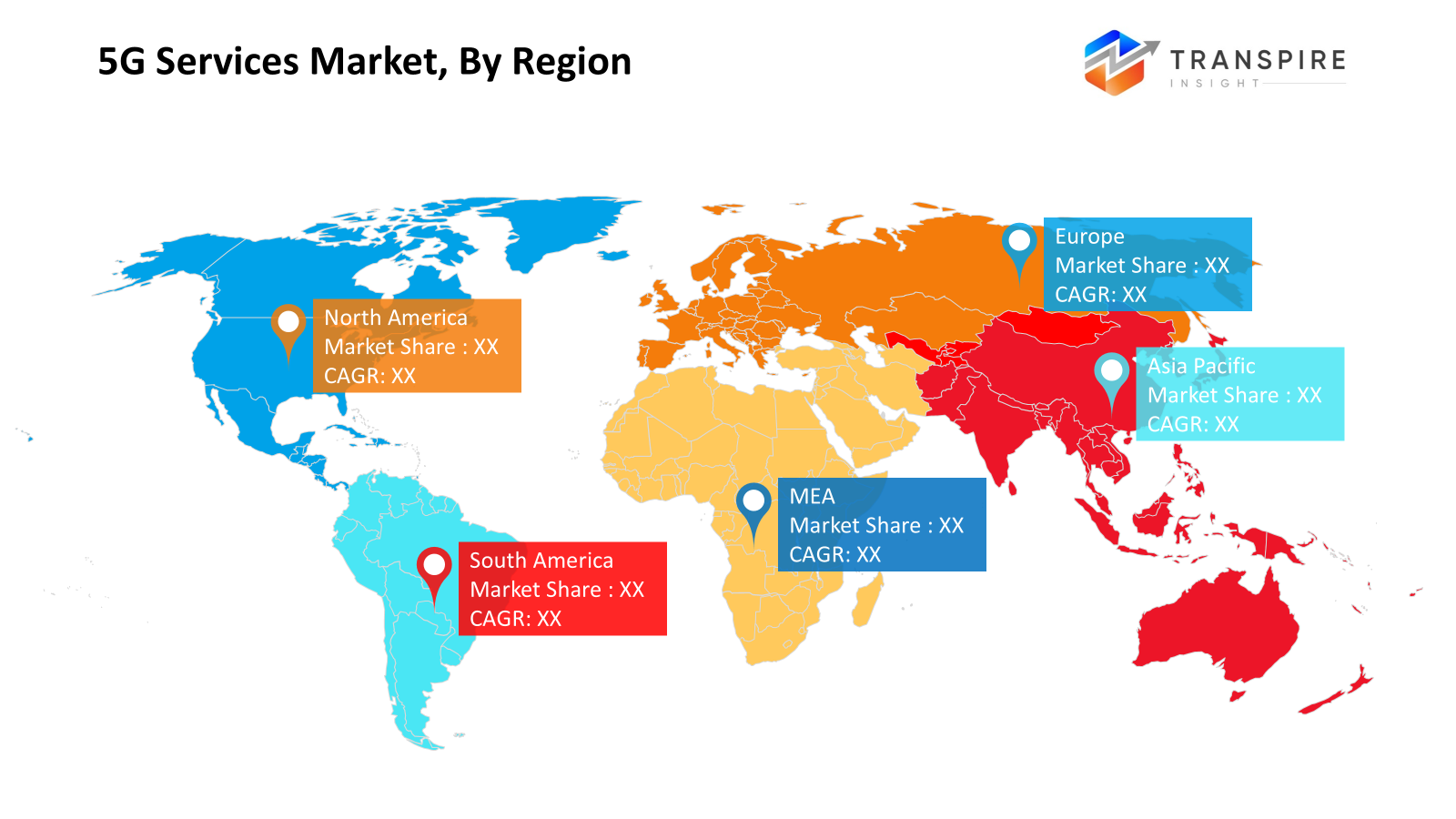
To learn more about this report, Download Free Sample Report
Recent Development News
- January 2026, Reliance Jio Platforms Ltd reported an increase of 11.2 % in its net profit in Q4 in the year 2025, which is largely driven by its increasing number of 5G subscribers and home broadband, thereby evidencing the success of the adoption of the 5G service in thefastest-growing countries in the world.
- January 2026, Ukraine’s most prominent telco, Kyivstar, launched the nation’s first local 5G trial area in the city of Lviv, and the test ambitions expanded to also include locations such as Kharkiv and Odesa, even in the war-torn nation. This shows resistance in the development of digital infrastructure even in rough times.
|
Report Metrics |
Details |
|
Market size value in 2025 |
USD 118.00 Billion |
|
Market size value in 2026 |
USD 135.00 Billion |
|
Revenue forecast in 2033 |
USD 460.00 Billion |
|
Growth rate |
CAGR of 19.20% from 2026 to 2033 |
|
Base year |
2025 |
|
Historical data |
2021 – 2024 |
|
Forecast period |
2026 – 2033 |
|
Report coverage |
Revenue forecast, competitive landscape, growth factors, and trends |
|
Regional scope |
North America; Europe; Asia Pacific; Latin America; Middle East & Africa |
|
Country scope |
United States; Canada; Mexico; United Kingdom; Germany; France; Italy; Spain; Denmark; Sweden; Norway; China; Japan; India; Australia; South Korea; Thailand; Brazil; Argentina; South Africa; Saudi Arabia; United Arab Emirates |
|
Key company profiled |
Verizon Communications Inc., AT&T Inc., China Mobile Ltd., China Telecom Corp. Ltd., Deutsche Telekom AG, Vodafone Group Plc, NTT Docomo Inc., SK Telecom Co., Ltd., T‑Mobile US, Inc., Orange S.A., Telefonica S.A., Bharti Airtel Ltd., KT Corporation, Cisco Systems, Inc., Intel Corporation |
|
Customization scope |
Free report customization (country, regional & segment scope). Avail customized purchase options to meet your exact research needs. |
|
Report Segmentation |
By Communication Type (Fixed Wireless Access (FWA), Enhanced Mobile Broadband (eMBB), Ultra-Reliable and Low-Latency Communications(uRLLC), Massive Machine-Type Communications(mMTC)), By Industrial Vertical (Consumer, Enterprises, Manufacturing, Public Safety, Healthcare & Social Work, Media & Entertainment, Energy & Utility, IT & Telecom, Transportation & Logistics, Aerospace & Defense, BFSI, Government, Retail, Mining, Oil & Gas, Agriculture, Construction, Real Estate) |
Key 5G Services Company Insights
Verizon Communications Inc. has the strongest positioning in the 5G services market in terms of the widespread availability of 5G Ultra Wideband in key cities across the USA, taking advantage of its mmWave and C-band spectrum to provide multi-gigabit speeds and ultra-low latency capabilities. The company's solid consumer and business presence allows Verizon to create differentiated offerings in 5G Home Internet and private 5G networks for industrial applications. Strategic partnering of Verizon in edge computing for AWS and Microsoft increases the attractiveness of its service offering and facilitates growth in profitable markets of IoT, AR/VR, and automations.
Key 5G Services Companies:
- Verizon Communications Inc.
- AT&T Inc.
- China Mobile Ltd.
- China Telecom Corp. Ltd.
- Deutsche Telekom AG
- Vodafone Group Plc
- NTT Docomo Inc.
- SK Telecom Co., Ltd.
- T‑Mobile US, Inc.
- Orange S.A.
- Telefonica S.A.
- Bharti Airtel Ltd.
- KT Corporation
- Cisco Systems, Inc.
- Intel Corporation
Global 5G Services market Report Segmentation
By Communication Type
- Fixed Wireless Access (FWA)
- Enhanced Mobile Broadband (eMBB)
- Ultra-Reliable and Low-Latency Communications(uRLLC)
- Massive Machine-Type Communications(mMTC)
By Industrial Vertical
- Consumer
- Enterprises
- Manufacturing
- Public Safety
- Healthcare & Social Work
- Media & Entertainment
- Energy & Utility
- IT & Telecom
- Transportation & Logistics
- Aerospace & Defense
- BFSI
- Government
- Retail
- Mining
- Oil & Gas
- Agriculture
- Construction
- Real Estate
Regional Outlook
- North America
- United States
- Canada
- Mexico
- Europe
- Germany
- United Kingdom
- France
- Spain
- Italy
- Rest of Europe
- Asia Pacific
- Japan
- China
- Australia & New Zealand
- South Korea
- India
- Rest of Asia Pacific
- South America
- Brazil
- Argentina
- Rest of South America
- Middle East & Africa
- Saudi Arabia
- United Arab Emirates
- South Africa
- Rest of the Middle East & Africa
Frequently Asked Questions
Find quick answers to common questions.
The approximate 5G Services Market size for the market will be USD 460.00 billion in 2033.
Key segments for the 5G Services Market are By Communication Type (Fixed Wireless Access (FWA), Enhanced Mobile Broadband (eMBB), Ultra-Reliable and Low-Latency Communications(uRLLC), Massive Machine-Type Communications(mMTC)), By Industrial Vertical (Consumer, Enterprises, Manufacturing, Public Safety, Healthcare & Social Work, Media & Entertainment, Energy & Utility, IT & Telecom, Transportation & Logistics, Aerospace & Defense, BFSI, Government, Retail, Mining, Oil & Gas, Agriculture, Construction, Real Estate).
Major 5G Services Market players are Verizon Communications Inc., AT&T Inc., China Mobile Ltd., Deutsche Telekom AG, Vodafone Group Plc.
The North America region is leading the 5G Services Market.
The CAGR of the 5G Services Market is 19.20%.
- Verizon Communications Inc.
- AT&T Inc.
- China Mobile Ltd.
- China Telecom Corp. Ltd.
- Deutsche Telekom AG
- Vodafone Group Plc
- NTT Docomo Inc.
- SK Telecom Co., Ltd.
- T‑Mobile US, Inc.
- Orange S.A.
- Telefonica S.A.
- Bharti Airtel Ltd.
- KT Corporation
- Cisco Systems, Inc.
- Intel Corporation
Recently Published Reports
-
Apr 2026
3D Optical Profiler Market
3D Optical Profiler Market Size, Share & Analysis Report By Type (Desktop 3D Optical Profiler, and Portable 3D Optical Profiler), By Technology (Confocal Technology, and White Light Interference), By End-Use Industry (Manufacturing, Research Institutions, Automotive, Aerospace and Defense, Medical Devices, and Other), and Geography (North America, Europe, Asia-Pacific, Middle East and Africa, South and Central America), 2021 - 2031
-
Feb 2025
Depth Sensor Market
Depth Sensor Market Size, Share & Analysis Report By Type (Infrared Depth Sensors, Time-of-Flight (ToF) Sensors, Stereo Vision Sensors, Structured Light Sensors, Ultrasonic Depth Sensors), By Application (Automotive, Robotics, Gaming, Consumer Electronics, Industrial Automation, Healthcare, Security & Surveillance, Others), By End Users (Automotive Manufacturers, Consumer Electronics Companies, Healthcare Providers, Industrial Companies, Security Agencies, Gaming Companies, Robotics Companies, Others), and Geography (North America, Europe, Asia-Pacific, Middle East and Africa, South and Central America), 2021 – 2031
-
Feb 2025
Digital Manufacturing Market
Digital Manufacturing Market Size, Share & Analysis Report By Component (Hardware, Software, and Services), By Technology (Robotics, 3D Printing, Internet of Things (IoT), and Others), By Application (Automotive and Transportation, Aerospace and Defense, Consumer Electronics, Industrial Machinery, and Others), By Process Type (Computer-Based Designing, Computer-Based Simulation, Computer 3D Visualization, Analytics, and Others), and Geography (North America, Europe, Asia-Pacific, Middle East and Africa, South and Central America), 2021 – 2031
-
Feb 2025
Digital Visa Services Market
Digital Visa Services Market Size, Share & Analysis Report By Type (Individual Travelers, Group Travelers), By Application (Tourism, Business Travel, Others), and Geography (North America, Europe, Asia-Pacific, Middle East and Africa, South and Central America), 2021 – 2031