

Global Power Inverter Market Size & Forecast:
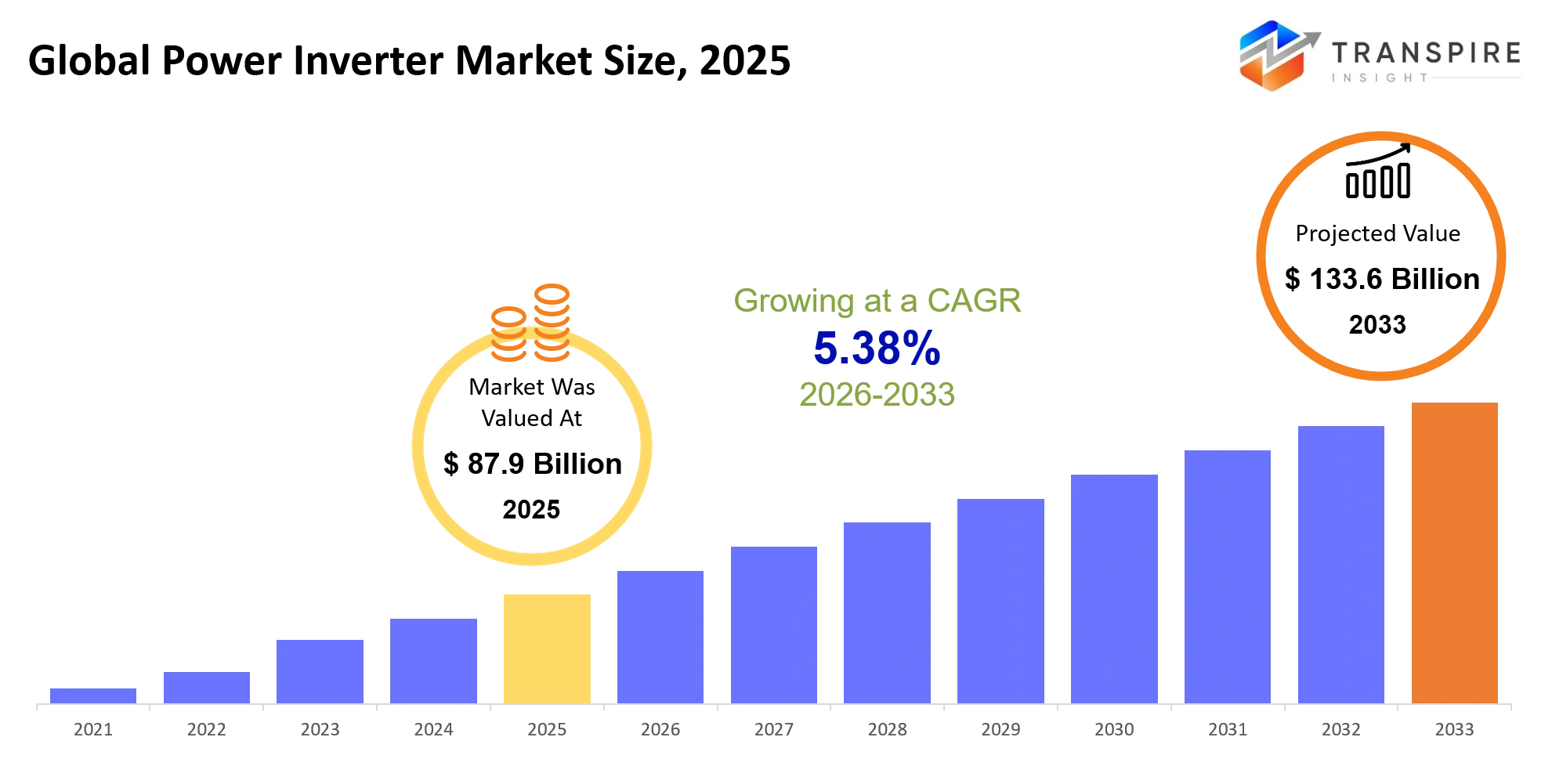
- Global Power Inverter Market Size 2025: USD 87.9 Billion
- Global Power Inverter Market Size 2033: USD 133.6 Billion
- Global Power Inverter Market CAGR: 5.38%
- Global Power Inverter Market Segments: By Type (Pure Sine Wave, Modified Sine Wave, Square Wave, Grid-Tied, Hybrid, Portable, Industrial, Others); By Power Rating (Below 1 kW, 1–5 kW, 5–10 kW, 10–50 kW, Above 50 kW, Utility Scale, Commercial Grade, Others); By Application (Residential, Commercial, Industrial, Automotive, Solar Systems, UPS Systems, Telecom Infrastructure, Others); By End User (Households, Utilities, Enterprises, Industries, Government, Telecom Operators, Data Centers, Others); By Distribution Channel (Direct Sales, Dealers, Retail Stores, Online Platforms, OEMs, Distributors, System Integrators, Others).
Global Power Inverter Market Summary:
As per Transpire Insight Analysis, the Global Power Inverter Market size is estimated at USD 87.9 Billion in 2025 and is anticipated to reach USD 133.6 Billion by 2033, growing at a CAGR of 5.38% from 2026 to 2033.
The global power inverter market is getting bigger because people need to be able to change electricity from one type to another. Power inverters are very important for changing direct current electricity into alternating current electricity that people can use. This is useful for things like backup power systems and systems that use energy from the sun.
The power inverter market is changing. Now people like to use hybrid and smart power inverters that can do things like work with solar panels and batteries and the main power grid.
big change is that people are making their energy at home with solar panels on their roofs and batteries to store energy. This is happening because electricity is getting more expensive and the main power grid is not always working well. The government is also helping by making programs to support energy from the sun. People want to be able to use energy when they need it. They want to use energy in a way that is good for the environment. So, they are buying power inverters. The companies that make power inverters are making them better by adding features like monitoring systems and making them work efficiently with other energy systems. The power inverter market is going to keep getting bigger.
Key Market Insights:
The industry is not only expanding from its conventional application base but is becoming a necessity in contemporary energy infrastructure. Technology development and the increasing use of renewable energy sources are changing the competitive scenario in the industry.
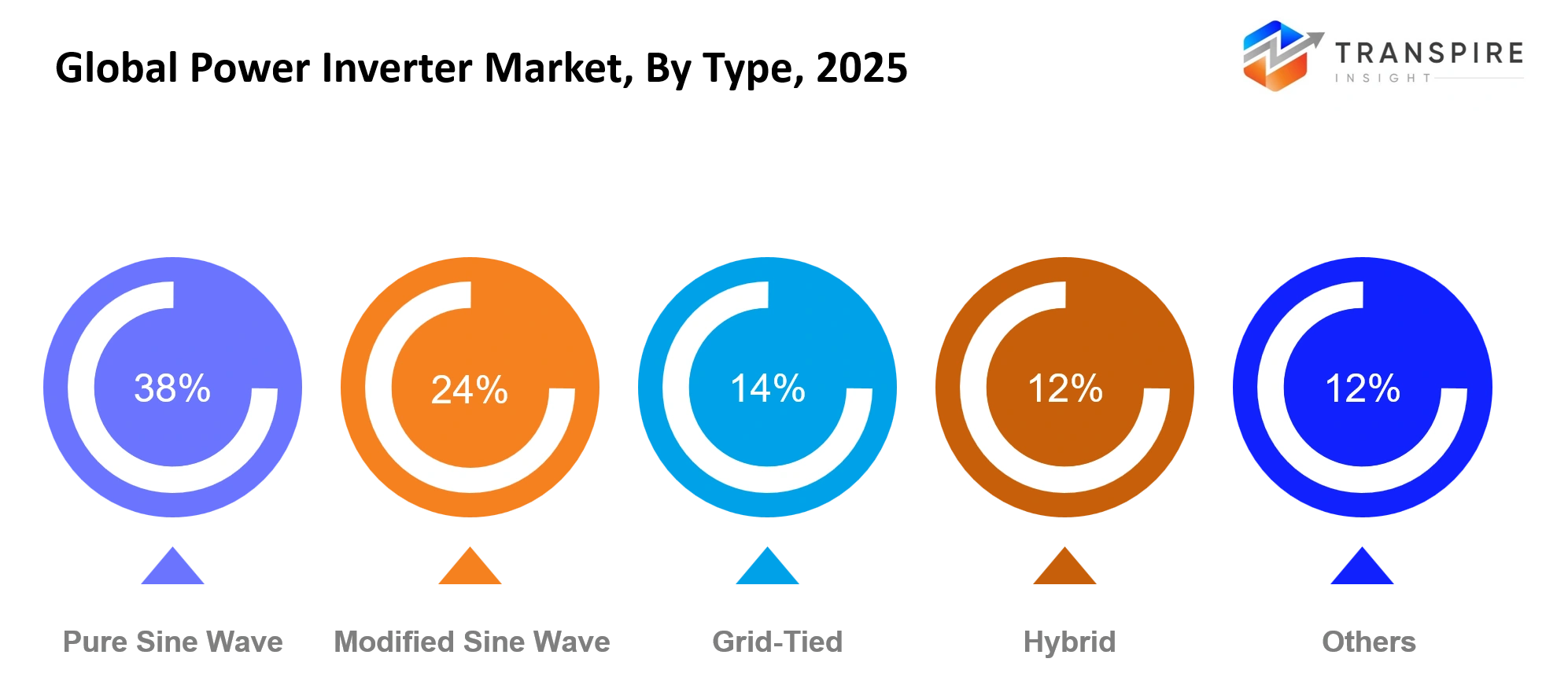
- The Pure Sine Wave Inverters segment represents about 38% of market volume due to the high demand for steady power output in electronics and households.
- The Modified Sine Wave Inverters segment is estimated at 24% of total demand owing to cost-effectiveness and wide distribution of basic backup systems.
- Grid-Tied Inverters make up about 14% of the market share as more utility companies and enterprises invest in renewable energy installations.
- The Hybrid Inverters segment contributes 12% of the total market revenue and gains popularity due to its capability to control energy sources and supply.
- The leading industry players include digital energy management systems to monitor energy consumption in real time.
- The increasing investments in solar energy infrastructure are fueling demand for efficient inverter systems in both urban and rural markets.
- Telecom companies are increasingly adopting inverter systems to ensure continuous operation and effective energy usage.
What are the Key Drivers, Restraints, and Opportunities in the Global Power Inverter Market?
Drivers
The factor that favours the growth of the market is the fast deployment of renewable energy sources and power generation facilities. Various governments from different regions of the world are using solar energy by offering incentives and implementing favourable policies and infrastructure. As the number of installations of solar energy projects and energy storage grows, the demand for power conversion devices becomes greater. This factor promotes the sale of inverters since they become an important part of the energy ecosystem. Apart from that, growing issues connected with power cuts and lack of reliability of grids encourage people and organisations to buy backup power systems.
Restraints
Despite favourable factors, various obstacles impede the market growth. High initial expenses on inverter devices, especially on the advanced ones such as hybrid and industrial inverters, is one of the obstacles. Additionally, technical difficulties associated with installation, operation, and connection with other systems are another obstacle. Besides, changes in raw material prices influence production efficiency and the prices of the products.
Opportunities
An important growth opportunity would be found in the development of intelligent energy management systems that incorporate solar energy generation, battery energy storage, and advanced grid technology. Investments being made in microgrids, EV charging stations, and commercial energy storage systems would be generating additional revenues for inverter companies. Countries in emerging markets with growing programs of electrification and rising targets for renewable energy would present important growth opportunities in the long term. Companies that specialise in digitalisation, remote monitoring, and energy optimisation technologies would have a competitive edge.
What Has the Impact of Artificial Intelligence Been on the Global Power Inverter Market?
The use of artificial intelligence in the global power inverter industry will change the market through increased efficiency, reliability, and energy management of the systems. In recent times, power inverters are designed using smart software that uses artificial intelligence to analyse energy production, energy consumption, and energy storage. Intelligent inverter systems are able to monitor and manage the process of energy transfer from solar panels to energy storage and the electric grid to ensure energy efficiency.
Another way artificial intelligence is changing the power inverter market is by predicting faults before they happen and recommending maintenance measures. Intelligent inverter systems are able to monitor parameters such as temperature and voltage. In the case of industrial installations, artificial intelligence algorithms are used in load balancing and energy demand prediction. Another significant advantage is remote monitoring and automation. Inverter technology connected to cloud-based platforms allows for real-time performance analytics and makes the decision-making process more efficient and effective. Nevertheless, the application of AI-supported inverters is not as popular as it could be in certain areas because of high costs of its implementation, difficulty in integration with old equipment and the requirement for professional knowledge. Nonetheless, AI is supposed to become increasingly relevant for power systems in the future. In June 2025, Enphase Energy enhanced the energy management features of its home energy system using AI-based technology to perform intelligent operation of inverters, predict maintenance requirements, optimise energy consumption in real time, and better utilise batteries. It demonstrates how AI is supporting the power inverters to boost efficiency and minimise downtime.
Key Market Trends
The global power inverter market is experiencing a shift as renewable energy incorporation, connectivity, and power storage become more relevant. Companies in this market are emphasising innovation and flexibility of inverter technologies in response to ever-changing energy needs.
- Usage of hybrid inverters has grown significantly because customers look for devices that can handle solar generation, battery energy storage, and electricity connection at once through one device.
- Smart monitoring services have changed from optional functions to standard equipment as people now can keep tabs on the operation of their systems using smartphones and Internet portals.
- The need for energy storage compatibility has become much higher since households and businesses buy batteries as an extra means of energy storage.
- New models come with integrated diagnostic and predictive maintenance services based on AI technology to boost performance and prevent outages.
- Higher capacity inverters are being used by industrial plants to maintain a high-quality power supply and an unceasing manufacturing process.
- The development of electric vehicle charging stations generates new demands for power converters.
- Online sales are becoming increasingly popular as they offer fast product comparisons and wide availability.
Global Power Inverter Market Segmentation
By type
Pure Sine Wave Inverters lead the market at 38% owing to the provision of stable and high-quality electricity, which is ideal for use by delicate electronic gadgets, houses, and commercial organisations. The second place is taken by Modified Sine Wave Inverters, which represent 24% of the global market share and will keep on appealing to customers who look for affordable inverters. Grid-Tied Inverters make up 14% of the demand, growing along with the increase in renewable energy projects around the world. Hybrid Inverters make up 12% of the market share and will grow fast, gaining a CAGR of 15.6%. Other inverters together occupy 12% of the global market due to various applications.
By Power Rating
Inverters ranging from 1 kW to 5 kW retain substantial popularity due to the fact that they provide sufficient electricity for domestic and small commercial purposes. Inverters below 1 kW will stay in favour of customers in portable and low-power applications, while 5 kW to 10 kW, and 10 kW to 50 kW inverters will become more widespread in commercial and industrial facilities. Inverters above 50 kW will gain popularity due to renewable energy projects.
By Application
Residential applications form a significant part of market demand owing to the growing popularity of rooftop solar and backup power solutions. Inverters are widely used in commercial buildings for energy efficiency and ensuring continuity of operations, whereas the industrial end-user segment is highly concerned about power stability and protecting their equipment. Sales demand from the automotive, telecom tower infrastructure, UPS applications, and solar energy applications keeps growing with the increase in electrification and digitalisation efforts.
By end-user
Households constitute an important source of inverter sales, as people are trying to find affordable and dependable power solutions. Utilities are becoming more advanced in inverter technology use to help integrate renewable energy sources into the existing grid system. Enterprises, industrial companies, government entities, telecom providers, and data centres are using efficient power conversion systems.
By Distribution channels
Direct sales, which will always be vital in case of customised projects of commercial and industrial nature that require larger scale. Dealers and distributors will always be essential in order to expand the reach in the marketplace. Retail stores serve the needs of residents while Internet sites are becoming more popular as well as convenient. OEM partners and system integrators become increasingly significant as companies want to implement total power infrastructure solutions.
What are the Key Use Cases Driving the Global Power Inverter Market?
Backup power is one of the primary applications that fuels the demand for power inverters. Pure sine wave inverters are employed in households, workplaces, and retail spaces to provide uninterrupted electricity to sensitive electronic devices, gadgets, and communication devices in case of a power outage. Another factor boosting the demand for power inverters is the increasing adoption of solar power systems. The power inverters are required to convert solar power into electrical power that can be used for residential, commercial, and industrial applications. Moreover, telecom services, data centres, and uninterruptible power supplies (UPS) rely more on advanced inverter solutions to operate without any hiccups.
Some emerging applications include hybrid energy systems, EV charging infrastructure, microgrids, and energy storage initiatives. The fast-growing number of hybrid solar inverters is a testament to the increasing need for an integrated energy solution that includes power generation, storage, and grid connectivity.
|
Report Metrics |
Details |
|
Market size value in 2025 |
USD 87.9 Billion |
|
Market size value in 2026 |
USD 92.6 Billion |
|
Revenue forecast in 2033 |
USD 133.6 Billion |
|
Growth rate |
CAGR of 5.38% from 2026 to 2033 |
|
Base year |
2025 |
|
Historical data |
2021 - 2024 |
|
Forecast period |
2026 - 2033 |
|
Report coverage |
Revenue forecast, competitive landscape, growth factors, and trends |
|
Regional scope |
United States; Canada; Mexico; United Kingdom; Germany; France; Italy; Spain; Denmark; Sweden; Norway; China; Japan; India; Australia; South Korea; Thailand; Brazil; Argentina; South Africa; Saudi Arabia; United Arab Emirates |
|
Key company profiled |
Sungrow, SMA Solar, Huawei, Schneider Electric, Delta Electronics, ABB, Enphase, Fronius, SolarEdge, Eaton, Microtek, Luminous, Growatt, GoodWe, Hitachi. |
|
Customization scope |
Free report customization (country, regional & segment scope). Avail customized purchase options to meet your exact research needs. |
|
Report Segmentation |
By Type (Pure Sine Wave, Modified Sine Wave, Square Wave, Grid-Tied, Hybrid, Portable, Industrial, Others); By Power Rating (Below 1 kW, 1–5 kW, 5–10 kW, 10–50 kW, Above 50 kW, Utility Scale, Commercial Grade, Others); By Application (Residential, Commercial, Industrial, Automotive, Solar Systems, UPS Systems, Telecom Infrastructure, Others); By End User (Households, Utilities, Enterprises, Industries, Government, Telecom Operators, Data Centers, Others); By Distribution Channel (Direct Sales, Dealers, Retail Stores, Online Platforms, OEMs, Distributors, System Integrators, Others). |
Which Regions are Driving the Global Power Inverter Market Growth?
North America
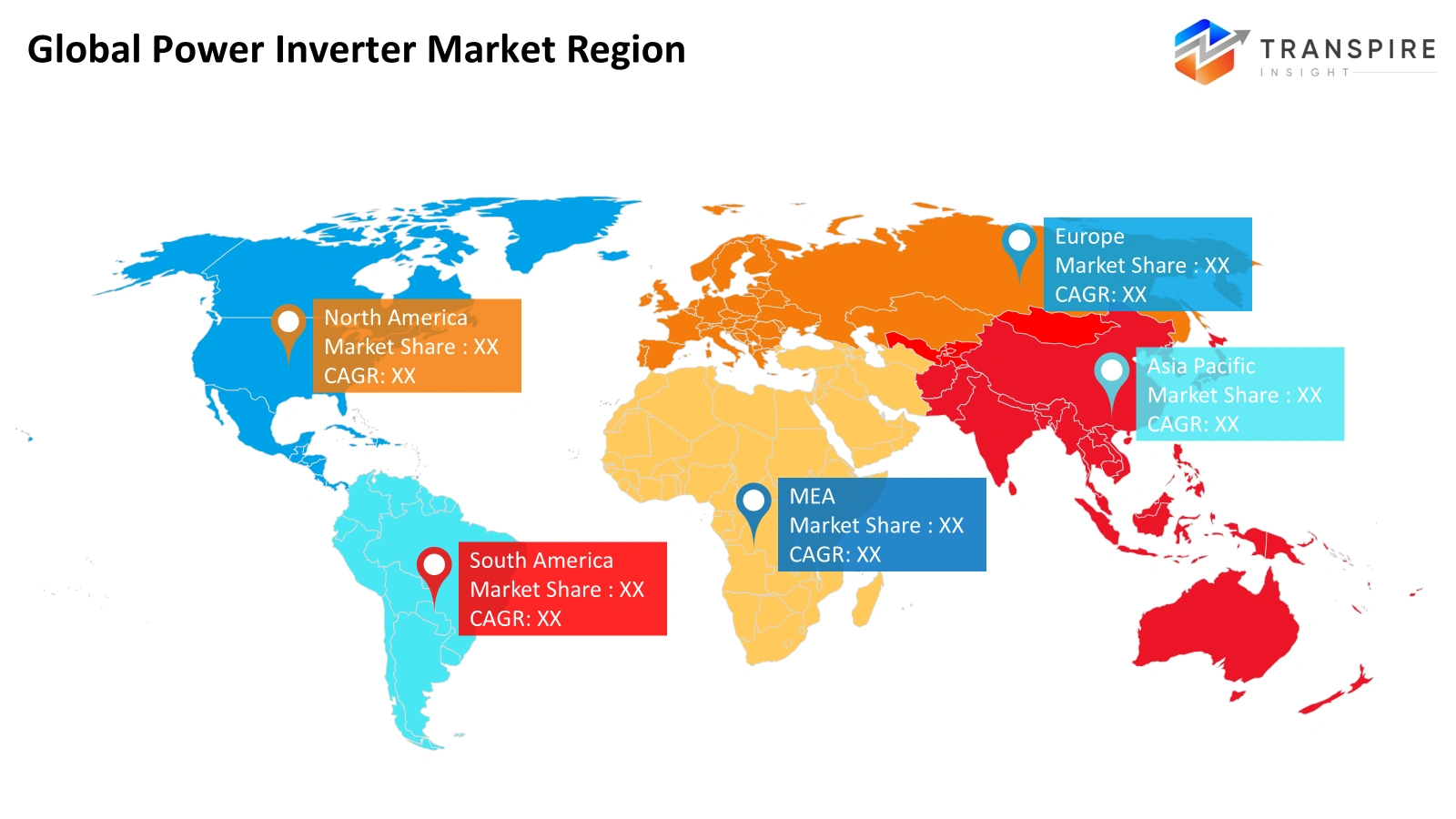
The North American region constitutes about 23% of the world market and shows a constant growth trend with more investment in the installation of solar energy systems, battery storage, and grid modernisation initiatives. Technological innovation and intelligent energy management system adoption are two key advantages of this region. With increased distributed energy resource deployments and the need for resilient energy infrastructure, there will be inverter installations in various industries. Future growth in clean energy projects would provide more opportunities in the upcoming years.
Europe
Europe is a contributor to the global power inverter market, with close to 24% of total revenue generation. The region is characterised by a mature renewable energy sector and ambitious goals towards sustainable energy production. Unlike the Asia Pacific region, growth of the market in Europe is driven by stringent energy efficiency measures and modernisation of the power infrastructure. The region is advantaged with a stable policy framework and consistent investments in solar and energy storage devices. In June 2026. The European Union imposed restrictions on using public money to finance solar inverters produced in China because of potential cybersecurity risks. The decision is anticipated to spur the demand for inverters produced in Europe and increase investment in the local power electronics industry.
Asia Pacific
The Asia Pacific region dominates the global market for power inverters, accounting for about 41% of total revenue generated. The region holds an advantage based on substantial investment in renewable energy, an increase in manufacturing operations, and uptake of residential solar panels. Nations such as China, India, Japan, and South Korea are likely to boost the uptake of the devices in the region through the development of energy infrastructure and electricity. The market position of the region is boosted by governmental efforts towards energy transition.
Who are the Key Players in the Global Power Inverter Marketand how do they Compete?
The global power inverter competition can be described in terms of innovation, product differentiation, and market expansion into the renewable energy market sector. Companies compete via the development of more efficient energy conversion, inclusion of digital monitoring technology and development of products for residential, commercial, industrial, and utility markets.
Manufacturers like Schneider Electric, SMA Solar Technology, Fronius International, and Delta Electronics concentrate on innovative approaches and top-class products. The companies' strategies include the creation of smart energy management and grid connection with highly efficient inverters that correspond to customers' demands. Competitive advantages of these companies lie in sophisticated monitoring technologies, reliable performance, and high company brand reputation.
Companies like Sungrow Power Supply, Huawei Digital Power, Growatt, and GoodWe concentrate on the fast-growing solar and energy storage markets. The strategy of these organisations consists of cost-efficient products, a diversified product line and rapid market expansion to emerging countries. It is expected that companies that manage to develop energy storage, artificial intelligence monitoring technology and grid management will gain a competitive advantage in the market.
Global Power Inverter Market companies
- Sungrow
- SMA Solar
- Huawei
- Schneider Electric
- Delta Electronics
- ABB
- Enphase
- Fronius
- SolarEdge
- Eaton
- Microtek
- Luminous
- Growatt
- GoodWe
- Hitachi
Recent Development News
In January 2025, SolarEdge Technologies implemented a global restructuring strategy that included the optimisation of its workforce, in response to changes in the inverter market environment in order to boost efficiency. This step will help the company become more competitive and profitable in the inverter market segment.
Source: https://www.reuters.com
In April 2025, the company Hitachi Industrial Equipment Systems introduced the advanced Grid Forming Inverter (GFM) system in its Narashino Works factory in Japan. It increases grid stability and allows for better use of renewable sources of energy, thus helping inverter technology become more widespread across the world.
Source: https://www.hitachi.com
In January 2026, ABB successfully acquired Gamesa Electric’s power electronics business unit. It gained utility-scale solar inverters, wind converters, and battery energy storage solutions.
Source: https://www.powerelectronicsnews.com
What Strategic Insights Define the Future of the Global Power Inverter Market?
The future development of the global power inverter industry will be determined by the fusion of renewable energy generation, battery energy storage systems, and smart energy management systems. As consumers, firms, and public utilities seek more energy independence and energy efficiency, the trend towards hybrid and digital energy inverters will increase and demand solutions that manage multiple energy sources at once.
An underlying risk is the increasing complexity of the product due to digitisation. The manufacturers of energy inverters might experience problems with cybersecurity, interoperability issues, and maintenance requirements in their products. Non-adaptable companies will suffer from delayed adoption of innovative products despite their good performance.
There are numerous opportunities in the integration of energy storage, microgrids, and electric vehicle charging infrastructure. For the realisation of these opportunities, manufacturers need to produce energy converters that have the potential to build flexible and decentralised energy infrastructures. Therefore, in order to benefit from future growth, manufacturers should invest in the development of AI monitoring, grid-interactive features, and partnerships within the renewable energy industry.
Key Segmentations are:
By Type
- Pure Sine Wave
- Modified Sine Wave
- Square Wave
- Grid-Tied
- Hybrid
- Portable
- Industrial
By Power Rating
- Below 1 kW
- 1–5 kW
- 5–10 kW
- 10–50 kW
- Above 50 kW
- Utility Scale,
- Commercial Grad
By Application
- Residential
- Commercial
- Industrial
- Automotive
- Solar Systems
- UPS Systems
- Telecom Infrastructure
By End User
- Households
- Utilities
- Enterprises,
- Industries
- Government
- Telecom Operators
- Data Centers
By Distribution Channel
- Direct Sales
- Dealers
- Retail Stores
- Online Platforms
- OEMs
- Distributors
- System Integrators
Regional Outlook
North America
- United States
- Canada
- Mexico
Europe
- Germany
- United Kingdom
- France
- Spain
- Italy
- Rest of Europe
Asia Pacific
- Japan
- China
- Australia & New Zealand
- South Korea
- India
- Rest of Asia Pacific
South America
- Brazil
- Argentina
- Rest of South America
Middle East & Africa
- Saudi Arabia
- United Arab Emirates
- South Africa
- Rest of the Middle East & Africa
Frequently Asked Questions
Find quick answers to common questions.
The global power inverter market size was valued at USD 87.9 Billion in 2025 and is poised to reach USD 133.6 Billion by 2033, expanding at a 5.38% CAGR.
Key segments for the global power inverter market are By Type (Pure Sine Wave, Modified Sine Wave, Square Wave, Grid-Tied, Hybrid, Portable, Industrial, Others); By Power Rating (Below 1 kW, 1–5 kW, 5–10 kW, 10–50 kW, Above 50 kW, Utility Scale, Commercial Grade, Others); By Application (Residential, Commercial, Industrial, Automotive, Solar Systems, UPS Systems, Telecom Infrastructure, Others); By End User (Households, Utilities, Enterprises, Industries, Government, Telecom Operators, Data Centers, Others); By Distribution Channel (Direct Sales, Dealers, Retail Stores, Online Platforms, OEMs, Distributors, System Integrators, Others).
Growth is primarily driven by Growth will be fueled mainly by increased penetration of renewable energy systems, increased demand for continuous power supplies, increasing installation of solar and wind energy systems, increased industrial automation, and increasing utilization of power electronics in the residential, commercial, and industrial segments.
The global market is led by major manufacturers including Sungrow, SMA Solar, Huawei, Schneider Electric, Delta Electronics, ABB, Enphase, Fronius, SolarEdge, Eaton, Microtek, Luminous, Growatt, GoodWe, Hitachi.
Asia Pacific accounts for 41% of the global power inverter market, making it the leading regional market. Its dominance is supported by rapid industrialisation, increasing renewable energy installations, expanding residential and commercial infrastructure, and strong demand for reliable backup power solutions across countries such as China, India, and Japan. These factors continue to shape global market trends and growth.
Growth opportunities in the global power inverter market include rising investments in renewable energy projects, increasing adoption of solar power systems, growing demand for energy storage solutions, expansion of electric vehicle charging infrastructure, and the need for reliable backup power in residential, commercial, and industrial sectors. Smart inverters integrated with IoT and energy management systems also create significant growth potential.
- Sungrow
- SMA Solar
- Huawei
- Schneider Electric
- Delta Electronics
- ABB
- Enphase
- Fronius
- SolarEdge
- Eaton
- Microtek
- Luminous
- Growatt
- GoodWe
- Hitachi
About the Authors

Avinash Kumar
I’m Avinash Kumar, a Senior Research Analyst at Transpire Insight, with expertise in the Electronics and Semiconductor and Energy & Power industry. My work focuses on analyzing emerging technologies, market trends, industry developments, and innovation across these sectors. I specialize in transforming complex technical and market insights into clear, research-backed content that helps professionals, businesses, and decision-makers stay informed. Through continuous industry research and data-driven analysis, I strive to deliver accurate, reliable, and practical perspectives on the latest advancements shaping the semiconductor and energy landscape.

Chakradhar Khansole
Chakradhar serves as the Research Director at Transpire Insight, bringing over 8 years of experience in technology, innovation, and strategic market intelligence. He specializes in transforming complex market data into actionable business insights that enable organizations to make informed, growth-oriented decisions. Recognized for his strategic vision and analytical expertise, Chakradhar leads high-impact research initiatives, delivering comprehensive market assessments, competitive intelligence, and forward-looking industry analysis.
Recently Published Reports
-
Apr 2026
Active Power Filter Market
Active Power Filter Market Size, Share & Analysis Report By Type (Shunt Active Power Filters, Series Active Power Filter, Hybrid Active Power Filter), By Application (Harmonics Mitigation, Reactive Power Compensation, Voltage Regulation, Power Factor Correction), By Phase (Single Phase, Three Phase), By End-User Industry (Manufacturing, Healthcare, Commercial, Automotive, Oil and Gas, Others), and Geography (North America, Europe, Asia-Pacific, Middle East and Africa, South and Central America), 2021 - 2031
-
Apr 2026
Electrical Transformer Market
Electrical Transformer Market Size, Share & Analysis Report By Core (Closed, Shell, and Berry), By Insulation (Gas, Oil, Solid, Air, and Other), By Phase (Single, and Three), By Rating (100 MVA to 500 MVA, 501 MVA to 800 MVA, and 801 MVA to 1200 MVA), and Geography (North America, Europe, Asia-Pacific, Middle East and Africa, South and Central America), 2021 – 2031
-
Apr 2026
Hydraulic Piston Pumps Market
Hydraulic Piston Pumps Market Size, Share & Analysis Report By Type (Axial Piston Pumps, Radial Piston Pumps), By Operating Pressure (Low Pressure, Medium Pressure, High Pressure), By Application (Construction, Mining, Agriculture, Automotive, Oil & Gas, Industrial Machinery, Others), By End-User (OEMs, Aftermarket), and Geography (North America, Europe, Asia-Pacific, Middle East and Africa, South and Central America), 2021 – 2031
-
Apr 2026
Laboratory Gas Generators Market
Laboratory Gas Generators Market Size, Share & Analysis Report By Product (Nitrogen Gas Generator, Hydrogen Gas Generator, Zero Air Gas Generator, Purge Gas Generator, TOC Gas Generators, Others), By Application (Gas Chromatography, Liquid Chromatography-mass Spectrometry (LC-MS), Gas Analyzers, Others), By End-user (Life Science, Chemical & Petrochemical, Food & Beverage, Others), and Geography (North America, Europe, Asia-Pacific, Middle East and Africa, South and Central America), 2021 – 2031