

Middle East and Africa Causal AI Market Summary
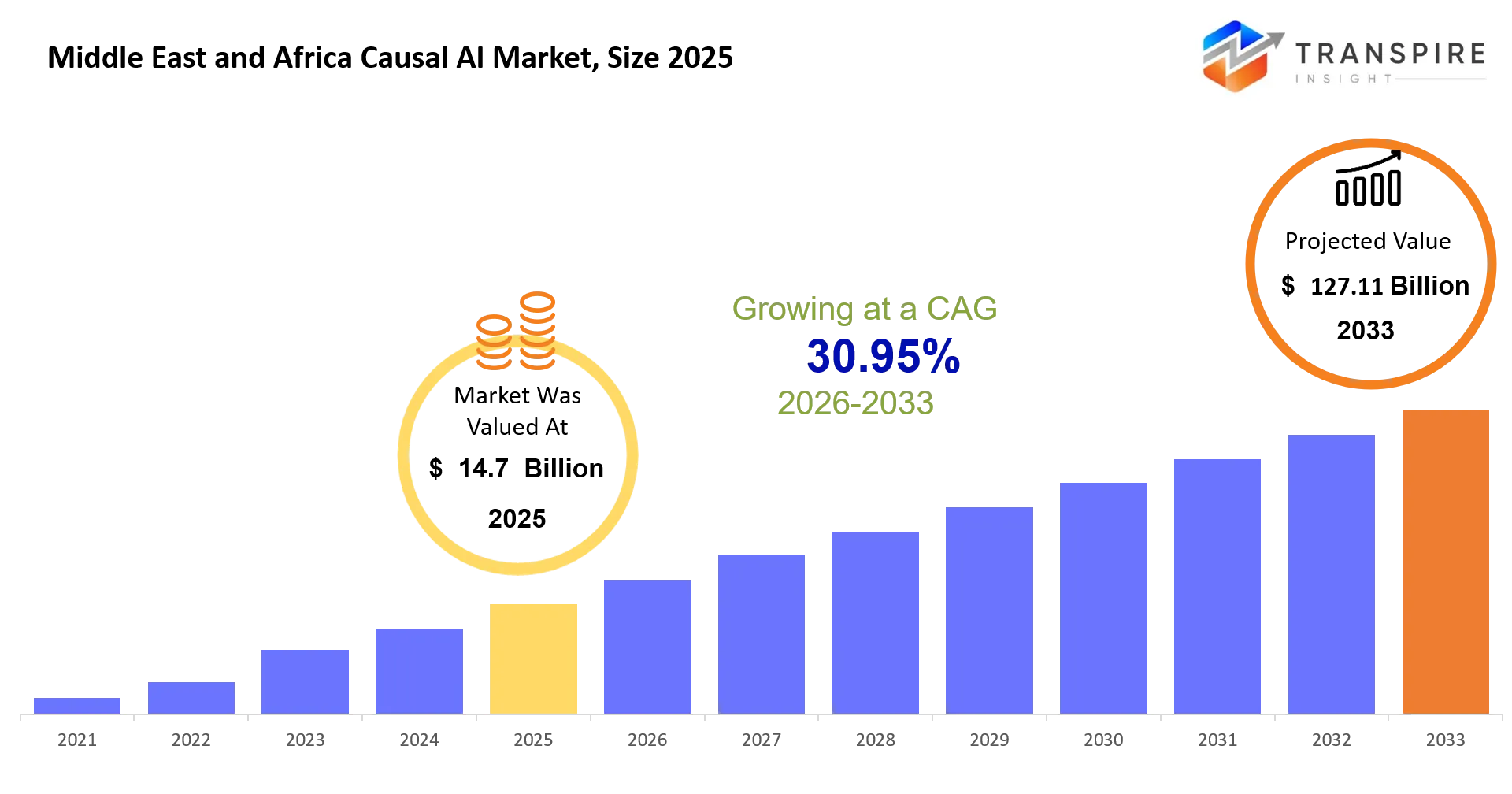
As per Transpire Insight Analysis the Middle East and Africa Causal AI Market size is estimated at USD 14.7 Million in 2025 and is anticipated to reach USD 127.11 Million by 2033, growing at a CAGR of 30.95% from 2026 to 2033.
The Middle East and Africa Causal AI market, helps enterprises figure out the real underlying causes behind business results, instead of just leaning on correlations and “maybe it’s related” type insights. In practice, banks , healthcare providers, manufacturers, telecom operators and government agencies are using causal AI to get better at fraud detection, tune up daily operations, back up policy choices, and also deliver explainable predictions that makes it easier to satisfy regulatory compliance.
Over the last five years the market has gradually moved away from experimental machine learning rollouts, and it’s more like they now want explainable and decision intelligence platforms that can handle mission-critical work, not just dashboards. The quick take up of sovereign AI programs across several Gulf nations, plus those digital transformation agendas that sped up after the COVID-19 pandemic, has really widened how much enterprises are putting into trustworthy AI systems.
And because many organizations are chasing transparent, auditable ways of deciding things, budgets have started shifting past standard predictive analytics toward causal reasoning platforms. That shift is creating solid, commercial openings for software vendors, cloud providers and enterprise AI service partners across the region, with a growing sense that explainability is not optional anymore.
Middle East and Africa Causal AI Market Size & Forecast:
- Middle East and Africa Causal AI Market Size 2025: USD 14.7 Million
- Expected Market Value 2033: USD 127.11 Million
- Forecast CAGR: 30.95%
- Leading country in 2025: United Arab Emirates (UAE)
- Fastest-growing country: Saudi Arabia
- Key Profile: Microsoft, Google Cloud, IBM, CausaLens, DataRobot, Oracle, SAP, AWS, SAS Institute, Salesforce, Qualcomm AI, H2O.ai, Dynatrace, Fiddler AI, Dataiku
Key Market Insights
- The Middle East and Africa Causal AI market is expected to grow from USD 14.7 million in 2025 to USD 127.11 million by 2033 , while enterprises keep ramping up AI investments, with strong momentum there.
- Within the region, the Middle East is leading with roughly 68% market share in 2025, powered by UAE and Saudi Arabia digital transformation initiatives.
- Africa, on the other hand, looks like it will move the quickest through 2033, mainly because cloud infrastructure and financial technology ecosystems are getting more mature.
- On the offering side, software platforms capture the largest slice at about 45% in 2025, largely because organizations deploy explainable AI solutions across their enterprise setups.
- Consulting and integration services still show up as the second-biggest segment, since companies need tailored rollouts, especially across regulated industries where details matter a lot.
- For deployment, cloud-based approaches are the fastest-growing option, enterprises prefer scalable AI infrastructure with less overall implementation friction, which makes sense really.
- In applications, risk management plus fraud detection brings in close to 35% of application revenue, especially across banking, insurance, and financial services .
- Healthcare and life sciences are emerging as the quickest-growing application space, driven by clinical decision support and treatment optimization programs.
- As for customers, large enterprises provide the biggest revenue contribution, while SMEs are adopting cloud-native causal analytics more and more, often through subscription style pricing models.
- Major players like Microsoft, Google Cloud, IBM, Oracle, SAP, and AWS are continuing to strengthen their positions through generative AI integration, strategic partnerships, and ongoing regional cloud expansion.
What are the Key Drivers, Restraints, and Opportunities in the Middle East and Africa Causal AI Market?
Government led artificial intelligence strategies across parts of the UAE, Saudi Arabia, Qatar, and South Africa seem to have become the main sort of catalyst for causal AI adoption. In practice, financial organizations, healthcare providers, and public sector teams are now asking for AI systems that can deliver transparent and explainable outcomes to meet regulatory expectations . This whole change has pushed many enterprises away from standard predictive analytics toward causal inference platforms , which are said to sharpen decision quality, lower compliance exposure, and also create tangible operational savings. Meanwhile, as cloud infrastructure keeps spreading across the region, software vendors are grabbing more steady recurring revenue, via enterprise subscriptions and AI advisory engagements.
That said, the limited availability of high quality structured data is still the most serious structural obstacle for broader deployment. A lot of organizations are stuck with split legacy systems, and that makes it hard to model causality properly across multiple business functions . To build dependable causal graphs you usually need domain expertise, lots of historical records, and rather careful validation procedures , so the effort becomes costly and kind of time consuming. As a result, adoption slows down most noticeably for mid sized organizations , which then delays actual commercial rollouts and in turn trims the overall market revenue upside.
The next growth phase is likely to come from sovereign AI spending and industry specific digital transformation initiatives . Gulf countries continue putting money into national AI infrastructure , while African banking organizations are increasingly refreshing digital banking platforms .
What Has the Impact of Artificial Intelligence Been on the Middle East and Africa Causal AI Market?
Artificial intelligence has, more or less, fundamentally reshaped how organizations across the Middle East and Africa actually deploy causal reasoning technologies. Nowadays enterprises tend to bring together machine learning together with causal inference models, graph analytics, and automated decision engines, so they can tune operations far past what traditional predictive analytics ever did. In practice, financial institutions are now using causal AI to separate the real drivers behind fraudulent transactions, which helps bring down false positives, while also making regulatory compliance feel less like a nightmare. Manufacturers often pair causal models with IoT sensors to spot failure patterns in equipment before the breakdown happens , which boosts production uptime and cuts maintenance costs. Healthcare organizations are increasingly leaning on explainable causal models for treatment planning, basically by surfacing connections between patient conditions, therapies and clinical outcomes. Energy companies too, utilize causal analytics to optimize asset performance and anticipate operational disruptions through real time sensor signals.
On top of that, advanced digital technologies have improved enterprise automation by embedding causal intelligence into cloud platforms, and into business process management systems. With these kinds of setups, teams can run scenario analysis quicker, automate policy evaluation, and do more accurate strategic planning across regulated industries. Still, broad adoption hits a very noticeable ceiling. Building dependable causal models is not small work, it tends to demand deep domain expertise, clean historical datasets, and a lot of computing power. A lot of organizations keep bumping into fragmented enterprise data , plus high integration costs, so the accuracy and scalability of causal AI deployments ends up constrained, even if the long term commercial upside looks pretty strong.
Key Market Trends
- Since 2022 enterprises have kinda moved away from correlation oriented analytics toward causal inference platforms that actually help with explainable business choices and regulatory compliance… sort of, in a more practical way.
- Between 2023 and 2026, Gulf governments expanded sovereign AI funding, which in turn sped up adoption inside banking, healthcare, and public administration, all at once, not slowly.
- Financial institutions more and more pair causal AI with fraud detection platforms, this reduces false positives a bit while also making risk assessment accuracy better overall.
- Cloud-native causal analytics platforms have ended up replacing a lot of on-premise deployments, because organizations want scalable, subscription style enterprise AI solutions, rather than the traditional setups.
- Microsoft, Google Cloud, IBM, Oracle, and AWS have been expanding regional AI infrastructure through cloud investments and industry partnerships, since 2023, which makes it feel like a steady push.
- Healthcare organizations are increasingly weaving causal reasoning into clinical decision support systems, to sharpen treatment planning and also patient outcome analysis, not just one of those things.
- Manufacturers now combine IoT sensor networks with causal AI models, to optimize predictive maintenance and reduce unplanned equipment downtime, in a more efficient manner.
- Organizations increasingly ask for explainable AI governance tools because stricter enterprise compliance requirements are showing up, alongside responsible AI frameworks that were introduced across the Gulf region.
- Hybrid AI architectures, where generative AI and causal reasoning work together, emerged after 2024, letting enterprise decision support systems feel more reliable, at least in most deployments.
- Strategic collaborations between cloud providers and regional governments continue expanding AI research ecosystems, and they keep pushing toward commercialization of advanced causal intelligence platforms.
Middle East and Africa Causal AI Market Segmentation
By Component
Software still takes the largest share, mostly because enterprise groups need causality modeling tools, visualization dashboards, and decision intelligence for day to day operations. The platforms basically create scalable surroundings, so teams can build the model, deploy it, and keep governance in check across different business units, at the same time. Then the Consulting Services kinda help organizations craft the most fitting implementation approach, while Integration Services link causal AI offerings with enterprise resource planning, customer relationship management, and those operational databases. Training Services, in turn, raise workforce competence and help widen model adoption between technical folks and business teams.
After deployment, Managed Services tend to keep things steady through continuous monitoring, upkeep, and performance tuning. Analytics Solutions turn company data into usable guidance, by surfacing cause and effect patterns that standard analytics sometimes gloss over. Other part offerings can include tailored tools, technical assistance, and niche industry applications, all aimed at the specific kind of operational needs each organization has. When investment stays balanced across these pieces, enterprise adoption tends to get stronger and long term business value looks better overall.
By Deployment
Cloud-Based deployment drives adoption, because scalable infrastructure helps cut down on the whole implementation time, and it also makes it easier for everyone across the enterprise to access it. Meanwhile On-Premise deployment is still a big deal for organizations that handle confidential information and really need direct control over data security and compliance. Hybrid setups kind of mix it all together, you get the flexibility of the cloud plus the sturdiness of local infrastructure so enterprises can weigh performance governance, and operational continuity at the same time. Private Cloud deployment tends to fit industries that are highly regulated, since they want dedicated computing resources, and tighter security measures.
Public Cloud keeps growing too, mostly through affordable subscription models , and because services show up fast across different regional markets. Edge AI enables real-time decision making, it processes information nearer to operational sites, so latency stays lower. Multi-Cloud strategies boost resilience by spreading workloads across several service providers which also reduces the lock-in effect to one vendor only. There are also other deployment models, for example they cover niche infrastructure needs tied to industry-specific operations and newer enterprise expectations.
By Technology
Causal Inference Models sit at the core of a lot of enterprise solutions because dependable cause–effect analysis really helps guide business decisions , you know. Bayesian Networks are used to judge probabilistic links across many variables, meanwhile Structural Causal Models help with decision accuracy by offering a clearer and more legible picture of complicated systems. Then Counterfactual AI basically lets organizations test alternative paths and check what business outcomes could happen before anything is actually rolled out . Explainable AI also matters here since it can strengthen regulatory compliance, giving reasoning that people can follow behind automated suggestions .
With Machine Learning Integration, predictive analytics gets paired with causal logic so business performance and operational planning can improve, more or less. Reinforcement Learning supports adaptive decision making by constantly refining recommendations via feedback from changing environments . Other add-ons often show up too, like graph-based analytics, knowledge representation , and industry tailored algorithms , which together widen commercial use. And overall continuous technology advancement keeps boosting model reliability , and that opens up more possibilities for broader enterprise deployment .
By Application
Risk Management still stays the leading application, because financial institutions , healthcare providers , and industrial organizations need dependable decision support for day to day operations and regulatory compliance, kind of end to end. Fraud Detection adds weight to transaction monitoring by spotting authentic cause and effect ties, not just plain correlations. Predictive Maintenance increases equipment availability by catching operational troubles early, before the nasty unexpected failures happen. Healthcare Analytics backs clinical decision making by assessing treatment outcomes together with patient health factors, in a way that feels more grounded.
Financial Forecasting helps improve investment planning by making the economic influences and business performance indicators clearer. Supply Chain Optimization supports inventory planning, supplier management, and logistics efficiency by using causal analysis of operational events. Marketing Analytics helps measure campaign effectiveness and customer behavior with more conviction, less guesswork. Other applications show up too, like policy evaluation, quality management, workforce planning, and environmental performance analysis across multiple industries.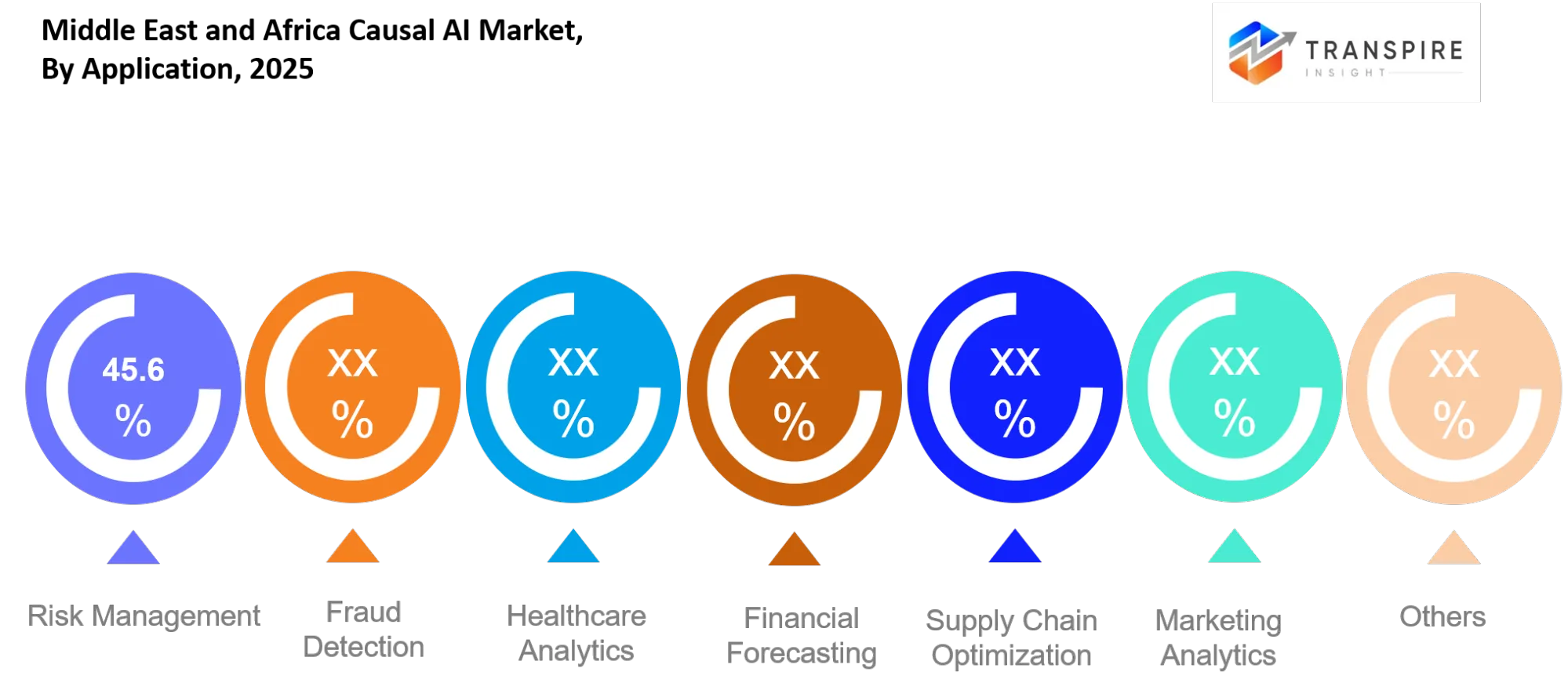
By End User
BFSI takes the largest slice because financial institutions rely on “clearer” decision frameworks for lending, anti fraud work, regulatory compliance and risk evaluation, without much room for ambiguity. In healthcare, orgs are slowly but steadily picking up causal analytics for clinical research, treatment improvement, and even hospital resource scheduling, kind of like trying to reason the why not just the what. Manufacturing teams usually push production efficiency via predictive maintenance and process optimization, all with cause-and-effect type analysis that’s meant to stay consistent. Retail, meanwhile uses causal intelligence for things like price setting, inventory pacing, and the way customer purchasing behavior actually shows up in real life.
Then the government agencies, they are using causal AI to boost policy review, public services delivery, and infrastructure planning. Telecommunications companies also benefit, improving network performance, customer stickiness, and overall service quality by leaning on more advanced analytical models. In the Energy & Utilities space , organizations optimize asset management, do demand forecasting, and work toward operational reliability by using causal insights in a practical manner. Other end users, like education, transportation, logistics, media, and professional services keep expanding their enterprise adoption too, even if it’s not always in the same rhythm everywhere.
What are the Key Use Cases Driving the Middle East and Africa Causal AI Market?
Risk management is mostly the leading use case here, since financial institutions need clear decision support, for lending and credit assessment too, plus compliance and fraud prevention which is kind of the big part. Causal models go a step further, they point to what really drives financial outcomes, so teams can make business decisions quicker and with more accuracy. And honestly, strong regulatory oversight across banking operations keeps pushing investment in explainable analytical platforms.
Healthcare analytics and predictive maintenance are still getting broader adoption in hospitals and also in manufacturing plants. Clinical organizations try to judge whether treatments work by using causal relationships, while industrial operators cut down equipment downtime by spotting the actual underlying causes behind operational failures. Even telecommunications providers jump into causal analytics, to improve network performance and keep more customers around.
Newer, more emerging angles show up too, like public policy evaluation and energy optimization, usually tied to digital transformation efforts across Gulf countries. Smart city programs are more and more using causal decision models to gauge infrastructure investments, and utility companies work on electricity distribution efficiency as well as renewable energy integration. If enterprise AI platforms keep getting invested in, that will likely expand commercial opportunities into more sectors during the forecast period.
|
Report Metrics |
Details |
|
Market size value in 2025 |
USD 14.7 Million |
|
Market size value in 2026 |
USD 19.25 Million |
|
Revenue forecast in 2033 |
USD 127.11 Million |
|
Growth rate |
CAGR of 30.95% from 2026 to 2033 |
|
Base year |
2025 |
|
Historical data |
2021 - 2024 |
|
Forecast period |
2026 - 2033 |
|
Report coverage |
Revenue forecast, competitive landscape, growth factors, and trends |
|
Regional scope |
Middle East and Africa (Saudi Arabia, United Arab Emirates, South Africa, Rest of Middle East and Africa) |
|
Key company profiled |
Microsoft, Google Cloud, IBM, CausaLens, DataRobot, Oracle, SAP, AWS, SAS Institute, Salesforce, Qualcomm AI, H2O.ai, Dynatrace, Fiddler AI, Dataiku . |
|
Customization scope |
Free report customization (country, regional & segment scope). Avail customized purchase options to meet your exact research needs. |
|
Report Segmentation |
By Component (Software, Platforms, Consulting Services, Integration Services, Training Services, Managed Services, Analytics Solutions, Others); By Deployment (Cloud-Based, On-Premise, Hybrid, Private Cloud, Public Cloud, Edge AI, Multi-Cloud, Others); By Technology (Causal Inference Models, Bayesian Networks, Structural Causal Models, Counterfactual AI, Explainable AI, Machine Learning Integration, Reinforcement Learning, Others); By Application (Risk Management, Fraud Detection, Predictive Maintenance, Healthcare Analytics, Financial Forecasting, Supply Chain Optimization, Marketing Analytics, Others); By End User (BFSI, Healthcare, Manufacturing, Retail, Government, Telecommunications, Energy & Utilities, Others) |
Which Regions are Driving the Middle East and Africa Causal AI Market Growth?
The Middle East seems to hold the biggest share of regional revenue, because national artificial intelligence strategies have made the policy setting more or less friendly for enterprise adoption. The United Arab Emirates and Saudi Arabia are still pushing forward with sovereign cloud infrastructure, digital government programs, and AI investment funds, and all of that encourages organizations to roll out explainable, causal intelligence platforms across banking, healthcare, energy, and public services. There’s also strong hyperscale cloud availability from global technology providers, and when that’s paired with supportive regulatory frameworks for digital transformation, enterprise confidence in advanced AI deployment gets noticeably stronger. On top of that, a sort of mature innovation ecosystem— research centers, startup accelerators, venture funding, plus international technology partnerships— keeps reinforcing regional leadership, even when priorities shift a bit.
Africa comes in as the second-largest regional contributor, but the market development doesn’t really follow the same route as the Gulf economies. Financial inclusion programs, a growing fintech ecosystem, and ongoing investment in digital banking have created fairly steady demand for causal analytics, which then helps with lending decisions, fraud prevention, and customer risk assessment. South Africa, Kenya, Nigeria, and Egypt continue placing money into enterprise cloud adoption and digital public services, so technology vendors can expect more predictable opportunities. Instead of depending on large government funded AI initiatives, the expansion here leans on consistent private sector investment, and slow modernization across financial services, telecommunications, and healthcare.
Meanwhile the Rest of the Middle East, along with emerging African economies, is expected to show the fastest growth through 2033, as digital infrastructure investment keeps picking up speed.
Who are the Key Players in the Middle East and Africa Causal AI Market and How Do They Compete?
Competition still feels sort of moderately consolidated because the big cloud players, along with enterprise software companies, effectively steer a lot of the large scale deployment story, while smaller specialized AI firms try to edge in with more advanced causal modeling capabilities. In practice, technology innovation, explainability, cloud integration, and industry tuned solutions tend to matter more than price , or at least that’s what most buyers act like. Bigger enterprise customers increasingly look at governance features, regulatory compliance, and the practical ability to plug causal reasoning into whatever AI platforms they already run today.
Microsoft leans into differentiation with Azure AI services, enterprise security, and really tight integration across productivity software, so organizations can roll out causal analytics inside familiar day to day business environments. Google Cloud goes after scalable AI infrastructure, Vertex AI, plus stronger data platforms, aiming to support enterprise decision intelligence across multiple industries. IBM meanwhile competes by pairing watsonx with AI governance tooling and consulting muscle , which makes adoption less painful for highly regulated sectors like banking and healthcare.
CausaLens positions itself around native causal AI technology, rather than the usual predictive analytics approach, and it offers explainable decision models that seem to resonate with financial institutions as well as scientific research groups. Dataiku expands through collaborative AI development platforms that help streamline deployment between technical teams and business stakeholders, while also reinforcing responsible AI governance. Oracle keeps extending AI features inside its enterprise applications and cloud infrastructure, so organizations can weave causal analytics directly into finance, supply chain, and operational workflows, without creating too many extra layers.
Company List
• Microsoft
• Google Cloud
• IBM
• CausaLens
• DataRobot
• Oracle
• SAP
• AWS
• SAS Institute
• Salesforce
• Qualcomm AI
• H2O.ai
• Dynatrace
• Fiddler AI
• Dataiku
Recent Development News
In April 2026, Google Cloud launched the Gemini Enterprise Agent Platform during Google Cloud Next 2026. The platform expands enterprise AI capabilities for agentic workflows and strengthens cloud-based AI adoption across regulated industries.
Source:https://cloud.google.com
In April 2026, Dataiku launched Kiji Privacy Proxy™, an open-source privacy layer for enterprise generative AI. The solution helps organizations protect sensitive information while accelerating responsible AI deployment across enterprise environments.
Source:https://www.dataiku.com
In January 2025, Microsoft and OpenAI announced an updated long-term strategic partnership agreement. The agreement supports continued AI research, Azure infrastructure expansion, and broader enterprise AI deployment.
Source:https://openai.com
What Strategic Insights Define the Future of the Middle East and Africa Causal AI Market?
The market seems to be moving toward enterprise decision intelligence, where causal reasoning, explainable AI and generative AI all start to play together as an integrated platform instead of being separate bits of tech. Over the next five to seven years, national AI strategies, sovereign cloud investments, and these more strict governance requirements are likely to keep pushing that shift, kind of quietly but still steadily.
There is also a less visible risk, market concentration around a small handful of hyperscale cloud providers. That concentration can raise vendor dependency, make implementation costs creep up, and trap enterprise customers in technology lock in, which is not exactly a nice surprise.
On the flip side, an emerging opportunity is also showing up, the kind where causal AI is paired with digital twins for manufacturing, energy, and smart infrastructure work across Gulf economies. Companies that want into this space should probably focus on industry specific solutions, with transparent AI governance plus open integration capabilities. Instead of only going head to head on model performance, they may want to stress differentiation by leaning into explainability, compliance, and long term interoperability, since enterprise buyers are putting more weight on those things.
Middle East and Africa Causal AI Market Report Segmentation
By Component
• Software
• Platforms
• Consulting Services
• Integration Services
• Training Services
• Managed Services
• Analytics Solutions
• Others
By Deployment
• Cloud-Based
• On-Premise
• Hybrid
• Private Cloud
• Public Cloud
• Edge AI
• Multi-Cloud
• Others
By Technology
• Causal Inference Models
• Bayesian Networks
• Structural Causal Models
• Counterfactual AI
• Explainable AI
• Machine Learning Integration
• Reinforcement Learning
• Others
By Application
• Risk Management
• Fraud Detection
• Predictive Maintenance
• Healthcare Analytics
• Financial Forecasting
• Supply Chain Optimization
• Marketing Analytics
• Others
By End User
• BFSI
• Healthcare
• Manufacturing
• Retail
• Government
• Telecommunications
• Energy & Utilities
• Others
Frequently Asked Questions
Find quick answers to common questions.
The Expected Middle East and Africa Causal AI Market size for the Market will be USD 127.11 Million in 2033.
Key Segments for the Middle East and Africa Causal AI Market are By Component (Software, Platforms, Consulting Services, Integration Services, Training Services, Managed Services, Analytics Solutions, Others); By Deployment (Cloud-Based, On-Premise, Hybrid, Private Cloud, Public Cloud, Edge AI, Multi-Cloud, Others); By Technology (Causal Inference Models, Bayesian Networks, Structural Causal Models, Counterfactual AI, Explainable AI, Machine Learning Integration, Reinforcement Learning, Others); By Application (Risk Management, Fraud Detection, Predictive Maintenance, Healthcare Analytics, Financial Forecasting, Supply Chain Optimization, Marketing Analytics, Others); By End User (BFSI, Healthcare, Manufacturing, Retail, Government, Telecommunications, Energy & Utilities, Others).
Major Middle East and Africa Causal AI Market Players are [list all key companies as named in the report metrics table].
The Current Middle East and Africa Causal AI Market size is USD 14.7 Million in 2025.
The Middle East and Africa Causal AI Market CAGR is 30.95% from 2026 to 2033.
• Microsoft
• Google Cloud
• IBM
• CausaLens
• DataRobot
• Oracle
• SAP
• AWS
• SAS Institute
• Salesforce
• Qualcomm AI
• H2O.ai
• Dynatrace
• Fiddler AI
• Dataiku
About the Authors

Mayur Shinde
I am Mayur Shinde, a Senior Research Analyst at Transpire Insight, specializing in the Automotive & Transportation and Information & Communication Technology (ICT) Industry. My work focuses on analyzing emerging market trends, technological advancements, competitive landscapes, and industry developments to deliver accurate, data-driven insights. I am passionate about transforming complex market information into clear, actionable content that helps businesses, professionals, and decision-makers stay informed and make confident strategic decisions.

Chakradhar Khansole
Chakradhar serves as the Research Director at Transpire Insight, bringing over 8 years of experience in technology, innovation, and strategic market intelligence. He specializes in transforming complex market data into actionable business insights that enable organizations to make informed, growth-oriented decisions. Recognized for his strategic vision and analytical expertise, Chakradhar leads high-impact research initiatives, delivering comprehensive market assessments, competitive intelligence, and forward-looking industry analysis.
Recently Published Reports
-
Apr 2026
3D Optical Profiler Market
3D Optical Profiler Market Size, Share & Analysis Report By Type (Desktop 3D Optical Profiler, and Portable 3D Optical Profiler), By Technology (Confocal Technology, and White Light Interference), By End-Use Industry (Manufacturing, Research Institutions, Automotive, Aerospace and Defense, Medical Devices, and Other), and Geography (North America, Europe, Asia-Pacific, Middle East and Africa, South and Central America), 2021 - 2031
-
Apr 2026
Depth Sensor Market
Depth Sensor Market Size, Share & Analysis Report By Type (Infrared Depth Sensors, Time-of-Flight (ToF) Sensors, Stereo Vision Sensors, Structured Light Sensors, Ultrasonic Depth Sensors), By Application (Automotive, Robotics, Gaming, Consumer Electronics, Industrial Automation, Healthcare, Security & Surveillance, Others), By End Users (Automotive Manufacturers, Consumer Electronics Companies, Healthcare Providers, Industrial Companies, Security Agencies, Gaming Companies, Robotics Companies, Others), and Geography (North America, Europe, Asia-Pacific, Middle East and Africa, South and Central America), 2021 – 2031
-
Apr 2026
Digital Manufacturing Market
Digital Manufacturing Market Size, Share & Analysis Report By Component (Hardware, Software, and Services), By Technology (Robotics, 3D Printing, Internet of Things (IoT), and Others), By Application (Automotive and Transportation, Aerospace and Defense, Consumer Electronics, Industrial Machinery, and Others), By Process Type (Computer-Based Designing, Computer-Based Simulation, Computer 3D Visualization, Analytics, and Others), and Geography (North America, Europe, Asia-Pacific, Middle East and Africa, South and Central America), 2021 – 2031
-
Apr 2026
Digital Visa Services Market
Digital Visa Services Market Size, Share & Analysis Report By Type (Individual Travelers, Group Travelers), By Application (Tourism, Business Travel, Others), and Geography (North America, Europe, Asia-Pacific, Middle East and Africa, South and Central America), 2021 – 2031