

Global Contact Center Software Market Size & Forecast:
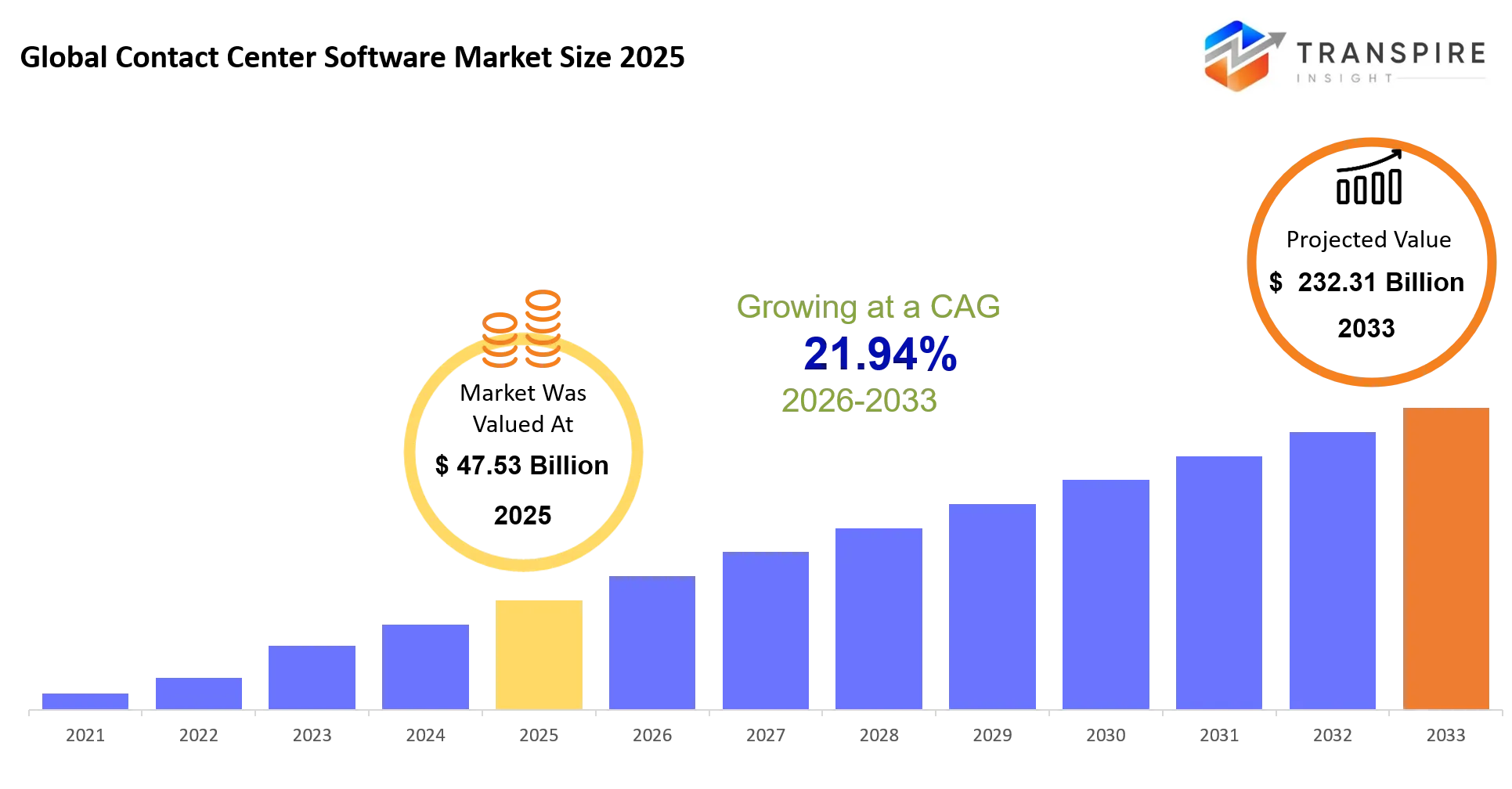
- Global Contact Center Software Market Size 2025: USD 47.53 Billion
- Global Contact Center Software Market Size 2033: USD 232.31 Billion
- Global Contact Center Software Market CAGR: 21.94%
- Global Contact Center Software Market Segments: By Component (Software, Services, Analytics, Workforce Optimization, AI Assistants, Others); By Deployment (Cloud, On-premise, Hybrid, Others); By Enterprise Size (Large Enterprises, SMEs, Others); By End User (BFSI, Retail, Healthcare, IT & Telecom, Government, Others); By Application (Inbound, Outbound, Omnichannel, Self-service, Others)
Global Contact Center Software Market Summary:
As per Transpire Insight Analysis, the Global Contact Center Software Market size is estimated at USD 47.53 billion in 2025 and is anticipated to reach USD 232.31 billion by 2033, growing at a CAGR of 21.94% from 2026 to 2033.
The contact center software Market is really important for businesses to talk to their customers these days. It helps them manage all kinds of conversations like phone calls, emails, live chat, social media and self-service channels in one place.
Over the past few years, companies have been moving away from old systems that they had to keep on their own premises. They are switching to cloud-based solutions because it makes things easier to manage and helps agents work from home. It saves them money on infrastructure. One big change is that more and more companies are using intelligence. This technology has made customer interactions better by routing calls to the right person using virtual assistants and giving real-time information.
Because people are using communication more and more and they want help fast and tailored to them, companies are adopting this software really quickly across all industries. As businesses try to make their service and work more efficient, they are putting more money into contact centre platforms that can grow with them and use artificial intelligence. This means the Market for contact center software has a lot of room to keep growing in the term.
Key Market Insights:
The Market is experiencing rapid transformation as firms adopt cloud-native customer engagement systems embedded with artificial intelligence. Companies are investing in intelligent contact centers to increase customer satisfaction levels, improve business efficiency, and facilitate communication using digital means.
- Software used in cloud-based contact centers occupies 47% of the Market, as more firms adopt flexible and subscription-based contact center software that makes implementation easy and allows for working remotely.
- Workforce optimization solutions are responsible for 18% of the Market, as many companies incorporate automated schedule creation, performance monitoring, and quality management tools to boost employee efficiency.
- Analytics solutions make up 15% of all revenues because of the increasing need for real-time customer insights and conversations to increase service quality.
- Artificial Intelligence-based assistants occupy 10% of the Market, as more enterprises adopt virtual agents for answering routine questions, reducing response times, and improving customer experience.
- Popular software vendors are increasing product lines by incorporating artificial intelligence, speech analytics, and omnichannel communications within the unified platform of customer engagement.
- Companies are moving away from conventional call centers toward digital contact centers, where customers can reach firms via voice, email, messaging apps, and social networks.
What are the Key Drivers, Restraints, and Opportunities in the Global Contact Center Software Market?
Drivers
The increased focus on delivering seamless customer experiences is one of the key reasons why contact center software is becoming widely adopted. Companies in the fields of banking, retail, healthcare, telecommunications, and others are switching to cloud-based solutions, which provide the opportunity to manage all types of communications, including voice calls, emails, chats, social media, and self-service from one platform. Such companies are motivated by the growth in digital communication with customers, as well as hybrid work models and real-time service management. Consequently, it helps them increase their productivity, reduce costs, and retain their clients, which contributes to the Market growth.
Restraints
The problem of data security, concerns related to cybersecurity, and integration with current enterprise systems continue to be key challenges. Implementation of cloud-based solutions, including those with customised settings, becomes quite difficult for many companies, especially small and medium businesses, because of their complexity and price.
Opportunities
Such potential growth opportunity would be the increased use of virtual assistants powered by artificial intelligence, predictive analytics, and specialised cloud-based contact centres for various industries. Since companies are focusing on intelligent automation and personalized customer interactions, there have been developments in platforms incorporating conversational AI, sentiment analysis, and workforce optimization capabilities. Digital transformation in emerging economies through increased cloud computing infrastructure and enterprise technology investments is predicted to generate more revenue for software vendors in the upcoming years.
What Has the Impact of Artificial Intelligence Been on the Global Contact Center Software Market?
The application of artificial intelligence technology has played an instrumental role in changing the global contact centre software Market. Artificial intelligence can improve the level of client engagement and improve the operations of contact center services. The use of virtual agents and automated call routing technologies has enabled businesses to deal with mundane queries, reduce wait times, and allow human agents to attend to more complicated calls. Additionally, another significant strength that is realised from the implementation of artificial intelligence in customer service management is the ability to make predictions based on the analysis of clients' behaviours and conversations. AI technology is able to analyse the volume of conversations, predict the number of calls that will be received at different times and suggest what actions to take depending on the situation.
The application of AI technology has made the work of agents more efficient since it involves automated quality management, sentiment analysis, and tracking of performance. Nevertheless, integration of artificial intelligence with legacy systems proves to be difficult and expensive, especially for small organisations. Additionally, training AI models is essential for them to respond correctly to customer queries. In March 2025,CXone Mpower Orchestrator from NICE was launched. This is an AI-based automation tool that facilitates the automation of customer interactions, provides real-time support to agents, and orchestrates workflows in digital and voice channels. It showcases the application of artificial intelligence in enhancing customer experience and response time efficiency in the contact center software Market worldwide.
Key Market Trends
The Global Contact Center Software Market is experiencing a trend towards the adoption of intelligent, cloud-first platforms with both automation and personalisation of customer engagement. Organisations are utilising AI, analytics, and omnichannel features to enhance the quality of service while making their operations more efficient.
- Organisations are switching from their traditional on-premises contact centers software to modern cloud-based platforms offering more flexibility, quicker implementation, and better remote workforce management solutions.
- AI has become more than just a chatbot capability and now covers virtual agents, real-time assistance, and management of customer interactions.
- Organisations are utilising omnichannel communications capabilities to allow smooth switching between various types of contact center channels such as phone, email, live chats, messengers, and social media channels.
- There is a growing demand for real-time analytics and conversation intelligence as organisations want to better understand their customers and employees and how services are provided.
- Software vendors are implementing predictive analytics and workforce optimisation tools to make better forecasts about customer behaviour and make operations more efficient.
- Organisations place more emphasis on personalising customer experience with the help of AI-driven recommendations and customer data.
- Data security and regulatory compliance become crucial in designing and developing contact center software.
Global Contact Center Software Market Segmentation
By Component
The software segment commands the biggest share of the worldwide contact center software Market, with Cloud-based Contact Center Software making up 47% of the Market as it has a scalable nature, low deployment costs, and supports the remote workforce. Workforce Optimisation makes up 18%, as this technology helps businesses optimise their schedules and improve the performance of their agents. Solutions for analytics account for 15%, as these tools allow customers to extract customer insights that help to drive their business operations. AI Assistants make up 10%, and others make up the last 10% of the software segment. Further on, intelligent automation and analytics will be gaining more importance as companies strive to engage customers in a better way and improve operational processes.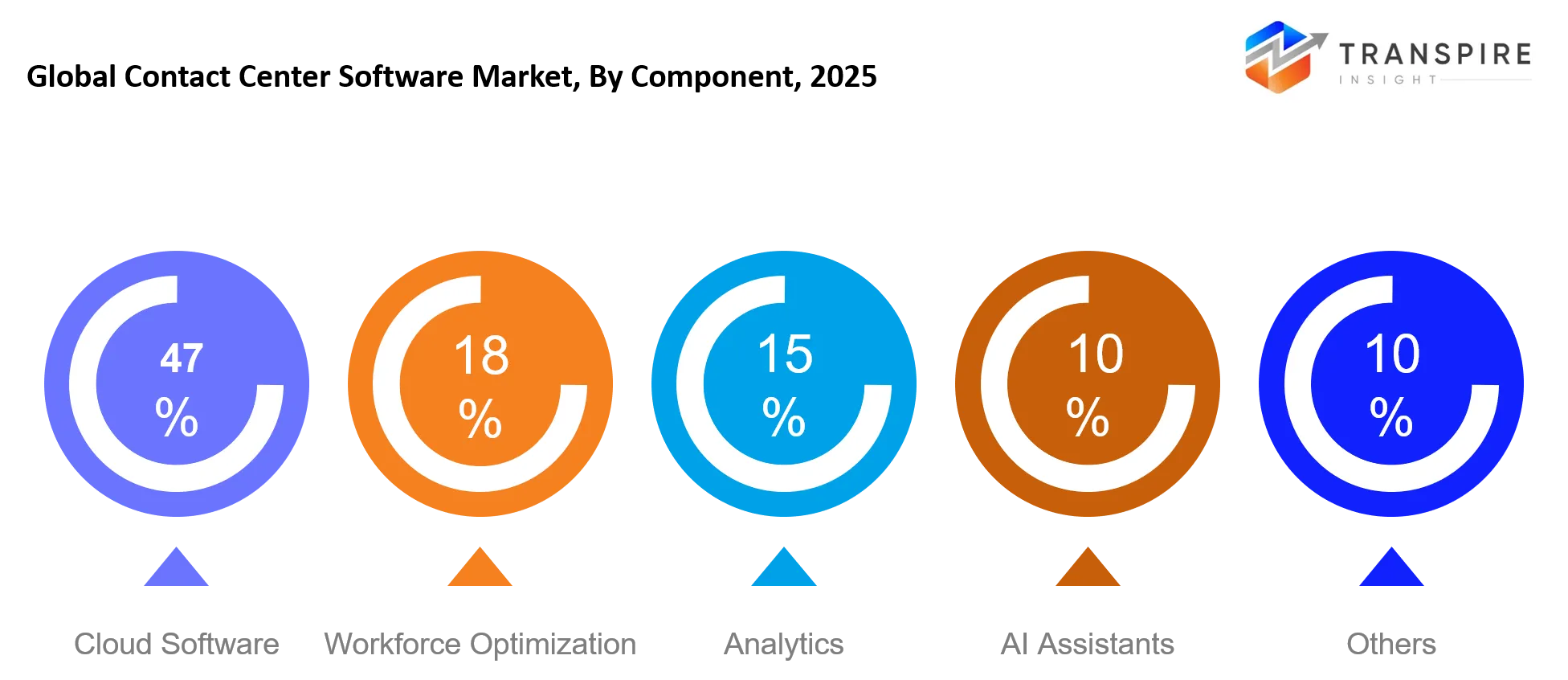
By Deployment
When it comes to deployment, cloud-based solutions are favoured as they are flexible, easier to upgrade and implement than on-premise infrastructure. Many companies are opting to move on-premises to save on maintenance expenses and improve business continuity. Moreover, hybrid deployment is gaining popularity among those who want to have better control over sensitive customer data.
By Enterprise size
Taking into account enterprise size, it is possible to state that large enterprises are the primary adopters of contact centre software solutions as a result of high numbers of customer interactions and considerable investments in digital transformation. Large companies implement sophisticated AI technologies, analytics, and omnichannel solutions to boost customer satisfaction rates and employee productivity. Small and medium-sized enterprises, in turn, are actively embracing such solutions through subscription-based cloud solutions that enable enterprise-level customer service at reasonable prices.
By End User
Considering end-user industries, BFSI is the leader as far as customer support requirements of BFSI enterprises require security, reliability, and personalisation of services via different communication channels. Retail enterprises are extending digital engagement to deal with a growing number of customer contacts via the web. Healthcare organisations are utilising contact center software solutions in order to optimise appointment scheduling and communication with patients, while IT & telecommunication companies need such solutions to manage large volumes of calls.
By Application
From an application point of view, the main attention has been drawn to omnichannel customer engagement that has become the key approach to combining different channels such as voice, emails, live chat, messaging, and social networks into one customer experience. Inbound customer care applications occupy a considerable share of implementations; however, outbound communications help in conducting various business activities, including sales, collecting payments, and customer retention. Self-service applications driven by virtual agents become increasingly popular, helping organisations to decrease the time needed for responses and service availability costs.
What are the Key Use Cases Driving the Global Contact Center Software Market?
The contact center software Market around the world is really competitive. Vendors are working hard to come up with cloud ideas, use artificial intelligence and engage with customers in many different ways to make their Market position stronger. The competition is not about managing calls anymore. Now providers are offering platforms that do a lot of things like communicate with customers, optimize the workforce, analyse data and automate tasks. Companies are trying to stand out by offering cloud services that can grow with the business solutions that're specific to certain industries and always improving their technology to make the customer experience better while reducing costs.
Some big vendors like NICE, Genesys, Cisco, Five9 and Talkdesk are competing with each other by making their intelligence capabilities and cloud platforms better. These companies are spending a lot of money on artificial intelligence, intelligent routing, real-time analytics and tools to engage the workforce to help businesses improve their service and make their agents more productive. They are also buying companies partnering with technology firms and always coming up with new products to make their presence in the global Market stronger and to meet the changing needs of businesses. As more and more people want customer engagement, vendors are investing in artificial intelligence that can generate things, predictive analytics and cloud infrastructure to get more customers and stay ahead of the competition, in both developed and emerging Markets. The contact centre software Market is getting more competitive every day. Vendors have to keep coming up with ideas to stay in the game.
|
Report Metrics |
Details |
|
Market size value in 2025 |
USD 47.53 Billion |
|
Market size value in 2026 |
USD 57.96 Billion |
|
Revenue forecast in 2033 |
USD 232.31 Billion |
|
Growth rate |
CAGR of 21.94% from 2026 to 2033 |
|
Base year |
2025 |
|
Historical data |
2021 - 2024 |
|
Forecast period |
2026 - 2033 |
|
Report coverage |
Revenue forecast, competitive landscape, growth factors, and trends |
|
Regional scope |
United States; Canada; Mexico; United Kingdom; Germany; France; Italy; Spain; Denmark; Sweden; Norway; China; Japan; India; Australia; South Korea; Thailand; Brazil; Argentina; South Africa; Saudi Arabia; United Arab Emirates |
|
Key company profiled |
Genesys, NICE, Five9, Cisco, Avaya, Talkdesk, RingCentral, Zendesk, Salesforce, Oracle, Microsoft, Amazon Connect, 8x8, Freshworks, Vonage |
|
Customization scope |
Free report customization (country, regional & segment scope). Avail customized purchase options to meet your exact research needs. |
|
Report Segmentation |
By Component (Software, Services, Analytics, Workforce Optimization, AI Assistants, Others); By Deployment (Cloud, On-premise, Hybrid, Others); By Enterprise Size (Large Enterprises, SMEs, Others); By End User (BFSI, Retail, Healthcare, IT & Telecom, Government, Others); By Application (Inbound, Outbound, Omnichannel, Self-service, Others) |
Which Regions are Driving the Global Contact Center Software Market Growth?
North America
North America is the largest region with 45% Market share due to highly developed digital infrastructure, cloud computing technology, and availability of leading software companies. Businesses in banking, healthcare, retail, and telecom sectors invest in AI-powered platforms for improved performance and efficiency. The high IT investment and automation are additional factors that support the Market dominance of North America. Innovation in cloud-based contact center software will further help North America to maintain its dominant position. In March 2025, NICE unveiled CXone Mpower Orchestrator, which is an automated solution driven by AI that allows end-to-end customer service orchestration in contact centers. The new solution has bolstered the position of North America as a leader in AI-driven contact center software by automating interactions for businesses and boosting efficiency.
Europe
Europe is the second-largest region with 25% Market share. The stability of the Market growth in Europe is facilitated by a highly focused approach on digital transformation, customer experience management, and compliance. Organisations from financial services, government institutions, and retail industries invest in updated customer communications technology for operational efficiency and improvement of their performance. The increased investment in workforce optimisation and analytics solutions will positively impact Market development in Europe. In February 2026,Genesys declared that the Genesys Cloud solution would become available for use in the AWS European Sovereign Cloud. It means that businesses from Europe will be able to use the AI-driven contact center solutions while complying with all strict requirements set by the EU when it comes to data sovereignty and security.
Asia Pacific
Asia Pacific, which holds 22% of the Market share, is the fastest-growing region at a CAGR of 21.6%. Digitisation and investments in cloud infrastructure and CX solutions are driving the adoption of software solutions within developing countries. Companies are increasingly using AI-driven virtual assistants and cloud contact center solutions to cater to their growing customer base. Growing investments in business technology and the growth of industries such as e-commerce, financial services, and telecom are likely to offer major future opportunities in the region.In November 2025,Tata Communications announced the integration of the NICE CXone Mpower solution into the Customer Interaction Suite of Tata Communications, powered by AI. The partnership intends to provide more modern contact centers for Indian and Asia Pacific enterprises by utilizing AI automation and cloud customer engagement solutions.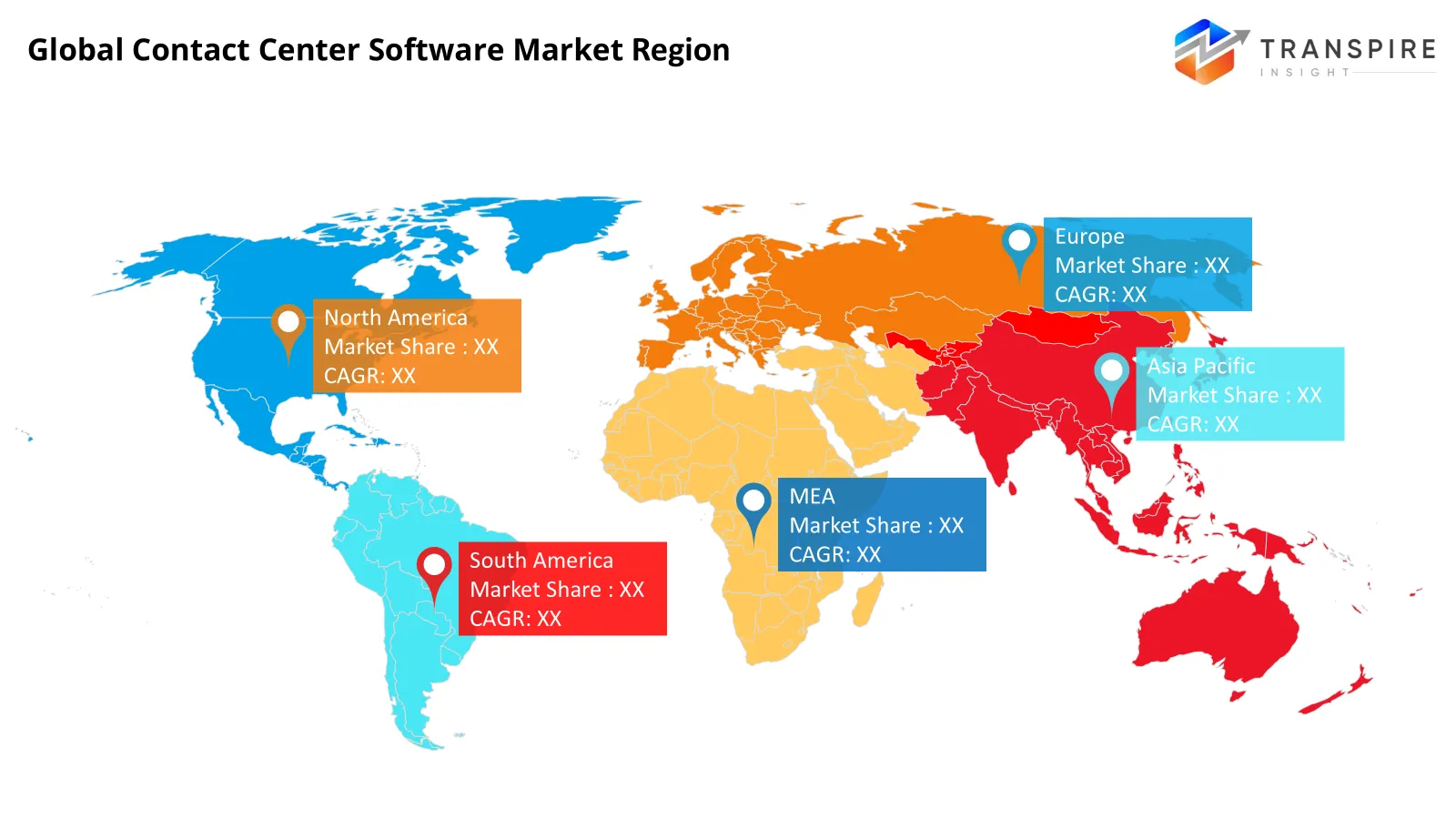
Who are the Key Players in the Global Contact Center Software Marketand how do they Compete?
The global Market of contact center software is characterised by stiff competition. The main areas of vendor competition include the use of innovative technologies in the cloud, artificial intelligence, and omnichannel customer engagement. Traditional competition among vendors is no longer based on the provision of call management but rather integration services including customer communication, workforce optimisation, and analytics.
Some of the major vendors in this Market, such as NICE, Genesys, Cisco, Five9, and Talkdesk, have been competing through the development of AI-based services and cloud-native applications. In other words, these vendors have been investing a lot in conversational AI, intelligent routing, real-time analytics, and workforce engagement tools aimed at helping enterprises to enhance the efficiency and productivity of service delivery. There are other service providers that include Amazon Web Services (Amazon Connect), 8x8, RingCentral, Avaya, and Zoom, which offer flexible, cost-effective, and easy-to-implement solutions in the form of contact centers. Most of these players compete by providing integrated services that can be easily incorporated into enterprise applications and offering robust security features. The demand for personalized customer engagement is on the rise, which makes it imperative for vendors to incorporate generative AI and predictive analytics in order to increase their customer base.
Global Contact Center Software Market companies
- Genesys
- NICE
- Five9
- Cisco
- Avaya
- Talkdesk
- RingCentral
- Zendesk
- Salesforce
- Oracle
- Microsoft
- Amazon Connect
- 8x8
- Freshworks
- Vonage
Recent Development News
In June 2025, NICE extended its strategic alliance with Amazon Web Services (AWS) in order to improve AI-enabled capabilities for customer service. As a result of the partnership, companies can use advanced AI capabilities, enhance automation processes and provide more personalized experiences to customers.
In June 2026, Genesys presented the latest developments in Agentic AI and Experience Orchestration at Future of CX 2026. The company introduced new customer journey management and automation solutions based on artificial intelligence technologies.
What Strategic Insights Define the Future of the Global Contact Center Software Market?
The Market of global contact center software evolves towards the development of smart, cloud-native platforms, which incorporate artificial intelligence, automation, analytics, and omni-channel communication into the integrated ecosystem of customer engagement. With businesses increasingly focusing on their digital customers' experiences, the deployment of intelligent solutions for virtual agents, real-time analytics, and workforce optimisation is likely to increase in both developed and developing economies.One issue that is frequently neglected is the increasing complexity of integrating the new generation of AI capabilities into existing infrastructure without compromising the safety of customer data, compliance, and consistency of customer experiences through various communication channels. Companies that lack modernisation of their IT infrastructure risk experiencing increased expenses and decreased service efficiency.
One important area for the future is the growth of self-service solutions powered by AI and the development of cloud platforms specifically designed for industries like banking, healthcare, retail, or telecommunications. Software developers are advised to pay attention to scalable cloud architectures, responsible AI implementations, and smart technology partnerships.
By Component
- Software
- Services
- Analytics
- Workforce Optimisation
- AI Assistants
By Deployment
- Cloud
- On-premise
- Hybrid
By Enterprise Size
- Large Enterprises
- SMEs
By End User
- BFSI
- Retail
- Healthcare
- IT & Telecom
- Government
By Application
- Inbound
- Outbound
- Omnichannel
- Self-service
Regional Outlook
North America
- United States
- Canada
- Mexico
Europe
- Germany
- United Kingdom
- France
- Spain
- Italy
- Rest of Europe
Asia Pacific
- Japan
- China
- Australia & New Zealand
- South Korea
- India
- Rest of Asia Pacific
South America
- Brazil
- Argentina
- Rest of South America
Middle East & Africa
- Saudi Arabia
- United Arab Emirates
- South Africa
- Rest of the Middle East & Africa
Frequently Asked Questions
Find quick answers to common questions.
The Global Contact Center Software Market size was valued at USD 47.53 Billion in 2025 and is poised to reach USD 232.31 Billion by 2033, expanding at a 21.94% CAGR.
Key Segments for the Global Contact Center Software Market are By Component (Software, Services, Analytics, Workforce Optimization, AI Assistants, Others); By Deployment (Cloud, On-premise, Hybrid, Others); By Enterprise Size (Large Enterprises, SMEs, Others); By End User (BFSI, Retail, Healthcare, IT & Telecom, Government, Others); By Application (Inbound, Outbound, Omnichannel, Self-service, Others).
Growth is primarily driven by The growth in the Market is due to increased usage of cloud-based contact center services, rising need for AI-based customer support, increasing trends of omnichannel communication, expansion of remote workforce, and improvement of customer experience at low cost.
The global Market is led by major manufacturers including Genesys, NICE, Five9, Cisco, Avaya, Talkdesk, RingCentral, Zendesk, Salesforce, Oracle, Microsoft, Amazon Connect, 8x8, Freshworks, Vonage.
The North American region represents 45% of the overall contact center software Market, mainly because of the extensive adoption of cloud-based contact centers, investments in artificial intelligence-based customer service solutions, and technology players. The high level of digitalisation across sectors and demand for omnichannel communication are other factors contributing to the dominance of the region in the Market.
Opportunities available within the worldwide contact center software industry consist of increasing demand for customer service through AI, greater acceptance of cloud-based contact centres, expansion into omnichannel communication services, rising demand from SMEs for affordable software subscription services, and increased integration of the software with CRM and analytics applications.
- Genesys
- NICE
- Five9
- Cisco
- Avaya
- Talkdesk
- RingCentral
- Zendesk
- Salesforce
- Oracle
- Microsoft
- Amazon Connect
- 8x8
- Freshworks
- Vonage
About the Authors

Mayur Shinde
I am Mayur Shinde, a Senior Research Analyst at Transpire Insight, specializing in the Automotive & Transportation and Information & Communication Technology (ICT) Industry. My work focuses on analyzing emerging market trends, technological advancements, competitive landscapes, and industry developments to deliver accurate, data-driven insights. I am passionate about transforming complex market information into clear, actionable content that helps businesses, professionals, and decision-makers stay informed and make confident strategic decisions.

Chakradhar Khansole
Chakradhar serves as the Research Director at Transpire Insight, bringing over 8 years of experience in technology, innovation, and strategic market intelligence. He specializes in transforming complex market data into actionable business insights that enable organizations to make informed, growth-oriented decisions. Recognized for his strategic vision and analytical expertise, Chakradhar leads high-impact research initiatives, delivering comprehensive market assessments, competitive intelligence, and forward-looking industry analysis.
Recently Published Reports
-
Apr 2026
3D Optical Profiler Market
3D Optical Profiler Market Size, Share & Analysis Report By Type (Desktop 3D Optical Profiler, and Portable 3D Optical Profiler), By Technology (Confocal Technology, and White Light Interference), By End-Use Industry (Manufacturing, Research Institutions, Automotive, Aerospace and Defense, Medical Devices, and Other), and Geography (North America, Europe, Asia-Pacific, Middle East and Africa, South and Central America), 2021 - 2031
-
Apr 2026
Depth Sensor Market
Depth Sensor Market Size, Share & Analysis Report By Type (Infrared Depth Sensors, Time-of-Flight (ToF) Sensors, Stereo Vision Sensors, Structured Light Sensors, Ultrasonic Depth Sensors), By Application (Automotive, Robotics, Gaming, Consumer Electronics, Industrial Automation, Healthcare, Security & Surveillance, Others), By End Users (Automotive Manufacturers, Consumer Electronics Companies, Healthcare Providers, Industrial Companies, Security Agencies, Gaming Companies, Robotics Companies, Others), and Geography (North America, Europe, Asia-Pacific, Middle East and Africa, South and Central America), 2021 – 2031
-
Apr 2026
Digital Manufacturing Market
Digital Manufacturing Market Size, Share & Analysis Report By Component (Hardware, Software, and Services), By Technology (Robotics, 3D Printing, Internet of Things (IoT), and Others), By Application (Automotive and Transportation, Aerospace and Defense, Consumer Electronics, Industrial Machinery, and Others), By Process Type (Computer-Based Designing, Computer-Based Simulation, Computer 3D Visualization, Analytics, and Others), and Geography (North America, Europe, Asia-Pacific, Middle East and Africa, South and Central America), 2021 – 2031
-
Apr 2026
Digital Visa Services Market
Digital Visa Services Market Size, Share & Analysis Report By Type (Individual Travelers, Group Travelers), By Application (Tourism, Business Travel, Others), and Geography (North America, Europe, Asia-Pacific, Middle East and Africa, South and Central America), 2021 – 2031