

Europe E-Commerce Software Market Summary
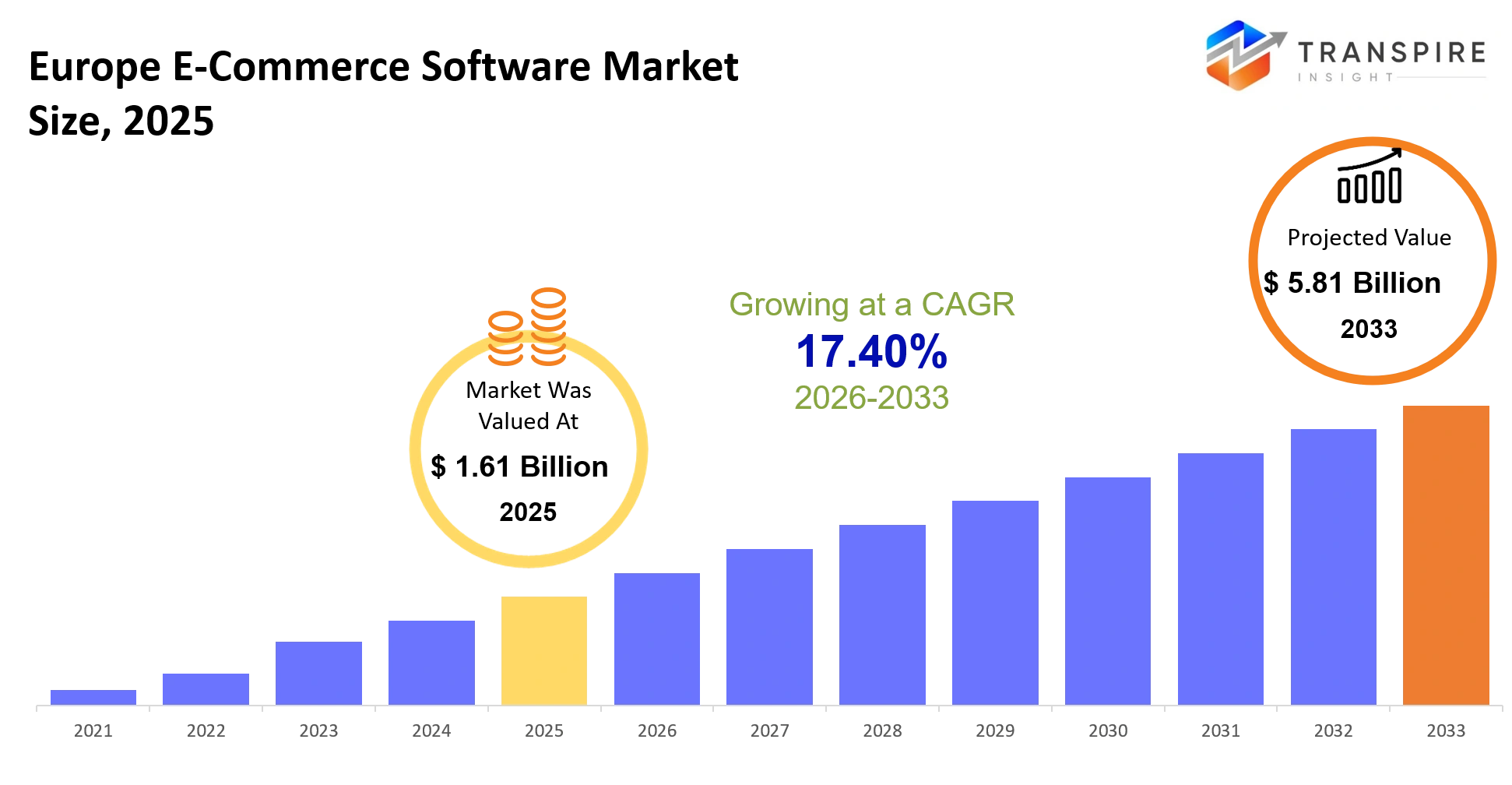
As per Transpire Insight Analysis the Europe E-Commerce Software Market size is estimated at USD 1.61 Billion in 2025 and is anticipated to reach USD 5.81 Billion by 2033, growing at a CAGR of 17.40% from 2026 to 2033.
Europe E-Commerce Software Market helps retailers, manufacturers, and distributors sort out online sales operations in one place, sorta. By linking product catalogs, payments, inventory, customer data and fulfillment processes, it creates a single digital flow. In the last 3–5 years, the whole market kinda slid away from separate online storefront tools, and instead leaned into combined commerce platforms. Those newer platforms run on automation, cloud infrastructure, and data analytics, so it feels less like “one app” and more like a connected system(s) which work together.
A big nudge came from the COVID-19 disruption. During that period, many businesses had to strengthen their digital sales channels, because in-person activities faced limitations, plus supply chain uncertainty kept showing up. That situation also encouraged firms to put money into software that boosts order visibility, makes personalization easier, and supports operational efficiency, without constant manual work.
Right now, European companies are balancing omnichannel strategies with cost control ,and because of that e-commerce software adoption is drifting toward scalable platforms. These platforms are built for cross-border sales, quicker decision-making, and sturdier revenue structures, even when conditions change.
Europe E-Commerce Software Market Size & Forecast:
- Europe E-Commerce Software Market Size 2025: USD 1.61 Billion
- Expected Market Value 2033: USD 5.81 Billion
- Forecast CAGR: 17.40%
- Leading region in 2025: Western Europe
- Fastest Growing region: Eastern Europe
- Key Profile: Shopify, Adobe Commerce, Salesforce, SAP, Oracle, BigCommerce, Wix, WooCommerce, Squarespace, VTEX, Commercetools, Shift4Shop, PrestaShop, Ecwid, OpenCart
Key Market Insights
- Western Europe comes out on top with like 55% market share in 2025 , mainly because the digital retail setup is already pretty mature and enterprises keep adopting platform upgrades.
- Eastern Europe kind of runs the speed race during 2025–2033, backed by SME digitalization and that ongoing growth of online retail ecosystems , you know, more stores, more platforms, more stuff happening.
- On the product side, cloud-based platforms are leading the way with almost 60% share, they basically step in for older commerce systems by rolling out in a scalable manner.
- Commerce management solutions sort of land in the next big spot, because retailers blend inventory workflows , payments handling, and customer operations into one coordinated approach, more or less.
- AI-powered e commerce platforms are one of the fastest growing segments up to 2033, they bring personalization, automation, and predictive analytics tools that work together smoother than before, honestly.
- In terms of channels, online retail applications are leading at around 65% in 2025, boosted by direct-to-consumer shifts, and also marketplace expansion.
- B2B commerce applications are the fastest-growing area too, as manufacturers digitize procurement and wholesale sales channels , more digitized purchasing paths.
- When you look at end users, large enterprises lead with about 58% share , investing in stronger commerce infrastructure and deeper integrations.
- Meanwhile small and medium enterprises are the quickest-growing end-user group, largely because affordable cloud solutions keep spreading across Europe.
What are the Key Drivers, Restraints, and Opportunities in the Europe E-Commerce Software Market?
The main force pushing the Europe E-Commerce Software Market forward is that move toward unified commerce platforms, kinda triggered by cloud adoption and even tighter expectations on the digital customer experience. A lot of European retailers are swapping out those split up systems for integrated solutions that link together sales channels, payment processing, inventory visibility, and analytics. That whole tech shift tends to lower day to day operating costs and also helps raise conversion rates so firms feel confident to ring-fence, bigger budgets for commerce software investments. On top of that, regulatory changes around digital payments and data management are nudging organizations to modernize platforms that can handle compliance requirements and also automate workflows. So you see faster adoption among retailers, who want scalable systems in the long run.
The hardest structural snag is still the integration piece with existing enterprise infrastructure. Many businesses are stuck running legacy setups that need costly migration, custom development work, and additional employee training. These things, they quietly stretch implementation timelines and they also limit adoption for smaller players with tighter technology budgets. From a Transpire Insight review of regional procurement notices and launch calendars, supply chain concentration is still the primary execution risk. Vendor dependency, plus limited interoperability, can drag out product rollouts and then reduce possible revenue wins.
The next growth phase should emerge from AI-fueled commerce optimization and a broader push into underserved European regions. Spending on generative AI, automated merchandizing, and predictive analytics is expected to open doors for platforms that really show measurable sales gains, not just theoretical value. Eastern European markets look set for stronger uptake, as digital infrastructure keeps leveling up, and when SMEs start looking for affordable commerce solutions that still feel reliable. It’s like, the promise isn’t only in the pitch, but in the results.
What Has the Impact of Artificial Intelligence Been on the Europe E-Commerce Software Market?
Artificial intelligence and digital tech are kinda reshaping commerce software, in a way that changes how retailers run operations, talk with customers, and measure sales results. AI-driven platforms can now automate product suggestions, dynamic pricing tweaks, customer groupings, and even workflow coordination, so there is less need for human hands all the time in online retail stuff. Machine learning models pore over earlier sales records , notice customer habits and various market signals to get demand estimates a bit more accurate , also helps with inventory planning and can lift the results from marketing pushes. Those predictive pieces make it possible for companies to reduce stock waste, adjust promotions more precisely, and reinforce customer staying power.
On top of that, advanced analytics plus automation tools are pushing operational efficiency forward, letting teams decide sooner, and also cutting out the same repetitive actions day after day. Retailers that use AI-enabled commerce systems may see better resource use, higher conversion rates, and forecasting results that are more on target. At the same time, digital platforms are increasingly mixing real time analytics with cloud computing and API-based connections, to keep commerce models flexible. Still, AI adoption isn’t all smooth sailing, because implementation costs can be high , the data integration work can be messy, and data quality isn’t always consistent across systems. Smaller companies in particular often can’t roll out advanced AI functions without specialized technical support, or at least the right technical know-how. Even with those barriers , AI investment keeps influencing where European commerce technology adoption is heading next.
Key Market Trends
- Cloud commerce adoption sort of kicked into higher gear after 2021, retailers started moving off older systems and they swapped in flexible, subscription style software models, not as much rigid infrastructure.
- AI-driven personalization really gathered steam after 2023 though, with retailers leaning on machine learning for suggestions, plus smoother customer engagement—like tighter conversations, at scale.
- In Europe, many businesses pushed omnichannel expansion across 2022–2025, linking physical locations with marketplaces and also their own direct online channels, sometimes they even treated them like one continuous surface.
- After 2022, headless commerce adoption also went up, enterprises wanted faster customization and a more steady customer experience delivery, kind of less friction when changes are needed on the front end.
- Spending on data privacy compliance rose too after GDPR got enforced, which basically encouraged platforms to double down on security measures, and add improved data handling features.
- From 2021 to 2025 subscription based commerce software models got a lot more attention, mainly because the upfront costs were lower for SMEs and it was easier to trial.
- Marketplace integration became a key priority after 2022 , sellers expanded across Amazon, regional platforms and social channels, more like a distributed shop strategy.
- Generative AI features kind of showed up around 2024, so teams could do automated content production, search optimization tasks and customer support workflows, with fewer manual steps in between.
- At the same time, cross-border e-commerce capabilities expanded across Europe, mostly in that period, pushed along by investments in multilingual, multi currency, and localized platforms.
- And strategic partnerships increased after 2023, software providers started integrating payment , logistics and analytics solutions—so the ecosystems could feel more connected, almost interlocked.
Europe E-Commerce Software Market Segmentation
By Deployment :
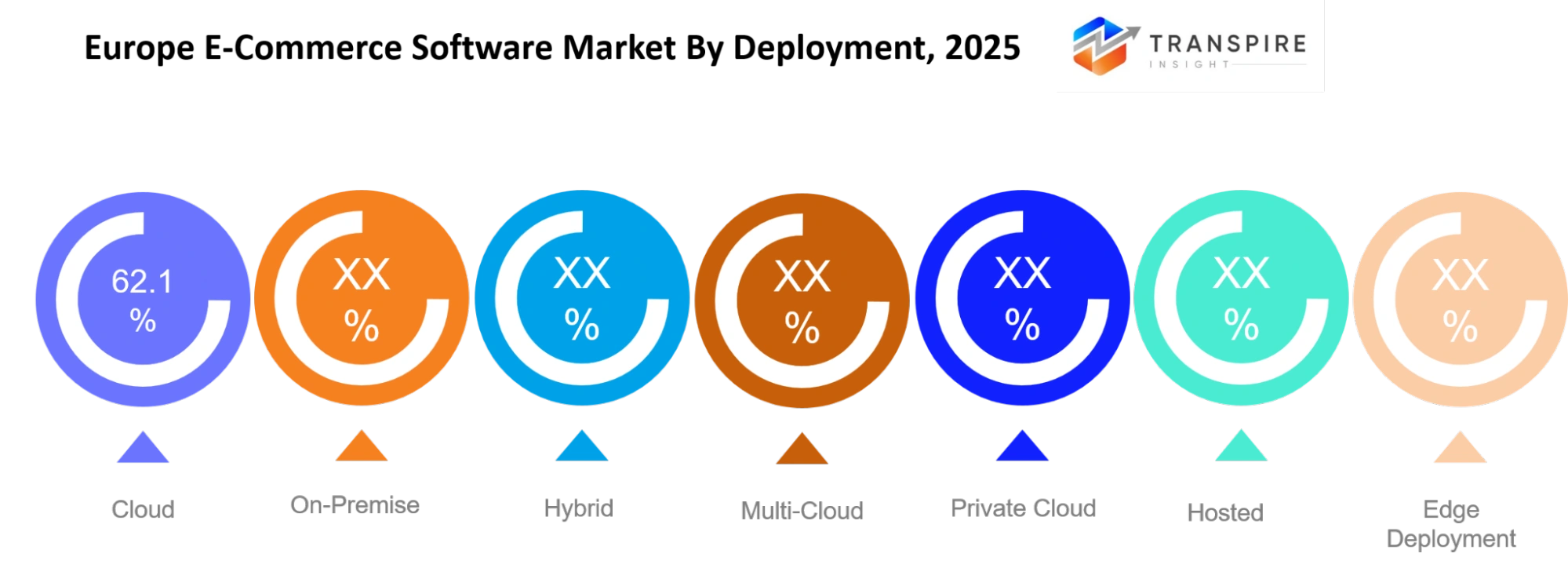
Cloud deployment is pulling people in faster, because retailers and large enterprises want flexible setups with less expensive infrastructure and quicker go-lives cycles. With cloud based platforms, teams can push real time updates, work remotely, and scale operations all at once, while they juggle various digital channels. Still, some organizations keep on-premise solutions in the mix, mostly those who want direct control over data protection and their internal systems , even if it makes the whole process a little slower. Hybrid approaches, multi-cloud strategies, private cloud options, hosted services, and even edge deployment models are likely to get more attention too, as companies try to land that sweet balance between performance, compliance, and everyday operational flexibility.
What gets chosen usually depends on business size, security constraints, and the tech budget. Edge deployment can help with quicker processing, especially for organizations working with massive transaction volumes and localized customer interactions. Private cloud tends to appeal to teams with very strict governance obligations around data handling. Hosted solutions keep resonating with companies that want managed infrastructure without really building a bigger technical crew.
By Component :
Software and platform solutions kinda form the main base for digital commerce operations, since they manage storefront stuff, customer touchpoints, and the whole sales workflow too. Payment solutions also keep getting more investment, because companies are trying to raise transaction safety, offer more payment flexibility, and make cross-border purchasing feel smoother. Analytics tools help with better decisions, by doing sales tracking, digging into customer behavior, and basically measuring performance outcomes.
Then there are services that will stay relevant because businesses still need integration support, some customization, ongoing maintenance, and technical guidance, even when things look stable. CRM integration along with marketing tools will keep growing, especially as organizations shift toward more personalized messaging and customer retention. Meanwhile platform providers will keep adding automation capabilities, to boost operational efficiency and make digital selling processes more simple, and less time-consuming.
By Enterprise Size :
Large enterprises kind of sit in a big spot because their technology budgets are higher, and their digital commerce needs get pretty complex. They tend to spend on advanced platforms that sort of tie together sales channels, supply operations, customer information, and analytics systems. Medium businesses will likely increase adoption too , since more affordable solutions give access to what feels like enterprise-level capabilities.
Smaller companies, and startups, can be major growth zones , mainly because subscription based software lowers the entry barrier. Also, government entities, schools and universities, plus non-profit organizations, are trying out digital platforms for online services, payments, and day-to-day engagement. In general, cost-aware solutions with a straightforward interface will help adoption spread across smaller organizations more easily.
By Application :
Store management still counts as a big application area, since organizations need ways for product presentation, pricing governance, and online sales administration. Payment processing applications keep growing as people want safe transactions and several payment options, not just one. Order management along with inventory management help companies get better precision, lower lag time, and keep customer expectations in line, more or less.
Marketing automation applications are set to pick up speed via auto campaigns, customer segmentation, and ongoing performance monitoring. Customer management tools support sharper engagement thanks to well kept customer records and communication workflows. Logistics management solutions are likely to get more investment too, because businesses are leaning into faster fulfillment and smoother delivery coordination.
By Business Model :
B2C models kinda stay strong, as retailers push harder on direct e-commerce selling, and also keep “tuning” customer experience in the background. B2B commerce, meanwhile, should keep expanding too, because manufacturers and distributors digitize stuff like procurement, sales routines, and even those partner interactions. Then D2C models keep getting more momentum, when brands prefer closer buyer relationships and want more influence on how sales operations are run, end to end.
On top of that, subscription commerce and marketplace commerce will likely open up fresh avenues, mainly because recurring revenue structures show up and product reach gets wider. Social commerce also looks like it will keep growing, as businesses tie digital marketing efforts directly to the buying journey, not just awareness. And C2C platforms, plus a few emerging models, will support extra online transaction chances across European markets too, with different communities and rules in each place.
What are the Key Use Cases Driving the Europe E-Commerce Software Market?
Store management is still kind of the main use case, backed by retailers, brands, and big enterprises who run digital storefronts. The demand kinda comes from wanting to steer product listings, set pricing, shape customer journeys and keep sales operations under one centralized roof, through a platform that does everything.
At the same time payment processing plus inventory management tools are getting more common with B2B distributors, manufacturers, and medium enterprises. Secure transactions, clear stock visibility, and quicker order handling are turning into priorities across both retail, and industrial commerce.
Then you also have AI based personalization, and automated commerce analytics which are starting to show real momentum for online retailers and subscription commerce providers. Predictive tools, along with automated recommendations are likely to open up fresh chances as digital platforms keep maturing.
|
Report Metrics |
Details |
|
Market size value in 2025 |
USD 1.61 Billion |
|
Market size value in 2026 |
USD 1.89 Billion |
|
Revenue forecast in 2033 |
USD 5.81 Billion |
|
Growth rate |
CAGR of 17.40% from 2026 to 2033 |
|
Base year |
2025 |
|
Historical data |
2021 - 2024 |
|
Forecast period |
2026 - 2033 |
|
Report coverage |
Revenue forecast, competitive landscape, growth factors, and trends |
|
Regional scope |
Europe (Germany, United Kingdom, France, Italy, Spain and Rest of Europe) |
|
Key company profiled |
Shopify, Adobe Commerce, Salesforce, SAP, Oracle, BigCommerce, Wix, WooCommerce, Squarespace, VTEX, Commercetools, Shift4Shop, PrestaShop, Ecwid, OpenCart . |
|
Customization scope |
Free report customization (country, regional & segment scope). Avail customized purchase options to meet your exact research needs. |
|
Report Segmentation |
By Deployment (Cloud, On-Premise, Hybrid, Multi-Cloud, Private Cloud, Hosted, Edge Deployment, Others); By Component (Software, Services, Platforms, Payment Solutions, Analytics Tools, CRM Integration, Marketing Tools, Others); By Enterprise Size (Large Enterprises, Medium Enterprises, Small Enterprises, Startups, Government Organizations, Educational Institutions, Non-Profits, Others); By Application (Store Management, Payment Processing, Order Management, Marketing Automation, Inventory Management, Customer Management, Logistics Management, Others); By Business Model (B2B, B2C, C2C, D2C, Subscription Commerce, Marketplace Commerce, Social Commerce, Others) |
Which Regions are Driving the Europe E-Commerce Software Market Growth?
Western Europe kind of owns the dominant spot in the Europe E-Commerce Software Market, with something like 55% market share in 2025 . You can mainly point to strong digital infrastructure, advanced payment regulations and these supportive data protection frameworks which just make the conditions feel right for commerce technology adoption. Also the region has that dense kind of web of retailers, technology providers, cloud service firms and digital payment companies, so everything connects pretty smoothly. And as enterprises keep investing in automation, plus omnichannel systems, Western Europe should keep its market position, probably through 2033.
Northern Europe shows up as a stable revenue contributor because there’s strong digital readiness, consistent technology policies and a high level of business take-up of online commerce solutions. In most countries there, the investment patterns stay reliable , backed by better connectivity and fairly efficient digital payment systems. This strong enterprise technology environment lets retailers and service providers bring in more advanced commerce platforms in a steady way . So even if economic conditions shift , software spending should remain continuously supported.
Eastern Europe is, on the other hand, the fastest-growing region, since improved digital infrastructure and more SME participation , plus retail system modernization, are creating real momentum. In particular, newer investments in online payment networks and cloud adoption have encouraged businesses to move from traditional sales methods, toward digital platforms. That kind of shift should open doors for software providers, investors, and technology partners who are looking to expand sometime between 2026 and 2033.
Who are the Key Players in the Europe E-Commerce Software Market and How Do They Compete?
Competition in the Europe E-Commerce Software Market still looks kind of fragmented, with global platforms, regional providers, and those specialized solution developers all going after the same budgets. They’re basically competing via technology innovation, pricing structures, integration abilities, and that service flexibility. Bigger vendors tend to push platform ecosystems outward, while newer players are nudging the old playbook with automation, added artificial intelligence features, and more industry-specific kinds of solutions that feel tailored.
Shopify throws its weight behind scalable cloud commerce tools built for businesses of different sizes. It keeps tightening its edge by rolling in merchant services, more automation oriented options, and payment related capabilities, so online selling gets simpler, for more merchants and more scenarios. Adobe instead leans hard into enterprise commerce solutions, with advanced personalization, analytics depth, and marketing integration that works at scale. In practice, its technology posture is meant for large retailers who want connected customer experiences that don’t fall apart across channels.
SAP differentiates largely through tight integration with enterprise resource planning systems, which lets larger organizations connect commerce workflows with other business processes. Salesforce expands through Commerce Cloud strengths, customer data integration, and partnerships that help power personalized digital experiences. BigCommerce competes with a flexible platform architecture, plus enterprise minded features that make it easier for brands to expand across multiple sales channels without constantly rebuilding everything.
Company List
- Shopify
- Adobe Commerce
- Salesforce
- SAP
- Oracle
- BigCommerce
- Wix
- WooCommerce
- Squarespace
- VTEX
- Commercetools
- Shift4Shop
- PrestaShop
- Ecwid
- OpenCart
Recent Development News
In November 2025, Shopware and Upsun expanded their strategic partnership to accelerate European e-commerce innovation. The collaboration combines Shopware’s open-source commerce platform with Upsun’s cloud application capabilities, helping merchants improve flexibility, data control, and digital infrastructure performance across Europe.
Source https://www.shopware.com/
In March 2026, SCAYLE announced a strategic partnership with Levi Strauss & Co. to become the global e-commerce platform for levi.com across the U.S., Canada, and Europe. The partnership strengthens SCAYLE’s enterprise commerce position by supporting direct-to-consumer expansion and omnichannel operations for a global retail brand.
Source https://www.scayle.com/
What Strategic Insights Define the Future of the Europe E-Commerce Software Market?
The Europe E-Commerce Software Market seems to be moving toward these smarter commerce ecosystems, where automation, artificial intelligence , and connected data platforms kind of all blend together and then end up shaping purchasing, fulfillment, and how customer engagement actually works, over the next 5–7 years. Underneath it all, the real push is that companies are trying to boost efficiency but also still handle these complex omnichannel operations, which is not always easy. At the same time there is this kind quiet danger showing up, like rising market concentration among a few big platform providers, and that could make everyone more dependent on a narrow set of technology ecosystems, so smaller businesses might end up with less flexibility. On the opportunity side, there’s an upswing in AI-driven commerce assistants and predictive analytics solutions, and this is especially visible across Eastern European markets, where digital adoption is speeding up. Market players should really focus on building modular platforms, with strong integration capabilities, plus regional partnerships too, so they can grab the new chances while also lowering that dependency risk.
Europe E-Commerce Software Market Report Segmentation
By Deployment
- Cloud
- On-Premise
- Hybrid
- Multi-Cloud
- Private Cloud
- Hosted
- Edge Deployment
By Component
- Software
- Services
- Platforms
- Payment Solutions
- Analytics Tools
- CRM Integration
- Marketing Tools
By Enterprise Size
- Large Enterprises
- Medium Enterprises
- Small Enterprises
- Startups
- Government Organizations
- Educational Institutions
- Non-Profits
By Application
- Store Management
- Payment Processing
- Order Management
- Marketing Automation
- Inventory Management
- Customer Management
- Logistics Management
By Business Model
- B2B
- B2C
- C2C
- D2C
- Subscription Commerce
- Marketplace Commerce
- Social Commerce
Frequently Asked Questions
Find quick answers to common questions.
The expected Europe E-Commerce Software Market size for the market will be USD 5.81 Billion in 2033.
Key segments for the Europe E-Commerce Software Market are By Deployment (Cloud, On-Premise, Hybrid, Multi-Cloud, Private Cloud, Hosted, Edge Deployment, Others); By Component (Software, Services, Platforms, Payment Solutions, Analytics Tools, CRM Integration, Marketing Tools, Others); By Enterprise Size (Large Enterprises, Medium Enterprises, Small Enterprises, Startups, Government Organizations, Educational Institutions, Non-Profits, Others); By Application (Store Management, Payment Processing, Order Management, Marketing Automation, Inventory Management, Customer Management, Logistics Management, Others); By Business Model (B2B, B2C, C2C, D2C, Subscription Commerce, Marketplace Commerce, Social Commerce, Others).
Major Europe E-Commerce Software Market players are Shopify, Adobe Commerce, Salesforce, SAP, Oracle, BigCommerce, Wix, WooCommerce, Squarespace, VTEX, Commercetools, Shift4Shop, PrestaShop, Ecwid, OpenCart.
The Europe E-Commerce Software Market size is USD 1.61 Billion in 2025.
The Europe E-Commerce Software Market CAGR is 17.40% from 2026 to 2033.
- Shopify
- Adobe Commerce
- Salesforce
- SAP
- Oracle
- BigCommerce
- Wix
- WooCommerce
- Squarespace
- VTEX
- Commercetools
- Shift4Shop
- PrestaShop
- Ecwid
- OpenCart
About the Authors

Mayur Shinde
I am Mayur Shinde, a Senior Research Analyst at Transpire Insight, specializing in the Automotive & Transportation and Information & Communication Technology (ICT) Industry. My work focuses on analyzing emerging market trends, technological advancements, competitive landscapes, and industry developments to deliver accurate, data-driven insights. I am passionate about transforming complex market information into clear, actionable content that helps businesses, professionals, and decision-makers stay informed and make confident strategic decisions.

Chakradhar Khansole
Chakradhar serves as the Research Director at Transpire Insight, bringing over 8 years of experience in technology, innovation, and strategic market intelligence. He specializes in transforming complex market data into actionable business insights that enable organizations to make informed, growth-oriented decisions. Recognized for his strategic vision and analytical expertise, Chakradhar leads high-impact research initiatives, delivering comprehensive market assessments, competitive intelligence, and forward-looking industry analysis.
Recently Published Reports
-
Apr 2026
3D Optical Profiler Market
3D Optical Profiler Market Size, Share & Analysis Report By Type (Desktop 3D Optical Profiler, and Portable 3D Optical Profiler), By Technology (Confocal Technology, and White Light Interference), By End-Use Industry (Manufacturing, Research Institutions, Automotive, Aerospace and Defense, Medical Devices, and Other), and Geography (North America, Europe, Asia-Pacific, Middle East and Africa, South and Central America), 2021 - 2031
-
Apr 2026
Depth Sensor Market
Depth Sensor Market Size, Share & Analysis Report By Type (Infrared Depth Sensors, Time-of-Flight (ToF) Sensors, Stereo Vision Sensors, Structured Light Sensors, Ultrasonic Depth Sensors), By Application (Automotive, Robotics, Gaming, Consumer Electronics, Industrial Automation, Healthcare, Security & Surveillance, Others), By End Users (Automotive Manufacturers, Consumer Electronics Companies, Healthcare Providers, Industrial Companies, Security Agencies, Gaming Companies, Robotics Companies, Others), and Geography (North America, Europe, Asia-Pacific, Middle East and Africa, South and Central America), 2021 – 2031
-
Apr 2026
Digital Manufacturing Market
Digital Manufacturing Market Size, Share & Analysis Report By Component (Hardware, Software, and Services), By Technology (Robotics, 3D Printing, Internet of Things (IoT), and Others), By Application (Automotive and Transportation, Aerospace and Defense, Consumer Electronics, Industrial Machinery, and Others), By Process Type (Computer-Based Designing, Computer-Based Simulation, Computer 3D Visualization, Analytics, and Others), and Geography (North America, Europe, Asia-Pacific, Middle East and Africa, South and Central America), 2021 – 2031
-
Apr 2026
Digital Visa Services Market
Digital Visa Services Market Size, Share & Analysis Report By Type (Individual Travelers, Group Travelers), By Application (Tourism, Business Travel, Others), and Geography (North America, Europe, Asia-Pacific, Middle East and Africa, South and Central America), 2021 – 2031