

Asia Pacific Live Commerce Market Size & Forecast:
- Asia Pacific Live Commerce Market Size 2025: USD 184.6 Billion
- Asia Pacific Live Commerce Market Size 2033: USD 816.03 Billion
- Asia Pacific Live Commerce Market CAGR: 20.42%
- Asia Pacific Live Commerce Market Segments: By Platform Type (Social Commerce Platforms, Marketplace Live Commerce, Brand-Owned Live Commerce, Influencer Commerce, Video Commerce Platforms, Mobile Commerce Platforms, Interactive Commerce Platforms, Others); By Device (Mobile Devices, Desktop Computers, Tablets, Smart TVs, Connected Devices, Gaming Consoles, Wearables, Others); By Application (Fashion, Beauty Products, Electronics, Home Goods, Food & Beverage, Luxury Products, Personal Care Products, Others); By End User (Retailers, Brands, SMEs, Influencers, E-commerce Companies, D2C Brands, Content Creators, Others).
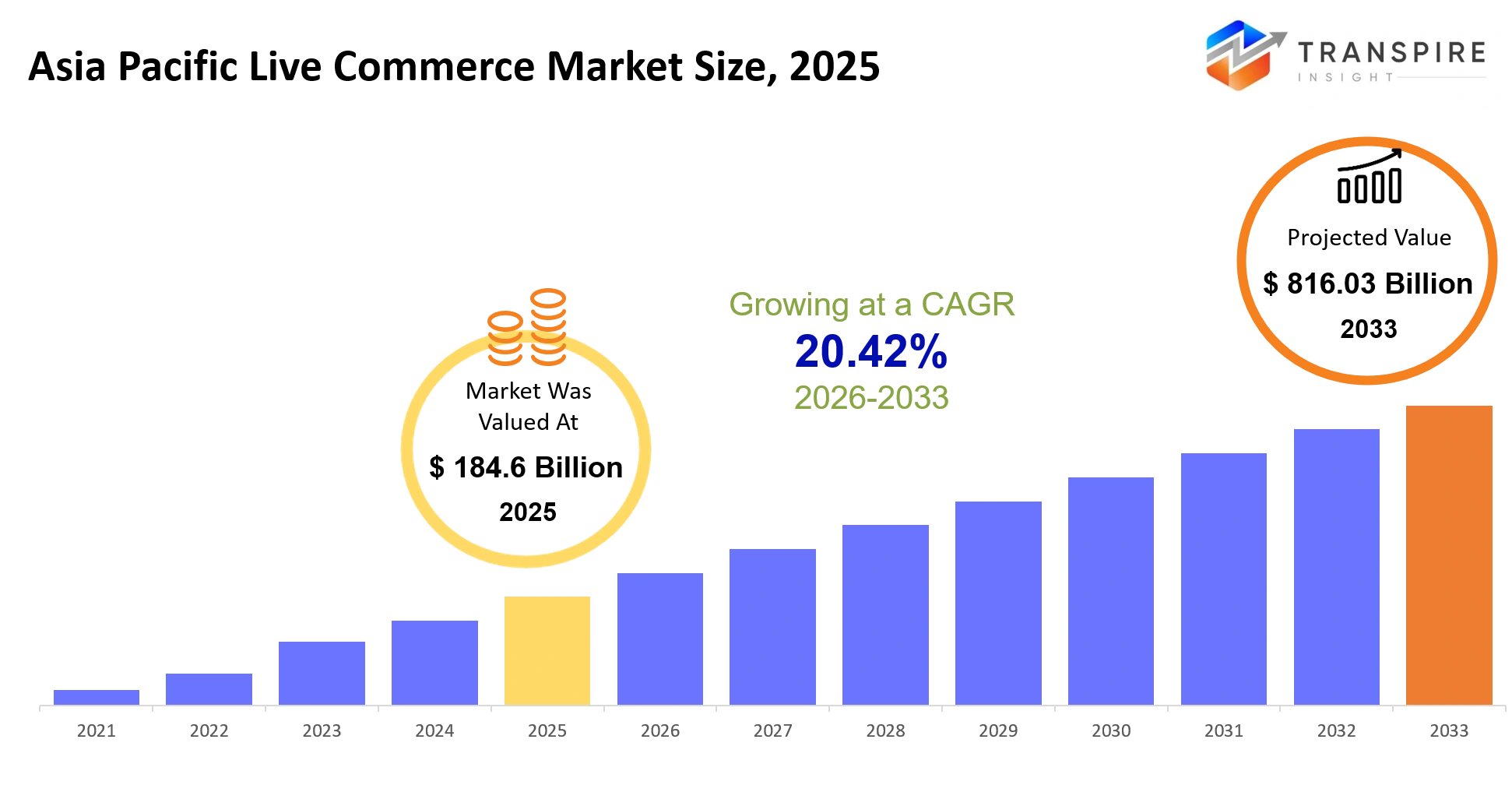
Asia Pacific Live Commerce Market Summary
The Asia Pacific Live Commerce Market was valued at USD 184.6 Billion in 2025. It is forecast to reach USD 816.03 Billion by 2033. That is a CAGR of 20.42% over the period.
The Asia Pacific Live Commerce Market converts live video interactions into point-of-sale purchases, breaking the down the purchase Funnel of consumers from product discovery to purchase within a single interface. Essentially, this helps sellers show product in live form while consumer can ask question, check information or purchase within a live session, minimizing inconvenience.
In the past 3-5 years, the market has been evolving from an experimental stage by influencers into an integral infrastructure of the retail segment by primarily operating on a multi-channel in integrated form over super-app models throughout the regions of China, India, and Southeast Asia. Structural change of integrating live commerce into the existing platform on a larger scale has transformed entertained live stream into profit oriented sales channels, primarily in super app platforms. During this transition, pandemic has induced drastic impact of the offline retail sector which leads the businesses to shift their customer engagement online and forced consumers into such entertaining consumption of goods and eventually become operational efficiency tool for merchants (conversion rates; customer acquisition cost)
Key Market Insights
- China accounts for almost 60% share of Asia Pacific live commerce market driven by matured ecosystem integration and influencer driven retail scale.
- Southeast Asia holds the fastest growth rates (2024-2030) boosted by a mobile-first population and the growing use of digital payments in Indonesia and Vietnam.
- Platform-based live commerce service holds a 55%+ market share, boosted by the marketplace integration in the social & e-commerce ecosystems.
- Influencer-led streaming services remain the second biggest as it capitalizes on creator monetization frameworks & audience-driven conversion engines.
- AI-driven live commerce tools represent the highest growth segment, until 2030, driven by the trend of automating personalization & real-time engagement.
- Fashion & Beauty's large application share is due to its strong visual component and impulsive buying habits.
- Electronics retail emerges as the rapidly developing application driven by its immediate and demonstrable features.
- E-commerce platforms contribute the largest share of end users in AP Live Commerce Market by holding more than 50% share.
- Small/Medium enterprises and individual sellers represent the fastest growing segment in this market and its growth is being aided by low-cost live streaming features allowing it to approach customers directly.
What are the Key Drivers, Restraints, and Opportunities in the Asia Pacific Live Commerce Market?
The Asia Pacific Live Commerce Market is driven by the fusion of mobile-first consumption and payment ecosystem, streamlining the friction from discovery to transaction. The integration of in-app purchase by short-video apps and super-apps has led to exponential increase in conversion rates, directly benefiting merchant's revenue and advertiser's spend. This structural trend has enabled brands to monetize attention in real-time, rather than through lagging e-commerce funnels. This has consequently fueled platform-dependence in the entire category of retail.
The strongest barrier is the disparate creator monetization infrastructure, and high operational dependence on algorithmic traffic. This has led to unpredictable visibility for smaller sellers, creating inconsistency in revenue scalability and higher customer acquisition cost. This asymmetry in structure has restrained adoption of traditional retailers that are under equipped in both infrastructure and advertising budget for an algorithmically dependent retail.
AI-driven personalization and the expansion of cross-border live commerce in SE Asia & India represents the strongest opportunity. AI recommendation systems and multilingual AI automated hosts are lowering the market entry for smaller retailers, and the establishment of cross-border logistics integration is opening new demand channels. For instance, Chinese platforms venturing in Thailand and Malaysia show higher frequency of transactions through culturally adaptive contents, and AI-driven product recommendation, which suggests an emergence of a new phase.
What Has the Impact of Artificial Intelligence Been on the Asia Pacific Live Commerce Market?
AI has also become an essential operational layer within the Asia Pacific Live Commerce Market, offering real-time personalization, automatic content optimization and variable pricing within the live broadcast. Live platforms now incorporate machine learning models that have the capacity to determine audience behavior instantly-customizing placement of specific items, discount triggers and host narrative to maximize conversion likelihood within live streams. This allows the market to become more efficient in its conversion rates, and less dependent on the need for the manually crafted campaigns.
Predictive analysis models have also been incorporated into live commerce platforms in order to better determine customer behavior and optimize stock level distribution according to live streaming schedules. The application of such models by online retailers allows them to not only ascertain peak interaction periods but also minimize potential stock outs while further increasing fulfillment rates in rapidly growing industries such as fashion and beauty.
Operationally, AI-powered recommendation systems have not only led to an increase in average order value (AOV) but also to additional, pre-bundle product sales based on immediate live interaction signals. Furthermore, platforms have indicated increased viewer retention as personalized feeds prevent audience departure from the platform within the live sessions.
However, the significant obstacle is that the computational cost and data required for adequate real-time personalization remain incredibly high. Many small business owners and operators lack the extensive data required for an adequately functioning model and will not have their personalization consistently optimized.
Key Market Trends
- Live Commerce in Asia Pacific evolved from experimental usage by influencers to native e-commerce tools on a super-app level since 2021.
- Chinese live commerce platform’s AI product recommendation increased accuracy over 30% in between 2022 and 2025 and resulted in an increase of conversion effectiveness.
- Retailers shifted from a single direction livestream sale format to an interactive and informative one-stop shop. The data gathered in a live session allowed a real-time price change or special offer based on buyer's behavior.
- ByteDance developed live commerce with an algorithmic controlled live streaming ecosystem, transforming creator revenue systems and decreasing reliance on manual traffic steering.
- Mobile payment adoption rate within Southeast Asian live commerce surpassed 70% by 2025 to speed up in-transaction, in-session check-out.
- Retailers channeled advertising spending on their static e-commerce banners to live streaming media by and achieve a higher ROAS as real-time live session engagement metrics is available.
- Alibaba Group has been enhancing hybrid e-commerce between offline supply chain and online live streaming storefront since 2023.
- Cross-border live commerce penetration boomed after 2022 as automated logistics and multilingual AI live host were integrated.
- Consumer behaviors have shifted to shorter attention span which lowered viewing duration but increased purchase rate in each live session.
- Competition had sharpened as regional e-commerce firms introduced AI host and automated product demonstrations that would slash live streaming operating costs by 2024.
Asia Pacific Live Commerce Market Segmentation
By Platform Type:
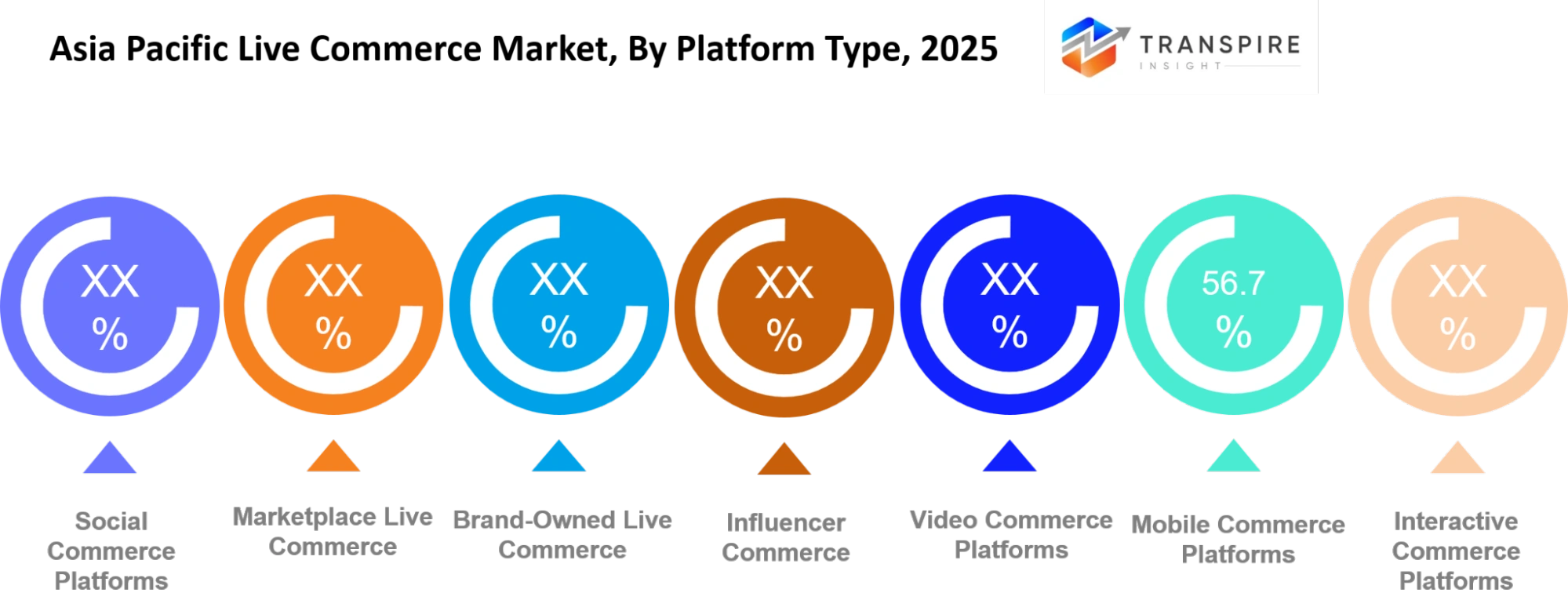
The real-time digital retail activity distribution across the Asia Pacific Live Commerce Market structure is driven by social commerce platforms, marketplace live commerce, brand-owned live commerce, influencer commerce, video commerce platforms, mobile commerce platforms, interactive commerce platforms, and other formats. The integration between platforms across social applications and e-commerce infrastructure drives increased conversion efficiency through integrated commerce and streaming channels.
Market growth has moved from separate streaming tools to integrated e-commerce frameworks within super-application architectures since 2021. Algorithm-based content recommendations, with a focus on real-time commerce functions, decrease the gap between product discovery and checkout, driving stronger engagement to sales conversion across digital retail.
By Device:
The Asia Pacific Live Commerce Market is predominantly mobile-accessed, owing to the mobile-first approach of Asia Pacific consumers, coupled with the ubiquitous usage of smart phones in both urban and sub-urban demographics. Longer session times to purchase higher-value items will be experienced on the desktop, whilst usage on tablets will predominantly remain a home-centric family/communal shopping experience among the different live commerce platforms.
Enhanced large-screen live streaming experiences through smart TVs and other connectable devices contribute to more extended viewing periods and group shopping. The market sees some growth in interaction through gaming consoles and wearables; though for the most part, enhancement to cross-device synchronicity and real-time streaming performance across digital retail platforms will drive adoption.
By Application:
The transaction flows are initiated by various categories that include fashion, beauty products, electronics, home furnishings, food and beverage, luxury products, personal care products and the rest that constitute the structures of the Asia Pacific live commerce market. The fashion and beauty categories will retain robust user engagement as these categories possess stronger visual demonstration strengths and exhibit increased frequency in spontaneous purchase decisions that is triggered through the live streams.
The Electronics and home furnishings segments will exhibit a growth in popularity as live demonstrations diminish buyer doubt over the functionalities and performance of electronic devices and furnishings. The food and beverage categories will rise through live showcases that reflect their freshness and methods of preparation, while the personal care and luxury goods categories will witness a boost through the implementation of trustworthy presenter-based influencer presentation schemes and product authenticity checking support systems.
By End User:
Retailers, brands, SMEs, influencers, e-commerce companies, D2C brands, content creators and others can represent the participation layers within the structures of the Asia Pacific live commerce market. The retailers and e-commerce companies will hold strong operational control by incorporating the latest integrated platforms and logistics support across their respective digital storefronts and live stream channels.
The SMEs and D2C brands are witnessing increased adoption by virtue of their lower entry costs and more efficient marketing expenses compared to traditional media. Influencers and content creators will fuel user engagement through their personalized presentation of goods, and brands will nurture more intimate relationships with consumers by utilizing the real-time buyer feedback systems and a tracking system that monitors sales conversions that are stimulated during the live stream sessions.
What are the Key Use Cases Driving the Asia Pacific Live Commerce Market?
The primary use case of the Asia Pacific Live Commerce Market is real-time product demonstration and immediate purchase across fashion and beauty e-commerce. Brands showcase texture, fit, and demonstration of their products through live shows in an authentic manner, thereby lessening customer doubts and compressing the time taken to make a purchase. High demand is seen here as live streaming replaces brick and mortar store experience with an interactive online sale that still builds trust in the buyer.
Expanding applications can be seen across electronics and home décor e-commerce and large retail stores, wherein e-commerce brands and big retailers conduct live sessions to elaborate on product features, compare products, and showcase different varieties to their consumers in real-time. Food and beverage brands employ live sessions to provide transparency on their food freshness, preparation processes, and supply sources to build trust across urban customers and SME owned sellers.
Nascent use cases involve D2C brands utilizing multilingual live hosts for real-time luxury product authenticity and also for cross-border selling. Moreover, influencers are experimenting on AI driven live streams that alter real-time communication on the basis of user behaviour to pave a path for newer personalised and automated forms of selling.
|
Report Metrics |
Details |
|
Market size value in 2025 |
USD 184.6 Billion |
|
Market size value in 2026 |
USD 222.3 Billion |
|
Revenue forecast in 2033 |
USD 816.03 Billion |
|
Growth rate |
CAGR of 20.42% from 2026 to 2033 |
|
Base year |
2025 |
|
Historical data |
2021 - 2024 |
|
Forecast period |
2026 - 2033 |
|
Report coverage |
Revenue forecast, competitive landscape, growth factors, and trends |
|
Regional scope |
Asia Pacific (India, China, Japan, Australia, South Korea, Rest of Asia Pacific) |
|
Key company profiled |
TikTok Shop, Alibaba, Amazon Live, YouTube Shopping, Meta, Shopee Live, LazLive, NTWRK, TalkShopLive, Bambuser, Firework, Livescale, Shopify, Buywith, Channelize. |
|
Customization scope |
Free report customization (country, regional & segment scope). Avail customized purchase options to meet your exact research needs. |
|
Report Segmentation |
By Platform Type (Social Commerce Platforms, Marketplace Live Commerce, Brand-Owned Live Commerce, Influencer Commerce, Video Commerce Platforms, Mobile Commerce Platforms, Interactive Commerce Platforms, Others); By Device (Mobile Devices, Desktop Computers, Tablets, Smart TVs, Connected Devices, Gaming Consoles, Wearables, Others); By Application (Fashion, Beauty Products, Electronics, Home Goods, Food & Beverage, Luxury Products, Personal Care Products, Others); By End User (Retailers, Brands, SMEs, Influencers, E-commerce Companies, D2C Brands, Content Creators, Others). |
Which Regions are Driving the Asia Pacific Live Commerce Market Growth?
China remains at the top of the Asia Pacific Live Commerce Market by value owing to its deep and highly connected digital retail ecosystem and intense consolidation in the leading platforms. Widespread super-app adoption and a highly interconnected payment infrastructure have enabled immediate transactions as consumers transition seamlessly from consuming content to purchasing. Well-developed logistics networks and dense urban fulfillment networks enable rapid delivery which further drives repeat purchase behavior. Supporting this, government support for digital infrastructure build-out and earlier adoption of influencer-led selling models have helped the dominance of a handful of players.
Japan and South Korea continue to stand as steady markets contributing to the Asia Pacific Live Commerce Market by value with an increased emphasis on premium content-driven commerce and a regulated trading environment. These markets have begun to shift focus towards high-quality product showcase and trust-based interaction over high volume-based impulsivity in purchases. Consumer purchasing is more methodical, influenced by established brand loyalty and a more stable economy, and as a result, e-retailers are able to invest significantly in more refined production and an environment with only verified sellers.
Southeast Asia is a fast-developing region thanks to its mobile internet penetration growth and increasing adoption of digital payments in countries such as Indonesia, Vietnam and Thailand. Increased investments in logistics and a well-connected network with cross-border e-commerce enabled enhanced delivery reliability which in turn spurred live commerce growth. The entry of multiple short video and social commerce platforms in the live commerce arena has been the primary driver of seller adoption starting 2023. This rise signals significant opportunities in the long term with the region poised for continued high growth, appealing to the mobile-first audience through carefully localized content strategies.
Who are the Key Players in the Asia Pacific Live Commerce Market and How Do They Compete?
Asia Pacific Live Commerce Market is competitive and moderately concentrated, with a few major digital platforms controlling traffic and monetization power of all e-commerce flows. Competition dynamics will focus more on algorithms and user engagement technology instead of pricing only and further integration within the ecosystem. Existing players have established market share and are expanding via constant update of features and functions while newcomers will change engagement methods by using short video live commerce and AI based personalization tools.
Alibaba Group continues its market leadership by integrating marketplace commerce closely to live streaming feature, thus directly connecting merchants with high-intent buyers in a contained environment. Advantage is in the full scope of logistics, payment and merchant data as a retail ecosystem. Future growth is sustained via more refined recommender systems based on AI technology and cooperation with regional merchants in Southeast Asia.
ByteDance is positioned as an algorithm driven live commerce player, driving engagement based product display within short-video platforms. It is differentiated by sophisticated real time personalization engines based on viewing behavior of participants during live streaming sessions. Expansion will follow based on the enlargement of social commerce features for new regional markets and additional tools for creator monetization.
Sea Limited and JD.com have a hybrid retail structure in relation to live commerce, with strong logistics infrastructure supporting curated shopping experience. Sea Limited is scaling its mobile first live selling in Southeast Asia using its substantial regional footprints, whereas JD.com emphasizes its reliable supply chain management to guarantee genuine products to customers. Expansion is via cross-border partnerships and optimized logistics capabilities to enhance trust building.
Company List
- TikTok Shop
- Alibaba
- Amazon Live
- YouTube Shopping
- Meta
- Shopee Live
- LazLive
- NTWRK
- TalkShopLive
- Bambuser
- Firework
- Livescale
- Shopify
- Buywith
- Channelize
Recent Development News
In June 2026, Asian digital markets reacted strongly to easing geopolitical tensions after a US-Iran agreement, improving investor sentiment toward live commerce and tech-driven retail platforms. The development indirectly supports expansion of cross-border live commerce activity by stabilizing logistics and energy-linked costs.
Source: https://indianexpress.com/
In April 2026, Alibaba Group launched a new artificial intelligence model for video generation and interactive commerce applications. The development enhances live commerce content creation capabilities and strengthens real-time product visualization across digital retail ecosystems.
Source: https://www.britannica.com/
What Strategic Insights Define the Future of the Asia Pacific Live Commerce Market?
The APAC Live Commerce Market is gradually morphing towards an AI driven marketplace model where content, personalization and payments will exist within the same livestream environment. This will drive growth in the coming 5-7 years as more and more short video apps get deeply integrated into e-commerce infrastructure, making direct transaction conversion the norm rather than an enhancement. This will be powered by the algorithms that distribute content, and growing digital payment capabilities in a mobile first region.
An understated threat is platform concentration, wherein traffic exposure and monetization terms are increasingly managed by a few large ecosystem players. Even a subtle shift in ranking algorithms, or commission models, could very quickly warp seller profits and diminish diversity within the marketplace.
A tangible emerging trend to leverage is that of AI-generated live hosts to power multilingual, cross-border sales into fragmented SE Asian markets without the constraint of a live presenter. Stakeholders must early invest in compatible AI e-commerce tools, and develop multi-channel distribution in order to mitigate dependence on algorithm based single platforms.
Asia Pacific Live Commerce Market Report Segmentation
By Platform Type
- Social Commerce Platforms
- Marketplace Live Commerce
- Brand-Owned Live Commerce
- Influencer Commerce
- Video Commerce Platforms
- Mobile Commerce Platforms
- Interactive Commerce Platforms
By Device
- Mobile Devices
- Desktop Computers
- Tablets
- Smart TVs
- Connected Devices
- Gaming Consoles
- Wearables
By Application
- Fashion
- Beauty Products
- Electronics
- Home Goods
- Food & Beverage
- Luxury Products
- Personal Care Products
By End User
- Retailers
- Brands
- SMEs
- Influencers
- E-commerce Companies
- D2C Brands
- Content Creators
Frequently Asked Questions
Find quick answers to common questions.
The Asia Pacific Live Commerce Market size is USD 816.03 Billion in 2033.
Key segments for the Asia Pacific Live Commerce Market are By Platform Type (Social Commerce Platforms, Marketplace Live Commerce, Brand-Owned Live Commerce, Influencer Commerce, Video Commerce Platforms, Mobile Commerce Platforms, Interactive Commerce Platforms, Others); By Device (Mobile Devices, Desktop Computers, Tablets, Smart TVs, Connected Devices, Gaming Consoles, Wearables, Others); By Application (Fashion, Beauty Products, Electronics, Home Goods, Food & Beverage, Luxury Products, Personal Care Products, Others); By End User (Retailers, Brands, SMEs, Influencers, E-commerce Companies, D2C Brands, Content Creators, Others).
Major Asia Pacific Live Commerce Market players are TikTok Shop, Alibaba, Amazon Live, YouTube Shopping, Meta, Shopee Live, LazLive, NTWRK, TalkShopLive, Bambuser, Firework, Livescale, Shopify, Buywith, Channelize.
The Asia Pacific Live Commerce Market size is USD 184.6 Billion in 2025.
The Asia Pacific Live Commerce Market CAGR is 20.42% from 2026 to 2033.
- TikTok Shop
- Alibaba
- Amazon Live
- YouTube Shopping
- Meta
- Shopee Live
- LazLive
- NTWRK
- TalkShopLive
- Bambuser
- Firework
- Livescale
- Shopify
- Buywith
- Channelize
About the Authors

Mayur Shinde
I am Mayur Shinde, a Senior Research Analyst at Transpire Insight, specializing in the Automotive & Transportation and Information & Communication Technology (ICT) Industry. My work focuses on analyzing emerging market trends, technological advancements, competitive landscapes, and industry developments to deliver accurate, data-driven insights. I am passionate about transforming complex market information into clear, actionable content that helps businesses, professionals, and decision-makers stay informed and make confident strategic decisions.

Chakradhar Khansole
Chakradhar serves as the Research Director at Transpire Insight, bringing over 8 years of experience in technology, innovation, and strategic market intelligence. He specializes in transforming complex market data into actionable business insights that enable organizations to make informed, growth-oriented decisions. Recognized for his strategic vision and analytical expertise, Chakradhar leads high-impact research initiatives, delivering comprehensive market assessments, competitive intelligence, and forward-looking industry analysis.
Recently Published Reports
-
Apr 2026
3D Optical Profiler Market
3D Optical Profiler Market Size, Share & Analysis Report By Type (Desktop 3D Optical Profiler, and Portable 3D Optical Profiler), By Technology (Confocal Technology, and White Light Interference), By End-Use Industry (Manufacturing, Research Institutions, Automotive, Aerospace and Defense, Medical Devices, and Other), and Geography (North America, Europe, Asia-Pacific, Middle East and Africa, South and Central America), 2021 - 2031
-
Apr 2026
Depth Sensor Market
Depth Sensor Market Size, Share & Analysis Report By Type (Infrared Depth Sensors, Time-of-Flight (ToF) Sensors, Stereo Vision Sensors, Structured Light Sensors, Ultrasonic Depth Sensors), By Application (Automotive, Robotics, Gaming, Consumer Electronics, Industrial Automation, Healthcare, Security & Surveillance, Others), By End Users (Automotive Manufacturers, Consumer Electronics Companies, Healthcare Providers, Industrial Companies, Security Agencies, Gaming Companies, Robotics Companies, Others), and Geography (North America, Europe, Asia-Pacific, Middle East and Africa, South and Central America), 2021 – 2031
-
Apr 2026
Digital Manufacturing Market
Digital Manufacturing Market Size, Share & Analysis Report By Component (Hardware, Software, and Services), By Technology (Robotics, 3D Printing, Internet of Things (IoT), and Others), By Application (Automotive and Transportation, Aerospace and Defense, Consumer Electronics, Industrial Machinery, and Others), By Process Type (Computer-Based Designing, Computer-Based Simulation, Computer 3D Visualization, Analytics, and Others), and Geography (North America, Europe, Asia-Pacific, Middle East and Africa, South and Central America), 2021 – 2031
-
Apr 2026
Digital Visa Services Market
Digital Visa Services Market Size, Share & Analysis Report By Type (Individual Travelers, Group Travelers), By Application (Tourism, Business Travel, Others), and Geography (North America, Europe, Asia-Pacific, Middle East and Africa, South and Central America), 2021 – 2031