

Middle East and Africa Personal Care Market Size & Forecast:
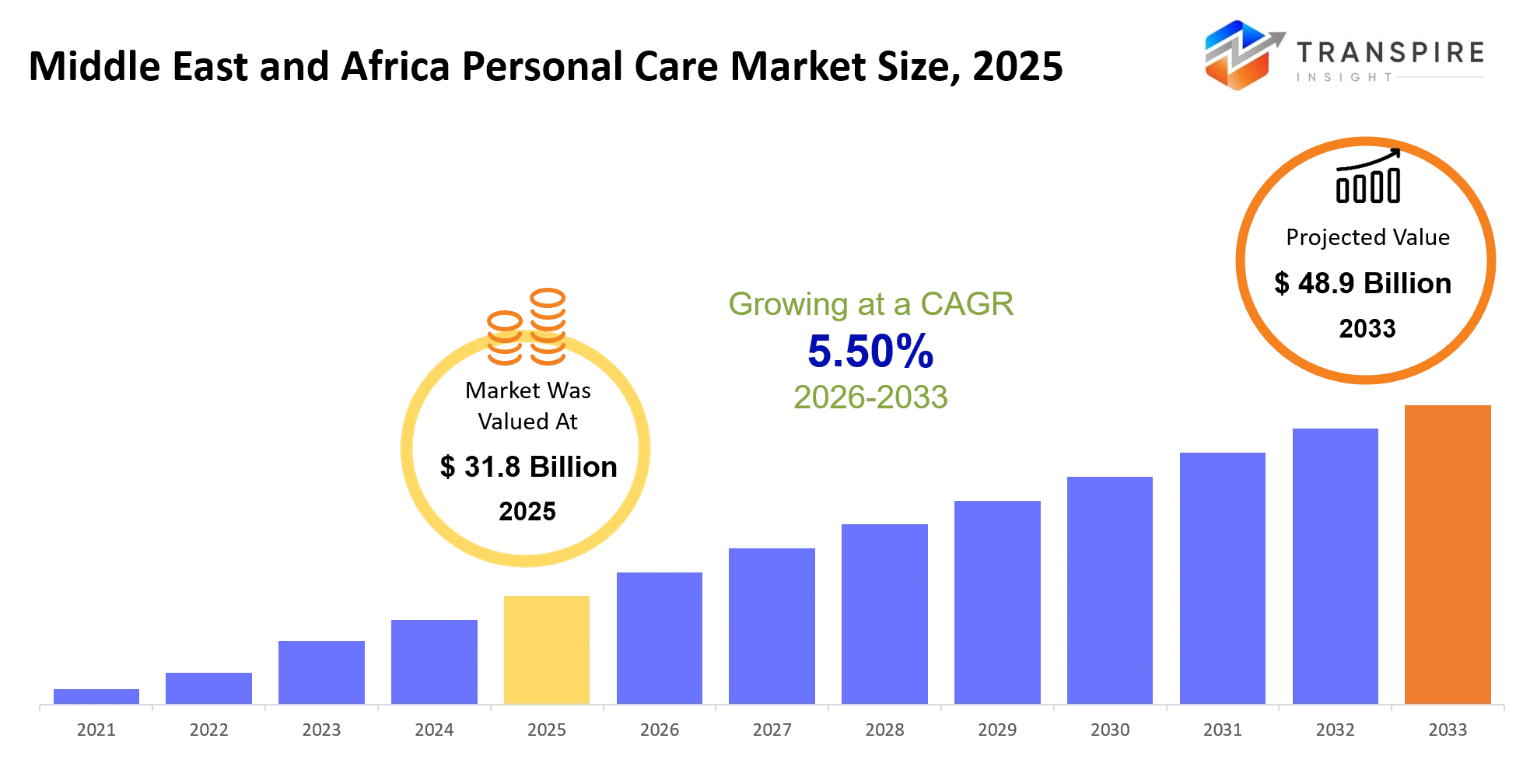
- Middle East and Africa Personal Care Market Size 2025: USD 31.8 Billion
- Middle East and Africa Personal Care Market Size 2033: USD 48.9 Billion
- Middle East and Africa Personal Care Market CAGR: 5.50%
- Middle East and Africa Personal Care Market Segments: By Product Type (Skin Care, Hair Care, Oral Care, Bath & Shower, Cosmetics, Others); By Distribution Channel (Supermarkets, Online Retail, Specialty Stores, Pharmacies, Others); By End User (Men, Women, Children, Others); By Ingredient Type (Natural, Organic, Synthetic, Others).
To learn more about this report,  Download Free Sample Report
Middle East and Africa Personal Care Market Summary
The Middle East and Africa Personal Care Market was valued at USD 31.8 Billion in 2025. It is forecast to reach USD 48.9 Billion by 2033. That is a CAGR of 5.50%over the period.
The Middle East and Africa personal care market kind of sits at the middle of it all, helping people keep up hygiene, skincare, hair care, oral care, and grooming routines while also backing health, confidence, and personal appearance. And across big cities plus the newer, fast-growing economies, these products have become like a daily habit, not just “nice to have” stuff. So it forms this pretty steady consumer goods ecosystem, moving through retail counters, e-commerce, pharmacies, and beauty specialty stores too, often at the same time, if you think about it.
In the last five years the whole market shifted in a more structural way, leaning toward more local beauty answers that match regional skin tones, hair textures, and even climate conditions. Also, the rise of the A-Beauty movement— it highlights Arab and African beauty traditions along with indigenous ingredients— has changed how product development gets prioritized, across the industry. One big reason behind the recent changes was the supply chain disruption during and after the pandemic period. That pushed manufacturers to diversify sourcing , and it also made them strengthen local production networks. Now, as brands put more effort into localized formulations, digital commerce, and more premium product portfolios, they tend to unlock higher consumer spend and, in turn, stronger brand loyalty. It basically shows up as sustained revenue growth across the region, over time, even when the market gets a bit unpredictable.
Key Market Insights
- Saudi Arabia and the UAE , taken together, make up more than 35% of Gulf beauty product sales. So yeah, the Gulf area is a huge revenue source really, like dominant by a lot.
- Sub-Saharan Africa should be the fastest-growing regional market through 2033, mainly because urban consumers are spending more and more, over time.
- When it comes to product types Hair care still leads everything, supported by a 17% growth rate between 2024 and 2025 , so pretty solid momentum.
- Skin care lands as the second-largest segment, and it’s basically riding on premium skincare adoption plus dermatologist-backed formulations that people trust.
- Men’s grooming products are forecast to outperform several older categories, because male consumers are expanding their spend on appearance- focused goods , not just the basics.
- Offline retail is still running the show, especially for distribution, with more than 70% of category sales in many African markets.
- E-commerce, though, has grown a lot since 2021, with digital beauty purchases growing quicker than the traditional retail routes.
- Shoppers are also increasingly choosing products with shea butter, baobab oil , marula oil, and other regionally sourced ingredients. Like the local angle matters.
- Premium and masstige beauty products have been gaining share because middle-income households keep shifting budgets toward personal care.
- Also, companies are investing in AI-driven formulation work, localized manufacturing, and broader regional expansion, basically to strengthen their competitive position.
- Key players include Unilever, Procter & Gamble, L'Oréal, Beiersdorf, Colgate-Palmolive, and Johnson & Johnson, all of them really.
- AI-assisted product development is helping speed up formulation testing, and it shortens innovation cycles too.
- Strategic investments in Saudi Arabia, South Africa, and the UAE are supporting long-term market penetration and staying power.
What are the Key Drivers, Restraints, and Opportunities in the Middle East and Africa Personal Care Market?
The strongest growth driver looks like it’s the expansion of region focused beauty and grooming products, sort of made around local consumer needs. Over the past several years brands started noticing that imported formulations that were developed for Western markets often just don’t really handle the regional climate conditions, hair textures, and skin characteristics properly. That realization, kind of sparked investment in localized product development too, and it lets companies ask for premium pricing while also boosting customer retention. The end result, that product relevance went up in a very tangible way, and it has directly helped drive higher sales volumes, plus stronger brand loyalty across multiple categories .
The biggest restraint is income disparity across a lot of African and Middle Eastern economies. Personal care products beyond basic hygiene items are still kind of discretionary buys for a large share of consumers. This kind of structural issue can’t be fixed quickly because it’s tied to broader economic development, employment levels, and household purchasing power. So, premium product penetration stays limited in several markets which hits revenue potential and also slows down those category upgrades .
A major opportunity sits in digital commerce, and AI enabled personalization, at least that’s where a lot of brands are heading. Beauty companies are using digital skin diagnostics, virtual consultations, and personalized recommendations more often now, to improve conversion rates . Saudi Arabia , the UAE, and South Africa are showing up as attractive investment destinations since smartphone penetration is high, and online beauty spending is growing too. The firms that blend localized formulations with digital customer engagement are better positioned to grab the next wave of market expansion .
What Has the Impact of Artificial Intelligence Been on the Middle East and Africa Personal Care Market?
Artificial intelligence is kind of reshaping the personal care sector, mainly by tweaking product development, demand forecasting, and how brands talk to consumers. More and more manufacturers roll out AI systems to sift through consumer preferences, judge ingredient effectiveness, and speed up formulation creation. With advanced machine learning, it becomes possible to sort through thousands of ingredient mixtures virtually, before any lab work even starts, so development schedules get shorter and research expenses often drop.
On top of that, AI helps with predictive demand forecasting. That makes it easier for brands to set inventory levels more precisely, and it can also reduce those annoying stockouts in both retail and e-commerce. Meanwhile, digital recommendation engines look at consumer behavior and purchase records to suggest personalized skincare and haircare options. The result tends to be higher conversion and better customer retention. In the actual production setting, AI-based quality monitoring supports steadier formulation consistency, while also cutting down manufacturing waste.
From an operations standpoint, these tools bring more supply chain visibility, help shorten innovation cycles, and improve marketing efficiency. A number of large, multinational beauty companies have increased their AI spending, aiming to move faster on ingredient discovery and product testing.
Still, there are limits when it comes to adoption. The integration costs can be pretty high for smaller regional manufacturers. And access to large, clean consumer datasets is not equally available across developing markets. Because of that, some models may deliver less reliable results, and rollout can slow down—especially for smaller local brands that have limited digital infrastructure, or not enough internal support.
Key Market Trends
- A-Beauty sort of came up as a big movement between 2024 and 2025 ,and it really shined a light on regional identity as well as indigenous ingredients, you know that idea.
- Hair care sales grew about 17% from 2024 to 2025, which beat several of those more traditional beauty segments, at least in most reports.
- Beauty brands also put more money into Saudi Arabia as the kingdom doubled down and basically solidified itself as the Gulf’s biggest beauty market.
- In parallel, AI-assisted product formulation moved beyond those early pilot runs, it went into actual commercial use during 2025 and 2026, not just testing.
- Consumers started picking products that include shea butter, baobab oil, and marula oil more often, kind of instead of the whole imported-ingredient story.
- Digital commerce then became a bigger sales lane, because brands expanded their direct-to-consumer setups. Premium skincare kept gaining ground with middle-income urban consumers across the different Gulf economies too.
- Companies rushed regional office openings and distribution spending ,so they could respond faster and more precisely to what’s happening locally.
- Also water-efficient and concentrated formulations caught attention, partly as a response to sustainability goals ,and the reality of resource constraints.
- Overall, the competitive focus shifted away from broad mass-market positioning and leaned more into personalization, science-backed claims, and localized branding.
Middle East and Africa Personal Care Market Segmentation
By Product Type
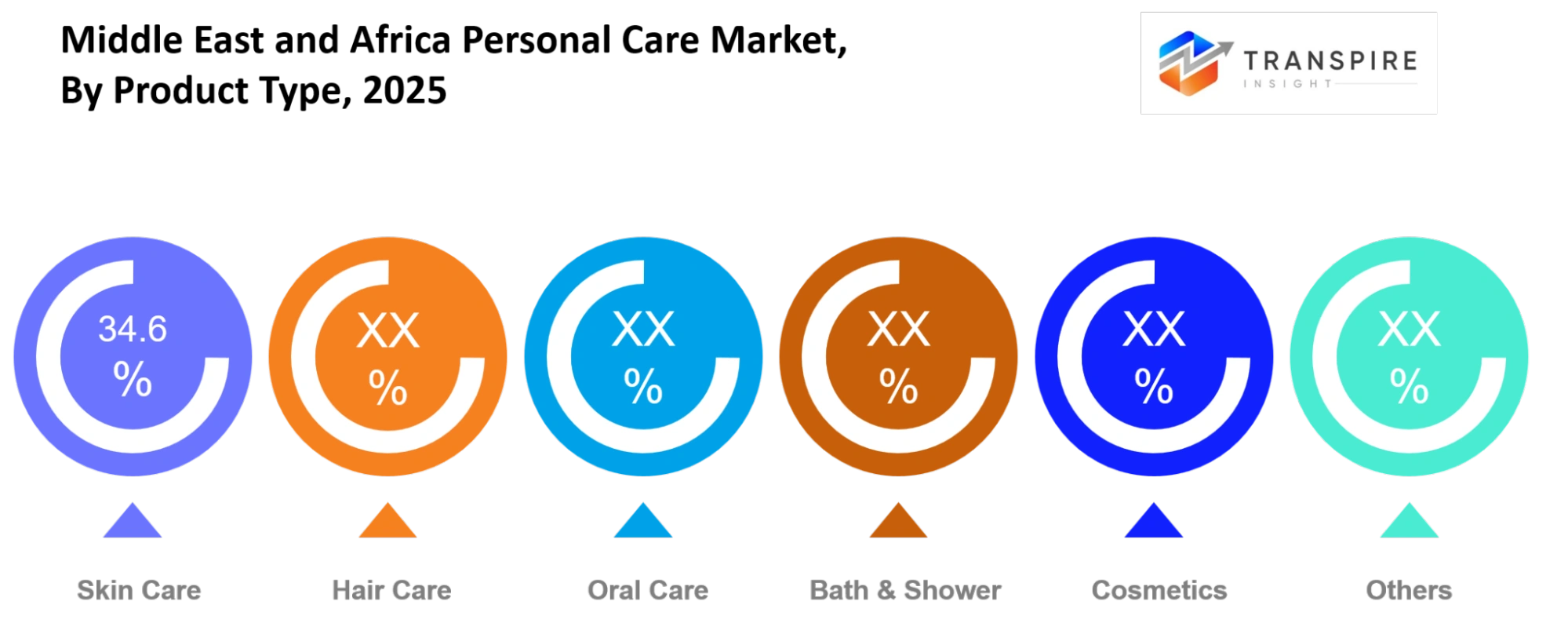
The product type segment kinda shows the wide span of personal care products , used for hygiene , grooming , beauty enhancements and everyday wellness routines. Skin Care sits pretty high up, since facial creams, moisturizers, cleansers , and treatment products help keep skin healthy across different age groups , and well, even different climate conditions. At the same time product innovation, premium formulations and specialized solutions keep pushing the category forward in both urban areas and developing markets.
Hair Care keeps a solid footprint because people keep buying shampoos, conditioners, oils, serums and styling products on a regular basis. Oral Care backs up preventive hygiene via toothpaste, mouthwash and dental care items, which really become part of the daily flow. Bath & Shower products give cleansing plus a freshness lift using soaps, body washes, and similar offerings. Cosmetics also matter , mainly for beauty enhancement and personal appearance through makeup and color cosmetics. As for Others , that part usually covers deodorants, fragrances, personal hygiene goods and specialized grooming solutions made for certain consumer needs , or niche preferences, depending on the market.
To learn more about this report, Download Free Sample Report
By Distribution Channel
The distribution channel segment sort of highlights the different sales networks that help move personal care products to consumers across the whole region. Supermarkets take a major share since broad product availability, handy shopping experiences and competitive pricing make it easier to buy more often. Also the retail infrastructure in important economies really helps sales, through structured retail outlets.
Online Retail keeps growing because digital platforms bring product variety, home delivery options, and even customer reviews before people make the choice. Specialty Stores also pull in buyers who want premium brands, beauty know how, and more tailored shopping experiences. Pharmacies keep matter too, especially when personal care products are tied to skin health, oral hygiene and general wellness applications. Other routes include convenience shops, direct selling channels, and independent retailers, which support access to the products across different consumer groups.
By End User
The end user segment kind of mirrors the different consumer groups that actually buy and use personal care products for a range of lifestyle, grooming needs, and day to day habits. Men are a major category because spending keeps going up for skincare, haircare, shaving products,and general grooming solutions. Manufacturers also keep rolling out more focused options that target particular preferences and those appearance goals people care about.
Women take up a big portion too, since beauty, skincare, haircare, and cosmetic items are a real part of routine self-care, regularly. Children drive demand for gentle formulations baby care products, and hygiene focused solutions made for sensitive skin, plus requirements that fit their age. “Others” is basically everyone else, like buyers looking for specialized items built for uncommon personal care needs, wellness intentions, or more specific lifestyle preferences.
By Ingredient Type
The ingredient type segment shows this real variety of formulations that manufacturers use, to handle different consumer preferences, plus product performance needs. Natural ingredients still have a strong spot, because plant extracts, botanical oils, and mineral based components basically speak to people who want more nature derived solutions. Meanwhile, product development keeps pushing on improving effectiveness, but also trying to keep ingredient authenticity, like it’s something you cannot really trade away.
Organic ingredients draw interest through certified sourcing, plus a more careful use of synthetic additives during production routines. Synthetic ingredients stay common too, since steady quality, cost efficiency, and proven performance help with large scale manufacturing requirements. Then there are others, like blended formulations and advanced ingredient technologies that kinda combine several material sources, in order to boost product stability, functionality and overall consumer experience.
What are the Key Use Cases Driving the Middle East and Africa Personal Care Market?
So the biggest source of demand just kinda shows up in everyday hygiene, grooming stuff , you know like hair care, skincare, oral care and those personal cleansing products. Hair care in particular really pulls hard, because it handles all kinds of hair textures and also those climate related problems that show up across a lot of Middle Eastern and African markets.
And then beyond the usual stuff, premium facial care, anti aging solutions, and specialized dermatological products are getting more traction , especially with city shoppers. The professional salon route, plus beauty clinics, they also help push the market forward through premium treatments , and branded product suggestions.
There are also emerging angles like personalized skincare, backed by AI based diagnostics, plus products built around local ingredients—things like baobab and marula extracts. Right now these categories are still kinda small, but they should turn into major growth drivers over the forecast period.
|
Report Metrics |
Details |
|
Market size value in 2025 |
USD 31.8 Billion |
|
Market size value in 2026 |
USD 33.5 Billion |
|
Revenue forecast in 2033 |
USD 48.9 Billion |
|
Growth rate |
CAGR of 5.50% from 2026 to 2033 |
|
Base year |
2025 |
|
Historical data |
2021 - 2024 |
|
Forecast period |
2026 - 2033 |
|
Report coverage |
Revenue forecast, competitive landscape, growth factors, and trends |
|
Regional scope |
Middle East and Africa (Saudi Arabia, United Arab Emirates, South Africa, Rest of Middle East and Africa) |
|
Key company profiled |
Unilever, Procter & Gamble, L'Oréal, Beiersdorf, Colgate-Palmolive, Johnson & Johnson, Henkel, Shiseido, Kao, Revlon, Amway, Oriflame, Avon, Dabur, Himalaya. |
|
Customization scope |
Free report customization (country, regional & segment scope). Avail customized purchase options to meet your exact research needs. |
|
Report Segmentation |
By Product Type (Skin Care, Hair Care, Oral Care, Bath & Shower, Cosmetics, Others); By Distribution Channel (Supermarkets, Online Retail, Specialty Stores, Pharmacies, Others); By End User (Men, Women, Children, Others); By Ingredient Type (Natural, Organic, Synthetic, Others). |
Which Regions are Driving the Middle East and Africa Personal Care Market Growth?
The Gulf Cooperation Council region is, kind of, the biggest revenue driver for the market. Countries like Saudi Arabia and the United Arab Emirates draw strong results from high disposable incomes, solid retail infrastructure and this really well developed beauty ecosystem. International brands still keep, let’s say, very broad distribution networks across these areas, and shoppers seem to take up premium products pretty fast. On top of that, government moves that back retail modernization and digital commerce, are helping lock in the regional momentum.
South Africa stays the second most important regional contributor, yet its growth pattern is different compared to the Gulf. The whole market gets support from a fairly mature retail landscape, established consumer brands and relatively steady regulatory rules. But unlike the premium heavy Gulf markets, South Africa blends value oriented products and premium offerings together, so demand ends up more balanced. That mix ends up supporting a pretty steady stream of revenue over time, not just spikes.
Sub Saharan Africa is expected to post the fastest growth all the way through 2033. Over the last few years, urbanization, a rising middle income group, and deeper retail penetration have shifted the conditions quite a bit. Better digital payment tools, plus easier access to e-commerce, have opened up routes to shoppers who used to be underserved by traditional retail channels. For investors and anyone entering fresh, this region basically offers some of the strongest long term expansion chances across the wider market.
Who are the Key Players in the Middle East and Africa Personal Care Market and How Do They Compete?
Competition in the Middle East and Africa personal care market is sort of moderately concentrated, where multinational consumer goods companies hold a good chunk of market share and local brands try to win by staying more regionally relevant, plus giving pricing flexibility. Most of the time they all end up fighting on brand strength, product innovation , distribution reach, and also on how well they can adjust the products to local consumer preferences, a bit like adapting to what people actually want.
L'Oréal sets itself apart thanks to big spending on beauty science, very strong research capability, and AI-enabled formulation development. Lately, its push toward AI partnerships and regional investments seems to speed up innovation, and it also boosts its visibility in local markets, which helps it stay present.
Unilever leans on a wide portfolio that covers personal hygiene, skincare and grooming. A key edge is its distribution networks, they are extensive, and its brand recognition is strong across both developed and emerging markets, kind of across the whole spectrum.
Procter & Gamble concentrates on product science, and it tends to go for a more premium stance, especially with brands like Olay, plus specialized hair care innovations. More recent launches that focus on water-efficient formulations show that its main theme is differentiated product development, not just small changes.
Beiersdorf plays its hand through dermatological expertise and deep skincare focus, while Dabur and Himalaya, they strengthen their positions with herbal and natural ingredient-focused offerings. Those options really resonate with regional consumers, because the whole “natural” angle tends to land well there, even when the category is crowded.
Company List
- Unilever
- Procter & Gamble
- L'Oréal
- Beiersdorf
- Colgate-Palmolive
- Johnson & Johnson
- Henkel
- Shiseido
- Kao
- Revlon
- Amway
- Oriflame
- Avon
- Dabur
- Himalaya
Recent Development News
In May 2026, L'Oréal Middle East launched a new office in Jeddah, Saudi Arabia. The investment strengthens the company's regional presence and supports workforce expansion in one of the Gulf's most important beauty markets.
Source: https://www.hpcmagmea.com
In March 2026, L'Oréal expanded its partnership with NVIDIA to accelerate AI-driven beauty discovery and formulation development. The initiative enables faster ingredient testing and supports next-generation product innovation.
Source: https://www.loreal-finance.com
In March 2026, L'Oréal completed the acquisition of Kering Beauté, including the House of Creed and long-term fragrance licensing agreements. The transaction strengthens its luxury beauty portfolio and expands growth opportunities in premium fragrance categories.
Source: https://www.loreal-finance.com
What Strategic Insights Define the Future of the Middle East and Africa Personal Care Market?
Honestly the market is kinda moving toward a model that mixes localized beauty solutions with digital engagement and science driven product building. In the next five to seven years, what really decides success won’t be just global brand recognition, but more like how well a company can push products that fit regional consumers, while still keeping that premium level of performance going. And you can really feel the strongest pull behind this shift, it comes from younger consumers looking for beauty that feels culturally relevant, plus those more personalized experiences
There’s also a risk that’s a little less obvious, it sits in raw material sourcing and supply chain concentration. A lot of premium formulations depend on specialized ingredients where availability can get thrown off by climate events, geopolitical disruptions, or even basic logistics constraints. But at the same time, AI enabled personalization and platforms built around locally sourced ingredients are turning into a pretty big emerging chance for growth
So for market participants, the most effective route seems to be tying regional product development know-how to digital commerce, data analytics, and also localized manufacturing investments. Businesses that manage to connect innovation with regional identity may end up getting deeper market penetration and better long term profitability too
Middle East and Africa Personal Care Market Report Segmentation
By Product Type
- Skin Care
- Hair Care
- Oral Care
- Bath & Shower
- Cosmetics
- Others
By Distribution Channel
- Supermarkets
- Online Retail
- Specialty Stores
- Pharmacies
- Others
By End User
- Men
- Women
- Children
- Others
By Ingredient Type
- Natural
- Organic
- Synthetic
- Others
Frequently Asked Questions
Find quick answers to common questions.
The expected Middle East and Africa Personal Care Market size for the market will be USD 48.9 Billion in 2033.
Key segments for the Middle East and Africa Personal Care Market are By Product Type (Skin Care, Hair Care, Oral Care, Bath & Shower, Cosmetics, Others); By Distribution Channel (Supermarkets, Online Retail, Specialty Stores, Pharmacies, Others); By End User (Men, Women, Children, Others); By Ingredient Type (Natural, Organic, Synthetic, Others).
Major Middle East and Africa Personal Care Market players are Unilever, Procter & Gamble, L'Oréal, Beiersdorf, Colgate-Palmolive, Johnson & Johnson, Henkel, Shiseido, Kao, Revlon, Amway, Oriflame, Avon, Dabur, Himalaya.
The Middle East and Africa Personal Care Market size is USD 31.8 Billion in 2025.
The Middle East and Africa Personal Care Market CAGR is 5.50% from 2026 to 2033.
- Unilever
- Procter & Gamble
- L'Oréal
- Beiersdorf
- Colgate-Palmolive
- Johnson & Johnson
- Henkel
- Shiseido
- Kao
- Revlon
- Amway
- Oriflame
- Avon
- Dabur
- Himalaya
About the Authors

Chetan Dhatrak
I’m Chetan Dhatrak, a Senior Research Analyst at Transpire Insight, specializing in the Consumer Goods, Foods and Beverages industry. I focus on analyzing market trends, consumer behavior, competitive landscapes, and industry developments to deliver accurate, data-driven insights. My research at Transpire Insight is built on credible sources and in-depth analysis, helping businesses and readers better understand market dynamics, emerging opportunities, and evolving consumer preferences. I’m committed to creating reliable, well-researched content that supports informed decision-making and reflects the latest developments in the consumer goods and food & beverage sectors.

Chakradhar Khansole
Chakradhar serves as the Research Director at Transpire Insight, bringing over 8 years of experience in technology, innovation, and strategic market intelligence. He specializes in transforming complex market data into actionable business insights that enable organizations to make informed, growth-oriented decisions. Recognized for his strategic vision and analytical expertise, Chakradhar leads high-impact research initiatives, delivering comprehensive market assessments, competitive intelligence, and forward-looking industry analysis.
Recently Published Reports
-
Apr 2026
Bottled Water Market
Bottled Water Market Size, Share & Analysis Report By Product Type (Still Bottled Water, Carbonated Bottled Water, Functional Bottled Water, and Others), By Packaging (PET, Cans, and Others), By Sales Channel (Supermarkets/Hypermarkets, Convenience Stores/Drug Stores, Grocery Stores/Club Stores, Foodservice, and Others) and Geography (North America, Europe, Asia-Pacific, Middle East and Africa, South and Central America), 2021 - 2032
-
Apr 2026
Color Cosmetic Packaging Market
Color Cosmetic Packaging Market Size, Share & Analysis Report By Application (Mascara Packaging, Liquid Packaging, and Liquid Face), By Type (Tubes & Bottles, Pens & Markers, Compacts & Containers, and Droppers & Pumps), and Geography (North America, Europe, Asia-Pacific, Middle East and Africa, South and Central America), 2021 - 2031
-
Apr 2026
External Microphone For Camera Market
External Microphone For Camera Market Size, Share & Analysis Report By Type (Shotgun Microphone, Lavalier Microphone, and Others), By Application (Digital Camera, Professional Video Camera, and Others), and Geography (North America, Europe, Asia-Pacific, Middle East and Africa, South and Central America), 2021 - 2031
-
Apr 2026
Foot Orthotic Insoles Market
Foot Orthotic Insoles Market Size, Share & Analysis Report By Type (Pre-fabricated, and Custom-made), By Material (Thermoplastic, Composite Carbon Fiber, and Others), By Distribution Channel (Drug Stores, Hospitals & Clinics, and Others), and Geography (North America, Europe, Asia-Pacific, Middle East and Africa, South and Central America), 2021 - 2031