
Global Personal Care Appliances Market Size & Forecast
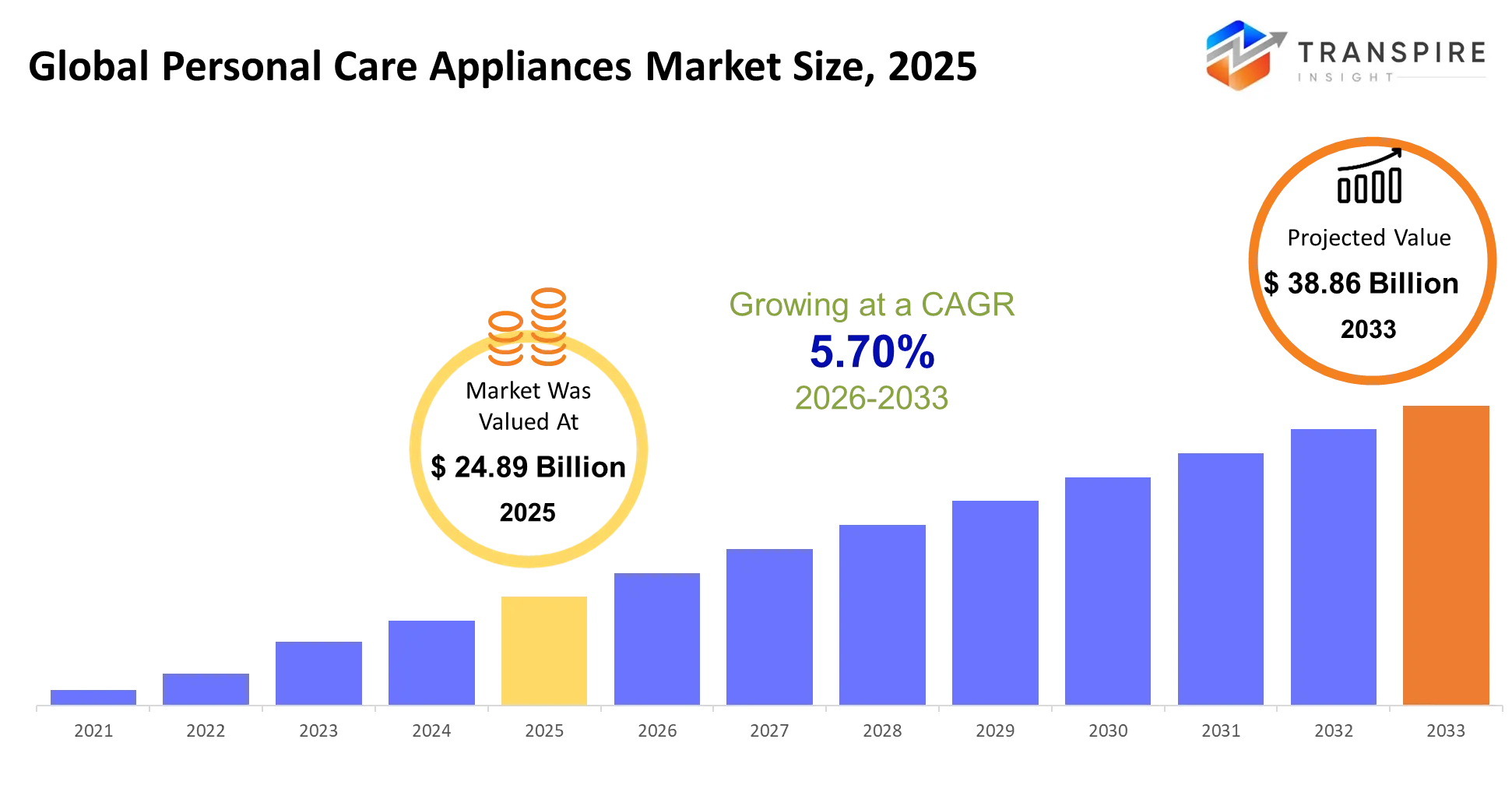
- Global Personal Care Appliances Market Size 2025: USD 24.89 Billion
- Global Personal Care Appliances Market Size 2033: USD 38.86 Billion
- Global Personal Care Appliances Market CAGR: 5.70%
- Global Personal Care Appliances Market Segments: By Product Type (Hair Dryers, Hair Straighteners, Electric Shavers, Epilators, Trimmers), By Distribution Channel (Online Retail, Supermarkets & Hypermarkets, Specialty Stores), By End-User (Men, Women)
To learn more about this report,  Download Free Sample Report
Global Personal Care Appliances Market Summary
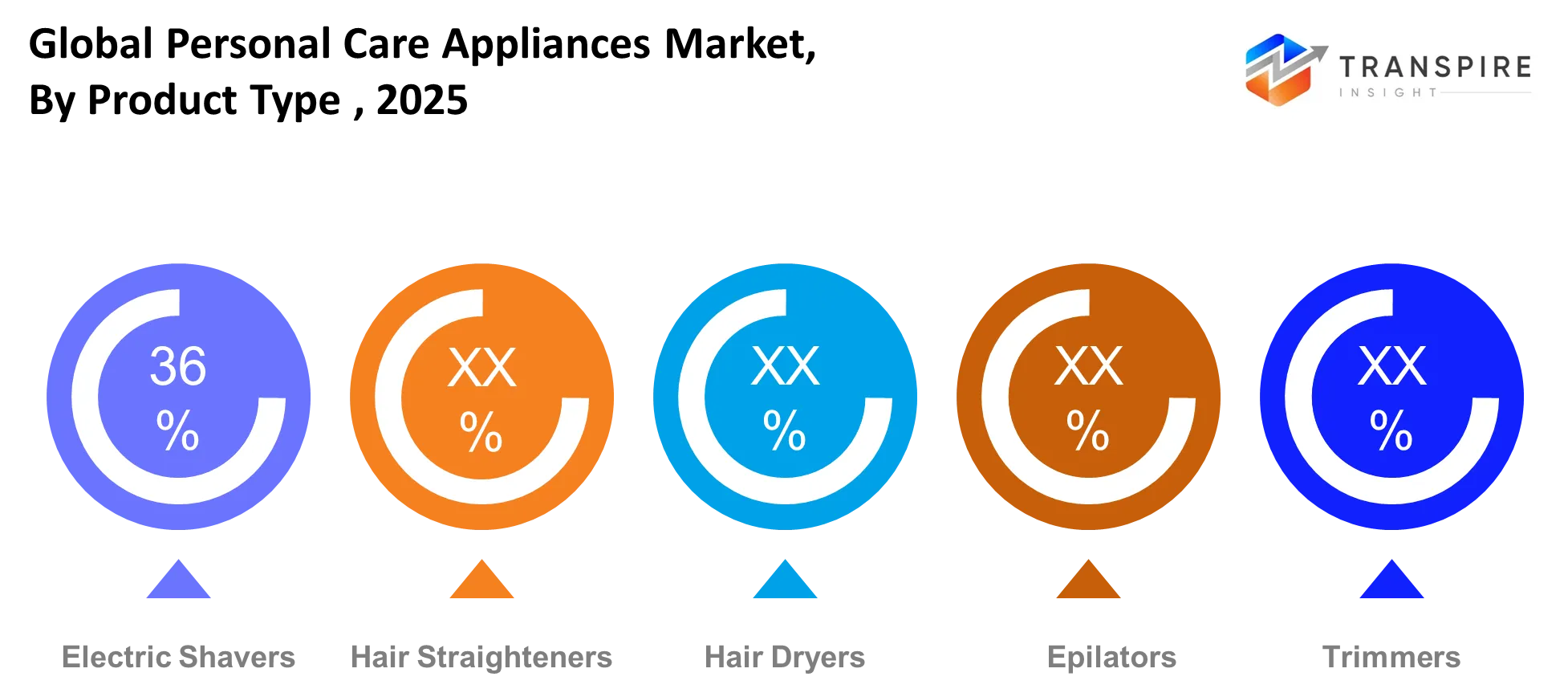
The global personal care appliances market was valued at USD 24.89 billion in 2025. It is expected to reach USD 38.86 billion by 2033, growing at a CAGR of 5.70%. Personal care appliances convert household electricity into heat, mechanical motion, or both to deliver grooming functions that consumers previously relied on salons or manual tools to perform. Electric shavers dominate with 36% market share because they deliver consistent shaving performance without consumable blade replacements, which makes the total cost of ownership attractive relative to disposable razors for daily users.
Two structural shifts reshaped this market between 2020 and 2025. First, professional-grade features migrated into consumer products as manufacturers incorporated ionic technology in hair dryers, ceramic heating in straighteners, and multi-blade systems in shavers. This feature migration allowed home users to replicate salon results without professional training, which reduced the frequency of salon visits and increased at-home grooming device adoption. Second, online retail overtook traditional channels as the primary distribution route, particularly for premium products. Direct-to-consumer brands leveraged digital marketing and influencer partnerships to reach buyers without physical retail overhead, creating price and feature competition that traditional brands had to match.
Current market growth follows disposable income expansion in emerging markets rather than replacement cycles in developed regions. Middle-class consumers in India, Southeast Asia, and Latin America are purchasing their first electric grooming appliances as household income crosses thresholds where discretionary spending on personal care becomes feasible. This creates a volume growth dynamic distinct from mature markets where consumers replace existing devices with upgraded models. The revenue implication is that market growth now tracks emerging market urbanization rates and wage growth rather than product innovation cycles in developed economies.
Key Global Personal Care Appliances Market Insights
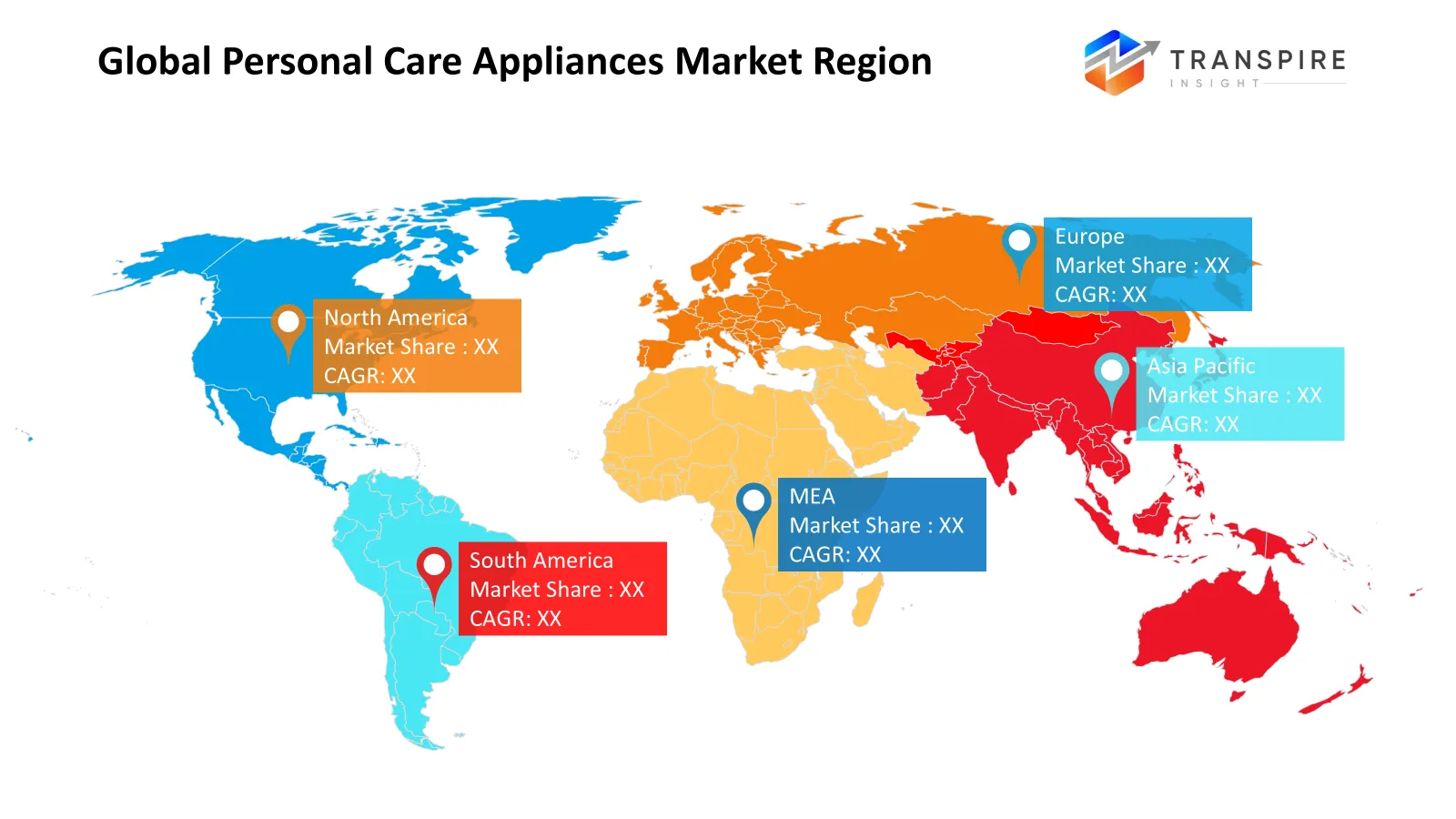
- Asia Pacific leads the global personal care appliances market with a 42.6% share in 2024, driven by rising disposable income, urbanization, and increasing grooming awareness in China and India.
- North America accounts for 26.4% of the market in 2024, sustained by premiumization trends and strong consumer preference for advanced grooming technology.
- Electric shavers command a dominant 36% market share in 2024, favored for convenience, speed, and elimination of recurring blade replacement costs.
- Hair dryers hold 28.3% of the product type segment in 2024, benefiting from ionic and infrared technology adoption in both consumer and professional categories.
- Online retail channels account for 47.8% of sales in 2024, accelerated by direct-to-consumer brand growth and influencer-driven marketing strategies.
- Specialty stores represent 24.6% of distribution in 2024, maintaining relevance through product demonstration and personalized consultation services.
- The women end-user segment leads with 58.2% market share in 2024, reflecting higher product diversity and purchase frequency in hair styling and removal categories.
- The men grooming segment is growing at 6.8% CAGR through 2033, driven by expanding product portfolios and normalized male grooming behaviors globally.
- Philips N.V. holds approximately 14-17% of the global market share in 2025, maintaining leadership through innovation in rotary shaver technology and premium product positioning.
- Dyson Ltd. captured significant premium segment share between 2020 and 2024, introducing high-velocity hair dryers priced above $400 that created a new luxury category.
What are the Key Drivers, Restraints, and Opportunities in the Global Personal Care Appliances Market?
Urbanization in emerging markets created millions of new consumers entering the addressable market for the first time. Countries like India, Indonesia, Vietnam, and the Philippines experienced rapid urban population growth between 2020 and 2025, with households moving from rural areas where electricity access was limited to cities where reliable power enabled grooming appliance adoption. This urban migration also changed grooming norms, as workplace professional appearance standards in offices and service industries drove demand for consistent hair styling and facial grooming. The economic impact appears in unit sales: India alone added over 15 million electric shaver and trimmer users between 2020 and 2024, converting from manual razors or salon-dependent grooming to at-home electric appliances. Manufacturers responded by introducing entry-level product lines priced between $15 and $40 to capture first-time buyers while preserving premium segments for upgrade purchases.
The primary growth barrier is product saturation in developed markets where replacement cycles stretch beyond five years for durable appliances. European and North American consumers already own electric shavers, hair dryers, and styling tools, which means new purchases concentrate on replacement or upgrade rather than initial acquisition. Manufacturers face difficult economics in these regions because they must either convince consumers to replace functioning devices early or wait for product failure to trigger organic replacement demand. The cost implication hits premium segments hardest: consumers who paid $300 to $500 for high-end hair dryers or shavers expect those products to last seven to ten years, which compresses annual replacement revenue. Even significant technology improvements like motor upgrades or battery life extensions struggle to convince consumers to discard working devices years before they would naturally replace them.
The clearest opportunity lies in hybrid work patterns creating demand for professional grooming tools at home rather than in salons. Remote and hybrid workers who previously visited salons weekly or biweekly for blowouts, styling, or grooming now purchase appliances that replicate professional results at home. This behavioral shift is particularly strong among women aged 25 to 45 who previously relied on salons for hair styling but now need tools that deliver comparable quality for video calls and occasional office appearances. Dyson, Panasonic, and Philips all expanded their premium home styling portfolios between 2022 and 2024 to capture this segment, introducing products with professional-grade features like temperature control, multiple heat settings, and styling attachments. This use case supports higher price points because buyers compare costs to accumulated salon visits rather than to basic consumer appliances.
What Has the Impact of Artificial Intelligence Been on the Global Personal Care Appliances Market?
Smart sensors and microprocessors now control temperature, airflow, and blade speed in real time based on hair type, skin sensitivity, and styling requirements. Hair dryers from brands like Dyson and Panasonic use thermistors to measure air temperature up to 40 times per second, adjusting heating elements to prevent heat damage while maintaining styling performance. Hair straighteners incorporate similar technology, monitoring plate temperature and adjusting power delivery to maintain consistent heat across the entire styling surface. These systems replaced fixed-temperature designs that either delivered insufficient heat for effective styling or risked hair damage from overheating. The operational improvement translates to better styling results with less user skill required, which expanded the addressable market to include consumers who previously avoided heat styling tools.
Machine learning algorithms personalize shaving and grooming recommendations through mobile apps connected to smart devices. Philips and Braun both introduced shavers with Bluetooth connectivity that track shaving patterns, pressure application, and coverage areas. The apps analyze this data to provide technique feedback and recommend optimal shaving settings based on individual beard density and growth patterns. Some systems also predict when blade replacement or cleaning is needed based on usage patterns rather than arbitrary time intervals. Early adopters report 15-20% reductions in skin irritation and missed spots, though adoption remains limited to premium segments where consumers accept $250 to $400 price points for connected devices.
The main limitation on broader AI adoption is that most grooming tasks remain fundamentally manual operations where algorithm optimization offers marginal value. A hair dryer can optimize temperature and airflow, but the user still controls brush placement, drying technique, and styling execution. Similarly, an electric shaver can adjust blade speed and cutting angle, but the user determines pressure, stroke direction, and coverage patterns. This means AI improvements deliver incremental performance gains rather than transformational capability changes. The technology gap is most evident in mid-market products where consumers are unwilling to pay 40-60% premiums for features that marginally improve results they already consider acceptable with conventional appliances.
Key Market Trends
- Direct-to-consumer grooming brands captured 12-15% of online retail share between 2021 and 2024, forcing traditional manufacturers to launch their own DTC channels.
- Premium hair dryer average selling prices increased 45% between 2019 and 2024, driven by Dyson and professional-grade feature adoption across brands.
- Male grooming product portfolios expanded from primarily shavers and trimmers to include hair styling tools, skincare devices, and body groomers by 2024.
- Cordless operation became standard in premium trimmers and shavers by 2023, with lithium-ion batteries delivering 60 to 90 minutes of runtime per charge.
- Influencer marketing spend in personal care appliances grew 320% between 2020 and 2024, overtaking television advertising as the primary awareness channel.
- Subscription models for blade replacements and consumables launched by multiple brands between 2022 and 2024, creating recurring revenue streams beyond device sales.
- Chinese manufacturers including Xiaomi and Flyco increased global market share from 8% in 2020 to 14% in 2024 through aggressive online pricing.
- Sustainability claims appeared in product marketing after 2022, with brands highlighting recyclable packaging, energy efficiency, and product longevity to appeal to environmental awareness.
Global Personal Care Appliances Market Segmentation
By Product Type
The global personal care appliances market segments by product type into hair dryers, hair straighteners, electric shavers, epilators, and trimmers. Electric shavers lead with 36% market share because they eliminate consumable costs associated with disposable razors while delivering consistent performance for daily facial hair removal. Rotary and foil shaver technologies serve different beard types and skin sensitivities, with rotary designs handling longer hair and irregular face contours while foil shavers deliver closer shaves on shorter growth. The segment concentrates among male consumers aged 25 to 55 who shave daily or multiple times weekly, making the economics of electric shavers attractive relative to blade replacement costs over a three to five year ownership period.
Hair dryers account for 28.3% of the product segment, serving both consumer and professional styling applications. The category underwent significant premiumization between 2019 and 2024 as manufacturers introduced ionic technology, infrared heating, and high-velocity motors that reduced drying time while minimizing heat damage. Dyson's entry into the hair dryer market in 2016 established a premium segment above $400 that did not previously exist, forcing traditional manufacturers to upgrade their product portfolios with professional-grade features. The segment is heavily weighted toward women consumers who use hair dryers multiple times weekly for styling rather than purely functional drying.
Hair straighteners, epilators, and trimmers collectively represent the remaining 35.7% of the market. Hair straighteners serve consumers seeking sleek, straight styling from naturally wavy or curly hair, with ceramic and titanium heating plates delivering temperature control between 150°C and 230°C. Epilators occupy a niche position, appealing to consumers preferring longer-lasting hair removal than shaving but avoiding waxing's complexity. Trimmers serve beard maintenance, body grooming, and precision edging for both men and women. The trimmer segment is growing fastest at 7.2% CAGR through 2033, driven by male grooming normalization and body grooming adoption across demographics. Manufacturers now offer specialized trimmer attachments for different body zones, creating product differentiation beyond basic facial grooming.
To learn more about this report, Download Free Sample Report
By Distribution Channel
Online retail dominates with 47.8% market share, overtaking physical retail between 2020 and 2024. E-commerce platforms provide consumers with broader product selection, competitive pricing, and customer reviews that reduce purchase risk for appliances they cannot test before buying. Direct-to-consumer brands like Harry's and Dollar Shave Club built entire businesses on online-only models, while established brands including Philips, Panasonic, and Braun expanded their owned e-commerce channels to reduce retailer margin pressure. Online retail is particularly strong for premium products where consumers research extensively before purchase, reading specifications, watching video reviews, and comparing features across brands. The channel economics favor manufacturers because they capture retail margin when selling direct, though they also absorb customer acquisition costs and shipping expenses that physical retailers previously handled.
Supermarkets and hypermarkets account for 27.6% of distribution, maintaining relevance for mainstream products priced below $100 where consumers make impulse purchases or replacement buys without extensive research. These channels provide shelf space for established brands and private-label products, with endcap displays and promotional pricing driving volume during seasonal peaks. The segment is declining slowly at 1.8% annually as consumers shift routine purchases online, but it remains important for reaching older demographics and rural markets with limited e-commerce adoption. Retailers like Walmart, Carrefour, and Tesco maintain personal care appliance sections because these products drive store traffic and support cross-selling opportunities in adjacent categories.
Specialty stores represent 24.6% of distribution, serving consumers who value product demonstration, expert consultation, and immediate availability. Retailers like Sephora, Ulta Beauty, and dedicated electronics stores provide hands-on experience with premium appliances, which matters for products where features like weight, noise level, and ergonomics affect satisfaction but cannot be evaluated from specifications alone. Specialty retail is particularly strong for hair styling tools where staff can demonstrate proper usage technique and recommend products based on individual hair type and styling goals. The channel maintains higher margins than mass retail but requires trained staff and demo inventory that increase operating costs. Several brands including Dyson and GHD sell exclusively through specialty retail and owned stores to preserve premium positioning and avoid price competition in mass channels.
By End-User
Women account for 58.2% of personal care appliance purchases, driven by higher product category diversity and greater purchase frequency across hair styling, removal, and facial care segments. Women consumers purchase hair dryers, straighteners, curling irons, epilators, and facial cleansing devices, with many households owning multiple products in each category for different styling needs and occasions. Purchase motivation combines functional grooming with style expression, which supports higher price points for fashion-forward designs and professional-grade performance features. Women also replace styling appliances more frequently than men, with average replacement cycles of three to four years compared to five to seven years for male grooming products. This shorter cycle reflects both product wear from frequent use and desire to upgrade for newer technology or styling capabilities.
Men represent 41.8% of the market and the faster-growing segment at 6.8% CAGR through 2033. Male grooming expanded beyond basic shaving between 2015 and 2025 as social norms around male appearance care evolved. Men now purchase trimmers for beard maintenance, body groomers for manscaping, hair clippers for self-haircuts, and increasingly adopt hair dryers and styling tools previously considered female-only products. The segment growth is particularly strong in Asia Pacific and Latin America, where urbanization and professional workplace expansion created grooming expectations that rural or informal employment did not require. Manufacturers responded by developing male-specific product lines with masculine aesthetics, simpler feature sets, and marketing that normalizes male grooming without challenging traditional gender norms. Premium men's grooming brands like The Art of Shaving and Braun Series 9 successfully command $200 to $400 price points by positioning electric shavers as luxury accessories rather than functional tools.
What are the Key Use Cases Driving the Global Personal Care Appliances Market?
The primary application is daily facial hair removal for men using electric shavers, serving consumers who shave three to seven times weekly for workplace or personal presentation. Electric shavers deliver consistent results without shaving cream, water, or blade disposal, making them convenient for busy morning routines or travel. The economics favor electric shavers for daily users because the initial investment of $100 to $300 eliminates recurring blade costs that would total $150 to $250 annually with disposable razors. Premium rotary shavers from Philips and foil shavers from Braun target this segment with features like wet/dry operation, quick charging, and precision trimming attachments that serve complete facial grooming needs in a single device.
Adjacent demand is building in at-home professional hair styling, where consumers replicate salon blowouts and straightening treatments using advanced styling tools. Women aged 25 to 50 who previously visited salons weekly or biweekly now invest in premium hair dryers, straighteners, and curling tools that deliver professional-quality results at home. This application requires devices with precise temperature control, ionic technology, and multiple heat settings to protect hair health while achieving desired styles. Dyson, GHD, and T3 all serve this segment with products priced between $200 and $500, positioning them as long-term investments that replace recurring salon expenses. The use case intensified during pandemic lockdowns when salon access was restricted, and many consumers who adapted to at-home styling continued the behavior after salons reopened.
Emerging applications center on body grooming and manscaping, where both men and women use specialized trimmers for hair removal on legs, chest, underarms, and intimate areas. This segment did not exist at scale before 2015 but grew rapidly as social media and marketing campaigns normalized body hair removal for men alongside established women's grooming practices. Philips, Panasonic, and Braun developed body grooming products with skin-protective guards, waterproof designs, and ergonomic shapes specifically for this use case. The category is highly fragmented with specialized products for different body zones, creating opportunities for manufacturers to sell multiple devices per consumer rather than single all-purpose tools. Growth is strongest in developed markets where body grooming is established and in urban areas of emerging markets where Western grooming norms are adopted by younger demographics.
Report Overview Table
|
Report Metrics |
Details |
|
Market size value in 2025 |
USD 24.89 Billion |
|
Market size value in 2026 |
USD 26.36 Billion |
|
Revenue forecast in 2033 |
USD 38.86 Billion |
|
Growth rate |
CAGR of 5.70% from 2026 to 2033 |
|
Base year |
2025 |
|
Historical data |
2021 – 2024 |
|
Forecast period |
2026 – 2033 |
|
Report coverage |
Revenue forecast, competitive landscape, growth factors, and trends |
|
Regional scope |
United States; Canada; Mexico; United Kingdom; Germany; France; Italy; Spain; Denmark; Sweden; Norway; China; Japan; India; Australia; South Korea; Thailand; Brazil; Argentina; South Africa; Saudi Arabia; United Arab Emirates |
|
Key companies profiled |
Philips N.V., Panasonic Corporation, Conair Corporation, Dyson Ltd., Wahl Clipper Corporation, Procter & Gamble Company (Braun), Spectrum Brands Holdings Inc. (Remington), Andis Company Inc., Xiaomi Corporation, Flyco Electrical Appliance Co. Ltd., Havells India Ltd., Vega Industries Pvt. Ltd., Syska Personal Care, TESCOM Denki Co. Ltd., Revlon Inc. |
|
Customization scope |
Free report customization (country, regional & segment scope). Avail customized purchase options to meet your exact research needs. |
|
Report Segmentation |
By Product Type (Hair Dryers, Hair Straighteners, Electric Shavers, Epilators, Trimmers), By Distribution Channel (Online Retail, Supermarkets & Hypermarkets, Specialty Stores), By End-User (Men, Women) |
Which Regions are Driving the Global Personal Care Appliances Market Growth?
Asia Pacific leads the global market with 42.6% share in 2024, driven by population scale, rapid urbanization, and rising middle-class incomes in China, India, and Southeast Asia. The region added over 300 million urban residents between 2020 and 2025, with households moving from rural areas where electricity access was inconsistent to cities where reliable power enabled appliance adoption. China represents the largest single market, with domestic brands like Xiaomi and Flyco competing alongside international manufacturers for consumers upgrading from manual grooming tools to electric appliances. India is the fastest-growing market within the region, with electric shaver and trimmer adoption accelerating as young professionals enter workplaces with grooming expectations. Distribution infrastructure in Asia Pacific favors online retail because physical specialty stores remain underdeveloped outside major cities, which allows e-commerce platforms and direct-to-consumer brands to reach tier-two and tier-three urban markets efficiently.
North America contributes 26.4% of global revenue and competes on premiumization rather than volume growth. The United States and Canada host saturated markets where most consumers already own basic grooming appliances, which shifts demand toward replacement purchases and premium product upgrades. Manufacturers target North American consumers with high-end products featuring advanced technology, superior build quality, and design aesthetics that justify $200 to $500 price points. Dyson's success in the North American hair dryer market demonstrated consumer willingness to pay substantial premiums for performance improvements, inspiring competitors to upgrade their portfolios. The region also leads in connected device adoption, with smart shavers and styling tools finding early acceptance among tech-savvy consumers who value app integration and personalized recommendations. Distribution remains balanced between online and physical retail, with specialty stores like Sephora and Ulta Beauty maintaining relevance through product demonstration and expert consultation.
Europe accounts for 23.7% of the market, characterized by mature consumption patterns and strong preferences for established brands with sustainability credentials. Germany, United Kingdom, France, and Italy drive regional demand, with consumers favoring products that demonstrate longevity, repairability, and environmental responsibility. European regulatory frameworks around energy efficiency and product safety create higher compliance costs but also establish quality standards that benefit established manufacturers over low-cost competitors. The region is experiencing modest growth at 4.2% CAGR through 2033, constrained by population stagnation and already high appliance penetration rates. Growth concentrates in product upgrades and category expansions, particularly male grooming products where adoption lags North American levels. Sustainability marketing resonates strongly in Europe, with brands highlighting recyclable materials, energy-efficient motors, and product longevity to appeal to environmentally conscious consumers willing to pay premiums for responsible manufacturing.
To learn more about this report, Download Free Sample Report
Who are the Key Players in the Global Personal Care Appliances Market and How Do They Compete?
The market operates in moderate fragmentation. Philips, Panasonic, Procter & Gamble (Braun), and Spectrum Brands (Remington) collectively hold approximately 35-40% of global market share, but no single player commands dominant positioning across all product categories and regions. Competition operates on four dimensions: technology innovation, brand heritage, distribution reach, and price positioning. Premium manufacturers compete through patented technologies and professional-grade features, while mid-market brands focus on reliable performance at accessible prices. Chinese manufacturers entered aggressively after 2020, offering products at 30-40% below established brand pricing through online channels, forcing incumbents to defend market share through brand differentiation rather than price matching.
Philips competes through technology leadership and diversified product portfolio spanning all major grooming categories. The company holds strong patent positions in rotary shaver design and pioneered waterproof, cordless operation that became industry standards. Philips targets both premium and mid-market segments, with OneBlade and Series 9000 shavers serving different price-performance positions. The company invested heavily in connected devices and mobile apps between 2020 and 2024, launching smart shavers with usage tracking and personalized recommendations. Philips maintains broad distribution across online, mass retail, and specialty channels, with particularly strong positioning in Europe and Asia Pacific. Panasonic follows a similar diversification strategy but emphasizes Japanese manufacturing quality and precision engineering as differentiation points. The company's Nanoe hair dryers and ES-series shavers compete in premium segments through advanced ion technology and blade metallurgy.
Dyson disrupted the hair care segment by introducing high-velocity digital motors and intelligent heat control at price points above $400, creating a luxury category where premium performance justified substantial cost premiums over conventional dryers. The company's Supersonic hair dryer and Airwrap styler both launched at prices 3-4x higher than comparable products, succeeding through direct-to-consumer marketing and influencer partnerships that built aspirational brand positioning. Procter & Gamble's Braun division competes primarily in electric shavers, leveraging German engineering heritage and premium positioning. Braun Series 9 and Series 7 shavers target daily users willing to pay $200 to $400 for close shaves with minimal skin irritation. Chinese manufacturers including Xiaomi and Flyco compete on value positioning, offering basic electric shavers, trimmers, and hair dryers at 40-60% below international brand prices. These companies target price-sensitive emerging market consumers and developed market buyers seeking functional products without premium features.
Company List
- Philips N.V.
- Panasonic Corporation
- Conair Corporation
- Dyson Ltd.
- Wahl Clipper Corporation
- Procter & Gamble Company
- Spectrum Brands Holdings Inc.
- Andis Company Inc.
- Xiaomi Corporation
- Flyco Electrical Appliance Co. Ltd.
- Havells India Ltd.
- Vega Industries Pvt. Ltd.
- Syska Personal Care
- TESCOM Denki Co. Ltd.
- Revlon Inc.
Recent Developments
In March 2026, Philips N.V. launched its new OneBlade Pro 360 in European markets, featuring improved blade technology and extended battery life targeting younger male consumers entering electric shaving. https://www.philips.com
In January 2026, Dyson Ltd. secured partnerships with major beauty retailers in India and Southeast Asia to expand physical distribution beyond its direct-to-consumer channels in high-growth markets. https://www.dyson.com
What Strategic Insights Define the Future of the Global Personal Care Appliances Market?
Over the next five to seven years, the personal care appliances market will be shaped by the tension between premiumization in developed markets and volume growth in emerging economies. Manufacturers face diverging strategic paths: chase profit margins through high-end innovation and connected features in North America and Europe, or pursue market share through affordable products and distribution expansion in Asia Pacific and Latin America. Companies trying to serve both segments risk brand dilution or operational inefficiency from managing radically different product portfolios and go-to-market approaches. The most successful players will likely specialize, either dominating premium segments through technology leadership or achieving scale advantages in value segments through vertical integration and efficient manufacturing.
The risk that market forecasts underestimate is disruption from adjacent product categories. Laser hair removal devices, IPL systems, and semi-permanent hair straightening treatments all offer alternatives that reduce long-term demand for daily-use appliances like shavers, epilators, and straighteners. If these treatments become more affordable and accessible over the next decade, they could capture share from traditional grooming appliances in developed markets where consumers already own basic tools and seek convenience rather than just functionality. This would compress the addressable market for replacement purchases, forcing manufacturers to rely more heavily on emerging market volume growth and new category creation rather than organic replacement cycles.
The opportunity that remains underdeveloped is male skincare appliances, particularly facial cleansing devices, anti-aging tools, and LED therapy systems. Male grooming expanded from basic shaving to include beard care and hair styling between 2010 and 2025, but skincare appliances remain predominantly female-oriented in product design and marketing. Companies that successfully adapt cleansing brushes, derma-rollers, and LED masks for male consumers could unlock a new product category worth billions annually. Success requires overcoming male hesitancy around skincare routines and developing products that deliver measurable results quickly enough to sustain daily usage habits. Brands like Foreo and NuFACE targeting younger male demographics through social media could establish early positioning before established grooming brands recognize the opportunity and enter with incumbent distribution advantages.
By Product
- Hair Dryers
- Hair Straighteners
- Electric Shavers
- Epilators
- Trimmers
By Distribution Channels
- Online Retail
- Supermarkets & Hypermarkets
- Specialty Stores
By End-User
- Men
- Women
Frequently Asked Questions
Find quick answers to common questions.
The Global Personal Care Appliances Market is expected to reach USD 38.86 Billion by 2033.
Key segments for the Global Personal Care Appliances Market are By Product Type (Hair Dryers, Hair Straighteners, Electric Shavers, Epilators, Trimmers), By Distribution Channel (Online Retail, Supermarkets & Hypermarkets, Specialty Stores), By End-User (Men, Women).
Major Global Personal Care Appliances Market players are Philips N.V., Panasonic Corporation, Conair Corporation, Dyson Ltd., Wahl Clipper Corporation, Procter & Gamble Company (Braun), Spectrum Brands Holdings Inc. (Remington), Andis Company Inc., Xiaomi Corporation, Flyco Electrical Appliance Co. Ltd., Havells India Ltd., Vega Industries Pvt. Ltd., Syska Personal Care, TESCOM Denki Co. Ltd., Revlon Inc.
The Global Personal Care Appliances Market size is USD 24.89 Billion in 2025.
The Global Personal Care Appliances Market CAGR is 5.70% from 2026 to 2033.
- Philips N.V.
- Panasonic Corporation
- Conair Corporation
- Dyson Ltd.
- Wahl Clipper Corporation
- Procter & Gamble Company
- Spectrum Brands Holdings Inc.
- Andis Company Inc.
- Xiaomi Corporation
- Flyco Electrical Appliance Co. Ltd.
- Havells India Ltd.
- Vega Industries Pvt. Ltd.
- Syska Personal Care
- TESCOM Denki Co. Ltd.
- Revlon Inc.
Recently Published Reports
-
Apr 2026
Bottled Water Market
Bottled Water Market Size, Share & Analysis Report By Product Type (Still Bottled Water, Carbonated Bottled Water, Functional Bottled Water, and Others), By Packaging (PET, Cans, and Others), By Sales Channel (Supermarkets/Hypermarkets, Convenience Stores/Drug Stores, Grocery Stores/Club Stores, Foodservice, and Others) and Geography (North America, Europe, Asia-Pacific, Middle East and Africa, South and Central America), 2021 - 2032
-
Apr 2026
Color Cosmetic Packaging Market
Color Cosmetic Packaging Market Size, Share & Analysis Report By Application (Mascara Packaging, Liquid Packaging, and Liquid Face), By Type (Tubes & Bottles, Pens & Markers, Compacts & Containers, and Droppers & Pumps), and Geography (North America, Europe, Asia-Pacific, Middle East and Africa, South and Central America), 2021 - 2031
-
Apr 2026
External Microphone For Camera Market
External Microphone For Camera Market Size, Share & Analysis Report By Type (Shotgun Microphone, Lavalier Microphone, and Others), By Application (Digital Camera, Professional Video Camera, and Others), and Geography (North America, Europe, Asia-Pacific, Middle East and Africa, South and Central America), 2021 - 2031
-
Apr 2026
Foot Orthotic Insoles Market
Foot Orthotic Insoles Market Size, Share & Analysis Report By Type (Pre-fabricated, and Custom-made), By Material (Thermoplastic, Composite Carbon Fiber, and Others), By Distribution Channel (Drug Stores, Hospitals & Clinics, and Others), and Geography (North America, Europe, Asia-Pacific, Middle East and Africa, South and Central America), 2021 - 2031