
France Social Commerce Market Size & Forecast:
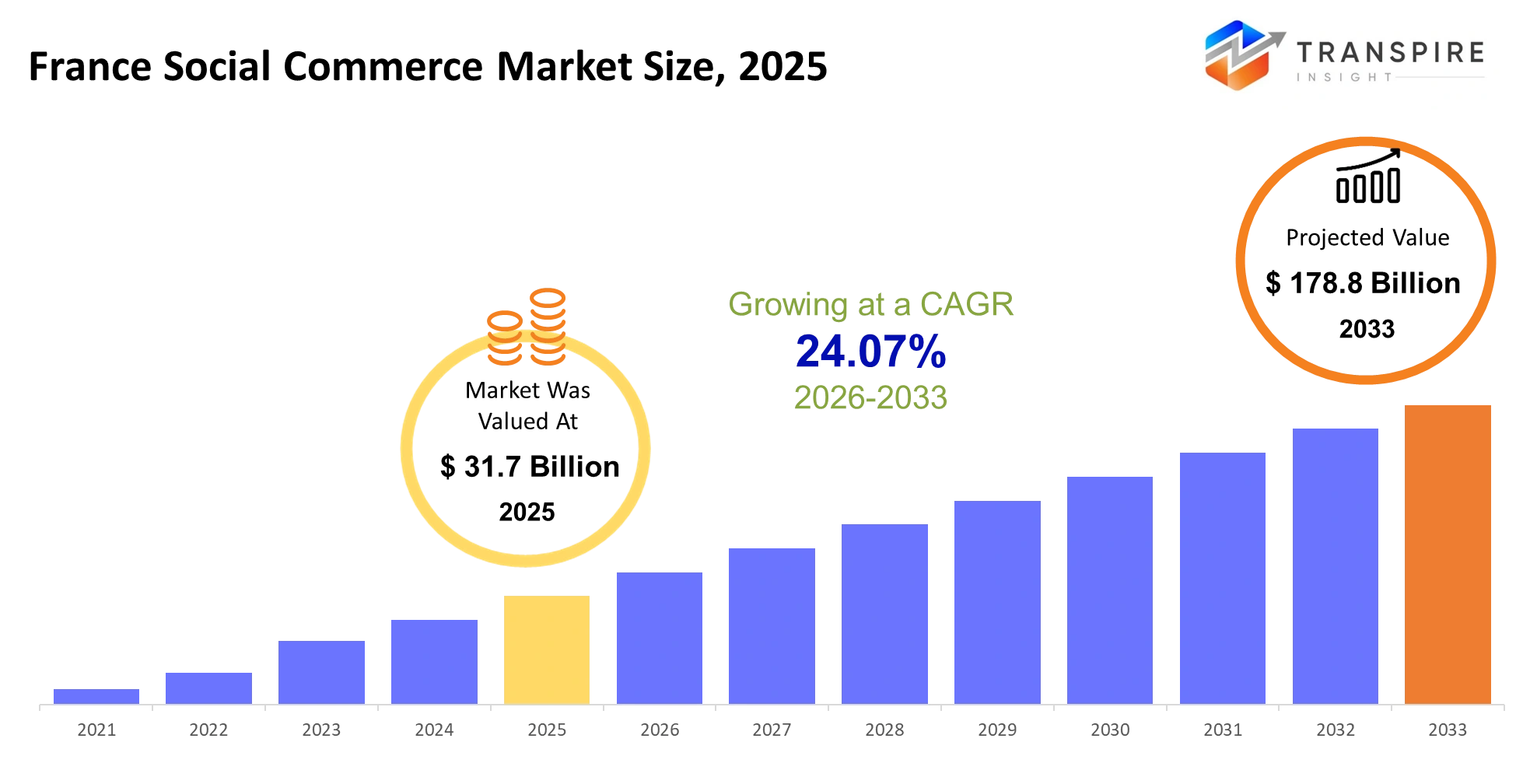
- France Social Commerce Market Size 2025: USD 31.7 Billion
- France Social Commerce Market Size 2033: USD 178.8 Billion
- France Social Commerce Market CAGR: 24.07%
- France Social Commerce Market Segments:By Type (Live Commerce, Influencer Commerce, Social Marketplace, Others); By Application (Fashion, Electronics, Beauty, Home Decor, Others); By End-User (Consumers, Brands, SMEs, Influencers, Retailers, Others); By Platform (Instagram, Facebook, TikTok, Pinterest, Others).
To learn more about this report,  Download Free Sample Report
France Social Commerce Market Summary
The France Social Commerce Market was valued at USD 31.7 Billion in 2025. It is forecast to reach USD 178.8 Billion by 2033. That is a CAGR of 24.07% over the period.
The France Social Commerce Market establishes product discovery and social platform engagement and payment processing as a single process which enables brands and creators to transform customer interest into revenue without sending customers to third party websites. The solution establishes direct purchase pathways for fashion and beauty products which customers discover through social media content because these products rely on visual elements to attract Impulse buyers who drive revenue for the business.
Market transformation over the past three to five years has proceeded from traditional product displays to video-based platforms which enable creators to build commercial systems. TikTok and Instagram have developed embedded checkout systems which make it possible for users to complete purchases during their current platform usage. The major driver behind the change occurred because people started to shop online during the COVID-19 pandemic while they began to use live-stream shopping as a common practice. Brands now dedicate larger portions of their budgets to influencer marketing and social media storefronts which enable them to track customer interactions that result in increased sales.
Key Market Insights
- The French Social Commerce Market in 2025 remains dominated by Île-de-France which holds more than 35% market share because of its extensive digital networks and concentrated brand presence.
- The southern regions of the country will experience their most rapid growth until 2033 because small and medium enterprises (SMEs) will implement digital solutions while regional influencer networks develop.
- The market for influencer commerce maintains its lead with approximately 40% market share in 2025 because creators establish trust which leads to higher conversion rates.
- The social marketplace maintains its position as the second largest market because integrated in-app storefronts continue to expand across various platforms.
- Live commerce becomes the fastest-growing segment during the period after 2024 because the interactive nature of live streaming boosts product sales.
- The fashion industry leads the market with over 30% share in 2025 because its visual products attract customers who follow fashion influencers.
- Beauty products have emerged as the fastest-growing application segment because users engage with tutorials and reviews through short-form videos.
- Consumers represent the main demand source because they make direct platform purchases which enable them to use instant checkout systems.
- Small and medium enterprises (SMEs) represent the most rapidly expanding sector because they can easily access social media platforms to initiate their digital growth journey.
- The main industry players include Meta Platforms, ByteDance, Pinterest Inc., Snap Inc., and Shopify.
- Companies direct their efforts toward developing new products which include in-app checkout systems and AI-based product recommendations and tools for creator monetization.
- The organization uses partnerships with influencers and brands to enhance customer engagement which leads to better conversion outcomes.
- The organization aims to expand its operations by developing partnerships with European small and medium enterprises and creating content networks that operate in specific regions.
- Organizations that use AI and analytics technology improvements gain better targeting capabilities which result in improved campaign performance and budget return on investment thus creating competitive advantages for their business.
What are the Key Drivers, Restraints, and Opportunities in the France Social Commerce Market?
The primary driver of the France Social Commerce Market is the social media platforms' implementation of shopping functions which enable users to make purchases from their platforms. The shift occurred because platforms competed to keep users while also making money, which resulted in systems that let users make purchases directly from content creators' online stores. Users who watch short-form videos for extended periods drive platforms to transform their user interactions into revenue, which leads to higher business revenue per customer and better brand success with selling their products.
The main restriction arises from data privacy laws which include GDPR regulations that establish complete restrictions for companies on their ability to gather and use customer information. The structural constraint prevents platforms and advertisers from delivering personalized ads because it increases their expenses for meeting regulatory requirements. The process of campaign optimization becomes difficult for smaller brands which results in slower market entry and decreased revenue opportunities.
The growth of AI-powered personalized experiences and live shopping technology creates a significant business opportunity. The platforms currently allocate funds for developing systems that offer instant product suggestions during their live shopping events. The French market will experience rising customer engagement and enhanced transaction volume through the development of 5G networks and the evolution of video commerce technologies.
What Has the Impact of Artificial Intelligence Been on the France Social Commerce Market?
The Social Commerce Market in France undergoes transformation through artificial intelligence which changes how platforms connect products to user needs while streamlining their sales processes. AI recommendation engines use customer browsing patterns together with their product interactions and buying history to create individualized product recommendations. Facebook and TikTok platforms employ machine learning algorithms to determine which content will generate the highest conversion rates, thus boosting both click-through rates and average order values.
Campaign performance achieves optimization through the essential functions that automation provides. The AI tools operate ad placement management together with real-time bidding strategy modification and automatic influencer selection based on audience matching. Predictive analytics enhance performance through their ability to forecast demand patterns while detecting top-selling products that will reach their highest status. The system enables brands to enhance their inventory planning process and marketing budget allocation, which results in better operational efficiency and decreased customer acquisition expenses.
The technologies produce tangible enhancements for both conversion rates and campaign return on investment and customer retention success. The main restriction exists because the system requires access to accurate data together with its developing algorithms. The combination of strict privacy laws and the inability to access detailed user information results in decreased model performance, which smaller enterprises find challenging because they cannot afford or manage AI systems.
Key Market Trends
- The acceleration of short-form video commerce in 2021 occurred because platforms developed content distribution systems that used algorithms to create better product discovery and conversion systems.
- Influencer-led campaigns evolved into performance-driven channels after 2023, with brands linking creator content directly to measurable sales metrics
- Post-2024, live commerce experienced rapid growth because live interaction raised customer spending while decreasing their buying uncertainties.
- Social platforms introduced native checkout systems between 2022 and 2025, which diminished their need for external e-commerce sites while boosting their ability to complete transactions.
- Small and medium enterprises made budget changes by transferring funds from conventional advertising methods toward social media storefronts because they found social media storefronts cheaper to use and more effective for reaching customers.
- AI personalization tools used machine learning to enhance product recommendation systems by tracking customer behavior instead of using demographic data.
- Privacy regulations reshaped advertising strategies after 2022 because brands required first-party data and contextual targeting methods to develop their advertising strategies.
- Cross-platform integration expanded, which enabled brands to share product information between different platforms such as Instagram and Pinterest and implement their unified commerce plans.
- Social media platforms now drive customers to make instant purchases because they create a visual shopping experience which leads to rapid buying decisions in the fashion and beauty industries.
France Social Commerce Market Segmentation
By Type
The type-based segmentation structure establishes standards for various selling formats which show how they attract customers and transform their interest into financial success. Creator-led endorsements establish trust which causes customers to make purchase decisions faster so influencer commerce maintains its dominant market position with a nearly 40% market share. Social marketplace follows with around 30% share as integrated storefronts simplify browsing and checkout within platforms. The market for live commerce has not reached its full potential because it only accounts for 15 to 20 percent yet the format continues to grow because users engage actively during live events while other formats remain restricted because they cannot scale.
Each format develops through its unique method of connecting content with its corresponding business activities. Influencer commerce advantages from its established trust and dedicated customer base while social marketplaces depend on their organized product search functions together with their efficient payment processing capabilities.Live commerce attracts more viewers because it uses two selling methods which create urgent purchasing situations. Future development will likely drive integration across formats, with platforms combining creator content, live sessions, and storefronts to deliver higher monetization efficiency for sellers and technology providers.
By Application
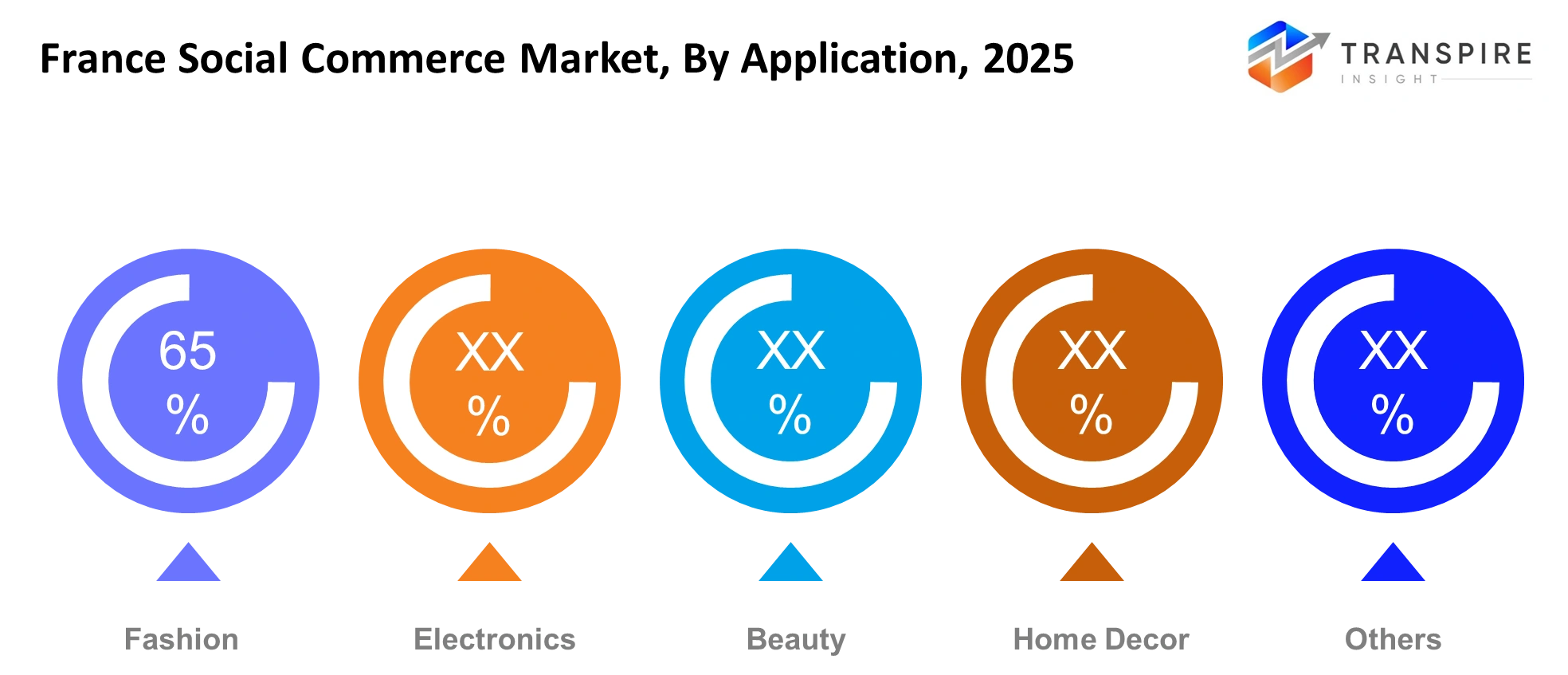
The process of application-based segmentation shows how various product categories connect with visual materials and how consumers behave. Fashion leads with over 30% share because fast-changing trends and strong visual appeal fit naturally with short-form content and influencer promotion. The beauty segment shows high growth potential because digital engagement creates repeat purchases and customers watch tutorials and reviews.
Electronics keeps a moderate market share because customers need to examine products for an extended period before making decisions about expensive items, while home decor and other product segments experience slow but continuous development. The examination of growth patterns shows a link between customer buying habits and their needs for content. Fashion and beauty benefit from impulse buying and strong alignment with video formats, while electronics depend on detailed demonstrations and trust-building content. Home decor expands through aspirational content that motivates customers to buy products linked to particular lifestyles. The future will see brands and developers use augmented reality together with personalized recommendations and interactive content to create better user experiences that will boost conversion rates in all product categories.
To learn more about this report, Download Free Sample Report
By End-User
The process of end-user segmentation shows how various users affect both transaction processes and revenue generation. Consumers dominate with the largest share because they interact directly with social platforms and experience convenient purchasing options. Brands maintain a strong market presence as they invest heavily in content creation and advertising through digital storefronts. The fast-expanding category of SMEs exists because its members can quickly enter the market, while influencers and retailers own essential but smaller portions of the business ecosystem.
Each group expands its activities through particular advantages that it possesses and its chosen operational functions. Consumers drive demand through their engagement activities and their purchasing activities, while brands evaluate their campaign results through performance metrics and actual financial benefits. SMEs achieve audience access through affordable methods, while influencers generate income by selling products through their trustworthy relationships with audiences. Future business relationships between participants will become closer, as integrated ecosystems will provide efficient transaction processing, precise audience targeting, and business growth prospects that benefit all participants.
By Platform
The system that segments users based on their platform usage determines which digital platforms they use to make purchases. Instagram controls 30% of the market because its users prefer visual content and its shopping features enable them to buy items without interruptions. Facebook maintains a significant market share because of its extensive user base and integration of marketplace services. TikTok grows at the fastest rate among all platforms because its users discover content through algorithms while they maintain high levels of platform interaction, whereas Pinterest and other platforms operate in specialized markets that still generate essential value.
Platform expansion requires three key elements which include content format, user demographic information and technological abilities. Instagram and TikTok increase their user engagement through video content which helps users discover products, while Facebook enables businesses to reach more customers through its community-based selling tools. Pinterest directs users to search engine results that match their future shopping plans. Future trends indicate that AI-driven personalization will become more integrated with enhanced checkout systems and cross-platform commerce methods. These advancements will enable developers and businesses to enhance their digital ecosystem reach and conversion rates.
What are the Key Use Cases Driving the France Social Commerce Market?
The main adoption driver for this system directly depends on fashion-based discovery which leads to purchasing because its visually appealing content results in immediate sales from online customers. Brands use short-form videos together with creator styling content to display their collections which helps customers make faster decisions and results in larger purchase amounts. Instagram and other platforms enable users to complete purchases directly from their product discoveries which leads to constant product demand in this particular market.
The beauty and consumer electronics industries function as growing fields that tutorial and product demonstration content created by influencers helps to expand. Beauty brands use step-by-step content and peer reviews to develop customer trust which results in repeat purchases while electronics sellers present their products through detailed demonstrations that handle all performance inquiries. Small and medium-sized enterprises together with independent creators use these content formats to connect with specific audience groups who need less marketing spending while achieving better conversion results across their target markets.
The retail industry shows great promise through its use of live-stream shopping and AI-based personalization. Real-time selling events create urgency and interactive engagement, while recommendation engines tailor product feeds based on user behavior. The two methods remain unimplemented because they have not yet reached their maximum operational capacity, yet they will transform brand inventory management and customer targeting methods during the upcoming evaluation period.
|
Report Metrics |
Details |
|
Market size value in 2025 |
USD 31.7 Billion |
|
Market size value in 2026 |
USD 39.5 Billion |
|
Revenue forecast in 2033 |
USD 178.8 Billion |
|
Growth rate |
CAGR of 24.07% from 2026 to 2033 |
|
Base year |
2025 |
|
Historical data |
2021 - 2024 |
|
Forecast period |
2026 - 2033 |
|
Report coverage |
Revenue forecast, competitive landscape, growth factors, and trends |
|
Regional scope |
France |
|
Key company profiled |
Meta, TikTok, Amazon, Shopify, Pinterest, Snapchat, YouTube, Alibaba, Flipkart, eBay, Walmart, Etsy, Meesho, Pinduoduo, Shopee. |
|
Customization scope |
Free report customization (country, regional & segment scope). Avail customized purchase options to meet your exact research needs. |
|
Report Segmentation |
By Type (Live Commerce, Influencer Commerce, Social Marketplace, Others); By Application (Fashion, Electronics, Beauty, Home Decor, Others); By End-User (Consumers, Brands, SMEs, Influencers, Retailers, Others); By Platform (Instagram, Facebook, TikTok, Pinterest, Others). |
Which Regions are Driving the France Social Commerce Market Growth?
Île-de-France dominates the market because it possesses advanced digital capabilities and its population is densely packed and it has many high-end brands and marketing firms. The Paris fashion hub serves as a vital connection point through which the fashion and beauty sectors use social commerce for their everyday business activities. The operational system functions effectively because it has developed logistical networks and modern payment systems which enable quick financial operations and immediate product delivery. Social media platforms like Instagram maintain their high user engagement rates because they have established powerful influencer networks and they can produce content at a high volume.
The regions of Auvergne-Rhône-Alpes and Provence-Alpes-Côte d'Azur establish themselves as reliable growth centers which maintain expansion through their small business development and their local brand growth. The regions analyze market behavior through their mid-sized enterprises which operate differently from Île-de-France by maintaining their business operations across multiple sectors. The digital transformation rules together with the increasing internet access create a stable system which supports business growth over extended time periods. The businesses in these areas use social commerce to reach customers beyond their physical locations which results in consistent revenue growth that businesses can predict.
The regions of Occitanie and Nouvelle-Aquitaine experience their fastest development because local businesses and creators join their operations at an increasing pace. The increased funding for mobile infrastructure and digital initiatives in various regions has created opportunities for people to participate in commerce which depends on content production. Local influencers use TikTok to reach specific market segments which enables them to boost sales in their local areas. The period from 2026 to 2033 will open new business possibilities for both investors and new companies who want to develop regional content solutions and small business strategies.
Who are the Key Players in the France Social Commerce Market and How Do They Compete?
The market shows a moderately consolidated environment since global platforms control most traffic and transaction operations while smaller companies focus on specific market segments. Companies compete through their algorithm performance and user interaction and their ability to enable smooth checkout experiences instead of competing on their product prices. Established companies maintain their market position through ongoing product development and platform expansion while new companies create market disruption through their innovative content and influencer-based commercial systems. The ability to manage data and develop personalized experiences creates a competitive edge that lasts over time.
Meta Platforms develops its market advantage through its unified advertising platform and cross-company data access which allows companies to reach specific audiences and achieve effective marketing results. TikTok uses its algorithm-based content discovery system to create the unique ability for users to find content which results in increased product visibility and drives large-scale impulse buying. Amazon uses its strong logistics capabilities and customer trust to provide dependable order delivery services while slowly introducing social features throughout its entire platform.
Shopify gives brands and small and medium-sized enterprises the ability to manage their own storefronts through its social platform connections which enable them to sell through multiple channels. Pinterest Inc. enables users to discover content through purposeful search methods and visual search technology which helps them prepare their purchases instead of making fast buying decisions. The companies expand their operations by using AI recommendation systems and creator partnerships and enhanced connections with platforms which lead to better conversion rates and customer loyalty.
Company List
- Meta
- TikTok
- Amazon
- Shopify
- Snapchat
- YouTube
- Alibaba
- Flipkart
- eBay
- Walmart
- Etsy
- Meesho
- Pinduoduo
- Shopee
Recent Development News
In January 2026, Meta announced expansion of AI-powered ad targeting tools across its platforms. The development improved personalization accuracy and campaign performance for social commerce advertisers.
Source: https://about.fb.com
What Strategic Insights Define the Future of the France Social Commerce Market?
The market is moving toward fully integrated ecosystems which enable users to access content and interact with others and make purchases through a single platform system. The shift occurs because platforms compete to keep users active while earning revenue through their built-in shopping features. AI-based personalization together with video-first content will become the primary method brands use to generate and convert customer interest during the upcoming five-to-seven-year period.
New data privacy laws will create a hidden danger because they will restrict advertisers from reaching their target audiences which will lessen the power of algorithm-based suggestions. This restriction will lead to higher expenses for acquiring new customers who will not be accessible through performance-based advertising methods. At the same time, an emerging opportunity exists in AI-powered live commerce, where real-time interaction and personalized recommendations can significantly improve conversion rates.
Market participants should invest in first-party data strategies and interactive content formats to reduce dependence on platform-controlled algorithms. This approach will help maintain competitive positioning while adapting to regulatory and technological shifts which will determine the future growth stage of the business.
France Social Commerce Market Report Segmentation
By Type
- Live Commerce
- Influencer Commerce
- Social Marketplace
- Others
By Application
- Fashion
- Electronics
- Beauty
- Home Decor
- Others
By End-User
- Consumers
- Brands
- SMEs
- Influencers
- Retailers
- Others
By Platform
- TikTok
- Others
Frequently Asked Questions
Find quick answers to common questions.
The confirmed 2033 market size figure in USD 178.8 Billion.
Key segments for the France Social Commerce Market are By Type (Live Commerce, Influencer Commerce, Social Marketplace, Others); By Application (Fashion, Electronics, Beauty, Home Decor, Others); By End-User (Consumers, Brands, SMEs, Influencers, Retailers, Others); By Platform (Instagram, Facebook, TikTok, Pinterest, Others).
Major France Social Commerce Market players are Meta, TikTok, Amazon, Shopify, Pinterest, Snapchat, YouTube, Alibaba, Flipkart, eBay, Walmart, Etsy, Meesho, Pinduoduo, Shopee.
The France Social Commerce Market size is USD 31.7 Billion in 2025.
The France Social Commerce Market CAGR is 24.07% from 2026 to 2033.
- Meta
- TikTok
- Amazon
- Shopify
- Snapchat
- YouTube
- Alibaba
- Flipkart
- eBay
- Walmart
- Etsy
- Meesho
- Pinduoduo
- Shopee
Recently Published Reports
-
Apr 2026
3D Optical Profiler Market
3D Optical Profiler Market Size, Share & Analysis Report By Type (Desktop 3D Optical Profiler, and Portable 3D Optical Profiler), By Technology (Confocal Technology, and White Light Interference), By End-Use Industry (Manufacturing, Research Institutions, Automotive, Aerospace and Defense, Medical Devices, and Other), and Geography (North America, Europe, Asia-Pacific, Middle East and Africa, South and Central America), 2021 - 2031
-
Apr 2026
Depth Sensor Market
Depth Sensor Market Size, Share & Analysis Report By Type (Infrared Depth Sensors, Time-of-Flight (ToF) Sensors, Stereo Vision Sensors, Structured Light Sensors, Ultrasonic Depth Sensors), By Application (Automotive, Robotics, Gaming, Consumer Electronics, Industrial Automation, Healthcare, Security & Surveillance, Others), By End Users (Automotive Manufacturers, Consumer Electronics Companies, Healthcare Providers, Industrial Companies, Security Agencies, Gaming Companies, Robotics Companies, Others), and Geography (North America, Europe, Asia-Pacific, Middle East and Africa, South and Central America), 2021 – 2031
-
Apr 2026
Digital Manufacturing Market
Digital Manufacturing Market Size, Share & Analysis Report By Component (Hardware, Software, and Services), By Technology (Robotics, 3D Printing, Internet of Things (IoT), and Others), By Application (Automotive and Transportation, Aerospace and Defense, Consumer Electronics, Industrial Machinery, and Others), By Process Type (Computer-Based Designing, Computer-Based Simulation, Computer 3D Visualization, Analytics, and Others), and Geography (North America, Europe, Asia-Pacific, Middle East and Africa, South and Central America), 2021 – 2031
-
Apr 2026
Digital Visa Services Market
Digital Visa Services Market Size, Share & Analysis Report By Type (Individual Travelers, Group Travelers), By Application (Tourism, Business Travel, Others), and Geography (North America, Europe, Asia-Pacific, Middle East and Africa, South and Central America), 2021 – 2031