

Asia Pacific B2C E-commerce Market Size & Forecast:
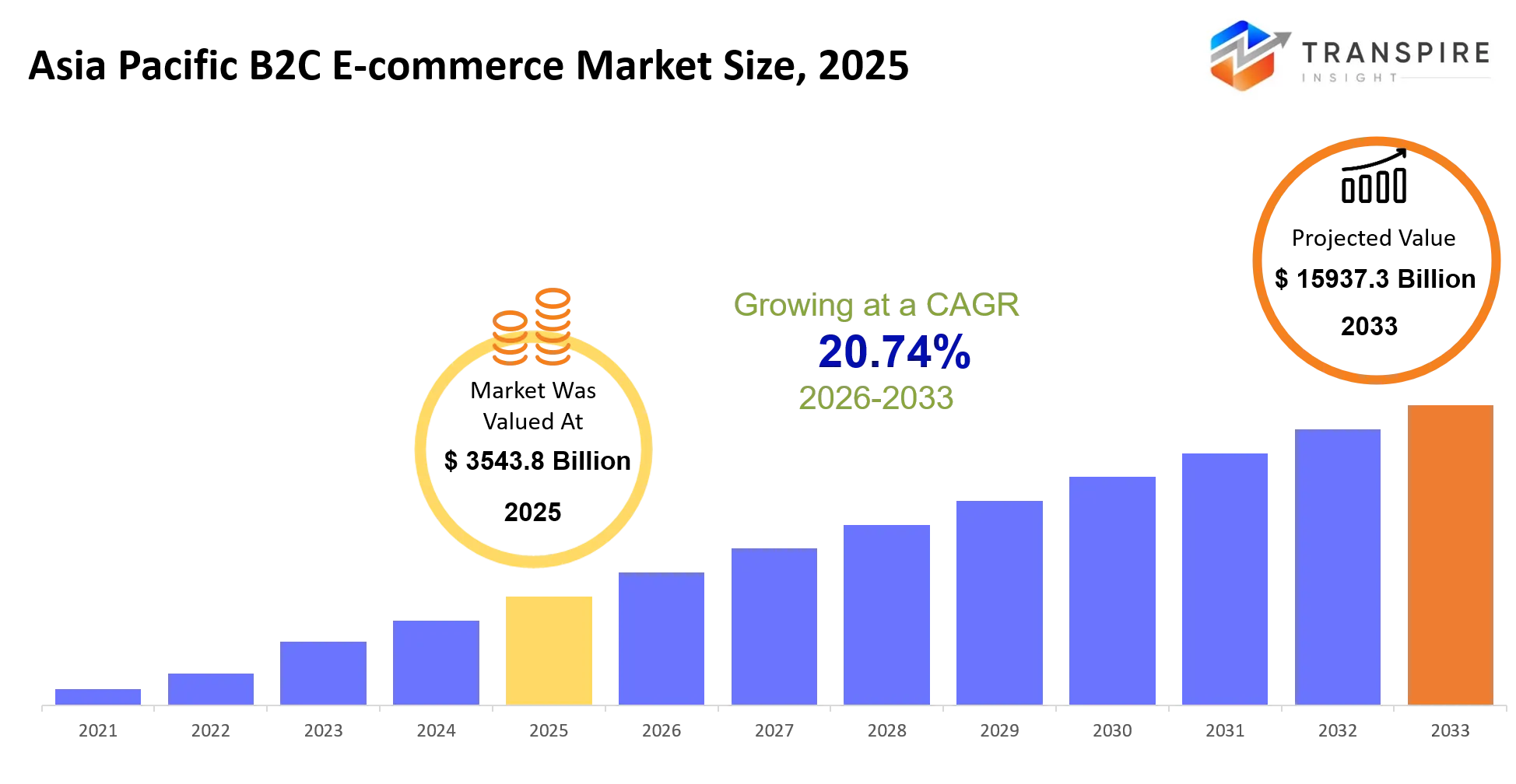
- Asia Pacific B2C E-commerce Market Size 2025:USD 3543.8 Billion
- Asia Pacific B2C E-commerce Market Size 2033: USD 15937.3 Billion
- Asia Pacific B2C E-commerce Market CAGR: 20.74%
- Asia Pacific B2C E-commerce Market Segments: By Product Type (Electronics, Fashion, Grocery, Beauty, Home Goods, Toys, Others); By Platform (Marketplace, Brand Website, Mobile Commerce, Social Commerce, Others); By Payment Method (Cards, Wallets, UPI, BNPL, COD, Others); By End User (Gen Z, Millennials, Adults, Seniors, Others)
To learn more about this report,  Download Free Sample Report
Asia Pacific B2C E-commerce Market Summary
The Asia Pacific B2C E-commerce Market was valued atUSD 3543.8 Billion in 2025. It is forecast to reach USD 15937.3 Billion by 2033. That is a CAGR of 20.74% over the period.
The Asia Pacific B2C e-commerce market sort of basically lets consumers grab everyday items, electronics, apparel, groceries and even services straight from digital storefronts, so retailers get a scalable route to reach customers, both in super packed urban hubs and in more underserved regional places. Over the last five years the whole situation kind of drifted away from simple online retail and into more connected digital commerce eco systems that blend mobile payments, social commerce, livestream shopping, and fast fulfillment networks, y’know. One big catalyst was the COVID-19 pandemic, and it nudged digital purchasing habits forward, it also pushed retailers to put quite a bit of money into online channels, logistics infrastructure, and last mile delivery capabilities, too.
So because of that shift you end up with this self re-enforcing loop that keeps turning. When payments feel easier and delivery is faster, transaction friction drops a bit, so people tend to buy more often, and the online catalog gets wider too, like more product categories in general. At the same time merchants gain from a broader audience and more detailed consumer intelligence, which helps them run sharper campaigns, and lift conversion results, and then that revenue momentum kind of ripples across the region.
Key Market Insights
- China is basically leading the Asia Pacific B2C e-commerce space, grabbing the biggest slice of regional revenue, and in a way setting the digital retail pace for everybody else.
- India is also moving fast, among the quickest growing e-commerce economies for the forecast window, backed by digital payments and a steady widening of logistics networks.
- Meanwhile Southeast Asia keeps picking up serious share gains, with cross-border shopping, mobile buying, and social commerce taking off more and more each quarter.
- Fashion still stays on top as the main product category, it accounts for the largest portion of online retail purchases across Asia-Pacific markets, overall.
- Consumer electronics is second, and it benefits from regular device refresh cycles, plus marketplace-led promotions that show up pretty often.
- Online grocery plus quick commerce seem to be the fastest-growing segments from 2025 to 2030, mostly because delivery capabilities are getting so quick. Like, it is really moving fast
- Marketplace based retail platforms kinda take the lead in app usage, mostly because they have a wide assortment and built-in payment options, so the whole end to end flow feels smoother, like less friction.
- Also social commerce , paired with live-stream shopping, seems to be the thing growing fastest right now, particularly with younger shoppers who tend to engage more with that sort of shopping cadence.
- Urban consumers make up the leading end-user share. That’s mainly due to higher internet penetration and stronger buying power overall.
- Meanwhile, shoppers from Tier-2 and Tier-3 cities are getting faster and faster as the fastest growing customer category, as logistics coverage spreads across more developing markets, little by little, bit by bit.
What are the Key Drivers, Restraints, and Opportunities in the Asia Pacific B2C E-commerce Market?
The main force speeding up the Asia Pacific B2C E-commerce Market is kinda the way mobile internet access, digital payments, and big logistics spending start to meet and sort of reinforce each other. With digital wallets now everywhere, online transactions feel easier, less effort really, and checkout is smoother. At the same time fulfillment networks keep getting stronger, so delivery windows that used to mean several days, can end up being same-day, or at least next-day, especially in many big cities. Put together, all of this cuts down purchasing friction and basically increases how often people actually complete transactions. And as shoppers get more at ease buying higher-value products online, merchants also end up capturing more order volume, plus they can push better customer lifetime value. That then, directly backs revenue growth across the different regional marketplaces.
Still, the biggest structural obstacle stays the uneven digital and logistics foundation across Asia-Pacific. Sure, the more mature markets tend to have advanced fulfillment systems, but a lot of rural and still developing places deal with delivery constraints , fragmented transportation, and inconsistent access to payments . These issues aren’t the kind you can just fix quickly, because they need sustained work in warehousing, transport, and digital infrastructure. So the outcome is slower customer acquisition beyond major urban centers, and retailers can see later monetization, especially when they’re trying broader regional penetration.
A big growth chance sits in AI-enabled social commerce, and also in cross border digital retail. Over time, platforms are merging live-stream selling , creator led promotion, and personalized suggestions together to nudge conversion rates upward. Southeast Asia, and India especially, look really interesting since internet use keeps rising, digital payments are getting more common, and online shopping habits are expanding too. On top of that, investments in automated warehousing, place based marketplaces, and AI powered shopping interactions are basically setting up the next wave of market expansion, even if it feels gradual at first.
What Has the Impact of Artificial Intelligence Been on the Asia Pacific B2C E-commerce Market?
Artificial intelligence is kind of reshaping the Asia Pacific B2C e-commerce market, by boosting operational efficiency, customer interaction, and supply chain results, day to day. Major platforms are leaning on AI powered suggestion systems that basically study browsing signals, buying records, and other behavioral data, so they can push very personalized product ideas. That tends to raise conversion rates, plus it often increases basket sizes too. On the back end, AI kinda helps with inventory scheduling, using demand forecasting at the product level and also at the regional level, which lets retailers curb stockouts but at the same time limits too much leftover stock.
More and more, machine learning models are getting used to predict purchasing patterns, fine tune pricing, and refine fulfillment routing, so in general e-commerce players can place warehouse inventory more smartly, reduce delivery lead times, and trim logistics spending. Then there are AI chatbots and virtual shopping companions, which take care of routine questions and minor issues, so response times go faster while customer support costs drop. Across the region, large platforms are also putting money into agentic shopping tools and richer AI driven shopping experiences, mainly to hold onto customers longer and keep engagement steady.
Still, AI rollout has its boundaries. Bringing advanced AI systems together across various countries, languages, and regulatory landscapes needs heavy funding and consistently good data. A lot of retailers also wrestle with scattered customer information, and different levels of digital readiness, and that can hurt model accuracy, plus it may delay the payoff from technology spend. Even with all that, AI stays one of the key catalysts for future e-commerce expansion in Asia Pacific.
Key Market Trends
- Since 2020, digital wallet adoption started to pick up speed across India, Indonesia, and Vietnam , so checkout got less annoying , and mobile commerce transaction volumes went up pretty fast, or at least it seems that way in day to day use.
- Livestream shopping sort of moved past China after 2021, and that—well—kind of nudged platforms like Alibaba, Shopee, and Lazada to weave in creator led commerce, like a more lived in storefront vibe, not just a clean catalog.
- From 2021 to 2025, same day and next day delivery networks became a real must have, which pushed companies to invest hard into automated fulfillment infrastructure even if demand was a bit uneven , here and there.
- Cross border e-commerce also gained more momentum as regional trade connections got better, so it became easier for merchants to sell to Southeast Asian consumers without having to build out huge physical retail footprints all over the place.
- AI powered recommendation engines, that used to be mainly simple personalization tools, evolved into revenue generating platforms. They now help optimize pricing , promotions, inventory allocation, and customer retention, all at once it seems.
- Online grocery purchasing stopped being only a pandemic driven “have to” thing, and it became more of a regular consumer habit, which encouraged retailers to set up dedicated quick-commerce operations.
- After 2022, Tier-2 and Tier-3 cities kind of showed up as real growth hotspots, with help from logistics coverage that was wider and smartphone penetration that went up across developing economies, even in areas that had been underserved before.
- Social commerce platforms took a larger bit of online transactions, particularly with younger folks who quite often trip on products via short video form content, more times than not .
- At the same time regional governments tightened and reinforced digital payment frameworks alongside consumer protection rules, so purchase experiences felt safer , and that kind of shift then helped broader involvement across online retail ecosystems.
- And competition itself shifted too, from being mostly price focused tactics toward ecosystem based models, where the biggest players bundle fintech services, logistics muscle advertising tools and loyalty programs into one combined value story.
Asia Pacific B2C E-commerce Market Segmentation
By Product Type :
Electronics are a big part of online buys in the Asia Pacific B2C E-commerce Market , mostly because people often go searching for smartphones, laptops , accessories, and household devices through digital channels. The ease of comparing products, the detailed specifications, promotional reductions , and a very broad catalog all help keep steady sales in this segment. Plus with new product releases happening all the time, shoppers tend to come back more often, and that can lift average order sizes too.
Fashion also stays extremely active, in part because buying tastes shift, and seasonal drops keep things moving. Grocery sales keep growing as online platforms get better at delivery speed and they manage freshness with more care. Beauty products often do well because of customer feedback, and digital suggestions , and the way people feel they can trust what others say. Meanwhile home goods, toys, and several other categories still bring in buyers who want convenience, choice, and value , all via online platforms.
By Platform :
Marketplace platforms take a good chunk of online transactions, mostly because there’s huge product variety, lots of sellers, and payment options built in, so shoppers find it easier to buy. They kind of turn into one central place where customers can browse offerings, check reviews, and wrap up the checkout faster. On top of that, solid logistics help a lot, and that’s what really pushes more adoption.
Meanwhile brand websites still pull in people who want a more direct connection with the manufacturer, plus they like those exclusive product releases. Mobile commerce keeps becoming more important too since smartphone usage keeps rising across the area. Social commerce has also started getting more attention, with content-first shopping journeys that feel more personal. And then there are other digital channels, which also expand online retail reach, while improving how companies stay engaged with customers.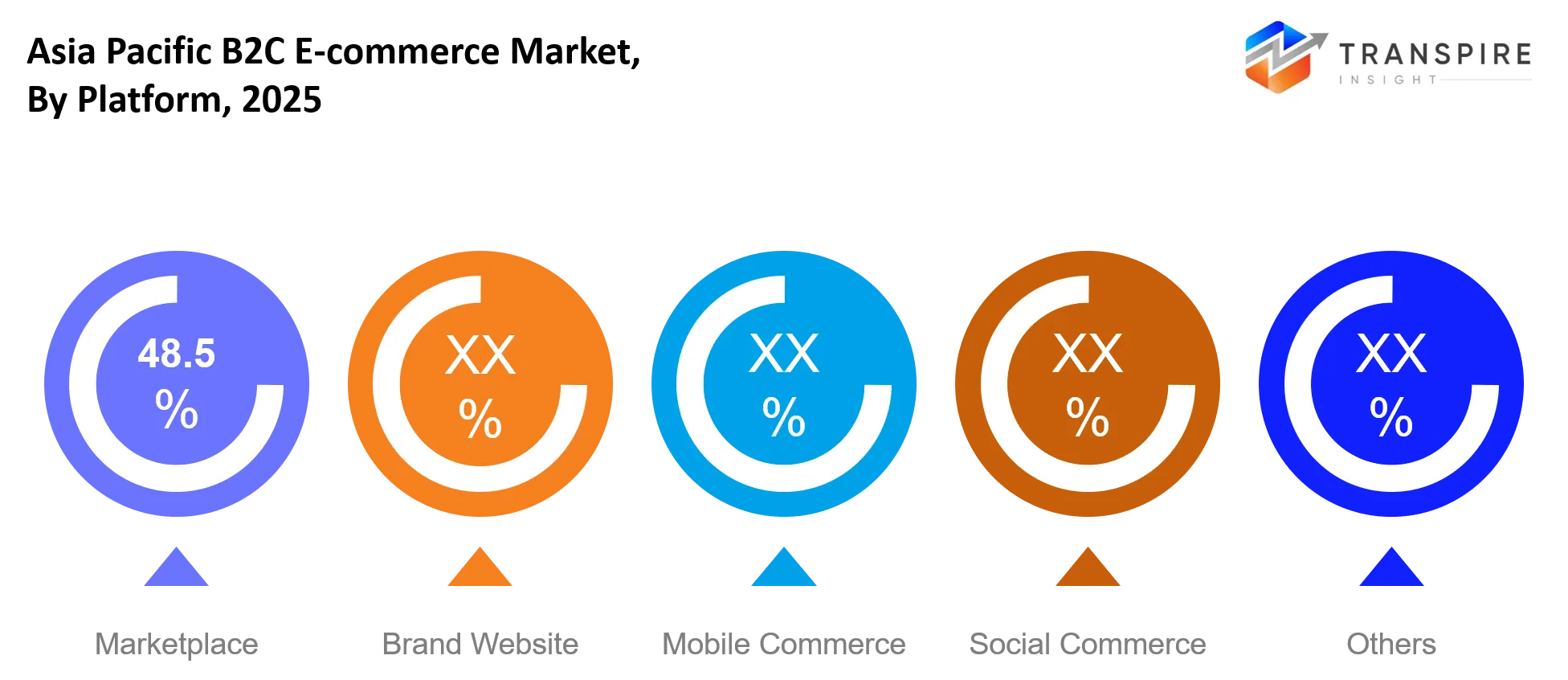
To learn more about this report, Download Free Sample Report
By Payment Method :
Card payments keep kinda being a big deal in digital transactions, especially for more expensive buys and for shoppers who already use online stores a lot. Credit and debit card systems are still broadly welcomed across most major e-commerce platforms, helping with secure and easy payment processing. Financial institutions keep pushing harder on digital payment protection, which boosts consumer confidence.
At the same time , digital wallets and UPI based payments have been growing really fast, mainly due to smoother checkout and the fact that people use smartphones everywhere. Buy Now Pay Later programs give customers more room to stretch spending on certain purchases, and Cash on Delivery is still relevant in areas where trust in digital payments is still developing. Then there are other payment avenues too, together forming a kind of varied payment ecosystem that fits different consumer choices.
By End User :
Gen Z consumers kind of actively engage with online shopping platforms, mostly using mobile devices and all those digital content feeds. Product discovery tends to happen through social media, short form videos, and influencer led promotions, so you see the stuff, you want the stuff, then it’s pretty fast. Their solid digital familiarity helps them buy online often across fashion, beauty, electronics, and even entertainment adjacent categories.
Millennials show up as a big chunk of the customer set, mainly because their purchasing activity stays high and their tastes are pretty broad. Adult consumers also add a lot through household related, grocery, and lifestyle purchases. Meanwhile senior consumers are joining more each year, as digital literacy keeps getting better. And there are also other consumer groups that quietly help market growth, which makes the customer base more diverse, and well that sort of thing then keeps transaction volume moving across several categories too.
What are the Key Use Cases Driving the Asia Pacific B2C E-commerce Market?
Honestly, the main use case behind the Asia Pacific B2C E-commerce Market is basically people buying stuff online, like consumer goods, especially electronics and fashion. Those two areas really pull in the largest number of orders, because shoppers can cross check prices, see more options, and catch promotions more often. On top of that, decent mobile connectivity plus delivery networks that actually work well, both help keep the whole purchasing rhythm going, pretty regularly.
Beyond that, there are other applications pushing forward in online grocery retail and beauty product sales. In more packed cities, families tend to rely on digital platforms for everyday groceries, mainly because delivery arrives faster , and it feels less hassle. At the same time younger buyers often turn to e-commerce channels for beauty and personal care items, and that happens with reviews, influencer posts, and suggestions that feel more personal.
Then you have the newer things coming in, like live stream shopping and AI powered customized commerce experiences. Social commerce platforms are making shopping paths that mix entertainment with buying, so it is less “search and checkout” and more like it just unfolds while you watch. Meanwhile stronger recommendation engines help retailers show selections that are highly tailored. It is still fairly early for many of these, but adoption is expected to rise across the forecast period.
|
Report Metrics |
Details |
|
Market size value in 2025 |
USD 0.28 Billion |
|
Market size value in 2026 |
USD 4259.5 Billion |
|
Revenue forecast in 2033 |
USD 15937.3 Billion |
|
Growth rate |
CAGR of 20.74% from 2026 to 2033 |
|
Base year |
2025 |
|
Historical data |
2021 - 2024 |
|
Forecast period |
2026 - 2033 |
|
Report coverage |
Revenue forecast, competitive landscape, growth factors, and trends |
|
Regional scope |
Asia Pacific (India, China, Japan, Australia, South Korea, Rest of Asia Pacific) |
|
Key company profiled |
Alibaba, Amazon, JD.com, Flipkart, Shopee, Lazada, Rakuten, Coupang, Tokopedia, eBay, Reliance Retail, Myntra, Meesho, Nykaa, Zalora |
|
Customization scope |
Free report customization (country, regional & segment scope). Avail customized purchase options to meet your exact research needs. |
|
Report Segmentation |
By Product Type (Electronics, Fashion, Grocery, Beauty, Home Goods, Toys, Others); By Platform (Marketplace, Brand Website, Mobile Commerce, Social Commerce, Others); By Payment Method (Cards, Wallets, UPI, BNPL, COD, Others); By End User (Gen Z, Millennials, Adults, Seniors, Others) |
Which Regions are Driving the Asia Pacific B2C E-commerce Market Growth?
China still feels like the biggest, dominant force in the Asia Pacific B2C E-commerce market, mainly because its digital shopping ecosystem is really well built, plus the logistics side is extensive, and payments are deeply stitched into everyday consumer habits. With big scale investments in automated warehouses, fulfillment centers,and last mile delivery networks, online merchants can reach huge numbers of customers in a fairly efficient way. Then there are the supportive digital economy policies, and pretty wide smartphone adoption, which together help keep participation strong not only in big cities, but also across regional areas. On top of that, major platform operators, payment providers, and logistics companies are already tightly connected, so the whole setup keeps feeding the regional leadership.
Japan comes next as the second largest contributor, though the way growth happens is not exactly like what China shows. Here, market momentum is more driven by steadier consumer spending, high internet penetration, and a stronger sense of trust in online transactions, rather than fast platform expansion. Established retailers keep putting resources into omnichannel commerce strategies, where physical stores and online operations work side by side. This kind of steady investing atmosphere creates dependable revenue flow,and it makes Japan a meaningful source of long-term market steadiness.
India is emerging as one of the fastest-growing markets across the region, even while digital infrastructure, payment systems, and logistics networks keep expanding more or less steadily. A lot of the recent lift has been fueled by the quick uptake of UPI-style transactions, alongside rising smartphone penetration and wider access to e-commerce in Tier-2 and Tier-3 towns. At the same time, investments in warehousing, fulfillment capabilities, and regional delivery networks have helped upgrade service quality and make online retail available to more people, basically farther out than before. During the 2026–2033 stretch, this ongoing momentum should unlock meaningful possibilities for platform operators, technology providers, logistics companies, plus investors looking for exposure to fast-scaling digital commerce markets.
Who are the Key Players in the Asia Pacific B2C E-commerce Market and How Do They Compete?
In the Asia Pacific B2C E-commerce market, competition sits mainly with a handful of big platform operators, even though smaller regional players and niche participants keep pushing on the established positions. What really matters now isn’t only price , it’s more like tech strength, how fast goods move, customer experience quality, and how well the whole ecosystem can connect together. More and more companies fight on digital payments, ad services, smoother logistics, and also more personal shopping journeys. Basically , the market still favors those businesses that manage to mix scale with genuine customer engagement and strong operational efficiency.
Alibaba Group stands out because it runs a wide digital ecosystem, it blends online retail, digital payments, cloud offerings, and logistics support in one connected setup. That kind of unified model lets merchants pull together several business services, all inside one platform environment. The company keeps trying to reinforce its competitive edge via artificial intelligence use cases, cross-border commerce drives, and continuing investments in digital retail innovation , in general.
JD.com is more focused on direct logistics control and fulfillment operations which helps it deliver faster and gives clearer inventory visibility compared with many marketplace-only competitors. By continuing to invest in automation, warehouse technology, and supply chain refinement, the firm improves service dependability and overall customer satisfaction. In other words, its logistics muscle stays a major advantage in these crowded digital retail markets, where everyone wants speed and certainty.
Company List
- Alibaba
- Amazon
- JD.com
- Flipkart
- Shopee
- Lazada
- Rakuten
- Coupang
- Tokopedia
- eBay
- Reliance Retail
- Myntra
- Meesho
- Nykaa
- Zalora
Recent Development News
In February 2026, Google entered a strategic partnership with Sea Ltd to develop AI tools for e-commerce and gaming. The collaboration includes building an AI-powered shopping prototype for Shopee, strengthening AI-driven commerce capabilities across Southeast Asia’s leading B2C e-commerce platform. Source https://www.reuters.com/
In February 2026, Wishlink secured funding of US$17.5 million in a round led by Vertex Ventures Southeast Asia & India. The investment will help scale Wishlink’s creator-commerce technology and infrastructure, accelerating social-commerce and direct-to-consumer shopping innovation in the Asia-Pacific e-commerce market. Source https://m.economictimes.com/
What Strategic Insights Define the Future of the Asia Pacific B2C E-commerce Market?
Asia Pacific B2C E-commerce Market seems to be drifting ,toward a more stitched together digital commerce way, where buying ,payments, logistics, ads and customer engagement all sort of run in one connected ecosystem. In the next five to seven years, most of the momentum won’t come only from people trying online shopping for the first time. It will come from whether platforms can push transaction frequency up, tune personalization better ,and extend their services across more consumer touchpoints. At the same time, artificial intelligence, real time data analysis, and automated fulfillment networks will quietly but clearly become the backbone of this shift.
There’s also a risk that doesn’t get as much attention. This is the growing concentration of market power. When a small group of big platforms ends up controlling more of the digital payments, the logistics infrastructure, and the consumer data itself, smaller merchants can become more dependent, and bargaining power can shrink. In practice, that may reduce competitive variety , and keep the market from staying as diverse.
On the flip side, there’s a pretty meaningful opportunity starting to show up. AI powered conversational commerce is picking up speed in Southeast Asia and India. mobile-first users are spending more time with digital assistants, plus they’re also using social shopping tools more often. Companies should build localized AI skills, and set up regional fulfillment networks sooner rather than later, because these capabilities will likely be key differentiators in the next round of competitive growth.
Asia Pacific B2C E-commerce Market Report Segmentation
By Product Type
- Electronics
- Fashion
- Grocery
- Beauty
- Home Goods
- Toys
By Platform
- Marketplace
- Brand Website
- Mobile Commerce
- Social Commerce
By Payment Method
- Cards
- Wallets
- UPI
- BNPL
- COD
By End User
- Gen Z
- Millennials
- Adults
- Seniors
Frequently Asked Questions
Find quick answers to common questions.
The Expected Asia Pacific B2C E-commerce Market size is USD 15937.3 Billion in 2033.
Key Segments for the Asia Pacific B2C E-commerce Market are By Product Type (Electronics, Fashion, Grocery, Beauty, Home Goods, Toys, Others); By Platform (Marketplace, Brand Website, Mobile Commerce, Social Commerce, Others); By Payment Method (Cards, Wallets, UPI, BNPL, COD, Others); By End User (Gen Z, Millennials, Adults, Seniors, Others).
Major Asia Pacific B2C E-commerce Market Players are Alibaba, Amazon, JD.com, Flipkart, Shopee, Lazada, Rakuten, Coupang, Tokopedia, eBay, Reliance Retail, Myntra, Meesho, Nykaa, Zalora.
The Current Asia Pacific B2C E-commerce Market size isUSD 3543.8 Billion in 2025.
The Asia Pacific B2C E-commerce Market CAGR is 20.74% from 2026 to 2033.
- Alibaba
- Amazon
- JD.com
- Flipkart
- Shopee
- Lazada
- Rakuten
- Coupang
- Tokopedia
- eBay
- Reliance Retail
- Myntra
- Meesho
- Nykaa
- Zalora
About the Authors

Mayur Shinde
I am Mayur Shinde, a Senior Research Analyst at Transpire Insight, specializing in the Automotive & Transportation and Information & Communication Technology (ICT) Industry. My work focuses on analyzing emerging market trends, technological advancements, competitive landscapes, and industry developments to deliver accurate, data-driven insights. I am passionate about transforming complex market information into clear, actionable content that helps businesses, professionals, and decision-makers stay informed and make confident strategic decisions.

Chakradhar Khansole
Chakradhar serves as the Research Director at Transpire Insight, bringing over 8 years of experience in technology, innovation, and strategic market intelligence. He specializes in transforming complex market data into actionable business insights that enable organizations to make informed, growth-oriented decisions. Recognized for his strategic vision and analytical expertise, Chakradhar leads high-impact research initiatives, delivering comprehensive market assessments, competitive intelligence, and forward-looking industry analysis.
Recently Published Reports
-
Apr 2026
3D Optical Profiler Market
3D Optical Profiler Market Size, Share & Analysis Report By Type (Desktop 3D Optical Profiler, and Portable 3D Optical Profiler), By Technology (Confocal Technology, and White Light Interference), By End-Use Industry (Manufacturing, Research Institutions, Automotive, Aerospace and Defense, Medical Devices, and Other), and Geography (North America, Europe, Asia-Pacific, Middle East and Africa, South and Central America), 2021 - 2031
-
Apr 2026
Depth Sensor Market
Depth Sensor Market Size, Share & Analysis Report By Type (Infrared Depth Sensors, Time-of-Flight (ToF) Sensors, Stereo Vision Sensors, Structured Light Sensors, Ultrasonic Depth Sensors), By Application (Automotive, Robotics, Gaming, Consumer Electronics, Industrial Automation, Healthcare, Security & Surveillance, Others), By End Users (Automotive Manufacturers, Consumer Electronics Companies, Healthcare Providers, Industrial Companies, Security Agencies, Gaming Companies, Robotics Companies, Others), and Geography (North America, Europe, Asia-Pacific, Middle East and Africa, South and Central America), 2021 – 2031
-
Apr 2026
Digital Manufacturing Market
Digital Manufacturing Market Size, Share & Analysis Report By Component (Hardware, Software, and Services), By Technology (Robotics, 3D Printing, Internet of Things (IoT), and Others), By Application (Automotive and Transportation, Aerospace and Defense, Consumer Electronics, Industrial Machinery, and Others), By Process Type (Computer-Based Designing, Computer-Based Simulation, Computer 3D Visualization, Analytics, and Others), and Geography (North America, Europe, Asia-Pacific, Middle East and Africa, South and Central America), 2021 – 2031
-
Apr 2026
Digital Visa Services Market
Digital Visa Services Market Size, Share & Analysis Report By Type (Individual Travelers, Group Travelers), By Application (Tourism, Business Travel, Others), and Geography (North America, Europe, Asia-Pacific, Middle East and Africa, South and Central America), 2021 – 2031