

United Kingdom E-commerce Fulfillment Services Market Size & Forecast:
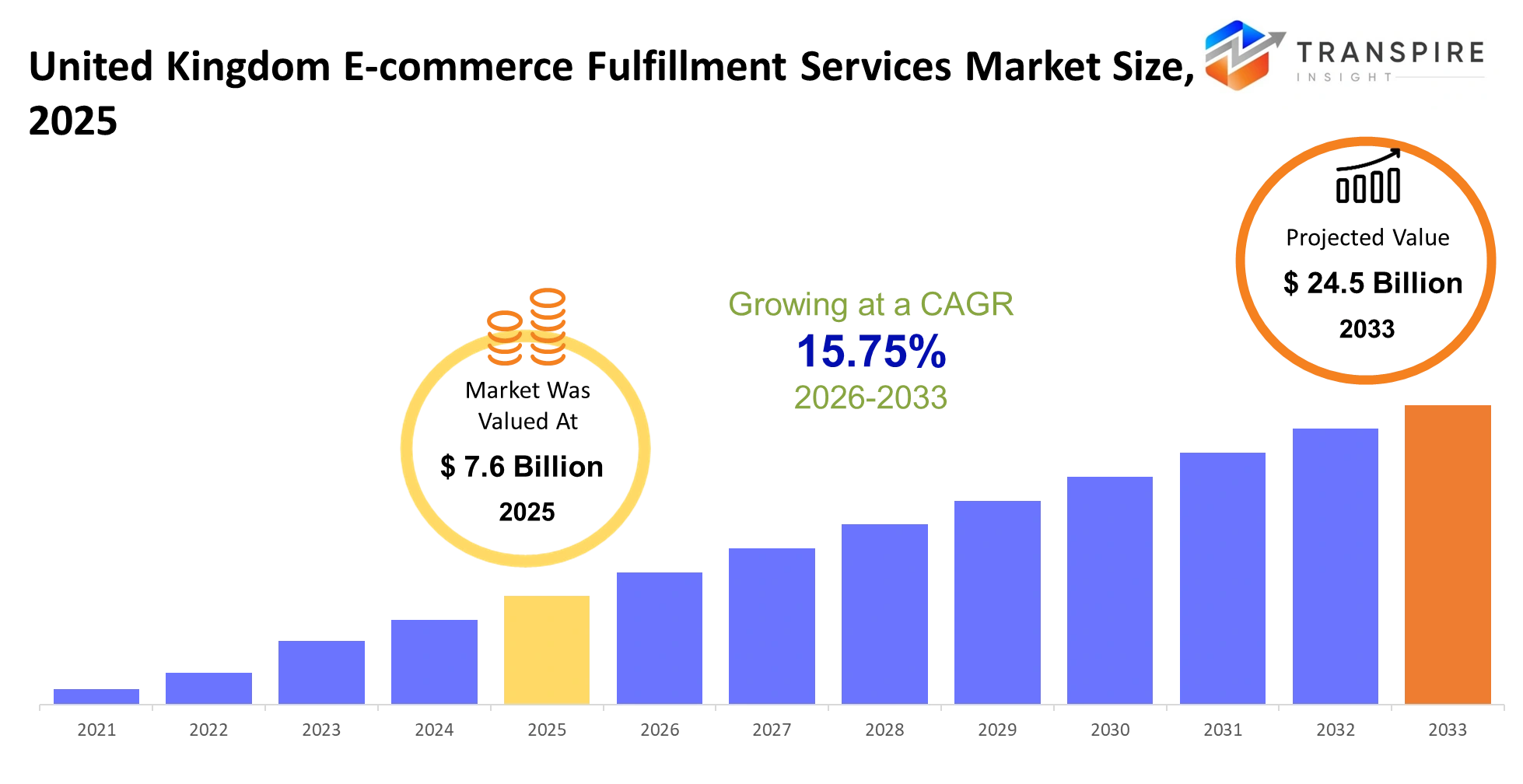
- United Kingdom E-commerce Fulfillment Services Market Size 2025: USD 7.6 Billion
- United Kingdom E-commerce Fulfillment Services Market Size 2033: USD 24.5 Billion
- United Kingdom E-commerce Fulfillment Services Market CAGR: 15.75%
- United Kingdom E-commerce Fulfillment Services Market Segments: By Service Type (Warehousing Services, Order Fulfillment Services, Packaging Services, Reverse Logistics Services, Inventory Management Services, Shipping Services, Others); By Deployment (Automated Fulfillment Centers, AI-enabled Fulfillment Systems, Robotics-based Fulfillment, Cloud-based Fulfillment Platforms, Others); By Application (Retail E-commerce, Grocery E-commerce, Fashion E-commerce, Electronics E-commerce, Healthcare E-commerce, Others); By End User (E-commerce Companies, Retailers, SMEs, D2C Brands, Enterprises, Others); By Delivery Type (Same-day Delivery, Next-day Delivery, Standard Delivery, Cross-border Delivery, Others).
To learn more about this report,  Download Free Sample Report
United Kingdom E-commerce Fulfillment Services Market Summary
The United Kingdom E-commerce Fulfillment Services Market was valued at USD 7.6 Billion in 2025. It is forecast to reach USD 24.5 Billion by 2033. That is a CAGR of 15.75% over the period.
In the United Kingdom , the e-commerce fulfillment services market kind of revolves around companies doing the physical backbone of online retail, like they receive inventory, tuck it away in a bunch of distributed warehouses , then they pick and pack each order, and finally they manage the last mile dispatch so retailers can hit fast delivery expectations without having to build their own logistics networks or whatever. Over the past few years, the whole market has been moving, more and more, toward fulfillment centers that are very automated and driven by software. So instead of relying on manual warehousing processes, robotics and real-time inventory systems and even data-led routing start to take the lead.
One big trigger was the COVID 19 pandemic, it really shook traditional retail channels , and it made online shopping stick around longer than people thought. That also revealed the weak spots in in-house logistics capacity. Then there’s also the post Brexit customs friction , which reshaped cross-border trade routes , and pushed retailers to keep more inventory inside the UK itself. Put together, these pressures sped up the move toward outsourcing to third-party fulfillment providers, and that improved delivery speed, lowered operational complexity, and essentially turned scalable warehouse networks into a core requirement for long-term e-commerce profitability.
Key Market Insights
- England is basically running the United Kingdom E-commerce Fulfillment Services Market, with something like nearly 70% share , mostly because the logistics setup is dense and online retail keeps getting stronger.
- Scotland and the Northern regions are the ones growing quickest through 2030, and this is tied to warehouse expansion plus better transport connectivity investments, which is kinda where the momentum is coming from.
- London and the Midlands sort of function as central logistics nerve centers, helping with fast order processing and smoother cross-border distribution.
- Also, the value-added services slice , like kitting and returns management, is projected to be the fastest-growing through 2030, since reverse logistics gets complicated quickly, you know.
- For customer type, B2C e-commerce takes the lead with close to 65% share in the United Kingdom E-commerce Fulfillment Services Market, mainly from rising online retail penetration.
- On the application side, cross-border e-commerce fulfillment is moving the quickest, because UK retailers are extending their EU and wider global shipping networks.
- Subscription-based delivery models are popping up more , and they tend to lift recurring fulfillment demand while improving how efficiently warehouses are used.
- By industry , retail and fashion are leading at about 45% share, because order frequency is high and inventory turns over fast.
- Electronics and consumer goods are also becoming a rapidly expanding end-user set, backed by growing digital adoption and a wider variety of products.
- Finally, SMEs increasingly prefer outsourcing logistics , which is basically fueling demand for flexible, scalable fulfillment solutions all across the United Kingdom E-commerce Fulfillment Services Market.
What are the Key Drivers, Restraints, and Opportunities in the United Kingdom E-commerce Fulfillment Services Market?
Honestly the main driver behind the United Kingdom E-commerce Fulfillment Services Market is the rapid scaling of same-day and next-day delivery expectations , largely set by the biggest online retailers. After the pandemic era, demand spikes sort of settled into a “new normal” with more frequent online buying, and that made speed feel nonnegotiable. Retailers then had to rethink their logistics , not really around cost efficiency but around moving faster. And as orders started coming in smaller, more scattered batches, brands started outsourcing fulfillment to third-party providers , usually those with distributed warehouse networks and some level of automation. That change basically expanded revenue channels for fulfillment operators since many contracts now emphasize per-order processing plus additional services like live shipment visibility and returns handling, which feels a bit more “connected” than older models.
One important structural restraint is the ongoing shortfall in skilled warehouse labor combined with expensive commercial real estate in logistics-heavy areas, for example Greater London and the Midlands. Together these factors slow down warehouse expansion and push up operating costs, especially for mid-sized providers that do not really have the same scale advantages. Since labor availability and land prices are influenced by wider macroeconomic conditions and local urban planning, this doesn’t get fixed quickly. So fulfillment capacity grows more slowly than peak-season demand, and that ends up limiting revenue capture while also hurting service consistency during the busy high-volume cycles in the United Kingdom E-commerce Fulfillment Services Market.
A big opportunity is sitting in expanding micro-fulfillment facilities, mostly with AI-driven inventory forecasting and robotics that just sort and move things faster. Some retailers , like grocery and fast-moving consumer goods operators, are already piloting small urban warehouses that bring last-mile dispatch down to under two hours. You can see this model taking real hold in cities such as Manchester and Birmingham , where the population density helps with quicker order gathering. As more infrastructure investment ramps up, this whole approach should open up fresh income streams and improve how the fulfillment network works, across the United Kingdom E-commerce Fulfillment Services Market.
What Has the Impact of Artificial Intelligence Been on the United Kingdom E-commerce Fulfillment Services Market?
Artificial intelligence is kinda reshaping the United Kingdom E-commerce Fulfillment Services Market, by improving how fulfillment networks coordinate the inventory flow, transport allocation, and warehouse automation, all together sort of. In big distribution centers, AI-driven warehouse management systems are optimizing robotic picking routes, they cut down travel time between shelves , and automate conveyor sequencing, which in turn boosts order cycle speed and lowers the chance of manual handling errors. Fleet operators are also using AI-based control systems to keep an eye on delivery vehicles in real time, tracking compliance factors like route adherence , fuel consumption patterns and even temperature conditions for delicate or sensitive goods.
Then machine learning models come in, they strengthen predictive capabilities by enabling demand forecasting at the SKU level, and that helps fulfillment providers pre-position inventory nearer to high-demand urban clusters. These same systems can also help with predictive maintenance, for example they spot wear patterns in automated sorting machines and in delivery fleets, so you get less unexpected downtime and smoother operations during peak shopping cycles. Many industry players say there are directional improvements too, like lower last-mile fuel consumption, and better warehouse throughput efficiency, especially when AI scheduling tools are fully integrated across the network.
Still, adoption is pretty constrained by high integration costs and fragmented legacy infrastructure across mid-tier logistics providers. A lot of systems don’t use standardized data formats, so model accuracy takes a hit, and enterprise-wide deployment slows down. Also, smaller fulfillment operators often have limited access to high quality training datasets, which ends up reducing the precision of optimization models in real world conditions across the United Kingdom E-commerce Fulfillment Services Market .
Key Market Trends
- After 2021, automation adoption went up really sharply,as warehouses in the UK started pushing more robotics in place to trim order processing times by nearly 30% or so.
- Around 2020 though, retailers kinda moved away from in-house logistics and leaned more on third-party fulfillment providers, because those supply chain disruptions showed where capacity was kinda limited.
- Then post 2022, the need for same-day delivery really surged, and that pressure made carriers—Royal Mail and DPDgroup especially add micro-distribution hubs, sort of everywhere they could fit them.
- Also, since 2023, AI-driven demand forecasting tools have been cutting down inventory misplacement inside UK fulfillment centers, basically by improving SKU-level allocation accuracy, which helped keep things calmer in the system.
- Brexit caused customs friction, and that changed cross-border e-commerce in a noticeable way, pushing more sales toward localized UK warehousing.
- And with energy prices bouncing around a lot in 2022–2024, operators focused harder on route planning optimization, and in the end improved fleet fuel efficiency by up to 15%.
- At the same time, fashion e-commerce saw returns processing volume climb a lot, so GXO Logistics and XPO Logistics started expanding reverse logistics infrastructure to handle it better.
- In the mid-sized firms, cloud-based warehouse management systems replaced older software, which sped up real-time inventory visibility across multi-node networks, not just one warehouse.
- Finally, after 2023, micro-fulfillment centers expanded across urban areas in the UK, which reduced last-mile delivery distances, and that made two-hour delivery feasibility a lot more realistic for customers.
United Kingdom E-commerce Fulfillment Services Market Segmentation
By Service Type :
Warehousing services help with storing and distributing products across central and regional hubs, which makes inventory much more reachable. Order fulfillment services kinda take over the whole picking, packing, and dispatch routine for online orders , and packaging services keep everything safe during transit or the boxes get shuffled the wrong way, you know. Reverse logistics deals with returns handling and reprocessing, while inventory management boosts stock tracking accuracy and also lowers the chances of stockouts across the whole network.
Shipping services basically connect fulfillment centers to last mile delivery networks ,so orders keep moving on time. When companies use a combined service setup, it strengthens coordination, and it also cuts down delivery lags across e-commerce channels in the United Kingdom E-commerce Fulfillment Services Market. By mixing various service types, operations get more efficient across both traditional retail and digital commerce supply chains.
To learn more about this report, Download Free Sample Report
By Deployment :
Automated fulfillment centers use conveyor systems and sorting machines, to speed up the processing part and reduce the manual work for people. AI-enabled systems support demand predictions and warehouse coordination in a more precise way. Robotics-based fulfillment is used for picking and packing tasks with better accuracy. Cloud-based platforms provide real-time access to data across multiple warehouse sites, and they improve system integration, so updates don’t get stuck in limbo.
Using combined deployment models can reduce operational downtime and improve scalability for logistics providers. A technology-driven deployment increases processing velocity and helps maintain steady performance during peak demand periods in the United Kingdom E-commerce Fulfillment Services Market, while also improving visibility across distributed supply chain networks .
By Application :
Retail e-commerce basically takes the lead on app usage , because orders come in so often and there’s just a huge range of products. Grocery e-commerce is a bit different, it needs quick turnaround times and temperature-managed handling , you know, cold chain style setups. Fashion e-commerce also stands out since returns are pretty high, so reverse logistics has to be run efficiently, not kind of half done. Electronics e-commerce is more sensitive, it leans on secure packaging and precise inventory tracking , otherwise you get shipment damage or order mix ups that are hard to fix.
Healthcare e-commerce then flips the priorities again, it must follow strict handling rules for medical supplies and pharmaceuticals, there’s very little room for variance. All this “application diversification” basically boosts demand for specialized fulfillment approaches across the United Kingdom E-commerce Fulfillment Services Market, and that backs customized logistics patterns based on product types and service needs.
By End User :
In the end, e-commerce businesses still look like the biggest end users, mainly because outsourced logistics models help lower infrastructure spending. Retailers are also leaning more toward fulfillment partnerships to cope with the rising volume of online orders . SMEs tend to depend on third party logistics providers so operations can scale without chaos. Meanwhile D2C brands often push direct shipping methods to enhance customer experience and keep better delivery control.
Bigger enterprises tend to invest in integrated fulfillment systems so they can manage high order quantities and multi-channel distribution at the same time. And as more end users jump in, service demand grows, which also improves take up of advanced logistics solutions across the United Kingdom E-commerce Fulfillment Services Market .
By Delivery Type :
Same day delivery is rolling out fast in city areas, mostly because customers now want instant order fulfillment , like really quickly. Next day delivery still stays pretty common across most retail categories . Standard delivery keeps doing its job too, it remains cost efficient for items that are not urgent. Cross border delivery keeps growing as UK retailers stretch into international sales channels, and they adjust their post Brexit trading setups.
Better logistics infrastructure helps, and distributed warehousing also plays a role, so faster delivery options become more practical. With more types of delivery available, companies can stay competitive and improve fulfillment efficiency across the United Kingdom , E-commerce Fulfillment Services Market.
What are the Key Use Cases Driving the United Kingdom E-commerce Fulfillment Services Market?
Retail e-commerce order fulfillment still feels like the main thing in the United Kingdom E-commerce Fulfillment Services Market, because people keep buying online at a high pace, so there’s always this need for quick picking, careful packing, and then last-mile dispatch, pretty much nonstop. And with big order volumes coming from fashion, electronics, and regular retail , companies end up trying to keep warehouses very responsive, aiming to shave off delivery time wherever they can.
Grocery delivery, plus logistics that goes direct-to-consumer, are also growing into secondary use cases, mostly with urban retailers and smaller sellers (SMEs). Grocery operators lean heavily on temperature-controlled storage, alongside rapid dispatch routines. Meanwhile D2C brands lean on fulfillment partners to handle a scalable nationwide run, without having to own or operate warehouse space themselves.
Cross-border e-commerce fulfillment is starting to show up as a real growth angle too, helped by post-Brexit trade changes and also by higher international sales from UK-based retailers. On top of that, subscription-like delivery models are becoming more common, and automated micro-fulfillment for hyperlocal orders is gaining momentum as technology keeps improving. In practice, this helps increase delivery speed and cuts operational friction across distribution networks, even when volume spikes.
|
Report Metrics |
Details |
|
Market size value in 2025 |
USD 7.6 Billion |
|
Market size value in 2026 |
USD 8.8 Billion |
|
Revenue forecast in 2033 |
USD 24.5 Billion |
|
Growth rate |
CAGR of 15.75% from 2026 to 2033 |
|
Base year |
2025 |
|
Historical data |
2021 - 2024 |
|
Forecast period |
2026 - 2033 |
|
Report coverage |
Revenue forecast, competitive landscape, growth factors, and trends |
|
Regional scope |
Middle East and Africa (Saudi Arabia, United Arab Emirates, South Africa, Rest of Middle East and Africa) |
|
Key company profiled |
Amazon Logistics, DHL Supply Chain, FedEx, UPS, CEVA Logistics, GXO Logistics, Kuehne+Nagel, XPO Logistics, Shopify Fulfillment Network, ShipBob, Rakuten Super Logistics, Ingram Micro, Delhivery, Arvato, Huboo. |
|
Customization scope |
Free report customization (country, regional & segment scope). Avail customized purchase options to meet your exact research needs. |
|
Report Segmentation |
By Service Type (Warehousing Services, Order Fulfillment Services, Packaging Services, Reverse Logistics Services, Inventory Management Services, Shipping Services, Others); By Deployment (Automated Fulfillment Centers, AI-enabled Fulfillment Systems, Robotics-based Fulfillment, Cloud-based Fulfillment Platforms, Others); By Application (Retail E-commerce, Grocery E-commerce, Fashion E-commerce, Electronics E-commerce, Healthcare E-commerce, Others); By End User (E-commerce Companies, Retailers, SMEs, D2C Brands, Enterprises, Others); By Delivery Type (Same-day Delivery, Next-day Delivery, Standard Delivery, Cross-border Delivery, Others). |
Which Regions are Driving the United Kingdom E-commerce Fulfillment Services Market Growth?
England is still the most dominant part of the United Kingdom E-commerce Fulfillment Services Market, mostly because it has a dense concentration of people, solid retail demand, and logistics infrastructure that’s already in place. The main fulfillment routes near London and the Midlands help with quick order handling and big warehouse rollouts. Connectivity is also a big reason— ports like Felixstowe, plus major air freight hubs, improve the inbound and outbound distribution speed. And there’s a mature third party logistics ecosystem, so retailers and e-commerce platforms outsource at relatively high rates, without much friction.
Scotland is more like a steady, steadily adding region, with consistent domestic consumption and fairly structured regional logistics planning. Places such as Glasgow and Edinburgh keep benefiting from ongoing investment into warehousing capacity, as well as better digital retail infrastructure. Compared with England, growth here is less about sudden volume spikes and more about long term retail steadiness, plus dependable supply chain demand. On top of that, the government supported regional development programs with a gradual build up of fulfillment capabilities across city areas and semi urban zones, in a kind of calm but continuous way.
Northern England, however, feels like it’s moving the fastest right now. That’s tied to newer logistics park setups and infrastructure upgrades in Manchester, Leeds, and nearby districts. Operational costs tend to be lower, and motorway as well as rail freight connectivity has improved, so large fulfillment operators are looking for capacity outside London. Investments connected to regional development initiatives have sped up warehouse construction, and even automation adoption. Overall, this suggests a shift toward more decentralized fulfillment networks across the United Kingdom E-commerce Fulfillment Services Market, and it should keep strengthening through 2026–2033.
Who are the Key Players in the United Kingdom E-commerce Fulfillment Services Market and How Do They Compete?
In the United Kingdom E-commerce Fulfillment Services Market, the whole thing feels kind of moderately consolidated near the top , but at the mid-tier level it is still pretty fragmented. The bigger incumbents protect their share mostly because of scale advantages, and meanwhile technology-enabled new entrants keep pushing on pricing along with higher service expectations. A lot of the competition now rides on whether a provider can actually automate well, how dense their warehousing network is, and how fast the last mile gets done, honestly. On top of that, retailers negotiate pretty hard for more flexible contract terms, so margin pressure just spreads across pretty much all providers, no matter the size.
Amazon runs on an integrated e-commerce and logistics setup, and it leans hard on AI-powered forecasting and micro-fulfillment sites to keep the Prime style same-day delivery edge. DHL Supply Chain, on the other hand, concentrates on contract logistics for enterprise customers, using automation-heavy warehouses and compliance-first systems especially in regulated sectors. GXO Logistics tries to stay in the lane as a more pure-play fulfillment provider, improving outsourced warehouse networks through robotics integration and multi-client operations that can scale across the UK.
Royal Mail leans on national postal infrastructure to cover last-mile routes while it keeps modernizing sorting hubs to manage the rising parcel volumes. DPDgroup differentiates by focusing on more advanced tracking systems and predictive delivery windows, which helps cut down failed deliveries and boosts customer visibility. XPO Logistics improves its position with stronger enterprise agreements by applying reverse logistics know-how, plus automation-led warehouse upgrades, and it keeps expanding its UK presence through tech investment and strategic client partnerships.
Company List
- Amazon Logistics
- DHL Supply Chain
- FedEx
- UPS
- CEVA Logistics
- GXO Logistics
- Kuehne+Nagel
- XPO Logistics
- Shopify Fulfillment Network
- ShipBob
- Rakuten Super Logistics
- Ingram Micro
- Delhivery
- Arvato
- Huboo
Recent Development News
In May 2026, Amazon announced expanded UK fulfillment and logistics investment as part of its £20 billion 2025–2027 commitment. The company is scaling new fulfillment sites, automation-driven warehouse upgrades, and trialing drone delivery systems, strengthening its dominance in UK e-commerce fulfillment infrastructure and accelerating last-mile delivery innovation.
Source: https://www.reuters.com/
In May 2026, Asda and Ocado entered a strategic technology partnership to overhaul Asda’s UK e-commerce fulfillment operations. Ocado will replace Asda’s core online ordering and fulfillment systems, enabling advanced automation, improved order routing, and integration with third-party delivery platforms, significantly modernizing UK grocery fulfillment efficiency.
Source: https://www.reuters.com/
What Strategic Insights Define the Future of the United Kingdom E-commerce Fulfillment Services Market?
The United Kingdom E-commerce Fulfillment Services Market is kind of moving, in a way, toward heavily automated decentralized fulfillment networks, where speed and closeness to consumers really end up being the competitive edge. I mean the reason is pretty consistent: people keep asking for faster delivery cycles, and at the same time there’s more cost pressure on the usual centralized warehousing model. Over the next 5–7 years, many operators will lean more on AI-enabled inventory distribution, plus micro-fulfillment hubs placed near urban demand zones. That should make them less dependent on those big regional warehouses, even if they don’t fully disappear.
There’s also a risk that doesn’t get talked about as much. It’s tied to how platform-controlled logistics ecosystems are becoming more concentrated, so a handful of large players could end up setting pricing , and even deciding who gets access to fulfillment infrastructure. In practice this can squeeze margins for independent providers and, you know, reduce how much they can differentiate their service. At the same time, being dependent on complicated automation stacks can make things fragile too—system integration failures, or cyber operational disruptions, can become a bigger vulnerability than people expect.
Still, there’s a real chance here. A key opportunity looks like hyperlocal fulfillment networks that are tied to real-time demand forecasting, especially in secondary UK cities where logistics infrastructure upgrades are happening. Companies that invest early in modular warehouse automation, and in interoperable software systems, may end up with an advantage. The best approach, overall, is to build fulfillment capacity that scales but is technology-agnostic enough—so it can adapt quickly when retailer demand patterns shift, or when delivery expectations change.
United Kingdom E-commerce Fulfillment Services Market Report Segmentation
By Service Type
- Warehousing Services
- Order Fulfillment Services
- Packaging Services
- Reverse Logistics Services
- Inventory Management Services
- Shipping Services
By Deployment
- Automated Fulfillment Centers
- AI-enabled Fulfillment Systems
- Robotics-based Fulfillment
- Cloud-based Fulfillment Platforms
By Application
- Retail E-commerce
- Grocery E-commerce
- Fashion E-commerce
- Electronics E-commerce
- Healthcare E-commerce
By End User
- E-commerce Companies
- Retailers
- SMEs
- D2C Brands
- Enterprises
By Delivery Type
- Same-day Delivery
- Next-day Delivery
- Standard Delivery
- Cross-border Delivery
Frequently Asked Questions
Find quick answers to common questions.
The United Kingdom E-commerce Fulfillment Services Market size is USD 24.5 Billion in 2033.
Key segments for the United Kingdom E-commerce Fulfillment Services Market are By Service Type (Warehousing Services, Order Fulfillment Services, Packaging Services, Reverse Logistics Services, Inventory Management Services, Shipping Services, Others); By Deployment (Automated Fulfillment Centers, AI-enabled Fulfillment Systems, Robotics-based Fulfillment, Cloud-based Fulfillment Platforms, Others); By Application (Retail E-commerce, Grocery E-commerce, Fashion E-commerce, Electronics E-commerce, Healthcare E-commerce, Others); By End User (E-commerce Companies, Retailers, SMEs, D2C Brands, Enterprises, Others); By Delivery Type (Same-day Delivery, Next-day Delivery, Standard Delivery, Cross-border Delivery, Others).
Major United Kingdom E-commerce Fulfillment Services Market players are Amazon Logistics, DHL Supply Chain, FedEx, UPS, CEVA Logistics, GXO Logistics, Kuehne+Nagel, XPO Logistics, Shopify Fulfillment Network, ShipBob, Rakuten Super Logistics, Ingram Micro, Delhivery, Arvato, Huboo.
The United Kingdom E-commerce Fulfillment Services Market size is USD 7.6 Billion in 2025.
The United Kingdom E-commerce Fulfillment Services Market CAGR is 15.75% from 2026 to 2033.
- Amazon Logistics
- DHL Supply Chain
- FedEx
- UPS
- CEVA Logistics
- GXO Logistics
- Kuehne+Nagel
- XPO Logistics
- Shopify Fulfillment Network
- ShipBob
- Rakuten Super Logistics
- Ingram Micro
- Delhivery
- Arvato
- Huboo
About the Authors

Kartik bhong
I am Kartik Bhong, a Senior Research Analyst at Transpire Insight, specializing in the Packaging, Manufacturing, and Construction industry. My work focuses on analyzing market trends, emerging technologies, industry regulations, and competitive landscapes to deliver accurate, data-driven insights. I am passionate about transforming complex industry information into clear, practical content that helps businesses, professionals, and decision-makers stay informed and make confident strategic decisions. Through continuous research and a strong commitment to accuracy, I strive to create reliable, well-researched content that reflects the latest developments across these dynamic industries and supports the vision of Transpire Insight in delivering valuable market intelligence.

Chakradhar Khansole
Chakradhar serves as the Research Director at Transpire Insight, bringing over 8 years of experience in technology, innovation, and strategic market intelligence. He specializes in transforming complex market data into actionable business insights that enable organizations to make informed, growth-oriented decisions. Recognized for his strategic vision and analytical expertise, Chakradhar leads high-impact research initiatives, delivering comprehensive market assessments, competitive intelligence, and forward-looking industry analysis.
Recently Published Reports
-
Apr 2026
Handling and Lifting Equipment Market
Handling and Lifting Equipment Market Size, Share & Analysis Report By Product (Cranes and Hoists, Forklifts, Conveyor Systems, Aerial Work Platforms, Others), By Application (E-Commerce, Automotive and Railway, Food and Beverages, Aviation, Others), and Geography (North America, Europe, Asia-Pacific, Middle East and Africa, South and Central America), 2021 - 2031
-
Apr 2026
HVAC Equipment Market
HVAC Equipment Market Size, Share & Analysis Report By Heating Equipment Type (Boilers and Furnaces, Heat Pumps, and Unitary Heaters), By Ventilation Equipment (Air Handling Units, Humidifiers and Dehumidifiers, Air Filters, and Fan Coiling Units), By Air Conditioning Equipment (Unitary Air Conditioners, Room Air Conditioners, Packaged Terminal Air Conditioners, and Chillers), By End User (Commercial, Residential, Industrial, and others), and Geography (North America, Europe, Asia-Pacific, Middle East and Africa, South and Central America), 2021 – 2031
-
Apr 2026
Refrigeration Valves Market
Refrigeration Valves Market Size, Share & Analysis Report By Type (Solenoid Valves, Expansion Valves, Check Valves, Service Valves, Others), By Application (Commercial Refrigeration, Industrial Refrigeration, Transport Refrigeration, Residential Refrigeration, Air Conditioning Systems), By End User (Food and Beverage Industry, Pharmaceutical Industry, HVAC Industry, Chemical Industry, Others), and Geography (North America, Europe, Asia-Pacific, Middle East and Africa, South and Central America), 2021 – 2031
-
Apr 2026
E-Commerce Packaging Materials Market
E-Commerce Packaging Materials Market By Material Type (Corrugated Boxes, Paper & Paperboard, Foam & Cushioning Materials, Plastic Packaging, Flexible Packaging, Protective Packaging, Others), By Product(Primary Packaging, Secondary Packaging, Tertiary Packaging), By Packaging Function (Protective Packaging, Branding & Presentation Packaging, Transit & Logistic Packaging, Sustainable Packaging, Tamper Evidence Packaging), By End-User (Retail & Consumer Goods, Electronic Appliances, Food & Beverages, Healthcare & Pharmaceutical, Fashion & Apparel, Home & Furnishing, Others); By Industry Analysis, Size, Share, Growth, Trends, and Forecasts 2021-2033