

Global Cloud-Based Payroll Software Market Size & Forecast:
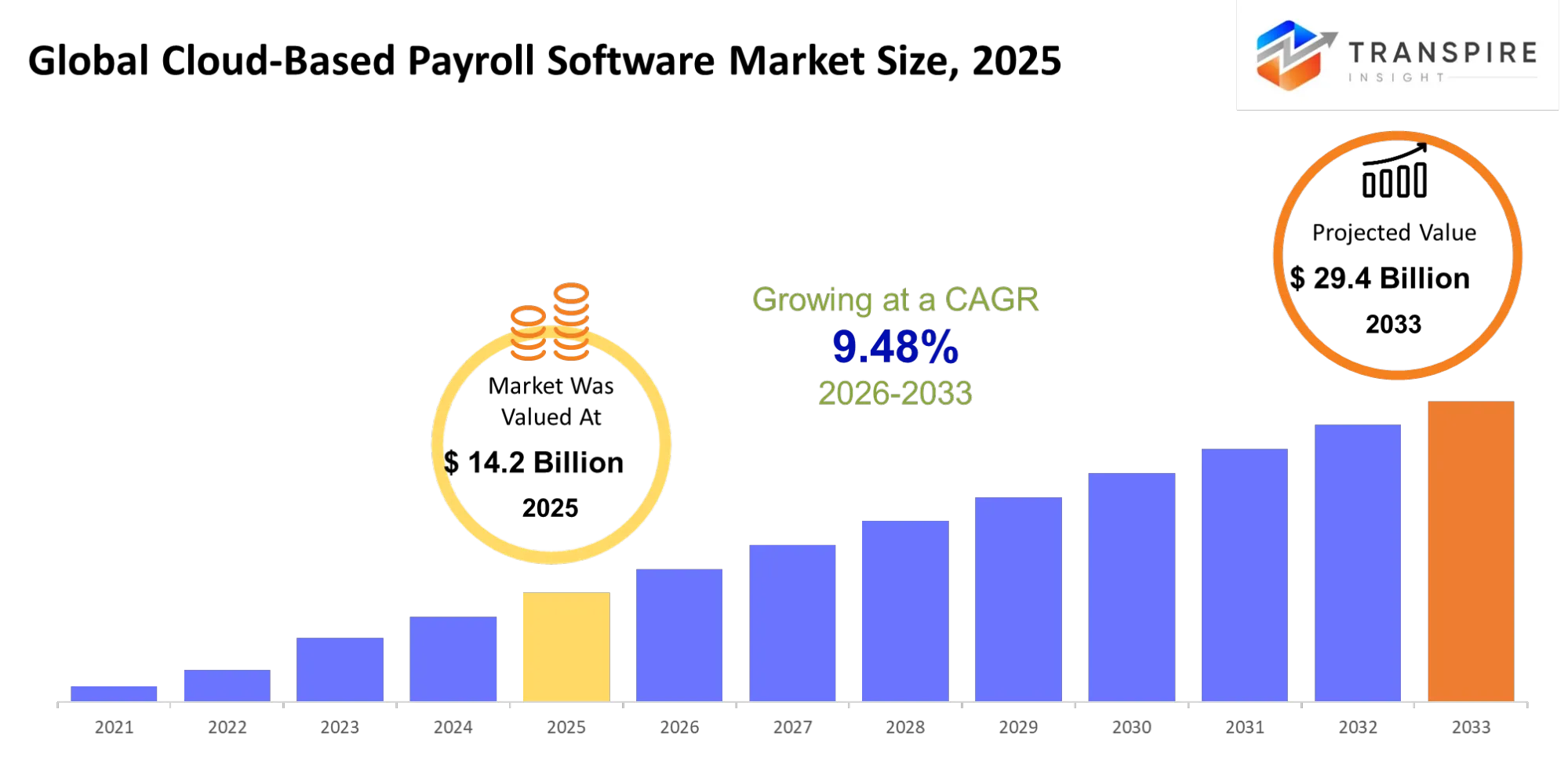
- Global Cloud-Based Payroll Software Market Size 2025: USD 14.2 Billion
- Global Cloud-Based Payroll Software Market Size 2033: USD 29.4 Billion
- Global Cloud-Based Payroll Software Market CAGR: 9.48%
- Global Cloud-Based Payroll Software Market Segments: By Component (Software, Services, Analytics, Compliance Management, Integration Solutions, Others); By Enterprise Size (Large Enterprises, SMEs, Micro Enterprises, Others); By Deployment (Public Cloud, Private Cloud, Hybrid Cloud, Others); By End User (BFSI, IT & Telecom, Retail, Healthcare, Manufacturing, Government, Others); By Function (Payroll Processing, Tax Management, Attendance & Leave Management, Workforce Management, Benefits Administration, Others)
Global Cloud-Based Payroll Software Market Summary
As per Transpire Insight Analysis, the Global Cloud-Based Payroll Software Market size is estimated at USD 14.2 Billion in 2025 and is anticipated to reach USD 29.4 Billion by 2033, growing at a CAGR of 9.48% from 2026 to 2033. This market focuses on delivering internet-hosted, subscription-based subscription frameworks that automate cross-border salary distribution, direct deposits, tax withholdings, and real-time labor compliance. Over the last few years - the operational baseline shifted dramatically as the explosion of distributed, multi-jurisdictional remote workforces forced organizations to abandon localized, legacy spreadsheets. This compliance movement triggered a major structural shift toward centralized cloud networks capable of instantly tracking changing local labor laws and tax filing rules. A critical real-world trigger has been the rapid rollout of strict digital data privacy mandates and localized e-filing laws across major economic corridors. Because companies must eliminate severe regulatory payroll penalties while cutting administrative processing friction, they are rapidly adopting automated, self-service cloud platforms to process global payroll in a single dashboard.
Key Market Insights
The global cloud-based payroll software market is fundamentally transitioning from static, siloed calculations to fully unified, AI-driven workforce intelligence and autonomous compliance execution systems. Driven by compounding regulatory fragmentation across multi-jurisdictional remote workforces and the heavy integration demands of modern human capital ecosystems, global enterprise networks are replacing legacy manual spreadsheets with real-time, automated platforms that connect HR, tax management, and cross-border salary distribution into a single operational ledger.
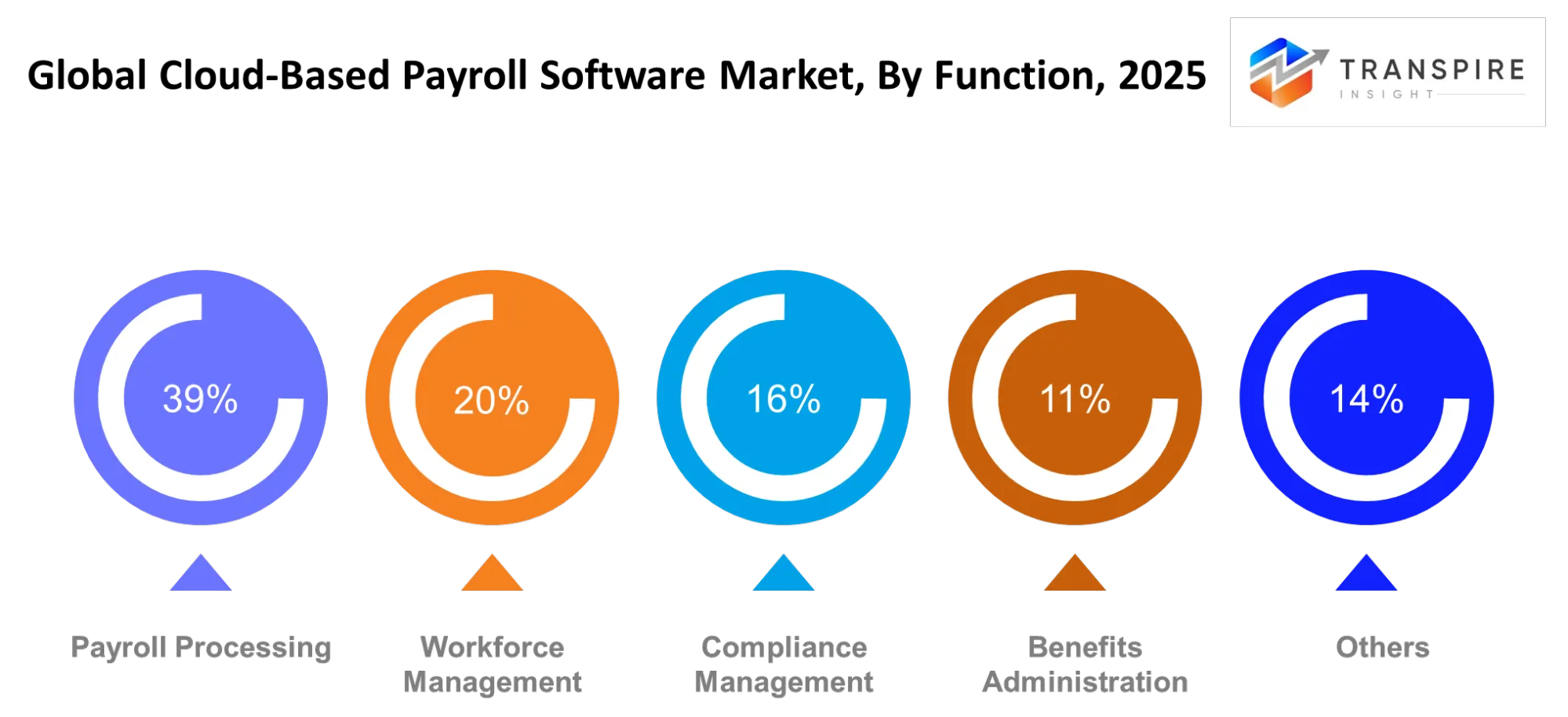
- Locking down a dominant 39% share, Payroll Processing software anchors the functional landscape, with market giants like Workday deploying native continuous calculation engines to completely eliminate traditional end-of-month processing delays.
- Expanding at an explosive, market-leading CAGR of 19.2%, AI-powered Payroll Automation operates as the primary technological driver as vendors like ADP integrate conversational assistants to cut common HR action cycles by up to 80%.
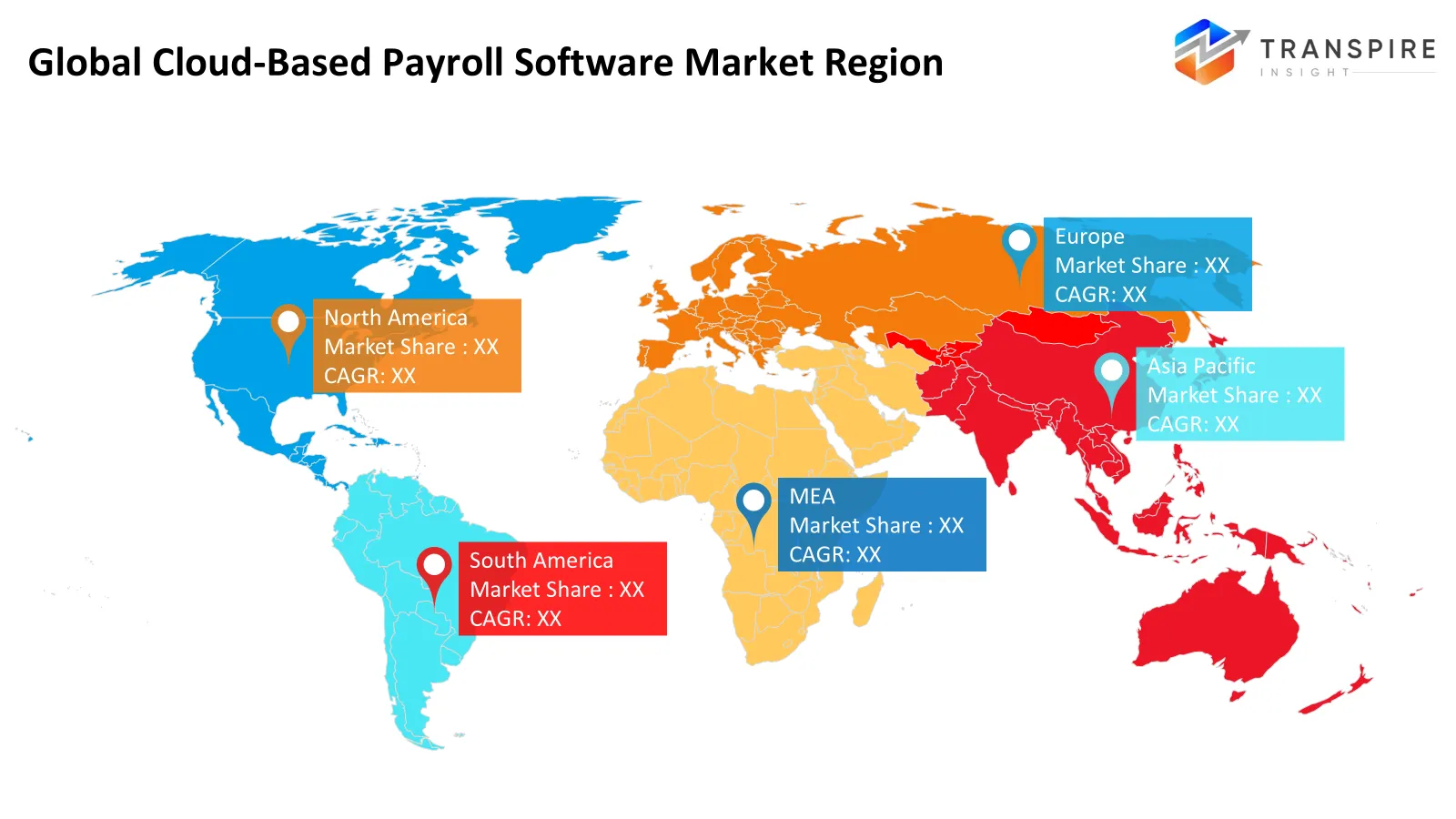
- Capturing a dominant 43% share of total industry revenue, North America stands as the undisputed geographic anchor, heavily supported by massive enterprise software migrations and rapid platform upgrades to enforce automated tax compliance rules.
- Securing an essential 26% market slice, Europe acts as a highly stable structural driver, compelling regional IT networks to adopt integrated cloud solutions from players like Sage to manage complex, cross-border digital data sovereignty mandates.
- Accounting for 23% of global industry volume, the Asia Pacific theater represents the fastest-growing territory with a skyrocketing 20.1% CAGR, propelled by mobile-first economic transformations that prompt organizations to adopt scalable engines like Zoho Payroll.
- Controlling a critical 20% portion of the functional matrix, Workforce Management solutions are undergoing deep structural updates as developers embed automated time-tracking and leave-allocation modules straight into core corporate payroll pipelines.
- Representing a substantial 16% share of the specialized software market, Compliance Management tools are gaining rapid operational momentum as payroll leaders deploy platforms like Rippling to automatically monitor and adjust to shifting local tax rates.
- Claiming an integrated 11% market footprint, Benefits Administration modules are transitioning toward closed-loop employee self-service, enabling global teams to autonomously track, update, and reconcile personal health and insurance deductions.
- Securing a targeted 14% slice of global sector capital, ancillary payroll offerings—including advanced analytics, API integration solutions, and professional managed services—are expanding steadily to bridge complex multi-cloud financial engineering skill gaps across small and mid-sized enterprises.
What Strategic Drivers, Restraints, and Opportunities Define the Global Cloud-Based Payroll Software Market?
Driver
The market is expanding due to the urgent operational need to centralize cross-border compensation tracking and automate shifting multi-state tax compliance across distributed corporate footprints. The sudden, permanent shift toward cross-border remote workforces and multi-jurisdictional gig worker contracting models means that legacy, on-premises payroll databases are no longer viable. This pressure was triggered by a rapid wave of strict e-filing mandates and digital privacy laws enacted globally, forcing leadership teams to replace localized manual spreadsheets with real-time cloud infrastructure. This operational evolution drives massive subscription software revenue as enterprises scale up automated engines to confidently adjust localized withholding brackets and eliminate severe compliance errors.
In March 2026, global payroll software pioneer ADP released its landmark 2026 HR Trends study - revealing that over 70% of businesses are actively deploying or exploring cloud-native AI infrastructure for complex payroll processing and tax management tasks. The comprehensive market research highlights that 60% of growing enterprises struggle with recurring payroll calculations and compliance anomalies during active pay cycles due to multi-jurisdictional labor law changes. By shifting toward specialized payroll engines with embedded statutory update models, organizations are cutting manual reconciliation cycles while driving a massive structural wave of enterprise platform adoptions. [https://www.adp.com/spark/articles/2026/03/the-2026-hr-trends-small-businesses-cant-ignore.aspx]
Restraint
Deep-seated data silo architectural barriers and resistance to cross-departmental application integration act as a persistent bottleneck capping broader market expansion. While cloud-native payroll systems have evolved significantly, traditional corporate setups persistently separate baseline core time-tracking engines, independent project-based ERP modules, and external localized accounting systems. This data fragmentation persists because establishing a completely unified, automated payroll stream requires overhauling complex, customized enterprise software stacks, which introduces intense deployment friction and prevents finance teams from running real-time workforce cost calculations.
Opportunity
The most lucrative growth window lies in the wholesale migration of global workforce ecosystems to API-first, automated multi-country payroll networks that embed dynamic workforce management directly into independent operational units. Fusing synchronized time-and-attendance tracking telemetry smoothly with cross-border compliance management models allows corporate finance teams to confidently execute complex contractor and employee salary calculations from a single digital ledger. This technological movement unlocks massive software licensing revenue as expanding enterprise networks across high-growth corridors invest heavily in fully integrated payroll platforms to systematically eliminate global currency translation friction.
What Has the Impact of Artificial Intelligence Been on the Global Cloud-Based Payroll Software Market?
Artificial intelligence is completely reshaping how professional HR and corporate finance departments run employee compensation models, moving cloud-based payroll platforms from basic data-entry ledger accounting into the era of predictive validation and fully autonomous compliance tracking. Instead of forcing human payroll managers to spend hours hunting down missed time punches, auditing manual timecards, or matching cross-border banking details, enterprise operations teams leverage machine learning models to instantly run predictive error detection and flag uncharacteristic anomalies before a salary cycle executes.
On the corporate payroll floor, advanced AI agents streamline complex financial pipelines by feeding raw historical timecard telemetry, localized employee tax brackets, and live regulatory changes directly into specialized data processing loops. These smart systems continuously audit multi-state payroll transactions, predicting localized tax misclassifications and alerting teams to regulatory shifts weeks in advance. However, a major operational limitation persists around an integration and accuracy gap; automated AI agents frequently struggle to interpret unique, multi-tiered corporate bonus rules and localized union labor contracts, meaning final human administrative sign-off remains non-negotiable.
Key Market Trends
The global cloud-based payroll software landscape is undergoing a major structural evolution, shifting away from standalone calculator engines toward unified "Workforce Operations" ecosystems that embed real-time financial data straight into central business infrastructure. Spurred by compounding international tax changes and the complex administrative challenges of tracking distributed remote teams, corporate HR and finance departments are replacing disconnected, manual administrative steps with intelligent automation frameworks and seamless API integration layers.
- For a long time, administrative teams ran compensation calculations as a static monthly batch process, but operational structures are rapidly shifting toward real-time payroll processing that recalculates wage liabilities continuously based on live shifts.
- Rather than forcing employees to submit manual tickets for basic document requests, organizations are universally adopting advanced mobile self-service portals to let staff independently update tax withholding forms and model deduction impacts.
- HR engineering teams used to maintain separate systems for time tracking and paycheck issuance, but modern development roadmaps are now unifying time, attendance, and payroll into a single database to eliminate manual data sync friction.
- Payroll departments are transitioning from descriptive error-hunting dashboards to predictive AI anomaly engines that scan employee profiles to automatically flag salary discrepancies and incorrect tax codes before a pay run executes.
- Instead of managing international talent through fragmented regional payroll providers, expanding global corporations are rapidly adopting centralized global payroll orchestration hubs that manage multi-currency payouts through a single pane of glass.
- Corporate governance structures are fundamentally shifting software procurement patterns, moving businesses away from legacy on-premises infrastructure toward cloud-first setups to instantly absorb rapid regulatory changes.
- Enterprise buyers are ditching traditional software-as-a-service models in favor of autonomous workforce platforms built around dual-agent AI frameworks that handle compliance filings and draft internal policies with minimal human intervention.
- Finance teams are moving past simple, basic reporting metrics, shifting their analytical focus to interactive people analytics dashboards that weigh live labor spend directly against localized productivity and project revenue outcomes.
- Corporate benefits administration is pivoting from manual open enrollment processes to automated, event-driven enrollment modules that sync lifestyle contract changes directly into employee premium deductions without HR intervention.
Global Cloud-Based Payroll Software Market Segmentation
By Component
Payroll Processing Software anchors this segment, holding a dominant 39% share of total industry revenue, while Workforce Management and Compliance Management follow as critical secondary pillars at 20% and 16%, respectively. Benefits Administration commands an 11% share, with Integration Solutions and professional services accounting for the final 14%. This division persists because every corporate workforce fundamentally requires a core calculation engine to parse gross-to-net pay calculations before specialized compliance auditing or benefits enrollment can occur. Payroll Processing systems retain their peak market position because enterprises must deploy centralized systems of record—like ADP or Workday—to handle baseline employee compensation securely. Meanwhile, Compliance Management and Integration Solutions are accelerating rapidly as companies demand real-time api-driven updates to manage shifting multi-jurisdictional tax laws. Moving forward, isolated payroll modules will fully dissolve into unified, automated ledger frameworks. Leading platform vendors will focus heavily on shifting from manual paycheck generation to embedding agentic AI models that continuously balance tax withholdings and update employee profiles without HR intervention.
By Deployment
Public Cloud configurations serve as the primary operational engine of the market, holding the largest portion of global infrastructure volume, while Hybrid and Private Cloud deployments represent the fastest-growing architectural segments. This growth logic is tied directly to the reality of modern enterprise computing, where organizations utilize public infrastructure to achieve rapid scalability and deploy employee self-service apps across distributed locations. Public cloud setups retain their high share because core workforce computing remains heavily concentrated on standardized external systems. However, Hybrid and Private configurations are growing at an accelerated clip because highly regulated enterprises—such as financial institutions and government bodies—demand separate, ring-fenced storage environments to safeguard highly sensitive personal identification numbers and bank details. Moving forward, deployment patterns will move past basic SaaS architectures. Market dominance will belong to platform developers who design fully containerized payroll architectures that enforce strict local data residency compliance across any cloud landscape.
By Enterprise Size
Large Enterprises function as the absolute financial anchor of the industry, capturing the largest portion of the revenue footprint due to their massive, multi-country employee payroll networks. Meanwhile, SMEs and Micro Enterprises are expanding as the fastest-growing adopter segments. The market dynamic relies on pure organizational scale and regulatory complexity; large corporations operate multiple legal entities across hundreds of tax districts, creating complex payroll compliance challenges that mandate heavy multi-currency processing architectures. Large enterprises prioritize deep core ERP integrations, automated global tax management, and structured workforce analytical engines to drive multi-state operational efficiency. Conversely, smaller firms and micro-enterprises focus on automated onboarding, lightweight time-tracking tools, and immediate local compliance to protect lean administrative budgets. Looking ahead, scalable market success will belong to software providers that can scale down complex enterprise global-payroll mechanics into low-touch, automated SaaS models tailored for smaller HR teams.
By End User
The BFSI and IT & Telecom verticals lead the market with a commanding share of global industry volume, driven by high-density digital workforce investments and rapid geographic expansion. Concurrently, Retail and Healthcare entities are rising as highly active, fast-growing secondary buyers. The underlying market logic is dictated by the sheer volume and volatility of employment types within these specific industries, where IT firms manage complex international remote talent networks and retail operators experience high seasonal employee turnover with variable shift schedules. BFSI networks deploy advanced payroll frameworks to maintain strict data privacy compliance across international offices, whereas Retail players leverage mobile attendance integrations to dynamically sync hourly wage payouts with shifting seasonal schedules. Moving forward, long-term profitability will belong to payroll vendors that engineer industry-specific compliance frameworks, allowing highly regulated hospital systems and banking corporations to automate complex shift differentials and statutory labor filings safely.
By Function
Core Payroll Processing rules this segment, expanding at a market-leading pace to account for 39% of total functional revenue as enterprises scramble to eliminate payroll processing delays. Simultaneously, Tax Management and Attendance & Leave Management represent highly vital secondary functional pipelines, locking down 16% and 20% of the market respectively. This structural alignment persists because the ultimate goal of any corporate payroll practice is to transition from manual, retrospective verification to continuous, error-free paycheck execution. Payroll Processing leads because businesses must accurately map working hours straight to local payroll ledgers to avoid labor disputes and defend corporate operational margins. Meanwhile, Tax Management capabilities are growing swiftly as global organizations demand automated tax filing tools to handle complex, shifting multi-state tax withholding requirements. Moving forward, functional boundaries will completely unify under predictive payroll systems. Rather than treating time tracking and tax management as detached administrative exercises, future systems will continuously run real-time paycheck calculations to preview liabilities weeks before the pay cycle ends.
What Key Use Cases Driving the Global Cloud-Based Payroll Software Market?
The primary use case centers on cross-border payroll processing software ingestion, where large enterprise networks use centralized cloud engines to consolidate disparate, multi-country worker data into a single operational ledger. This setup relies on continuous gross-to-net calculation pipelines to instantly normalize variable local hours, giving corporate finance functions a unified pane of glass to distribute accurate, multi-currency salaries while completely eliminating traditional end-of-month administrative data friction.
Beyond baseline ledger accounting, expanding applications focus heavily on automated multi-state compliance management and localization within high-velocity tech and retail sectors. Driven by rapid remote-work expansions and complex independent contractor networks, organizations rely on real-time geographical tracking to autonomously register new corporate tax accounts, adjust localized withholding brackets, and submit instant e-filings across shifting provincial boundaries to eliminate human processing penalties.
Emerging use cases are shifting toward proactive people analytics and generative AI-driven labor forecasting across heavy manufacturing and healthcare facilities. As hospital networks and factory floors face volatile shift changes, operators leverage predictive machine learning agents to model the future budget impact of overtime rules, dynamically balancing shift differentials and benefit deductions to protect corporate operating margins.
|
Report Metrics |
Details |
|
Market size value in 2025 |
USD 14.2 Billion |
|
Market size value in 2026 |
USD 15.6 Billion |
|
Revenue forecast in 2033 |
USD 29.4 Billion |
|
Growth rate |
CAGR of 9.48% from 2026 to 2033 |
|
Base year |
2025 |
|
Historical data |
2021 - 2024 |
|
Forecast period |
2026 - 2033 |
|
Report coverage |
Revenue forecast, competitive landscape, growth factors, and trends |
|
Regional scope |
United States; Canada; Mexico; United Kingdom; Germany; France; Italy; Spain; Denmark; Sweden; Norway; China; Japan; India; Australia; South Korea; Thailand; Brazil; Argentina; South Africa; Saudi Arabia; United Arab Emirates |
|
Key company profiled |
ADP, Paychex, Workday, UKG, SAP, Oracle, Ceridian, Paycom, Gusto, Rippling, BambooHR, Sage, Zoho Payroll, Deel, Remote |
|
Customization scope |
Free report customization (country, regional & segment scope). Avail customized purchase options to meet your exact research needs. |
|
Report Segmentation |
By Component (Software, Services, Analytics, Compliance Management, Integration Solutions, Others); By Enterprise Size (Large Enterprises, SMEs, Micro Enterprises, Others); By Deployment (Public Cloud, Private Cloud, Hybrid Cloud, Others); By End User (BFSI, IT & Telecom, Retail, Healthcare, Manufacturing, Government, Others); By Function (Payroll Processing, Tax Management, Attendance & Leave Management, Workforce Management, Benefits Administration, Others) |
Which Regions are Driving the Global Cloud-Based Payroll Software Market Growth?
North America maintains a commanding grip on the cloud-based payroll software market, capturing a dominant 43% share of all worldwide industry revenue. This geographic leadership is heavily driven by intense enterprise migrations aimed at automating highly fragmented multi-state withholding structures and managing complex employee health benefit deductions. The regional ecosystem is structurally supported by a highly mature network of large-scale corporate entities and stringent federal tax filing regulations that mandate zero-error digital reporting cycles. Consequently, deploying cloud-native payroll infrastructures has become an immediate operational standard for domestic corporations to safely track cross-border labor costs and protect compliance margins.
Europe serves as a highly stable, predictable secondary pillar for the global market, locking down an essential 26% share of total industry demand. While North American operational expansion focuses primarily on hyper-scale corporate benefits management and rapid cross-state tax calculation updates, European cloud payroll adoption is shaped by rigid regional data sovereignty mandates and localized labor union agreements. This regional market stability is structurally insulated by strict General Data Protection Regulation (GDPR) frameworks that compel IT teams to maintain absolute localized control over sensitive personal identification records and banking information. To balance active multi-country payroll tracks amid changing cross-border statutory filing dates, European enterprise networks continuously invest in integrated human capital management (HCM) solutions to enforce rigid data compliance boundaries.
In May 2026, European enterprise technology pioneer Sage officially launched its integrated Sage HCM platform at the Sage Future 2026 conference to unite accounting, payroll, and HR into a single mid-market data plane. This product rollout features a new generation of explainable, "glass box" automated AI workflows built in direct collaboration with PwC to deliver completely transparent data tracing from input to ledger outcome. By allowing regional operators to automate complex cross-border compliance filings while maintaining complete visibility over audit logs, this system launch addresses severe administrative back-office bottlenecks across the continent. This deployment establishes a highly reliable, data-driven framework for regional mid-market businesses to scale their cross-border workforces without increasing regulatory overhead.
The Asia Pacific region has emerged as the fastest-growing territory globally, accelerating at a market-leading CAGR of 20.1% to capture a 23% slice of global sales. This sudden structural shift is driven by massive digital transformation overhauls across expanding mobile-first economies and a rapid pivot toward automated workforce platforms within high-velocity retail and manufacturing ecosystems. Historically, regional business networks relied on fragmented local vendors and manual spreadsheet calculations to run monthly salary runs, but the territory has now rapidly pivoted toward integrated cloud-first SaaS nodes to manage variable contractor compensation. Looking ahead, future financial and technical optimization in this booming corridor relies entirely on deploying centralized mobile-first payroll applications to safely manage complex shift differentials and eliminate cross-currency transaction friction.
Who Are the Key Players in the Global Cloud-Based Payroll Software Market and How Do They Compete?
Competition in this space is a high-stakes battle between massive - full-suite Human Capital Management (HCM) systems and agile, API-first global employment platforms. Rather than simply competing on baseline pricing per employee, vendors win high-value corporate contracts by providing real-time local compliance automation, frictionless multi-currency processing layers, and unified self-service mobile applications that bridge complex HR pipelines.
ADP wins by utilizing an unyielding enterprise scale strategy, positioning its platform as an ironclad global governance hub for multi-jurisdictional corporations. The company differentiates itself by embedding a continuous calculations engine directly alongside its localized statutory updating modules to automate complex tax filing protocols seamlessly. Their expansion approach centers on heavy investments in advanced global infrastructure, deploying unified managed service layers across 140+ distinct countries to capture high-density multinational business networks.
Workday dominates the upper-tier market by deploying a radical technological innovation strategy, wrapping its cloud payroll modules directly into a single, unified enterprise system of record. Workday stands out by leveraging its advanced "Illuminate" AI architecture to run automated anomaly tracking and predictive audit checks across global employee databases before pay cycles execute. Their structural expansion relies on building bidirectional data cloud partnerships and launching specialized mid-market deployment agents to drastically compress time-to-value for expanding organizations.
Company List
- ADP
- Paychex
- Workday
- UKG
- SAP
- Oracle
- Ceridian (Dayforce)
- Paycom
- Gusto
- Rippling
- BambooHR
- Sage
- Zoho Payroll
- Deel
- Remote
Recent Development News
In March 2025, global HR and payroll platform Deel officially completed the structural acquisition of Safeguard Global’s enterprise global payroll division. This strategic acquisition directly consolidates Safeguard’s specialized multi-country accounting workforce and complex human capital management (HCM) integration tools in-house, significantly boosting Deel's native capacity to execute high-volume, multi-jurisdictional payroll orchestration projects for large international enterprise customers. [https://payroll.org]
In May 2025, workforce management platform pioneer Rippling officially finalized a massive USD 450 Million Series G funding round, establishing a post-money corporate valuation of USD 16.8 Billion. This capital injection, backed by prominent tier-one investment institutions including Goldman Sachs and Sands Capital, directly funds the international technical scaling of Rippling's core software platform to accelerate unified payroll, IT, and device governance tracking across global offices. [https://huntscanlon.com]
In April 2026, payroll and human capital giant Paychex officially rolled out its next-generation Paychex Flex application release featuring an integrated Intelligent Admin Dashboard and an AI-powered custom reporting interface. This product launch embeds advanced predictive compliance tracking alerts and native, automated cross-account data analytics straight into the system layer, giving corporate operations teams the ability to instantly flag withholding errors and resolve unexpected payroll deviations before active pay runs execute. [https://www.paychex.com]
What Strategic Insights Define the Future of the Global Cloud-Based Payroll Software Market?
The cloud-based payroll software market is rapidly heading toward an era of fully continuous, programmatic ledger synchronization where traditional monthly batch processing completely merges with real-time labor utilization execution. This evolution shifts corporate payroll teams away from simply auditing static historical pay stubs to continuously optimizing the live unit economics of blended contractor workforces, multi-state tax liabilities, and variable on-demand wage streams.
However, a major hidden risk lies in the dangerous operational fragility of decentralized API token routing between decoupled HR engines. As companies grant third-party applications independent read-write access to core system-of-record employee profiles, a single unmapped webhook failure or schema update drift can silently break cross-border compliance validations, triggering catastrophic local tax filing errors before automated warning systems are tripped.
An emerging opportunity is unfolding around the integration of localized cryptographic compliance verification directly into unified multi-country payroll pipelines. Platforms can leverage these immutable cryptographic frameworks to instantly normalize multi-jurisdictional contractor registrations, allowing expanding organizations to eliminate slow manual banking intermediation and execute immediate cross-border payouts to satisfy stringent local labor rules.
To win long-term, technology executives must transition away from treating payroll as an isolated back-office reporting function. Finance departments should pivot toward embedding native programmatic compliance guardrails straight into daily timecard tracking workflows, converting raw operational employee telemetry into proactive predictive analytics to resolve localized classification errors before a pay cycle runs.
Global Cloud-Based Payroll Software Market Segmentation
By Component
- Software
- Services
- Analytics
- Compliance Management
- Integration Solutions
- Others
By Enterprise Size
- Large Enterprises
- SMEs
- Micro Enterprises
- Others
By Deployment
- Public Cloud
- Private Cloud
- Hybrid Cloud
- Others
By End User
- BFSI
- IT & Telecom
- Retail
- Healthcare
- Manufacturing
- Government
- Others
By Function
- Payroll Processing
- Tax Management
- Attendance & Leave Management
- Workforce Management
- Benefits Administration
- Others
Regional Analysis
North America
- United States
- Canada
- Mexico
Europe
- Germany
- United Kingdom
- France
- Italy
- Spain
- Russia
- Rest of Europe
Asia Pacific
- China
- Japan
- India
- South Korea
- Australia
- Rest of Asia Pacific
South America
- Brazil
- Argentina
- Rest of South America
Middle East & Africa
- Saudi Arabia
- United Arab Emirates
- Qatar
- South Africa
- Rest of the Middle East & Africa
Frequently Asked Questions
Find quick answers to common questions.
The global cloud-based payroll software market size was valued at USD 14.2 Billion in 2025 and is poised to reach USD 29.4 Billion by 2033, expanding at a 9.48% CAGR.
Key segments for the global cloud-based payroll software market are Component (Software, Services, Analytics, Compliance Management, Integration Solutions, Others); Enterprise Size (Large Enterprises, SMEs, Micro Enterprises, Others); Deployment (Public Cloud, Private Cloud, Hybrid Cloud, Others); End User (BFSI, IT & Telecom, Retail, Healthcare, Manufacturing, Government, Others); Function (Payroll Processing, Tax Management, Attendance & Leave Management, Workforce Management, Benefits Administration, Others).
Growth is primarily driven by the urgent operational need to centralize cross-border compensation tracking, a permanent industry shift toward multi-jurisdictional remote and gig workforces, and a rapid global rollout of strict digital data privacy mandates and e-filing laws.
The global market is led by major manufacturers including ADP, Paychex, Workday, UKG, SAP, Oracle, Ceridian, Paycom, Gusto, Rippling, BambooHR, Sage, Zoho Payroll, Deel, and Remote.
North America holds a dominant 43% share of the total industry revenue, anchoring global dynamics due to massive enterprise software migrations, high-density corporate benefits management needs, and rapid platform upgrades to enforce automated local tax compliance rules.
Key commercial opportunities include the wholesale migration of global corporate ecosystems to API-first, automated multi-country payroll networks, embedding real-time time-and-attendance tracking telemetry straight into centralized regulatory calculation loops, and deploying cryptographic compliance verification pipelines to systematically eliminate cross-currency transaction friction.
- ADP
- Paychex
- Workday
- UKG
- SAP
- Oracle
- Ceridian (Dayforce)
- Paycom
- Gusto
- Rippling
- BambooHR
- Sage
- Zoho Payroll
- Deel
- Remote
About the Authors

Mayur Shinde
I am Mayur Shinde, a Senior Research Analyst at Transpire Insight, specializing in the Automotive & Transportation and Information & Communication Technology (ICT) Industry. My work focuses on analyzing emerging market trends, technological advancements, competitive landscapes, and industry developments to deliver accurate, data-driven insights. I am passionate about transforming complex market information into clear, actionable content that helps businesses, professionals, and decision-makers stay informed and make confident strategic decisions.

Chakradhar Khansole
Chakradhar serves as the Research Director at Transpire Insight, bringing over 8 years of experience in technology, innovation, and strategic market intelligence. He specializes in transforming complex market data into actionable business insights that enable organizations to make informed, growth-oriented decisions. Recognized for his strategic vision and analytical expertise, Chakradhar leads high-impact research initiatives, delivering comprehensive market assessments, competitive intelligence, and forward-looking industry analysis.
Recently Published Reports
-
Apr 2026
3D Optical Profiler Market
3D Optical Profiler Market Size, Share & Analysis Report By Type (Desktop 3D Optical Profiler, and Portable 3D Optical Profiler), By Technology (Confocal Technology, and White Light Interference), By End-Use Industry (Manufacturing, Research Institutions, Automotive, Aerospace and Defense, Medical Devices, and Other), and Geography (North America, Europe, Asia-Pacific, Middle East and Africa, South and Central America), 2021 - 2031
-
Apr 2026
Depth Sensor Market
Depth Sensor Market Size, Share & Analysis Report By Type (Infrared Depth Sensors, Time-of-Flight (ToF) Sensors, Stereo Vision Sensors, Structured Light Sensors, Ultrasonic Depth Sensors), By Application (Automotive, Robotics, Gaming, Consumer Electronics, Industrial Automation, Healthcare, Security & Surveillance, Others), By End Users (Automotive Manufacturers, Consumer Electronics Companies, Healthcare Providers, Industrial Companies, Security Agencies, Gaming Companies, Robotics Companies, Others), and Geography (North America, Europe, Asia-Pacific, Middle East and Africa, South and Central America), 2021 – 2031
-
Apr 2026
Digital Manufacturing Market
Digital Manufacturing Market Size, Share & Analysis Report By Component (Hardware, Software, and Services), By Technology (Robotics, 3D Printing, Internet of Things (IoT), and Others), By Application (Automotive and Transportation, Aerospace and Defense, Consumer Electronics, Industrial Machinery, and Others), By Process Type (Computer-Based Designing, Computer-Based Simulation, Computer 3D Visualization, Analytics, and Others), and Geography (North America, Europe, Asia-Pacific, Middle East and Africa, South and Central America), 2021 – 2031
-
Apr 2026
Digital Visa Services Market
Digital Visa Services Market Size, Share & Analysis Report By Type (Individual Travelers, Group Travelers), By Application (Tourism, Business Travel, Others), and Geography (North America, Europe, Asia-Pacific, Middle East and Africa, South and Central America), 2021 – 2031