

Europe Workforce Management Market Size & Forecast:
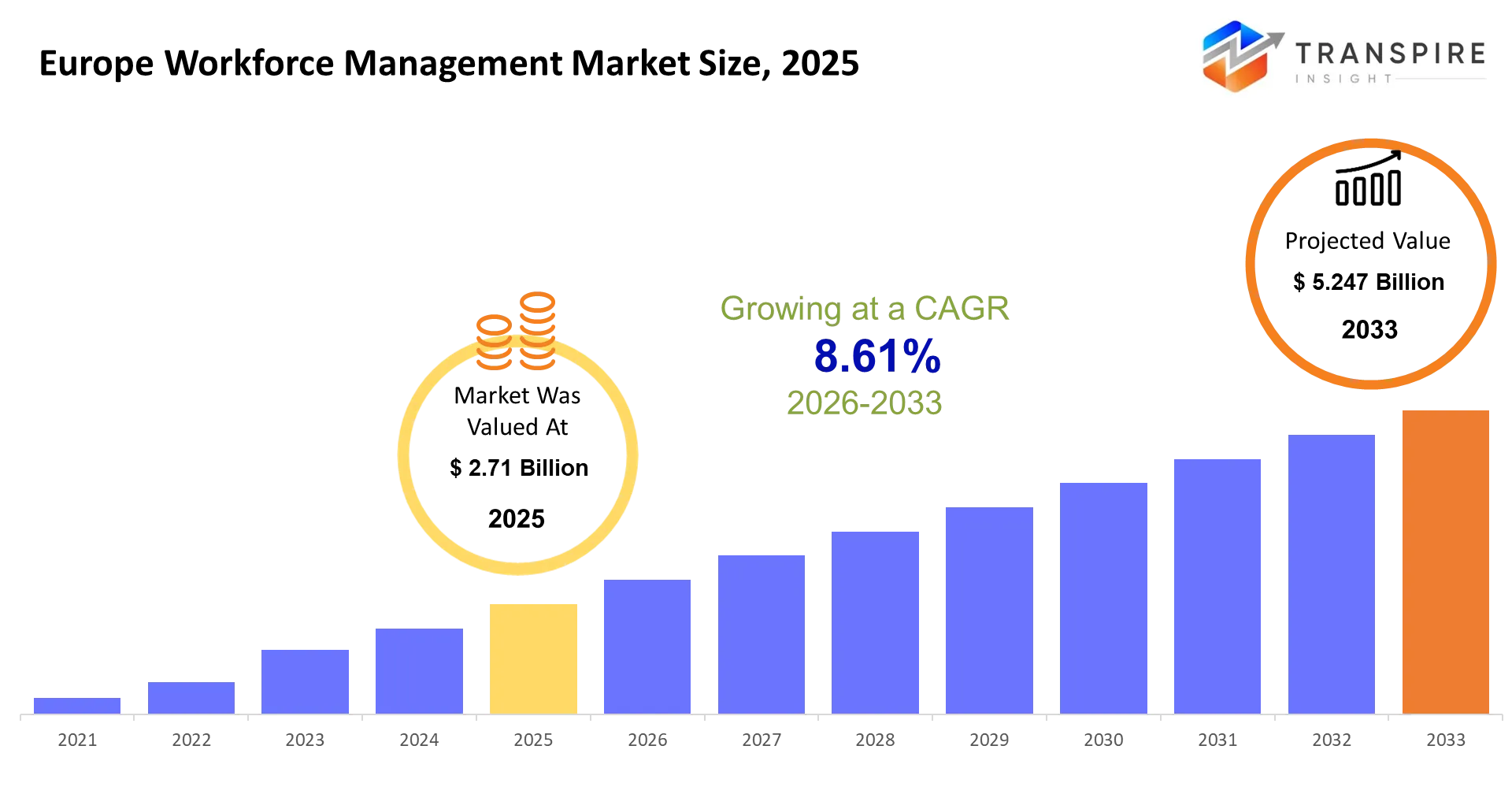
- Europe Workforce Management Market Size 2025: USD 2.71 Billion
- Europe Workforce Management Market Size 2033: USD 5.247 Billion
- Europe Workforce Management Market CAGR: 8.61%
- Europe Workforce Management Market Segments: By Type (Software, Services, Analytics Tools, AI Solutions, Mobile Workforce Tools, Others), By Application (Time Tracking, Scheduling, Performance Management, Payroll, Workforce Analytics, Others), By End-User (Enterprises, SMEs, Government, BFSI, Others), By Deployment (Cloud, On-premise, Hybrid, SaaS, Others).
To learn more about this report,  Download Free Sample Report
Europe Workforce Management Market Summary:
The Europe Workforce Management Market size is estimated at USD 2.71 Billion in 2025 and is anticipated to reach USD 5.247 Billion by 2033, growing at a CAGR of 8.61% from 2026 to 2033. European Workforce Management systems have emerged as essential operational tools which hospitals logistics providers manufacturing companies retail businesses and public sector organizations use to handle their workforce shortages and their unpredictable work schedules and their staffing needs which require strict compliance. The platforms help organizations to manage their work schedules and to monitor their employee output and to streamline their time tracking processes and to match their workforce allocation with their changing business needs. The market has shifted structurally over the past five years from basic attendance tracking toward AI-enabled workforce orchestration which uses predictive scheduling and real-time analytics to control staffing decisions throughout multiple operational sites.
The COVID-19 pandemic which caused labor shortages throughout Europe served as the main event which revealed how much companies relied on manual methods to manage their workforce. The combination of European labor regulations which became more stringent and hybrid work arrangements compelled organizations to implement digital workforce planning solutions at an accelerated pace. The market demand for HR software has shifted from voluntary system upgrades toward essential operational software solutions which protect business functions during critical situations, resulting in extended contract durations with customers and increased system integration costs and expanded software use in industries which have high employee contact.
Key Market Insights
- Germany maintained its lead position in the European Workforce Management Market during 2025 with its 24 percent market share which resulted from manufacturing digitization and enterprise software adoption.
- The Eastern European market will experience its fastest growth rate until 2030 because shared service centers and retail workforce modernization continue to expand.
- The workforce management industry reached its solution market share of 58 percent during 2025 because businesses selected cloud-based workforce platforms which provided them with system flexibility and remote access capabilities.
- Workforce analytics together with AI-based scheduling systems became the most rapidly expanding product category during 2025 to 2030 period because organizations needed to decrease their labor expenses.
- The second most important segment in time and attendance management process remained operational because European labor laws required organizations to comply with strict payroll requirements.
- Large enterprises captured approximately 63% revenue share in the Europe Workforce Management Market during 2025 due to complex multi-location staffing operations.
- Retail and e-commerce applications dominated with nearly 28% market share in 2025 because businesses require real-time shift planning and seasonal workforce flexibility.
- Healthcare workforce management will experience its most rapid growth until 2030 because hospitals face staffing shortages which need to be solved through regulatory scheduling requirements.
- Manufacturing companies are increasing their spending on predictive workforce planning systems which help them reduce downtime while boosting operational efficiency across their European manufacturing sites.
- AI-based workforce forecasting tools have become highly sought after by organizations which need to manage their changing labor force availability together with their new overtime policies.
What are the Key Drivers, Restraints, and Opportunities in the Europe Workforce Management Market?
The European Workforce Management Market experiences its most powerful growth because European Union countries enforce stricter labor compliance standards and working-time regulations. Employers have been compelled to adopt complete workforce management systems because regulations now require them to monitor overtime, provide employee scheduling details, and report payroll information between different countries. The transition to efficient staffing practices during the pandemic period accelerated after businesses encountered labor shortages which showed them their financial vulnerabilities. The healthcare, logistics, and manufacturing industries now implement AI-powered scheduling and workforce analytics solutions to decrease overtime expenses and enhance employee productivity while ensuring they follow all regulations. Organizations now consider workforce management software as essential for their operations because it evolved from an HR support function into a main operational resource which boosts enterprise software expenses and generates recurring subscription revenue.
The most significant obstacle for organizations exists because they need to connect their current systems with their older enterprise infrastructure. European organizations continue to use outdated payroll, ERP, and timekeeping software which operates differently across their national and subsidiary locations. Organizations face high costs and extended deployment times and they need dedicated IT professionals when they want to replace or connect their existing systems. The process of adopting mid-sized enterprises to new technologies gets delayed because they need to stop their operations for cloud migration which brings financial risks and compliance challenges in industries with strict regulations.
AI-driven predictive workforce planning system development in Eastern and Central Europe creates a major chance for business expansion. Retailers and logistics companies and manufacturing businesses are spending money on real-time labor forecasting systems which link their workforce scheduling processes with demand forecasting and operational analytics systems. The combination of improved regional cloud infrastructure and growing SaaS adoption will enable vendors who provide multilingual compliance-ready workforce platforms to achieve their upcoming enterprise deployment expansion.
What Has the Impact of Artificial Intelligence Been on the Europe Workforce Management Market?
The Europe Workforce Management Market experiences transformation through artificial intelligence and advanced digital technologies which automate scheduling and compliance monitoring and workforce allocation tasks. AI-enabled workforce platforms now benefit multiple European enterprises which operate in healthcare and retail and logistics and manufacturing sectors by automating shift scheduling and overtime tracking and payroll validation and labor law compliance. The systems decrease administrative tasks which employers use to manage staffing needs during employee absences.
Machine learning models provide enhanced capabilities for workforce planning through their predictive abilities. Employers use forecasting engines which assess historical attendance information and seasonal demand patterns and weather interruptions and operational workloads to produce accurate staffing predictions. The logistics and retail sectors use predictive scheduling tools to decrease overtime costs and decrease workforce underutilization while they boost employee availability during times of high customer demand. Workforce analytics helps hospitals and manufacturing facilities achieve better labor productivity while decreasing scheduling disputes and enabling their operations to continue without interruptions.
Workforce intelligence platforms use their advanced capabilities to enhance regulatory compliance through their ability to detect potential violations before they happen. The process of adopting artificial intelligence technology in European countries requires businesses to overcome the challenge of integrating new systems with outdated ERP and payroll systems. The deployment process becomes more expensive and takes longer because companies need to manage their operations through disconnected systems which span different countries.
Key Market Trends
- Cloud-based workforce platforms took over traditional on-premise systems in large European enterprises between 2020 and 2025 because companies needed to manage remote workers.
- European healthcare providers increased their spending on predictive scheduling tools because hospitals experienced staffing shortages which resulted in higher overtime expenses after the pandemic.
- Retailers implemented AI-driven labor forecasting platforms in 2022 to match their staffing needs with changes in e-commerce demand and seasonal customer buying patterns.
- The Nordic region and Germany experienced faster adoption of workforce analytics because new labor laws established stricter compliance requirements which required companies to meet new payroll and scheduling standards.
- SAP and Workday developed their AI-powered workforce intelligence systems between 2023 and 2025 to help organizations increase employee retention rates.
- Manufacturing companies developed closer ties between their workforce management systems and ERP systems and factory automation systems to achieve better labor productivity and decreased operational downtime.
- Small and medium-sized enterprises adopted SaaS workforce platforms because subscription pricing models made implementation more affordable than traditional enterprise solutions.
- Western European logistics operators implemented mobile workforce applications to oversee their field workers who operate outside of offices while their operations experience supply chain disruptions.
- After 2021 regulatory reforms employers with operations in multiple countries required integrated payroll systems which would help them comply with increasingly complex international labor regulations.
- Workforce management vendors established stronger regional ties with cloud infrastructure vendors to enhance their cybersecurity systems and data localization compliance and speed up their software deployment processes.
Europe Workforce Management Market Segmentation
By Type
The software solutions market remains dominated by integrated platforms which combine scheduling attendance tracking payroll coordination and compliance management into single systems. The implementation process needs services which provide implementation support and consulting assistance and system customization work and future maintenance support to multinational companies that have operations in different European labor regions. Employers prefer analytics tools which use artificial intelligence to predict staffing needs and optimize labor expenses because these tools provide better results than traditional systems.
Mobile workforce tools are also gaining traction across logistics healthcare and field service operations where decentralized employee management has become operationally critical. Businesses now prefer system architectures which use modular design and cloud compatibility to connect their ERP systems with HR functions. The future competition within this market segment will depend on four key factors which include the extent of automation and system integration and security features and multilingual regulatory compliance capabilities. Vendors who develop predictive analytics tools and generative AI features will create better software revenue streams through recurring payments while their customers will have improved retention rates.
By Application
The primary application area in time tracking and attendance management remains active because European labor compliance regulations mandate businesses to record employee work hours and maintain complete payroll records together with their scheduling details. The introduction of scheduling applications together with workforce allocation solutions has increased operational capacity throughout healthcare organizations and retail businesses and manufacturing facilities since labor shortages became visible to all sectors. The market for payroll integration solutions remains strong because enterprises require systems that can manage multiple countries' tax obligations and labor compliance requirements through integrated software solutions.
Workforce analytics applications are now the fastest-growing category because organizations increasingly depend on predictive staffing models together with productivity measurement tools. Companies need performance management systems because hybrid work models create obstacles for employee assessment and organizational responsibility tracking. Organizations now need real-time operational intelligence instead of needing administrative workforce tracking solutions. The technology vendors who can create unified platforms which combine forecasting capabilities with compliance automation and employee engagement solutions will achieve success in winning enterprise contracts while increasing their platform usage among customers.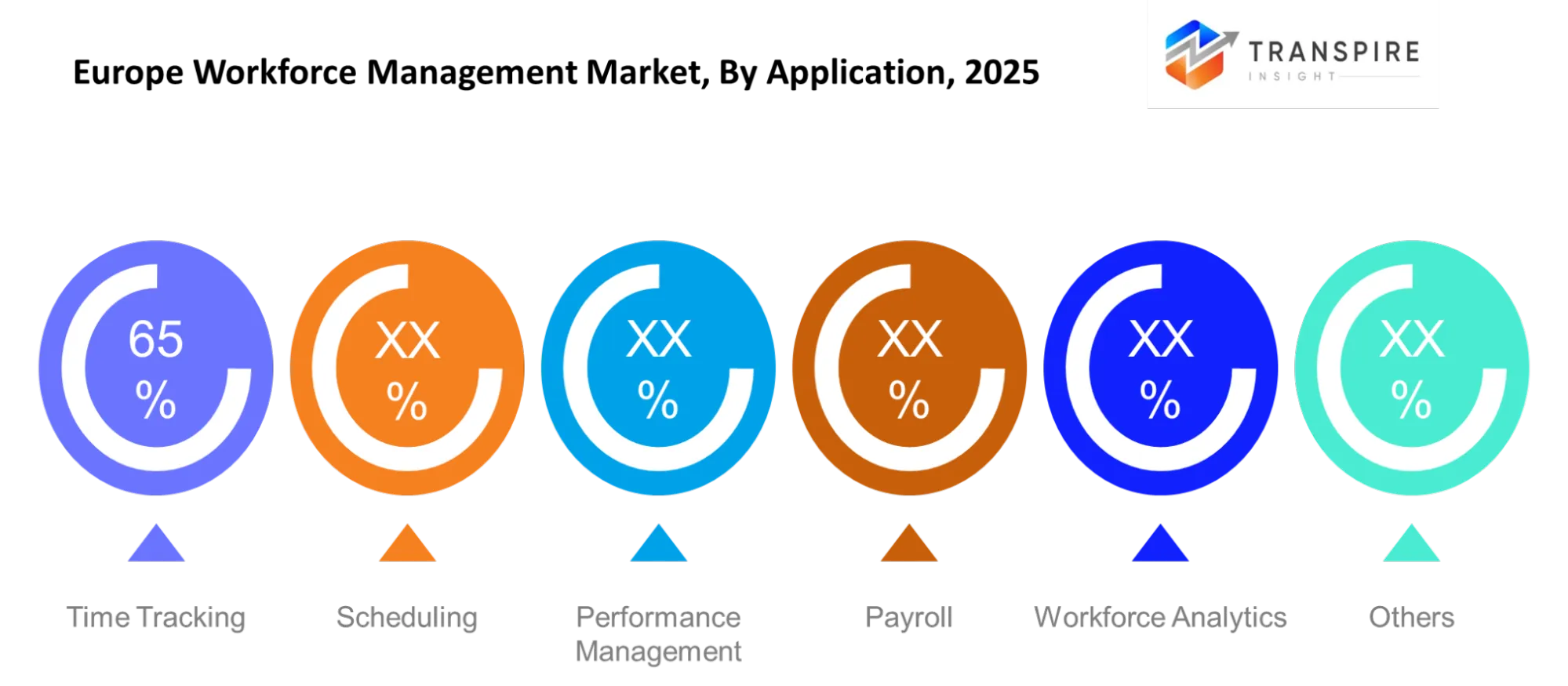
To learn more about this report, Download Free Sample Report
By End-User
The end-user segment distribution shows large enterprises as the dominant group because multinational organizations need to handle their complex staffing systems and multiple compliance requirements and their high workforce numbers throughout their various operational sites. Manufacturing groups continue to spend large amounts of money on workforce orchestration platforms which enable better use of labor resources and maintain business operations. The fastest-growing customer segment for businesses occurs through subscription-based deployment models which enable small and medium-sized enterprises to implement their systems more cost-effectively while reducing technical challenges.
Government organizations and BFSI institutions also maintain stable demand because workforce transparency, payroll accuracy, and regulatory oversight remain operational priorities. The different end-user groups show distinct demand patterns because enterprises search for solutions that provide better scalability and analytics capabilities while smaller businesses need solutions that allow quick and affordable system implementation. The upcoming market trend indicates mid-sized organizations will increase their software adoption because cloud infrastructure develops and software vendors start to offer industry-specific workforce solutions which comply with local labor laws and business processes.
By Deployment
The deployment segment sees cloud deployment as its leading method because enterprises need to scale their operations while providing remote access and receiving faster updates and saving on infrastructure expenses. Since 2021, SaaS-based workforce platforms have experienced substantial growth because hybrid work models created a need for centralized employee management systems that work across different operational areas. On-premise deployments continue to retain relevance among government agencies, financial institutions, and highly regulated sectors where data sovereignty and cybersecurity remain critical concerns.
Organizations need to establish their payroll and ERP systems through interactive deployment methods because hybrid deployment models currently support their existing systems. Organizations choose their deployment methods based on three factors which include cybersecurity regulations and integration complexity and their need to maintain operational flexibility over time. Investors will direct their future funding toward cloud-native systems that use API-driven frameworks to deliver AI analytics and mobile workforce management and real-time compliance control. Companies that provide complete migration solutions together with local data storage options will achieve better market standing in European business sectors.
What are the Key Use Cases Driving the Europe Workforce Management Market?
The main reasons European healthcare systems and retail chains and manufacturing facilities use the platform stem from its time tracking and workforce scheduling capabilities. Enterprises need automated systems for shift planning and attendance verification and payroll coordination because labor regulations and overtime rules create operational challenges which result in higher administrative costs.
The logistics and field service industries experience rapid growth in secondary applications because mobile workforce coordination has become vital for their operations. Distribution companies and transportation operators increasingly use workforce analytics platforms to optimize driver allocation, monitor productivity, and respond faster to supply chain disruptions and fluctuating delivery volumes.
AI-based workforce forecasting and employee wellbeing analytics represent new use cases which are currently developing. Hospitals and large industrial operators are beginning to deploy predictive staffing systems that identify burnout risks, absenteeism patterns, and future labor shortages before operational performance declines.
|
Report Metrics |
Details |
|
Market size value in 2025 |
USD 2.71 Billion |
|
Market size value in 2026 |
USD 2.943 Billion |
|
Revenue forecast in 2033 |
USD 5.247 Billion |
|
Growth rate |
CAGR of 8.61% from 2026 to 2033 |
|
Base year |
2025 |
|
Historical data |
2021 - 2024 |
|
Forecast period |
2026 - 2033 |
|
Report coverage |
Revenue forecast, competitive landscape, growth factors, and trends |
|
Regional scope |
Europe (Germany, United Kingdom, France, Italy, Spain and Rest of Europe) |
|
Key company profiled |
ADP, Workday, SAP, Oracle, IBM, Kronos, Ceridian, Ultimate Software, NICE Systems, Verint, Infor, Atoss, BambooHR, Zoho, Replicon |
|
Customization scope |
Free report customization (country, regional & segment scope). Avail customized purchase options to meet your exact research needs. |
|
Report Segmentation |
By Type (Software, Services, Analytics Tools, AI Solutions, Mobile Workforce Tools, Others), By Application (Time Tracking, Scheduling, Performance Management, Payroll, Workforce Analytics, Others), By End-User (Enterprises, SMEs, Government, BFSI, Others), By Deployment (Cloud, On-premise, Hybrid, SaaS, Others) |
Which Regions are Driving the Europe Workforce Management Market Growth?
The primary market in Western Europe leads all other markets because businesses in this region implement digital technologies while developing established cloud systems and enforcing strict labor regulations. The United Kingdom France Germany and Netherlands lead in multinational employer adoption because these countries offer advanced workforce management solutions needed to operate extensive business networks. The enforcement of regulations concerning payroll transparency and employee scheduling and overtime monitoring has resulted in extended software implementations across the healthcare and manufacturing and logistics industries. The regional market maintains its power because enterprise software vendors and cloud providers and HR technology partners create a strong business ecosystem which enables continuous investment in their platforms.
The second-largest contributor to Northern Europe exists but Western European markets show different patterns because employees prefer better operational sustainability than compliance requirements. Nordic countries maintain their workforce analytics and hybrid work technologies and employee engagement platforms at a constant investment level because their workforces function in highly digital environments. Public sector modernization initiatives combined with digital infrastructure improvements have enabled healthcare systems and municipal services and financial institutions to achieve ongoing digital transformation. The region generates stable software and services revenue through its continuous enterprise spending and its dedication to long-term workforce development planning.
The Eastern European market is growing at an accelerated pace because of its rapidly expanding logistics hubs and shared service centers and industrial manufacturing facilities.
Who are the Key Players in the Europe Workforce Management Market and How Do They Compete?
The Europe Workforce Management Market maintains moderate consolidation as companies compete through their AI capabilities, cloud integration capabilities, and ability to meet regulatory requirements together with their functions for managing workforces across multiple countries. The market share battles between large enterprise software providers and their integrated HR ecosystems while specialized SaaS vendors introduce new ways to install software which need less time and cost. Companies use predictive analytics together with mobile workforce coordination and country-specific labor regulation compliance for their European operations to gain competitive advantage. The combination of workforce automation solutions with payroll and ERP and employee engagement tools enables vendors to achieve higher enterprise retention and increased subscription revenue.
SAP offers multinational European enterprises a unique value through its ERP system and compliance management solutions which enable businesses to maintain international standards. The company enhances its cloud HCM portfolio by developing AI-based workforce analytics and automation solutions which enable various business units to use its systems. Workday uses its cloud-native system together with its real-time workforce intelligence tools to help organizations manage their workforce planning needs across multiple locations. The company aims to establish strategic partnerships with regional cloud providers while developing industry-specific workforce solutions for healthcare and retail sectors.
UKG develops its prediction-based scheduling system together with its employee sentiment analysis tools and labor optimization solutions which enterprise users need to manage their workforce operations in manufacturing and logistics fields. The company establishes its market position through advanced workforce analytics systems and mobile-based workforce management tools.
Company List
- ADP
- Workday
- SAP
- Oracle
- IBM
- Kronos
- Ceridian
- Ultimate Software
- NICE Systems
- Verint
- Infor
- Atoss
- BambooHR
- Zoho
- Replicon
Recent Development News
In February 2026,Totalmobile–Solvares Merger Creates Major European WFM Platform: Totalmobile and Solvares Group announced a strategic merger forming a major European workforce optimisation and field service management platform.The combined company will serve 4,000+ customers across Europe and integrate scheduling, field execution, and workforce planning tools under one structure.
Source: https://www.totalmobile.com
In January 2026, Payoneer Expands European Workforce Management Capabilities via Acquisition: Payoneer expanded its European workforce management footprint by acquiring Ireland-based EOR platform Boundless.This strengthens its Workforce Management (WFM) division and enhances compliant cross-border payroll and hiring capabilities across Europe, especially for SMEs operating in fragmented labor markets.
Source: https://www.nasdaq.com
What Strategic Insights Define the Future of the Europe Workforce Management Market?
The Europe Workforce Management Market is moving toward a future where autonomous workforce orchestration will dominate operations through AI systems which will handle real-time staffing and scheduling along with labor optimization tasks with reduced need for human input. The current situation leads to this transition because companies experience ongoing labor shortages while face stricter cross-border employment rules and need to boost their productivity rates without increasing their worker numbers. The upcoming five to seven years will see organizations gain competitive advantage through predictive decision intelligence which will connect with ERP systems and supply chain systems and operational planning systems.
The increasing concentration of workforce data within a few cloud software providers creates an unrecognized danger. When businesses become highly reliant on integrated SaaS systems, the resulting vendor lock-in and switching costs will restrict their ability to negotiate prices and hinder innovation efforts of smaller vendors. The field of AI-powered workforce wellbeing analytics is creating new opportunities, especially in healthcare and industrial sectors which are dealing with burnout-related labor retention problems.
Market participants should focus on creating platforms which use API-based interoperability to connect with existing enterprise systems because deployment options will become essential for maintaining long-term contracts and achieving success in new markets.
Europe Workforce Management Market Report Segmentation
By Type
- Software
- Services
- Analytics Tools
- AI Solutions
- Mobile Workforce Tools
- Others
By Application
- Time Tracking
- Scheduling
- Performance Management
- Payroll
- Workforce Analytics
- Others
By End-User
- Enterprises
- SMEs
- Government
- BFSI
- Others
By Deployment
- Cloud
- On-premise
- Hybrid
- SaaS
- Others
Frequently Asked Questions
Find quick answers to common questions.
The Approximate Europe Workforce Management Market size for the Market will be USD 5.247 Billion in 2033.
The key Segments of the Europe Workforce Management Market are By Type (Software, Services, Analytics Tools, AI Solutions, Mobile Workforce Tools, Others), By Application (Time Tracking, Scheduling, Performance Management, Payroll, Workforce Analytics, Others), By End-User (Enterprises, SMEs, Government, BFSI, Others), By Deployment (Cloud, On-premise, Hybrid, SaaS, Others).
Major Players in the Europe Workforce Management Market are ADP, Workday, SAP, Oracle, IBM, Kronos, Ceridian, Ultimate Software, NICE Systems, Verint, Infor, Atoss, BambooHR, Zoho, Replicon.
The Current Market size of the Europe Workforce Management Market is USD 2.71 Billion in 2025.
The Europe Workforce Management Market CAGR is 8.61%.
- ADP
- Workday
- SAP
- Oracle
- IBM
- Kronos
- Ceridian
- Ultimate Software
- NICE Systems
- Verint
- Infor
- Atoss
- BambooHR
- Zoho
- Replicon
Recently Published Reports
-
Apr 2026
3D Optical Profiler Market
3D Optical Profiler Market Size, Share & Analysis Report By Type (Desktop 3D Optical Profiler, and Portable 3D Optical Profiler), By Technology (Confocal Technology, and White Light Interference), By End-Use Industry (Manufacturing, Research Institutions, Automotive, Aerospace and Defense, Medical Devices, and Other), and Geography (North America, Europe, Asia-Pacific, Middle East and Africa, South and Central America), 2021 - 2031
-
Apr 2026
Depth Sensor Market
Depth Sensor Market Size, Share & Analysis Report By Type (Infrared Depth Sensors, Time-of-Flight (ToF) Sensors, Stereo Vision Sensors, Structured Light Sensors, Ultrasonic Depth Sensors), By Application (Automotive, Robotics, Gaming, Consumer Electronics, Industrial Automation, Healthcare, Security & Surveillance, Others), By End Users (Automotive Manufacturers, Consumer Electronics Companies, Healthcare Providers, Industrial Companies, Security Agencies, Gaming Companies, Robotics Companies, Others), and Geography (North America, Europe, Asia-Pacific, Middle East and Africa, South and Central America), 2021 – 2031
-
Apr 2026
Digital Manufacturing Market
Digital Manufacturing Market Size, Share & Analysis Report By Component (Hardware, Software, and Services), By Technology (Robotics, 3D Printing, Internet of Things (IoT), and Others), By Application (Automotive and Transportation, Aerospace and Defense, Consumer Electronics, Industrial Machinery, and Others), By Process Type (Computer-Based Designing, Computer-Based Simulation, Computer 3D Visualization, Analytics, and Others), and Geography (North America, Europe, Asia-Pacific, Middle East and Africa, South and Central America), 2021 – 2031
-
Apr 2026
Digital Visa Services Market
Digital Visa Services Market Size, Share & Analysis Report By Type (Individual Travelers, Group Travelers), By Application (Tourism, Business Travel, Others), and Geography (North America, Europe, Asia-Pacific, Middle East and Africa, South and Central America), 2021 – 2031