
Europe Healthcare Workforce Management System Market Size & Forecast:
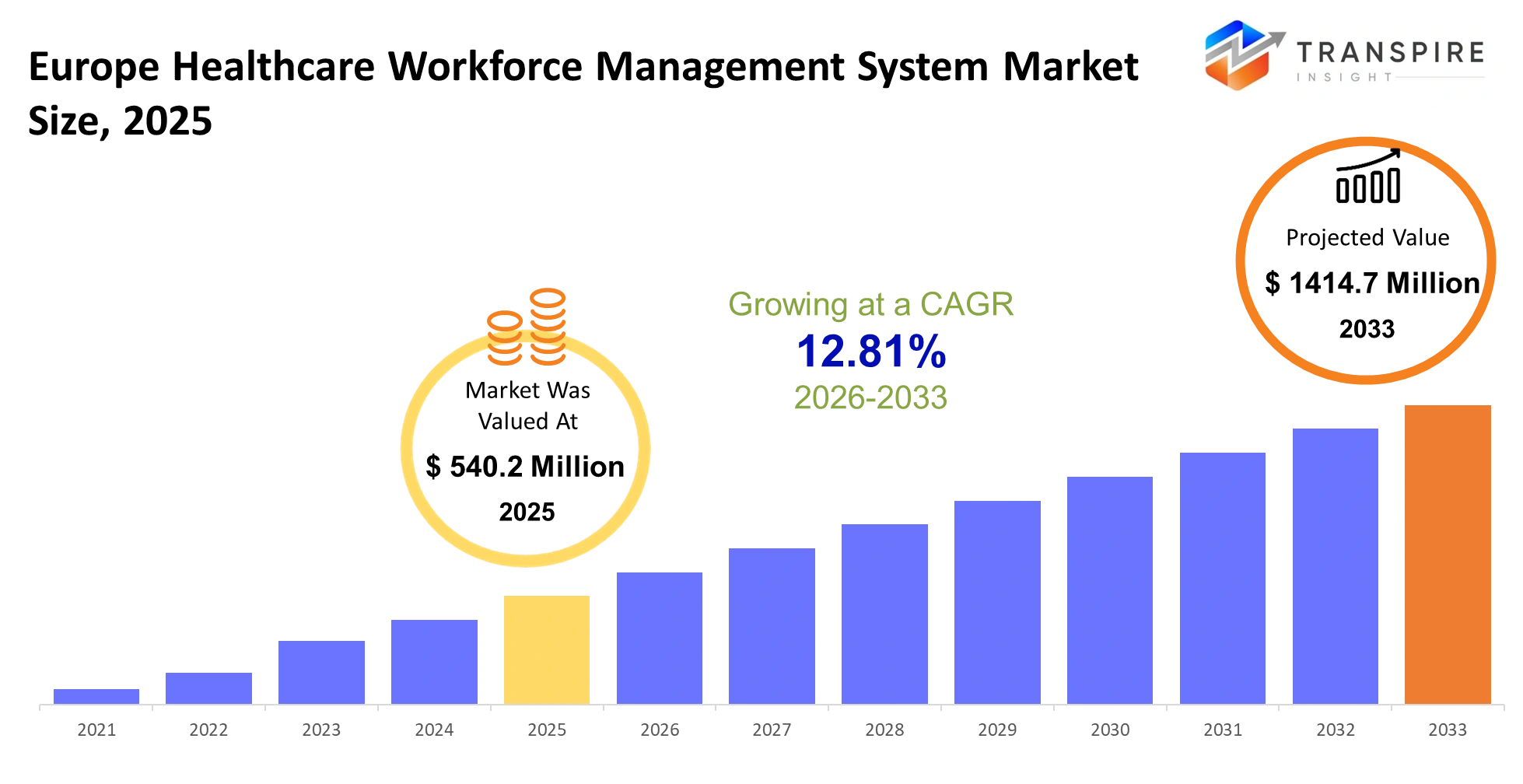
- Europe Healthcare Workforce Management System Market Size 2025: USD 540.2 Million
- Europe Healthcare Workforce Management System Market Size 2033: USD 1414.7 Million
- Europe Healthcare Workforce Management System Market CAGR: 12.81%
- Europe Healthcare Workforce Management System Market Segments: By Type (Software, Services, Cloud Solutions, AI-based Systems, Mobile Solutions, Others), By Application (Staff Scheduling, Time & Attendance, Payroll Management, Analytics, Compliance Management, Others), By End-User (Hospitals, Clinics, Healthcare Providers, Nursing Homes, Others), By Deployment (Cloud, On-premise, Hybrid, Private Cloud, Others).
To learn more about this report,  Download Free Sample Report
Europe Healthcare Workforce Management System Market Summary:
The Europe Healthcare Workforce Management System Market size is estimated at USD 540.2 Million in 2025 and is anticipated to reach USD 1414.7 Million by 2033, growing at a CAGR of 12.81% from 2026 to 2033. The market for healthcare workforce management systems in Europe has become essential for medical facilities and permanent care institutions which need to manage two competing needs. The platforms enable healthcare facilities to handle their nurse scheduling and physician roster creation and shift distribution and compliance assessment and overtime management tasks. The market has evolved from its initial basic scheduling software products to AI-powered workforce management systems which can forecast staffing requirements and automatically match employees to shifts and connect with electronic health record systems and payroll software.
The COVID-19 pandemic revealed that European healthcare systems relied on vulnerable manual staffing methods to operate their medical facilities. The hospitals responded by increasing their investments in cloud-based workforce solutions which would enable better labor tracking while decreasing employee exhaustion. The current transition is producing predictable software revenue streams which result in more extended contracts for businesses while public hospitals enhance their adoption of new systems to manage ongoing workforce challenges and comply with changing labor laws.
Key Market Insights
- The European Healthcare Workforce Management System Market in 2025 saw Western Europe reach a 42% market share because it had better hospital IT systems.
- Germany leads regional revenue generation because large healthcare networks prioritize automated staffing optimization and labor compliance management systems.
- The Nordic region represents the fastest-growing market through 2030, supported by aggressive healthcare digitization and cloud-based workforce analytics investments.
- To handle their increasing patient load Southern European healthcare facilities are turning to workforce software solutions that address their staffing shortages in public healthcare.
- The Europe Healthcare Workforce Management System Market in 2025 saw software platforms achieve a 61% market share because businesses needed solutions for automated workforce management across their entire operations.
- Time and attendance management solutions held the second-largest market share because hospitals require accurate payroll integration and overtime tracking capabilities.
- The segment for AI-driven predictive scheduling solutions will experience its most rapid growth between 2025 and 2030 as healthcare providers use these tools to achieve better operational outcomes and prevent clinician exhaustion.
- Cloud-based healthcare workforce management systems gain market share because they decrease implementation expenses and enhance workforce oversight across multiple locations.
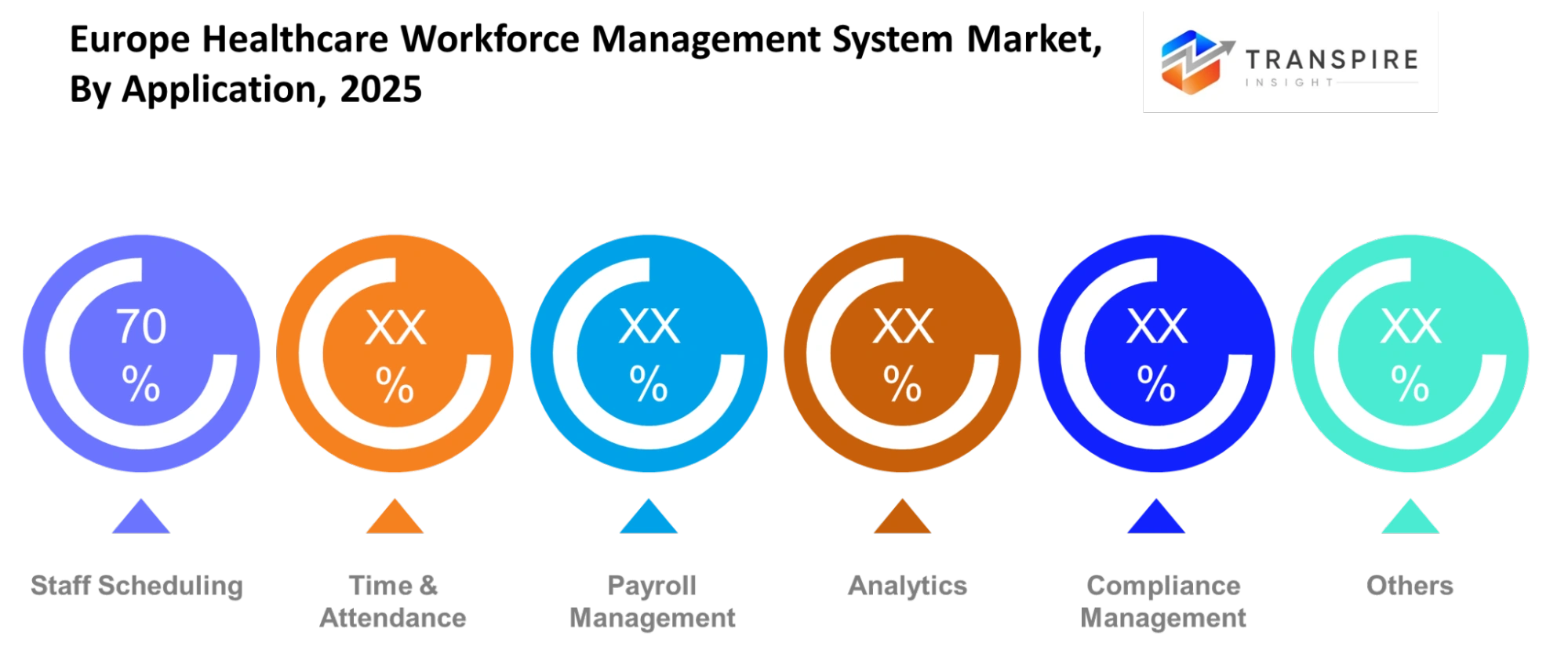
- Staff scheduling and rostering accounted for approximately 38% of Europe Healthcare Workforce Management System Market revenue in 2025 because workforce shortages created ongoing operational needs.
- Hospitals represented the leading end-user segment with nearly 58% market share in 2025 because their staffing needs involve complex systems which operate around the clock.
What are the Key Drivers, Restraints, and Opportunities in the Europe Healthcare Workforce Management System Market?
The primary driver which propels the European Healthcare Workforce Management System Market forward stems from the rising financial burdens which hospitals experience due to their ongoing staff shortages and their increasing expenses for labor. After the COVID-19 crisis, healthcare systems across Germany, the UK, and France faced higher dependence on temporary staff and overtime-heavy scheduling models which extremely raised their operational costs. The demand for AI-powered workforce management systems which automate shift assignments and predict staffing shortages while improving operational processes emerged as critical business needs. Hospitals now view workforce optimization software as essential cost control systems which drive their spending on enterprise software and multi-year subscription agreements throughout the entire region.
European healthcare IT systems suffer from two major challenges because of their fragmented structure. Public hospitals continue to use outdated payroll systems as well as HR systems and patient record systems which do not work together with contemporary workforce management systems. The process of replacing or integrating these systems demands extensive financial resources together with both regulatory consent and workforce retraining procedures which require extended periods to accomplish. The intricate process results in delayed deployment cycles, which hampers cloud migration initiatives and decreases the digital transformation rate among mid-sized healthcare organizations that have limited funds for digital advancement.
The development of predictive workforce analytics and cross-border telehealth staffing models has created a valuable opportunity for business growth. Nordic countries and the Netherlands are investing heavily in cloud-based healthcare ecosystems that combine workforce data with patient flow analytics. Vendors who combine AI staffing prediction with actual clinical demand forecasting will lead the upcoming wave of operational changes in healthcare across Europe.
What Has the Impact of Artificial Intelligence Been on the Europe Healthcare Workforce Management System Market?
The European Healthcare Workforce Management System Market experiences transformation through artificial intelligence and cutting-edge digital technologies because these innovations create real-time operational workforce planning capabilities which replace traditional workforce planning methods that required manual execution. Hospitals deploy AI-powered scheduling systems which create optimal staffing solutions by assessing patient arrivals and doctor availability and patient acuity and labor guidelines. The systems enable healthcare organizations to decrease their manual scheduling tasks which results in better scheduling efficiency and higher shift-filling success throughout their extensive healthcare system operations. Healthcare organizations utilize machine learning models to analyze historical workforce data and patient admission records in order to forecast staffing shortages and absenteeism rates and peak emergency department demand.
Healthcare providers using predictive workforce analytics have reported measurable operational improvements which included lower agency staffing costs and reduced clinician burnout and faster response times during high patient-volume periods. Cloud-based workforce platforms create connections between payroll systems and electronic health record systems and compliance management systems which allow administrators to monitor labor productivity and regulatory adherence through unified dashboard systems.
The European healthcare sector faces a major obstacle in AI implementation because its healthcare IT systems have developed into disconnected systems which operate throughout the continent. The majority of hospitals continue to use outdated HR and payroll systems which cannot connect with contemporary AI systems resulting in costly delays and difficult integration efforts.
Key Market Trends
- Western European hospitals have implemented cloud workforce platforms since 2021 to decrease their expenses from staff overtime and their need to use temporary workers.
- The scheduling tools developed by UKG and Workday which use artificial intelligence became popular during the COVID-19 pandemic because the staffing interruptions showed how poorly the manual scheduling system performed.
- From 2022 until 2025 Nordic healthcare systems spent more money on predictive staffing analytics to enhance their emergency department staffing accuracy.
- After 2020 European countries increased their labor compliance regulations which required healthcare organizations to use automated systems for managing staff tiredness and tracking nurse work hours.
- After COVID-19 hospitals began to adopt software-as-a-service delivery methods for their workforce systems because they needed to monitor staff members across multiple locations.
- German and French healthcare organizations unified their HR payroll and scheduling operations into single workforce management systems which helped them work more efficiently.
- After 2021 mobile workforce applications experienced major growth because clinicians wanted to use real-time shift swapping with remote access and self-scheduling functions.
- Healthcare organizations stopped buying standalone scheduling tools and started using workforce intelligence systems which provide payroll and EHR interoperability.
- After Oracle and SAP added AI-powered workforce optimization tools to their European hospital systems competition between the two companies increased.
- Southern European long-term care facilities implemented automated staffing systems at a faster rate during the period from 2022 to 2025 because caregiver shortages created operational challenges.
Europe Healthcare Workforce Management System Market Segmentation
By Type
Healthcare organizations need software solutions that provide centralized workforce visibility together with automated scheduling and integrated payroll management. German hospitals and French hospitals and United Kingdom hospitals are switching from their current workforce systems to digital platforms which provide unified operations to enhance staff productivity. AI-based systems and cloud solutions are gaining stronger market traction as providers seek predictive staffing models capable of reducing overtime costs and clinician burnout. Mobile workforce solutions experienced rapid growth because healthcare staff required the ability to access flexible shifts and schedule work remotely after the pandemic period.
Public healthcare institutions which operate legacy infrastructure require services for system integration and staff training and system customization. The coming competition in this market will concentrate on three main areas which include interoperability and predictive analytics and cybersecurity capabilities. Vendors who dedicate resources to develop AI-powered automation together with expandable cloud infrastructure will achieve better business contracts and continuous revenue stream success.
By Application
The staff scheduling applications continue to dominate the market because healthcare providers face labor shortages and increasing labor expenses which require them to focus on operational efficiency and optimization of their services. Time and attendance systems maintain their strong market position because European labor compliance requirements create strict demands and organizations need to manage their overtime expenses. The payroll management platforms serve as essential tools for healthcare networks that want to unify their workforce data with their financial records and staffing budget systems.
Hospital administrators utilize workforce analytics tools together with compliance management applications to predict their patient volume through their staffing needs and actual patient flow monitoring capabilities. Healthcare organizations are also investing in analytics-driven workforce planning because it helps them enhance care quality while decreasing their need for temporary staff. Future growth within application segments will likely favor platforms capable of combining scheduling, compliance monitoring, and predictive analytics into a single operational ecosystem, creating stronger value propositions for enterprise healthcare buyers.
To learn more about this report, Download Free Sample Report
By End-User
The complete operations of hospitals necessitate complex staffing solutions which enable them to handle their various departments and continuous patient care needs. The dedicated workforce management systems of hospitals enable them to solve scheduling problems while using their staff resources effectively and meeting their staffing requirements. Healthcare clinics and outpatient facilities are adopting more software solutions because their patient numbers increase and their need for operational efficiency grows which directly affects their financial performance.
European countries face a growing need for nursing homes and long-term care facilities because their senior citizen population increases and their workforce shortages persist. The facilities require automated scheduling systems which will enable them to organize their workforce according to the requirements of their patients who need support throughout the day. The healthcare industry in certain areas needs better system integration solutions which smaller healthcare providers need to overcome their financial constraints and market entry problems. The market will direct its future investment activities toward workforce platforms which can be scaled to meet the requirements of specialized care environments that include elderly care facilities and rehabilitation centers and multi-site healthcare delivery networks.
By Deployment
The deployment segment sees its primary growth through cloud deployment because healthcare organizations need scalable systems which provide remote access while reducing infrastructure maintenance expenses. Hospitals and healthcare networks use cloud-based workforce systems to handle staffing needs at multiple sites while achieving instant employee monitoring and centralized compliance assessment. Healthcare providers are increasingly adopting hybrid deployment models which enable them to maintain greater data security while they update their outdated IT systems.
Public healthcare organizations that need to control their data access rights and protect their existing technological assets choose on-premise deployments as their preferred solution. Large healthcare organizations are increasingly adopting private cloud systems to enhance their cybersecurity measures and gain specific operational authority. Healthcare systems experienced an accelerated shift towards cloud-based systems when they understood that their workforce management systems needed to operate without interruptions during the pandemic. The healthcare sector will focus on three key areas when developing future deployment systems which include creating better system connections and building stronger security measures and enabling machine learning capabilities.
What are the Key Use Cases Driving the Europe Healthcare Workforce Management System Market?
The primary application of hospital staff scheduling exists because healthcare systems require staff to cover their rotating shifts and handle their emergency staffing needs and adhere to their labor compliance obligations across their various departments. Workforce management platforms assist hospitals in decreasing their overtime expenses and increasing their nurse allocation effectiveness and sustaining their staffing levels throughout peak patient admission times.
Healthcare providers and long-term care facilities are increasingly adopting workforce analytics and attendance tracking applications to manage caregiver shortages and reduce dependence on temporary staff. Outpatient clinics are implementing mobile scheduling tools that enable clinicians to view shift changes and switch their schedules and control their work availability from remote locations.
The emerging use cases involve predictive workforce planning which connects with patient flow analytics and AI-based systems that handle fatigue monitoring. The Nordic healthcare networks currently test staffing optimization systems which use electronic health record data to predict workforce needs during seasonal patient surges and emergency response operations.
|
Report Metrics |
Details |
|
Market size value in 2025 |
USD 540.2 Million |
|
Market size value in 2026 |
USD 608.3 Million |
|
Revenue forecast in 2033 |
USD 1414.7 Million |
|
Growth rate |
CAGR of 12.81% from 2026 to 2033 |
|
Base year |
2025 |
|
Historical data |
2021 - 2024 |
|
Forecast period |
2026 - 2033 |
|
Report coverage |
Revenue forecast, competitive landscape, growth factors, and trends |
|
Regional scope |
Europe (Germany, United Kingdom, France, Italy, Spain and Rest of Europe) |
|
Key company profiled |
Kronos, Cerner, Oracle, SAP, IBM, ADP, McKesson, GE Healthcare, Infor, Workday, NICE Systems, Verint, Atoss, Cornerstone, Ultimate Software. |
|
Customization scope |
Free report customization (country, regional & segment scope). Avail customized purchase options to meet your exact research needs. |
|
Report Segmentation |
By Type (Software, Services, Cloud Solutions, AI-based Systems, Mobile Solutions, Others), By Application (Staff Scheduling, Time & Attendance, Payroll Management, Analytics, Compliance Management, Others), By End-User (Hospitals, Clinics, Healthcare Providers, Nursing Homes, Others), By Deployment (Cloud, On-premise, Hybrid, Private Cloud, Others). |
Which Regions are Driving the Europe Healthcare Workforce Management System Market Growth?
Western European countries control the market because their healthcare systems in Germany, the United Kingdom, France, and the Netherlands have made substantial investments toward digital hospital systems and automated workforce management solutions. Hospitals in this region needed to update their workforce management systems before other European countries because labor regulations and union presence and increasing staffing expenses created challenges for them. Public healthcare systems in this area control bigger IT expenditures while forming partnerships with major software companies like SAP and Oracle. The region maintains its leading position in the market because advanced hospital systems and healthcare IT integrators and cloud infrastructure providers form a well-established ecosystem that drives continuous software spending.
Northern Europe stands as the second biggest regional economy because its growth patterns show different trends from Western Europe due to operational efficiency and workforce sustainability goals which drive adoption more than hospital digitization efforts. Sweden and Denmark and Finland operate their public healthcare systems through organized systems that maintain stable technology investments and execute regulations consistently.
Healthcare providers in this region increasingly focus on predictive workforce analytics, clinician wellbeing monitoring, and AI-assisted staffing optimization to manage aging populations and healthcare labor shortages. The combination of strong digital literacy and government-supported cloud transformation programs establishes a secure foundation which enables software implementation and consistent revenue from ongoing services.
Who are the Key Players in the Europe Healthcare Workforce Management System Market and How Do They Compete?
The Europe Healthcare Workforce Management System Market maintains its competitive landscape through moderate consolidation between major enterprise software companies and dedicated healthcare workforce technology providers. The evaluation of competition now depends on three main factors which include AI-based scheduling precision and the capacity to connect with hospital information technology systems and the handling of complicated European labor regulations. The established vendors protect their market position through public healthcare network contracts which extend beyond current contracts, while new cloud-native companies provide mid-sized healthcare organizations with quick implementation solutions and subscription payment models. Hospitals now prioritize technology integration capabilities because they require unified workforce platforms that connect with their payroll systems and electronic health records and workforce analytics.
UKG establishes its unique position through its development of sophisticated workforce scheduling and clinician engagement solutions which are tailored for high-staffing-churn healthcare settings. The company expands its operations through Europe by offering cloud-based workforce analytics and AI-powered scheduling solutions which enable hospitals to optimize their spending and minimize employee exhaustion. Oracle competes by merging workforce management functions with hospital finance and HR and enterprise resource planning systems to enhance operational visibility across healthcare organizations that operate multiple facilities.
SAP maintains its competitive edge through its strong presence in German and Western European healthcare networks which already use SAP-based administrative systems.
Company List
- Kronos
- Cerner
- Oracle
- SAP
- IBM
- ADP
- McKesson
- GE Healthcare
- Infor
- Workday
- NICE Systems
- Verint
- Atoss
- Cornerstone
- Ultimate Software
Recent Development News
In March 2026, UKG Named a Leader in the IDC MarketScape for AI‑led Workforce Management and EMEA Compliance: A major shift in the U.S. beverage landscape as 7UP expands into energy drinks through a strategic collaboration. This move reflects increasing crossover between soda and energy drink segments to capture younger consumers.
Source: https://www.ukg.co.uk
In March 2026, UK’s Flexzo AI raised €10.3 million to transform healthcare workforce management with agentic AI: The UK startup secured Series A funding to expand its healthcare workforce-management platform, including adoption across NHS Trusts. This is the most directly relevant company-specific Europe news in your topic area because it ties funding to a healthcare workforce system product.
Source: https://www.eu-startups.com
What Strategic Insights Define the Future of the Europe Healthcare Workforce Management System Market?
The Europe Healthcare Workforce Management System Market has started to adopt AI-powered platforms which use cloud-based systems to combine automated staffing solutions and predictive analytics tools and compliance monitoring systems and patient flow management systems. European healthcare systems need to improve operational efficiency while facing financial pressure and labor shortage challenges because patient demands are increasing. Healthcare providers will consider workforce intelligence platforms as essential operational systems during the next five to seven years.
The healthcare workforce data concentration risk exists because enterprise software companies now control most of that information. The existing system creates dependency risks for hospitals because AI systems depend on interoperability standards which have not yet developed. Eastern and Southern Europe currently experience a major opportunity because their public healthcare systems are developing new programs which require cloud-based solutions and digital workforce technologies.
Market participants should select modular platforms which enable system integration with existing hospital infrastructure while providing AI workforce forecasting capabilities and regional compliance support.
Europe Healthcare Workforce Management System Market Report Segmentation
By Type
- Software
- Services
- Cloud Solutions
- AI-based Systems
- Mobile Solutions
- Others
By Application
- Staff Scheduling
- Time & Attendance
- Payroll Management
- Analytics
- Compliance Management
- Others
By End-User
- Hospitals
- Clinics
- Healthcare Providers
- Nursing Homes
- Others
By Deployment
- Cloud
- On-premise
- Hybrid
- Private Cloud
- Others
Frequently Asked Questions
Find quick answers to common questions.
The approximate Europe Healthcare Workforce Management System Market size for the market will be USD 1414.7 Million in 2033.
The key segments of the Europe Healthcare Workforce Management System Market are By Type (Software, Services, Cloud Solutions, AI-based Systems, Mobile Solutions, Others), By Application (Staff Scheduling, Time & Attendance, Payroll Management, Analytics, Compliance Management, Others), By End-User (Hospitals, Clinics, Healthcare Providers, Nursing Homes, Others), By Deployment (Cloud, On-premise, Hybrid, Private Cloud, Others).
Major players in the Europe Healthcare Workforce Management System Market are Kronos, Cerner, Oracle, SAP, IBM, ADP, McKesson, GE Healthcare, Infor, Workday, NICE Systems, Verint, Atoss, Cornerstone, Ultimate Software.
The current market size of the Europe Healthcare Workforce Management System Market is USD 540.2 Million in 2025.
The Europe Healthcare Workforce Management System Market CAGR is 12.81%.
- Kronos
- Cerner
- Oracle
- SAP
- IBM
- ADP
- McKesson
- GE Healthcare
- Infor
- Workday
- NICE Systems
- Verint
- Atoss
- Cornerstone
- Ultimate Software
Recently Published Reports
-
Apr 2026
AI in Diabetic Retinopathy Market
AI in Diabetic Retinopathy Market Size, Share & Analysis Report By Type (Screening AI Systems, Diagnostic AI Systems, and Predictive AI Models), By Application Segment (Hospitals, Ophthalmology Clinics, Diagnostic Centers, and Research and Development), and Geography (North America, Europe, Asia-Pacific, Middle East and Africa, South and Central America), 2021 - 2031
-
Apr 2026
Psychometric Tests Market
Psychometric Tests Market Size, Share & Analysis Report By Type (Personality Tests, Ability/Aptitude Tests, Skill/Knowledge Tests, and Others), By Application (Talent Acquisition and Talent Management), and Geography (North America, Europe, Asia-Pacific, Middle East and Africa, South and Central America), 2021 – 2031
-
Apr 2026
Rare Biological Sample Collection Market
Rare Biological Sample Collection Market Size, Share & Analysis Report By Type (Isolation Kits & Reagent, Blood Collection Tubes, and Others), By Application (Oncology, Transcriptomics, Pharmacogenomics, and Others), and Geography (North America, Europe, Asia-Pacific, Middle East and Africa, South and Central America), 2021 – 2031
-
Apr 2026
Patient Lift Pendant Market
Patient Lift Pendant Market By Product Type (Wired Pendants, Wireless, Programmable), By Operation Type(Manual, Electric), By End-Users (Healthcare Professionals, Patients), By Application (Hospitals, Homecare, Rehabilitation Centers, Others), By Industry Analysis, Size, Share, Growth, Trends, and Forecasts 2021-2033
Our Clients
.jpg)