

Middle East and Africa Enterprise Compliance Management (ECM) Market Size & Forecast:
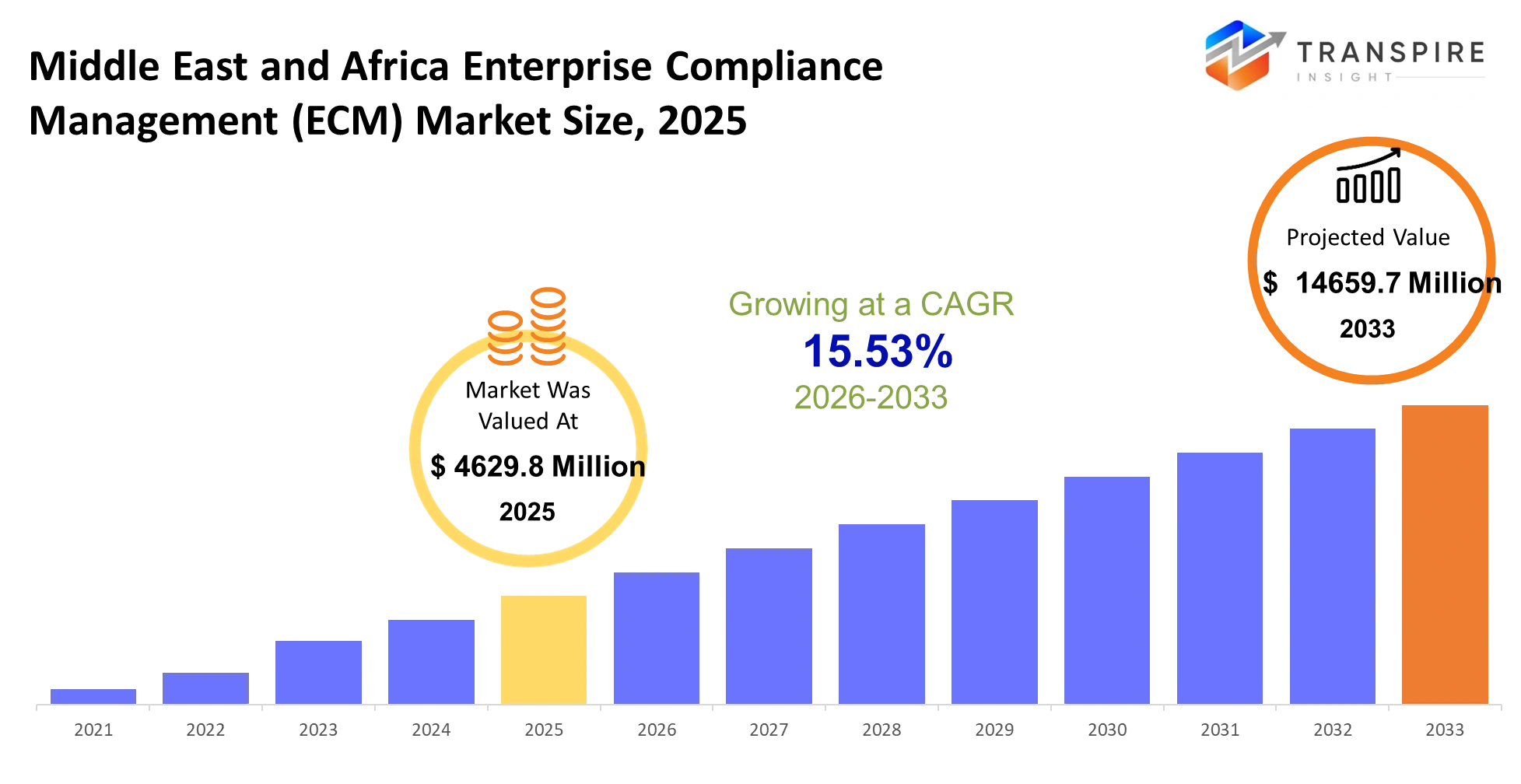
- Middle East and Africa Enterprise Compliance Management (ECM) Market Size 2025: USD 4629.8 Million
- Middle East and Africa Enterprise Compliance Management (ECM) Market Size 2033: USD 14659.7 Million
- Middle East and Africa Enterprise Compliance Management (ECM) Market CAGR: 15.53%
- Middle East and Africa Enterprise Compliance Management (ECM) Market Segments: By Component (Software, Services), By Deployment (Cloud, On-Premise), By Application (Risk, Audit, Policy Management), By Compliance Type (Regulatory, Internal), By End-User (BFSI, Healthcare, Government Organizations)
To learn more about this report,  Download Free Sample Report
Middle East and Africa Enterprise Compliance Management (ECM) Market Summary:
The Middle East and Africa Enterprise Compliance Management (ECM) Market size is estimated at USD 4629.8 Million in 2025 and is anticipated to reach USD 14659.7 Million by 2033, growing at a CAGR of 15.53% from 2026 to 2033. The ECM market in Middle East and Africa (Saudi Arabia, United Arab Emirates, South Africa, Rest of Middle East and Africa) would be part of the overall industry for enterprise software and risk management solutions where businesses would want to adopt systematic solutions that would enable them to integrate their operations with changing legislative requirements. Companies operating in different industries such as banking, energy, and telecom would require solutions which provide them real time visibility and preparedness for audits while at the same time ensuring compliance with local regulations. Government institutions would keep on updating their requirements regarding data security and transparency, thereby making compliance software more relevant for enterprises.
What Has the Impact of Artificial Intelligence Been on the Middle East and Africa Enterprise Compliance Management (ECM) Market?
Artificial intelligence is transforming the Enterprise Compliance Management (ECM) Market throughout the Middle East and Africa because it promotes organizations to adopt data-driven decision-making together with automated governance practices. Organizations in the Middle East and Africa Enterprise Compliance Management (ECM) Market will use artificial intelligence to process extensive regulatory data with fast and precise results which will enhance their market research capabilities and compliance monitoring processes. Machine learning algorithms will identify hidden risk patterns, while predictive analytics will help firms anticipate regulatory changes and align strategies accordingly. The evolution of businesses will result in better transparency practices, which will minimize the need for human monitoring in all business sectors.
The Middle East and Africa Enterprise Compliance Management (ECM) Market will experience operational changes because artificial intelligence will enhance both demand forecasting and operational efficiency. Smart automation tools will streamline compliance workflows, which will decrease both operational costs and error rates. AI-powered systems will enhance supply chain compliance because they track vendor risks while verifying compliance with regional regulations. Enterprises will establish improved management capabilities for cross-border activities which apply to both finance and energy sectors that face strict regulatory oversight.
The implementation of AI technology within the ECM framework of MEA organizations will create a competitive edge through innovative solutions. Organizations will use AI technologies to develop compliance strategies that adjust according to their specific industry risk requirements. The implementation of innovations will improve governance practices while enabling organizations to swiftly respond to changes occurring in the market.
Key Market Trends & Insights:
- Saudi Arabia is the dominant player with a market share of around 32% in 2025, owing to stringent financial regulations and digital governance policies.
- UAE is the fastest-growing region, growing at over 11% CAGR until 2030 owing to the need for fintech and smart city compliance measures.
- Stable growth rate is observed in South Africa, where corporate governance and increasing awareness about enterprise risk management drive the market.
- Compliance management solutions dominate the market with over 55% share, driven by demand for automated audit and report generation systems.
- The risk management solution is second-largest in size, aided by increased emphasis on predictive analytics tools.
- The market segment which includes cloud-based ECM systems experiences the fastest growth rate because its adoption costs and ability to expand demonstrate effective business solutions.
- The financial services application dominates the market with approximately 40% market share because of rigorous anti-money laundering regulations.
- The energy & utility application represents the fastest-growing segment, driven by the need for sustainability and environmental compliance measures.
- Large enterprises dominate the end-user segment with over 60% share, using advanced ECM solutions for managing multinationals' compliance processes.
Middle East and Africa Enterprise Compliance Management (ECM) Market Segmentation
By Component
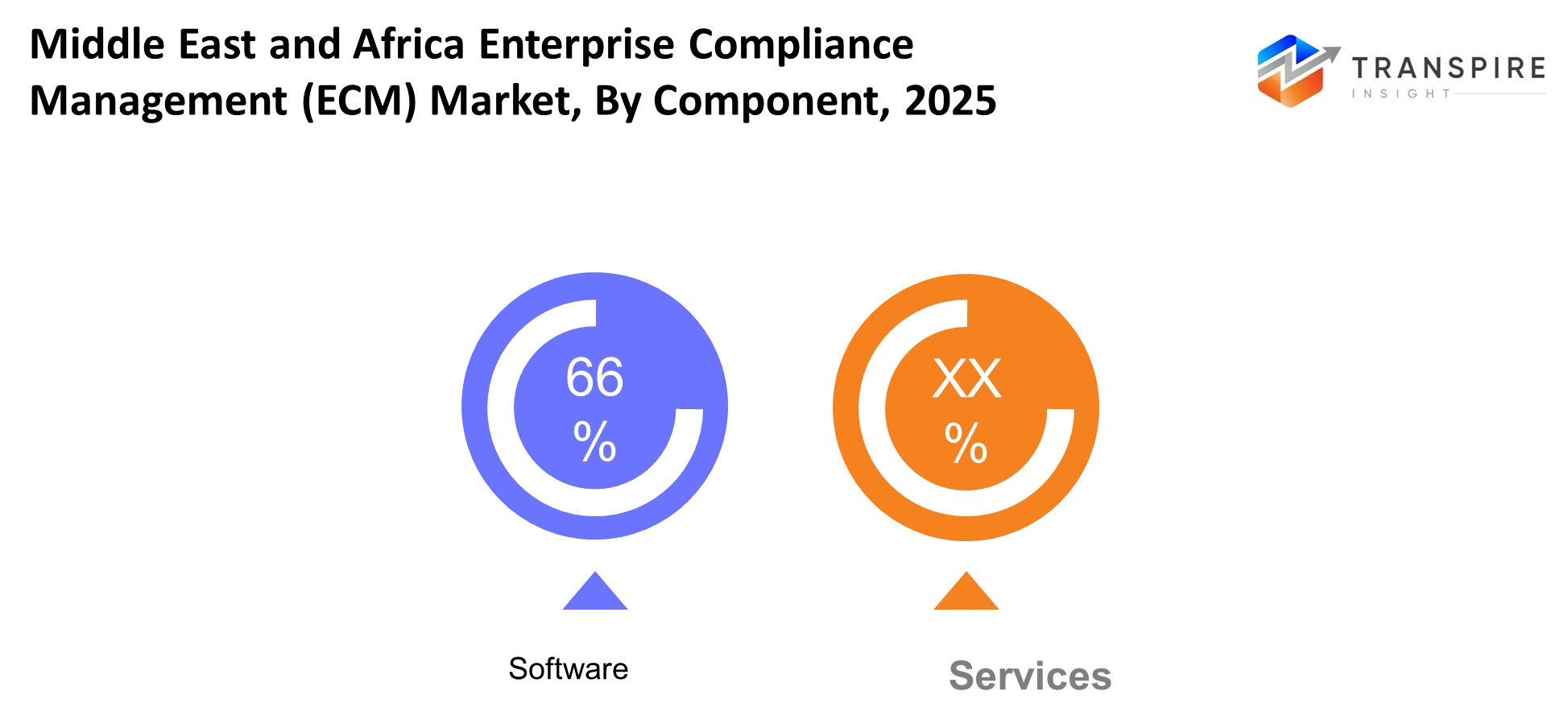
Software will be critical since firms are expected to implement an all-in-one solution to handle the task of managing regulation compliance tracking and reporting. The demand for automation will grow substantially as companies seek to reduce operational errors. Real-time dashboards and AI-powered alert systems will provide decision-making support through their advanced technological capabilities. The use of software solutions is expected to grow because of digital transformation.
Services will help to implement, customize, and operate systems, as firms will need assistance to comply with regional standards of compliance. Consulting and service solutions are expected to become increasingly popular, as different countries have their own regulations regarding compliance requirements. Service providers will focus on training and implementation, making sure everything works smoothly.
To learn more about this report, Download Free Sample Report
By Deployment
The cloud deployment model will have significant traction because enterprises will lean towards scalable and economical options. The remote availability and easy updating capabilities will enhance the appeal of cloud platforms for businesses that will function in different locations. Improved security features and regional data hosting will eliminate issues related to data protection. More adoption is expected as the cloud infrastructure will evolve further.
The on-premise deployment model will hold relevance for businesses that will emphasize data management and strict internal policies. Large corporations and government organizations will use their own infrastructure for critical processes. Personalization and management will facilitate sustained adoption despite higher operational expenses. This deployment option will endure if the regulatory environment demands local data storage..
By Application
Applications for risk management will be widespread since organizations will concentrate on assessing any possible risks that could pose problems to their operations. The use of predictive analysis and monitoring tools will provide information for informed decisions to be made. The organization will depend on such applications for the sake of continuity and avoiding any fines.
Management applications for audit will allow organizations to conduct a systematic assessment of their compliance with policies using automation tools. Similarly, policy management applications will aid organizations in enforcing policies within the company. Management applications will be adopted to ensure compliance with both internal and external policies.
By Compliance Type
Compliance would be an essential trend, as the government would enforce more stringent regulations on issues such as data privacy, finances, and governance. There is going to be increased investment in systems which will keep up with the changing regulatory demands. Compliance will get easier with real-time updates and automation of reports. There is likely to be significant growth in this sector due to the strict regulations being enforced.
Internal compliance is going to involve ensuring proper conduct and compliance within the organization itself. The organization would be implementing policies aimed at reducing the risk of any unethical conduct or inefficiency.
By End-User
Adoption will be facilitated by BFSI, given that regulatory oversight would be more intense here. The need for fraud detection and effective risk management would ensure the deployment of compliance solutions. Continuous surveillance would enhance transparency and foster trust. Compliance management systems would still be major adopters within this industry segment.
There would be greater adoption of compliance systems in the healthcare sector owing to increased data protection and patient safety concerns. Compliance solutions would also be adopted by government organizations in order to improve administrative efficiency and enhance transparency. There would be more deployments of compliance management systems among end-users.
What are the Main Challenges for the Middle East and Africa Enterprise Compliance Management (ECM) Market Growth?
Technological and operational issues will keep impeding growth in the Middle East and Africa Enterprise Compliance Management (ECM) Market. Organizations will find it difficult to integrate their compliance management system with their existing information technology framework, especially if their IT structure is outdated and affects the performance and scalability of their ECM solution. The complexities of the workflow and the regulatory regime from country to country will also extend the implementation period and raise the burden of operation.
Development and manufacturing constraints will similarly hinder the Middle East and Africa Enterprise Compliance Management (ECM) Market. It will be challenging for companies to develop compliance management systems that suit various industries. The costs of development and customization, along with frequent changes in regulation, will push up prices. It will also take longer for products to comply with regional laws.
Adoption issues will continue to be a concern since inadequate technological infrastructure and lack of expertise will pose difficulties in adopting such systems. SMEs will find themselves unable to invest due to funding problems in adopting more sophisticated compliance software. Some growth constraints in ECM in the Middle East and Africa will be as a result of low awareness levels and resistance to change.
Competitive issues and future risks will arise as players seek to gain a share of the ECM market through offering low-priced alternatives. There will be more price pressures as global and regional providers seek to dominate the market. Frequent regulatory updates and cyber risks will lead to regular system upgrades.
Country Insights
The Middle East and Africa enterprise compliance management (ecm) market will witness heterogeneous results in terms of growth among the regions because of the differences in regulations and the economic needs of the region. Saudi Arabia and the UAE will spearhead the implementation of ecm because of the growth of digital governance projects, which will be followed by stronger regulatory actions.
South Africa will exhibit consistent progress in the field because of the improvements in corporate governance regulations as well as increasing awareness regarding the compliance risks in their organization. The Rest of the Middle East and Africa will see a slow but steady progress in the adoption of the technology due to their shortcomings in their IT infrastructure and budget constraints.
Recent Development News
In April 2026, West China Cement announced acquisition of AfriSam Holdings. The deal expands West China Cement’s footprint in Africa, strengthening its regional operational and regulatory compliance capabilities amid growing cross-border governance requirements.https://www.slaughterandmay.com/
In February 2026, MTN Group announced its proposed acquisition of the remaining 75% stake in IHS Towers. The transaction, valued at approximately $6.2 billion, is expected to enhance MTN’s control over infrastructure and compliance governance across African markets.https://en.wikipedia.org/wiki/MTN_Group
|
Report Metrics |
Details |
|
Market size value in 2025 |
USD 4629.8 Million |
|
Market size value in 2026 |
USD 5338.1 Million |
|
Revenue forecast in 2033 |
USD 14659.7 Million |
|
Growth rate |
CAGR of 15.53% from 2026 to 2033 |
|
Base year |
2025 |
|
Historical data |
2021 - 2024 |
|
Forecast period |
2026 - 2033 |
|
Report coverage |
Revenue forecast, competitive landscape, growth factors, and trends |
|
Regional scope |
Middle East and Africa (Saudi Arabia, United Arab Emirates, South Africa, Rest of Middle East and Africa) |
|
Key company profiled |
SAP, Oracle, IBM, Microsoft, Thomson Reuters, Wolters Kluwer, MetricStream, NAVEX, Diligent, SAI360, Riskonnect, Workiva, Resolver, LogicGate, Accenture |
|
Customization scope |
Free report customization (country, regional & segment scope). Avail customized purchase options to meet your exact research needs. |
|
Report Segmentation |
By Component (Software, Services), By Deployment (Cloud, On-Premise), By Application (Risk, Audit, Policy Management), By Compliance Type (Regulatory, Internal), By End-User (BFSI, Healthcare, Government Organizations) |
How Can New Companies Establish a Strong Foothold in the Middle East and Africa Enterprise Compliance Management (ECM) Market?
For newcomers to build up a formidable presence in the Middle East and Africa Enterprise Compliance Management (ECM) Market, one should focus on niche markets and localize the product. Companies that leverage weaknesses in regulation, such as privacy laws and accounting standards, will thrive in the Middle East and Africa Enterprise Compliance Management (ECM) Market.
Furthermore, enterprises will require innovation to establish themselves in the market. Enterprises that utilize artificial intelligence to meet regulatory requirements will be distinguished from others in the market. Innovation by startups in the sector entails process automation through audit monitoring and risk warnings. Enterprises that demonstrate innovation include ClauseMatch and local regtechs, who have created highly adaptable compliance management systems.
The formation of strategic partnerships will add even more power to market penetration through the provision of local expertise and distribution channels. Collaboration with cloud service providers, consultancy firms, and government-driven digitalization projects will speed up implementation. In the Middle East and Africa ECM Market, firms that leverage their technological superiority along with strong local ties will be able to establish themselves quickly.
Key Middle East and Africa Enterprise Compliance Management (ECM) Market Company Insights
There will be stiff competition in the Middle East and Africa enterprise compliance management (ecm) market due to the involvement of international technology companies and local competitors. There will be an increased demand for the use of artificial intelligence in compliance management and cloud solutions as well as automation. Innovation is expected to drive positioning in this regard since enterprises will look for flexibility and scalability in managing regulations.
Partnerships are likely to be vital since vendors are expected to work with local companies and national programs in order to increase their market share. Market expansion will be expected since there will be a focus on countries like Saudi Arabia and the UAE where growth rates are very high. Solutions that are localized will also help in aligning the products with the needs of specific nations.
There is likely to be fierce competition in the market due to continuous upgrades in cybersecurity and pricing structures among other factors.
Company List
- SAP
- Oracle
- IBM
- Microsoft
- Thomson Reuters
- Wolters Kluwer
- MetricStream
- NAVEX
- Diligent
- SAI360
- Riskonnect
- Workiva
- Resolver
- LogicGate
- Accenture
What are the Key Use-Cases Driving the Growth of the Middle East and Africa Enterprise Compliance Management (ECM) Market?
The Middle East and Africa Enterprise Compliance Management (ECM) Market is showing signs of momentum due to its application in important use cases within the financial services sector that involve the use of ECM platforms for anti-money laundering measures and compliance reporting. Financial institutions are increasingly opting for automation tools in an effort to mitigate fraud and increase transparency. These use cases are driving the growth of the market by increasing efficiency and saving compliance costs.
Use cases in the healthcare sector have been fueling the expansion of the Middle East and Africa Enterprise Compliance Management (ECM) Market through the implementation of compliance tools to monitor patient data security and adhere to relevant guidelines and regulations. These tools help in tracking patient data to improve data privacy and compliance requirements.
The manufacturing and energy industries have been contributing to adoption as well because of the application of compliance systems to adhere to safety and environmental regulations. The real-time monitoring and reporting capabilities enable these businesses to evade penalties as well as become more sustainable in their operations. In the Middle East and Africa Enterprise Compliance Management (ECM) Market, such cases are presenting significant growth potential.
Another set of emerging use-cases that will contribute to future growth is smart cities and related governmental regulations in which compliance management systems will be utilized for data governance, procurement transparency, and other regulations. Such innovations will ensure the scalability of the market going forward.
Middle East and Africa Enterprise Compliance Management (ECM) Market Report Segmentation
By Component
- Software
- Services
By Deployment
- Cloud
- On-Premise
By Application
- Risk
- Audit
- Policy Management
By Compliance Type
- Regulatory
- Internal
By End-User
- BFSI
- Healthcare
- Government Organizations
Frequently Asked Questions
Find quick answers to common questions.
The approximate Middle East and Africa Enterprise Compliance Management (ECM) Market size for the market will be USD 14659.7 Million in 2033.
Key segments for the Middle East and Africa Enterprise Compliance Management (ECM) Market are By Component (Software, Services), By Deployment (Cloud, On-Premise), By Application (Risk, Audit, Policy Management), By Compliance Type (Regulatory, Internal), By End-User (BFSI, Healthcare, Government Organizations).
Major Middle East and Africa Enterprise Compliance Management (ECM) Market players are SAP, Oracle, IBM, Microsoft, Thomson Reuters, Wolters Kluwer, MetricStream, NAVEX, Diligent, SAI360, Riskonnect, Workiva, Resolver, LogicGate, Accenture.
The Middle East and Africa Enterprise Compliance Management (ECM) Market size is USD 4629.8 Million in 2025.
The Middle East and Africa Enterprise Compliance Management (ECM) Market CAGR is 15.53%.
- SAP
- Oracle
- IBM
- Microsoft
- Thomson Reuters
- Wolters Kluwer
- MetricStream
- NAVEX
- Diligent
- SAI360
- Riskonnect
- Workiva
- Resolver
- LogicGate
- Accenture
Recently Published Reports
-
Dec 2024
3D Optical Profiler Market
3D Optical Profiler Market Size, Share & Analysis Report By Type (Desktop 3D Optical Profiler, and Portable 3D Optical Profiler), By Technology (Confocal Technology, and White Light Interference), By End-Use Industry (Manufacturing, Research Institutions, Automotive, Aerospace and Defense, Medical Devices, and Other), and Geography (North America, Europe, Asia-Pacific, Middle East and Africa, South and Central America), 2021 - 2031
-
Feb 2025
Depth Sensor Market
Depth Sensor Market Size, Share & Analysis Report By Type (Infrared Depth Sensors, Time-of-Flight (ToF) Sensors, Stereo Vision Sensors, Structured Light Sensors, Ultrasonic Depth Sensors), By Application (Automotive, Robotics, Gaming, Consumer Electronics, Industrial Automation, Healthcare, Security & Surveillance, Others), By End Users (Automotive Manufacturers, Consumer Electronics Companies, Healthcare Providers, Industrial Companies, Security Agencies, Gaming Companies, Robotics Companies, Others), and Geography (North America, Europe, Asia-Pacific, Middle East and Africa, South and Central America), 2021 – 2031
-
Feb 2025
Digital Manufacturing Market
Digital Manufacturing Market Size, Share & Analysis Report By Component (Hardware, Software, and Services), By Technology (Robotics, 3D Printing, Internet of Things (IoT), and Others), By Application (Automotive and Transportation, Aerospace and Defense, Consumer Electronics, Industrial Machinery, and Others), By Process Type (Computer-Based Designing, Computer-Based Simulation, Computer 3D Visualization, Analytics, and Others), and Geography (North America, Europe, Asia-Pacific, Middle East and Africa, South and Central America), 2021 – 2031
-
Feb 2025
Digital Visa Services Market
Digital Visa Services Market Size, Share & Analysis Report By Type (Individual Travelers, Group Travelers), By Application (Tourism, Business Travel, Others), and Geography (North America, Europe, Asia-Pacific, Middle East and Africa, South and Central America), 2021 – 2031