
Middle East and Africa AI Data Center Market Size & Forecast:
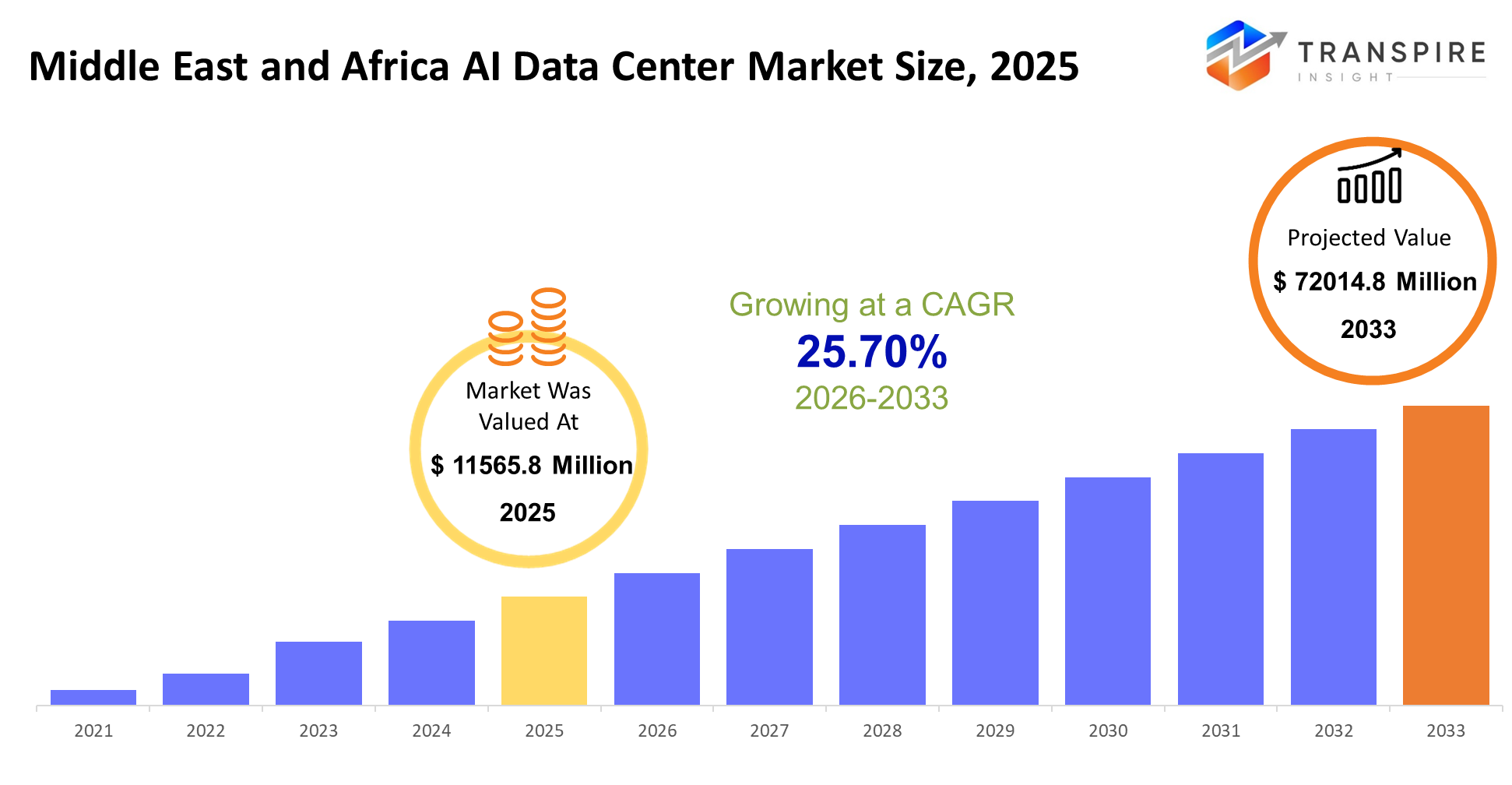
- Middle East and Africa AI Data Center Market Size 2025: USD 11565.8 Million
- Middle East and Africa AI Data Center Market Size 2033: USD 72014.8 Million
- Middle East and Africa AI Data Center Market CAGR: 25.70%
- Middle East and Africa AI Data Center Market Segments: By Component (Hardware, Software), By Data Center Type (Hyperscale, Colocation, Enterprise), By Cooling Type (Air, Liquid), By Application (AI Training, Inference), By End-User (IT Companies, Enterprises, Cloud Providers)
To learn more about this report,  Download Free Sample Report
Middle East and Africa AI Data Center Market Summary:
The Middle East and Africa AI Data Center Market size is estimated at USD 11565.8 Million in 2025 and is anticipated to reach USD 72014.8 Million by 2033, growing at a CAGR of 25.70% from 2026 to 2033. The Middle East and Africa (Saudi Arabia, United Arab Emirates, South Africa, Rest of Middle East and Africa) AI Data Center Market will show a shift toward local computing systems which will run on infrastructure within the sector. The governments will focus on maintaining data ownership which will require operators to establish their facilities nearer to customer locations. The enterprise requirement for faster AI training and inference processing will determine how facilities should be designed to achieve energy efficiency through their liquid-cooling systems. The national strategies of Saudi Arabia and the United Arab Emirates will boost hyperscale investments while South Africa will serve as the central hub for regional connectivity. The selection of sites and methods of power acquisition and partnership establishment will follow sustainability goals and regulatory guidelines throughout the corridors.
What Has the Impact of Artificial Intelligence Been on the Middle East and Africa AI Data Center Market?
The artificial intelligence technology is currently developing new operational methods for the Middle East and Africa AI data center industry which uses AI technologies to improve decision-making through enhanced accuracy and speed and system performance. The Middle East and Africa AI data center market uses AI technology to create market research and data analysis tools which analyze massive datasets through real-time processing to help operators identify usage patterns and workload requirements and regional consumption patterns.
The Middle East and Africa AI data center market benefits from artificial intelligence which boosts operational production rates and enhances intelligent automation capabilities throughout its facilities. The AI-driven systems will handle the management of cooling systems and power distribution and server usage with little need for human operators which will lead to cost savings and better system availability. AI-powered forecasting tools will optimize supply chain processes by helping organizations to acquire equipment more efficiently while eliminating obstacles and improving vendor collaboration. The upcoming technological improvements will enable organizations to achieve faster project delivery times and better expense management throughout the area.
Artificial intelligence will deliver more than efficient operations because it will create new business opportunities for companies to develop unique products that set them apart from their rivals. The service providers will create customized solutions that can expand according to business needs to support enterprise operations while they track emerging industry developments. The intelligent infrastructure system will allow operators to handle increasing digital demands while they compete in a fast-moving business environment.
Key Market Trends & Insights:
- Due to an increase in AI-dependent applications, the Middle East and Africa AI data center industry market is poised for tremendous growth.
- The industry size is predicted to cross the multi-billion USD mark by 2030 owing to high growth rates and market share of hyperscale companies.
- Increased AI demand is encouraging the deployment of liquid cooling and high-density racks within the Middle East and Africa AI data center market.
- Advanced technologies such as predictive analytics and machine learning are helping improve efficiency, minimizing downtime and energy usage in facilities.
- The adoption of secondary cities as hubs for expanding AI data center operations is expected to be common soon.
- Saudi Arabia is the most dominant country with over 35% market share in 2025 owing to digital transformation programs and infrastructural development by the government.
- United Arab Emirates will have the fastest-growing Middle East and Africa AI data center market from 2025 to 2030.
- South Africa will also occupy considerable market share due to developed connectivity network and regional data center.
- Hyperscale data centers will maintain dominance in the market with more than 50% share in 2025.
- Colocation services will be the second-biggest segment owing to SMEs' need of economical data center facilities.
- The edge data center segment accounts for the highest growth rate and is forecasted to grow considerably up until 2030 owing to its real-time AI processing requirements.
- Cloud computing represents the highest usage of applications, with 45% market share driven by digital transformation of enterprises and hybrid cloud adoption.
- Artificial intelligence (AI)-based analytics holds the title of fastest-growing application segment with its rising demand for predictive analytics and automation solutions.
- The IT and telecommunications industry holds the largest market share with more than 40%, attributed to the growing data traffic and rollout of 5G networks.
Middle East and Africa AI Data Center Market Segmentation
By Component
There will be continued relevance for hardware in the coming years, due to the increased need for fast computers, powerful GPUs, and effective storage systems. The development of infrastructure will revolve around providing the necessary computing power for AI applications and ensuring proper data processing capabilities. Software will become more relevant as smart systems take charge of workloads, automate various processes, and optimize performance.
The use of software solutions will make operations such as real-time tracking and prediction of maintenance requirements easier, as well as workload balancing. There will be increasing reliance on speed and reliability for digital services. The ongoing process of developing software together with hardware integration will provide optimal system performance. The current trend will determine how countries in the region will build their infrastructure.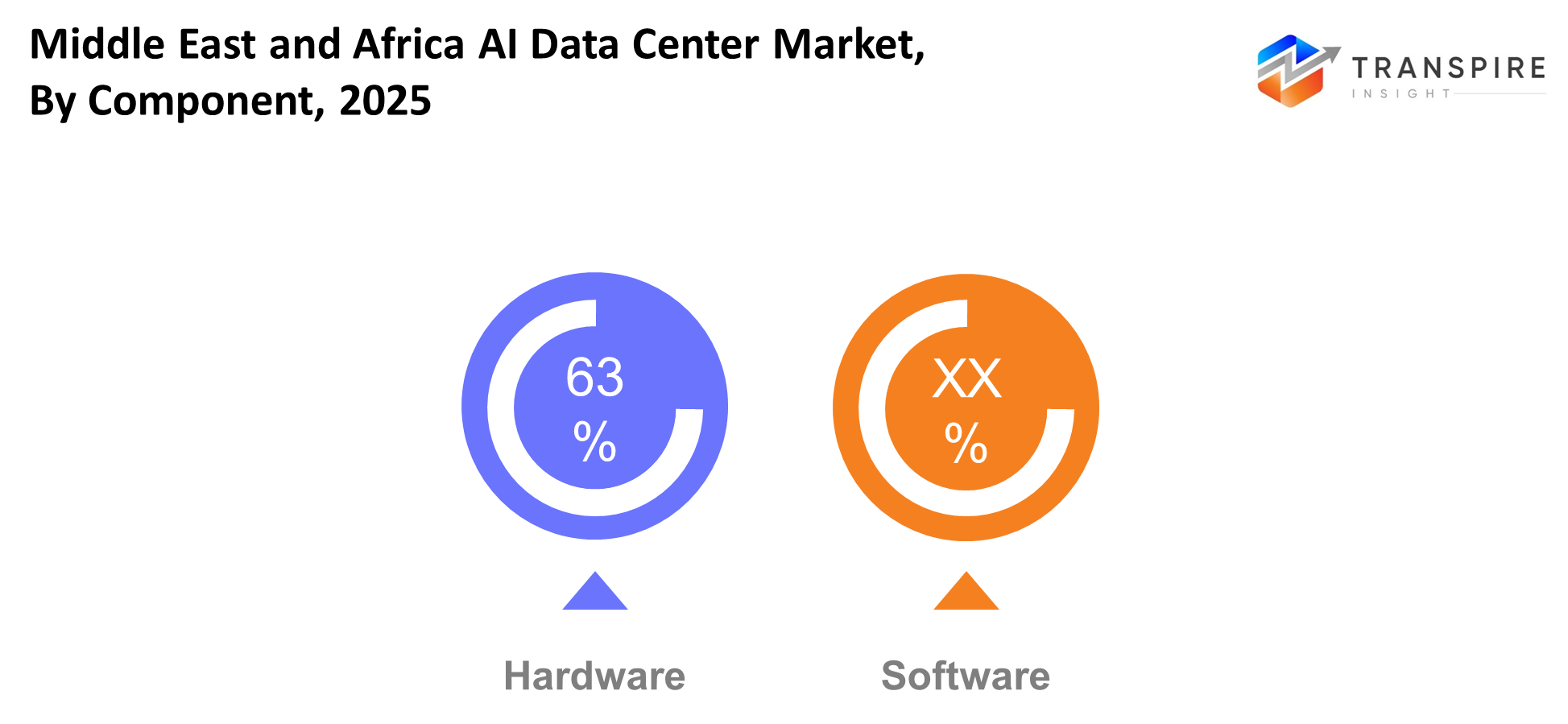
To learn more about this report, Download Free Sample Report
By Data Center Type
Hyperscale facilities will prevail owing to substantial investments made by cloud providers and government-led digital transformation programs. Such facilities will be able to process a significant amount of data and provide computing capacity for the increasing number of uses of artificial intelligence. Colocation facilities will attract customers who would prefer to invest less in infrastructure. Enterprises will use their own data centers to ensure complete control over their internal processes and data security.
Colocation facilities will be more proactive about offering a broader range of services to satisfy the demands of startups and medium enterprises. Hyperscale facilities will concentrate on optimizing their performance and reducing their carbon footprint to compensate for their high energy consumption levels. Enterprises will have hybrid centers to keep up with new trends and requirements.
By Cooling Type
Despite its ease and cheaper installation costs, air cooling will continue to be preferred because of its straightforward nature. On the other hand, the rising computational needs will result in greater heat production, prompting users to adopt more sophisticated techniques. This will see liquid cooling gaining traction owing to its ability to manage heat effectively and use power more efficiently. It is likely to be adopted during new constructions that aim at maximizing AI capabilities.
The user will assess the upcoming cost efficiency of various cooling systems. The operation of the liquid cooling system is necessary for sustainability because it consumes less power and extends equipment operational life. However, the air cooling system will remain relevant when there are few workloads.
By Application
AI training is going to rely on robust computing frameworks, which can handle large volumes of data and construct sophisticated AI models. This sector is going to contribute towards the rising need for robust and scalable infrastructure that can address demanding workloads. Inference will keep growing as organizations utilize trained AI models for applications like automation and analytics.
Workloads associated with AI training are likely to continue clustering in highly equipped large-scale facilities. Inference applications are expected to diversify across various sectors, leading to the increased requirement for efficient data processing. This ratio is likely to impact the way data centers are built and optimized. Advancements in algorithms are likely to enhance efficiency in both sectors.
By End-User
It will be driven mainly by IT firms that have constant needs for processing and management of data, development of software, and other digital services. The need to enhance decision making and operational efficiency will push organizations to invest more in AI infrastructure. The providers of cloud computing services will deliver essential IT solutions to enterprises through their ability to provide flexible and scalable systems. Each of those end-user segments will add up to the demand for enhanced data centers in the region.
Cloud computing providers will expand their geographic footprint to meet increasing demands from clients for fast and reliable access to their services. Hybrid and multi-cloud systems will be implemented among organizations to achieve a balance between cost efficiency and performance. IT firms will keep innovating through incorporation of AI technologies.
What are the Main Challenges for the Middle East and Africa AI Data Center Market Growth?
However, there are numerous technical and logistical challenges that still hinder the pace and efficiency of deployments in the middle east and africa AI data center market. The requirements for high-performing AI applications necessitate advanced hardware, but issues of performance reliability and thermal management persist. Scalability is another challenge, as it involves substantial improvements in power consumption and cooling technologies. Moreover, logistical restrictions concerning procurement of AI-specific hardware also add to the challenges experienced in the middle east and africa AI data center market.
Furthermore, barriers associated with manufacturing and commercialization also influence the development of the middle east and africa AI data center market. The construction of AI-enabled data centers necessitates complex building standards and expensive compliance requirements. Issues of adherence to local data privacy and energy regulations lead to longer development periods and increased operating costs. Moreover, cost considerations associated with AI data center technology, such as liquid cooling and large-scale server storage, pose limitations on scaling initiatives.
Further adoption barriers exist owing to inadequacies within infrastructure and technical know-how of a few nations. Many parts are still not supplied with electricity and fast internet, thus not providing the necessary resources to operate on AI technology. Underfunding and lack of investment in new markets limit the scope for growth. All these factors hamper the ability of enterprises to embrace data centers, thus reducing the rate of development of the middle east and africa AI data center market.
There are also some competitive threats and future risks involved in this regard, as players in the global scene keep coming up with more sophisticated technologies, thus increasing price pressures. Frequent innovations mean that older equipment might get obsolete, leading to additional investments being made regularly. Changing regulation policies and the sustainability demands will affect strategic planning in the middle east and africa AI data center market.
Country Insights
With the help of investments in public infrastructure and digital programs, Saudi Arabia will become stronger in its positions. The expansion strategy of this country will involve a development towards a smart city and AI-powered services, which creates the need for more modern facilities. In addition, power availability and governmental programs will promote capacity building and infrastructural development.
As one of the most important regions in terms of connectivity and favorable legislation, UAE will still be a home for global companies. Its further growth will be stimulated with cloud services and innovation hubs, which contribute to AI implementation. Besides, the location of this region is very important in terms of inter-border data flow.
Due to already available telecom infrastructure and rising enterprise needs in digital transformation, South Africa will keep being an attractive country for development. The further investments will be related to the increase in power availability and connectivity to create the right environment for AI tasks.
The remaining part of the Middle East and Africa is expected to see slow improvements due to filling of the gaps in the infrastructure and funding. The nations will concentrate on increasing their connectivity and inviting investments from abroad to facilitate their growth digitally. The local requirement for data storage and cloud computing will increase gradually.
Recent Development News
In March 2026, Alphabet Inc. announced acquisition. Google’s parent company agreed to acquire data center and energy infrastructure firm Intersect for $4.75 billion to strengthen power capacity supporting AI data center expansion.https://timesofindia.indiatimes.com
In April 2026, the BlackRock-led consortium announced the acquisition. A group including BlackRock, Microsoft, Nvidia, and UAE-backed MGX moved forward with a ~$40 billion acquisition of Aligned Data Centers to scale global AI data center capacity, including strategic links to Middle East investment capital.https://www.tomshardware.com
|
Report Metrics |
Details |
|
Market size value in 2025 |
USD 11565.8 Million |
|
Market size value in 2026 |
USD 14526.5 Million |
|
Revenue forecast in 2033 |
USD 72014.8 Million |
|
Growth rate |
CAGR of 25.70% from 2026 to 2033 |
|
Base year |
2025 |
|
Historical data |
2021 - 2024 |
|
Forecast period |
2026 - 2033 |
|
Report coverage |
Revenue forecast, competitive landscape, growth factors, and trends |
|
Regional scope |
Middle East and Africa (Saudi Arabia, United Arab Emirates, South Africa, Rest of Middle East and Africa) |
|
Key company profiled |
NVIDIA, Intel, AMD, Google, Microsoft, Amazon, IBM, Oracle, Dell, HPE, Cisco, Lenovo, Supermicro, Inspur, Huawei |
|
Customization scope |
Free report customization (country, regional & segment scope). Avail customized purchase options to meet your exact research needs. |
|
Report Segmentation |
By Component (Hardware, Software), By Data Center Type (Hyperscale, Colocation, Enterprise), By Cooling Type (Air, Liquid), By Application (AI Training, Inference), By End-User (IT Companies, Enterprises, Cloud Providers) |
How Can New Companies Establish a Strong Foothold in the Middle East and Africa AI Data Center Market?
In order to compete effectively in the Middle East and Africa AI Data Center Market, newcomers have to develop an entry strategy that involves specialization and localization. Instead of competing directly with hyperscalers, the newcomers should focus on developing specialized solutions such as edge computing and AI-driven infrastructure for use in smart cities. In this case, newcomers will take advantage of prevailing industry trends and develop solutions to satisfy the needs of unserved consumers in the Middle East and Africa AI Data Center Market.
Innovation will increasingly play a critical role in helping newcomers secure a competitive advantage through innovations of energy-efficient data centers, modular data centers, and AI-powered automation systems. Innovations in data centers' cooling systems and maintenance systems can greatly aid newcomer companies to establish their positions in the industry since efficiency is one of the most important issues for the industry. Collaboration with telecommunication companies, governments, and cloud platforms is key to market entry.
Examples of firms that are already making use of the power of differentiation are shown by the way in which it leads to successful operations within their organizations. Organizations such as Africa Data Centres and Khazna Data Centers continue to grow thanks to their partnership and their capacity to offer their services in their target markets. These organizations come up with scalable solutions that cater to the needs of various markets, proving that they have unique approaches to market expansion within the industry.
Key Middle East and Africa AI Data Center Market Company Insights
Technology-based firms operating globally will invest heavily in building robust infrastructure and forging partnerships with regional government agencies. The firm’s financial strength will enable quick establishment of a highly efficient technology infrastructure within the region. Competitive positioning within the regions will be defined by efficient energy utilization, scalable solutions, and ability to meet the growing demand for AI-powered solutions.
The localized approach will be the preferred choice among technology providers, involving offering solutions tailored to meet individual requirements of business entities as well as improved flexibility of services delivery. Expanding operations into newer cities will create new growth avenues and provide access to new customers. Competitive advantage will be determined by understanding regional needs, keeping costs low, and fostering partnerships within the region.
Alliances will emerge among companies to compete effectively, with companies entering into strategic partnerships to improve access to technologies. Investment in innovations such as cooling and automation technologies will make companies better able to deliver services efficiently.
Company List
What are the Key Use-Cases Driving the Growth of the Middle East and Africa AI Data Center Market?
The AI data center market in the Middle East and Africa region is expanding because different industries require actual solutions which deliver substantial results. Healthcare needs AI systems that operate on protected data networks to achieve optimal performance when identifying patients' conditions and processing their health records. The Middle East and Africa AI data center market will experience increasing demand because hospitals and research centers need advanced computing to analyze imaging data and genomic information and monitor patients in real time.
Smart city projects which use digital systems and automated urban environments need advanced technological solutions to succeed. AI-enabled traffic systems and surveillance networks and energy management platforms will depend on low-latency data processing. The Middle East and Africa AI data center market will continue to grow because this will create a requirement for edge and hyperscale facilities. Local data management helps governments achieve operational efficiency while meeting their legal obligations for data control.
Businesses and financial institutions use artificial intelligence solutions, which create big advantages through their analytics capabilities and their abilities to identify fraud and assess customer buying behavior. Large organizations will develop data systems to manage their rising demands for operational and transactional data storage which their business activities require. AI will become a standard tool for manufacturing companies because it helps them predict equipment failures and improve production processes, thereby increasing their need for technical infrastructure.
The future growth of the system will depend on new technologies, including autonomous systems, IoT ecosystems, and real-time analytics platforms. The use cases will establish ongoing requirements which demand both faster processing capabilities and dependable storage solutions, which will turn the Middle East and Africa AI data center market into an essential element for digital transformation throughout the region.
Middle East and Africa AI Data Center Market Report Segmentation
By Component
- Hardware
- Software
By Data Center Type
- Hyperscale
- Colocation
- Enterprise
By Cooling Type
- Air
- Liquid
By Application
- AI Training
- Inference
By End-User
- IT Companies
- Enterprises
- Cloud Providers
Frequently Asked Questions
Find quick answers to common questions.
The Approximate Middle East and Africa AI Data Center Market size for the Market will be USD 72014.8 Million in 2033.
Key Segments for the Middle East and Africa AI Data Center Market are By Component (Hardware, Software), By Data Center Type (Hyperscale, Colocation, Enterprise), By Cooling Type (Air, Liquid), By Application (AI Training, Inference), By End-User (IT Companies, Enterprises, Cloud Providers).
Major Middle East and Africa AI Data Center Market players are NVIDIA, Intel, AMD, Google, Microsoft, Amazon, IBM, Oracle, Dell, HPE, Cisco, Lenovo, Supermicro, Inspur, Huawei.
The Current Middle East and Africa AI Data Center Market size is USD 11565.8 Million in 2025.
The Middle East and Africa AI Data Center Market CAGR is 25.70%.
- NVIDIA
- Intel
- AMD
- Microsoft
- Amazon
- IBM
- Oracle
- Dell
- HPE
- Cisco
- Lenovo
- Supermicro
- Inspur
- Huawei
Recently Published Reports
-
Dec 2024
3D Optical Profiler Market
3D Optical Profiler Market Size, Share & Analysis Report By Type (Desktop 3D Optical Profiler, and Portable 3D Optical Profiler), By Technology (Confocal Technology, and White Light Interference), By End-Use Industry (Manufacturing, Research Institutions, Automotive, Aerospace and Defense, Medical Devices, and Other), and Geography (North America, Europe, Asia-Pacific, Middle East and Africa, South and Central America), 2021 - 2031
-
Feb 2025
Depth Sensor Market
Depth Sensor Market Size, Share & Analysis Report By Type (Infrared Depth Sensors, Time-of-Flight (ToF) Sensors, Stereo Vision Sensors, Structured Light Sensors, Ultrasonic Depth Sensors), By Application (Automotive, Robotics, Gaming, Consumer Electronics, Industrial Automation, Healthcare, Security & Surveillance, Others), By End Users (Automotive Manufacturers, Consumer Electronics Companies, Healthcare Providers, Industrial Companies, Security Agencies, Gaming Companies, Robotics Companies, Others), and Geography (North America, Europe, Asia-Pacific, Middle East and Africa, South and Central America), 2021 – 2031
-
Feb 2025
Digital Manufacturing Market
Digital Manufacturing Market Size, Share & Analysis Report By Component (Hardware, Software, and Services), By Technology (Robotics, 3D Printing, Internet of Things (IoT), and Others), By Application (Automotive and Transportation, Aerospace and Defense, Consumer Electronics, Industrial Machinery, and Others), By Process Type (Computer-Based Designing, Computer-Based Simulation, Computer 3D Visualization, Analytics, and Others), and Geography (North America, Europe, Asia-Pacific, Middle East and Africa, South and Central America), 2021 – 2031
-
Feb 2025
Digital Visa Services Market
Digital Visa Services Market Size, Share & Analysis Report By Type (Individual Travelers, Group Travelers), By Application (Tourism, Business Travel, Others), and Geography (North America, Europe, Asia-Pacific, Middle East and Africa, South and Central America), 2021 – 2031