

Global Revenue Management Software Market Summary:
According to Transpire Insights, a detailed research report on the market reflects that the cloud-based deployment segment dominates the Global Revenue Management Software Market, accounting for approximately 71% of the total share worldwide. Oracle Corporation leads the market with approximately (around USD 57.4 billion) in annual revenue and an estimated 18–22% global market share, making it the leading contributor to global market development, innovation, AI-driven revenue optimization, cloud-based revenue management solutions, advanced analytics, and overall market growth dynamics.
Market Snapshot
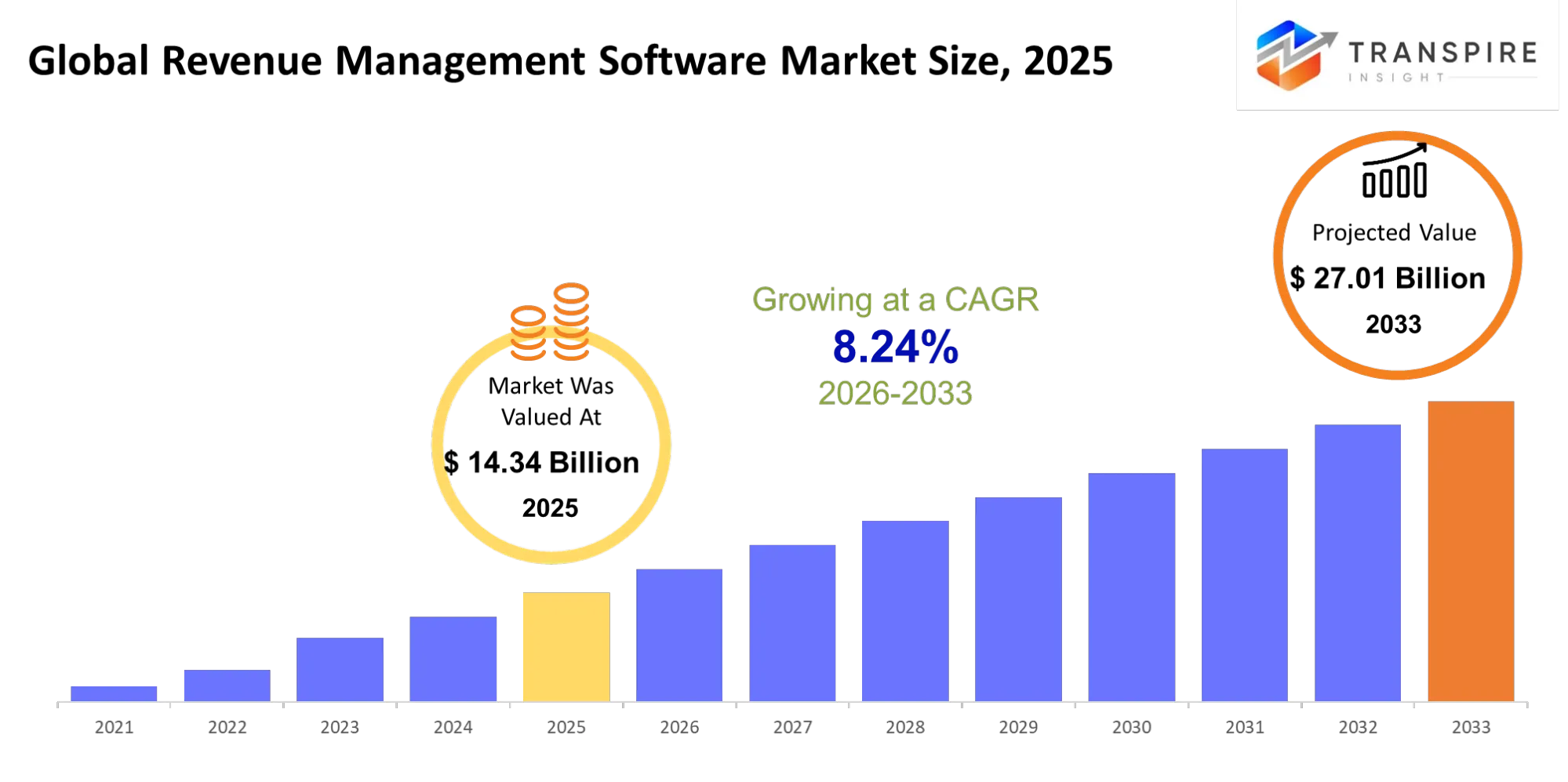
- Global Market Value (2025): USD 14.34 Billion.
- Expected Market Value (2026): USD 15.52 Billion.
- Estimated Market Value (2033): USD 27.01 Billion.
- Forecast CAGR (2026–2033): 8.24%.
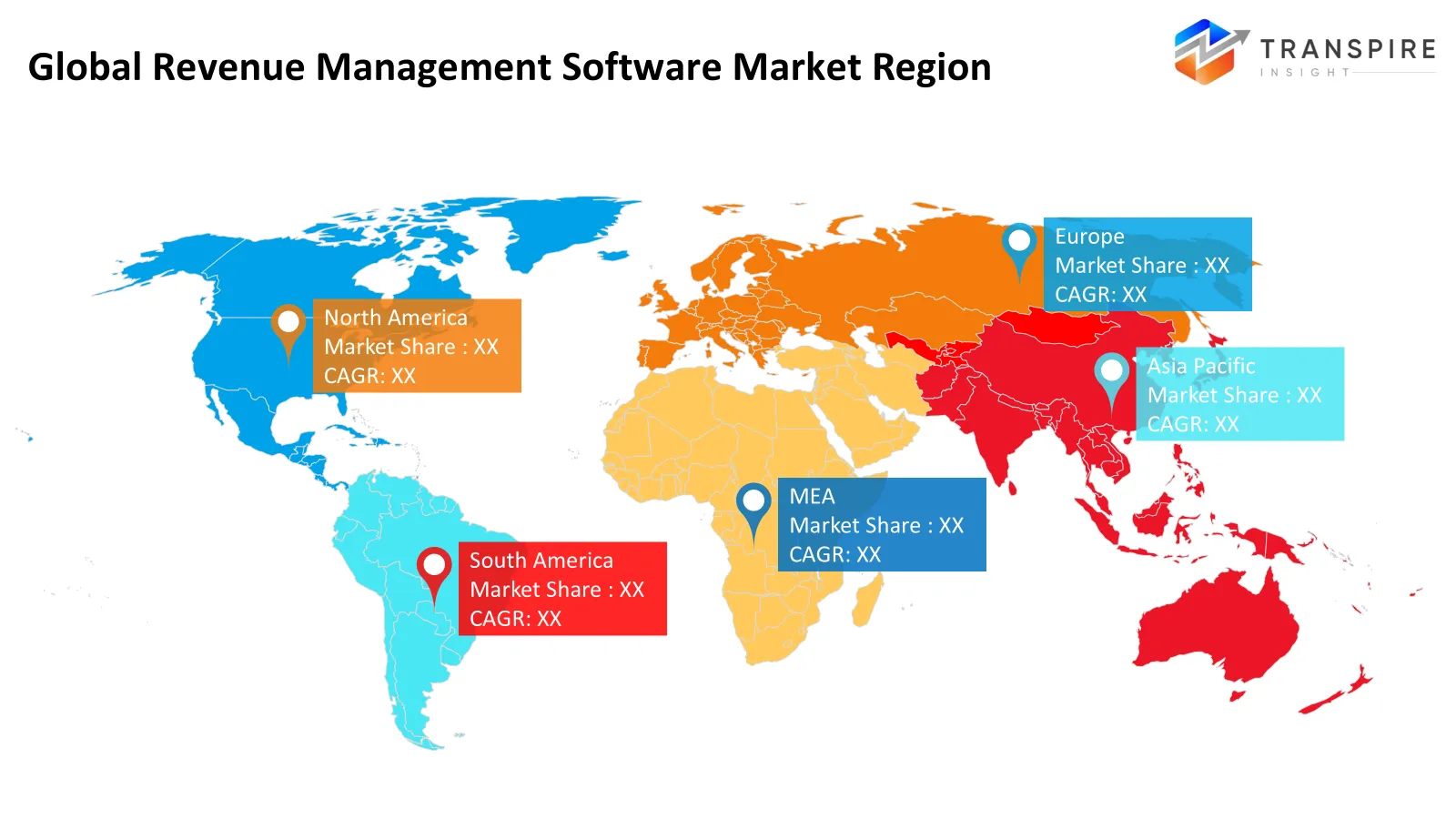
- Leading Region in 2025: North America
- Second-largest Region: Europe
- Fastest Growing Region: Asia Pacific
Introduction
Selling the right product to the right consumer at the right time and price is the strategic practice of revenue management. By combining past data, market trends, and customer behavior, revenue management software (RMS) digitizes this process. To prevent income leakage, it automatically adjusts prices, controls channel distribution, and regulates billing. In order to optimize product availability and price elasticity and increase revenue and profitability, revenue management (RM) uses analytics to forecast customer behavior at the micromarket level. Revenue Management System (RMS): a technological system that automates pricing, product distribution, and client segmentation using data and algorithms. Dynamic pricing and profitability, ensures you make the most money during peak times by automatically modifying prices and inventory in real-time based on supply, demand, and competitor data. By automating revenue recognition, forecasting, and billing reconciliation, time savings and automation eliminate up to 90% of manual operations, lowering operating expenses and reducing human error. Data-driven forecasting, makes use of AI and predictive analytics to provide up to 80% more accurate revenue projections, enabling you to proactively adjust to shifting customer behavior. Seamless compliance, makes complicated revenue recognition rules like IFRS 15 and ASC 606 easier to understand. Unified financial ecosystem, breaks down departmental silos by integrating seamlessly with your current ERP or billing platform.
- June 2026 – Namics Corporation expanded its advanced semiconductor materials portfolio by introducing next-generation molded underfill materials designed for high-density flip-chip and advanced packaging applications. The new materials enhance package reliability, thermal performance, and mechanical strength for AI, HPC, and automotive semiconductor devices.
Key Market Highlights: -
- North America is anticipated to hold approximately 44% share of the Global Revenue Management Software Market over the predicted timeframe.
- Europe is expected to grow at a rapid CAGR in the Global Revenue Management Software Market by holding approximately27% of the share during the forecast period.
- Asia Pacific is anticipated to hold approximately22% share of the Global Revenue Management Software Market over the predicted timeframe.
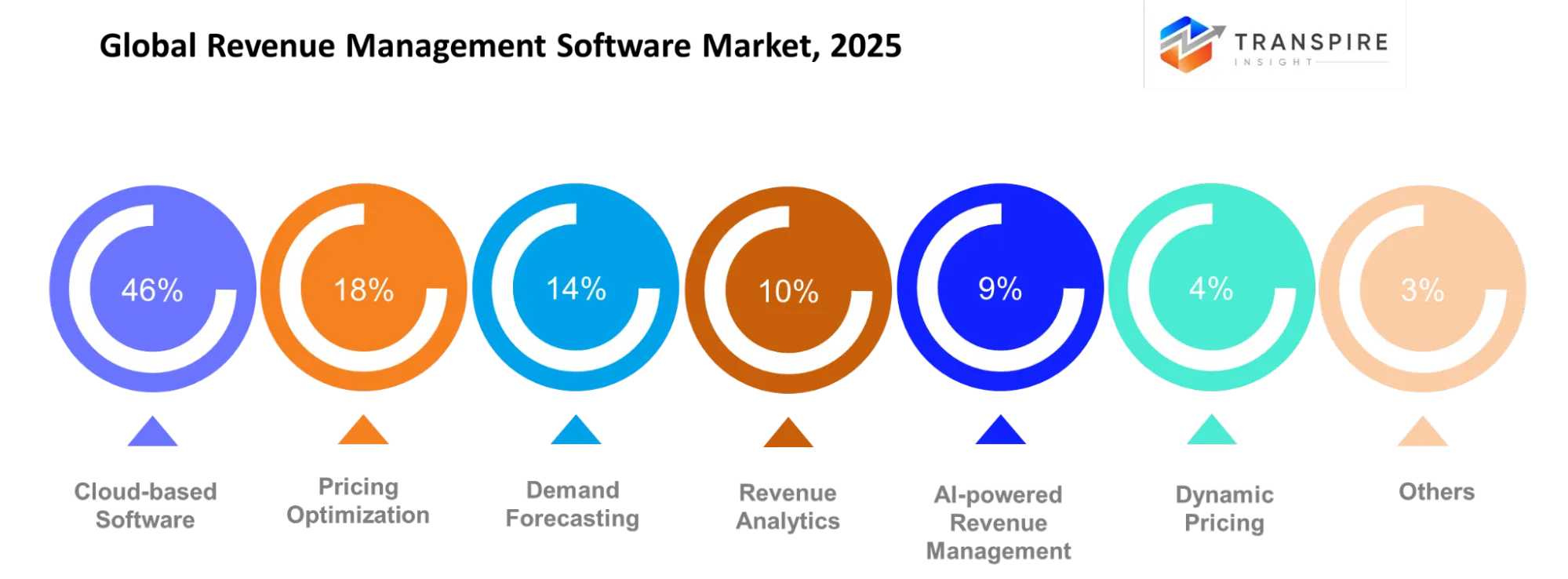
- By deployment, the Cloud-based Software segment dominated the market and holds approximately 46% share in 2025 and is projected to grow at a substantial CAGR during the forecast period.
- By component, the Pricing Optimization segment dominated the market and holds approximately 35% share in 2025 and is projected to grow at a substantial CAGR during the forecast period.
- By end user, the BFSI (Banking, Financial Services, and Insurance) segment dominated the market and holds approximately 30% share in 2025 and is projected to grow at a substantial CAGR during the forecast period.
- By application, the Price Management segment dominated the market and holds approximately 25% share in 2025 and is projected to grow at a substantial CAGR during the forecast period.
- Global Tech Subsidies: Governments across major economies offer R&D tax credits, innovation grants, and digital transformation incentives that encourage investment in AI-enabled, cloud-based revenue management software. These policies reduce deployment costs, accelerate technology adoption, and support sustained market growth.
How is Technology Driving Growth in the GlobalRevenue Management Software Market?
By examining past, competitive, and market data, AI and machine learning provide predictive analytics, real-time demand forecasting, and data-driven price decisions. Cloud-based SaaS Platforms, using API-driven architectures, provide scalable, cost-effective deployment with seamless integration into existing enterprise systems. Revenue operations automation, to increase operational effectiveness and lower revenue leakage, streamlines pricing, billing, payment, and channel management procedures. Industry-specific solutions, provide specialized revenue optimization services for industries like retail, telecommunications, healthcare, hospitality, and transportation. Automation enhances operational efficiency by reducing manual processes and revenue leakage, while industry-specific solutions address the unique pricing, forecasting, and revenue optimization needs of diverse sectors.
Market Drivers
AI and Machine Learning Integration: To evaluate past data, estimate customer behavior, and make real-time price adjustments, businesses are making significant investments in AI/ML forecasting. Cross-industry adoption, to maximize promotions, control markdowns, and simplify billing, industries such as healthcare, retail, and media are utilizing these solutions in addition to traditional hospitality and aviation. As businesses transition to cloud-native deployments, they are moving from on-premises systems to cloud-based software to meet the need for scalable, real-time data access. Dynamic pricing maximizes profits by automatically modifying product or service prices in real-time depending on demand, competition rates, and historical data. Efficiency and ROI, by simplifying billing and reconciling, over 90% of manual revenue procedures are eliminated, frequently resulting in an annual ROI of over 95%.Improved forecasting, uses predictive analytics to provide 80% more accurate revenue modeling, reducing the possibility of fraud and wasted revenue.
- May 2026 – Henkel AG & Co. KGaA strengthened its semiconductor packaging solutions portfolio by expanding its LOCTITE underfill material offerings for advanced chip packaging. The development supports improved reliability, high-volume manufacturing, and next-generation electronic assembly for AI, consumer electronics, and automotive applications.
- The Customer Revenue Optimization (CRO) industry in the UK has reached £1.2 billion, driven by the widespread embrace of digital transformation by SMEs and enterprises.
Restrain
The Global Revenue Management Software Market faces challenges from high implementation and subscription costs, integration complexities with legacy systems, shortages of skilled professionals, and organizational resistance to adopting AI-driven, automated revenue management solutions, particularly among small and medium-sized enterprises.
Analysis of Prices and Consumer Behaviour
Implementation and subscription costs, cloud-based or on-premises deployment models, software customization, integration with current enterprise systems, and the integration of cutting-edge technologies like artificial intelligence (AI), machine learning (ML), predictive analytics, and real-time pricing optimization all have an impact on the price of the global revenue management software market. The desire for revenue optimization, operational effectiveness, precise demand forecasting, and data-driven pricing strategies drives consumer behavior in the market. To increase profitability, automate revenue operations, and improve decision-making, the hotel, retail, healthcare, telecommunications, transportation, and manufacturing sectors are seeing rising demand for AI-enabled, cloud-based revenue management software. High implementation costs, complicated legacy system integration, and recurring subscription prices, however, continue to be significant determinants of purchase decisions, especially for small and medium-sized businesses.
Top Companies in the Global Revenue Management Software Market
- Oracle
- SAP
- IDeaS Revenue Solutions
- Duetto
- Infor
- PROS Holdings
- SAS Institute
- CSG International
- Zoho
- Salesforce
- Microsoft
- Amadeus
- Atomize
- Pricefx
- Revinate
Global Revenue Management Software Market Segmentation
The Global Revenue Management Software Market share is divided into five categories: deployment, component, end user, enterprise type and application
The Cloud-based Software dominated the market, accounting for nearly 46% in 2025 and is expected to rise at a significant CAGR during the forecast period.
The Global Revenue Management Software Market is segmented by deployment into, Cloud-based Software, On-premise Software, Hybrid Software, SaaS Platforms, AI-powered Revenue Management, Enterprise Revenue Platforms, Mobile Revenue Solutions, Others. Among these, the Cloud-based Software segment dominated the market, accounting for nearly 46% in 2025 and expected to increase at a significant CAGR during the forecast period. Due to its reduced initial investment, scalability, remote accessibility, quicker deployment, smooth integration with enterprise applications, automated software upgrades, and subscription-based pricing model, cloud-based software accounted for approximately 46% of the market in 2025. These benefits enable businesses to accelerate digital transformation projects, reduce IT maintenance costs, and improve operational efficiency.
The BFSI (Banking, Financial Services, and Insurance) dominated the market, accounting for nearly 30% in 2025, and is expected to rise at a significant CAGR during the forecast period.
The Global Revenue Management Software Market is segmented by end user into, Hospitality, Airlines, Retail, Healthcare, Manufacturing, Media & Entertainment, BFSI, Others. Among these, the BFSI (Banking, Financial Services, and Insurance) segment dominated the market, accounting for nearly 30% in 2025 and expected to increase at a significant CAGR during the forecast period. Driven by the requirement for real-time pricing, profitability optimization, regulatory compliance, and revenue assurance, the BFSI (Banking, Financial Services, and Insurance) sector accounted for about 30% of the market in 2025. In order to increase forecasting accuracy, automate pricing strategies, boost operational efficiency, and optimize profitability across a range of financial goods and services, financial institutions are increasingly implementing AI-powered revenue management software.
The Price Management dominated the market, accounting for nearly 25% in 2025 and is expected to rise at a significant CAGR during the forecast period.
The Global Revenue Management Software Market is segmented by application into, Revenue Optimization, Yield Management, Price Management, Forecasting, Customer Analytics, Promotion Management, Financial Planning, Others. Among these, the Price Management segment dominated the market, accounting for nearly 25% in 2025 and expected to increase at a significant CAGR during the forecast period. Due to rising need for dynamic pricing, real-time market intelligence, and profit optimization, the Price Management category accounted for around 25% of the market in 2025. Businesses are implementing AI-powered pricing strategies to boost revenue generation across various sales channels, increase competitiveness, adapt to shifting consumer demand, and maximize margins.
Regional Segment Analysis of the GlobalRevenue Management Software Market:
- North America (U.S., Canada, Mexico)
- Europe (Germany, France, U.K., Italy, Spain, Rest of Europe)
- Asia-Pacific (China, Japan, India, Rest of APAC)
- South America (Brazil and the Rest of South America)
- The Middle East and Africa (UAE, South Africa, Rest of MEA)
North America is the fastest-growing region in the GlobalRevenue Management Software Market during the period, holding approximately 44% share.
North America is expected to grow at a rapid CAGR in the Global Revenue Management Software Market holding approximately 30% share during the forecast period. With a 44% market share, North America is the fastest-growing area in the global revenue management software market. This is due to the region's strong presence of top software providers, high adoption of AI-based analytics, sophisticated cloud infrastructure, and digital transformation initiatives. Regional growth is further accelerated by the growing demand for automated pricing, forecasting, and revenue optimization solutions.
Europe is expected to grow at a rapid CAGR in theGlobal Revenue Management Software Market, holding approximately 27% of the share during the forecast period
Europe is expected to grow at a rapid CAGR in the Global Revenue Management Software Market holding approximately 25% share during the forecast period. Due to growing digital transformation, the adoption of AI-based analytics, regulatory constraints, and the need for automated revenue optimization, Europe is predicted to develop at a quick compound annual growth rate (CAGR) in the global revenue management software market, holding a share of over 27%. Cloud-based revenue management solutions are increasingly used by companies in the hospitality, retail, banking, and transportation sectors.
Asia Pacific is the fastest-growing region in the Global Revenue Management Software Market during the period, holding approximately 22% share.
Asia Pacific is the fastest-growing region in the Global Revenue Management Software Market, holding approximately 28% share during the forecast period. With a 22% market share, Asia Pacific is the fastest-growing area in the global revenue management software market. This is due to the region's rapid digitalization, increased e-commerce activity, increasing acceptance of cloud technologies, and rising demand for AI-based pricing solutions. To improve competitiveness and operational efficiency, companies in emerging economies are investing in revenue optimization solutions.
Strategies for Market Growth in Non-Leading Regions:
The technology can lead to rapid market success in those economies that are not yet developed by using specialized achievements of cost-efficient and modular revenue management software targeted specifically at small and medium companies. The creation of local technological infrastructure including regional support centers will allow overcoming problems related to the implementation of technology and lowering operating expenses. Close partnerships with local companies involved in software distribution, industry representatives, and suppliers of enterprise technology will facilitate access to the market. Special training program development and initiatives aimed at the enhancement of the workforce will minimize the negative consequences of personnel sufficiency and contribute to the effectiveness of revenue management systems. The introduction of flexible financing, subscription pricing, and SaaS technology will make technology more affordable. Furthermore, cooperation with various government institutions, digital transformation initiatives, and online selling platforms will open the access to technology and ensure the sustainable development of the company in small countries.
Future Market Trends for the GlobalRevenue Management Software Market: -
- AI and Predictive Analytics: To automate pricing decisions, examine customer behavior, and increase real-time forecasting accuracy, platforms are incorporating cutting-edge AI and machine learning.
- Cloud-Based (SaaS) Models: Businesses are switching from on-premise legacy systems to adaptable cloud-based software, which offers cheaper upfront costs, scalability, and remote accessible.
- Total Revenue Optimization: Systems are developing to handle a variety of revenue sources. RMS currently optimizes supplementary services, food and beverage, spa, and subscription models rather of only base products (such as hotel rooms or airline seats).
- Intelligent Integration: More and more contemporary revenue management systems are made to work in unison with current operational, CRM, and ERP systems.
- Real-Time Elasticity Modeling: In order to maximize value, businesses are implementing dynamic price-plan adjustments based on competitor tracking, usage-based models, and current market conditions.
Recent Development
- In June 2026 – Mews expanded its AI-powered revenue management capabilities by fully integrating the Atomize Revenue Management System (RMS) into its hospitality platform.
- In May 2026 – Revenue Analytics was recognized as a Major Player in the IDC MarketScape, Worldwide Revenue Management Systems for Hospitality 2026 Vendor Assessment.
- In April 2026 – RateGain Travel Technologies announced a strategic partnership with Duetto to integrate AI-powered pricing intelligence with hotel distribution solutions. The collaboration enables real-time pricing optimization, automated revenue strategies, and enhanced channel management for hotels worldwide.
This study forecasts revenue at global, regional and country levels from 2020 to 2033. Transpire Insights has segmented the Global Revenue Management Software Market based on the below-mentioned segments:
Global Revenue Management Software Market, By Deployment
- Cloud-based Software
- On-premise Software
- Hybrid Software
- SaaS Platforms
- AI-powered Revenue Management
- Enterprise Revenue Platforms
- Mobile Revenue Solutions
- Others
Global Revenue Management Software Market, By Component
- Pricing Optimization
- Demand Forecasting
- Revenue Analytics
- Inventory Optimization
- Dynamic Pricing
- Reporting & Dashboards
- Workflow Automation
- Others
Global Revenue Management Software Market, By End User
- Hospitality
- Airlines
- Retail
- Healthcare
- Manufacturing
- Media & Entertainment
- BFSI
- Others
Global Revenue Management Software Market, By Enterprise Size
- Large Enterprises
- Medium Enterprises
- Small Enterprises
- Hotel Chains
- Airlines
- E-commerce Companies
- Corporate Groups
- Others
Global Revenue Management Software Market, By Application
- Revenue Optimization
- Yield Management
- Price Management
- Forecasting
- Customer Analytics
- Promotion Management
- Financial Planning
- Others
Global Revenue Management Software Market, By Regional Analysis
North America
- United States
- Canada
- Mexico
Europe
- Germany
- United Kingdom
- France
- Italy
- Spain
- Russia
- Rest of Europe
Asia Pacific
- China
- Japan
- India
- South Korea
- Australia
- Rest of Asia Pacific
South America
- Brazil
- Argentina
- Rest of South America
Middle East & Africa
- Saudi Arabia
- United Arab Emirates
- Qatar
- South Africa
- Rest of the Middle East & Africa
Frequently Asked Questions
Find quick answers to common questions.
The market was valued at USD 14.34 billion in 2025 and is expected to reach USD 27.01 billion by 2033, growing at an 8.24% CAGR.
Growth is driven by increasing AI, machine learning, cloud-based SaaS adoption, predictive analytics, dynamic pricing, automation, and demand for improved forecasting, profitability, and revenue optimization.
The Cloud-based Software segment dominated with approximately 46% share in 2025 due to scalability, lower costs, faster deployment, and seamless enterprise integration capabilities.
North America leads the market with approximately 44% share, supported by advanced technology infrastructure, AI adoption, digital transformation, and strong presence of software providers.
Future trends include AI-powered analytics, real-time pricing, SaaS platforms, intelligent integrations, predictive forecasting, and automated revenue optimization to enhance business profitability and efficiency.
- Oracle
- SAP
- IDeaS Revenue Solutions
- Duetto
- Infor
- PROS Holdings
- SAS Institute
- CSG International
- Zoho
- Salesforce
- Microsoft
- Amadeus
- Atomize
- Pricefx
- Revinat
About the Authors

Mayur Shinde
I am Mayur Shinde, a Senior Research Analyst at Transpire Insight, specializing in the Automotive & Transportation and Information & Communication Technology (ICT) Industry. My work focuses on analyzing emerging market trends, technological advancements, competitive landscapes, and industry developments to deliver accurate, data-driven insights. I am passionate about transforming complex market information into clear, actionable content that helps businesses, professionals, and decision-makers stay informed and make confident strategic decisions.

Chakradhar Khansole
Chakradhar serves as the Research Director at Transpire Insight, bringing over 8 years of experience in technology, innovation, and strategic market intelligence. He specializes in transforming complex market data into actionable business insights that enable organizations to make informed, growth-oriented decisions. Recognized for his strategic vision and analytical expertise, Chakradhar leads high-impact research initiatives, delivering comprehensive market assessments, competitive intelligence, and forward-looking industry analysis.
Recently Published Reports
-
Apr 2026
3D Optical Profiler Market
3D Optical Profiler Market Size, Share & Analysis Report By Type (Desktop 3D Optical Profiler, and Portable 3D Optical Profiler), By Technology (Confocal Technology, and White Light Interference), By End-Use Industry (Manufacturing, Research Institutions, Automotive, Aerospace and Defense, Medical Devices, and Other), and Geography (North America, Europe, Asia-Pacific, Middle East and Africa, South and Central America), 2021 - 2031
-
Apr 2026
Depth Sensor Market
Depth Sensor Market Size, Share & Analysis Report By Type (Infrared Depth Sensors, Time-of-Flight (ToF) Sensors, Stereo Vision Sensors, Structured Light Sensors, Ultrasonic Depth Sensors), By Application (Automotive, Robotics, Gaming, Consumer Electronics, Industrial Automation, Healthcare, Security & Surveillance, Others), By End Users (Automotive Manufacturers, Consumer Electronics Companies, Healthcare Providers, Industrial Companies, Security Agencies, Gaming Companies, Robotics Companies, Others), and Geography (North America, Europe, Asia-Pacific, Middle East and Africa, South and Central America), 2021 – 2031
-
Apr 2026
Digital Manufacturing Market
Digital Manufacturing Market Size, Share & Analysis Report By Component (Hardware, Software, and Services), By Technology (Robotics, 3D Printing, Internet of Things (IoT), and Others), By Application (Automotive and Transportation, Aerospace and Defense, Consumer Electronics, Industrial Machinery, and Others), By Process Type (Computer-Based Designing, Computer-Based Simulation, Computer 3D Visualization, Analytics, and Others), and Geography (North America, Europe, Asia-Pacific, Middle East and Africa, South and Central America), 2021 – 2031
-
Apr 2026
Digital Visa Services Market
Digital Visa Services Market Size, Share & Analysis Report By Type (Individual Travelers, Group Travelers), By Application (Tourism, Business Travel, Others), and Geography (North America, Europe, Asia-Pacific, Middle East and Africa, South and Central America), 2021 – 2031