
Europe Telecom Billing and Revenue Management Market Size & Forecast:
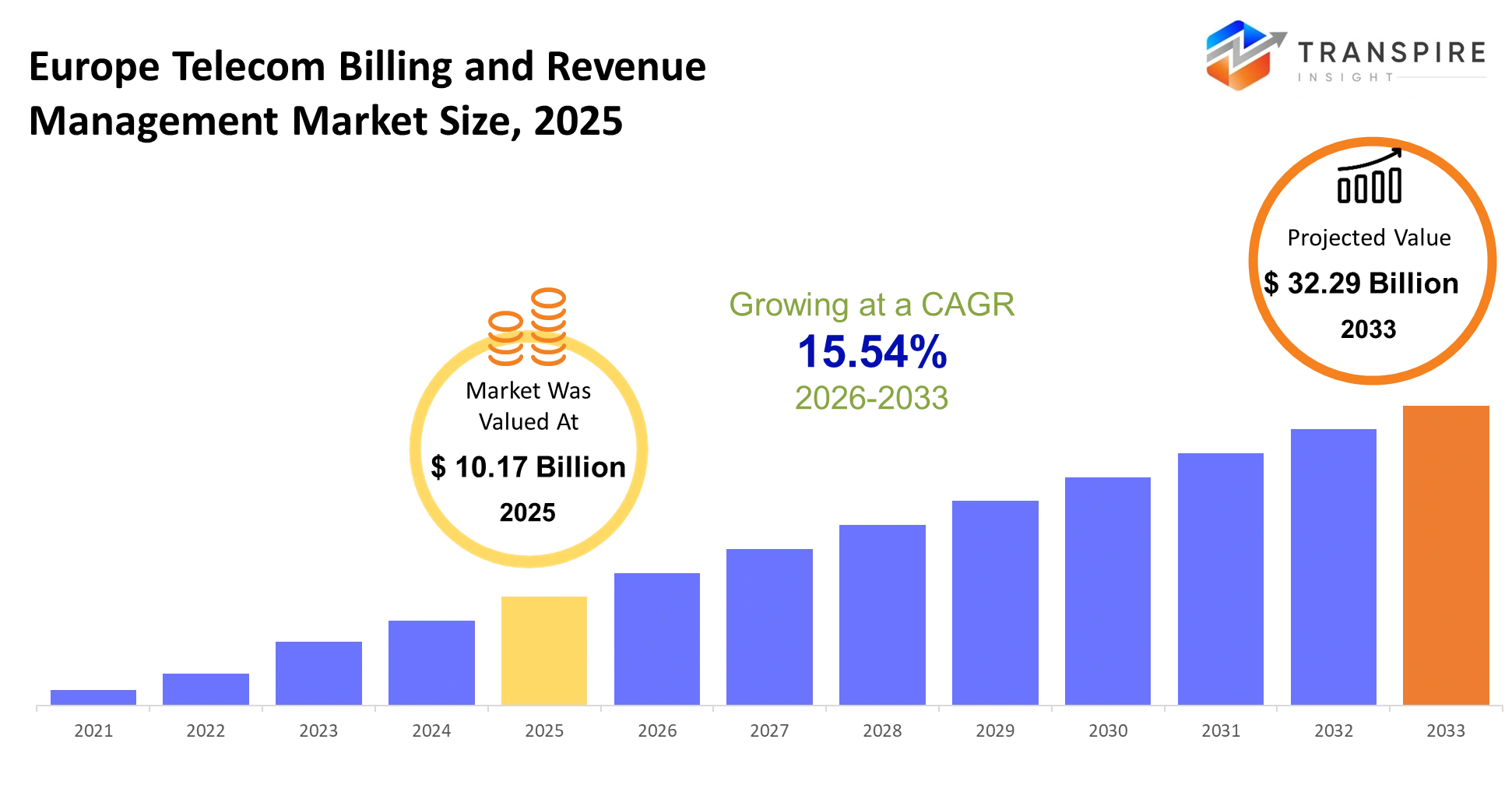
- Europe Telecom Billing and Revenue Management Market Size 2025: USD 10.17 Billion
- Europe Telecom Billing and Revenue Management Market Size 2033: USD 32.29 Billion
- Europe Telecom Billing and Revenue Management Market CAGR: 15.54%
- Europe Telecom Billing and Revenue Management Market Segments: By Type (Billing Systems, Revenue Assurance, Fraud Management, Others); By Application (Telecom Operators, ISPs, OTT Providers, Others); By End-User (Telecom Companies, Enterprises, Others); By Deployment (Cloud, On-premise, Hybrid, Others)
To learn more about this report,  Download Free Sample Report
Europe Telecom Billing and Revenue Management Market Summary
The Europe Telecom Billing and Revenue Management Market was valued at USD 10.17 Billion in 2025. It is forecast to reach USD 32.29 Billion by 2033. That is a CAGR of 15.54% over the period.
European telecom billing and revenue management systems function as essential components which support operators in their efforts to generate revenue from mobile services broadband services IoT services and enterprise connectivity solutions. The systems operate in real time to manage charging processes and partner settlement operations and subscription control activities and fraud prevention measures and customer billing procedures throughout various complex digital service systems. The system enables telecom companies to improve revenue protection while enabling them to implement various pricing strategies which include 5G services and streaming packages and Internet of Things devices.
The market has undergone changes during the past five years as companies moved away from traditional on-site billing systems toward revenue management systems which use cloud technology and artificial intelligence. After COVID-19, telecom operators encountered increased network demands, which required them to accelerate their digital customer onboarding processes and develop new service offerings at an increased pace. Europe implemented stricter data management and roaming regulations, which forced telecom operators to update their outdated billing systems. Telecom companies need advanced systems that can handle their growing 5G and IoT operations because these systems must process large numbers of fast transactions, which leads to increased spending on software and extensive service agreements.
Key Market Insights
- The European Telecom Billing and Revenue Management Market from 2025 saw Western Europe control 46% of the market because of its investment in advanced 5G infrastructure.
- The UK France and Germany generate the most regional revenue through their telecom cloud migration initiatives and their OSS/BSS modernization projects.
- The Eastern European market shows the highest growth rate between 2025 and 2030 because of increased broadband access and upcoming telecom network improvements.
- The telecom billing solutions that operate through cloud technology achieved 54% of total industry revenue in 2025 because operators prefer platforms that provide both scalability and reduced maintenance requirements.
- Telecom companies use managed services to outsource both their billing optimization work and their compliance management tasks which makes this segment the second biggest market segment.
- The AI-based revenue management software segment will experience the highest growth until 2030 because it provides businesses with tools for real-time analysis and forecast billing functions.
- Revenue assurance applications accounted for nearly 34% market share in 2025 by reducing billing errors and minimizing revenue leakage.
- The IoT billing management system developed into a fast-growing application area because of rising subscriptions for connected devices in industrial and automotive fields.
- The market in 2025 showed large telecom operators controlling 61% of the market because their subscriber bases and complicated service systems gave them an advantage.
- The MVNOs represent the end-user category which will experience the highest growth during the forecast period because their digital service models require minimal infrastructure investment.
What are the Key Drivers, Restraints, and Opportunities in the Europe Telecom Billing and Revenue Management Market?
The Europe Telecom Billing and Revenue Management Market experiences its highest expansion because of 5G network deployment and the introduction of unified digital services. European telecom operators are no longer selling only voice and data plans. They now package streaming subscriptions, IoT connectivity, cloud communications, and enterprise network services under unified billing models. Telecom companies started this transformation process because they faced decreased profits from their standard mobile services and they had to pay for rising infrastructure expenses. The companies began to make substantial investments in cloud-native billing systems which enable them to execute immediate charging operations and dynamic pricing adjustments. The telecom industry uses these platforms to launch service bundles at increased speed while they decrease revenue loss and create income from high-volume low-value transactions which result from connected devices.
The market’s biggest structural restraint is the complexity of replacing legacy OSS/BSS infrastructure across large telecom networks. Many European operators continue to use their ancient billing systems which have been in operation for more than 30 years and which connect to their customer databases and roaming systems and their regulatory compliance frameworks. The system migration process demands multiple years of financial commitments and operational downtime management and complete system testing for different platforms. The telecom industry needs to avoid service interruptions and billing errors because these two problems can lead to financial losses which causes organizations to work at a slower pace on modernization efforts. The cloud adoption process experiences delays because of this situation which also reduces short-term software deployment revenue that vendors receive.
AI-driven autonomous revenue management platforms constitute the major future business opportunity. Telecom providers across Germany, the UK, and Nordic countries are increasing investment in predictive analytics engines that identify billing anomalies, automate dispute resolution, and optimize customer pricing in real time. The growth of private 5G networks and industrial IoT deployments will create a demand for operators who need automated billing systems which can process millions of machine-to-machine transactions without needing human work.
What Has the Impact of Artificial Intelligence Been on the Europe Telecom Billing and Revenue Management Market?
The Europe Telecom Billing and Revenue Management Market experiences transformation through artificial intelligence and advanced analytics which automate complex charging, settlement, and revenue assurance functions across multi-service telecom networks. Telecom operators increasingly deploy AI-powered billing engines to process real-time usage data, detect anomalous charging patterns, and automate dispute resolution workflows. The systems enable operators to decrease manual work for invoice validation and roaming settlements and partner reconciliation processes which results in shorter billing cycles and better cash flow visibility.
Machine learning models support predictive revenue management through customer churn risk assessment and service consumption pattern forecasting and 5G and IoT pricing structure optimization. Several European telecom providers now use AI-driven analytics platforms to predict network usage spikes and dynamically allocate charging resources, improving transaction processing stability during peak traffic periods. This system enables operators to decrease revenue loss while automatically detecting compliance violations and fraud which leads to better customer retention and reduced operational support expenses.
Cloud-native telecom monetization platforms improve operational efficiency through their ability to create unified digital ecosystems which connect customer analytics with subscription management and automated policy control. AI adoption faces a significant barrier because organizations struggle to connect current analytics solutions with their existing OSS/BSS systems which have extensive legacy components. The fragmented infrastructure used by many telecom operators creates challenges for data normalization and interoperability and real-time synchronization which become costly when trying to implement these processes throughout their entire network.
Key Market Trends
- The European telecom industry has shifted from on-premise OSS/BSS systems to cloud-native billing solutions which allow multiple services to generate revenue since 2021.
- The European telecom industry moved to real-time charging systems which replaced monthly batch billing after 2023 when 5G networks became commercially available across Europe.
- Vodafone Group and Deutsche Telekom dedicated more funding to AI-based revenue assurance systems which help them detect billing errors and fraudulent activities.
- After 2020, telecom companies needed to upgrade their disconnected customer database systems and payment processing systems due to new roaming regulation standards and tighter GDPR compliance rules.
- The industrial and automotive sectors drive IoT subscription growth, which forces telecom companies to change their billing systems from consumer-based pricing to machine-to-machine billing systems.
- Since 2022, telecom companies have been using managed service contracts to outsource their billing system modernization projects because it decreases their operational workload and system implementation hazards.
- Nordic telecom companies used predictive analytics technology to enhance their billing systems which led to better customer churn prediction and automatic price determination abilities.
- The telecom industry experienced increased adoption of convergent billing systems which allowed service providers to package their broadband and streaming and cybersecurity and business connection services into one digital subscription model.
- The competitive market changed when Amdocs and Ericsson and Netcracker Technology began providing SaaS-based telecom monetization solutions throughout Western European markets.
- Eastern European telecom markets became essential areas for business growth because fiber infrastructure development improved internet service access and customer acquisition opportunities.
Europe Telecom Billing and Revenue Management Market Segmentation
By Type:
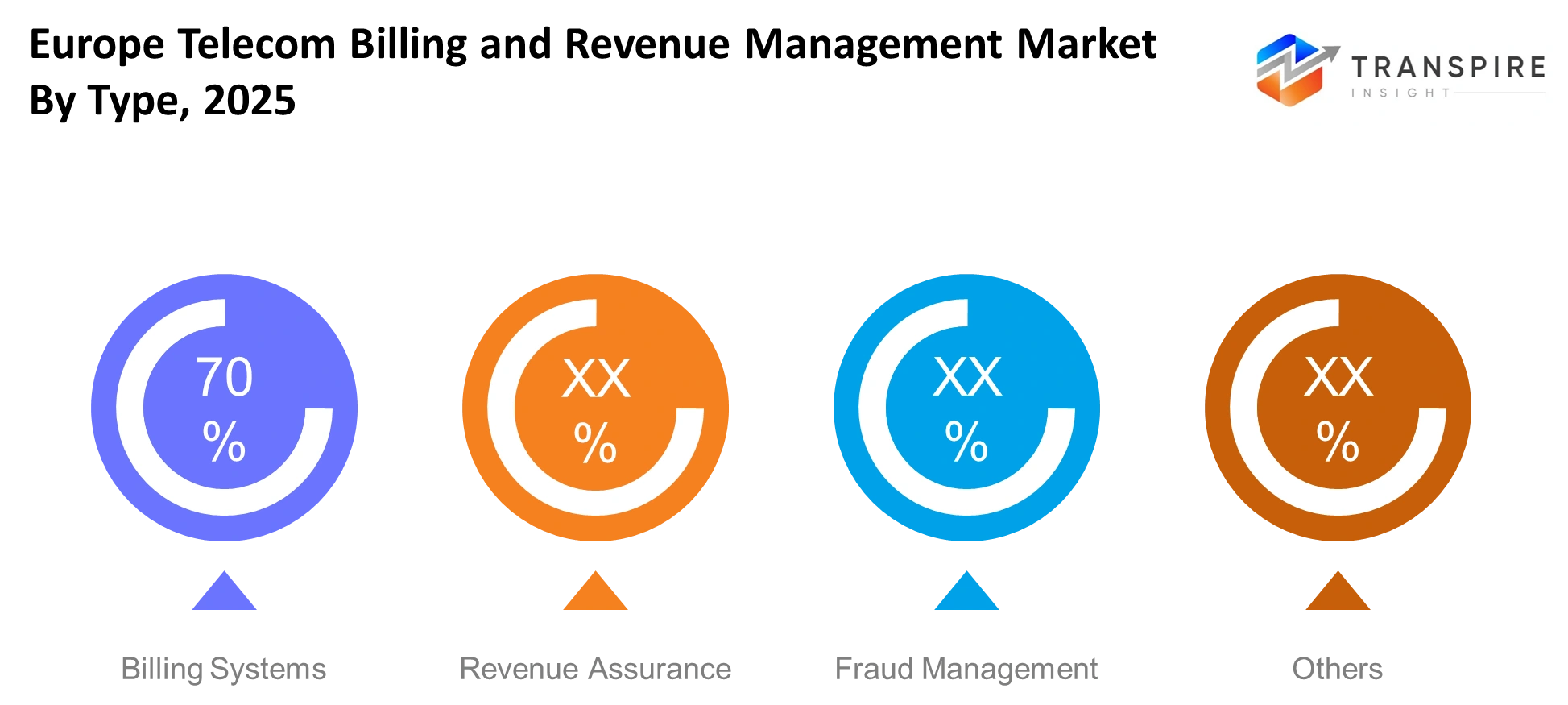
The telecom industry showed strong revenue growth through 2025 because billing systems provided more than 40% of total revenues as operators chose to implement convergent charging systems together with real-time invoicing functions. European telecom networks required adaptable monetization systems because 5G subscriptions and digital wallets and bundled service offerings experienced rapid growth. Large operators continued to upgrade their existing billing systems by implementing cloud-native solutions which could handle high-volume payments and changing pricing structures.
The revenue assurance and fraud management sectors experienced rapid growth because telecom companies encountered rising financial difficulties which affected their profit margins. AI-based fraud detection tools together with automated reconciliation engines prevented revenue losses from roaming settlements and digital payment disputes. Telecom companies requested product developers to create predictive analytics tools together with automated compliance systems which would decrease operational risks and speed up dispute resolution. Telecom software vendors and infrastructure providers will invest more in hybrid monetization suites during the forecast period because these systems combine billing with fraud prevention and customer analytics functions.
To learn more about this report, Download Free Sample Report
By Application:
The telecom market showed its strongest demand through telecom operators which controlled approximately 50% of total market demand in 2025 because they operated large subscriber networks and offered new digital services. The commercial launch of 5G standalone networks required operators to update their billing systems which needed to deliver low-latency performance together with enterprise connectivity and IoT billing support. Operators required automated revenue management systems because they needed to launch products faster while decreasing their billing cycle delays.
The expansion of OTT providers as a subscription-based digital entertainment service and cloud communication platform required them to develop scalable recurring billing systems. Eastern European ISPs invested in automated invoicing systems because their fiber broadband expansion projects resulted in increased customer acquisition. Future market direction will favor platforms which can handle multi-service subscription orchestration together with usage-based pricing and partner settlement automation to manage telecom and digital content ecosystems.
By End-User:
Telecom companies accounted for the largest share of end-user spending in 2025 because large-scale network operations generated complex billing environments involving roaming, enterprise contracts, and bundled digital services. Businesses relied on automated charging and revenue assurance systems because they handled high transaction volumes through mobile, broadband, and machine-to-machine connectivity. Telecom providers increased their investment in AI-enabled analytics platforms to enhance customer retention and decrease billing disputes.
The adoption of enterprise solutions progressed throughout the period because private 5G networks and cloud based communication services became available to manufacturing and logistics and financial services. Large enterprises increasingly required centralized billing systems capable of managing multiple connectivity contracts and subscription-based communication services. The demand for customizable billing ecosystems which integrate cybersecurity and analytics and cloud service management tools will drive enterprise monetization platform providers to develop software solutions throughout the forecast period.
By Deployment:
The market witnessed its top performance through cloud deployment in 2025 when it achieved approximately 54 percent market share because telecom operators needed to reduce infrastructure expenses while increasing software deployment efficiency. The cloud-native billing systems which operated in cloud environments allowed service providers to launch digital services through automated software updates while processing transactions in real time without needing to purchase additional physical systems. The 5G network expansion and subscriber growth made telecom operators to increase their operational flexibility, which led to higher demand for services.
Established operators started to adopt hybrid deployment models because they needed to handle sensitive customer data through on-premise systems while using cloud systems for their analytics and charging processes. Telecommunication companies faced challenges with on-premise systems because the solutions required expensive maintenance and failed to meet the current telecom monetization demands. The software vendors will find important business prospects through hybrid cloud architecture during the forecast period because it enables organizations to achieve secure data interoperability and efficient data control and fast transaction processing capabilities.
What are the Key Use Cases Driving the Europe Telecom Billing and Revenue Management Market?
Real-time customer billing and convergent charging remain the primary use cases driving adoption across European telecom networks. Large mobile operators depend on advanced revenue management platforms to process high-volume 5G data usage, roaming transactions, and bundled subscription services with minimal billing latency. Operators who handle multiple countries for their subscriber base and settle business connectivity deals show the highest need for this service.
Secondary use cases are expanding rapidly across broadband providers and OTT service companies. Fiber internet providers in Eastern Europe use automated invoicing and customer lifecycle management tools to accommodate their increasing subscriber base. OTT platforms use telecom billing systems to handle subscription payments and partner settlements and promotional price models for their streaming and digital communication services.
The industrial sectors of manufacturing logistics and smart mobility now use IoT monetization and private 5G billing management as their newest applications. Telecom providers are testing AI-powered predictive revenue assurance tools which find billing discrepancies and improve pricing systems to prevent revenue loss.
|
Report Metrics |
Details |
|
Market size value in 2025 |
USD 10.17 Billion |
|
Market size value in 2026 |
USD 11.75 Billion |
|
Revenue forecast in 2033 |
USD 32.29 Billion |
|
Growth rate |
CAGR of 15.54% from 2026 to 2033 |
|
Base year |
2025 |
|
Historical data |
2021 - 2024 |
|
Forecast period |
2026 - 2033 |
|
Report coverage |
Revenue forecast, competitive landscape, growth factors, and trends |
|
Regional scope |
Europe (Germany, United Kingdom, France, Italy, Spain, Rest of Europe) |
|
Key company profiled |
Amdocs, Ericsson, Huawei, Nokia, Netcracker, Oracle, SAP, IBM, Comarch, CSG Systems, Subex, Cerillion, Sterlite Technologies, Optiva, MATRIXX Software |
|
Customization scope |
Free report customization (country, regional & segment scope). Avail customized purchase options to meet your exact research needs. |
|
Report Segmentation |
By Type (Billing Systems, Revenue Assurance, Fraud Management, Others); By Application (Telecom Operators, ISPs, OTT Providers, Others); By End-User (Telecom Companies, Enterprises, Others); By Deployment (Cloud, On-premise, Hybrid, Others) |
Which Regions are Driving the Europe Telecom Billing and Revenue Management Market Growth?
The Europe Telecom Billing and Revenue Management Market sees Western Europe as its leading market because Western Europe possesses advanced telecom facilities and Western Europe actively builds 5G networks and Western Europe has strict rules for data management and roaming services. Countries such as Germany and the UK and France continue their significant investments in cloud-native OSS/BSS modernization to create digital services that connect different systems. The region's major telecom operators handle intricate systems which include mobile and broadband and IoT and digital entertainment services, thus creating a greater need for automated solutions that manage billing and revenue protection. The market leadership of the region gets strengthened through a complete software vendor ecosystem and a strong presence of hyperscale cloud services and existing partnerships with telecom technology vendors.
Northern Europe achieves steady revenue growth because its telecom companies implement AI-based monetization systems and digital services which provide early warning of service failures. Nordic telecom operators choose to enhance their operational performance through predictive analytics and automatic systems for managing customer interactions while Western Europe emphasizes monetizing subscribers at a large scale. The need for real-time charging systems and cloud billing systems receives long-term backing from businesses which benefit from high digital literacy and strong enterprise connectivity capabilities. Telecom operators throughout Sweden and Finland and Denmark follow consistent modernization procedures which make software implementation and managed service contracts more predictable.
The fastest regional market growth in Eastern Europe occurs because telecom companies expand their fiber networks and 5G technology and digital customer base operations. The three countries of Poland and Romania and the Czech Republic raised their spending on infrastructure after the region's broadband modernization efforts and European Union digital transformation funding started to gain traction following 2022. The regional telecom operators currently need billing systems which can expand their capacity to manage increasing mobile data usage and digital service subscriptions while operating without major restrictions from their existing systems. The software vendors and cloud providers and managed service companies which focus on telecom monetization solutions will experience substantial market possibilities between 2026 and 2033 because of this growth path.
Who are the Key Players in the Europe Telecom Billing and Revenue Management Market and How Do They Compete?
The Europe Telecom Billing and Revenue Management Market shows moderate consolidation, with a small group of large telecom software providers controlling major operator contracts across Western Europe.Companies focus their competition on developing cloud-native systems while creating automated processes through artificial intelligence and building systems that unify mobile and broadband and Internet of Things and business customer billing operations. The established vendors use their long-term managed service agreements and their complete telecom OSS/BSS system integration to protect their existing market territories. Specialized SaaS providers build their business success through their capacity to deliver implementation times that are quicker and their ability to manage systems with less effort and their use of subscription pricing models that enable customers to choose their payment methods.
Amdocs competes through end-to-end monetization platforms that combine billing, customer experience management, and AI-driven revenue assurance within unified telecom ecosystems. The company's strong relationships with major European telecom operators enable it to execute large digital transformation projects that involve 5G monetization and cloud migration. Ericsson establishes its unique identity through its development of real-time charging systems that work most effectively in 5G networks which require minimal latency. Ericsson strengthens its market position through its expansion of cloud-native business support system partnerships which enable operators to modernize their 5G networks that operate independently.
Netcracker Technology provides hybrid cloud deployment services which help telecom operators who need ongoing system support while they implement new billing systems. The company expands its managed service offerings through new automation tools which help businesses achieve lower operational expenses and quicker service deployment. The monetization systems developed by Nokia enable enterprises to generate revenue from their private 5G networks and industrial IoT billing systems and advanced analytics functions. CSG Systems International competes through agile SaaS-based subscription management platforms which enable digital service providers and OTT ecosystems to onboard customers faster while optimizing recurring revenue across their multiple services.
Company List
- Amdocs
- Ericsson
- Huawei
- Nokia
- Netcracker
- Oracle
- SAP
- IBM
- Comarch
- CSG Systems
- Subex
- Cerillion
- Sterlite Technologies
- Optiva
- MATRIXX Software
Recent Development News
In February 2026, Amdocs announced a multi-year strategic collaboration with Amazon Web Services to accelerate AI-driven telecom modernization. The partnership combines Amdocs’ agentic AI operating system with AWS cloud technologies to help telecom operators modernize billing, customer experience, and revenue management infrastructure faster across large-scale 5G environments. https://www.nasdaq.com
In March 2026, Netcracker Technology expanded its partnership with Rakuten Mobile to support AI-enabled digital BSS operations. The agreement strengthened deployment of automated telecom monetization and customer management systems, reflecting rising operator investment in AI-based billing automation and cloud-native revenue management platforms.https://www.netcracker.com
What Strategic Insights Define the Future of the Europe Telecom Billing and Revenue Management Market?
The Europe Telecom Billing and Revenue Management Market is moving toward fully automated, AI-orchestrated monetization ecosystems capable of handling real-time transactions across 5G, IoT, satellite connectivity, and enterprise digital services. The collapse of traditional telecom revenue models has become the driving force that compels operators to create revenue streams from their dispersed usage-based service offerings which require less operational expenses and enable quicker product launches. Over the next five to seven years, telecom billing platforms will increasingly function as intelligent revenue optimization engines rather than back-office accounting systems.
The system faces an underrecognized threat because vendor establishments are becoming more centralized around a limited number of cloud-native OSS/BSS solution providers. The telecommunications industry faces a major danger because large operators will become dependent on software systems that create major challenges when they need to switch software applications.
A major emerging opportunity exists because private 5G and industrial IoT monetization platforms are expected to expand throughout manufacturing and logistics centers across Eastern Europe. Market participants should prioritize modular, API-driven billing architectures that support rapid integration with enterprise applications, edge computing systems, and AI-powered analytics platforms before large-scale industrial deployments mature after 2028.
Europe Telecom Billing and Revenue Management Market Report Segmentation
By Type
- Billing Systems
- Revenue Assurance
- Fraud Management
- Others
By Application
- Telecom Operators
- ISPs
- OTT Providers
- Others
By End-User
- Telecom Companies
- Enterprises
- Others
By Deployment
- Cloud
- On-premise
- Hybrid
- Others
Frequently Asked Questions
Find quick answers to common questions.
The Europe Telecom Billing and Revenue Management Market size is USD 32.29 Billion in 2033.
Key segments for the Europe Telecom Billing and Revenue Management Market are By Type (Billing Systems, Revenue Assurance, Fraud Management, Others); By Application (Telecom Operators, ISPs, OTT Providers, Others); By End-User (Telecom Companies, Enterprises, Others); By Deployment (Cloud, On-premise, Hybrid, Others).
Major Europe Telecom Billing and Revenue Management Market players are Amdocs, Ericsson, Huawei, Nokia, Netcracker, Oracle, SAP, IBM, Comarch, CSG Systems, Subex, Cerillion, Sterlite Technologies, Optiva, MATRIXX Software.
The Europe Telecom Billing and Revenue Management Market size is USD 10.17 Billion in 2025.
The Europe Telecom Billing and Revenue Management Market CAGR is 15.54% from 2026 to 2033.
- Amdocs
- Ericsson
- Huawei
- Nokia
- Netcracker
- Oracle
- SAP
- IBM
- Comarch
- CSG Systems
- Subex
- Cerillion
- Sterlite Technologies
- Optiva
- MATRIXX Software
Recently Published Reports
-
Apr 2026
3D Optical Profiler Market
3D Optical Profiler Market Size, Share & Analysis Report By Type (Desktop 3D Optical Profiler, and Portable 3D Optical Profiler), By Technology (Confocal Technology, and White Light Interference), By End-Use Industry (Manufacturing, Research Institutions, Automotive, Aerospace and Defense, Medical Devices, and Other), and Geography (North America, Europe, Asia-Pacific, Middle East and Africa, South and Central America), 2021 - 2031
-
Apr 2026
Depth Sensor Market
Depth Sensor Market Size, Share & Analysis Report By Type (Infrared Depth Sensors, Time-of-Flight (ToF) Sensors, Stereo Vision Sensors, Structured Light Sensors, Ultrasonic Depth Sensors), By Application (Automotive, Robotics, Gaming, Consumer Electronics, Industrial Automation, Healthcare, Security & Surveillance, Others), By End Users (Automotive Manufacturers, Consumer Electronics Companies, Healthcare Providers, Industrial Companies, Security Agencies, Gaming Companies, Robotics Companies, Others), and Geography (North America, Europe, Asia-Pacific, Middle East and Africa, South and Central America), 2021 – 2031
-
Apr 2026
Digital Manufacturing Market
Digital Manufacturing Market Size, Share & Analysis Report By Component (Hardware, Software, and Services), By Technology (Robotics, 3D Printing, Internet of Things (IoT), and Others), By Application (Automotive and Transportation, Aerospace and Defense, Consumer Electronics, Industrial Machinery, and Others), By Process Type (Computer-Based Designing, Computer-Based Simulation, Computer 3D Visualization, Analytics, and Others), and Geography (North America, Europe, Asia-Pacific, Middle East and Africa, South and Central America), 2021 – 2031
-
Apr 2026
Digital Visa Services Market
Digital Visa Services Market Size, Share & Analysis Report By Type (Individual Travelers, Group Travelers), By Application (Tourism, Business Travel, Others), and Geography (North America, Europe, Asia-Pacific, Middle East and Africa, South and Central America), 2021 – 2031