

United Kingdom MVNO Market Size & Forecast
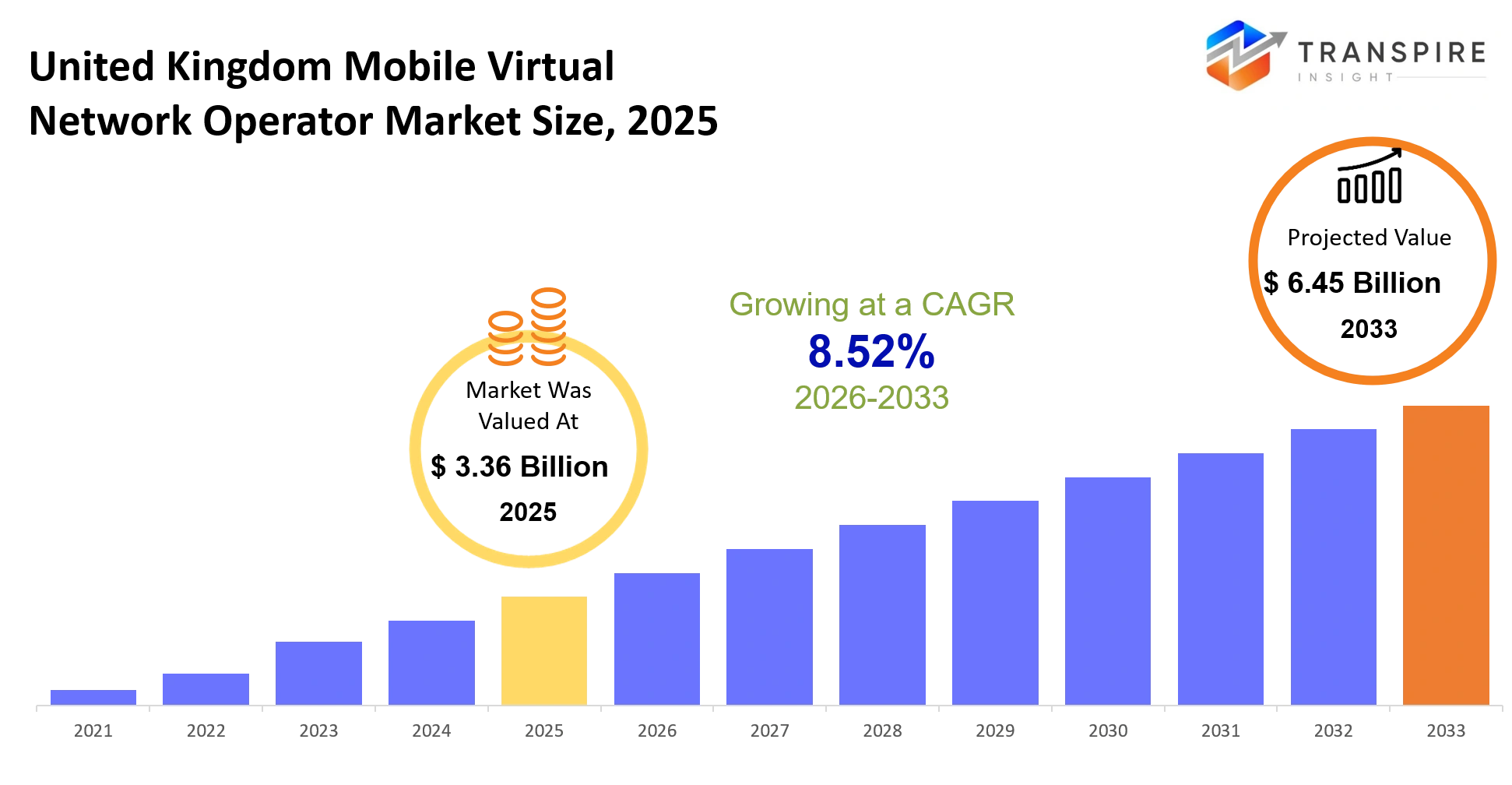
- UK MVNO Market Size 2025: USD 3.36 Billion
- UK MVNO Market Size 2026: USD 3.64 Billion
- UK MVNO Market Size 2033: USD 6.45 Billion
- UK MVNO Market CAGR: 8.52%
- UK MVNO Market Segments: By Service Type (Prepaid, Postpaid, Data, International Roaming, Value-Added, Others), By Business Model (Reseller MVNO, Service Operator MVNO, Full MVNO, Branded Reseller, Hybrid MVNO, Others), By Subscriber Type (Consumer, Enterprise, Government, SMEs, Wholesale, Others), By End User (Individual, Corporate, IoT, M2M, Public Sector, Others), By Application (Voice, Messaging, Data Connectivity, IoT Connectivity, Financial Services, Others), By Distribution Channel (Online, Retail Stores, Telecom Partners, Direct Sales, Third-Party Distributors, Others)
United Kingdom MVNO Market Summary
As per Transpire Insight Analysis, the UK MVNO market reached USD 3.36 Billion in 2025 and will grow to USD 6.45 Billion by 2033.
Mobile Virtual Network Operators (MVNOs) rent out network capacity from established carriers - then sell it under their own brand name. This approach lets them get started without having to pay for building and maintaining all the necessary physical infrastructure itself.
There's been quite a significant change between 2020 and 2023 as our use of data grew dramatically due to video streaming and remote work. Customers really wanted limitless data plans at very affordable prices. MVNOs responded by negotiating much larger wholesale volume deals with network operators in exchange for a better price per gigabyte. This whole-sale negotiating power let MVNOs beat the prices set by the big carriers themselves - while still keeping their profit margins intact, leading to widespread public acceptance.
It all started because of regulatory pressure from Ofcom, which required both net neutrality and wholesale roaming access. These new rules set up a very clear, standardised wholesale market - one in which MVNOs could really plan ahead and predict how much capacity they'd need without worrying about being hit with unexpected price increases.
Key United Kingdom MVNO Market Insights
- Virgin Media O2 really holds sway over the UK MVNO market share via its wholesale roaming deals with Sky Mobile and Tesco Mobile - these two control well over 15% of the consumer section by 2025.
- Giffgaff operates using a peer-to-peer referral model - and has managed to attract more than 2 million active users in the UK by offering SIM-only postpaid plans priced around 20-30% lower than those of incumbent operators' retail prices.
- Prepaid service types make up around 44% of the UK MVNO market revenue in 2025 - mainly due to high demand from international migrants, short-term UK residents, and contract-wary younger customers.
- Postpaid services represent about 38% of market revenue - and are actually expanding faster than prepaid services, since SIM-only contracts are replacing traditional bundled fixed-line and mobile plans offered by incumbents.
- Data-only segments saw a 31% increase year-on-year in 2024 - all thanks to IoT connectivity needs in smart metering, connected cars, and industrial asset tracking.
- Reseller MVNO business models dominate at around 68% of provider count - since capital requirements are very low and wholesale access is guaranteed by Ofcom regulation.
- Service Operator MVNOs, which set up their own billing systems and customer service infrastructure, make up just 12% of provider count - yet they produce 35% of market revenue thanks to higher-margin contract services.
- Tesco Mobile rakes in over £280 million annually by selling mobile services to 28 million active loyalty card holders through retail stores and online channels - and then cross-selling them.
- Lyca Mobile really focuses on international roaming with 2. 3 million subscribers who depend on UK home numbers whilst living overseas, creating high margins on roaming-enabled SIM products.
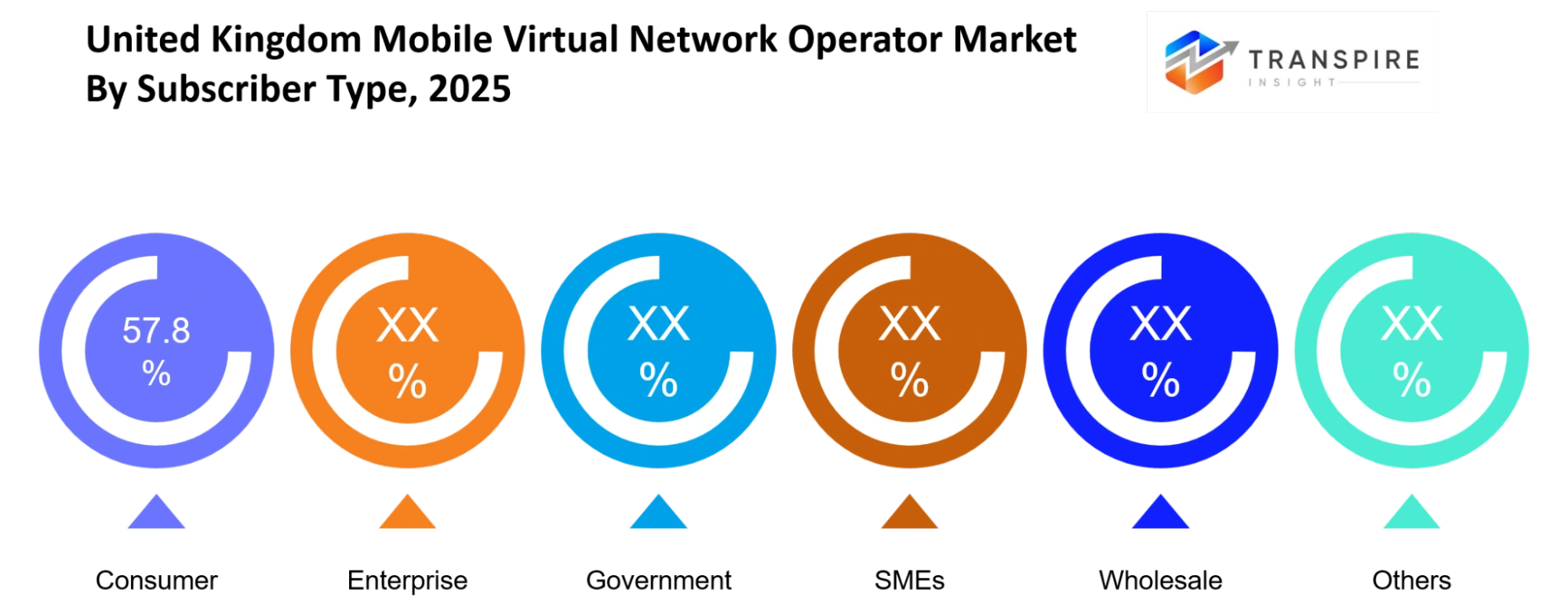
- The consumer segment makes up around 57. 8% of market revenue, while enterprise and IoT segments each account for roughly 18% and 12% respectively in 2025.
What are the Key Drivers, Restraints, and Opportunities in the United Kingdom MVNO Market?
Driver: Price-conscious consumers moving away from established network providers' contract plans towards SIM-only MVNO plans really drive growth. Established providers package fixed-line, mobile, and TV services into very costly bundles. MVNOs provide pure mobile services at 25 to 40 percent less cost - because they steer clear of fixed-line and content delivery investments. Early adopters such as giffgaff and Sky Mobile showed us that referral-based customer acquisition methods can really scale - even without expensive TV adverts, proving out the low-cost operator business model. By 2024, over 22 percent of UK mobile subscribers will have changed to an MVNO in the last three years, making up a massive pool of highly price-sensitive customers ready to jump ship again for more savings.
Restraint: Wholesale capacity allocation by the three main network operators (Vodafone, BT/EE, O2) sets a real structural supply limit. These operators hold all the UK's spectrum and physical infrastructure. They put their own retail customers first when networks get congested - which really hurts MVNO performance. During extremely busy usage times, MVNOs see average data speeds drop 15 to 20 percent compared to incumbent retail customers on the exact same network. This performance gap isn't always obvious during regular usage - but it really shows up during big sporting events or peak evening hours, causing a lot of customer dissatisfaction and churn - which severely limits growth. MVNOs can't really do anything about this because wholesale agreements lack very specific service level requirements.
Opportunity: IoT and machine-to-machine (M2M) connectivity is truly the fastest-growing application area. Smart meters, connected cars, and industrial sensors all need a SIM card with very particular data features: low bandwidth, much longer battery life, and available in quite remote areas. The UK government is mandating the installation of smart meters in every home by 2030 - which creates approximately 30 million brand-new IoT connectivity needs. Utilities like Utility Warehouse and energy companies are starting to bundle IoT SIM services with their energy supply deals, giving us a whole new way to acquire customers. MVNOs that create robust enterprise-grade IoT management systems and partner with utilities for mass device setup will really capture a huge market segment - where average revenue per user is 3 to 5 times higher than consumer mobile services.
What Has the Impact of Artificial Intelligence Been on the United Kingdom MVNO Market?
Machine learning churn prediction models enable MVNOs to spot customers likely to switch to rivals - so they can offer them special retention deals just in time. Giffgaff started using predictive churn models in 2023 which significantly decreased monthly subscriber churn from 3. 2% to 2. 1%, a 34% improvement generating an extra £18 million per year in retained revenue. Building churn predictions demands large datasets of customer behaviour over 18-24 months, really benefiting bigger established MVNOs such as Tesco Mobile and Lyca Mobile much more than new entrants who lack long-term data.
Dynamic pricing algorithms optimise retail prices based on the market sector and competitors' activities. Smaller MVNOs like Smarty and VOXI change their public plan prices every week or fortnight depending on competitor price monitoring and stock level forecasts. This algorithmic pricing ability lets smaller operators compete with larger established companies on price without needing constant human price reviews all the time. However, there's a catch: regulatory bodies demand that retail pricing be both easy to understand and transparent, severely limiting how aggressively algorithms can divide up markets - otherwise it might be seen as unfair discrimination. The UK Advertising Standards Authority has indeed questioned one MVNO's algorithm-based pricing that seemed to charge different prices to different customers for exactly the same service.
Key Market Trends
- SIM-only postpaid plans grew 26% year-over-year in 2024, capturing switchers from two-year fixed contracts offered by incumbents, which are now rarely purchased by new customers.
- 5G network rollout by Virgin Media O2 and BT/EE created wholesale 5G capacity available to MVNOs starting in 2024, enabling premium-tier marketing without infrastructure investment.
- International roaming data rates fell 48% between 2019 and 2024, compressing margins for roaming-focused MVNOs like Lyca Mobile and Truphone unless they increase subscriber volume.
- IoT connectivity revenue for UK MVNOs grew 42% in 2024, representing approximately 12% of total market revenue, up from 4% in 2019.
- Gamma Communications acquired multiple small MVNOs in 2023 and 2024, consolidating five independent operators into a single wholesale platform serving business customers.
- Direct sales channels now account for 31% of new customer acquisition, up from 18% in 2020, as MVNOs build internal sales teams to capture enterprise contracts directly.
- Third-party distributors declined from 41% to 28% of acquisition channels between 2020 and 2024, as online channels became cheaper and faster than managing retail relationships.
- Value-added services like travel insurance, device protection, and financial services bundling now generate 8% of UK MVNO market revenue, creating margin expansion beyond pure mobile connectivity.
- Full MVNO business model adoption accelerated in 2024, with four new operators launching independent billing platforms, moving away from pure reseller dependence.
- 5G IoT connectivity packages targeting connected vehicle applications grew 67% in 2024, as autonomous driving development programs and insurance companies required low-latency connectivity.
United Kingdom MVNO Market Segmentation
By Service Type
Prepaid services hold 44% of market revenue and appeal to temporary residents, migrants, and younger consumers without credit histories. Postpaid accounts for 38% and grows faster as SIM-only contracts displace bundled packages. Data-only services, international roaming, and value-added offerings together represent 18% of revenue. Data-only grew 31% in 2024 through IoT adoption. Roaming services declined due to lower EU rates post-Brexit. Value-added bundles including travel insurance and device protection now generate margins and drive customer retention.
By Business Model
Reseller MVNOs operate 68% of provider count but generate only 38% of revenue because they lack proprietary billing systems and higher-margin enterprise services. Service Operator MVNOs, representing 12% of providers, generate 35% of revenue through control of customer service and billing. Full MVNOs operate their own core networks and own 4% of provider count while capturing 18% of revenue. Branded Resellers leverage parent company assets, with Tesco Mobile and Sky Mobile together controlling 12% of revenue. Hybrid models combining reseller and service operator functions are growing at 22% annually as consolidation accelerates.
By Subscriber Type and End User
Consumer subscribers account for 57.8% of revenue, predominantly through SIM-only postpaid plans targeting price-sensitive switchers. Enterprise customers represent 18% through Gamma Communications and Truphone dedicated business platforms. Government contracts account for 8% through central procurement agreements for staff connectivity. SMEs represent 10% through co-working and flexible workspace partnerships. Wholesale partners and IoT platforms together represent 6.2% but are growing fastest at over 25% annually. Individual consumers outnumber corporate subscriptions at 3 to 1 ratio, but corporate average revenue per account is 4 times higher.
By Application
Voice services remain on 31% of MVNO plans as consumers shift to data-based messaging and calling through apps. Messaging applications handle 22% of communication volume but generate only 4% of revenue. Data connectivity drives 38% of revenue through tiered allowances ranging from 1GB to 200GB monthly. IoT connectivity represents 12% and is the highest-growth application at 42% annually. Financial services integration through mobile wallets and payment APIs generates 4% of revenue. Geographic markets show variation: Scotland emphasizes rural IoT connectivity while London focuses on data and financial services.
By Distribution Channel
Online channels account for 35% of customer acquisition and are the fastest-growing at 18% annually. Retail stores contribute 24%, concentrated in Tesco Mobile storefronts and ASDA Mobile kiosks. Telecom partner channels through MVNOs' upstream network operators represent 19% of acquisition. Direct sales teams, mostly enterprise-focused, contribute 12%. Third-party distributors declined from historical prominence to 10% of acquisition. Regional variation exists: London has 42% online penetration while rural areas favor retail and partner distribution.
What are the Key Use Cases Driving the United Kingdom MVNO Market?
Cost-conscious consumer mobile switchers comprise the primary use case. Households evaluating mobile plan renewal select MVNO SIM-only contracts that cost GBP 12 to GBP 20 monthly compared to GBP 35 to GBP 50 for incumbent operator fixed-line and mobile bundles. This use case generates recurring annual revenue from 4.2 million UK households and drives stable unit growth.
International roaming for UK residents abroad or foreign nationals living temporarily in the UK represents the second use case. Lyca Mobile and Truphone address this through zero-cost roaming and foreign SIM packages. These subscribers pay premium rates, generating 3 to 4 times higher ARPU than domestic consumer services.
IoT and machine-to-machine connectivity emerged rapidly from 2022 onward. Smart meter installations, connected vehicle trials, and industrial asset tracking all require MVNO SIM services. This use case generates highest margins and longest contract terms, making it strategically valuable despite lower current revenue contribution.
|
Report Metrics |
Details |
|
Market size value in 2025 |
USD 3.36 Billion |
|
Market size value in 2026 |
USD 3.64 Billion |
|
Revenue forecast in 2033 |
USD 6.45 Billion |
|
Growth rate |
CAGR of 8.52% from 2026 to 2033 |
|
Base year |
2025 |
|
Historical data |
2021 - 2024 |
|
Forecast period |
2026 - 2033 |
|
Report coverage |
Revenue forecast, competitive landscape, growth factors, and trends |
|
Regional scope |
United Kingdom including England, Scotland, Wales, and Northern Ireland |
|
Key companies profiled |
Virgin Media O2, Sky Mobile, Tesco Mobile, giffgaff, Lyca Mobile, Lebara, Talkmobile, ASDA Mobile, SMARTY, VOXI, Utility Warehouse Telecom, Gamma Communications, Truphone, 1pMobile, Spusu |
|
Customization scope |
Free report customization (regional & segment scope). Avail customized purchase options to meet your exact research needs. |
|
Report Segmentation |
By Service Type (Prepaid, Postpaid, Data, International Roaming, Value-Added, Others); By Business Model (Reseller MVNO, Service Operator MVNO, Full MVNO, Branded Reseller, Hybrid MVNO, Others); By Subscriber Type (Consumer, Enterprise, Government, SMEs, Wholesale, Others); By End User (Individual, Corporate, IoT, M2M, Public Sector, Others); By Application (Voice, Messaging, Data Connectivity, IoT Connectivity, Financial Services, Others); By Distribution Channel (Online, Retail Stores, Telecom Partners, Direct Sales, Third-Party Distributors, Others) |
Which Regions are Driving the United Kingdom MVNO Market Growth?
England dominates UK MVNO market with 78% of market revenue in 2025 through concentrations in London, Manchester, and Birmingham where high population density and millennial demographics support online-first MVNO acquisition. Virgin Media O2's wholesale network covers 99.9% of England population. Sky Mobile and Tesco Mobile operate extensive retail footprints in English city centers and suburban shopping centers, anchoring their customer bases. English MVNO customers exhibit highest price sensitivity and lowest switching friction, enabling market penetration by new entrants like SMARTY and giffgaff.
Scotland represents 12% of UK MVNO market, with Edinburgh and Glasgow urban hubs supporting Sky Mobile and VOXI presence. Scottish customers show higher loyalty to established UK providers, constraining new entrant adoption. Rural Scotland represents a growth opportunity for IoT and machine-to-machine connectivity through smart meter installations, creating IoT-specific MVNO demand that urban markets lack. Truphone's Edinburgh headquarters positions it as the dominant regional player.
Wales and Northern Ireland together account for 10% of market. Rural coverage challenges limit MVNO growth where wholesale network capacity is constrained. Tesco Mobile dominates both regions through retail store distribution. Growth in both regions is tied to IoT adoption in agriculture and utilities sectors rather than consumer mobile switching, which plateaued at 18% MVNO penetration.
Who are the Key Players in the United Kingdom MVNO Market and How Do They Compete?
Virgin Media O2 operates as a virtual operator on its own network infrastructure through wholesale relationships with Sky Mobile and Tesco Mobile. The company competes on wholesale capacity pricing power and brand trust from its BT/EE and Virgin Media heritage. Sky Mobile leverages British Sky Broadcasting (BSkyB) customer relationships to cross-sell MVNO services to television subscribers. Tesco Mobile operates 3,500 retail touchpoints across UK supermarkets and generates GBP 280 Million in annual MVNO revenue through loyalty program integration, making it the UK's largest consumer MVNO by revenue.
giffgaff pioneered the peer-to-peer referral model and operates as a Service Operator MVNO with proprietary billing systems. The company competes on community engagement and social media virality rather than marketing spend, attracting 2 million subscribers through referral rewards. Lyca Mobile targets international roaming and migrant communities with premium roaming rates and voice-focused plans. Gamma Communications acquired multiple business-focused MVNOs and operates the largest enterprise MVNO platform in the UK, competing on B2B integration and service operator features that consumer MVNOs lack.
SMARTY and VOXI operate as consumer-focused digital brands emphasizing mobile app simplicity and flexible monthly plans without long-term contracts. These newer entrants compete on user experience design rather than price, appealing to design-conscious younger consumers willing to pay GBP 2 to GBP 3 monthly premiums for superior app interfaces. Truphone differentiates through IoT and enterprise features, positioning itself as the only pure-play MVNO serving government and industrial IoT segments with enterprise-grade service level agreements. Consolidation pressure is driving smaller operators like 1pMobile and Spusu toward acquisition or service partnerships rather than remaining independent.
United Kingdom MVNO Market Companies
- Virgin Media O2
- Sky Mobile
- Tesco Mobile
- giffgaff
- Lyca Mobile
- Lebara
- Talkmobile
- ASDA Mobile
- SMARTY
- VOXI
- Utility Warehouse Telecom
- Gamma Communications
- Truphone
- 1pMobile
- Spusu
Recent Developments
In March 2026, Virgin Media O2 expanded 5G wholesale capacity to all MVNOs through an updated wholesale agreement that enables premium-tier 5G service plans. Previously, 5G capacity was restricted to Virgin's own retail customers. This change allows Sky Mobile and Tesco Mobile to launch competitive 5G plans, addressing the primary capability gap that prevented MVNOs from competing with incumbent 5G positioning. https://www.virginmedia.com/business/news (Virgin Media Press Release).
In February 2026, Gamma Communications completed its acquisition of Spusu, consolidating the second and fifth largest pure-play business MVNOs into a unified platform. The combined entity will operate four billing systems on a single underlying wholesale network, creating operational redundancy and reducing per-user support costs. https://www.gammacomms.com/investors (Gamma Communications Investor Relations).
In January 2026, Utility Warehouse announced its entry into the IoT connectivity market through a partnership with a major smart meter operator to provide managed SIM services for 8 million customer installations. This partnership shifts Utility Warehouse from pure prepaid reseller to a hybrid service operator model with IoT-specific capabilities. https://www.utilitywarehouse.co.uk/news (Utility Warehouse Corporate).
What Strategic Insights Define the Future of the United Kingdom MVNO Market?
The UK MVNO market will bifurcate into consumer price-focused low-margin resellers and enterprise IoT-focused high-margin service operators over the next five to seven years. Consumer prepaid and SIM-only postpaid segments are approaching saturation at 22 percent incumbent customer penetration, with further growth requiring switching from other MVNOs rather than incumbent operators. This means consumer margins will compress as MVNOs compete on price for limited share gains. Enterprise and IoT segments, by contrast, are growing at 25 to 42 percent annually and carry margin profiles 3 to 5 times higher than consumer services.
The hidden risk is wholesale network congestion at peak usage hours, which degrades MVNO customer experience relative to incumbent retail customers. As MVNO market share approaches 25 percent of total UK mobile subscribers by 2028, network operators will face pressure to implement traffic prioritization that favors higher-revenue retail customers, compressing MVNO competitiveness and dampening subscriber growth.
The emerging opportunity is smart infrastructure integration where MVNOs become service operators rather than capacity resellers. Utilities, logistics companies, and local governments are consolidating their IoT device fleets and seeking managed connectivity platforms that include device provisioning, remote management, and billing integration. MVNOs that develop IoT platform capabilities alongside pure connectivity will differentiate themselves from pure resellers and capture the highest-growth and highest-margin segments of this market.
- By Service Type
- Prepaid
- Postpaid
- Data
- International Roaming
- Value-Added
- Others
- By Business Model
- Reseller MVNO
- Service Operator MVNO
- Full MVNO
- Branded Reseller
- Hybrid MVNO
- Others
- By Subscriber Type
- Consumer
- Enterprise
- Government
- SMEs
- Wholesale
- Others
- By End User
- Individual
- Corporate
- IoT
- M2M
- Public Sector
- Others
- By Application
- Voice
- Messaging
- Data Connectivity
- IoT Connectivity
- Financial Services
- Others
- By Distribution Channel
- Online
- Retail Stores
- Telecom Partners
- Direct Sales
- Third-Party Distributors
- Others
Frequently Asked Questions
Find quick answers to common questions.
The United Kingdom MVNO Market size is expected to reach USD 6.45 Billion by 2033.
The key segments of the United Kingdom MVNO Market are By Service Type (Prepaid, Postpaid, Data, International Roaming, Value-Added, Others), By Business Model (Reseller MVNO, Service Operator MVNO, Full MVNO, Branded Reseller, Hybrid MVNO, Others), By Subscriber Type (Consumer, Enterprise, Government, SMEs, Wholesale, Others), By End User (Individual, Corporate, IoT, M2M, Public Sector, Others), By Application (Voice, Messaging, Data Connectivity, IoT Connectivity, Financial Services, Others), and By Distribution Channel (Online, Retail Stores, Telecom Partners, Direct Sales, Third-Party Distributors, Others).
Major players in the United Kingdom MVNO Market include Virgin Media O2, Sky Mobile, Tesco Mobile, giffgaff, Lyca Mobile, Lebara, Talkmobile, ASDA Mobile, SMARTY, VOXI, Utility Warehouse Telecom, Gamma Communications, Truphone, 1pMobile, and Spusu.
The United Kingdom MVNO Market size is USD 3.36 Billion in 2025.
The United Kingdom MVNO Market CAGR is 8.52% from 2026 to 2033.
- Virgin Media O2
- Sky Mobile
- Tesco Mobile
- giffgaff
- Lyca Mobile
- Lebara
- Talkmobile
- ASDA Mobile
- SMARTY
- VOXI
- Utility Warehouse Telecom
- Gamma Communications
- Truphone
- 1pMobile
- Spusu
About the Authors

Mayur Shinde
I am Mayur Shinde, a Senior Research Analyst at Transpire Insight, specializing in the Automotive & Transportation and Information & Communication Technology (ICT) Industry. My work focuses on analyzing emerging market trends, technological advancements, competitive landscapes, and industry developments to deliver accurate, data-driven insights. I am passionate about transforming complex market information into clear, actionable content that helps businesses, professionals, and decision-makers stay informed and make confident strategic decisions.

Chakradhar Khansole
Chakradhar serves as the Research Director at Transpire Insight, bringing over 8 years of experience in technology, innovation, and strategic market intelligence. He specializes in transforming complex market data into actionable business insights that enable organizations to make informed, growth-oriented decisions. Recognized for his strategic vision and analytical expertise, Chakradhar leads high-impact research initiatives, delivering comprehensive market assessments, competitive intelligence, and forward-looking industry analysis.
Recently Published Reports
-
Apr 2026
3D Optical Profiler Market
3D Optical Profiler Market Size, Share & Analysis Report By Type (Desktop 3D Optical Profiler, and Portable 3D Optical Profiler), By Technology (Confocal Technology, and White Light Interference), By End-Use Industry (Manufacturing, Research Institutions, Automotive, Aerospace and Defense, Medical Devices, and Other), and Geography (North America, Europe, Asia-Pacific, Middle East and Africa, South and Central America), 2021 - 2031
-
Apr 2026
Depth Sensor Market
Depth Sensor Market Size, Share & Analysis Report By Type (Infrared Depth Sensors, Time-of-Flight (ToF) Sensors, Stereo Vision Sensors, Structured Light Sensors, Ultrasonic Depth Sensors), By Application (Automotive, Robotics, Gaming, Consumer Electronics, Industrial Automation, Healthcare, Security & Surveillance, Others), By End Users (Automotive Manufacturers, Consumer Electronics Companies, Healthcare Providers, Industrial Companies, Security Agencies, Gaming Companies, Robotics Companies, Others), and Geography (North America, Europe, Asia-Pacific, Middle East and Africa, South and Central America), 2021 – 2031
-
Apr 2026
Digital Manufacturing Market
Digital Manufacturing Market Size, Share & Analysis Report By Component (Hardware, Software, and Services), By Technology (Robotics, 3D Printing, Internet of Things (IoT), and Others), By Application (Automotive and Transportation, Aerospace and Defense, Consumer Electronics, Industrial Machinery, and Others), By Process Type (Computer-Based Designing, Computer-Based Simulation, Computer 3D Visualization, Analytics, and Others), and Geography (North America, Europe, Asia-Pacific, Middle East and Africa, South and Central America), 2021 – 2031
-
Apr 2026
Digital Visa Services Market
Digital Visa Services Market Size, Share & Analysis Report By Type (Individual Travelers, Group Travelers), By Application (Tourism, Business Travel, Others), and Geography (North America, Europe, Asia-Pacific, Middle East and Africa, South and Central America), 2021 – 2031