

North America Mobile Virtual Network Operator (MVNO) Market Size & Forecast:
- North America Mobile Virtual Network Operator (MVNO) Market Size 2025: USD 97.4 Billion
- North America Mobile Virtual Network Operator (MVNO) Market Size 2033: USD 170.6 Billion
- North America Mobile Virtual Network Operator (MVNO) Market CAGR: 7.19%
- North America Mobile Virtual Network Operator (MVNO) Market Segments: By Type (Reseller MVNO, Full MVNO), By Service (Prepaid, Postpaid), By End-User (Consumer, Enterprise).
To learn more about this report,  Download Free Sample Report
North America Mobile Virtual Network Operator (MVNO) Market Summary:
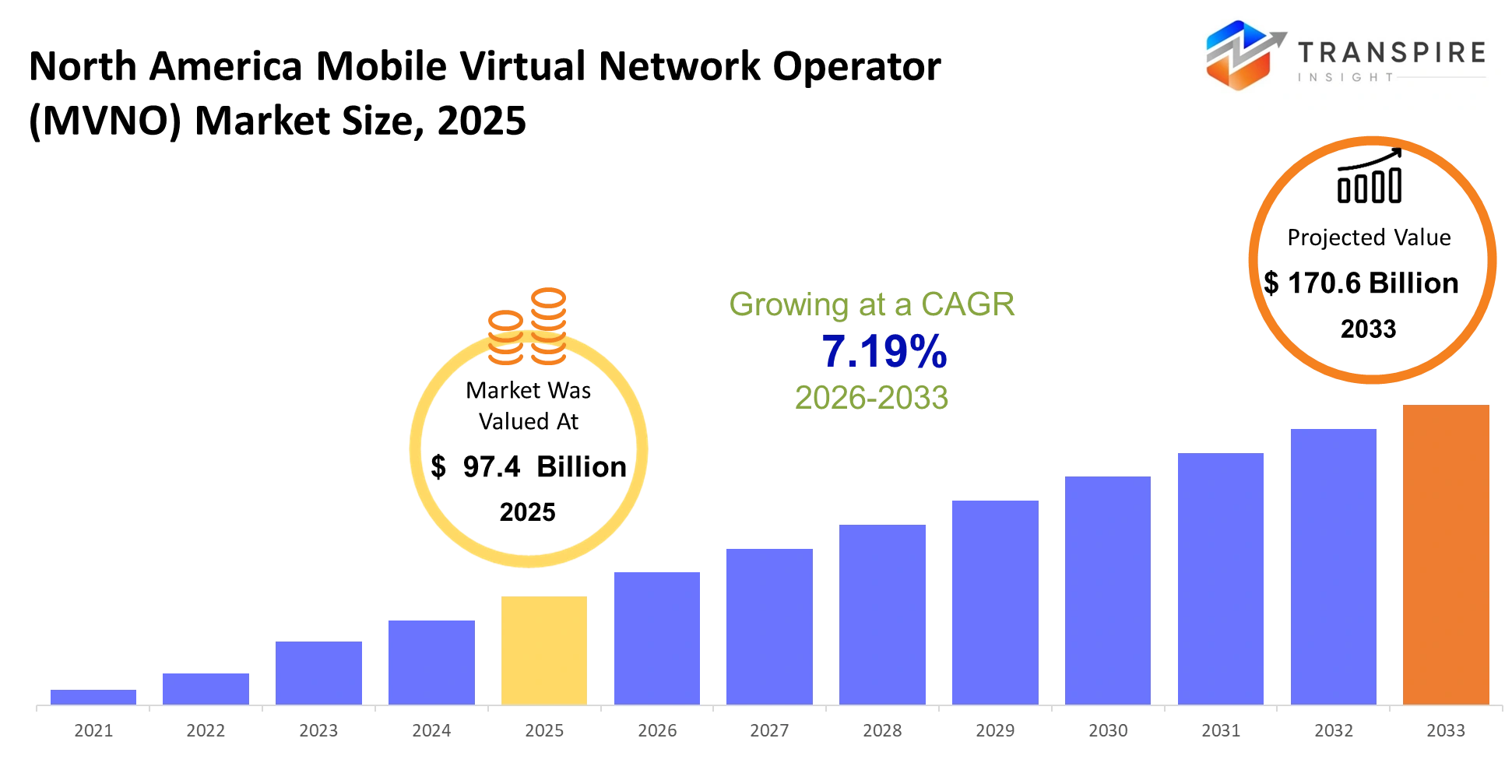
The North America Mobile Virtual Network Operator (MVNO) Market size is estimated at USD 97.4 Billion in 2025 and is anticipated to reach USD 170.6 Billion by 2033, growing at a CAGR of 7.19% from 2026 to 2033. The North America (Canada, the United States, and Mexico) Mobile Virtual Network Operator (MVNO) Market within the telecommunications services industry is shifting toward flexible offerings. Consumers will expect transparent pricing together with niche plans and digital-first onboarding, which will force providers to create new customer experiences. eSIM adoption will reduce dependence on physical distribution. cloud-native platforms will enable faster operations between networks and their partner organizations. Regulatory attention on fair competition will continue to open access for smaller brands. The prepaid culture will continue to shape both the Mexican and American markets, while Canada will develop a premium segment that matches its changing data usage patterns and need for combined digital services.
Key Market Trends & Insights:
North America (which includes Canada, the United States, and Mexico) mobile virtual network operator (MVNO) market currently experiences a trend that directs users toward planning services which match their individual needs. Customers will select service providers who match their specific requirements which include data-intensive streaming needs and affordable prepaid service options. The mvnos will develop more effective customer identification methods which enable them to create specific service packages that include adaptable pricing options instead of standard telecom solutions.
The mvnos will use digital-first engagement methods as the main approach to their business operations and customer interaction. The introduction of mobile applications plus self-service dashboards plus instant activation via eSIM technology will create new ways for users to access onboarding and support services. Customers will demand the ability to switch between networks without needing physical equipment to do so. The mvnos will develop digital ecosystems that provide users with simple navigation experiences at the same time as they decrease their dependence on physical store locations and achieve operating cost savings.
The business world will remain competitive through its partnership-driven expansion model. Retail brands and fintech platforms and content providers will team up with mvnos to create service ecosystems which include embedded connectivity solutions. The company will achieve improved customer loyalty through its unified telecom access and financial services and entertainment and e-commerce components which create an enhanced user experience across north america.
The regulatory framework together with network access regulations will determine how mvnos develop their businesses and compete with others in their field. Governments will require operators to establish fair wholesale contracts which enable smaller companies to acquire essential network resources at justifiable costs. 5G technology will advance and create new service quality standards which require mvnos to implement immediate operational changes. The company will work to achieve a balance between its pricing strategy and product performance because customers now expect rapid internet speeds and dependable network service throughout both urban and semi-urban areas.
North America Mobile Virtual Network Operator (MVNO) Market Segmentation
By Type
Reseller MVNO- Reseller MVNOs will operate through network capacity leases from established carriers because they lack any core infrastructure ownership. Their strength will lie in branding, pricing innovation, and targeted customer acquisition. The operators will focus on delivering products to market quickly while keeping their operating costs low because price-sensitive customers represent their main target market. Reseller MVNOs will develop their services through simplified plans because digital onboarding becomes more common and their network control remains restricted.
Full MVNO- Full MVNOs will achieve better network control because they operate their complete core network systems which include their billing and subscriber databases. The company will gain operational independence which enables them to design unique services through feature development that meets evolving customer demands. The company will use technological investments to enhance service reliability and operational flexibility while establishing itself as a competitive alternative to traditional carriers through radio access network partnerships.
By Service
Prepaid- Prepaid services will maintain their strong market position because users who want both budget control and service flexibility will continue to use them. Customers will prefer plans which do not require them to stay with the service provider for an extended period because this allows them to change their spending according to their actual usage. MVNOs will create appealing prepaid packages which include high data options that meet the streaming needs and social media requirements of their customers. The segment will succeed because it provides transparent information together with straightforward recharge methods which people from different income levels can use.
Postpaid- Postpaid services will attract users who value convenience bundled benefits and predictable billing cycles. The MVNOs will improve these service plans by adding entertainment subscription services and device financing options. Enterprise users and premium consumers will increasingly lean toward postpaid offerings for reliability and added perks. Providers will dedicate their efforts to creating billing systems that operate without interruptions while they develop customized plans for their clients.

To learn more about this report, Download Free Sample Report
By End-User
Consumer- The consumer segment will dominate demand because people want mobile services that are both inexpensive and packed with features. MVNOs will develop services that meet the needs of students and families and digital-native users. Customers will develop their preferences through three main factors which include personalized experiences and adaptable pricing methods and advanced digital systems. The rising demand for data leads consumers to select services which provide them with fast and dependable internet access and complete digital service packages that improve their daily connection needs.
Enterprise- Businesses will adopt enterprise solutions because they need affordable ways to handle their communication requirements. MVNOs will provide customized plans for workforce connectivity and IoT deployments and remote operations. Organizations will prefer solutions that offer them both scalable capabilities and centralized billing and exceptional customer service. The digital transformation process will make organizations need MVNOs as their flexible partners who deliver specialized services that meet their changing business communication requirements.
Regional Insights
MVNOs will establish their presence in the United States market by concentrating on specific consumer segments whose needs for mobile services differ from one another. The market will shift toward using digital methods for customer onboarding together with application-based account management and prepaid services that offer better value than existing products. Network operators need to establish strong alliances with major telecommunications companies to succeed in their business operations. MVNOs will develop their service offerings by introducing new pricing models which deliver better affordability to customers who stream content and use mobile services throughout the day.
The Canadian market will provide mvnos with a more organized space which caters to high-end customers. Consumers will expect service reliability to reach their needs while receiving combined packages that deliver both connectivity and digital services. The regulatory frameworks which govern network infrastructure access from new market entrants will determine how much competition will exist in the industry. The region's MVNOs will develop their brand identity through unique services that meet urban customer needs while using clear pricing to reach out to customers in remote areas.
The Mexican market will continue to function as a vibrant and economically flexible market which exhibits strong customer preference for prepaid services. The mobile virtual network operators will develop their services based on two main elements which include affordable pricing and simple recharge options and the ability to provide service through their extensive network. The company will depend on retail partnerships to establish customer connections that will enable them to reach various market locations. As more people start using smartphones telecom companies will create mobile plans which provide users with adequate data for their daily communication needs through social media and messaging platforms.
The growth strategies and customer acquisition methods used by mvnos will depend on the specific regional differences found throughout North America. The United States market will focus on product innovation and market segmentation while Canada will deliver premium services and Mexico will provide affordable services to its clients. The two countries will require mvnos to develop their operational methods which will enable them to operate effectively across both locations while using shared technological systems and partnership networks.
Recent Development News
United States: Expansion Through Partnerships and Digital Integration
Recent activity in the United States highlights how major non-telecom players are entering the mvno space through strategic collaborations. Cable giants Comcast and Charter are preparing a business-focused wireless service powered by T-Mobile’s 5G network, signaling deeper convergence between broadband and mobile services. At the same time, fintech platforms like Klarna are launching app-based mobile plans, reinforcing a shift toward bundled digital ecosystems and seamless eSIM-driven onboarding.
Canada: Premium Positioning and Service Enhancement Trends
In Canada, developments are leaning toward enhancing service quality and value rather than aggressive price competition. Operators are refining data offerings and adding international connectivity features to attract a more demanding user base. Across North America, examples such as Ultra Mobile increasing data allowances without raising prices reflect a broader regional expectation for higher value plans. Canadian providers will align with this trend by focusing on reliability, bundled services, and customer experience improvements.
Mexico: Affordability Meets Innovation in Emerging Models
Mexico is witnessing experimentation with unconventional mvno models that emphasize accessibility and user flexibility. New entrants are exploring privacy-focused services, including options that allow cryptocurrency-based payments and instant activation through eSIM technology. While such models will face regulatory scrutiny, they signal a shift toward alternative service structures that cater to digitally aware and cost-conscious consumers across the region.
Regional Outlook: Technology and Brand-Led Market Evolution
Across North America, recent developments show mvnos moving beyond traditional telecom boundaries into technology-driven and brand-led ecosystems. Companies are leveraging artificial intelligence, embedded connectivity, and cross-industry collaborations to differentiate their offerings. Additionally, interest from high-profile entrepreneurs and digital creators in launching branded mobile services reflects how mvnos are becoming platforms for audience monetization and customer engagement, reshaping competitive dynamics in the region.
|
Report Metrics |
Details |
|
Market size value in 2025 |
USD 97.4 Billion |
|
Market size value in 2026 |
USD 104.9 Billion |
|
Revenue forecast in 2033 |
USD 170.6 Billion |
|
Growth rate |
CAGR of 7.19% from 2026 to 2033 |
|
Base year |
2025 |
|
Historical data |
2021 – 2024 |
|
Forecast period |
2026 – 2033 |
|
Report coverage |
Revenue forecast, competitive landscape, growth factors, and trends |
|
Reional scope |
North America (Canada, The United States, and Mexico) |
|
Key company profiled |
TracFone Wireless Inc., Google Fi, Consumer Cellular Inc., Boost Mobile (Dish Network), Mint Mobile, Cricket Wireless (AT&T), Metro by T-Mobile, Ting Mobile, US Mobile, Republic Wireless, FreedomPop, Red Pocket Mobile, Lycamobile Group, Ultra Mobile, Straight Talk Wireless. |
|
Customization scope |
Free report customization (country, regional & segment scope). Avail customized purchase options to meet your exact research needs. |
|
Report Segmentation |
By Type (Reseller MVNO, Full MVNO), By Service (Prepaid, Postpaid), By End-User (Consumer, Enterprise). |
Key North America Mobile Virtual Network Operator (MVNO) Market Company Insights
The North American mobile virtual network operator market will include telecom companies and brand-based operators who will establish their competitive presence in the market. TracFone Wireless and Google Fi and FreedomPop will focus on providing digital services through their flexible pricing options. Xfinity Mobile and Spectrum Mobile will offer broadband services together with their cable-supported mobile networks. The Mexican market will see players like Bait (Walmart Mexico) develop retail systems to increase their market presence while Canadian operators will concentrate on delivering high-end services and creating better customer experiences.
Company List
- TracFone Wireless Inc.
- Google Fi
- Consumer Cellular Inc.
- Boost Mobile (Dish Network)
- Mint Mobile
- Cricket Wireless (AT&T)
- Metro by T-Mobile
- Ting Mobile
- US Mobile
- Republic Wireless
- FreedomPop
- Red Pocket Mobile
- Lycamobile Group
- Ultra Mobile
- Straight Talk Wireless
North America Mobile Virtual Network Operator (MVNO) Market Report Segmentation
By Type
- Reseller MVNO
- Full MVNO
By Service
- Prepaid
- Postpaid
By End-User
- Consumer
- Enterprise
Frequently Asked Questions
Find quick answers to common questions.
The approximate North America Mobile Virtual Network Operator (MVNO) Market size for the market will be USD 170.6 Billion in 2033.
Key segments for the North America Mobile Virtual Network Operator (MVNO) Market By Type (Reseller MVNO, Full MVNO), By Service (Prepaid, Postpaid), By End-User (Consumer, Enterprise).
Major players in the North America Mobile Virtual Network Operator (MVNO) Market are TracFone Wireless Inc., Google Fi, Consumer Cellular Inc., Boost Mobile (Dish Network), Mint Mobile, Cricket Wireless (AT&T), Metro by T-Mobile, Ting Mobile, US Mobile, Republic Wireless, FreedomPop, Red Pocket Mobile, Lycamobile Group, Ultra Mobile, Straight Talk Wireless.
The North America Mobile Virtual Network Operator (MVNO) Market size is USD 97.4 Billion in 2025.
The North America Mobile Virtual Network Operator (MVNO) Market CAGR is 7.19%.
- TracFone Wireless Inc.
- Google Fi
- Consumer Cellular Inc.
- Boost Mobile (Dish Network)
- Mint Mobile
- Cricket Wireless (AT&T)
- Metro by T-Mobile
- Ting Mobile
- US Mobile
- Republic Wireless
- FreedomPop
- Red Pocket Mobile
- Lycamobile Group
- Ultra Mobile
- Straight Talk Wireless
Recently Published Reports
-
Apr 2026
3D Optical Profiler Market
3D Optical Profiler Market Size, Share & Analysis Report By Type (Desktop 3D Optical Profiler, and Portable 3D Optical Profiler), By Technology (Confocal Technology, and White Light Interference), By End-Use Industry (Manufacturing, Research Institutions, Automotive, Aerospace and Defense, Medical Devices, and Other), and Geography (North America, Europe, Asia-Pacific, Middle East and Africa, South and Central America), 2021 - 2031
-
Apr 2026
Depth Sensor Market
Depth Sensor Market Size, Share & Analysis Report By Type (Infrared Depth Sensors, Time-of-Flight (ToF) Sensors, Stereo Vision Sensors, Structured Light Sensors, Ultrasonic Depth Sensors), By Application (Automotive, Robotics, Gaming, Consumer Electronics, Industrial Automation, Healthcare, Security & Surveillance, Others), By End Users (Automotive Manufacturers, Consumer Electronics Companies, Healthcare Providers, Industrial Companies, Security Agencies, Gaming Companies, Robotics Companies, Others), and Geography (North America, Europe, Asia-Pacific, Middle East and Africa, South and Central America), 2021 – 2031
-
Apr 2026
Digital Manufacturing Market
Digital Manufacturing Market Size, Share & Analysis Report By Component (Hardware, Software, and Services), By Technology (Robotics, 3D Printing, Internet of Things (IoT), and Others), By Application (Automotive and Transportation, Aerospace and Defense, Consumer Electronics, Industrial Machinery, and Others), By Process Type (Computer-Based Designing, Computer-Based Simulation, Computer 3D Visualization, Analytics, and Others), and Geography (North America, Europe, Asia-Pacific, Middle East and Africa, South and Central America), 2021 – 2031
-
Apr 2026
Digital Visa Services Market
Digital Visa Services Market Size, Share & Analysis Report By Type (Individual Travelers, Group Travelers), By Application (Tourism, Business Travel, Others), and Geography (North America, Europe, Asia-Pacific, Middle East and Africa, South and Central America), 2021 – 2031