
Middle East and Africa Medical Smart Rings Market Size & Forecast:
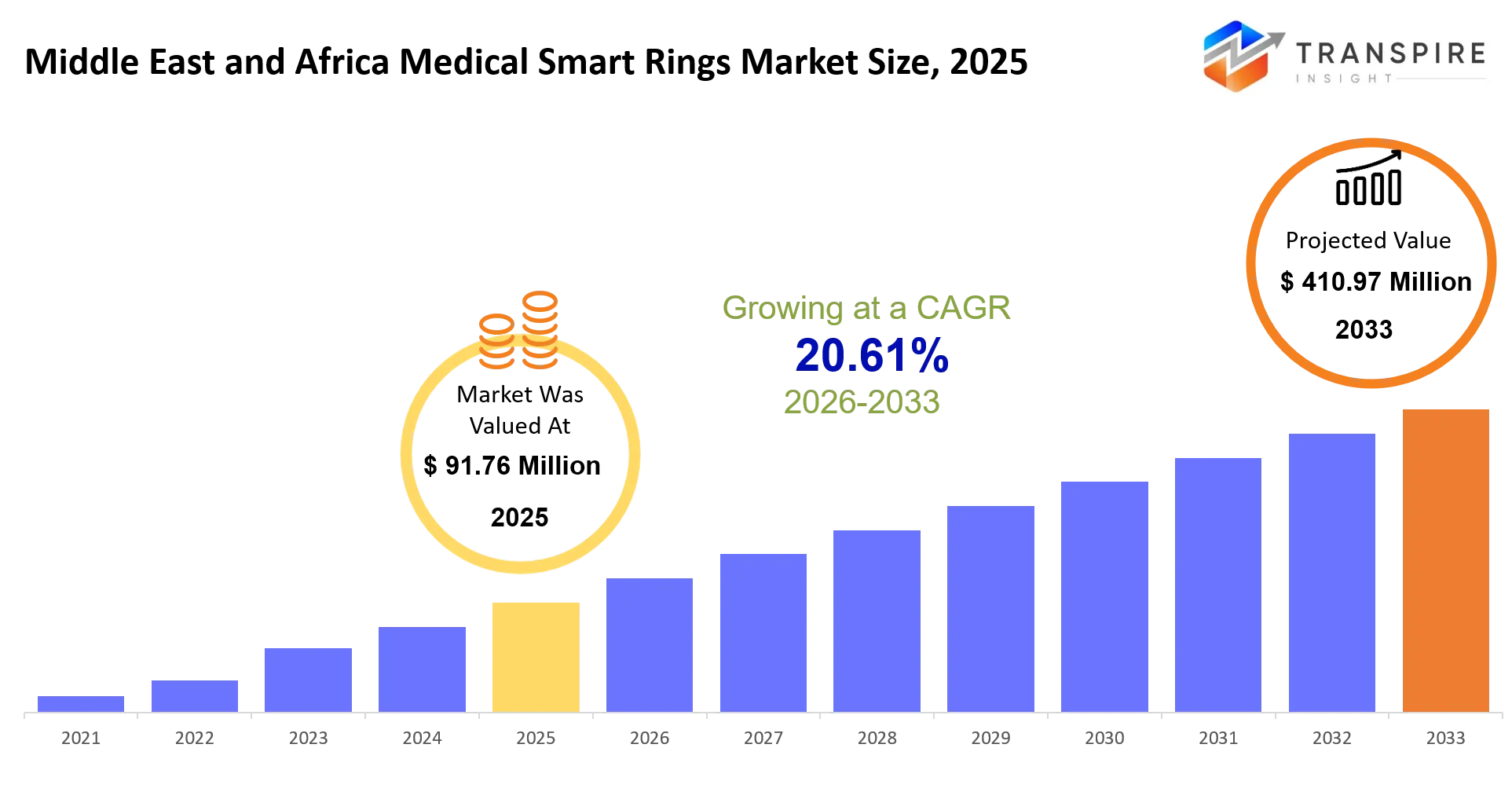
- Middle East and Africa Medical Smart Rings Market Size 2025: USD 91.76 Million
- Middle East and Africa Medical Smart Rings Market Size 2033: USD 410.97 Million
- Middle East and Africa Medical Smart Rings Market CAGR: 20.61%
- Middle East and Africa Medical Smart Rings Market Segments: By Product Type (Health Monitoring Rings, Sleep Tracking Rings, Fitness Rings, ECG-enabled Rings, Others); By Application (Heart Monitoring, Sleep Tracking, Activity Tracking, Wellness Monitoring, Others); By End User (Consumers, Hospitals, Clinics, Others); By Connectivity (Bluetooth, NFC, Others)
To learn more about this report,  Download Free Sample Report
Middle East and Africa Medical Smart Rings Market Summary
The Middle East and Africa Medical Smart Rings Market was valued at USD 91.76 Million in 2025. It is forecast to reach USD 410.97 Million by 2033. That is a CAGR of 20.61% over the period.
Medical smart rings seem to tackle a very real healthcare snag, because they can do continuous monitoring of vital signs without you needing those bulky wearable things. They are small enough, but still they check things like heart rate, how well people sleep , blood oxygen levels , activity rhythm, temperature shifts, and sometimes even ECG style signals. That way, users and healthcare professionals can spot health problems earlier, and it gets easier to handle long-term conditions in a more controlled way.
In the last five years, the market kinda moved away from purely fitness oriented wearables, and more toward health monitoring that actually feels clinically relevant. This shift has been helped by better sensor precision, smaller tech miniaturization, plus AI health analytics that can make sense of the data faster, and sometimes with less noise. The COVID 19 pandemic made everyone pay more attention to remote patient monitoring and digital health services, so healthcare systems and consumers across the Middle East and Africa started adopting connected health devices at a quicker pace.
Now, since providers want affordable monitoring tools, and consumers also want preventive care that fits everyday life, smart rings are drifting past the “wellness only” lane and into more medical-grade use cases. And with that evolution, new revenue paths are opening across healthcare services, telemedicine, and the broader digital health ecosystem.
Key Market Insights
- The Middle East and Africa Medical Smart Rings Market is seeing strong adoption of health centered wearables, sort of tied in with telehealth and wider digital healthcare ecosystems.
- In 2025, Gulf Cooperation Council countries contributed around 45% of regional revenue , largely helped by healthcare digitization moves that are already in motion.
- South Africa sits as the second biggest regional market because private healthcare infrastructure keeps growing, along with more wearable device penetration among consumers.
- Saudi Arabia is forecast to become the fastest growing country market through 2033, backed by Vision 2030 healthcare modernization investments.
- When it comes to product demand, Health Monitoring Rings led the way with almost 38% market share in 2025, which shows the ongoing clinical monitoring needs.
- Sleep Tracking Rings took the second spot as screening for sleep disorders became a more prominent healthcare priority.
- ECG enabled Rings are expected to expand quicker through 2033, since cardiovascular monitoring is getting broader clinical acceptance.
- On the application side, Heart Monitoring applications made up roughly 34% of market revenue in 2025, driven by chronic disease management programs that keep expanding.
- Hospitals and healthcare providers are also rolling out smart ring data for remote patient monitoring more often , which in turn reduces routine follow up visits.
- Key participants, like Oura, Samsung, Ultrahuman, Garmin and Huawei, are focusing on sensor innovation , AI based health insights, partnerships, and region by region expansion strategies.
What are the Key Drivers, Restraints, and Opportunities in the Middle East and Africa Medical Smart Rings Market?
The strongest growth catalyst comes from the expansion of remote patient monitoring and digital healthcare programs, you know, that kind of thing. Healthcare systems across Gulf countries are more often putting money into connected health infrastructure, in order to reduce hospital burden and also help with chronic disease management. Smart rings can deliver continuous physiological data without requiring active patient engagement, which makes them well suited for cardiovascular monitoring , sleep assessment, and long term wellness tracking. With better sensor performance and battery efficiency, providers seem more confident , and that really opens up fresh revenue pathways across telehealth and preventive healthcare services.
At the same time, the biggest barrier stays the high cost of advanced medical smart rings, plus limited reimbursement structures across much of the region. A lot of products still sit in the category of premium consumer electronics, rather than reimbursable medical devices. That structural issue slows adoption among middle income populations , and it also caps the ability for healthcare providers to roll them out at scale. On top of that, regulatory approval pathways for wearable health technologies remain fragmented across several countries. So commercialization takes longer and it can suppress potential revenue generation.
Looking ahead, a major future opportunity is in tying smart rings into AI enabled healthcare platforms and chronic disease management programs. Cardiovascular disease, diabetes, and sleep disorders keep adding pressure to regional healthcare systems, pretty consistently. Smart rings that can produce clinically actionable insights could become important tools for population health management strategies , especially when integrated with broader care models.
What Has the Impact of Artificial Intelligence Been on the Middle East and Africa Medical Smart Rings Market?
Artificial intelligence has, honestly, changed medical smart rings from kind of passive data grabbers into more “intelligent” health monitoring systems , not really just collecting info. With advanced algorithms you get continuous streams of physiological data being examined , like heart rate variability , sleep pattern shapes , blood oxygen levels, activity trends , and even temperature fluctuations. Then AI models can find abnormal patterns on their own and sort of nudge people with personalized health recommendations , so less effort goes into manually interpreting the numbers.
Also, the machine learning part has made predictive health monitoring way better. Smart ring platforms now lean on historical biometric datasets to detect early signs of cardiovascular stress, sleep disorders, recovery deficiencies , and general wellness deterioration before symptoms start to look obvious . This kind of predicting supports preventive interventions and, in turn, helps healthcare decision-making.
On the operational side, AI-driven analytics boost monitoring efficiency by filtering all that health data into clinically relevant insights. Healthcare providers can prioritize high-risk patients , and users also get more accurate health guidance. And the signal processing improvements help a lot too: sensor accuracy is better , false alerts drop down, so user confidence is stronger and adoption feels more realistic.
Still, AI adoption isn’t perfect , there are limitations. The integration costs can be high, healthcare data systems are often fragmented, and training datasets that match local regions may be limited, which can reduce predictive accuracy. Plus, lifestyle patterns , environmental conditions, and overall population health characteristics across Middle Eastern and African markets are not the same , so algorithm optimization and big deployment at scale can get complicated.
Key Market Trends
- From 2021 to 2025, smart ring makers started putting more emphasis on heart condition and sleep diagnostics, instead of only basic fitness tracking, kind of thing.
- After 2023 , ECG-enabled ring launches grew a lot , because cardiovascular monitoring turned into one of those “must have” healthcare uses.
- AI powered health scoring systems got better at foreseeing wellness needs by looking at several biometric signals at the same time, not just one stream.
- In 2025, higher-end smart ring models made up more than 60% of all product revenues , which shows people really leaned toward advanced medical features.
- Also, sleep tracking precision improved around 20–30% over earlier devices, mainly through better sensor tech, and more stable readings.
- Since 2022, remote healthcare programs have been folding in wearable-generated data into patient check routines, so clinicians could see more context.
- A bunch of regional healthcare providers put more money into digital monitoring systems to cut down on hospital visits and support better patient results.
- Companies like Oura, Samsung, and Ultrahuman sped up product development using advanced biosensors and software analytics .
- NFC capability showed up as a new development path, enabling safer connections and future healthcare applications, even if it’s not fully mainstream yet.
- Overall, manufacturers are increasingly framing smart rings as preventive health tools rather than casual consumer fitness accessories, like, a shift in the whole story.
Middle East and Africa Medical Smart Rings Market Segmentation
By Product Type
Health Monitoring Rings, Sleep Tracking Rings, Fitness Rings, ECG-enabled Rings, Others: These Health Monitoring Rings sort of take a big place in the market because they can track several indicators at once , like heart rate , blood oxygen levels , body temperature , and even recovery patterns that feel a bit “readable” day to day. Demand keeps climbing too, since healthcare providers and regular individuals want continuous monitoring tools that kinda help with preventive care and longer term health management.
Sleep Tracking Rings also pull a lot of attention, mainly because they give deeper insights into sleep duration , sleep stages, and recovery quality. And honestly , more awareness around sleep-related health conditions has helped adoption spread across both wellness spaces and healthcare settings.
Fitness Rings, meanwhile, are more about daily movement measurement, exercise tracking , calorie monitoring, and performance assessment , all packed into a small form factor that doesn’t feel bulky. ECG-enabled Rings lean hard toward cardiovascular monitoring, and they add more advanced capabilities that help spot irregular heart rhythms and other heart related signals.
For Others, the category covers newer products with specialized sensors and wellness functions aimed at stress tracking, metabolic monitoring, and extra health analytics. Going forward, product improvements and tweaks will likely encourage wider adoption, across many kinds of users and different healthcare use cases, too.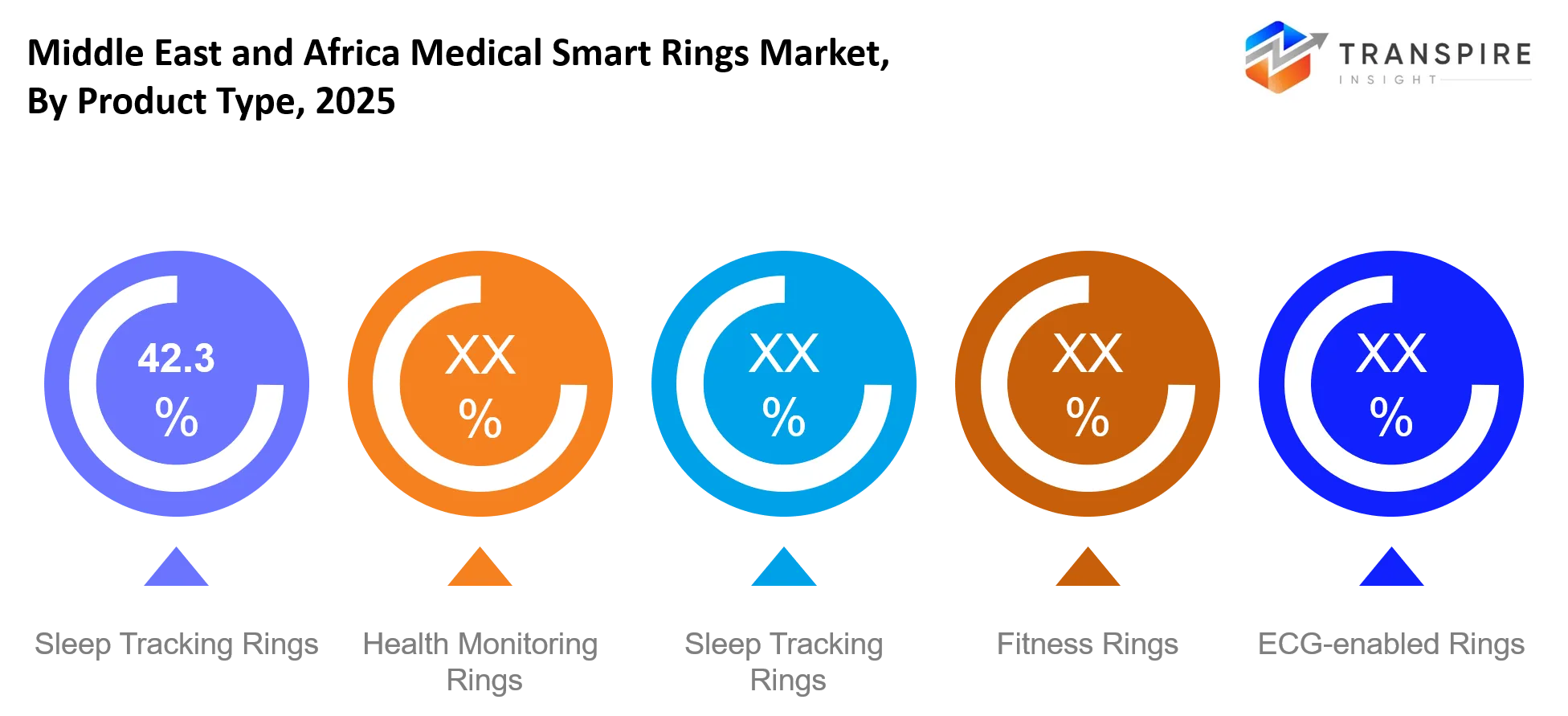
To learn more about this report, Download Free Sample Report
By Application
Heart Monitoring, Sleep Tracking, Activity Tracking, Wellness Monitoring, Others : Heart Monitoring kind of stays a big application area because continuous cardiovascular check ups still matter a lot for both preventive healthcare and chronic disease management. Smart rings give useful information that supports long-term observation of heart rate patterns and general cardiovascular wellness. Sleep Tracking keeps growing too , since healthcare organizations and regular consumers are placing more value on sleep quality and recovery rhythms. When you get detailed sleep insights, it helps people make lifestyle changes and also back health management programs.
Activity Tracking works in a direct way by measuring movement levels, exercise intensity and physical performance during the day. Wellness Monitoring blends several biometric indicators to offer a wider view of overall health condition and recovery directions. For the Others segment, you might see things like stress monitoring, temperature monitoring and deeper physiological analysis. As software features expand, and as sensors improve further, there will keep being new opportunities for application across healthcare and wellness settings.
By End User
Clinics also benefit from wearable monitoring tech, for better patient assessment and longer term health tracking abilities. The data produced by connected devices supports healthcare professionals during treatment planning and routine evaluations, not just one time. The Others section covers research institutions, insurance organizations, wellness programs, and telehealth providers. As digital healthcare ecosystems keep expanding, they will likely keep pushing adoption across these extra end user groups as well, even if they use it in slightly different ways.
By Connectivity
Bluetooth, NFC, Others: Bluetooth still feels like the go to choice for connectivity, since it makes communication between smart rings and connected mobile devices. It is also very low power use and it works with a wide range of devices so data synchronization stays quick, plus user convenience is better. What keeps it high on the market is the way it integrates with smartphones and health apps. If the wireless performance keeps getting improved, adoption should also become even stronger.
NFC connectivity keeps drawing interest, mainly because it supports secure authentication and it makes device pairing simpler too. More openings may show up as healthcare systems look at connected patient identification, and also digital access arrangements. The Others section covers alternative wireless communication methods, meant for specific operational needs and specialized situations. In the future, connectivity infrastructure upgrades should help smart ring platforms deliver more functionality, stronger protection, and smoother user experience overall.
What are the Key Use Cases Driving the Middle East and Africa Medical Smart Rings Market?
Heart health monitoring still feels like the biggest, most important use case, the thing that keeps pushing adoption forward. Healthcare providers and consumers are leaning more and more on smart rings to track heart rate variability, resting heart rate, recovery signals, and even early signs of cardiovascular abnormalities. When monitoring is continuous it basically delivers useful insights that help with preventive healthcare, plus chronic disease management, in a more grounded way.
Sleep assessment and wellness monitoring are also growing fast, like really fast. Hospitals, clinics, and telehealth teams are increasingly pulling sleep data straight from wearables to help evaluate patients and also to run longer term health programs. Activity tracking, and recovery analysis too, seem to be catching on with wellness people and corporate health plans, the kinds of programs that want something measurable.
Newer applications are starting to show up around metabolic health monitoring, stress assessment, and AI enabled predictive healthcare analytics. Looking ahead, there may be chances to integrate with digital therapeutics, build insurance based wellness programs, and support chronic disease management platforms that use ongoing physiological data for more personalized healthcare interventions.
|
Report Metrics |
Details |
|
Market size value in 2025 |
USD 91.76 Million |
|
Market size value in 2026 |
USD 110.67 Million |
|
Revenue forecast in 2033 |
USD 410.97 Million |
|
Growth rate |
CAGR of 20.61% from 2026 to 2033 |
|
Base year |
2025 |
|
Historical data |
2021 - 2024 |
|
Forecast period |
2026 - 2033 |
|
Report coverage |
Revenue forecast, competitive landscape, growth factors, and trends |
|
Regional scope |
Middle East and Africa (Saudi Arabia, United Arab Emirates, South Africa, Rest of Middle East and Africa) |
|
Key company profiled |
Oura, Samsung, Ultrahuman, Circular, Movano, RingConn, Noise, boAt, Fitbit, Garmin, Apple, Huawei, Xiaomi, Amazfit, Philips |
|
Customization scope |
Free report customization (country, regional & segment scope). Avail customized purchase options to meet your exact research needs. |
|
Report Segmentation |
By Product Type (Health Monitoring Rings, Sleep Tracking Rings, Fitness Rings, ECG-enabled Rings, Others); By Application (Heart Monitoring, Sleep Tracking, Activity Tracking, Wellness Monitoring, Others); By End User (Consumers, Hospitals, Clinics, Others); By Connectivity (Bluetooth, NFC, Others) |
Which Regions are Driving the Middle East and Africa Medical Smart Rings Market Growth?
Honestly, the Gulf Cooperation Council area kind of leads the market, because of big healthcare digitization spend, better technology uptake speeds, and government-backed healthcare modernization push es that keeps unfolding. Saudi Arabia and the United Arab Emirates keep on extending telehealth infrastructure, plus digital health services, sort of in parallel. There’s also solid purchasing power which helps with taking up premium wearable health technologies. Then, a more mature healthcare environment sort of makes the whole thing stay strong and keeps the leadership position more stable.
South Africa meanwhile shows up as the second-largest contributor, and it feels different from the Gulf markets due to the mix of private healthcare expansion together with a growing consumer tech adoption. Strong private healthcare networks keep creating steady demand for advanced health monitoring solutions. And the market momentum is supported by more and more digital health integration happening across clinical settings. With stable healthcare investment, long-term revenue generation stays more predictable.
Now the wider African market is expected to see the fastest growth all the way through 2033. Healthcare digitization initiatives, plus expanding mobile connectivity and better reach to digital health technologies, are basically opening up new spaces. Investments in remote healthcare infrastructure have sped up the adoption chances in underserved regions too. So overall, these changes end up making pretty attractive entry points for both technology providers and healthcare innovators, even if the timing can vary by country.
Who are the Key Players in the Middle East and Africa Medical Smart Rings Market and How Do They Compete?
Competition is still kind of moderately concentrated, and in practice technology innovation is the main thing that really sets people apart. Firms end up competing via sensor accuracy, AI based health insights, battery performance, plus ecosystem integration, and then also healthcare partnerships. The already-established wearable providers keep defending their market share, while the more specialized smart ring manufacturers try to push the limits a bit further.
Oura, for its part, leans hard into advanced health analytics, sleep science capabilities, and basically healthcare oriented monitoring features. Its whole ecosystem is built around long term health insights, with subscription based analytics services attached. The company keeps expanding geographically and it is also reinforcing partnerships that make the monitoring feel more clinically relevant. Samsung, meanwhile, banks on smartphone ecosystem integration and on the distribution reach of consumer electronics, so smart ring adoption spreads more easily.
Ultrahuman differentiates through metabolic health tracking , AI driven wellness analytics, and product innovation aimed at health minded consumers. Garmin uses its physiological monitoring know-how, and focuses on performance analytics to back up users who care about health. Huawei competes through ecosystem connectivity, sensor development, and it keeps expanding across emerging technology markets. Overall, these tactics help stabilize the competitive position and they back long term growth too.
Company List
- Oura
- Samsung
- Ultrahuman
- Circular
- Movano
- RingConn
- Noise
- boAt
- Fitbit
- Garmin
- Apple
- Huawei
- Xiaomi
- Amazfit
- Philips
Recent Development News
In April 2026, Oura entered a long-term partnership with U.S. Soccer. The agreement expanded the use of Oura Ring health monitoring technology across athlete training and recovery programs, strengthening the company's position in performance health analytics.http://www.ussoccer.com/
In February 2026, Ultrahuman launched the Ring Pro smart ring. The new device introduced a redesigned form factor and up to 15 days of battery life, enhancing competition within the premium medical and wellness smart ring segment.https://techcrunch.com
In August 2025, Ultrahuman announced the acquisition of viO HealthTech. The transaction enabled the launch of advanced cycle and ovulation tracking capabilities, expanding smart ring applications in women's health monitoring.https://techcrunch.com
What Strategic Insights Define the Future of the Middle East and Africa Medical Smart Rings Market?
The market is sort of structurally moving toward clinically integrated wearable healthcare solutions, not just standalone wellness devices. In the near term, advances in biosensors, AI-powered health analytics and the supporting digital health infrastructure will keep pushing smart rings into a more meaningful role as preventive healthcare tools , plus chronic disease management programs. Like eventually, the real long-run growth will hinge on whether these rings get successfully tucked into healthcare systems, insurers, and telemedicine platforms, and not remain separate.
There s also a less obvious risk, the kind you don’t always see at first, market concentration around a small set of premium technology providers. If device prices stay high, and the proprietary ecosystems stay locked up, accessibility could narrow and broader market penetration may get slowed down. On top of that, regulatory requirements for medical-grade wearable technologies might rise the compliance costs, so over time it becomes harder for more players to join.
A major emerging opportunity, though, sits in AI-enabled remote healthcare platforms that blend wearable-generated health data with predictive analytics. Businesses that build partnerships with healthcare providers, insurers , and government health initiatives may end up in a better spot to grab future value. Market participants should focus on clinical validation, on healthcare integration, and on region-specific digital health alliances so they can form durable competitive advantages through 2033.
Middle East and Africa Medical Smart Rings Market Report Segmentation
-
By Product Type
Health Monitoring Rings
Sleep Tracking Rings
Fitness Rings
ECG-enabled Rings
Others -
By Application
Heart Monitoring
Sleep Tracking
Activity Tracking
Wellness Monitoring
Others -
By End User
Consumers
Hospitals
Clinics
Others -
By Connectivity
Bluetooth
NFC
Others
Frequently Asked Questions
Find quick answers to common questions.
The Expected Middle East and Africa Medical Smart Rings Market size for the Market will be USD 410.97 Million in 2033.
Key Segments for the Middle East and Africa Medical Smart Rings Market are By Product Type (Health Monitoring Rings, Sleep Tracking Rings, Fitness Rings, ECG-enabled Rings, Others); By Application (Heart Monitoring, Sleep Tracking, Activity Tracking, Wellness Monitoring, Others); By End User (Consumers, Hospitals, Clinics, Others); By Connectivity (Bluetooth, NFC, Others).
Major Middle East and Africa Medical Smart Rings Market Players are Oura, Samsung, Ultrahuman, Circular, Movano, RingConn, Noise, boAt, Fitbit, Garmin, Apple, Huawei, Xiaomi, Amazfit, Philips.
The Current Middle East and Africa Medical Smart Rings Market size is USD 91.76 Million in 2025.
The Middle East and Africa Medical Smart Rings Market CAGR is 20.61%from 2026 to 2033.
- Oura
- Samsung
- Ultrahuman
- Circular
- Movano
- RingConn
- Noise
- boAt
- Fitbit
- Garmin
- Apple
- Huawei
- Xiaomi
- Amazfit
- Philips
About the Authors

Avinash Kumar
I’m Avinash Kumar, a Senior Research Analyst at Transpire Insight, with expertise in the Electronics and Semiconductor and Energy & Power industry. My work focuses on analyzing emerging technologies, market trends, industry developments, and innovation across these sectors. I specialize in transforming complex technical and market insights into clear, research-backed content that helps professionals, businesses, and decision-makers stay informed. Through continuous industry research and data-driven analysis, I strive to deliver accurate, reliable, and practical perspectives on the latest advancements shaping the semiconductor and energy landscape.

Chakradhar Khansole
Chakradhar serves as the Research Director at Transpire Insight, bringing over 8 years of experience in technology, innovation, and strategic market intelligence. He specializes in transforming complex market data into actionable business insights that enable organizations to make informed, growth-oriented decisions. Recognized for his strategic vision and analytical expertise, Chakradhar leads high-impact research initiatives, delivering comprehensive market assessments, competitive intelligence, and forward-looking industry analysis.
Recently Published Reports
-
Apr 2026
Fiber Optic Faceplates Market
Fiber Optic Faceplates Market Size, Share & Analysis Report By Type (< 300 mm2, 300-350 mm2, and > 350 mm2, By Application (Night Vision, Holographic Imaging, Medical, and Others), and Geography (North America, Europe, Asia-Pacific, Middle East and Africa, South and Central America), 2021 - 2031
-
Apr 2026
High Temperature Superconductors Market
High Temperature Superconductors Market Size, Share & Analysis Report By Type (1G HTS, and 2G HTS), By Application (Power Cable, Fault Current Limiter, and Transformer), and Geography (North America, Europe, Asia-Pacific, Middle East and Africa, South and Central America), 2021 - 2031
-
Apr 2026
Industrial Plugs and Socket Market
Industrial Plugs and Socket Market Size, Share & Analysis Report By Type (Industrial Plugs, Industrial Sockets), By Current (Up to 32 A, 32 to 125 A, Above 125 A), By Protection (Dustproof and Splash Proof, Waterproof, Explosion Proof), By End User (Heavy Industries, Oil and Gas, Chemicals and Pharmaceuticals, Power Generation, Others), and Geography (North America, Europe, Asia-Pacific, Middle East and Africa, South and Central America), 2021 - 2031
-
Apr 2026
InGaAs Avalanche Photodiodes Market
InGaAs Avalanche Photodiodes Market Size, Share & Analysis Report By Type (1100 - 1700 nm, and 1000 - 1600 nm), By Application (Missile Warning System, Muzzle Flash Detection, Wafer Defect Inspection, Laser Rangefinders, and Others), and Geography (North America, Europe, Asia-Pacific, Middle East and Africa, South and Central America), 2021 - 2031